 Скачать презентацию Chemistry 125 Lecture 22 October 26 2009 Type
29e3b4a7918baf7a61c267720fce4095.ppt
- Количество слайдов: 46



Chemistry 125: Lecture 22 October 26, 2009 Type Theory, Valence Theory & Constitutional Structure (1858) By mid-century there was serious conflict between the French advocates of type theory and the Germanic advocates of radical theory. Youthful chemists Couper and Kekulé replaced both radical and type theories with a new approach involving atomic valence and molecular structure, and based on the tetravalence and self-linking of carbon. Valence structures offered the first clear explanation for isomerism, and led to the invention of nomenclature, notation, and molecular models closely related to those in use today. For copyright notice see final page of this file
1830 s - 1850 s “Substitution” or “Type” or “Unitary” Theory
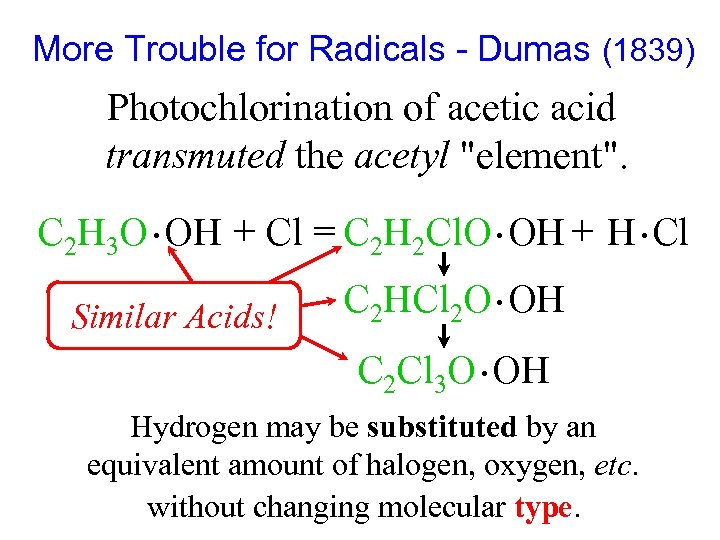
More Trouble for Radicals - Dumas (1839) Photochlorination of acetic acid transmuted the acetyl "element". C 2 H 3 O • OH + Cl = C 2 H 2 Cl. O • OH + H • Cl Similar Acids! C 2 HCl 2 O • OH C 2 Cl 3 O • OH Hydrogen may be substituted by an equivalent amount of halogen, oxygen, etc. without changing molecular type.
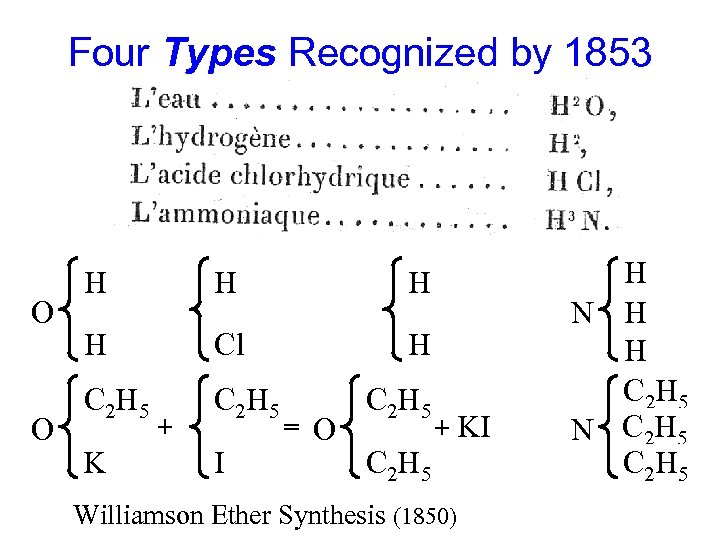
Four Types Recognized by 1853 O O H H Cl H C 2 H 5 K H + I = O C 2 H 5 + KI C 2 H 5 Williamson Ether Synthesis (1850) H N H H C 2 H 5 N C 2 H 5 H
![Unitary (not Dualistic) Theory [Molecules are like] planetary systems held together by a force](https://present5.com/presentation/29e3b4a7918baf7a61c267720fce4095/image-5.jpg "Unitary (not Dualistic) Theory [Molecules are like] planetary systems held together by a force")
Unitary (not Dualistic) Theory [Molecules are like] planetary systems held together by a force resembling gravitation, but acting in accord with much more complicated laws. Dumas (1840) Formulae…may be used as an actual image of what we rationally suppose to be the arrangement of constituent atoms in a compound, as a orrery is an image of what we conclude to be the arrangement of our planetary system. A. W. Williamson (age 27, 1851) Butyl_Bromide Bromobutane Two-Word Relic One-Word Relic of Radical Dualism Theory A Philosopher lecturing on the Orrery of "Unitary" of Derby (1766) Joseph Wright
![Berzelius (1838) “By reacting chlorine with ordinary ether [Dumas] produced a very interesting compound](https://present5.com/presentation/29e3b4a7918baf7a61c267720fce4095/image-6.jpg "Berzelius (1838) “By reacting chlorine with ordinary ether [Dumas] produced a very interesting compound")
Berzelius (1838) “By reacting chlorine with ordinary ether [Dumas] produced a very interesting compound which he reckoned, according to theory of substitutions, to be an ether in which 4 atoms of chlorine replace 4 atoms of hydrogen. An element as eminently electronegative as chlorine would never be able to enter into an organic radical : this idea is contrary to the first principles of chemistry…” A neutral anhydrous tartrate loses an atom of water at +190°; it has ceased to be a tartrate and has become another salt first use of “R” to denote a generalized radical
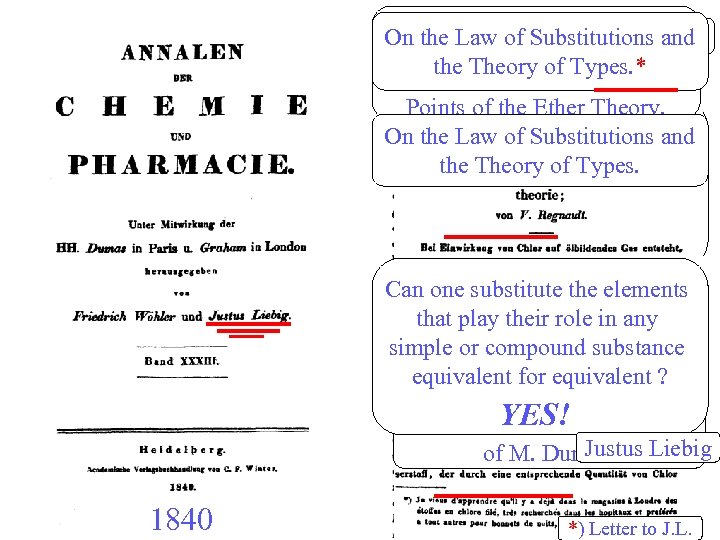
On the Reaction of Chlorine Remarks on Substitutions and On the Law ofthe Previous Paper with the Chlorides of Ethanol the Theory and Several and Methanol of Types. * Points of the Ether Theory. am a far cry from sharing On. Ithe Law of Substitutions and the ideas thatof Types. the Theory M. Dumas has linked to the so-called laws of the substitution theory. “Liebig’s Annalen” Can one substitute the elements that play their role in any simple or compound substance equivalent for equivalent ? On the YES! Substitution Law Justus of M. Dumas. Liebig 1840 *) Letter to J. L.
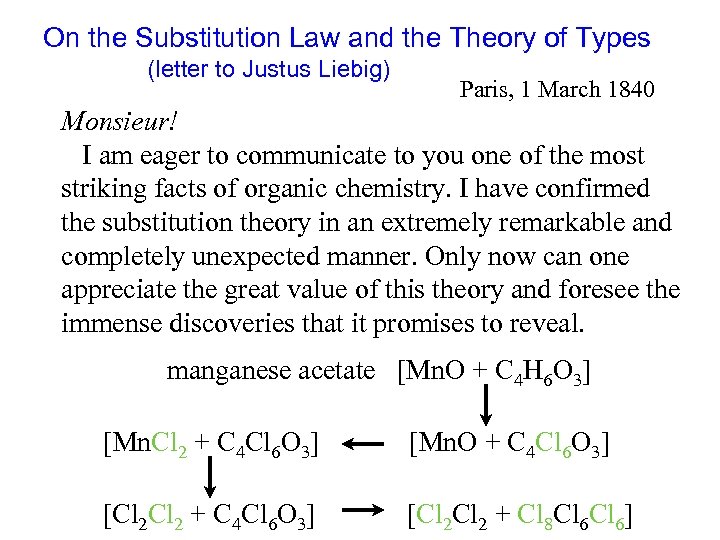
On the Substitution Law and the Theory of Types (letter to Justus Liebig) Paris, 1 March 1840 Monsieur! I am eager to communicate to you one of the most striking facts of organic chemistry. I have confirmed the substitution theory in an extremely remarkable and completely unexpected manner. Only now can one appreciate the great value of this theory and foresee the immense discoveries that it promises to reveal. manganese acetate [Mn. O + C 4 H 6 O 3] [Mn. Cl 2 + C 4 Cl 6 O 3] [Mn. O + C 4 Cl 6 O 3] [Cl 2 Cl 2 + Cl 8 Cl 6]
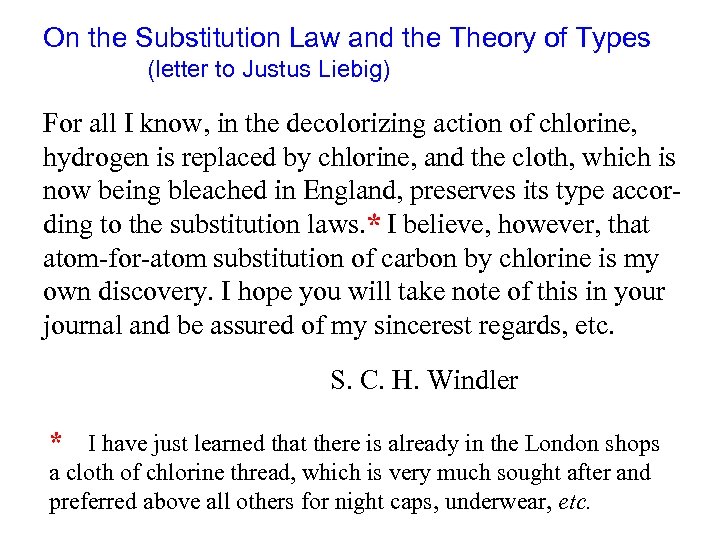
On the Substitution Law and the Theory of Types (letter to Justus Liebig) For all I know, in the decolorizing action of chlorine, hydrogen is replaced by chlorine, and the cloth, which is now being bleached in England, preserves its type according to the substitution laws. * I believe, however, that * atom-for-atom substitution of carbon by chlorine is my own discovery. I hope you will take note of this in your journal and be assured of my sincerest regards, etc. S. C. H. Windler * I have just learned that there is already in the London shops a cloth of chlorine thread, which is very much sought after and preferred above all others for night caps, underwear, etc.
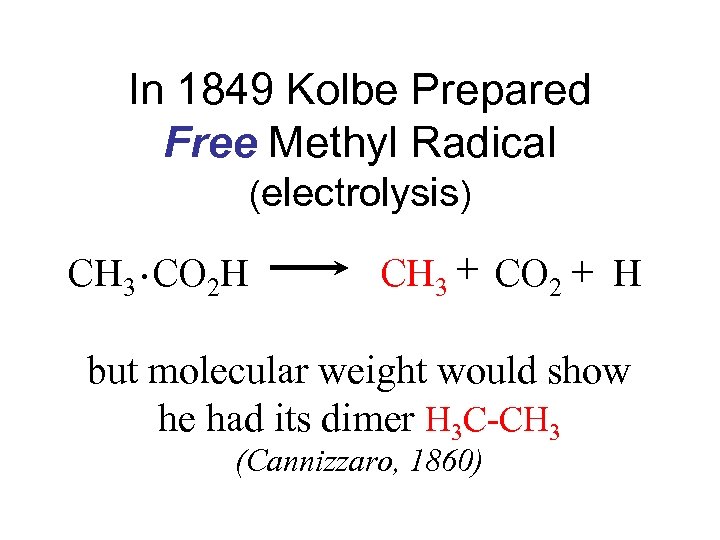
In 1849 Kolbe Prepared Free Methyl Radical (electrolysis) CH 3 • CO 2 H CH 3 + CO 2 + H but molecular weight would show he had its dimer H 3 C-CH 3 (Cannizzaro, 1860)
Ironically the key reactions of both radical and type theories did involve free radicals (SOMO not HOMO/LUMO reactions)
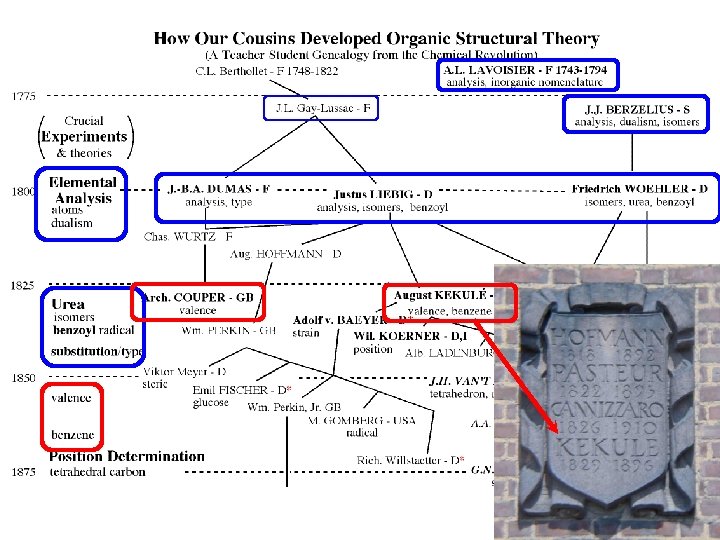
Genealogy Top
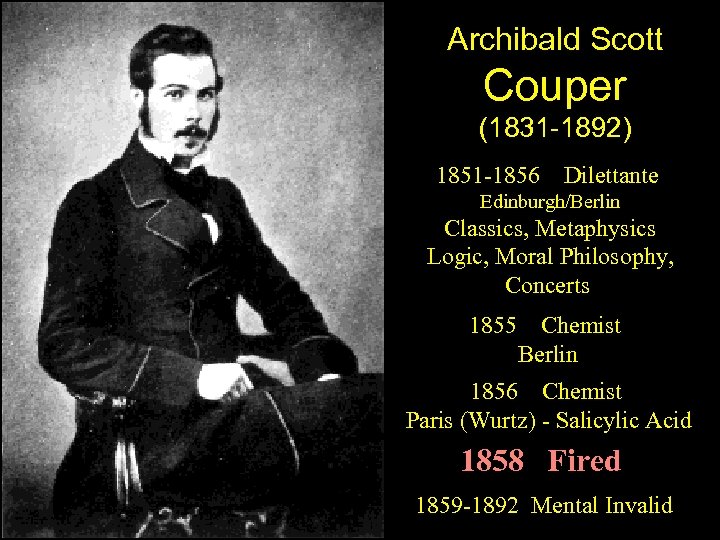
Archibald Scott Couper (1831 -1892) 1851 -1856 Dilettante Edinburgh/Berlin Classics, Metaphysics Logic, Moral Philosophy, Concerts 1855 Chemist Berlin 1856 Chemist Paris (Wurtz) - Salicylic Acid 1858 Fired 1859 -1892 Mental Invalid
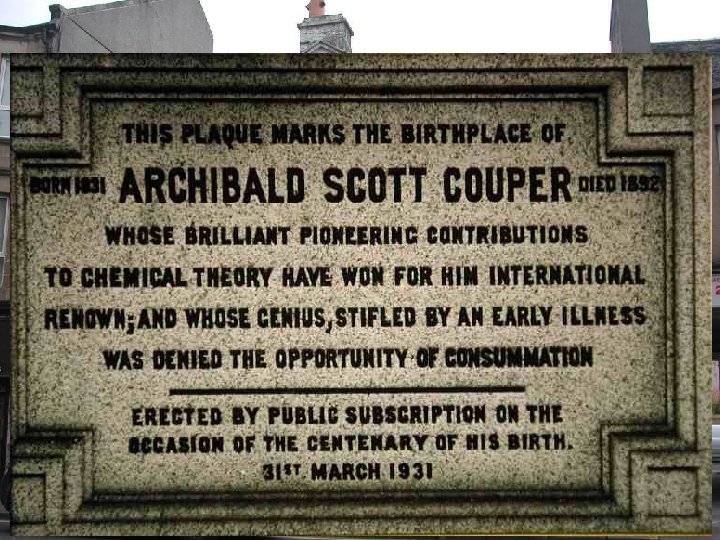
Kirkintilloch (near Glasgow)
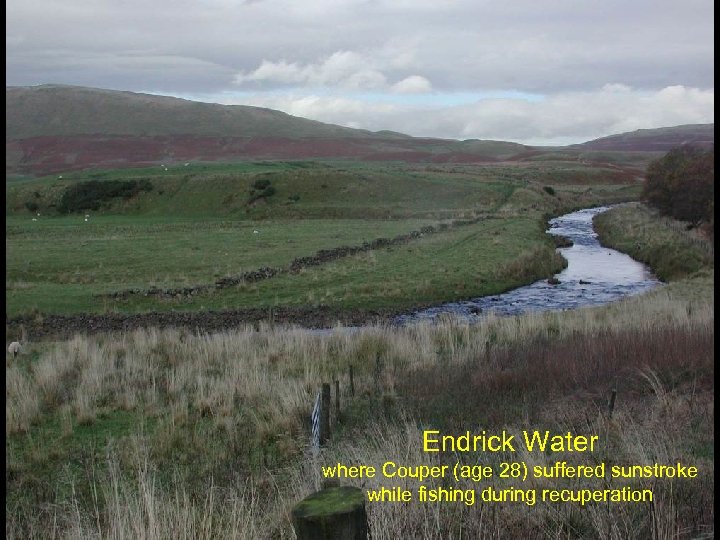
Endrick Water where Couper (age 28) suffered sunstroke while fishing during recuperation
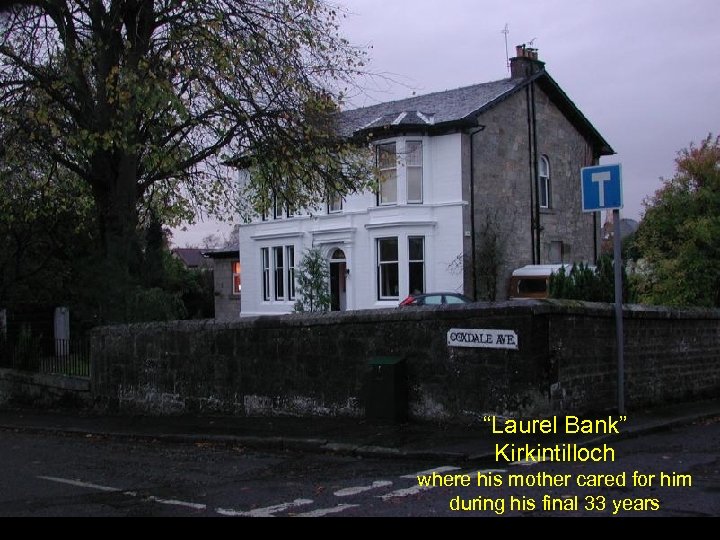
“Laurel Bank” Kirkintilloch where his mother cared for him during his final 33 years
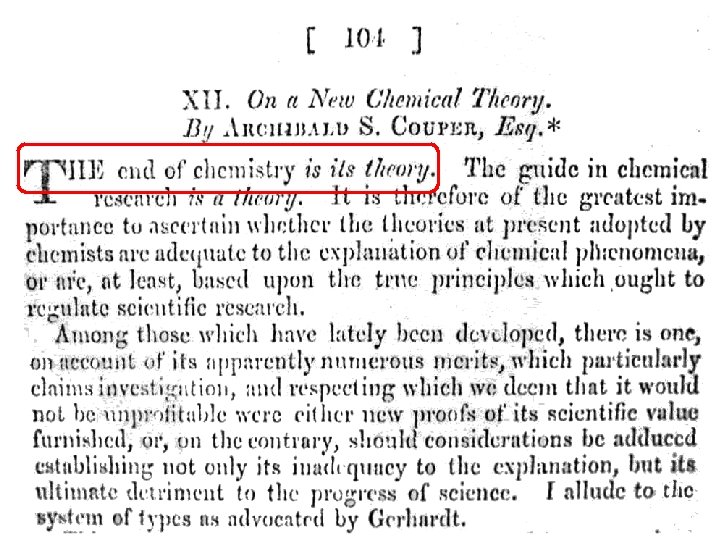
Theory and Types
p. 106 - on the French Type Theory Should the principle which is therein adopted be applied to the common events of life, it will be found that it is simply absurd. Suppose that some one were to systematize the formation of letters into words that formed the contents of a book.
p. 106 - on the French Type Theory Were he to begin by saying that he had discovered a certain word which would serve as a type, and from which by substitution and double decomposition all the others are to be derived, - that he by this means not only could form new words, but new books, and books almost an infinitum, - he would state certainly an empirical truth.
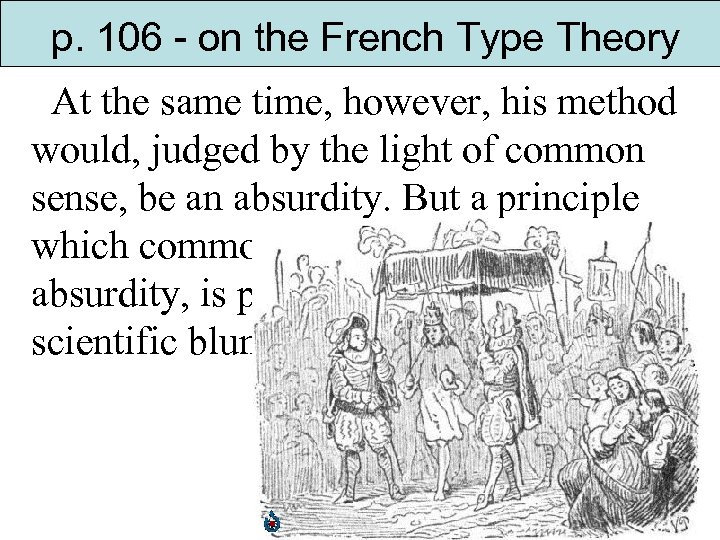
p. 106 - on the French Type Theory At the same time, however, his method would, judged by the light of common sense, be an absurdity. But a principle which common sense brands with absurdity, is philosophically false and a scientific blunder.
p. 107 - on the German Radical Theory I can only remark that it is not merely an unprofitable figure of language, but is injurious to science, inasmuch as it tends to arrest scientific inquiry by adopting the notion that these quasi elements contain some unknown and ultimate power which it is impossible to explain.
p. 107 - on the German Radical Theory It stifles inquiry at the very point where an explanation is demanded, by putting the seal of elements, of ultimate powers, on bodies which are known to be anything but this. Absolutely true but stated undiplomatically, especially for a newcomer.
p. 108 - Look to the Elements Science demands the strict adherence to a principle in direct contradiction to this view. That first principle, without which research cannot advance a step, dare not be ignored; namely, that a whole is simply a derivative of its parts. [? ]
p. 108 - Look to the Elements As a consequence of this, it follows that it is absolutely necessary to scientific unity and research to consider these bodies as entirely derivative, and as containing no secret ultimate power whatever, and that the properties which these so-called quasi elements possess are a direct consequence of the properties of the individual elements of which they are made up.
p. 109 - Focus on Carbon In applying this method, I propose at present to consider the single element carbon. This body is found to have two highly distinguishing characteristics: 1. It combines with equal numbers of hydrogen, chlorine, oxygen, sulfur, &c. 2. It enters into chemical union with itself. These two properties, in my opinion, explain all that is characteristic of organic chemistry.
1858 Tetravalence and Self-Linking of Carbon
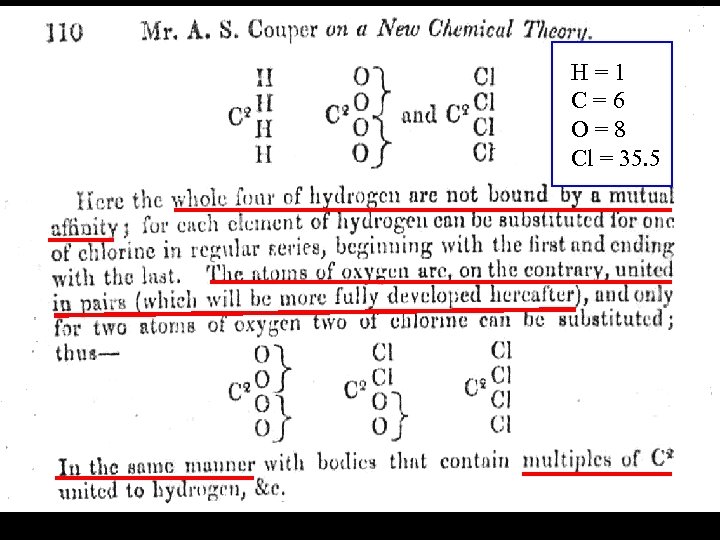
C 2 as nucleus H=1 C=6 O=8 Cl = 35. 5
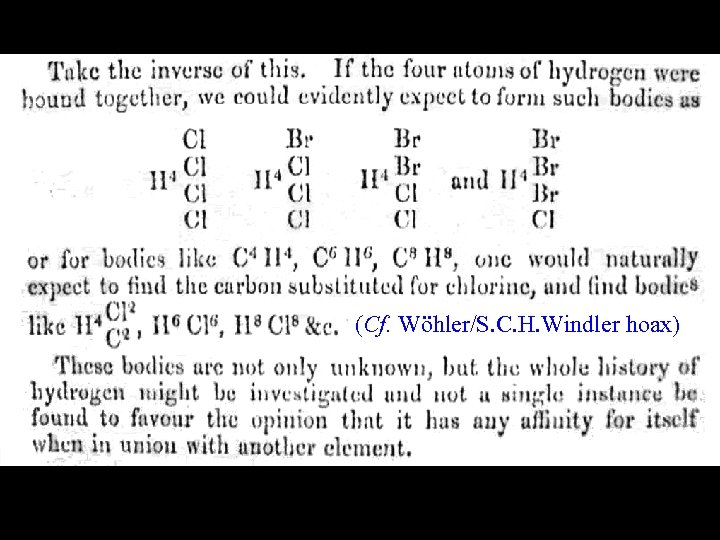
(Cf. Wöhler/S. C. H. Windler hoax)
"Structural" Formulae
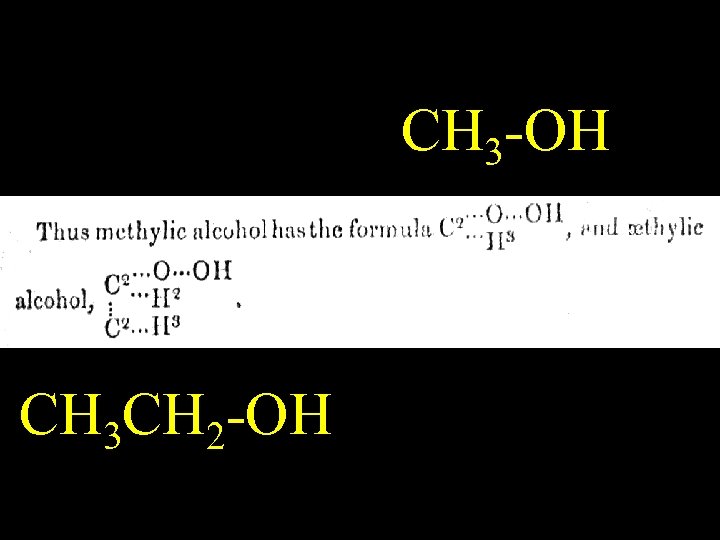
CH 3 -OH CH 3 CH 2 -OH
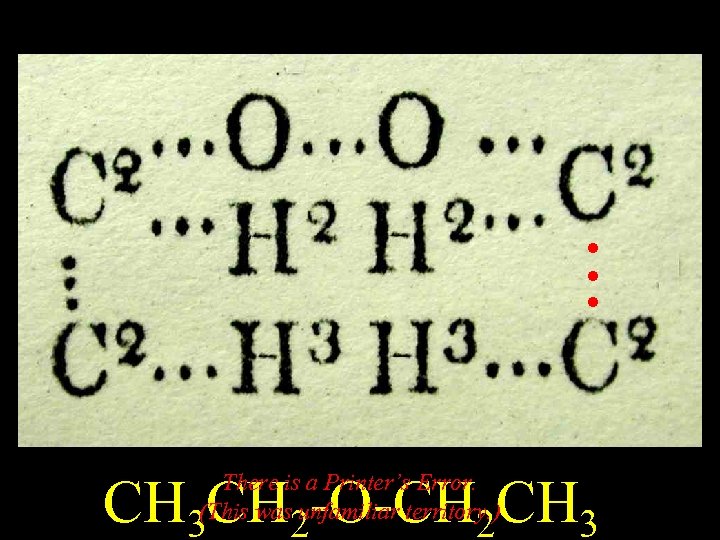
Ethyl Ether . . . There is a Printer’s Error. (This was unfamiliar territory. ) CH 3 CH 2 -O-CH 2 CH 3
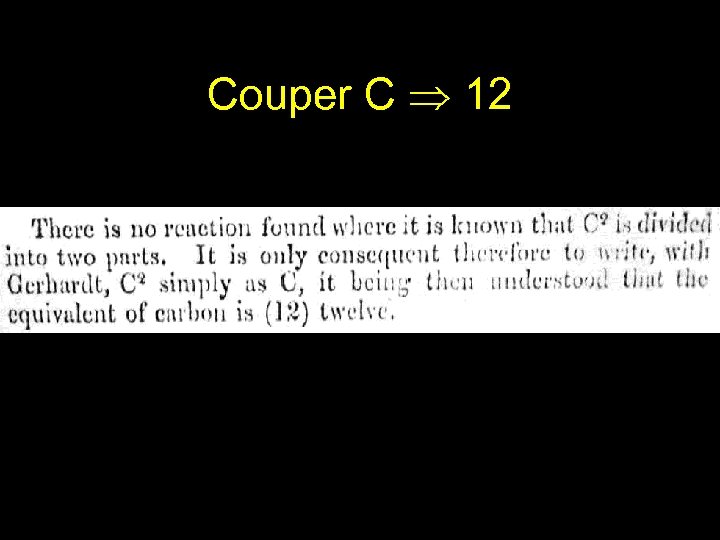
Couper C 12
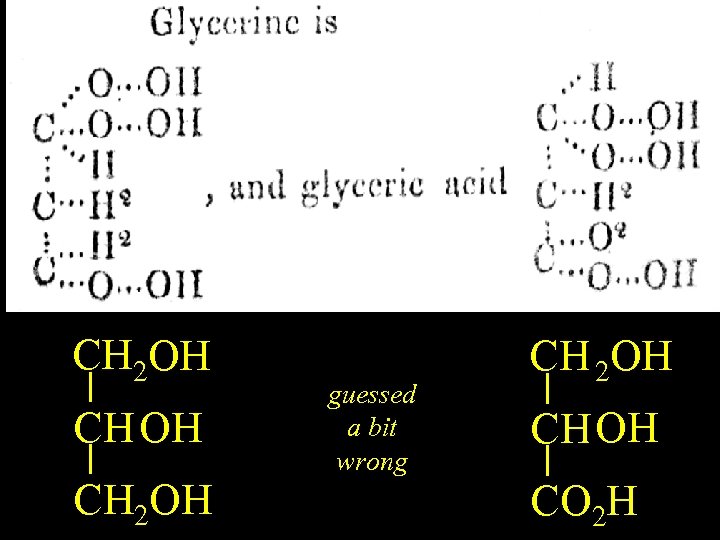
Glycerine CH(OH)2 2 OH CH 2 OH guessed a bit wrong CH(OH)2 2 OH OH CH 2 CO 2 H
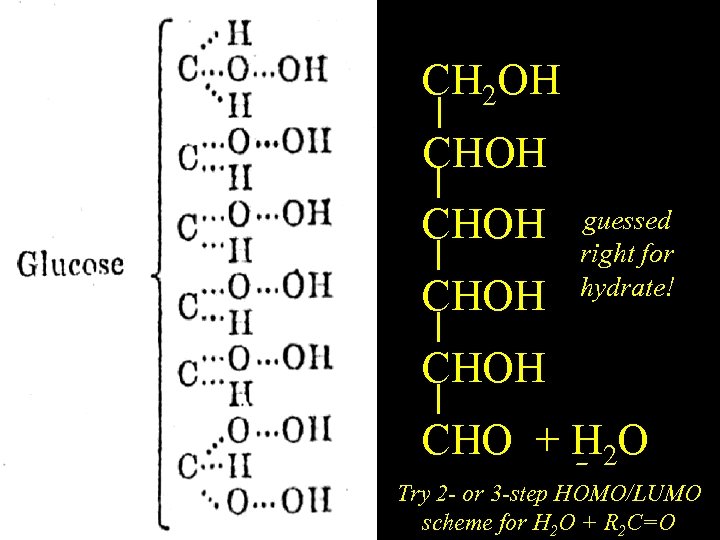
CH 2 OH English Glucose CHOH guessed right for hydrate! CHOH O +2 CH(OH)H 2 O Try 2 - or 3 -step HOMO/LUMO scheme for H 2 O + R 2 C=O
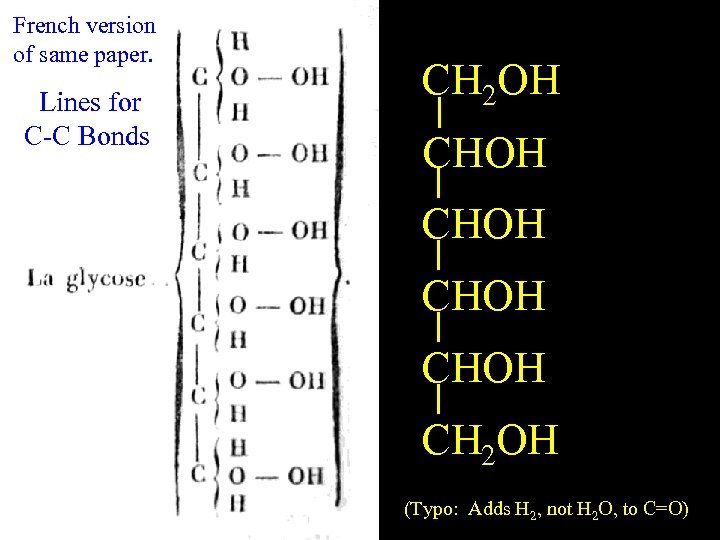
French version of same paper. Lines for C-C Bonds CH 2 OH English Glucose CHOH CH 2 OH (Typo: Adds H 2, not H 2 O, to C=O)
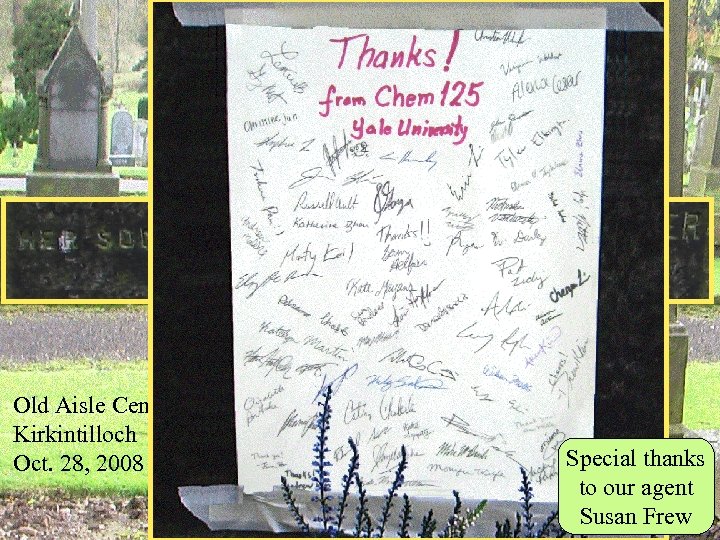
Old Aisle Cemetery Kirkintilloch Oct. 28, 2008 Special thanks to our agent Susan Frew
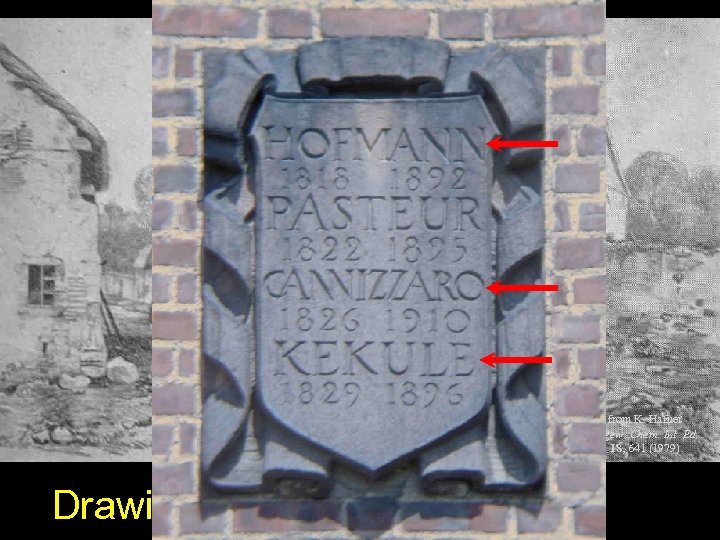
from K. Hafner Angew. Chem. Int. Ed. 18, 641 (1979) Drawing by Kekulé age 13
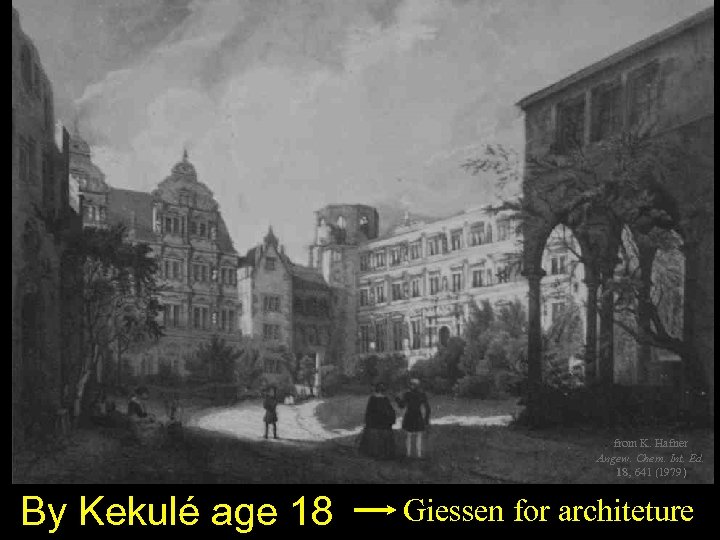
from K. Hafner Angew. Chem. Int. Ed. 18, 641 (1979) By Kekulé age 18 Giessen for architeture
Liebig's advice to Paris-bound graduate August Kekulé (1851) There you will broaden your horizons, there you will learn a new language, there you will learn to know the life of a great city, but there you will not learn chemistry!
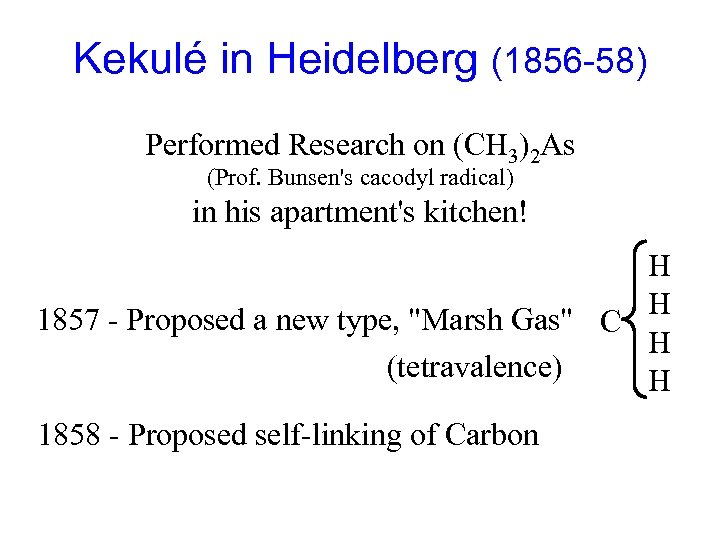
Kekulé in Heidelberg (1856 -58) Performed Research on (CH 3)2 As (Prof. Bunsen's cacodyl radical) in his apartment's kitchen! H H 1857 - Proposed a new type, "Marsh Gas" C H (tetravalence) H 1858 - Proposed self-linking of Carbon
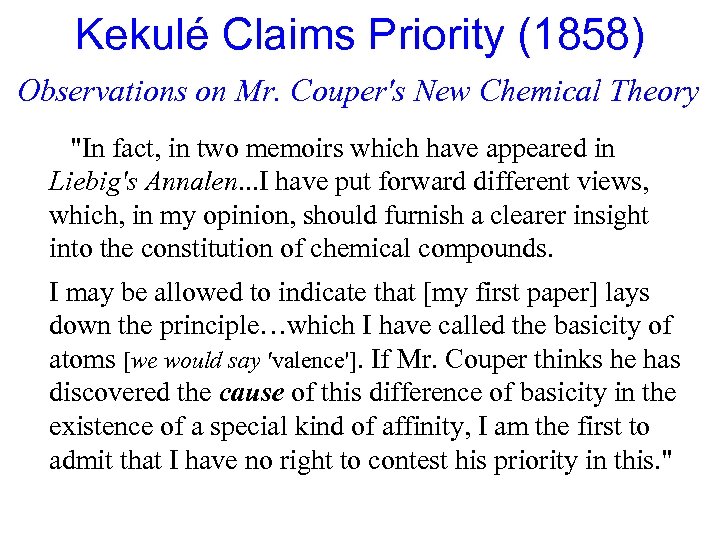
Kekulé Claims Priority (1858) Observations on Mr. Couper's New Chemical Theory "In fact, in two memoirs which have appeared in Liebig's Annalen. . . I have put forward different views, which, in my opinion, should furnish a clearer insight into the constitution of chemical compounds. I may be allowed to indicate that [my first paper] lays down the principle…which I have called the basicity of atoms [we would say 'valence']. If Mr. Couper thinks he has discovered the cause of this difference of basicity in the existence of a special kind of affinity, I am the first to admit that I have no right to contest his priority in this. "
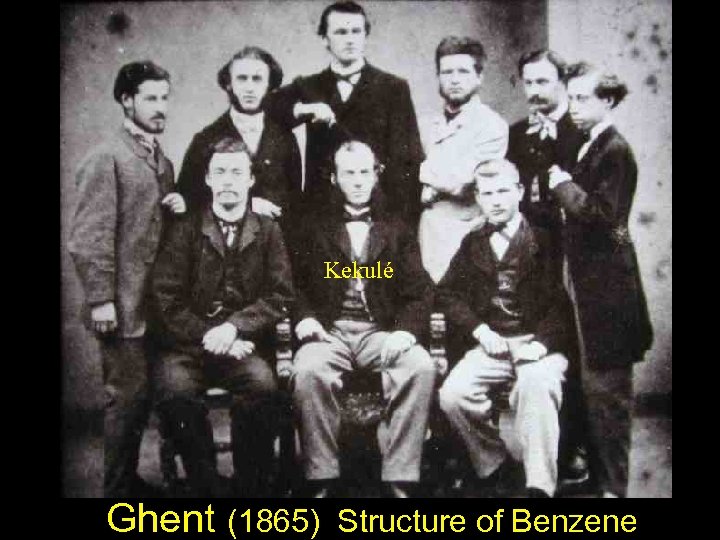
Kekulé Ghent (1865) Structure of Benzene
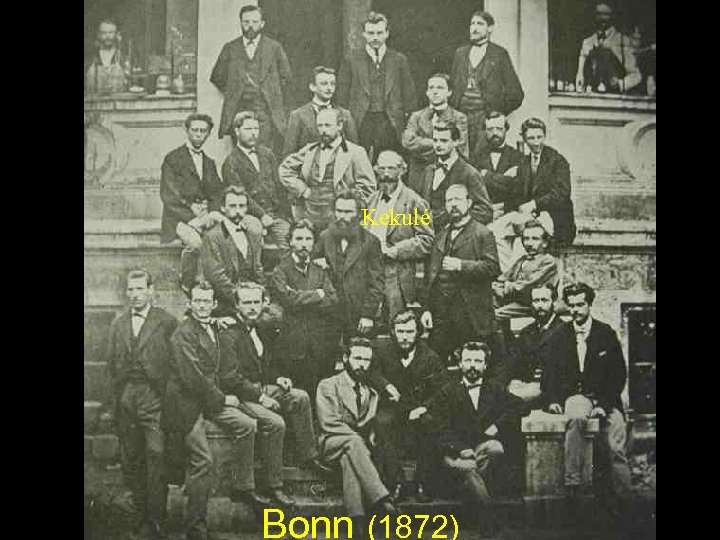
Kekulé Bonn (1872)
Facts, Ideas, and Words Nomenclature Notation Models
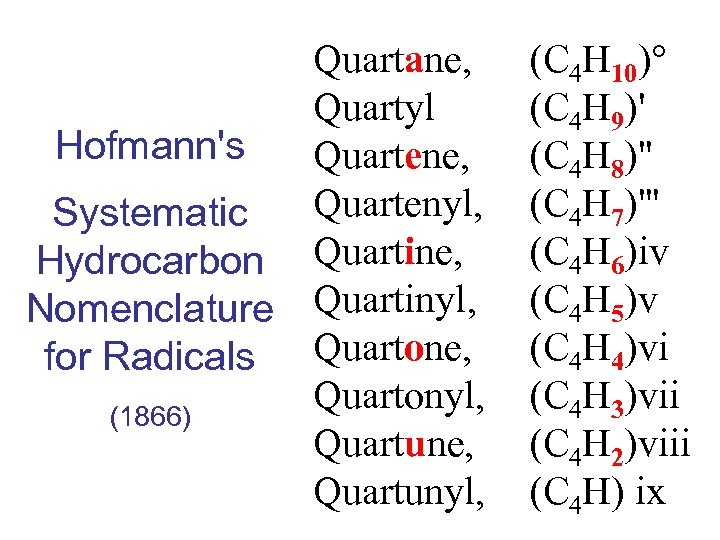
Quartane, Quartyl Hofmann's Quartene, Quartenyl, Systematic Hydrocarbon Quartine, Nomenclature Quartinyl, for Radicals Quartone, Quartonyl, (1866) Quartune, Quartunyl, (C 4 H 10)° (C 4 H 9)' (C 4 H 8)'' (C 4 H 7)''' (C 4 H 6)iv (C 4 H 5)v (C 4 H 4)vi (C 4 H 3)vii (C 4 H 2)viii (C 4 H) ix
End of Lecture 22 Oct. 26, 2009 Copyright © J. M. Mc. Bride 2009. Some rights reserved. Except for cited third-party materials, and those used by visiting speakers, all content is licensed under a Creative Commons License (Attribution-Non. Commercial-Share. Alike 3. 0). Use of this content constitutes your acceptance of the noted license and the terms and conditions of use. Materials from Wikimedia Commons are denoted by the symbol . Third party materials may be subject to additional intellectual property notices, information, or restrictions. The following attribution may be used when reusing material that is not identified as third-party content: J. M. Mc. Bride, Chem 125. License: Creative Commons BY-NC-SA 3. 0
Скачать презентацию Chemistry 125 Lecture 22 October 26 2009 Type
29e3b4a7918baf7a61c267720fce4095.ppt