


 Скачать презентацию Chemical Engineering as an Academic Major and a
8b1b7eee3273e49c9cd829d6e5a5d8aa.ppt
- Количество слайдов: 52
 Chemical Engineering as an Academic Major and a Career Mark J. Mc. Cready Professor and Department Chair Chemical Engineering mjm@nd. edu http: //www. nd. edu/~mjm http: //www. nd. edu/~chegdept 1
 Outline • The origins of chemical engineering – What was it? – What has it become? • What kinds of courses do you take to become a chemical engineer? • What are the opportunities for research? • What kinds of careers do chemical engineers follow? mjm@nd. edu http: //www. nd. edu/~mjm http: //www. nd. edu/~chegdept 2
 Overview • Chemical engineering is the discipline that uses a molecular understanding of matter to produce from raw materials in useful quantities, all of the synthetic materials that are used by humankind. • In addition to chemistry and biology, the primary subjects that make this possible are molecular thermodynamics and transport phenomena. • The design part of chemical engineering often involves invention of new materials based on molecular knowledge and creation of new cellular level processes -- yes we use bacteria as chemical factories. mjm@nd. edu http: //www. nd. edu/~mjm http: //www. nd. edu/~chegdept 3
 Color Scheme • This is the standard slide, no humor is intended. • Acknowledgement – Professor Edward Maginn • Slides on career info mjm@nd. edu http: //www. nd. edu/~mjm http: //www. nd. edu/~chegdept 4
 Color Scheme • If you see this color slide, it is possible that – A. I am not being entirely serious – B. I am inserting a disclaimer -- in case my colleagues in other disciplines would not agree with what I say ! • It is up to your judgement to decide!! • Acknowledgements – http: //www. notveryfunnyjokes. com – http: // www. custombutnotgoodmusicclips. com mjm@nd. edu http: //www. nd. edu/~mjm http: //www. nd. edu/~chegdept 5
 We can start with a Definition • www. dictionary. com • chemical engineering (km-kl nj-nîrng) • n. • The branch of engineering that deals with the technology of large-scale chemical production and the manufacture of products through chemical processes. • • ------------------------------------chemical engineer n. mjm@nd. edu http: //www. nd. edu/~mjm http: //www. nd. edu/~chegdept 7
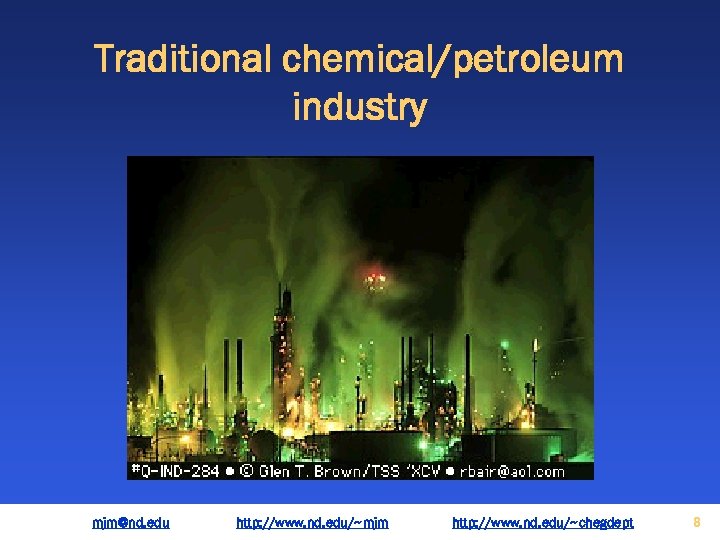 Traditional chemical/petroleum industry mjm@nd. edu http: //www. nd. edu/~mjm http: //www. nd. edu/~chegdept 8
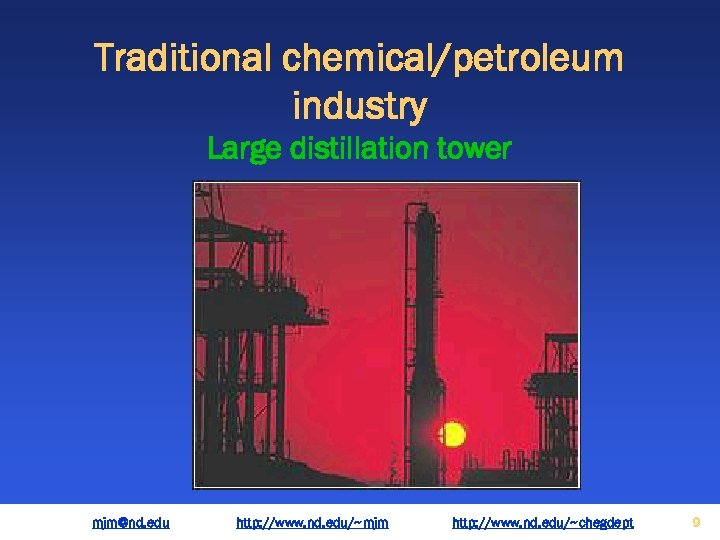 Traditional chemical/petroleum industry Large distillation tower mjm@nd. edu http: //www. nd. edu/~mjm http: //www. nd. edu/~chegdept 9
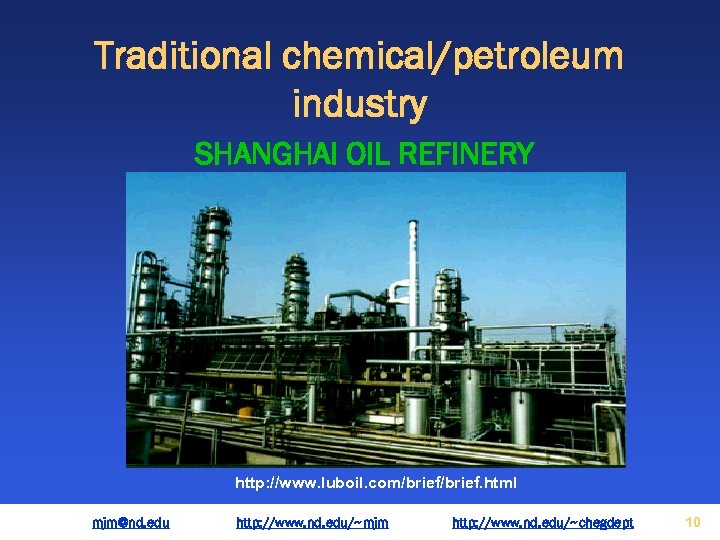 Traditional chemical/petroleum industry SHANGHAI OIL REFINERY http: //www. luboil. com/brief. html mjm@nd. edu http: //www. nd. edu/~mjm http: //www. nd. edu/~chegdept 10
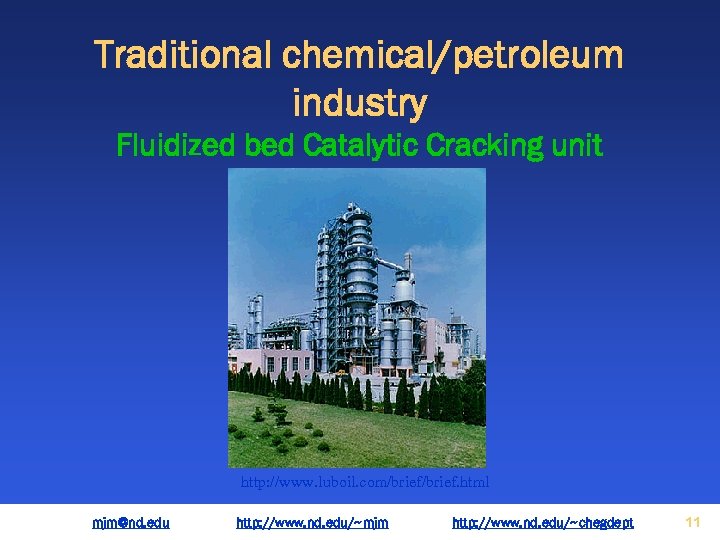 Traditional chemical/petroleum industry Fluidized bed Catalytic Cracking unit http: //www. luboil. com/brief. html mjm@nd. edu http: //www. nd. edu/~mjm http: //www. nd. edu/~chegdept 11
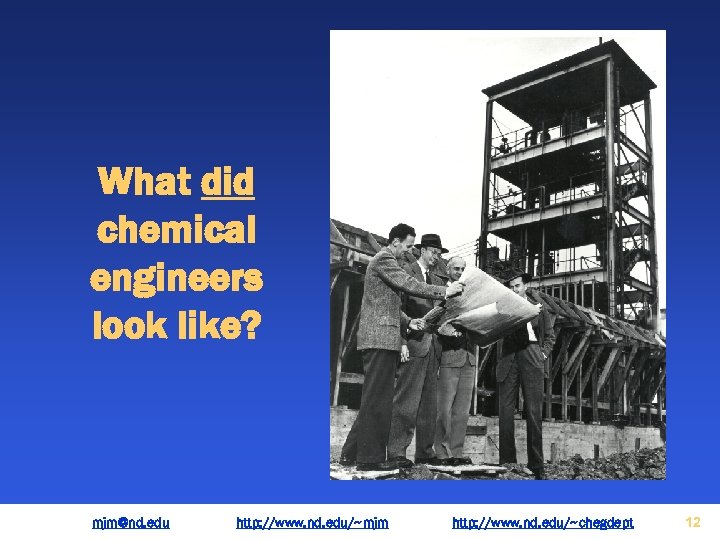 What did chemical engineers look like? mjm@nd. edu http: //www. nd. edu/~mjm http: //www. nd. edu/~chegdept 12
 An academic joke • http: //www. jokes-for-all. com • At Cambridge University during an examination one day a bright young student popped up and asked the proctor to bring him Cakes and Ale. The following dialog ensued: • Proctor: I beg your pardon? • Student: Sir, I request that you bring me Cakes and Ale. • Proctor: Sorry, no. • Student: Sir, I really must insist. I request and require that you bring me Cakes and Ale. • At this point, the student produced a copy of the four hundred year old Laws of Cambridge, written in Latin and still nominally in effect, and pointed to the section which read (roughly translated): "Gentlemen sitting examinations may request and require Cakes and Ale. " Pepsi and hamburgers were judged the modern equivalent, and the student sat there, writing his examination and happily slurping away. • Three weeks later, the student was fined five pounds for not wearing a sword to the examination. mjm@nd. edu http: //www. nd. edu/~mjm http: //www. nd. edu/~chegdept 13
 What is chemical engineering? • Chemical Engineering originated with the need to transform raw materials into useful products through chemical reactions. • The reactions were discovered by chemists starting in the 1600’s and by the end of the 1800’s, there was a need to produce large quantities of an ever increasing number of materials. • The “scale-up” of a laboratory reaction (~grams) to a profitable commercial process 106 grams) is usually not a matter of just making bigger laboratory equipment (flasks, beaker and Bunsen burners). mjm@nd. edu http: //www. nd. edu/~mjm http: //www. nd. edu/~chegdept 14
 (Aside) What is engineering? • “To define it rudely but not inaptly, engineering is the art of doing that well with one dollar which any bungler can do with two dollars. ” – -Arthur M. Wellington, The Economic Theory of the Location of Railways, Introduction (6 th ed. , 1900). mjm@nd. edu http: //www. nd. edu/~mjm http: //www. nd. edu/~chegdept 15
 We can also say about chemical engineering. . . • Chemical engineers use the principles of engineering analysis and knowledge of chemistry to design, build and operate processes that provide society with items such as: • petroleum fuels, toothpaste, low fat potato chips, paint, plastic for athletic shoes or carpeting, insecticides, pharmaceuticals, computer chips, etc. – If nothing sticks to Teflon, how does it stick to the pan? – How can you make carpet from crude oil? mjm@nd. edu http: //www. nd. edu/~mjm http: //www. nd. edu/~chegdept 16
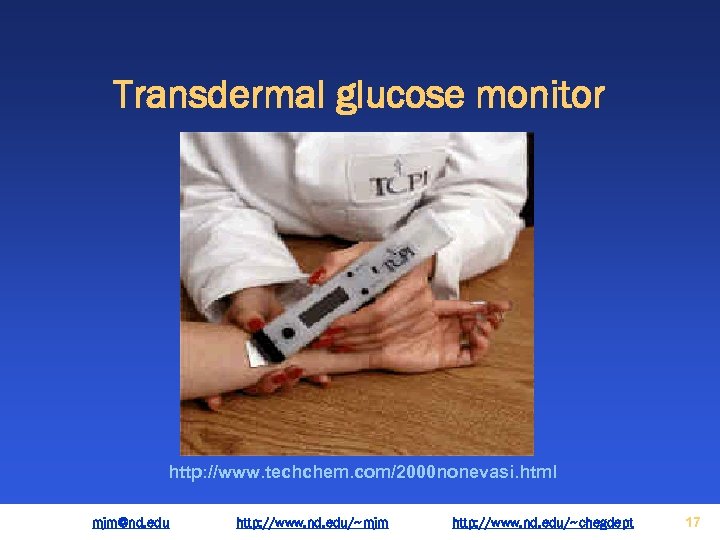 Transdermal glucose monitor http: //www. techchem. com/2000 nonevasi. html mjm@nd. edu http: //www. nd. edu/~mjm http: //www. nd. edu/~chegdept 17
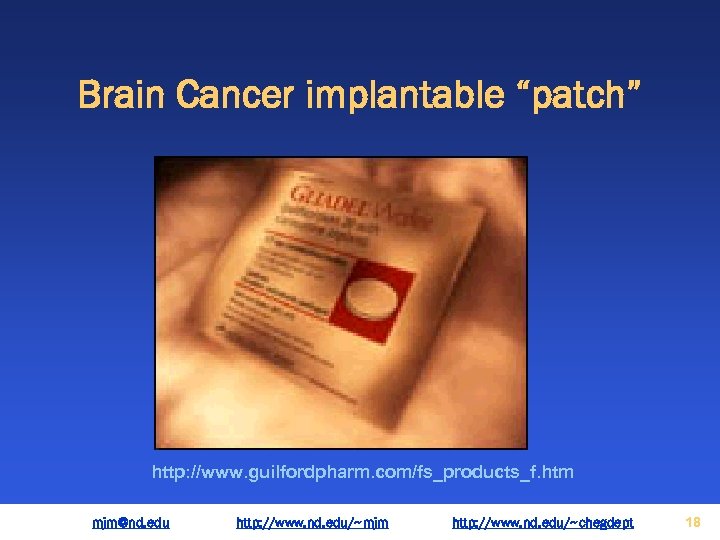 Brain Cancer implantable “patch” http: //www. guilfordpharm. com/fs_products_f. htm mjm@nd. edu http: //www. nd. edu/~mjm http: //www. nd. edu/~chegdept 18
 . . . the future of chemical engineering. . . • In the future we might expect: replacement bones, tendons, skin and other organs, superconducting integrated circuits, ceramic and plastic automobiles, nonmetallic bridges and building structures and clothes that don’t get dirty!! mjm@nd. edu http: //www. nd. edu/~mjm http: //www. nd. edu/~chegdept 19
 Synthesis of replacement parts for people • Bob Langer, Chemical Enginering Professor at MIT • Alan Alda, One of Langer’s students • Video from Scientific American Frontiers mjm@nd. edu http: //www. nd. edu/~mjm http: //www. nd. edu/~chegdept 20
 Chemical reactor for growing heart tissue mjm@nd. edu http: //www. nd. edu/~mjm http: //www. nd. edu/~chegdept 21
 Synthetic heart cells mjm@nd. edu http: //www. nd. edu/~mjm http: //www. nd. edu/~chegdept 22
 Synthetic heart cells mjm@nd. edu http: //www. nd. edu/~mjm http: //www. nd. edu/~chegdept 23
 Bad sports clichés • http: //www. sportscliche. com • • • They wanted it more than we did. We beat ourselves. We didn't maintain the intensity for the entire 60 minutes. We brought our A-game. I'm really proud of the way our guys hung in there. • • He's an impact player. He's some kind of player. (Mind telling us what kind? ) You can't say enough about him. He’s the real deal! mjm@nd. edu http: //www. nd. edu/~mjm http: //www. nd. edu/~chegdept 24
 Not a cliché ! • “Chemical Engineering is what chemical engineers do!” J. Wei, Dean of Engineering at Princeton – Chemical Engineers and Chemical Engineering are not defined by what we make, but by the body of knowledge that we learn, our view of the world and the mathematical tools that we use. mjm@nd. edu http: //www. nd. edu/~mjm http: //www. nd. edu/~chegdept 25
 What do students take to become chemical engineers? • First let us try still harder to see what chemical engineers need to understand to be able to do what we have seen. mjm@nd. edu http: //www. nd. edu/~mjm http: //www. nd. edu/~chegdept 26
 Primary characteristics of chemical engineers • Most all of the products of the world are made of materials that are in a different form from the raw materials from which they were made. • Chemical engineers understand matter in terms of its fundamental nature, – i. e. , molecules, – can describe molecules or groups of molecules quantitatively • They use molecular understanding to deal with processes involving chemical, biological and physical transformations of matter • To effectively do this, they can answer the important questions necessary to bridge the gap from molecular sizes up to the dimensions of everyday life. mjm@nd. edu http: //www. nd. edu/~mjm http: //www. nd. edu/~chegdept 27
 Comparing different engineering disciplines • A way to think of which kind of engineer you might want to be is to connect with your “inner self” – You know, . . . from when you were 10 years old. • Or at least sometime before education changed who you are. – What about the world did you find most fascinating? mjm@nd. edu http: //www. nd. edu/~mjm http: //www. nd. edu/~chegdept 28
 Comparing different engineering disciplines • If: – Mechanical engineering inherently deals with all of the mechanical devices of humankind. • If – Civil engineering involves the design and construction of large structures. • If – Electrical engineering deals with the materials and processes that allow communication systems and computers. • Then: – Chemical engineering describes the processes of nature mjm@nd. edu http: //www. nd. edu/~mjm http: //www. nd. edu/~chegdept 29
 What do chemical engineers learn about to become one? • Fundamental Science, – Mathematics, Chemistry, Physics, Biology • Engineering science topics: – Chemical Thermodynamics – Transport Phenomena • Integration of these in courses such as – Reaction Engineering, Separation Processes and Process Design mjm@nd. edu http: //www. nd. edu/~mjm http: //www. nd. edu/~chegdept 30
 The curriculum Sophomore year Junior year mjm@nd. edu http: //www. nd. edu/~mjm http: //www. nd. edu/~chegdept 31
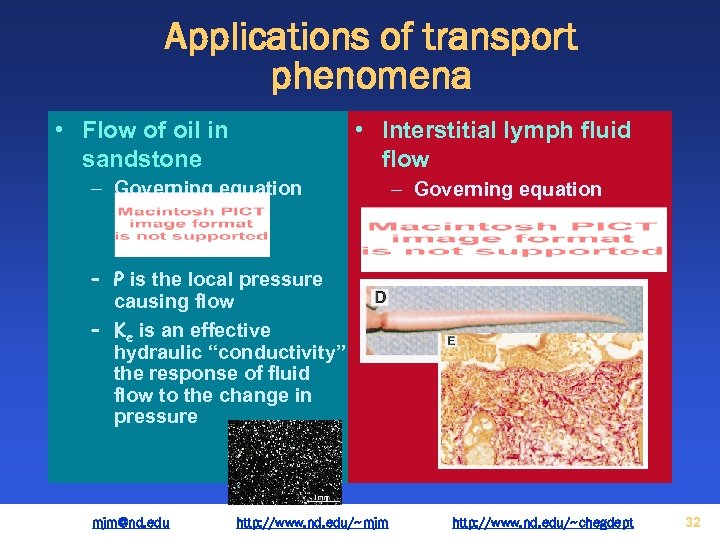 Applications of transport phenomena • Flow of oil in sandstone • Interstitial lymph fluid flow – Governing equation – P is the local pressure causing flow – Ke is an effective hydraulic “conductivity” the response of fluid flow to the change in pressure mjm@nd. edu http: //www. nd. edu/~mjm http: //www. nd. edu/~chegdept 32
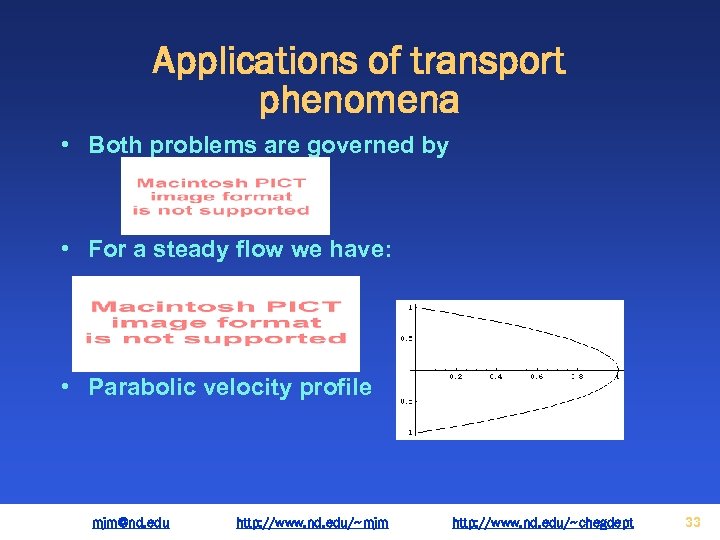 Applications of transport phenomena • Both problems are governed by • For a steady flow we have: • Parabolic velocity profile mjm@nd. edu http: //www. nd. edu/~mjm http: //www. nd. edu/~chegdept 33
 The curriculum Sophomore year Junior year mjm@nd. edu http: //www. nd. edu/~mjm http: //www. nd. edu/~chegdept 34
 Phase equilibria • Fundamental chemical relation – The fugacity of a component in each phase is equal, I II • fi = fi • Vapor - liquid equilibria – Basis for designing distillation columns, (or where the alcohol goes when you cook with wine. ) • Gas-liquid equilibria – Solubility of oxygen or carbon dioxide in water • Happy fishes • Happy people drinking carbonated drinks, mjm@nd. edu http: //www. nd. edu/~mjm http: //www. nd. edu/~chegdept 35
 The curriculum senior year We also have a “Pre-med” (biology) option, an Environmental Option and a Materials Certificate Program. mjm@nd. edu http: //www. nd. edu/~mjm http: //www. nd. edu/~chegdept 36
 Reaction Kinetics • Gaseous chemical • Enzyme binds to a species adsorbs on a substrate to cause a catalyst and reacts reaction • Langmuir-Hinshelwood • Michaelis-Menten mjm@nd. edu http: //www. nd. edu/~mjm http: //www. nd. edu/~chegdept 37
 Opportunities for research as an undergraduate • Characterization and synthesis of advanced materials • Nanoscale bioengineering • Complex fluids and flows • Surface science and catalysis • Minimizing the impact of chemical manufacturing processes • Applied molecular thermodynamics mjm@nd. edu http: //www. nd. edu/~mjm http: //www. nd. edu/~chegdept 38
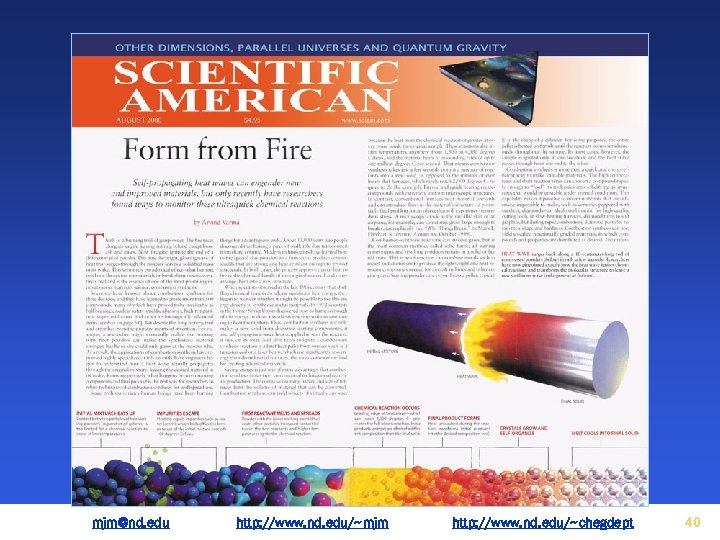
 Combustion synthesis • Synthesis of advanced ceramic materials, • A. Varma and coworkers mjm@nd. edu http: //www. nd. edu/~mjm http: //www. nd. edu/~chegdept 39
 mjm@nd. edu http: //www. nd. edu/~mjm http: //www. nd. edu/~chegdept 40
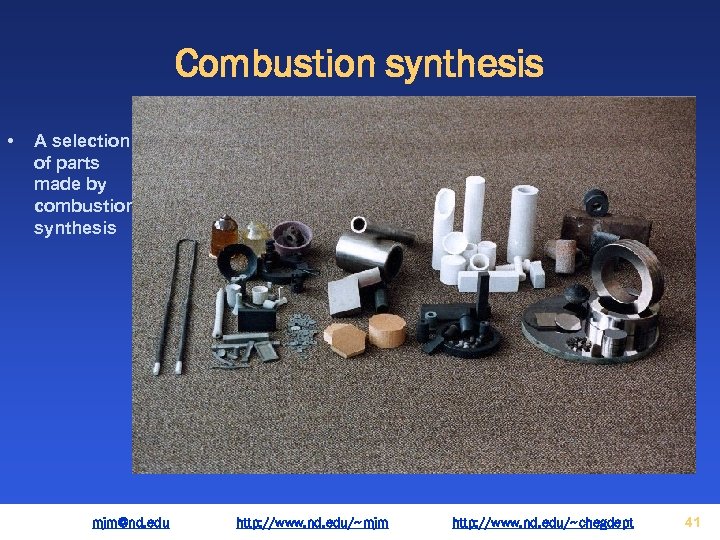 Combustion synthesis • A selection of parts made by combustion synthesis mjm@nd. edu http: //www. nd. edu/~mjm http: //www. nd. edu/~chegdept 41
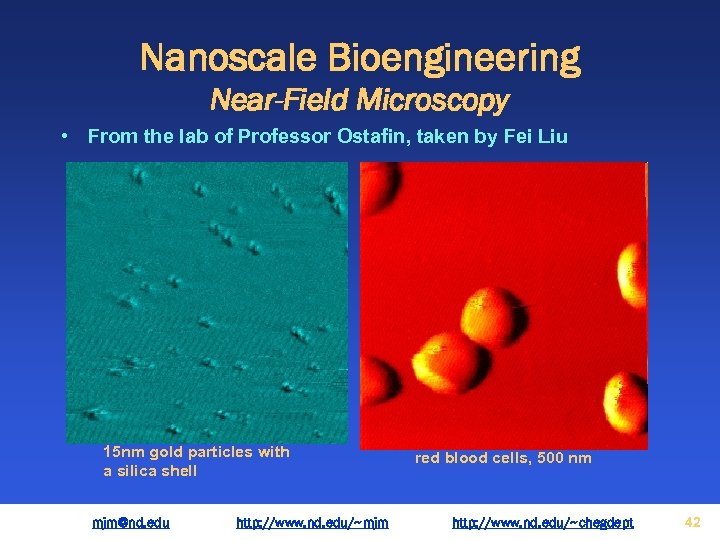 Nanoscale Bioengineering Near-Field Microscopy • From the lab of Professor Ostafin, taken by Fei Liu 15 nm gold particles with a silica shell mjm@nd. edu http: //www. nd. edu/~mjm red blood cells, 500 nm http: //www. nd. edu/~chegdept 42
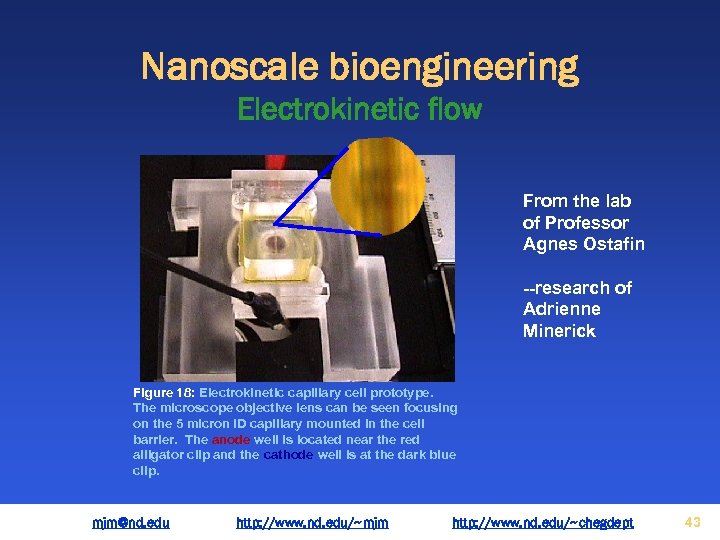 Nanoscale bioengineering Electrokinetic flow From the lab of Professor Agnes Ostafin --research of Adrienne Minerick Figure 18: Electrokinetic capillary cell prototype. The microscope objective lens can be seen focusing on the 5 micron ID capillary mounted in the cell barrier. The anode well is located near the red alligator clip and the cathode well is at the dark blue clip. mjm@nd. edu http: //www. nd. edu/~mjm http: //www. nd. edu/~chegdept 43
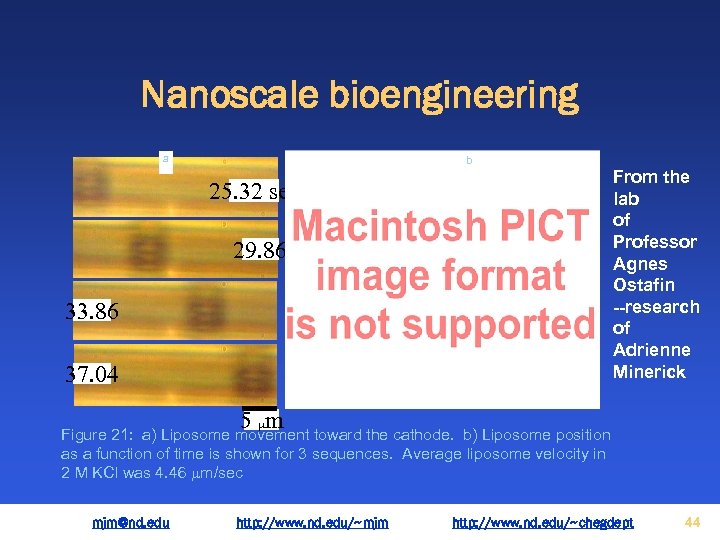 Nanoscale bioengineering a b From the lab of Professor Agnes Ostafin --research of Adrienne Minerick 25. 32 sec 29. 86 33. 86 37. 04 5 m Figure 21: a) Liposome movement toward the cathode. b) Liposome position as a function of time is shown for 3 sequences. Average liposome velocity in 2 M KCl was 4. 46 m/sec mjm@nd. edu http: //www. nd. edu/~mjm http: //www. nd. edu/~chegdept 44
 Waves in gas-liquid flows From the lab of Professor Mark Mc. Cready --research of William Kuru mjm@nd. edu http: //www. nd. edu/~mjm http: //www. nd. edu/~chegdept 45
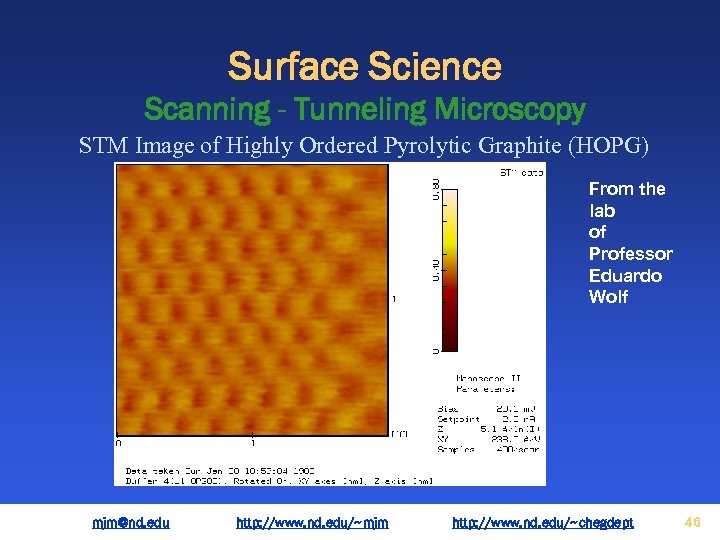 Surface Science Scanning - Tunneling Microscopy STM Image of Highly Ordered Pyrolytic Graphite (HOPG) From the lab of Professor Eduardo Wolf mjm@nd. edu http: //www. nd. edu/~mjm http: //www. nd. edu/~chegdept 46
 Surface Science Scanning - Tunneling Microscopy STM Image of Octadecanol Adsorbed on HOPG Surface (from the lab of Professor Eduardo Wolf) mjm@nd. edu http: //www. nd. edu/~mjm http: //www. nd. edu/~chegdept 47
 What do chemical engineers from Notre Dame do? mjm@nd. edu http: //www. nd. edu/~mjm http: //www. nd. edu/~chegdept 48
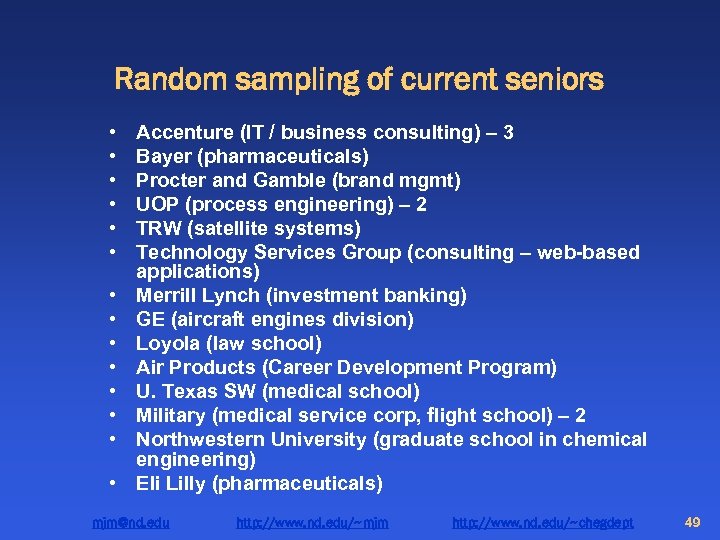 Random sampling of current seniors • • • • Accenture (IT / business consulting) – 3 Bayer (pharmaceuticals) Procter and Gamble (brand mgmt) UOP (process engineering) – 2 TRW (satellite systems) Technology Services Group (consulting – web-based applications) Merrill Lynch (investment banking) GE (aircraft engines division) Loyola (law school) Air Products (Career Development Program) U. Texas SW (medical school) Military (medical service corp, flight school) – 2 Northwestern University (graduate school in chemical engineering) Eli Lilly (pharmaceuticals) mjm@nd. edu http: //www. nd. edu/~mjm http: //www. nd. edu/~chegdept 49
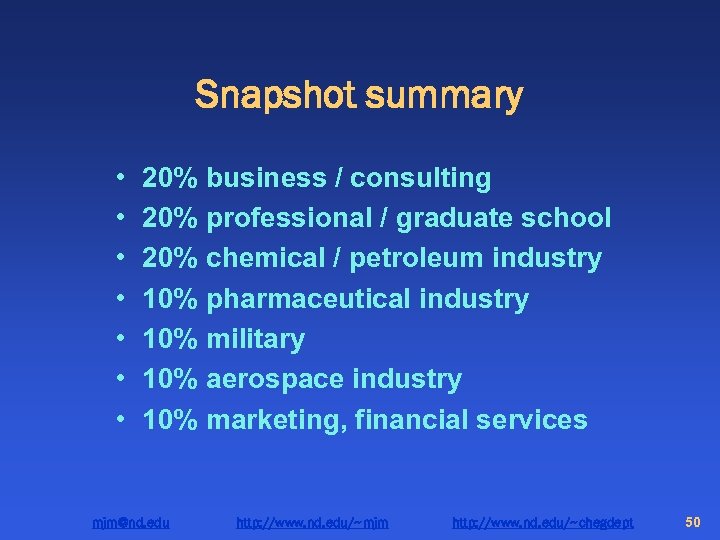 Snapshot summary • • 20% business / consulting 20% professional / graduate school 20% chemical / petroleum industry 10% pharmaceutical industry 10% military 10% aerospace industry 10% marketing, financial services mjm@nd. edu http: //www. nd. edu/~mjm http: //www. nd. edu/~chegdept 50
 Why can our graduates have such varied careers? • Our program is broad and fundamental – Not geared toward a particular product or industry • Traditional chemical and petroleum industry is in stable phase • Pharmaceutical industry is growing • Other growth industries (IT, business consulting, financial services) recognize the value of a fundamental engineering education mjm@nd. edu http: //www. nd. edu/~mjm http: //www. nd. edu/~chegdept 51
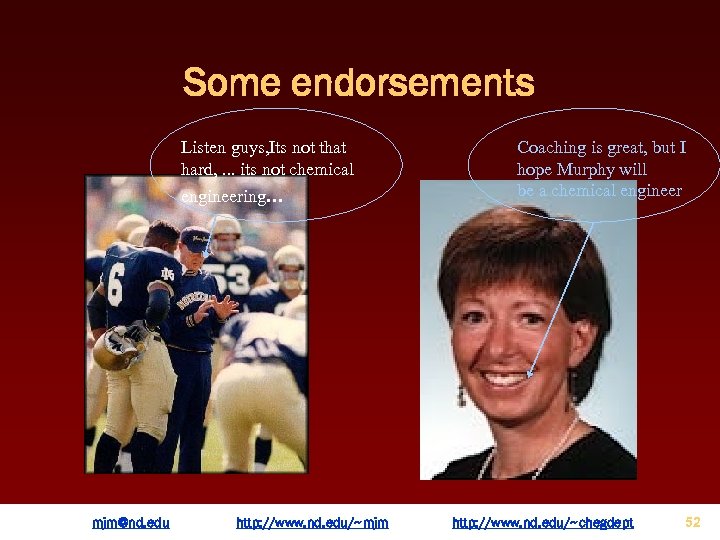 Some endorsements Listen guys, Its not that hard, . . . its not chemical engineering. . . mjm@nd. edu http: //www. nd. edu/~mjm Coaching is great, but I hope Murphy will be a chemical engineer http: //www. nd. edu/~chegdept 52
 Summary • Chemical engineers use an understanding of the molecular nature of matter, along with thermodynamics and transport phenomena to create, design and produce, usually involving chemical, biological or physical transformations, into such as varied items as – Food products, pharmaceuticals, basic and fine chemicals, and new drug delivery devices. – Future products are not limited to replacement parts for people, micro-scale diagnostic tools and “memory polymers” mjm@nd. edu http: //www. nd. edu/~mjm http: //www. nd. edu/~chegdept 53