


 Скачать презентацию Check your answers 1 a The Framers
63651cbe923f49e581960800cfe5fecf.ppt
- Количество слайдов: 58
 Check your answers
 1 a) The Framers wanted the Legislative branch to dominate as: • They feared Executive tyranny • They wanted an elected and representative Congress to be the voice of ‘the people’ and therefore dominant 1 b) The Executive has dominated recently due to: • The growth of America and therefore Federal government • The growth of responsibilities • The nature of challenges – Great depression ; World war; Cold War ; Superpower status; 9/11; Credit crunch 2. A Congressman: Is a member of the House of Representatives
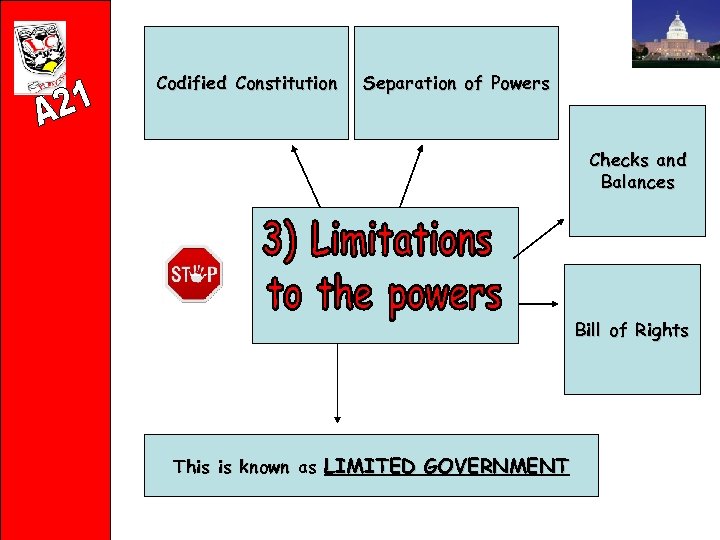 Codified Constitution Separation of Powers Checks and Balances Bill of Rights This is known as LIMITED GOVERNMENT
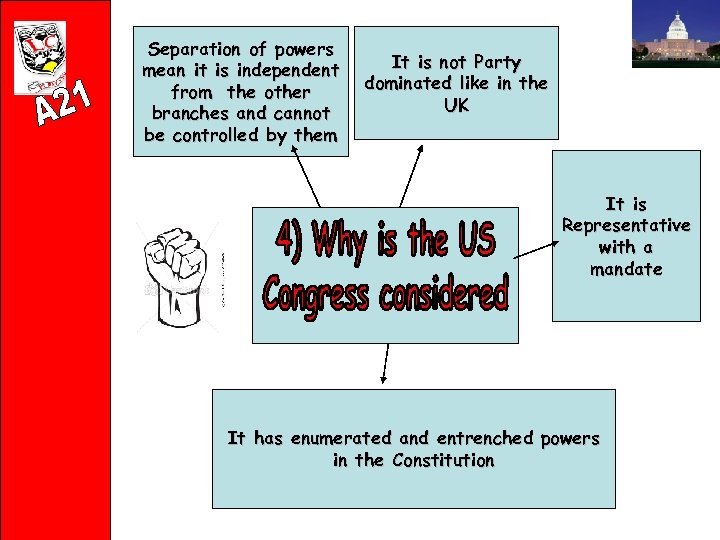 Separation of powers mean it is independent from the other branches and cannot be controlled by them It is not Party dominated like in the UK It is Representative with a mandate It has enumerated and entrenched powers in the Constitution
 1 The US has a BICAMERAL system because: • It creates the most representative government – Pop/state • It would check and balance each other ensuring fairness and good legislation 2 The largest chamber is the House of Representatives 3 It has 435 members 4 Its constituencies are called: Congressional districts 5 They are elected every 2 years 6 The Framers wanted to ensure The representatives would be highly responsive to their districts and more respected as they were legitimate & representative 7 The largest representation according to population is California
 8 California has 55 seats 9 Small population states include: Wyoming, Delaware, North Dakota 10 Every 10 years there are Possible changes due to census change 11 The important set of elections are Mid Terms 12 These elections are important because: • They can bring about divided government or can affirm the Presidential mandate • They can act as a ‘bell weather’ to the Presidents progress after two years • They can kick start an election campaign for President
 1 The Senate has : 100 seats excluding VP 2 The Senate represents the States – equally 3 Senators are elected Every 6 years 4 The 2 houses are elected differently. . To allow for experience and added debate in Senate • Senate is : To allow for more long term careful thinking in the Senate • 5 The President of the • To merge representative ‘folks back home’ HOR to be tempered by diverse State wide thinking from Senate The Vice President – Joe Biden. They can vote when a tied vote Biden (never) Cheney (6 times)
 • 6 Two exclusive powers to Senate are : Confirmation of Federal Appointments • Ratification of Foreign Treaties CONFIRMATION OF FEDERAL APPOINTMENTS Gives the Senate the power to control, if need be, the Presidents appointments. Senators must approve their appointment by a simple majority vote. It is unusual for Presidential appointments to be blocked but is a political negotiating tool when in divided government. It has been used to block appointment of George Bush Snr’s choice of John Tower as defence secretary (1989) RATIFICATION OF TREATIES This gives the Senate power of oversight into Foreign policy – a very Presidential domain. The Senate has to ratify foreign treaties made by Presidents to make them binding. Several have been rejected including Treaty of Versailles and nuclear limiting SALT treaty- Presidents now tend to pass treaties by Executive order to bypass this threat
 113 th Congress • 435 Members • Represent by Population • HOUSE OF REPRESENTATIVES • REPUBLICANS control HOR • Elected every TWO years • Candidates must be over 25 • Be US citizen for at least 7 years • Have lived in the State for 7 years • Under 20% • 44 Black ; 25 Hispanic ; 7 Asian ; 1 Native American (19%) • Average 56. 7 • Professional background: business / public service /politics / law POWERS EXCLUSIVE TO HOR • To consider money bills FIRST • To begin impeachment • To choose President in event of a tie
 1. MAJORITY LEADER Key Party kingpin and ‘leader’ of largest party in house • HOUSE OF REPRESENTATIVES • Crucial in coalition building / log rolling / legislation 2. MINORITY LEADER • Key Party kingpin and ‘leader’ of minority party in house • Still crucial in coalition building / log rolling / legislation as the majorities in the House are usually not very big 3. SPEAKER • Unlike the UK the Speaker is PARTISAN (Newt Gingrich) Roles ·Refers bills to Committees, appoints select committee and conference committee chairs while influencing the appointment of standing committee chairs, Appoints majority party contingent on House rules committee, and presides over the House enforcing its rules.
 HOUSE OF REPRESENTATIVES • • • To To To pass laws pass the budget undertake investigations into the actions of the executive branch • To start constitutional amendments by a 2/3 rds majority in both houses • To declare war • To confirm the appointment of a newly elected vice President
 100 Members • Represent by STATE • DEMOCRATS control Senate • Elected every SIX years • Candidates must be over 30 • Be US citizen for at least 9 years • SENATE • Have lived in the State for 9 years • 20% most ever • 1 Black ; 2 Hispanic ; 1 Asian • Average 62 • Professional background: Law / business / public service /politics POWERS EXCLUSIVE TO SENATE • Confirmation • Ratification • To try impeachment • To choose Vice President in event of a tie
 1. MAJORITY LEADER • Key Party kingpin and ‘leader’ of largest party in Senate • Crucial in coalition building / log rolling / legislation 2. MINORITY LEADER SENATE • Key Party kingpin and ‘leader’ of minority party in Senate • Still crucial in coalition building / log rolling / legislation as the majorities in the House are usually not very big 3. VICE PRESIDENT • Holds the casting vote – can be important in building coalitions • Timetables bills in absence of House rules committee • Can take over from President when incapacitated
 • • • AGREE Senators represent an entire State not a small part of it. Senators serve 6 years—x 3 Representatives Senators are 1 out of 100 compared with 1 out of 435 in the House Senators are much more likely to chair a committee than those in the House. Senators have greater name recognition—due to their smaller number and more prestigious nature of the Senate. House members frequently seek election to the Senate which speaks volumes. It is the ideal starting point to the Presidency and has been successful for Obama, Kennedy, Johnston etc Senators are also frequently chosen as Vice Presidential running mates Senators have EXCLUSIVE POWERS—to ratify treaties / confirm Presidential appointments which gives it a say in holding the Executive to account—much more so than the House powers.
 • • DISAGREE It requires BOTH Chambers to compromise in order to achieve effective legislation and policy. All bills must go through BOTH houses—none can pass without the agreement of the other. BOTH houses have powerful Standing committees—which can conduct investigative hearings at the committee stage At conference committee stage members of BOTH houses are represented. BOTH houses must agree to the compromise bill agreed in conference committee To introduce a Constitutional Amendment both are required To override a Presidential veto a 2/3 rds majority in both chambers is needed.
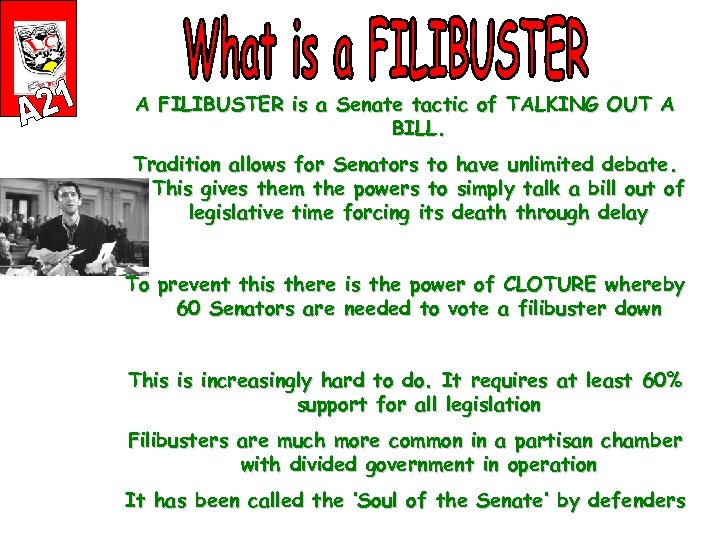 A FILIBUSTER is a Senate tactic of TALKING OUT A BILL. Tradition allows for Senators to have unlimited debate. This gives them the powers to simply talk a bill out of legislative time forcing its death through delay To prevent this there 60 Senators are is the power of CLOTURE whereby needed to vote a filibuster down This is increasingly hard to do. It requires at least 60% support for all legislation Filibusters are much more common in a partisan chamber with divided government in operation It has been called the ‘Soul of the Senate’ by defenders
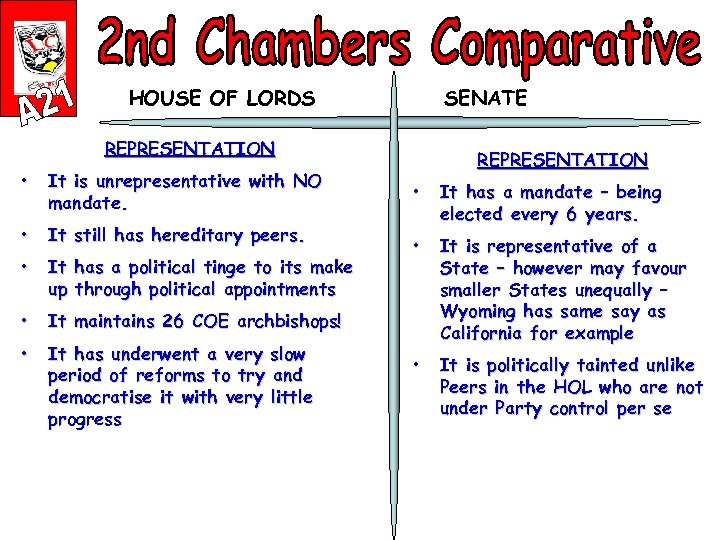 HOUSE OF LORDS SENATE REPRESENTATION • It is unrepresentative with NO mandate. • It still has hereditary peers. • It has a political tinge to its make up through political appointments • It maintains 26 COE archbishops! • It has underwent a very slow period of reforms to try and democratise it with very little progress REPRESENTATION • It has a mandate – being elected every 6 years. • It is representative of a State – however may favour smaller States unequally – Wyoming has same say as California for example • It is politically tainted unlike Peers in the HOL who are not under Party control per se
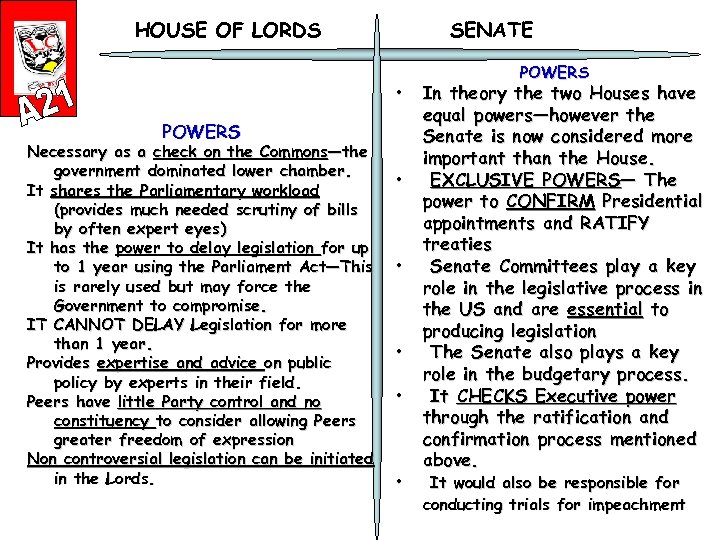 HOUSE OF LORDS SENATE • POWERS Necessary as a check on the Commons—the government dominated lower chamber. It shares the Parliamentary workload (provides much needed scrutiny of bills by often expert eyes) It has the power to delay legislation for up to 1 year using the Parliament Act—This is rarely used but may force the Government to compromise. IT CANNOT DELAY Legislation for more than 1 year. Provides expertise and advice on public policy by experts in their field. Peers have little Party control and no constituency to consider allowing Peers greater freedom of expression Non controversial legislation can be initiated in the Lords. • • • POWERS In theory the two Houses have equal powers—however the Senate is now considered more important than the House. EXCLUSIVE POWERS— The power to CONFIRM Presidential appointments and RATIFY treaties Senate Committees play a key role in the legislative process in the US and are essential to producing legislation The Senate also plays a key role in the budgetary process. It CHECKS Executive power through the ratification and confirmation process mentioned above. It would also be responsible for conducting trials for impeachment
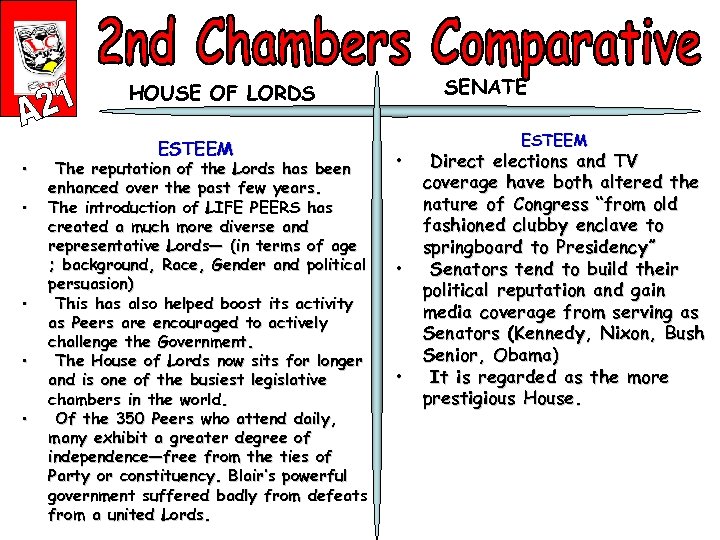 SENATE HOUSE OF LORDS • • • ESTEEM The reputation of the Lords has been enhanced over the past few years. The introduction of LIFE PEERS has created a much more diverse and representative Lords— (in terms of age ; background, Race, Gender and political persuasion) This has also helped boost its activity as Peers are encouraged to actively challenge the Government. The House of Lords now sits for longer and is one of the busiest legislative chambers in the world. Of the 350 Peers who attend daily, many exhibit a greater degree of independence—free from the ties of Party or constituency. Blair’s powerful government suffered badly from defeats from a united Lords. • • • ESTEEM Direct elections and TV coverage have both altered the nature of Congress “from old fashioned clubby enclave to springboard to Presidency” Senators tend to build their political reputation and gain media coverage from serving as Senators (Kennedy, Nixon, Bush Senior, Obama) It is regarded as the more prestigious House.
 SENATE HOUSE OF LORDS • • • ESTEEM The reputation of the Lords has been enhanced over the past few years. The introduction of LIFE PEERS has created a much more diverse and representative Lords— (in terms of age ; background, Race, Gender and political persuasion) This has also helped boost its activity as Peers are encouraged to actively challenge the Government. The House of Lords now sits for longer and is one of the busiest legislative chambers in the world. Of the 350 Peers who attend daily, many exhibit a greater degree of independence—free from the ties of Party or constituency. Blair’s powerful government suffered badly from defeats from a united Lords. • • • ESTEEM Direct elections and TV coverage have both altered the nature of Congress “from old fashioned clubby enclave to springboard to Presidency” Senators tend to build their political reputation and gain media coverage from serving as Senators (Kennedy, Nixon, Bush Senior, Obama) It is regarded as the more prestigious House.
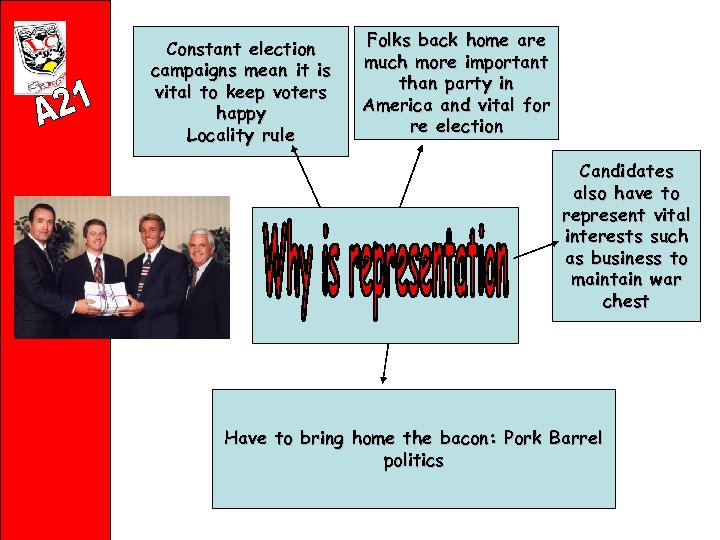 Constant election campaigns mean it is vital to keep voters happy Locality rule Folks back home are much more important than party in America and vital for re election Candidates also have to represent vital interests such as business to maintain war chest Have to bring home the bacon: Pork Barrel politics
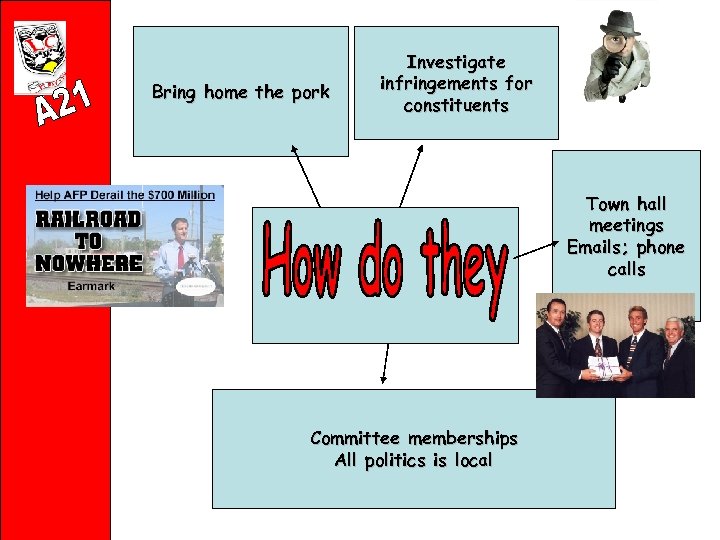 Bring home the pork Investigate infringements for constituents Town hall meetings Emails; phone calls Committee memberships All politics is local
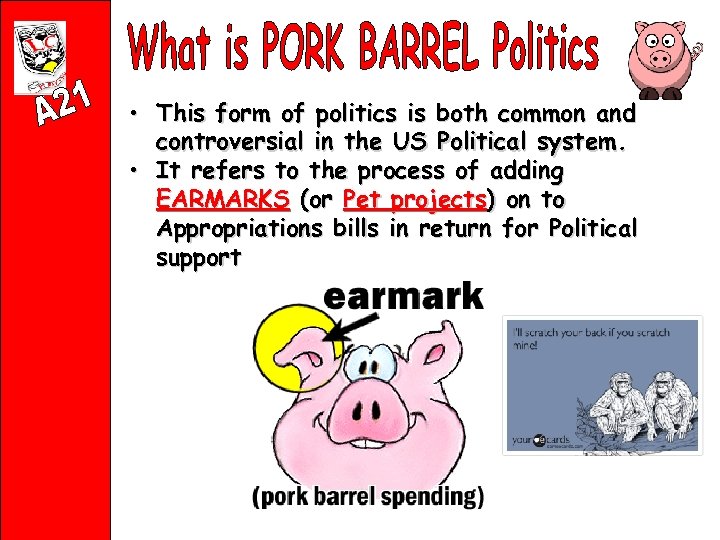 • This form of politics is both common and controversial in the US Political system. • It refers to the process of adding EARMARKS (or Pet projects) on to Appropriations bills in return for Political support
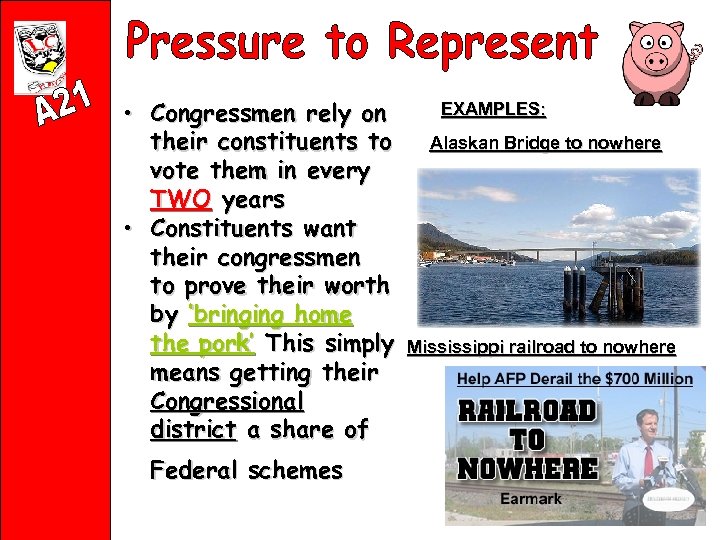 • Congressmen rely on their constituents to vote them in every TWO years • Constituents want their congressmen to prove their worth by ‘bringing home the pork’ This simply means getting their Congressional district a share of Federal schemes EXAMPLES: Alaskan Bridge to nowhere Mississippi railroad to nowhere
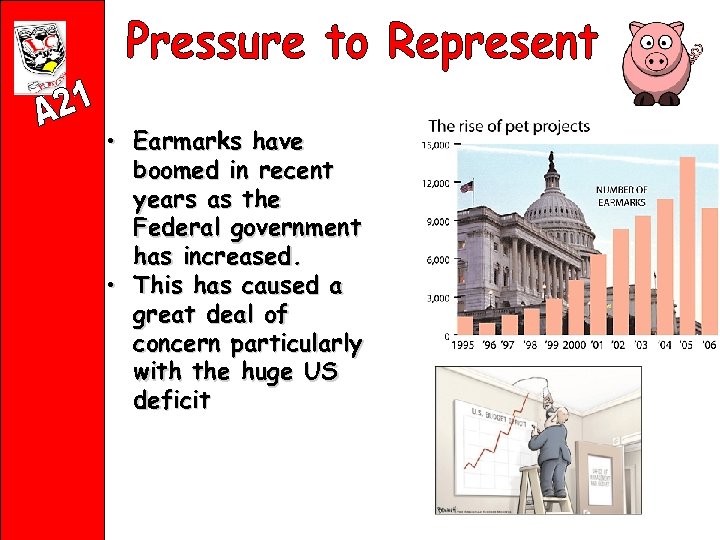 • Earmarks have boomed in recent years as the Federal government has increased. • This has caused a great deal of concern particularly with the huge US deficit
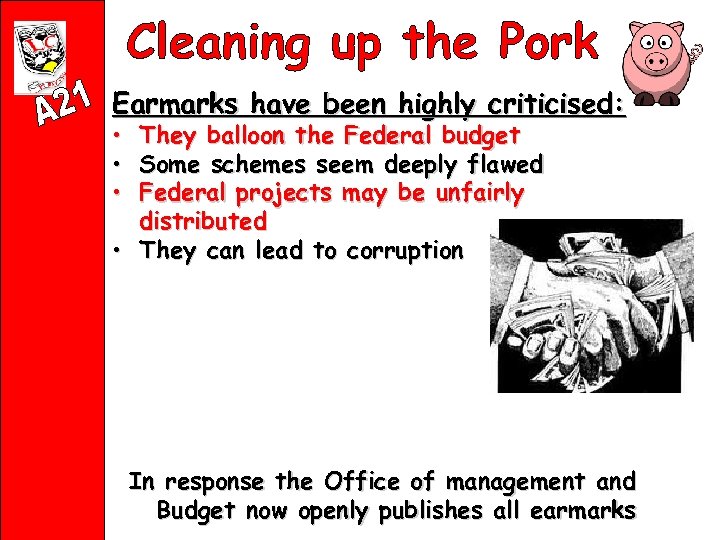 Earmarks have been highly criticised: • • • They balloon the Federal budget Some schemes seem deeply flawed Federal projects may be unfairly distributed • They can lead to corruption In response the Office of management and Budget now openly publishes all earmarks
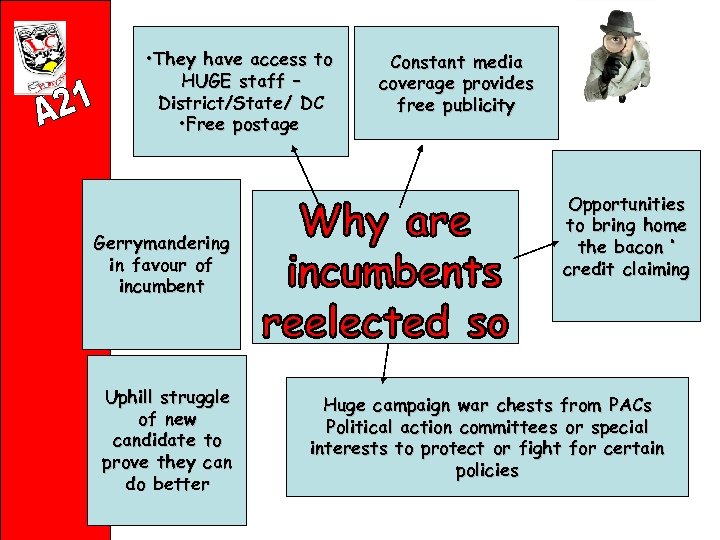 • They have access to HUGE staff – District/State/ DC • Free postage Gerrymandering in favour of incumbent Uphill struggle of new candidate to prove they can do better Constant media coverage provides free publicity Opportunities to bring home the bacon ‘ credit claiming Huge campaign war chests from PACs Political action committees or special interests to protect or fight for certain policies
 7 Are there any challenges to this dominance? • The rise of the TEA PARTY has provided strong opposition to some candidates – Anti Washington – kick the bums out – 1994, 2008, 2010 • Unpopular incumbents can be targeted particularly over a scandal • Smaller war chest than opponents 8 TERM LIMITS: Have been suggested for years as a way of keeping congressional terms limited to certain time frames thereby keeping Congress fresh and proactive
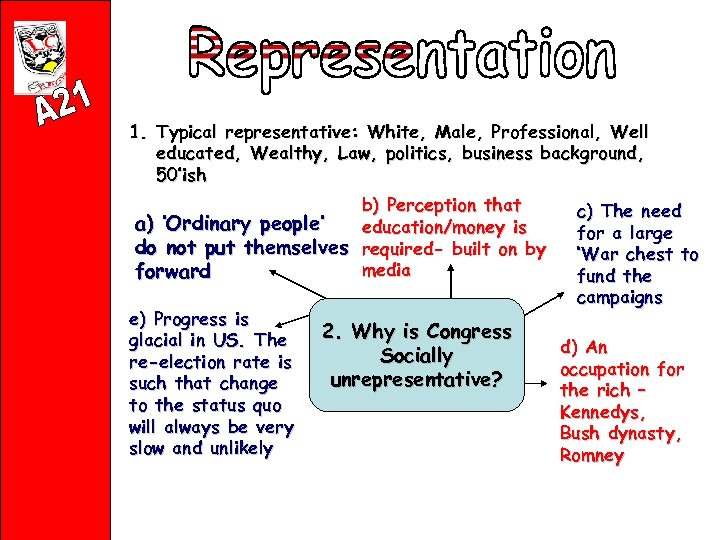 1. Typical representative: White, Male, Professional, Well educated, Wealthy, Law, politics, business background, 50’ish b) Perception that a) ‘Ordinary people’ education/money is do not put themselves required- built on by media forward e) Progress is glacial in US. The re-election rate is such that change to the status quo will always be very slow and unlikely 2. Why is Congress Socially unrepresentative? c) The need for a large ‘War chest to fund the campaigns d) An occupation for the rich – Kennedys, Bush dynasty, Romney
 3. The House is more representative than the Senate due to: • Constant reelection every 2 years • Locality rule links congressman/woman to district • Senator is in charge of diverse State / Congressmen are in charge of less diverse more unified districts • Congressmans role is to bring back the pork 4. Signs of Greater representation: • More women than ever before (20%) Use of Emilys list to promote women candidates in politics • Growth of PAC’s Political Action Committees to push forward candidates. NAACP • Growing black/hispanic activism (Bush campaigned strongly in Cuban America) • Majority Minority districts – districts with heavy minority influence
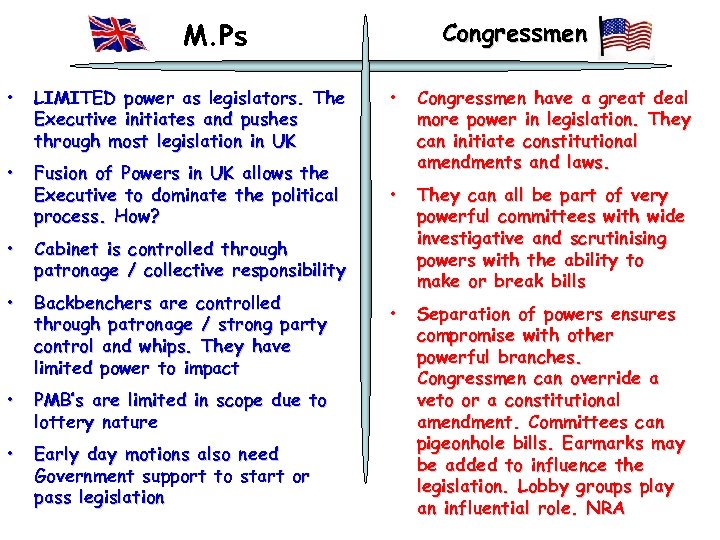 M. Ps • LIMITED power as legislators. The Executive initiates and pushes through most legislation in UK • Fusion of Powers in UK allows the Executive to dominate the political process. How? • Cabinet is controlled through patronage / collective responsibility • Backbenchers are controlled through patronage / strong party control and whips. They have limited power to impact • PMB’s are limited in scope due to lottery nature • Early day motions also need Government support to start or pass legislation Congressmen • Congressmen have a great deal more power in legislation. They can initiate constitutional amendments and laws. • They can all be part of very powerful committees with wide investigative and scrutinising powers with the ability to make or break bills • Separation of powers ensures compromise with other powerful branches. Congressmen can override a veto or a constitutional amendment. Committees can pigeonhole bills. Earmarks may be added to influence the legislation. Lobby groups play an influential role. NRA
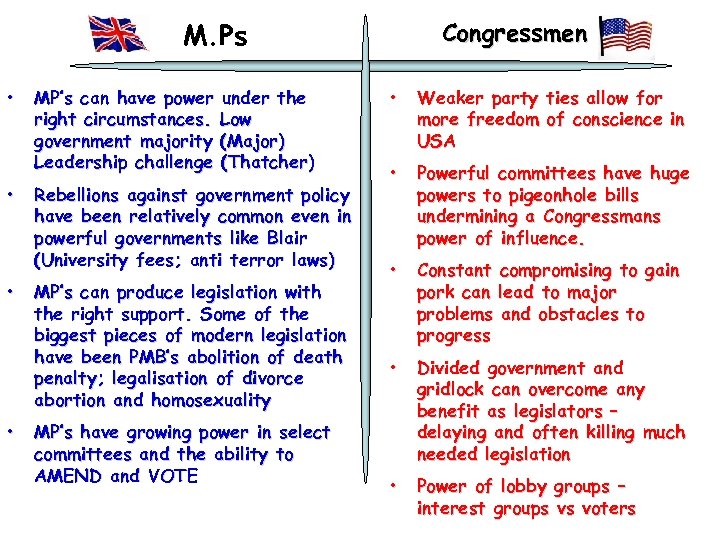 M. Ps • • MP’s can have power under the right circumstances. Low government majority (Major) Leadership challenge (Thatcher) Rebellions against government policy have been relatively common even in powerful governments like Blair (University fees; anti terror laws) MP’s can produce legislation with the right support. Some of the biggest pieces of modern legislation have been PMB’s abolition of death penalty; legalisation of divorce abortion and homosexuality MP’s have growing power in select committees and the ability to AMEND and VOTE Congressmen • Weaker party ties allow for more freedom of conscience in USA • Powerful committees have huge powers to pigeonhole bills undermining a Congressmans power of influence. • Constant compromising to gain pork can lead to major problems and obstacles to progress • Divided government and gridlock can overcome any benefit as legislators – delaying and often killing much needed legislation • Power of lobby groups – interest groups vs voters
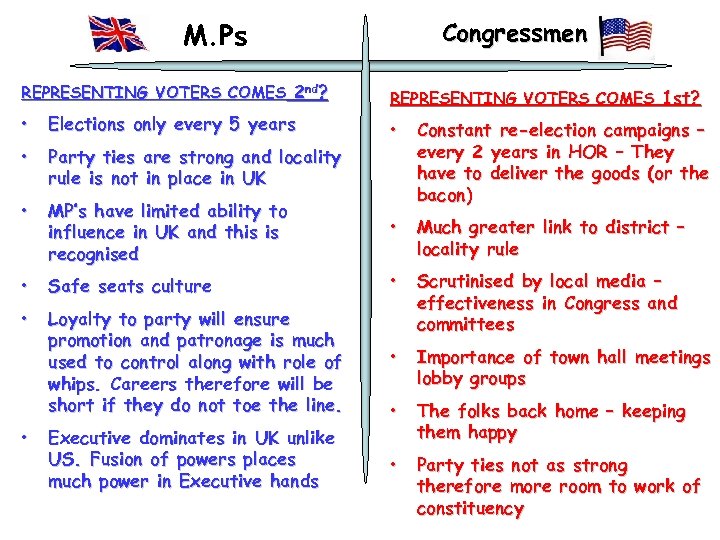 M. Ps Congressmen REPRESENTING VOTERS COMES 2 nd? REPRESENTING VOTERS COMES 1 st? • Elections only every 5 years • • Party ties are strong and locality rule is not in place in UK • MP’s have limited ability to influence in UK and this is recognised Constant re-election campaigns – every 2 years in HOR – They have to deliver the goods (or the bacon) • Much greater link to district – locality rule • Safe seats culture • • Loyalty to party will ensure promotion and patronage is much used to control along with role of whips. Careers therefore will be short if they do not toe the line. Scrutinised by local media – effectiveness in Congress and committees • Importance of town hall meetings lobby groups • Executive dominates in UK unlike US. Fusion of powers places much power in Executive hands The folks back home – keeping them happy • Party ties not as strong therefore more room to work of constituency •
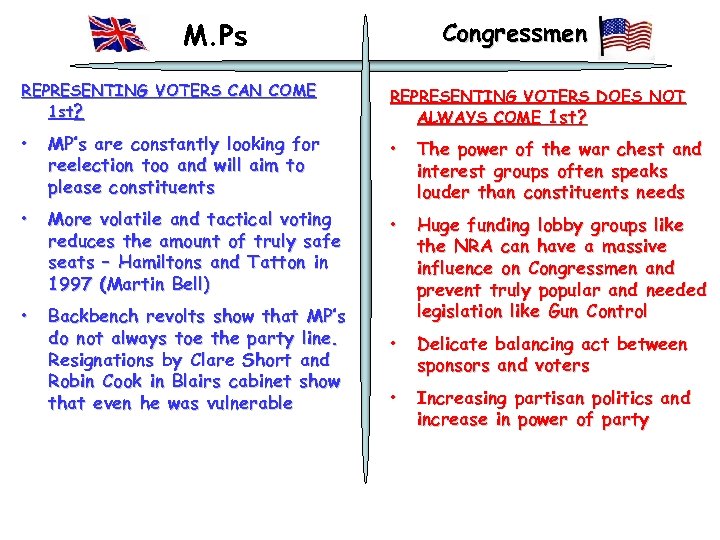 M. Ps Congressmen REPRESENTING VOTERS CAN COME 1 st? REPRESENTING VOTERS DOES NOT ALWAYS COME 1 st? • MP’s are constantly looking for reelection too and will aim to please constituents • The power of the war chest and interest groups often speaks louder than constituents needs • More volatile and tactical voting reduces the amount of truly safe seats – Hamiltons and Tatton in 1997 (Martin Bell) • • Backbench revolts show that MP’s do not always toe the party line. Resignations by Clare Short and Robin Cook in Blairs cabinet show that even he was vulnerable Huge funding lobby groups like the NRA can have a massive influence on Congressmen and prevent truly popular and needed legislation like Gun Control • Delicate balancing act between sponsors and voters • Increasing partisan politics and increase in power of party
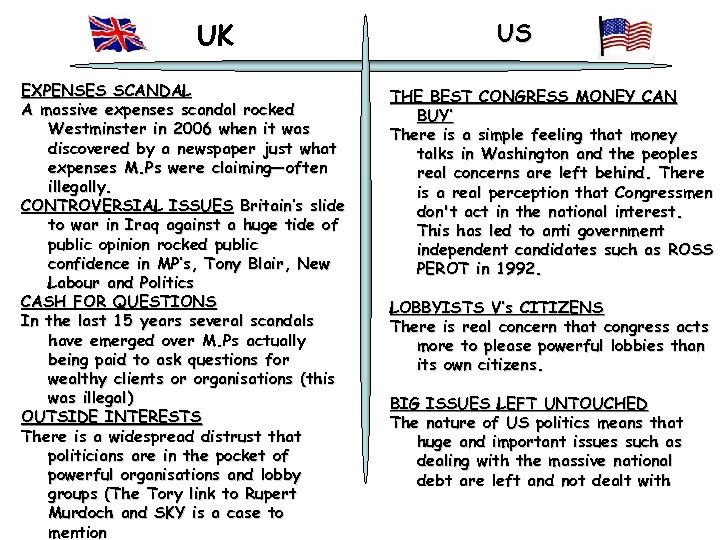 UK EXPENSES SCANDAL A massive expenses scandal rocked Westminster in 2006 when it was discovered by a newspaper just what expenses M. Ps were claiming—often illegally. CONTROVERSIAL ISSUES Britain’s slide to war in Iraq against a huge tide of public opinion rocked public confidence in MP’s, Tony Blair, New Labour and Politics CASH FOR QUESTIONS In the last 15 years several scandals have emerged over M. Ps actually being paid to ask questions for wealthy clients or organisations (this was illegal) OUTSIDE INTERESTS There is a widespread distrust that politicians are in the pocket of powerful organisations and lobby groups (The Tory link to Rupert Murdoch and SKY is a case to mention US THE BEST CONGRESS MONEY CAN BUY’ There is a simple feeling that money talks in Washington and the peoples real concerns are left behind. There is a real perception that Congressmen don't act in the national interest. This has led to anti government independent candidates such as ROSS PEROT in 1992. LOBBYISTS V’s CITIZENS There is real concern that congress acts more to please powerful lobbies than its own citizens. BIG ISSUES LEFT UNTOUCHED The nature of US politics means that huge and important issues such as dealing with the massive national debt are left and not dealt with
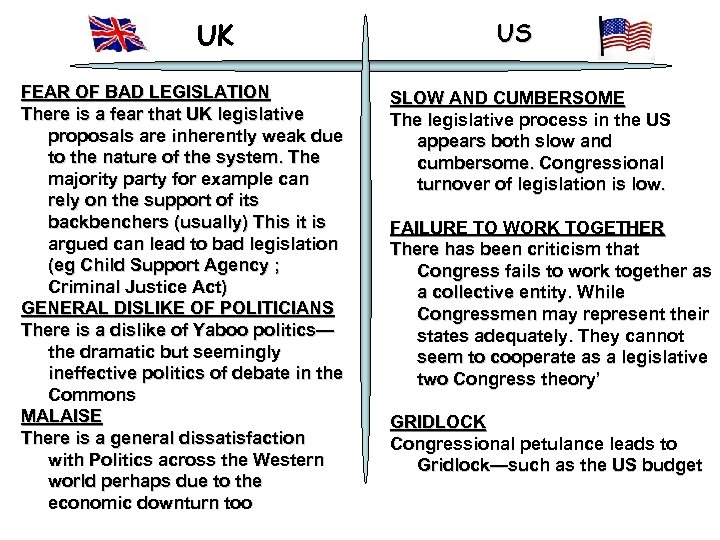 UK FEAR OF BAD LEGISLATION There is a fear that UK legislative proposals are inherently weak due to the nature of the system. The majority party for example can rely on the support of its backbenchers (usually) This it is argued can lead to bad legislation (eg Child Support Agency ; Criminal Justice Act) GENERAL DISLIKE OF POLITICIANS There is a dislike of Yaboo politics— the dramatic but seemingly ineffective politics of debate in the Commons MALAISE There is a general dissatisfaction with Politics across the Western world perhaps due to the economic downturn too US SLOW AND CUMBERSOME The legislative process in the US appears both slow and cumbersome. Congressional turnover of legislation is low. FAILURE TO WORK TOGETHER There has been criticism that Congress fails to work together as a collective entity. While Congressmen may represent their states adequately. They cannot seem to cooperate as a legislative two Congress theory’ GRIDLOCK Congressional petulance leads to Gridlock—such as the US budget
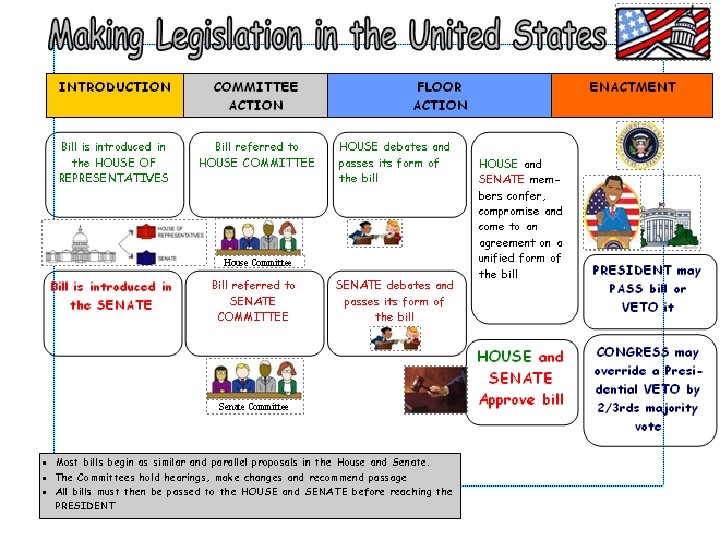
 The reasons are that Congress is actually DESIGNED NOT TO WORK. The system of CHECKS AND BALANCES is such that the only way anything can be done is through a very rigorous set of COMPROMISES • Between institutions • Between Parties • AND often Within Parties There are 7 factors that have been considered by Anthony Bennett as to why legislation is so difficult to pass:
 There a great deal of hurdles to overcome in the US system “It is stacked against the enactment of Law” In the US the COMMITTEE STAGE is fundamental and comes BEFORE the Second reading • It is carried out by a permanent and SPECIALIST Policy committee • They have life or death say over bills AND are deferred to by other members due to their status as Specialist. In UK, there are 3 readings and a committee stage. The Committee stage comes after the 2 nd reading and is carried out by a non specialist and partisan committee Remember how much control the Government / party has in these areas.
 • Any bill must have a MAJORITY in BOTH HOUSES • Any bill must have a MAJORITY of 3/5 ths in the SENATE (To end a FILIBUSTER requires 60 members) • Any bill VETOED by the President must have a MAJORITY of 2/3 rds in BOTH HOUSES Supporters in this case have an uphill struggle. EXAMPLE: Clinton vetoed the LATE TERM ABORTION BAN BILL • The House voted over 2/3 rds to overrule the veto • The Senate however were 3 votes short of the 2/3 rds required • THEREFORE: despite the fact that the majority overall wanted the ban the President (and minority supporters) still won the day
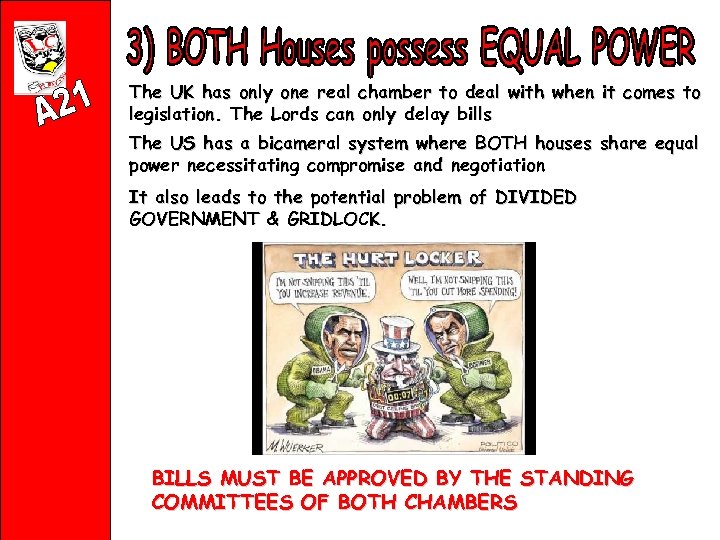 The UK has only one real chamber to deal with when it comes to legislation. The Lords can only delay bills The US has a bicameral system where BOTH houses share equal power necessitating compromise and negotiation It also leads to the potential problem of DIVIDED GOVERNMENT & GRIDLOCK. BILLS MUST BE APPROVED BY THE STANDING COMMITTEES OF BOTH CHAMBERS
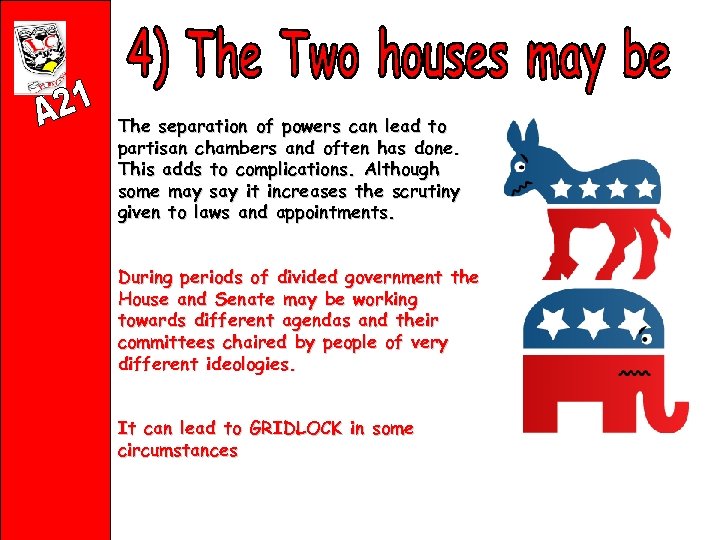 The separation of powers can lead to partisan chambers and often has done. This adds to complications. Although some may say it increases the scrutiny given to laws and appointments. During periods of divided government the House and Senate may be working towards different agendas and their committees chaired by people of very different ideologies. It can lead to GRIDLOCK in some circumstances
 Again the separation of powers can lead to divided Government between President and Congress. This adds to complications. Between 1969 and 2001 for only 6 years did the President remain the same party as the Congress The use of the Presidential veto is greatest during a period of divided Government. (7 per year as opposed to an average of 2 per year) Divided government can cause a President a great deal of problems as Clinton found out. Clinton (Dem) wanted an increase in the minimum wage Congress (Rep) wanted cuts in Federal programmes!
 A Presidential majority is no guarantee of success. Of Clintons 6 legislative proposals in 1993 only 2 were passed (even with majority’s in the House and Senate Most votes in Congress are BIPARTISAN – One group of Democrats AND Republicans voting against another group of Dems and Reps. Check the example of No Child Left Behind
 Previously there was a set of key players called ‘ the Kings of the Hill’ -Speaker ; majority leader and Committee chairmen -Over time however power moved from very powerful committee chairmen to subcommittee chairmen. -The powerful FEW became the considerably less powerful MANY Piecing together coalions therefore is notoriously difficult now “LIKE SEWING BUTTONS ON TO CUSTARD”
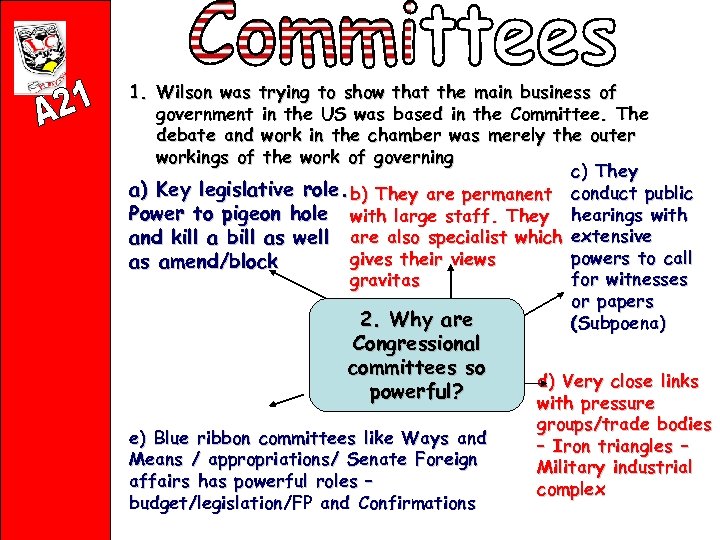 1. Wilson was trying to show that the main business of government in the US was based in the Committee. The debate and work in the chamber was merely the outer workings of the work of governing c) They a) Key legislative role. b) They are permanent conduct public Power to pigeon hole with large staff. They hearings with and kill a bill as well are also specialist which extensive powers to call gives their views as amend/block for witnesses gravitas or papers 2. Why are (Subpoena) Congressional committees so powerful? e) Blue ribbon committees like Ways and Means / appropriations/ Senate Foreign affairs has powerful roles – budget/legislation/FP and Confirmations d) Very close links with pressure groups/trade bodies – Iron triangles – Military industrial complex
 1. Most important committees- House Rules / Ways and Means/ Senate Foreign affairs / Senate Judicial 2. 16 in each House 3. Divided into Subcommittees 4. House committee: approx 45 -50 5. Senate committee: approx: 18 6. Committee members used to be decided by seniority NOW chosen to mirror party strength and chosen by party committee – Chairs always come from majority party. 7. Seniority rule was simply the longest serving member became chair – role reduced in 1970’s 8. POWER to: influence legislative process – amend/block/initiate Control the purse strings ; Senates advice and consent powers ; impeachment process; scrutinise and check the powers of the executive branch 9. IRON TRIANGLES are deep and powerful relationships developed between legislators and industrial or lobby groups which can dominate policy making and lead to unfair influence EXAMPLE: Pentagon; armed forces committee defence industry
 1. POWERS OF HOUSE RULES COMMITTEE? • One of the Standing committees BUT VERY IMPORTANT • Timetables bills for consideration on floor • Deals with getting bills from committee to 2 nd reading • Prioritises for quick passage • Sets RULES – Sets out the rules of debate and therefore potential for amendment 2. CONFERENCE COMMITTEE? • Both houses have EQUAL POWER • Bills through BOTH houses CONCURRENTLY • Therefore there may have to be compromises negotiated after 3 rd reading • They are AD HOC and contain members from both houses • They aim to RECONCILE THE DIFFERENCES IN BILLS • The final version is then voted on
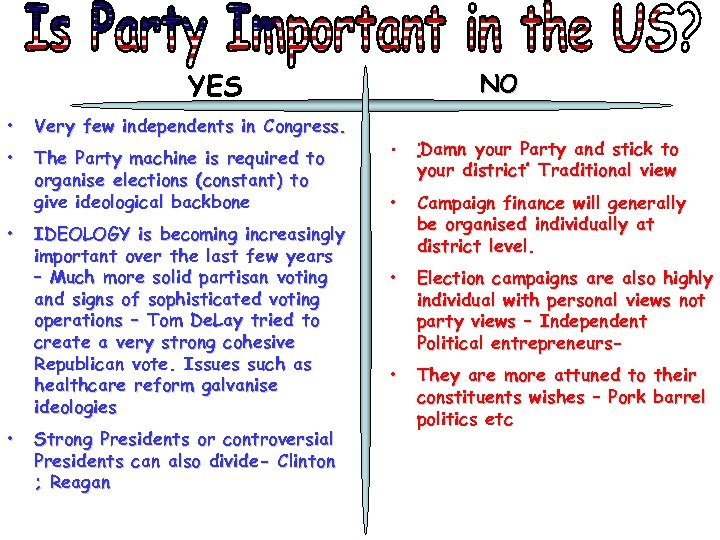 YES • Very few independents in Congress. • The Party machine is required to organise elections (constant) to give ideological backbone • • IDEOLOGY is becoming increasingly important over the last few years – Much more solid partisan voting and signs of sophisticated voting operations – Tom De. Lay tried to create a very strong cohesive Republican vote. Issues such as healthcare reform galvanise ideologies Strong Presidents or controversial Presidents can also divide- Clinton ; Reagan NO • ‘Damn your Party and stick to • Campaign finance will generally be organised individually at district level. • Election campaigns are also highly individual with personal views not party views – Independent Political entrepreneurs- • They are more attuned to their constituents wishes – Pork barrel politics etc your district’ Traditional view
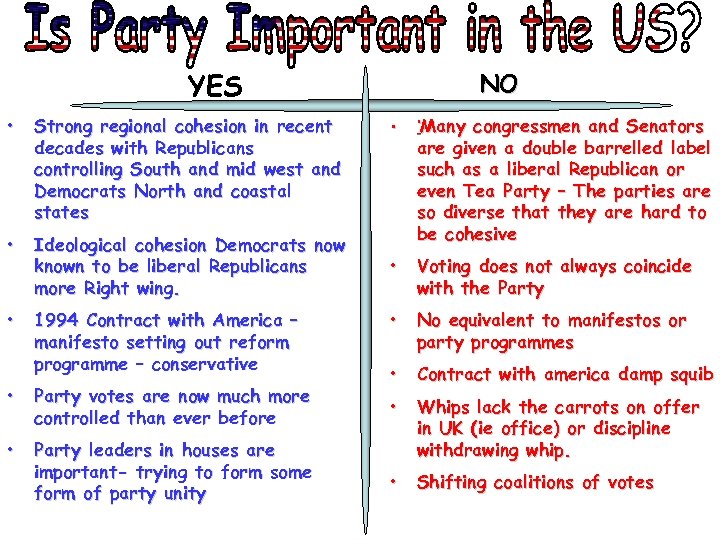 YES • Strong regional cohesion in recent decades with Republicans controlling South and mid west and Democrats North and coastal states • Ideological cohesion Democrats now known to be liberal Republicans more Right wing. • 1994 Contract with America – manifesto setting out reform programme – conservative • Party votes are now much more controlled than ever before • Party leaders in houses are important- trying to form some form of party unity NO • ‘Many congressmen and Senators • Voting does not always coincide with the Party • No equivalent to manifestos or party programmes • Contract with america damp squib • Whips lack the carrots on offer in UK (ie office) or discipline withdrawing whip. • Shifting coalitions of votes are given a double barrelled label such as a liberal Republican or even Tea Party – The parties are so diverse that they are hard to be cohesive
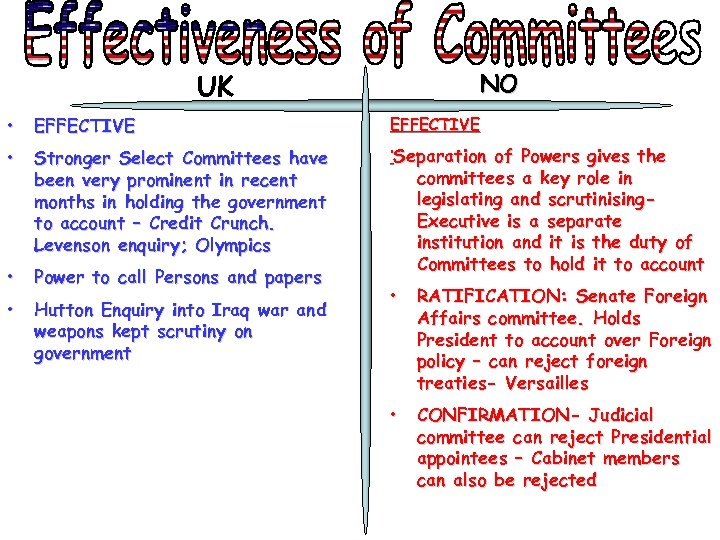 UK NO • EFFECTIVE • Stronger Select Committees have been very prominent in recent months in holding the government to account – Credit Crunch. Levenson enquiry; Olympics ‘Separation of Powers gives the • Power to call Persons and papers • Hutton Enquiry into Iraq war and weapons kept scrutiny on government committees a key role in legislating and scrutinising. Executive is a separate institution and it is the duty of Committees to hold it to account • RATIFICATION: Senate Foreign Affairs committee. Holds President to account over Foreign policy – can reject foreign treaties- Versailles • CONFIRMATION- Judicial committee can reject Presidential appointees – Cabinet members can also be rejected
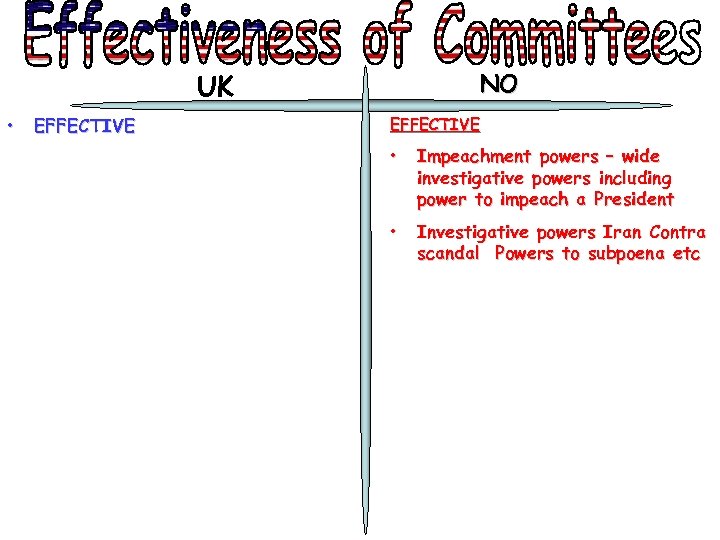 UK • EFFECTIVE NO EFFECTIVE • Impeachment powers – wide investigative powers including power to impeach a President • Investigative powers Iran Contra scandal Powers to subpoena etc
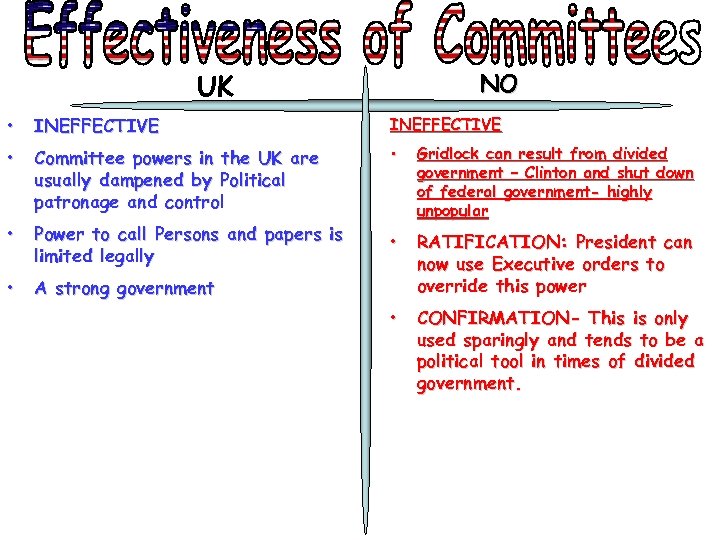 UK NO • INEFFECTIVE • Committee powers in the UK are usually dampened by Political patronage and control • • Power to call Persons and papers is limited legally Gridlock can result from divided government – Clinton and shut down of federal government- highly unpopular • • A strong government RATIFICATION: President can now use Executive orders to override this power • CONFIRMATION- This is only used sparingly and tends to be a political tool in times of divided government.