


 Скачать презентацию Chaucer s Sense of Closur An dialogue of ending
31c1d39c96779a930c1df1c2da192c1f.ppt
- Количество слайдов: 23
 Chaucer’s Sense of Closur An dialogue of ending in The Canterbury Tales and The House of Fame.
 The Canterbury Tales n n “Unfinished but complete” - Don Howard “Finished but incomplete” – Gittes re-invents Howard’s famous line.
 Problems with Closure, part 1: The Canterbury Tales— n Fact 1: the Pilgrims never reach Canterbury. n n They’re right outside Canterbury when the Parson begins his tale. Some critics have argued for the significance of the “oneway journey” and that Chaucer did not mean to have them return (Howard).
 Problems with Closure, part 1: The Canterbury Tales— n Fact 2: The number of pilgrims and tales are not set in stone n There are twenty-nine pilgrims mentioned in the General Prologue, but “the mention of three priests (I. 164) brings the total to thirty-one” (Gittes 166) n n The number of pilgrims is variable (could go on indefinitely) if the middle part of the pilgrimage was ever “truly” finished—not unlike 1001 Arabian Nights, argues Gittes (166). Only twenty-two pilgrims, of the thirty-one, have told tales by the end (I. 792 -94)… Harry Bailey states that each pilgrim will tell two tales, but the Franklin states that each will tell “a tale or two” (V. 698) The Cannon and his Yeoman join the pilgrimage, upsetting “the limitations on the number” (Gittes 166) n Gittes cites Don Howard: “the narrator’s recitation might go on indefinitely, producing more people and from them more tales” (166).
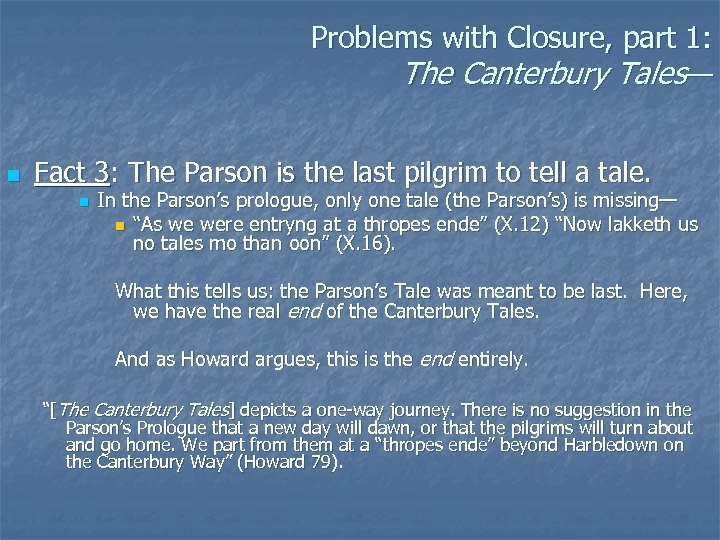 Problems with Closure, part 1: The Canterbury Tales— n Fact 3: The Parson is the last pilgrim to tell a tale. n In the Parson’s prologue, only one tale (the Parson’s) is missing— n “As we were entryng at a thropes ende” (X. 12) “Now lakketh us no tales mo than oon” (X. 16). What this tells us: the Parson’s Tale was meant to be last. Here, we have the real end of the Canterbury Tales. And as Howard argues, this is the end entirely. “[The Canterbury Tales] depicts a one-way journey. There is no suggestion in the Parson’s Prologue that a new day will dawn, or that the pilgrims will turn about and go home. We part from them at a “thropes ende” beyond Harbledown on the Canterbury Way” (Howard 79).
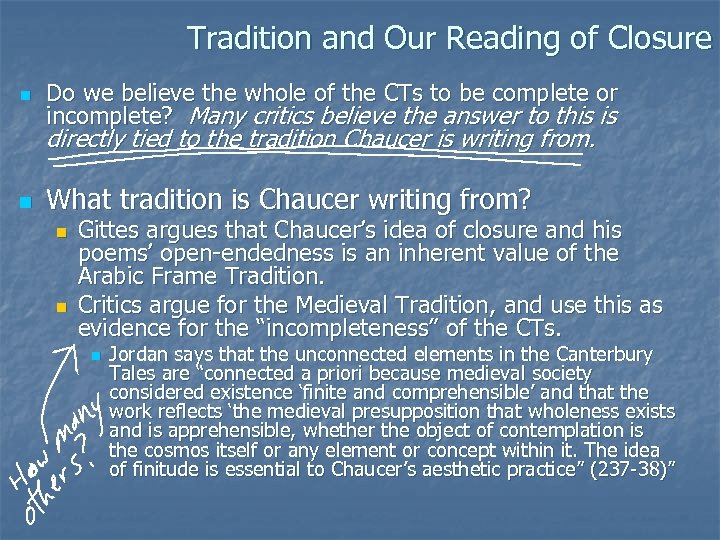 Tradition and Our Reading of Closure n Do we believe the whole of the CTs to be complete or incomplete? Many critics believe the answer to this is directly tied to the tradition Chaucer is writing from. n What tradition is Chaucer writing from? n n Gittes argues that Chaucer’s idea of closure and his poems’ open-endedness is an inherent value of the Arabic Frame Tradition. Critics argue for the Medieval Tradition, and use this as evidence for the “incompleteness” of the CTs. n Jordan says that the unconnected elements in the Canterbury Tales are “connected a priori because medieval society considered existence ‘finite and comprehensible’ and that the work reflects ‘the medieval presupposition that wholeness exists and is apprehensible, whether the object of contemplation is the cosmos itself or any element or concept within it. The idea of finitude is essential to Chaucer’s aesthetic practice” (237 -38)”
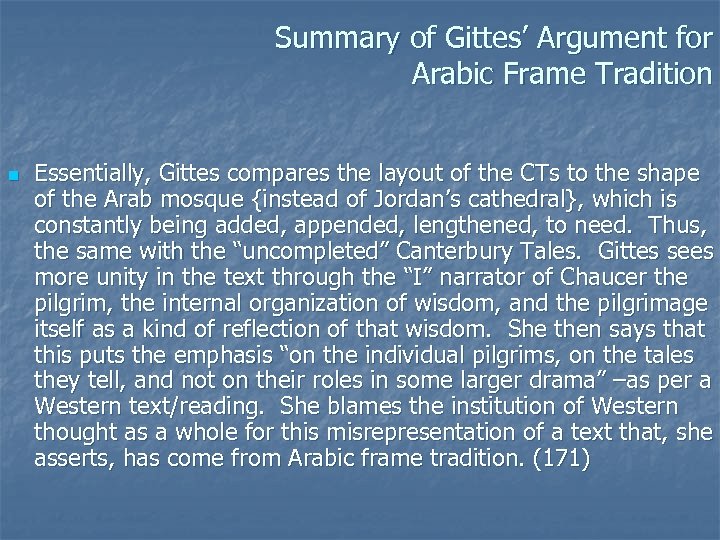 Summary of Gittes’ Argument for Arabic Frame Tradition n Essentially, Gittes compares the layout of the CTs to the shape of the Arab mosque {instead of Jordan’s cathedral}, which is constantly being added, appended, lengthened, to need. Thus, the same with the “uncompleted” Canterbury Tales. Gittes sees more unity in the text through the “I” narrator of Chaucer the pilgrim, the internal organization of wisdom, and the pilgrimage itself as a kind of reflection of that wisdom. She then says that this puts the emphasis “on the individual pilgrims, on the tales they tell, and not on their roles in some larger drama” –as per a Western text/reading. She blames the institution of Western thought as a whole for this misrepresentation of a text that, she asserts, has come from Arabic frame tradition. (171)
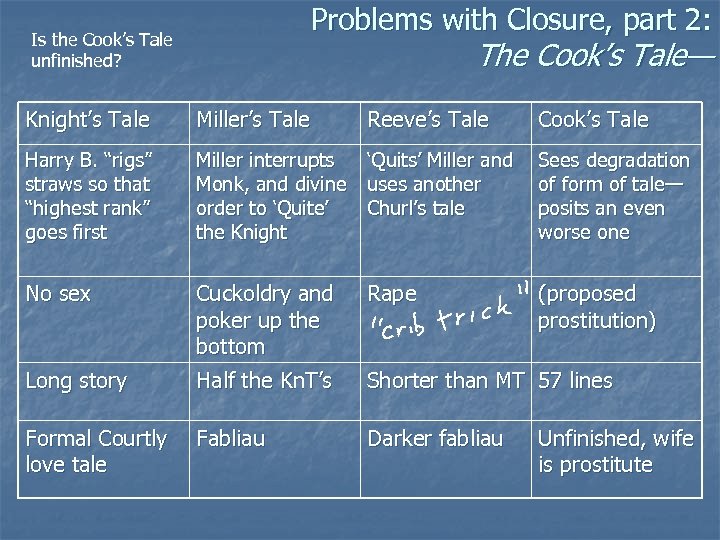 Problems with Closure, part 2: Is the Cook’s Tale unfinished? The Cook’s Tale— Knight’s Tale Miller’s Tale Harry B. “rigs” straws so that “highest rank” goes first Miller interrupts ‘Quits’ Miller and Monk, and divine uses another order to ‘Quite’ Churl’s tale the Knight Sees degradation of form of tale— posits an even worse one No sex Cuckoldry and poker up the bottom Half the Kn. T’s Rape (proposed prostitution) Fabliau Darker fabliau Long story Formal Courtly love tale Reeve’s Tale Cook’s Tale Shorter than MT 57 lines Unfinished, wife is prostitute
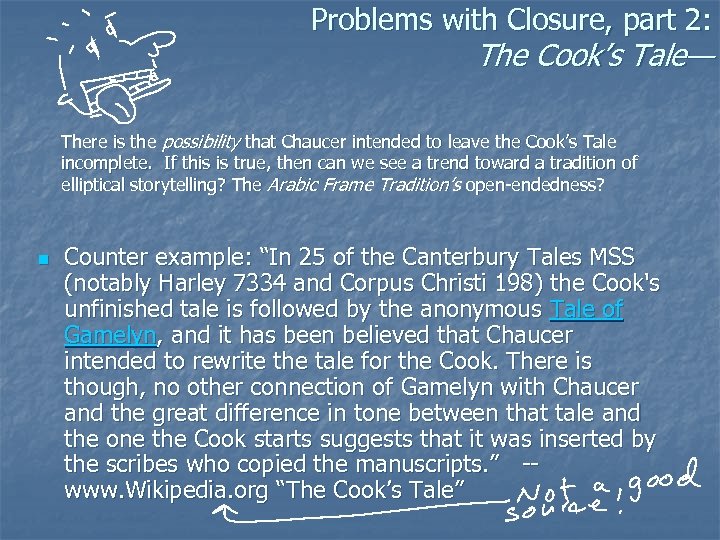 Problems with Closure, part 2: The Cook’s Tale— There is the possibility that Chaucer intended to leave the Cook’s Tale incomplete. If this is true, then can we see a trend toward a tradition of elliptical storytelling? The Arabic Frame Tradition’s open-endedness? n Counter example: “In 25 of the Canterbury Tales MSS (notably Harley 7334 and Corpus Christi 198) the Cook's unfinished tale is followed by the anonymous Tale of Gamelyn, and it has been believed that Chaucer intended to rewrite the tale for the Cook. There is though, no other connection of Gamelyn with Chaucer and the great difference in tone between that tale and the one the Cook starts suggests that it was inserted by the scribes who copied the manuscripts. ” -www. Wikipedia. org “The Cook’s Tale”
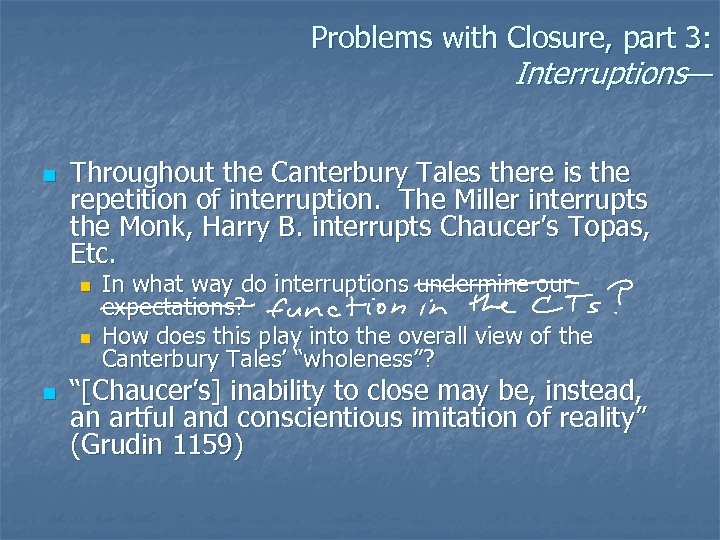 Problems with Closure, part 3: Interruptions— n Throughout the Canterbury Tales there is the repetition of interruption. The Miller interrupts the Monk, Harry B. interrupts Chaucer’s Topas, Etc. n n n In what way do interruptions undermine our expectations? How does this play into the overall view of the Canterbury Tales’ “wholeness”? “[Chaucer’s] inability to close may be, instead, an artful and conscientious imitation of reality” (Grudin 1159)
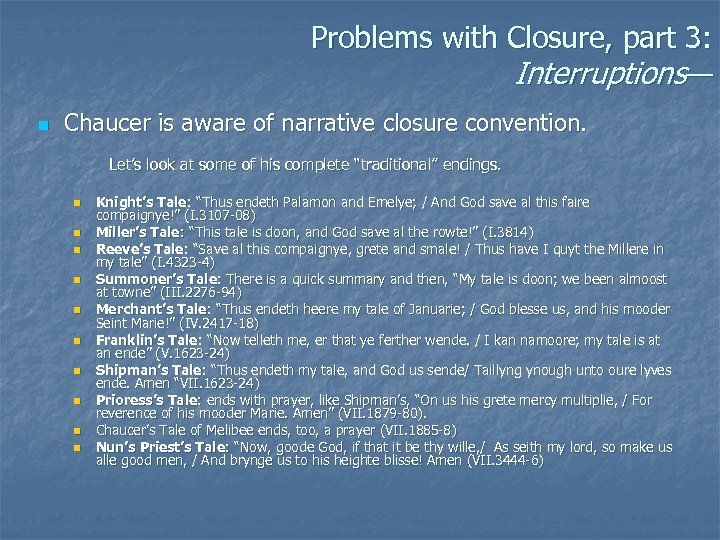 Problems with Closure, part 3: Interruptions— n Chaucer is aware of narrative closure convention. Let’s look at some of his complete “traditional” endings. n n n n n Knight’s Tale: “Thus endeth Palamon and Emelye; / And God save al this faire compaignye!” (I. 3107 -08) Miller’s Tale: “This tale is doon, and God save al the rowte!” (I. 3814) Reeve’s Tale: “Save al this compaignye, grete and smale! / Thus have I quyt the Millere in my tale” (I. 4323 -4) Summoner’s Tale: There is a quick summary and then, “My tale is doon; we been almoost at towne” (III. 2276 -94) Merchant’s Tale: “Thus endeth heere my tale of Januarie; / God blesse us, and his mooder Seint Marie!” (IV. 2417 -18) Franklin’s Tale: “Now telleth me, er that ye ferther wende. / I kan namoore; my tale is at an ende” (V. 1623 -24) Shipman’s Tale: “Thus endeth my tale, and God us sende/ Taillyng ynough unto oure lyves ende. Amen “VII. 1623 -24) Prioress’s Tale: ends with prayer, like Shipman’s, “On us his grete mercy multiplie, / For reverence of his mooder Marie. Amen” (VII. 1879 -80). Chaucer’s Tale of Melibee ends, too, a prayer (VII. 1885 -8) Nun’s Priest’s Tale: “Now, goode God, if that it be thy wille, / As seith my lord, so make us alle good men, / And brynge us to his heighte blisse! Amen (VII. 3444 -6)
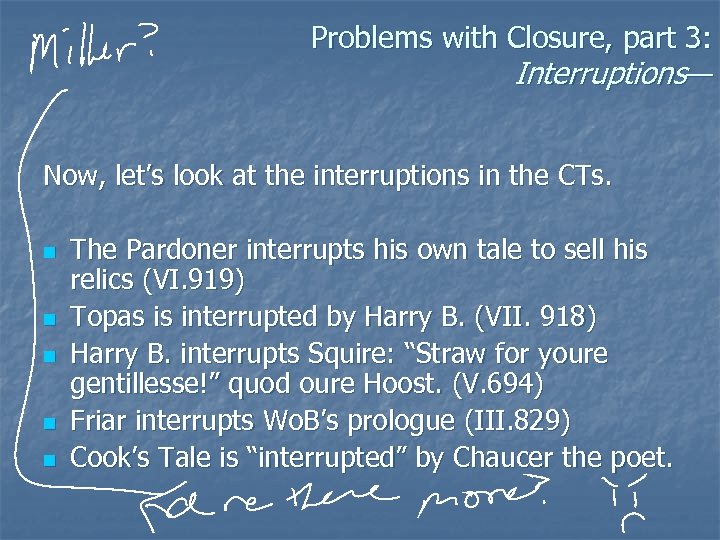 Problems with Closure, part 3: Interruptions— Now, let’s look at the interruptions in the CTs. n n n The Pardoner interrupts his own tale to sell his relics (VI. 919) Topas is interrupted by Harry B. (VII. 918) Harry B. interrupts Squire: “Straw for youre gentillesse!” quod oure Hoost. (V. 694) Friar interrupts Wo. B’s prologue (III. 829) Cook’s Tale is “interrupted” by Chaucer the poet.
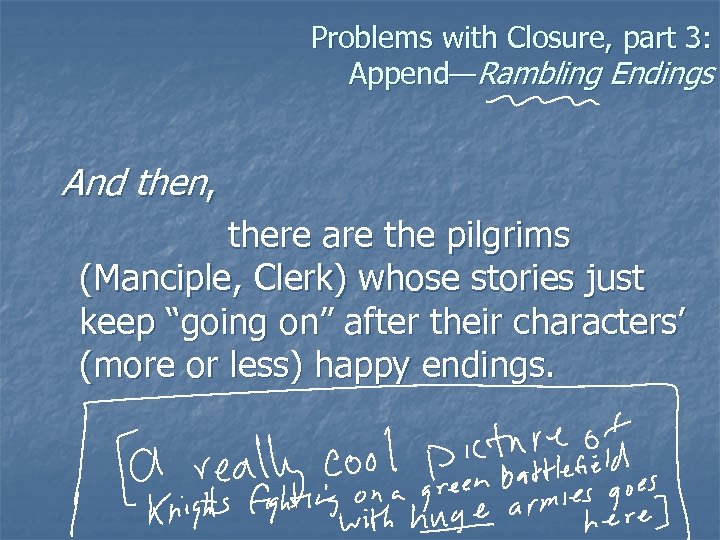 Problems with Closure, part 3: Append—Rambling Endings And then, there are the pilgrims (Manciple, Clerk) whose stories just keep “going on” after their characters’ (more or less) happy endings.
 Problems with Closure, part 3: Append—Parson’s End n Critics have argued that because of the invocation of the sign Libra, this is to signify the “scales of judgment” and tie us firmly to an apocalyptic ending. n The apocalyptic text Chaucer modeled it after was the Bible.
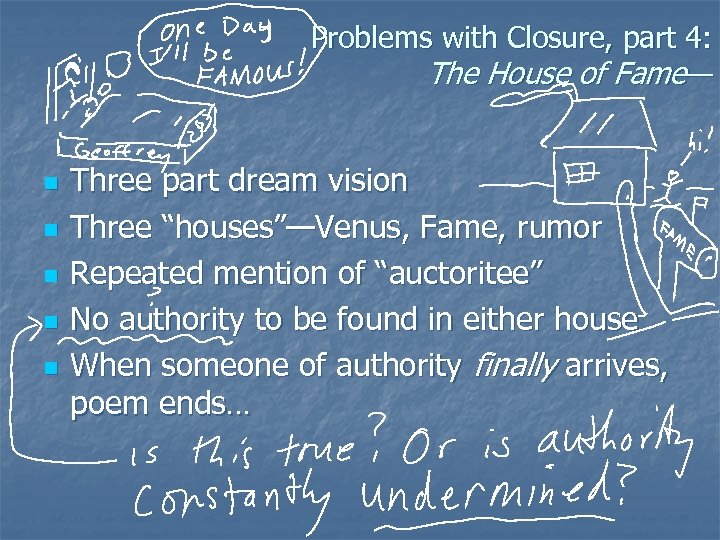 Problems with Closure, part 4: The House of Fame— n n n Three part dream vision Three “houses”—Venus, Fame, rumor Repeated mention of “auctoritee” No authority to be found in either house When someone of authority finally arrives, poem ends…
 Problems with Closure, part 4: The House of Fame— n n “Both highly dialogic, especially in their framing, the House of Fame and the Legend of Good Women are simply unfinished, whether intentionally or not” (Grudin 1165) Many scholars believe this poem to be intentionally inconclusive, rather than unfinished (Mc. Gerr) n “One grand question-mark to make us ponder and reread” (Boitani)
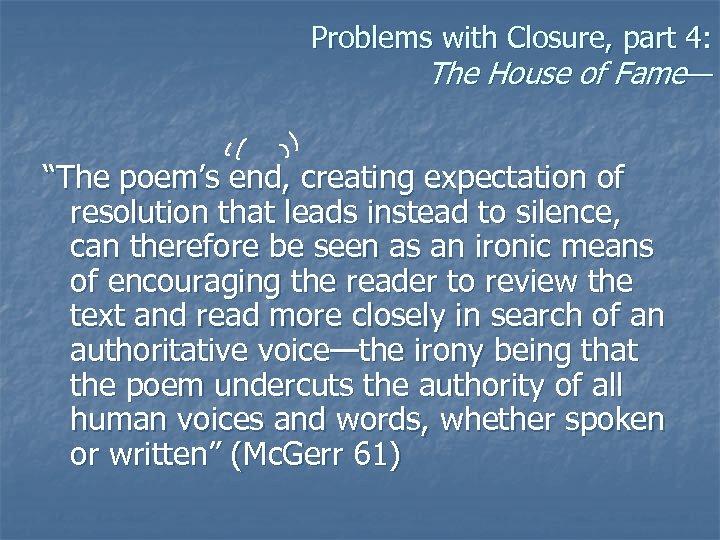 Problems with Closure, part 4: The House of Fame— “The poem’s end, creating expectation of resolution that leads instead to silence, can therefore be seen as an ironic means of encouraging the reader to review the text and read more closely in search of an authoritative voice—the irony being that the poem undercuts the authority of all human voices and words, whether spoken or written” (Mc. Gerr 61)
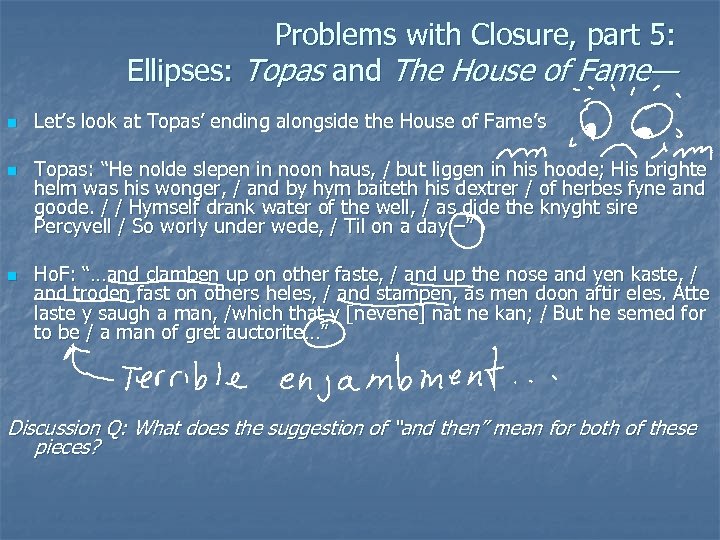 Problems with Closure, part 5: Ellipses: Topas and The House of Fame— n n n Let’s look at Topas’ ending alongside the House of Fame’s Topas: “He nolde slepen in noon haus, / but liggen in his hoode; His brighte helm was his wonger, / and by hym baiteth his dextrer / of herbes fyne and goode. / / Hymself drank water of the well, / as dide the knyght sire Percyvell / So worly under wede, / Til on a day –” Ho. F: “…and clamben up on other faste, / and up the nose and yen kaste, / and troden fast on others heles, / and stampen, as men doon aftir eles. Atte laste y saugh a man, /which that y [nevene] nat ne kan; / But he semed for to be / a man of gret auctorite…” Discussion Q: What does the suggestion of “and then” mean for both of these pieces?
 Was Chaucer’s Work Just Unfinished? n n n Beverly Boyd suggests that “Chaucer’s store of unfinished works is very large for a poet of his reputation. ” She gives these reasons for it’s incompleteness: first, the oral presentation before a live audience would remove pressure to bring the work to a final state; second, a presentation of a portion of the work to an individual friend of patron would have the same effect… (Delany 228) Robert Payne argues that Chaucer “experimented with inconclusiveness in both the structure and themes of his earlier narrative poems as one way of exploring the powers of rhetoric” (Mc. Gerr 3) Howard began to see the varieties of endings as a sign of open-endedness in the whole of the CTs. “Piero Boitani’s study of the house of fame[…] argued for consideration of that poem as an ‘in-finite’ work that presents the problematic relationship of literature, language, and reality. ” (3) Donald Rowe wrote on Legend of Good Women, states that the incompleteness of the conclusion in that poem is “finished incompletion” and reflects the human condition. (3)
 The End? Toward A Critical Response n n n Both the Canterbury Tales and the House of Fame remain “incomplete” but is it Chaucer’s MO to go against Medieval convention? What about his other, finished work? Let’s take a quick look at the Parliament of Fowles— Sheila Delany argues that the Parliament of Fowles, “defers the conclusion of its narrative to outside the poem, and falls deliberately one line short of its perfect seven hundred” (Delany, 228). n Delany suggests that Chaucer’s endings are mimetic, in the way we know where we begin (birth) but not quite where we end (death? afterlife? ) (228). Discussion question: is this true of the CT pilgrims? In short: troublesome (or, rather, troubling) endings exists in most of Chaucer’s long work. But is the fragmented and “unfinished” CTs purposeful, or just unfinished? n n
 Chaucer’s Retraction n How are we to interpret? n n “Chaucer’s poems repeatedly suggest the dangers of jumping to conclusions” (Mc. Gerr 1) What do retractions do? n n Serve to remind us explicitly of the role of the audience. Leaves it to the reader to decide if the words revoked need to be. Asserts the narrator’s intent. Asks the reader to asses the work’s affect on us, retrospectively, from the “vantage point of the end” (Mc. Gerr 136).
 Pilgrimage in Retrospect “The narrator’s performance, begun in the opening passage of the General Prologue, looks back upon a pilgrimage now completed and remembered. In some instances we must as we read look back upon previous tales or groups of tales to understand the performance we witness—we look back to the Knight’s Tale during the Miller’s performance, to the Wife’s during the Clerk’s. At the end of the work we are given a summa on penitence, and penance itself requires a retrospective examination of past deeds. At the end of the summa the author himself looks back upon the corpus of his writings” (Howard 196 -7)
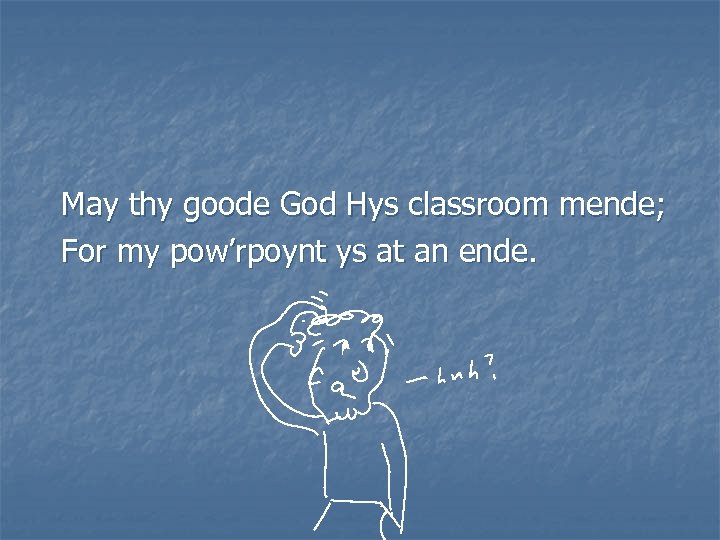 May thy goode God Hys classroom mende; For my pow’rpoynt ys at an ende.