


 Скачать презентацию chasing shadows with TAOS TAIWANESE AMERICAN OCCULTATION SURVEY
e5aba834e3b082957f151b40d44c0e48.ppt
- Количество слайдов: 34
 chasing shadows with TAOS: TAIWANESE AMERICAN OCCULTATION SURVEY federica bianco, SAO - UPenn
 the TAOS collaboration C. Alcock (Cf. A) T. Axelrod (Arizona) F. Bianco (UPenn, Cf. A) Y. -I. Byun (Yonsei) Y. -H. Chang (NCU) W. -P. Chen (NCU) K. Cook (LLNL) R. Dave (UPenn) J. Giammarco (UPenn) Y. -J. Huang (NCU) S. -K. King (ASIAA) D. -W. Kim (Yonsei) T. Lee (ASIAA) M. Lehner (Cf. A, UPenn) H. Liang (NCU) J. Lissauer (NASA Ames) S. L. Marshall (SLAC) T. Nihei (UPenn, Cf. A) I. de Pater (UC Berkeley) R. Porrata (UC Berkeley) P. Protopapas (Cf. A) J. Rice (UC Berkeley) M. Schwamb (UPenn) A. Wang (ASIAA) S. -Y. Wang (ASIAA) C. -Y. Wen (ASIAA) Z. -W. Zhang (NCU)
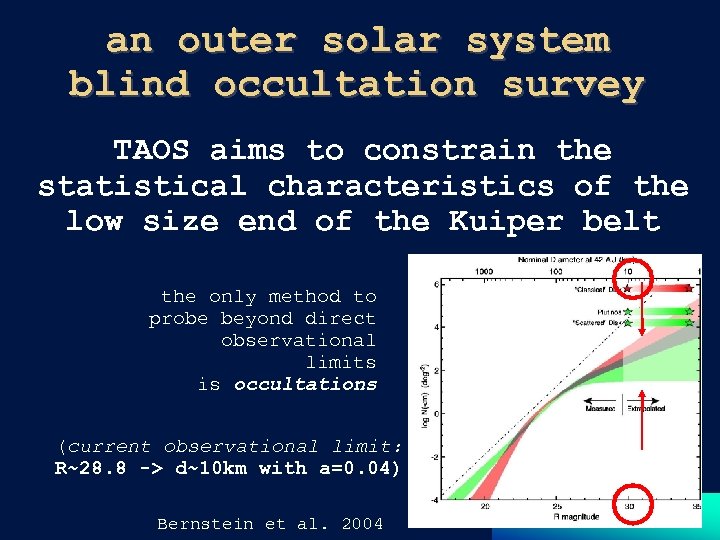 an outer solar system blind occultation survey TAOS aims to constrain the statistical characteristics of the low size end of the Kuiper belt the only method to probe beyond direct observational limits is occultations (current observational limit: R~28. 8 -> d~10 km with a=0. 04) Bernstein et al. 2004
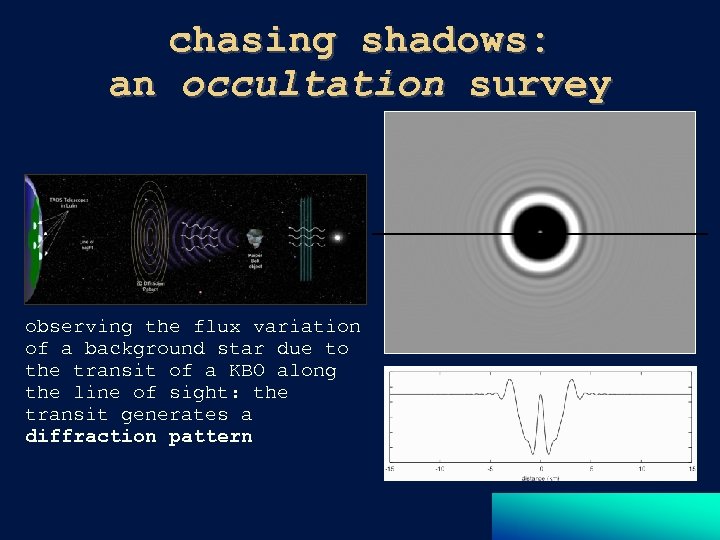 chasing shadows: an occultation survey observing the flux variation of a background star due to the transit of a KBO along the line of sight: the transit generates a diffraction pattern
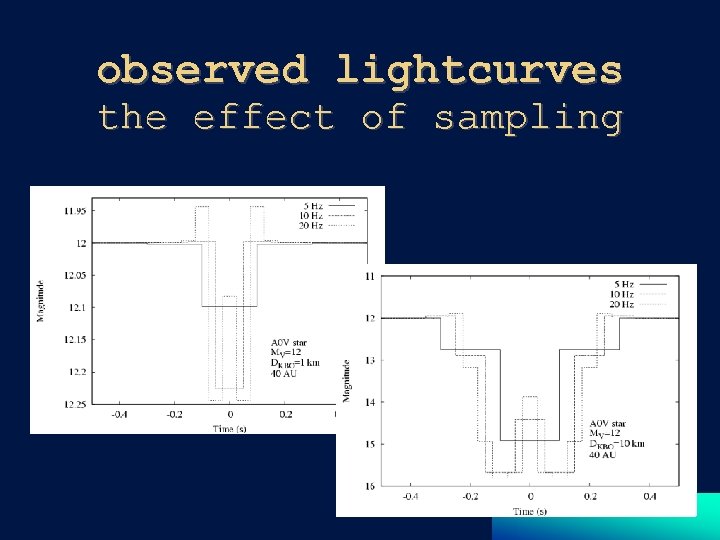 observed lightcurves the effect of sampling
 project description status future
 project description status future
 challenges of a blind occultation survey • brief duration of the events for size range 1~20 km @ ~45 AU < 1 sec fast zippermode photometry
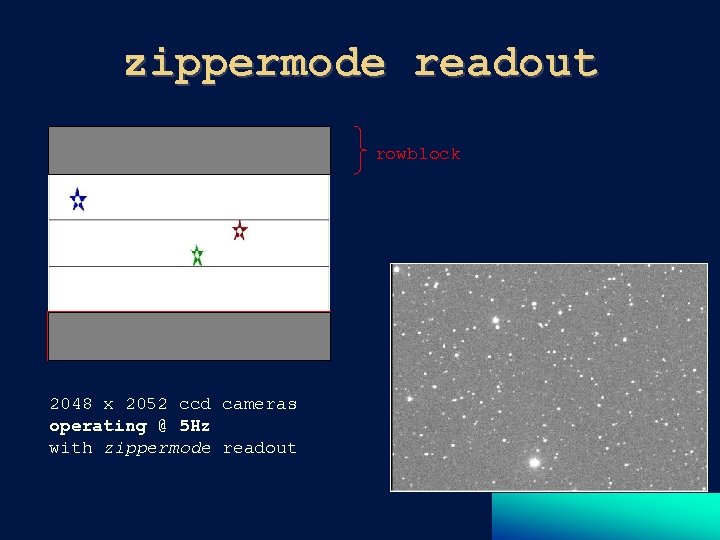 zippermode readout rowblock 2048 x 2052 ccd cameras operating @ 5 Hz with zippermode readout
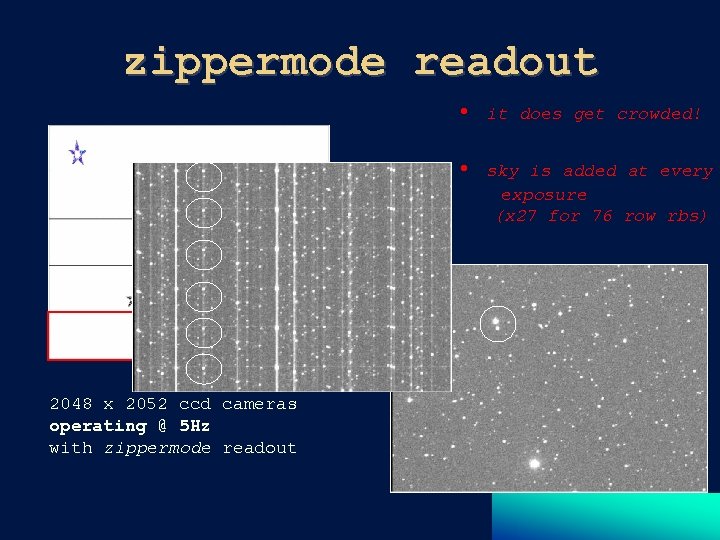 zippermode readout • • 2048 x 2052 ccd cameras operating @ 5 Hz with zippermode readout it does get crowded! sky is added at every exposure (x 27 for 76 row rbs)
 challenges of a blind occultation survey • brief duration of the events for size range 1~20 km @ ~50 AU < 1 sec fast zippermode photometry • false alarms and contaminations terrestrial contamination (birds, planes, ufo…) atmospheric scintillation phenomena multiple telescopes
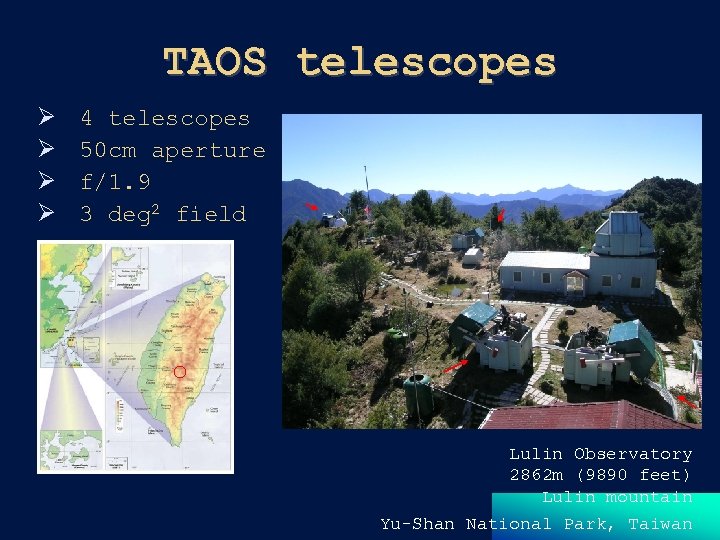 TAOS telescopes 4 telescopes 50 cm aperture f/1. 9 3 deg 2 field Lulin Observatory 2862 m (9890 feet) Lulin mountain Yu-Shan National Park, Taiwan

 current status of the TAOS system: • 3 operating telescopes, the 4 th to come at the end of the summer • automated operation mode completed • a posteriori aperture photometry
 1 year data with 2 -3 operating telescopes: we are analyzing the data collected between 02/07/05 and 02/15/06 • duty cycle ~5% (~13% of dark time) • • • 99 TAOS fields observed 415 runs 348. 9124 collection hours 5, 315, 232 rowblocks ~6. 6 Tb raw image data ~105, 000 star hours No occultations yet, which is consistent with most theoretical models
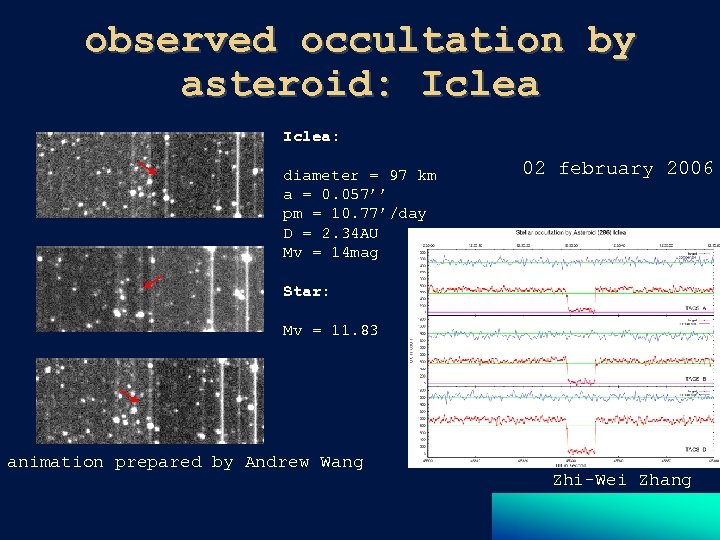 observed occultation by asteroid: Iclea: diameter = 97 km a = 0. 057’’ pm = 10. 77’/day D = 2. 34 AU Mv = 14 mag 02 february 2006 Star: Mv = 11. 83 animation prepared by Andrew Wang Zhi-Wei Zhang

 real time analysis • real time PSF fitting photometry better S/N (we can follow more stars) allows follow up of occultations • real time efficiency provides immediate completeness result
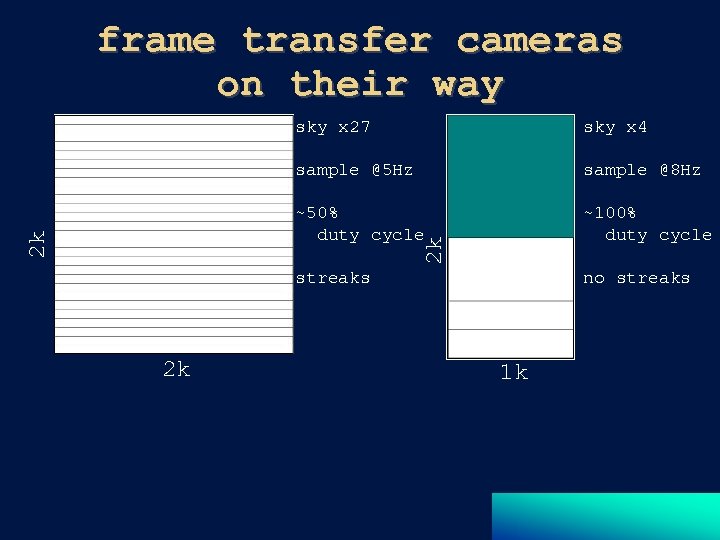 frame transfer cameras on their way sample @8 Hz ~50% duty cycle ~100% duty cycle streaks no streaks 2 k sky x 4 sample @5 Hz 2 k sky x 27 2 k 1 k
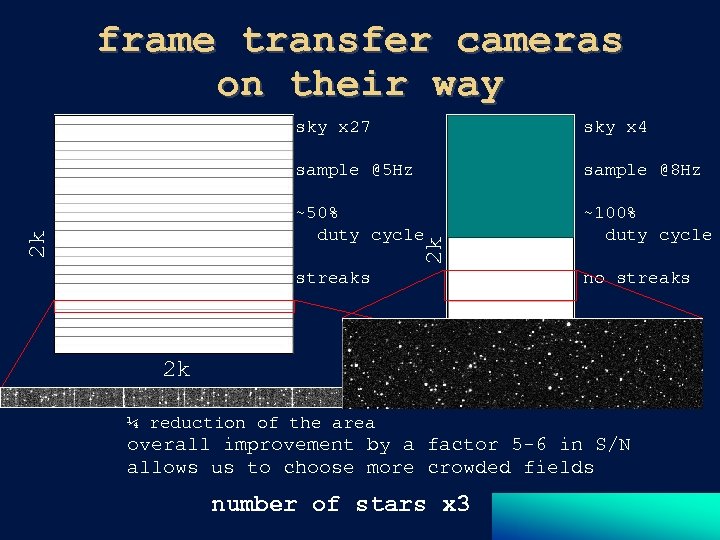 frame transfer cameras on their way sample @8 Hz ~50% duty cycle ~100% duty cycle streaks no streaks 2 k sky x 4 sample @5 Hz 2 k sky x 27 2 k 1 k ¼ reduction of the area overall improvement by a factor 5 -6 in S/N allows us to choose more crowded fields number of stars x 3
 move to new site looking for a drier site
 move to new site looking for a drier site
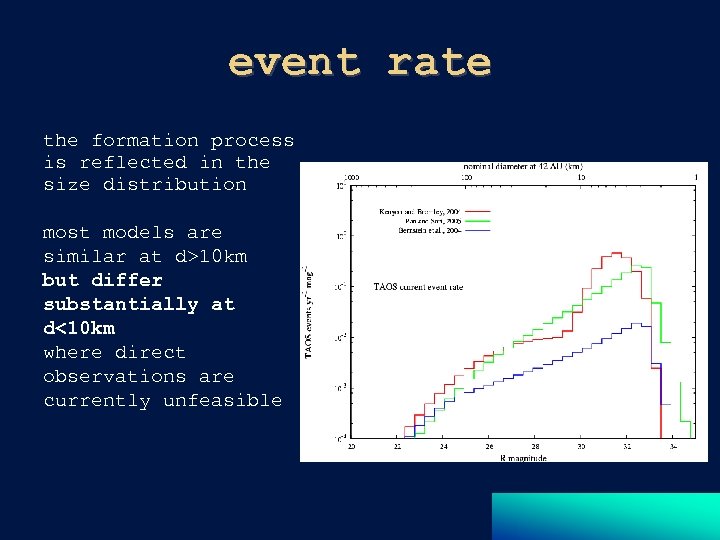 event rate the formation process is reflected in the size distribution most models are similar at d>10 km but differ substantially at d<10 km where direct observations are currently unfeasible
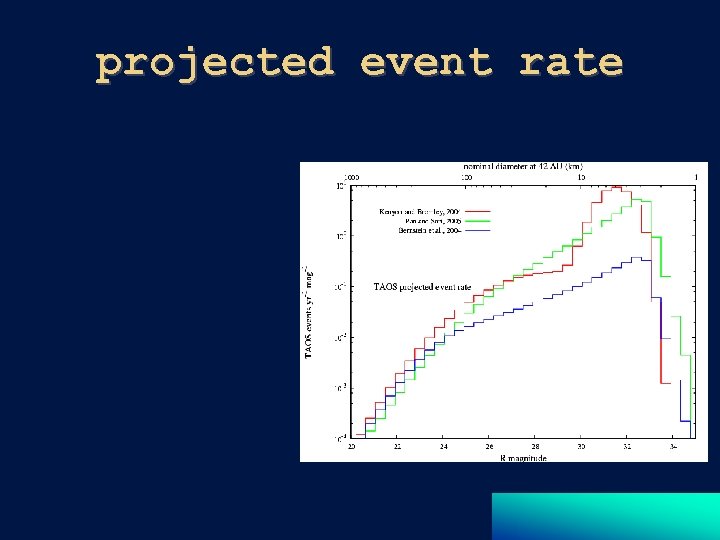 projected event rate
 thank you!
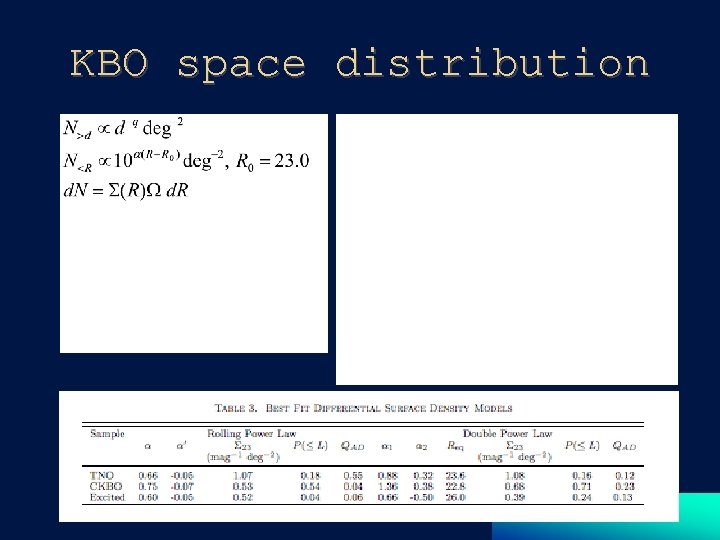
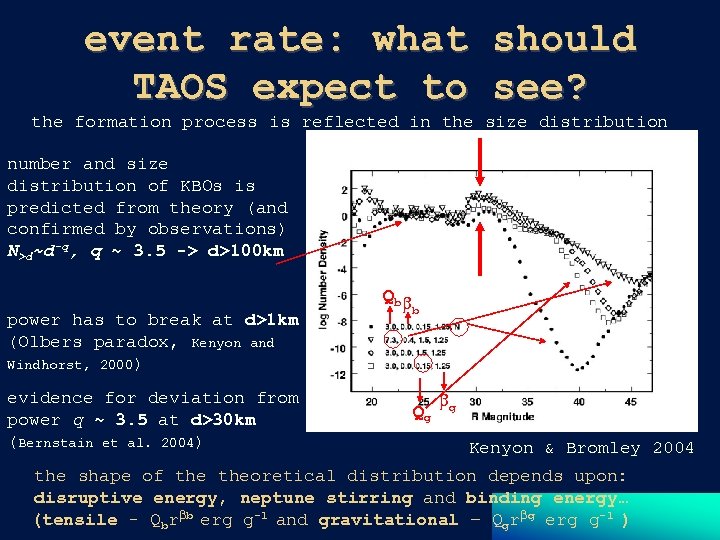 event rate: what should TAOS expect to see? the formation process is reflected in the size distribution number and size distribution of KBOs is predicted from theory (and confirmed by observations) N>d~d-q, q ~ 3. 5 -> d>100 km power has to break at d>1 km (Olbers paradox, Kenyon and Windhorst, 2000) evidence for deviation from power q ~ 3. 5 at d>30 km (Bernstain et al. 2004) Qb b b Qg bg Kenyon & Bromley 2004 the shape of theoretical distribution depends upon: disruptive energy, neptune stirring and binding energy… (tensile - Qbrbb erg g-1 and gravitational – Qgrbg erg g-1 )
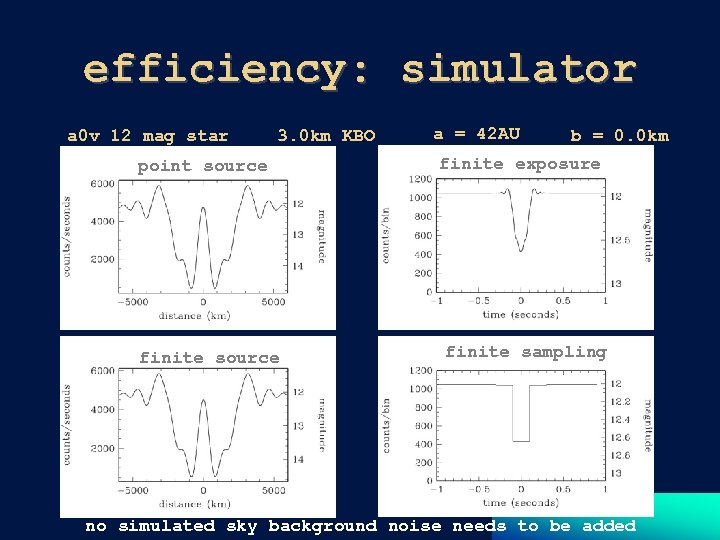 efficiency: simulator a 0 v 12 mag star 3. 0 km KBO point source finite source a = 42 AU b = 0. 0 km finite exposure finite sampling no simulated sky background noise needs to be added
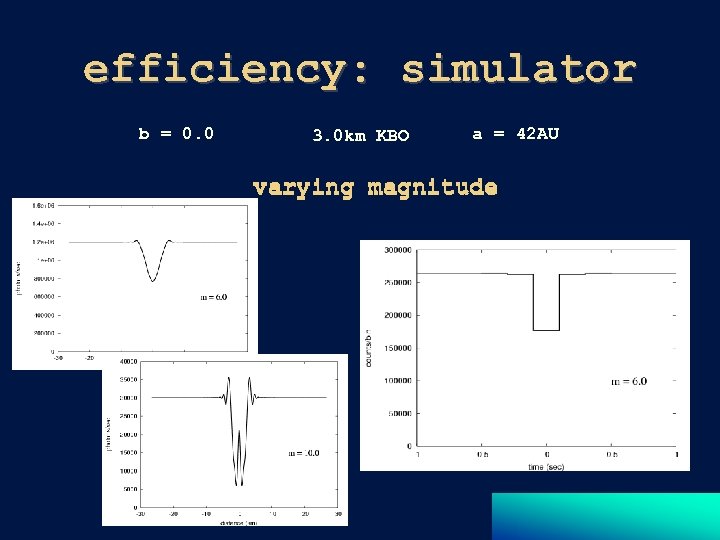 efficiency: simulator b = 0. 0 3. 0 km KBO a = 42 AU varying magnitude
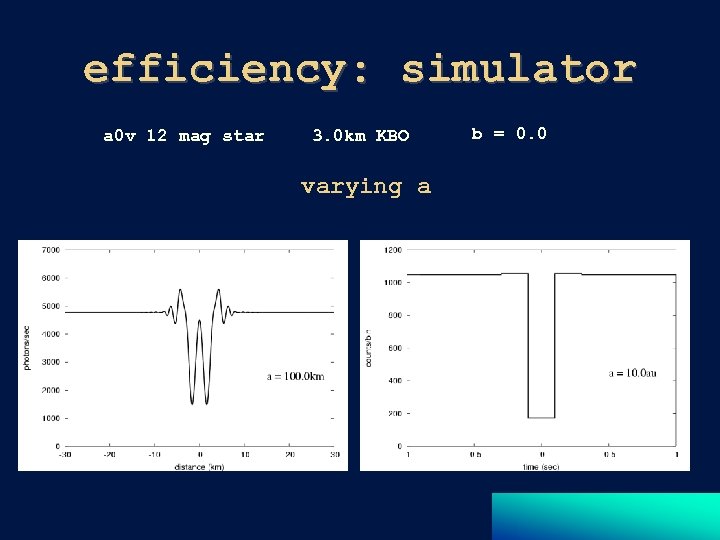 efficiency: simulator a 0 v 12 mag star 3. 0 km KBO varying a b = 0. 0
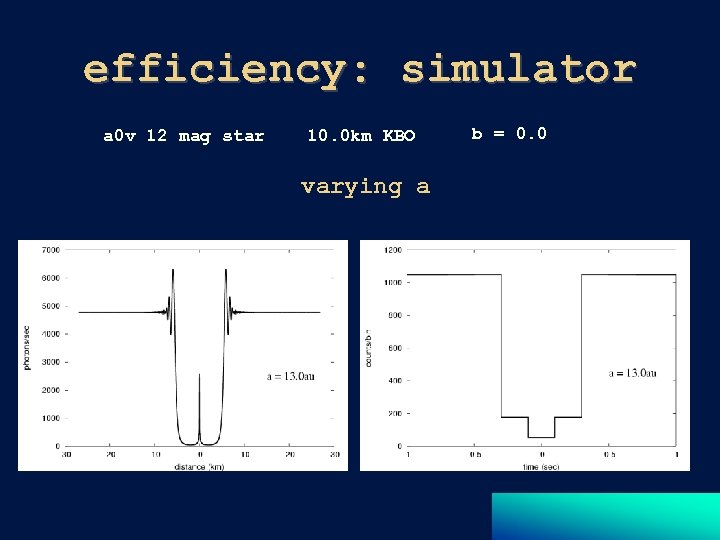 efficiency: simulator a 0 v 12 mag star 10. 0 km KBO varying a b = 0. 0
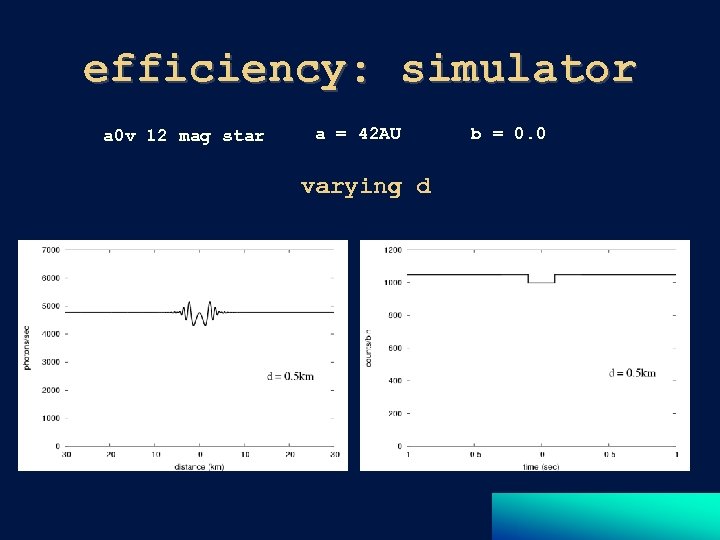 efficiency: simulator a 0 v 12 mag star a = 42 AU varying d b = 0. 0
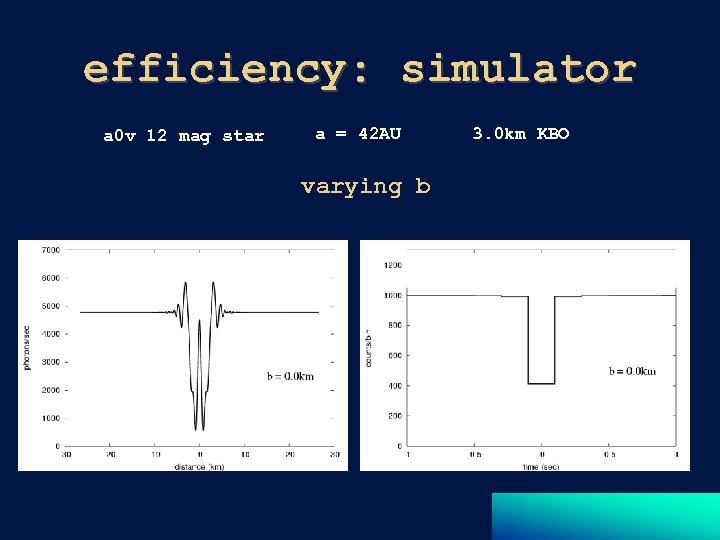 efficiency: simulator a 0 v 12 mag star a = 42 AU varying b 3. 0 km KBO
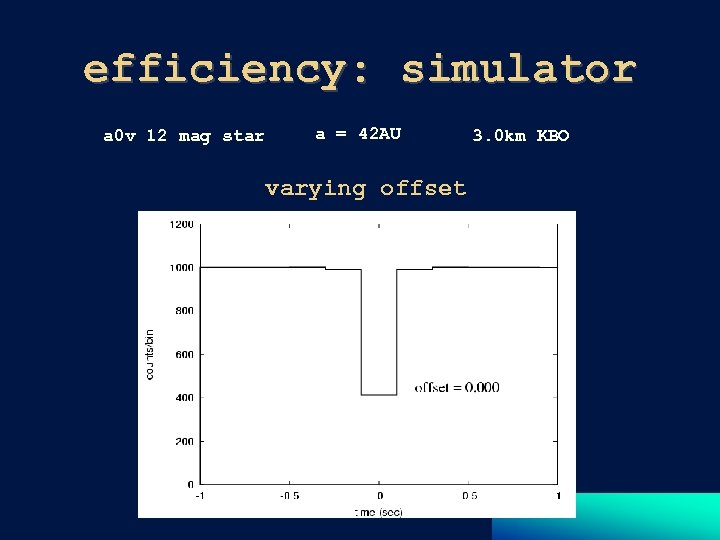 efficiency: simulator a 0 v 12 mag star a = 42 AU varying offset 3. 0 km KBO
 KBO space distribution