 Скачать презентацию Charting Your Course For Global Expansion Understanding The
1f1b54b84969f33019b6786da3b5c903.ppt
- Количество слайдов: 48




Charting Your Course For Global Expansion Understanding The Trends, Risks And Opportunities April 2014 Joe Barber Erin Herndon
Agenda • Introductions • Developing a Global Benefits Strategy • Global Benefits Background • Key Employer Challenges • Global Benefits Governance • Expanding into a New Country • Global Benefits Management – Emerging Themes MERCER 1
Today’s objectives Explain the fundamentals Share experiences Answer your questions Have fun MERCER 2
Questions? Learning environment – no one knows everything The only silly question is the one not asked What initial questions do you have? Q&A throughout and at end of each session MERCER 3

DEVELOPING A GLOBAL BENEFITS STRATEGY MERCER
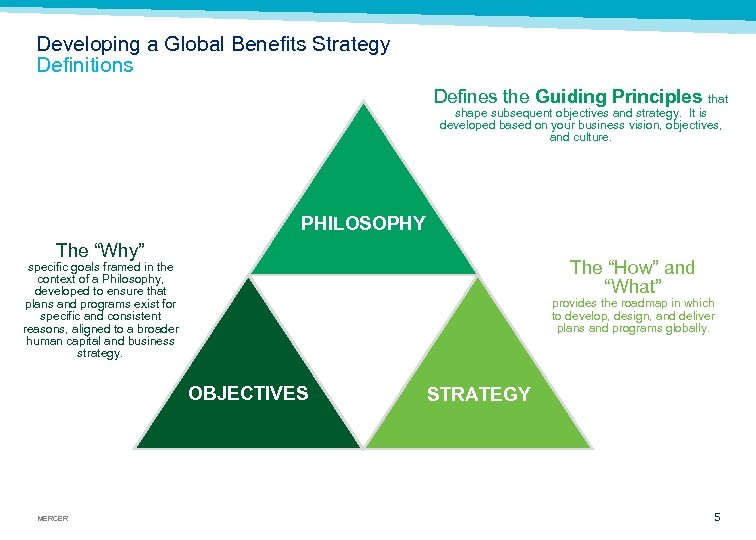
Developing a Global Benefits Strategy Definitions Defines the Guiding Principles that shape subsequent objectives and strategy. It is developed based on your business vision, objectives, and culture. PHILOSOPHY The “Why” The “How” and “What” specific goals framed in the context of a Philosophy, developed to ensure that plans and programs exist for specific and consistent reasons, aligned to a broader human capital and business strategy. provides the roadmap in which to develop, design, and deliver plans and programs globally. OBJECTIVES MERCER STRATEGY 5
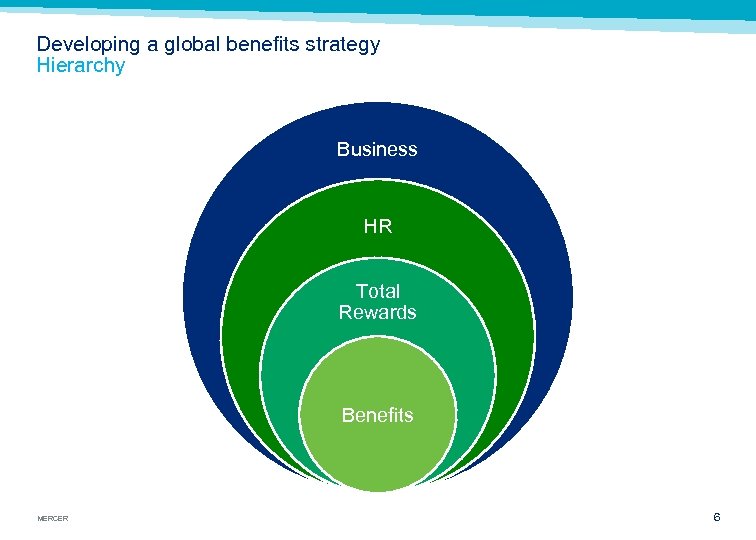
Developing a global benefits strategy Hierarchy Business HR Total Rewards Benefits MERCER 6

GLOBAL BENEFITS BACKGROUND LEVELS OF BENEFIT PROVISION MERCER
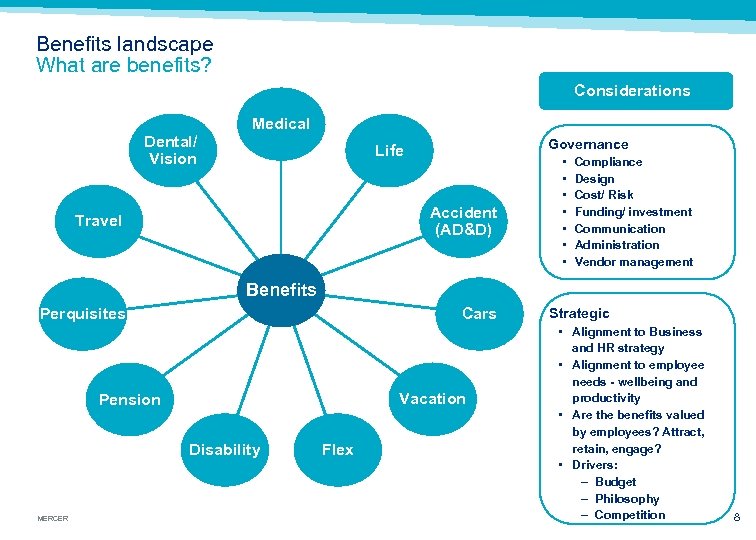
Benefits landscape What are benefits? Considerations Medical Dental/ Vision Governance Life Accident (AD&D) Travel • • Compliance Design Cost/ Risk Funding/ investment Communication Administration Vendor management Benefits Cars Perquisites Vacation Pension Disability MERCER Flex Strategic • Alignment to Business and HR strategy • Alignment to employee needs - wellbeing and productivity • Are the benefits valued by employees? Attract, retain, engage? • Drivers: – Budget – Philosophy – Competition 8
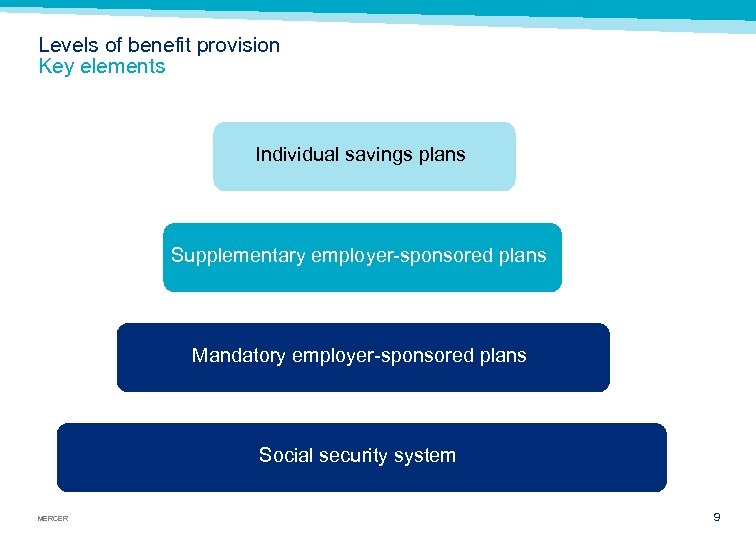
Levels of benefit provision Key elements Individual savings plans Supplementary employer sponsored plans Mandatory employer sponsored plans Social security system MERCER 9
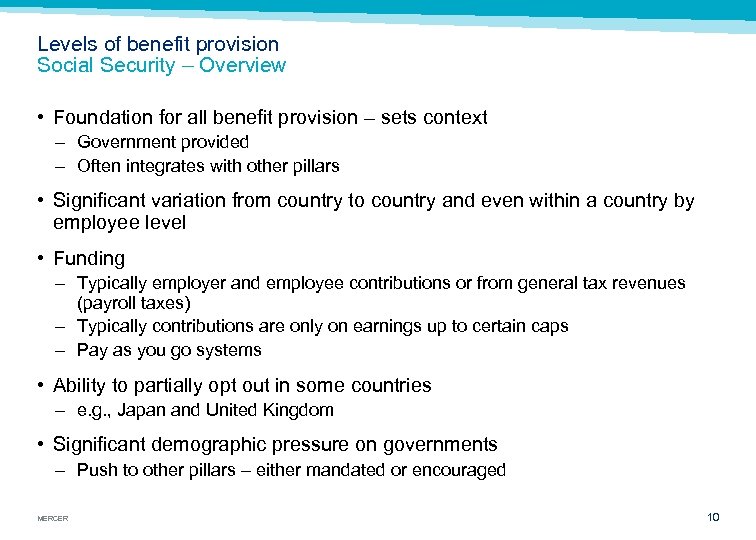
Levels of benefit provision Social Security – Overview • Foundation for all benefit provision – sets context – Government provided – Often integrates with other pillars • Significant variation from country to country and even within a country by employee level • Funding – Typically employer and employee contributions or from general tax revenues (payroll taxes) – Typically contributions are only on earnings up to certain caps – Pay as you go systems • Ability to partially opt out in some countries – e. g. , Japan and United Kingdom • Significant demographic pressure on governments – Push to other pillars – either mandated or encouraged MERCER 10
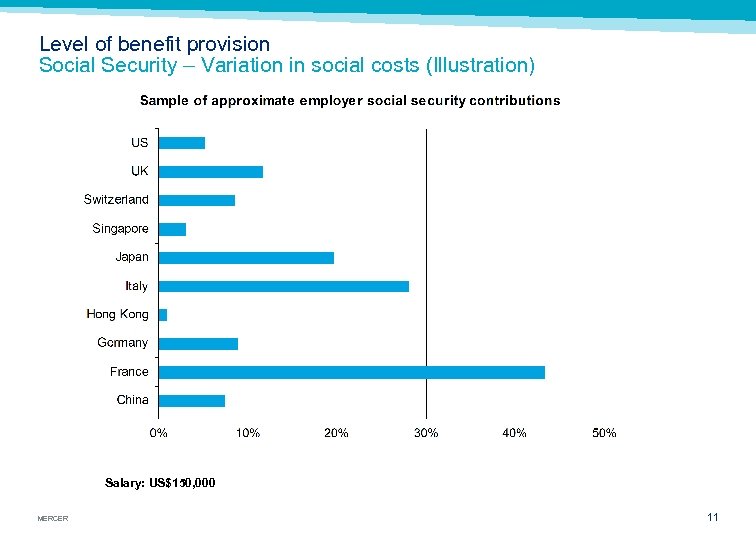
Level of benefit provision Social Security – Variation in social costs (Illustration) Salary: US$150, 000 MERCER 11
Levels of benefit provision Mandated benefits – Overview • Companies are required to provide certain benefits to their employees and have no choice with certain limited exceptions e. g. , very small headcount • Mandated benefits may be defined: – Nationally – Collective bargaining agreements that vary by industry – By employee class (e. g. , France: Cadre & Non Cadre; Italy: Dirigenti & Non Dirigenti) • There may or may not be a choice to select a provider • Companies may be able to opt out of a mandatory system provided they provide at a minimum the same level (e. g. , Norway retirement) • Companies may use the mandated benefit as the basis to provide supplemental benefits (e. g. , MPF in Hong Kong) MERCER 12
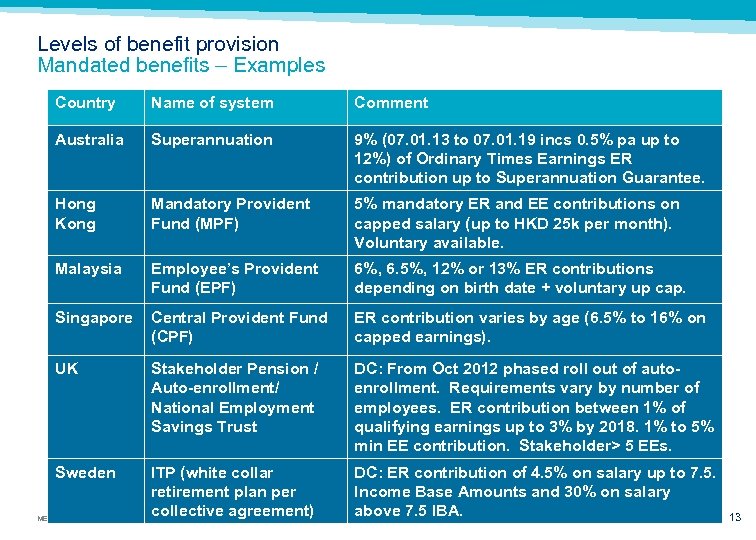
Levels of benefit provision Mandated benefits – Examples Country Name of system Comment Australia Superannuation 9% (07. 01. 13 to 07. 01. 19 incs 0. 5% pa up to 12%) of Ordinary Times Earnings ER contribution up to Superannuation Guarantee. Hong Kong Mandatory Provident Fund (MPF) 5% mandatory ER and EE contributions on capped salary (up to HKD 25 k per month). Voluntary available. Malaysia Employee’s Provident Fund (EPF) 6%, 6. 5%, 12% or 13% ER contributions depending on birth date + voluntary up cap. Singapore Central Provident Fund (CPF) ER contribution varies by age (6. 5% to 16% on capped earnings). UK Stakeholder Pension / Auto-enrollment/ National Employment Savings Trust DC: From Oct 2012 phased roll out of autoenrollment. Requirements vary by number of employees. ER contribution between 1% of qualifying earnings up to 3% by 2018. 1% to 5% min EE contribution. Stakeholder> 5 EEs. Sweden ITP (white collar retirement plan per collective agreement) DC: ER contribution of 4. 5% on salary up to 7. 5. Income Base Amounts and 30% on salary above 7. 5 IBA. MERCER 13
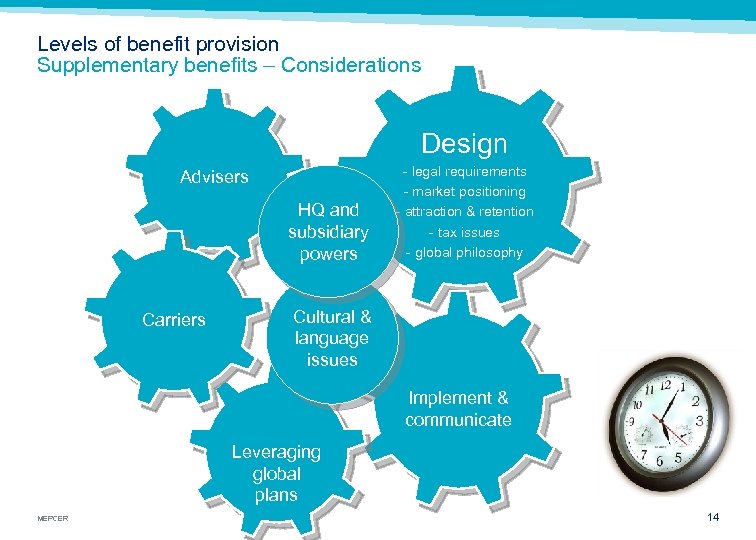
Levels of benefit provision Supplementary benefits – Considerations Design Advisers HQ and subsidiary powers Carriers legal requirements market positioning attraction & retention tax issues global philosophy Cultural & language issues Implement & communicate Leveraging global plans MERCER Mercer 14
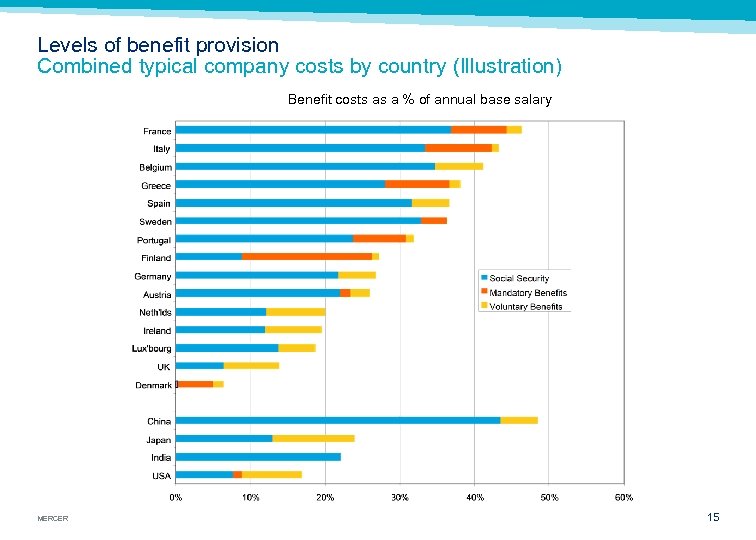
Levels of benefit provision Combined typical company costs by country (Illustration) Benefit costs as a % of annual base salary MERCER 15

KEY EMPLOYER CHALLENGES MERCER
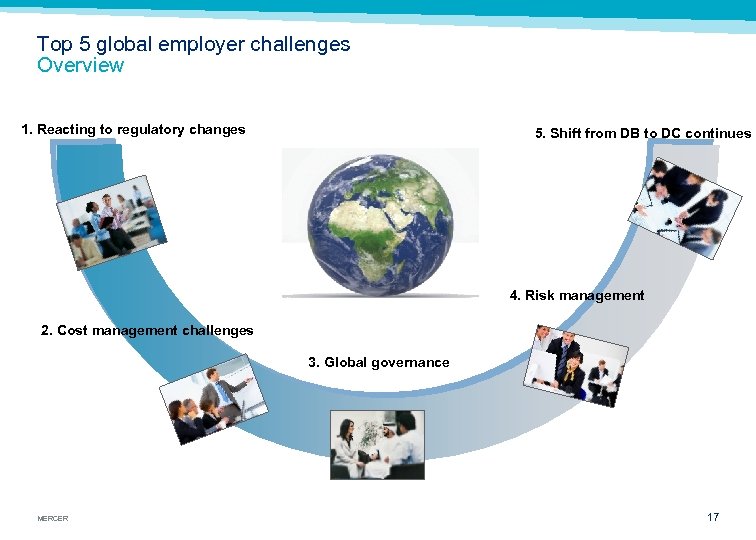
Top 5 global employer challenges Overview 1. Reacting to regulatory changes 5. Shift from DB to DC continues 4. Risk management 2. Cost management challenges 3. Global governance MERCER 17
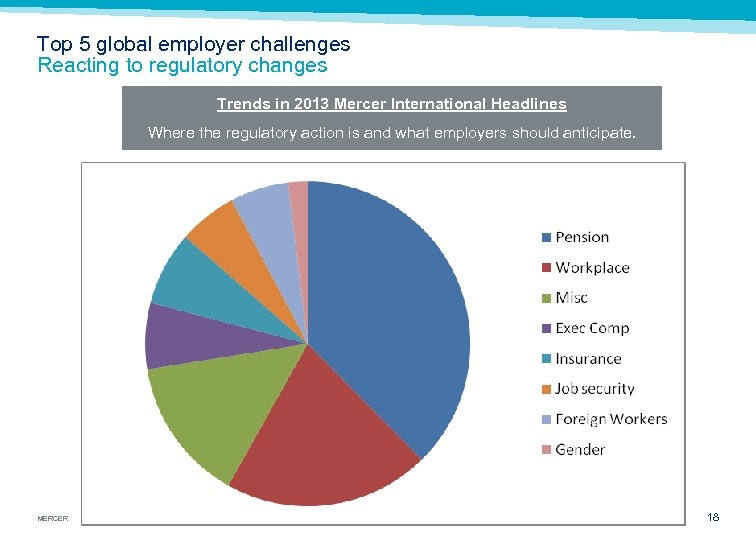
Top 5 global employer challenges Reacting to regulatory changes Trends in 2013 Mercer International Headlines Where the regulatory action is and what employers should anticipate. MERCER 18
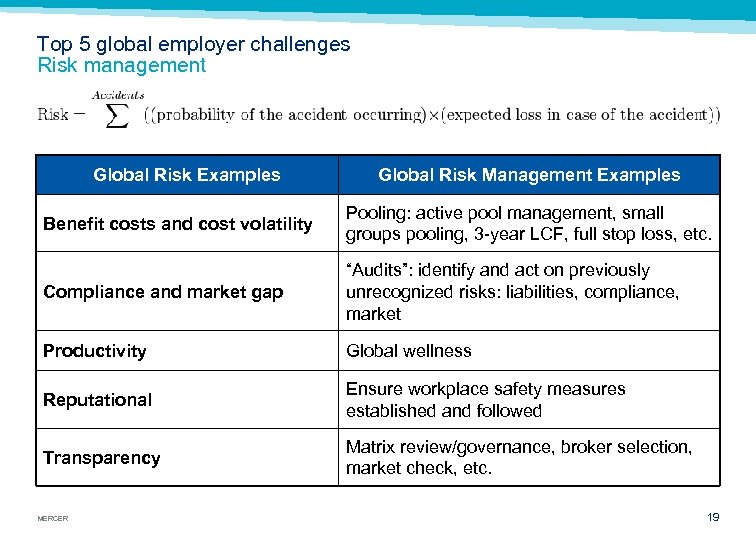
Top 5 global employer challenges Risk management Global Risk Examples Global Risk Management Examples Benefit costs and cost volatility Pooling: active pool management, small groups pooling, 3 year LCF, full stop loss, etc. Compliance and market gap “Audits”: identify and act on previously unrecognized risks: liabilities, compliance, market Productivity Global wellness Reputational Ensure workplace safety measures established and followed Transparency Matrix review/governance, broker selection, market check, etc. MERCER 19

EMPLOYEE PERSPECTIVE MERCER
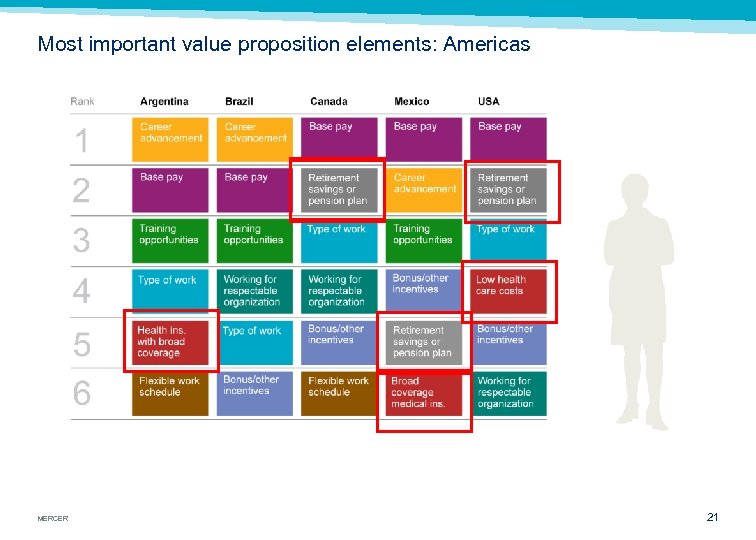
Most important value proposition elements: Americas MERCER 21
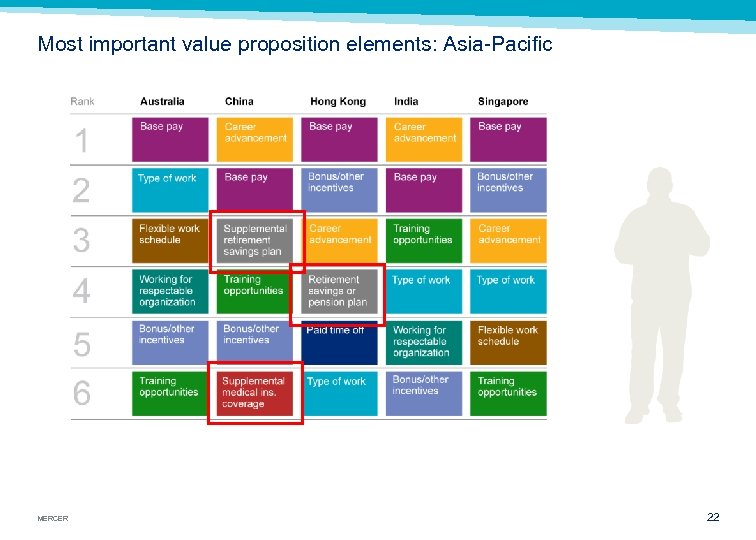
Most important value proposition elements: Asia Pacific MERCER 22
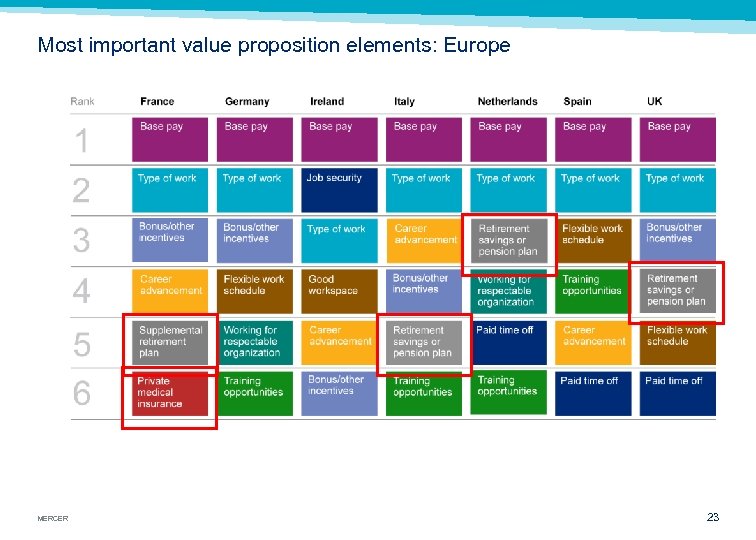
Most important value proposition elements: Europe MERCER 23
GLOBAL BENEFITS GOVERNANCE DEFINITION, CONTEXT, COMPONENTS MERCER
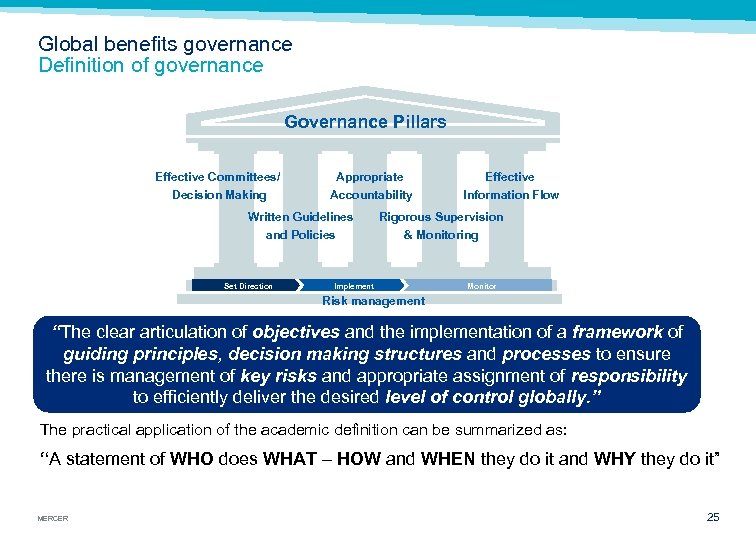
Global benefits governance Definition of governance Governance Pillars Effective Committees/ Decision Making body Appropriate Accountability Written Guidelines and Policies Set Direction Effective flow Information Flow Rigorous Supervision & Monitoring Implement Monitor Risk management “The clear articulation of objectives and the implementation of a framework of guiding principles, decision making structures and processes to ensure there is management of key risks and appropriate assignment of responsibility to efficiently deliver the desired level of control globally. ” The practical application of the academic definition can be summarized as: “A statement of WHO does WHAT – HOW and WHEN they do it and WHY they do it” MERCER 25
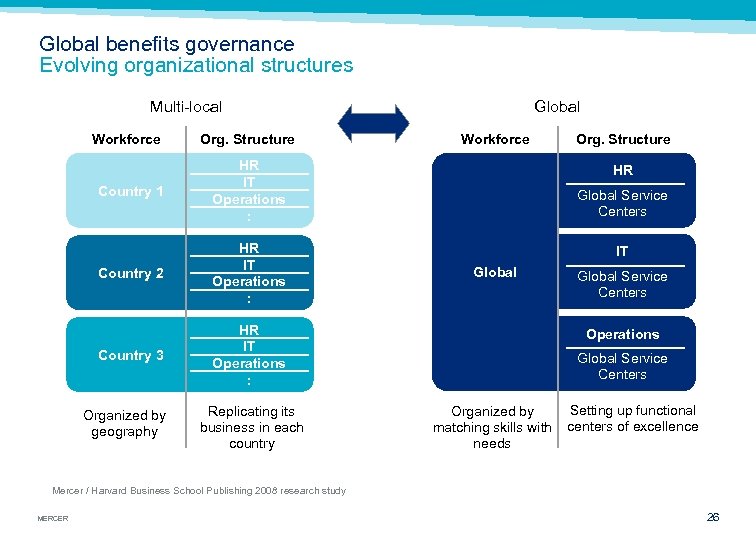
Global benefits governance Evolving organizational structures Multi local Workforce Org. Structure Country 1 Country 2 Country 3 Workforce HR IT Operations : Global HR IT Operations : Organized by geography Replicating its business in each country Org. Structure HR Global Service Centers IT Global Service Centers Operations Global Service Centers Organized by matching skills with needs Setting up functional centers of excellence Mercer / Harvard Business School Publishing 2008 research study MERCER 26
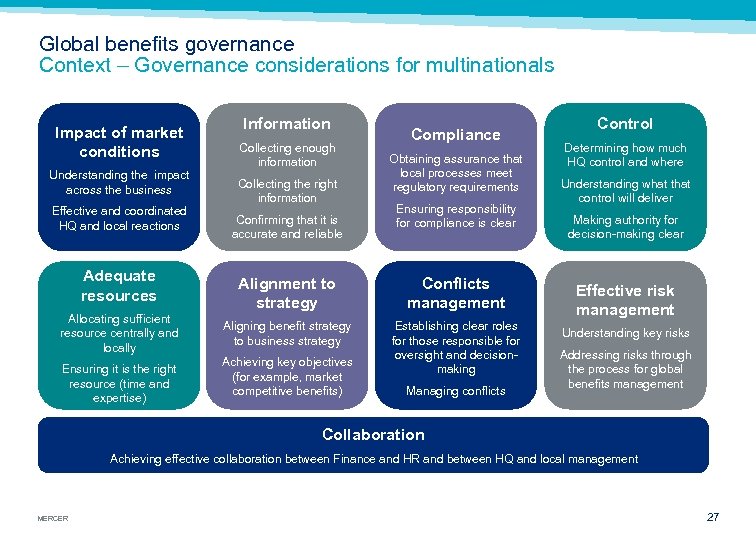
Global benefits governance Context – Governance considerations for multinationals Impact of market conditions Understanding the impact across the business Effective and coordinated HQ and local reactions Adequate resources Allocating sufficient resource centrally and locally Ensuring it is the right resource (time and expertise) Information Collecting enough information Collecting the right information Confirming that it is accurate and reliable Compliance Obtaining assurance that local processes meet regulatory requirements Ensuring responsibility for compliance is clear Alignment to strategy Conflicts management Aligning benefit strategy to business strategy Establishing clear roles for those responsible for oversight and decision making Achieving key objectives (for example, market competitive benefits) Managing conflicts Control Determining how much HQ control and where Understanding what that control will deliver Making authority for decision making clear Effective risk management Understanding key risks Addressing risks through the process for global benefits management Collaboration Achieving effective collaboration between Finance and HR and between HQ and local management MERCER 27
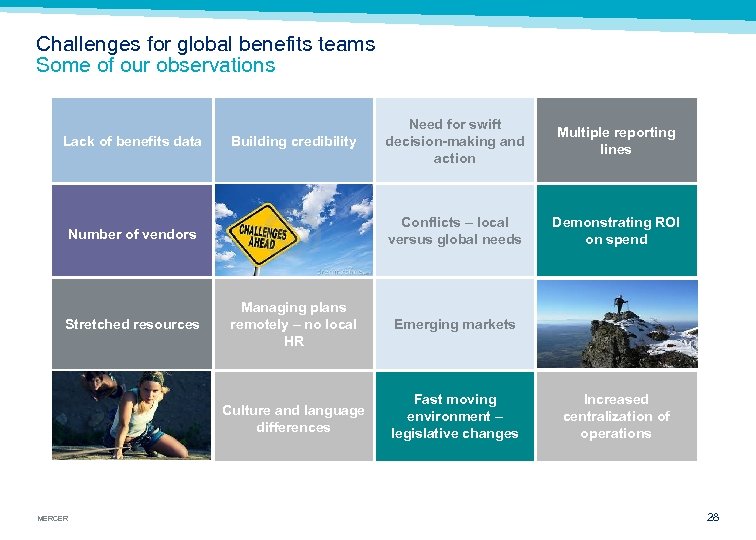
Challenges for global benefits teams Some of our observations Lack of benefits data Number of vendors Multiple reporting lines Conflicts – local versus global needs Building credibility Need for swift decision-making and action Demonstrating ROI on spend MERCER Emerging markets Culture and language differences Stretched resources Managing plans remotely – no local HR Fast moving environment – legislative changes Increased centralization of operations 28
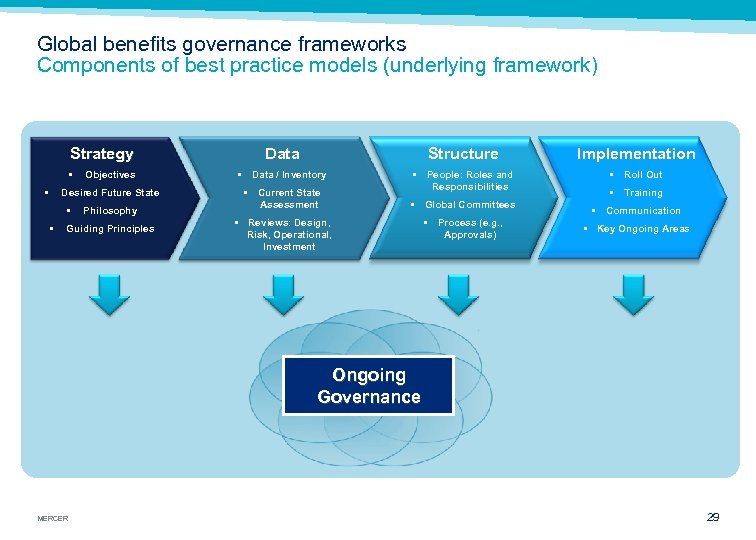
Global benefits governance frameworks Components of best practice models (underlying framework) Data Structure Implementation Objectives • Data / Inventory • Roll Out Desired Future State • Current State Assessment • People: Roles and Responsibilities Strategy • • Philosophy Guiding Principles • Global Committees • Reviews: Design, Risk, Operational, Investment • Process (e. g. , Approvals) • Training • Communication • Key Ongoing Areas Ongoing Governance MERCER 29
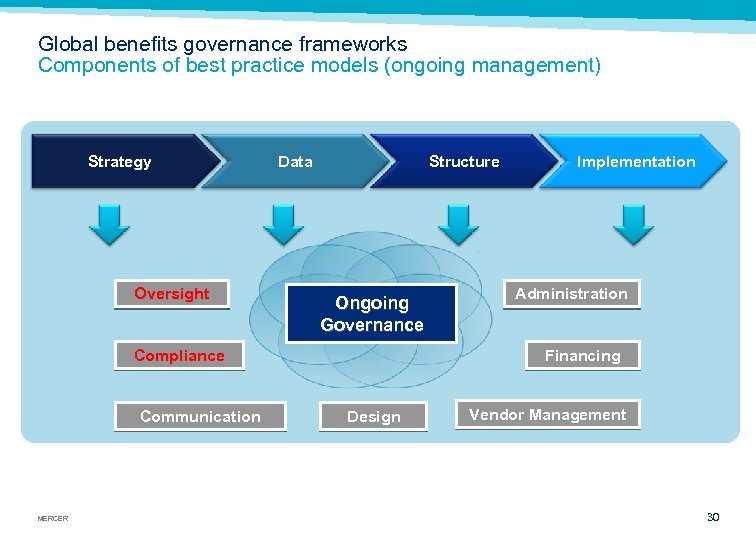
Global benefits governance frameworks Components of best practice models (ongoing management) Strategy Oversight Data Structure Ongoing Governance Compliance Communication MERCER Implementation Administration Financing Design Vendor Management 30
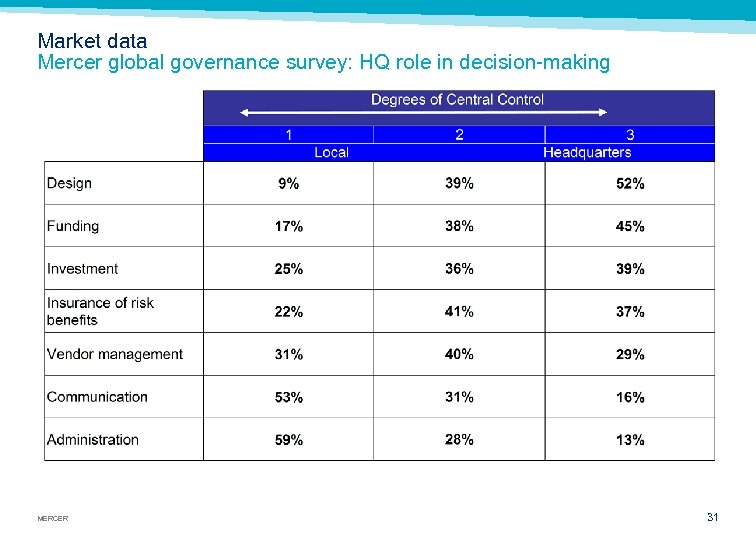
Market data Mercer global governance survey: HQ role in decision making MERCER 31
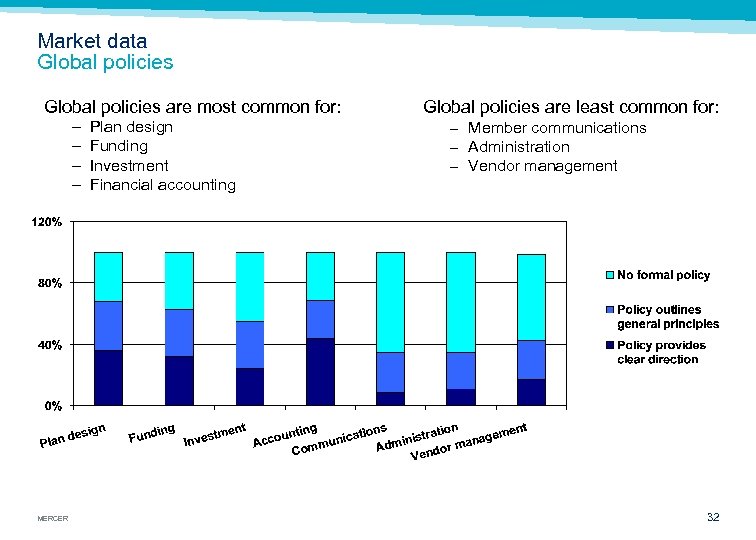
Market data Global policies are most common for: – – MERCER Plan design Funding Investment Financial accounting Global policies are least common for: – Member communications – Administration – Vendor management 32
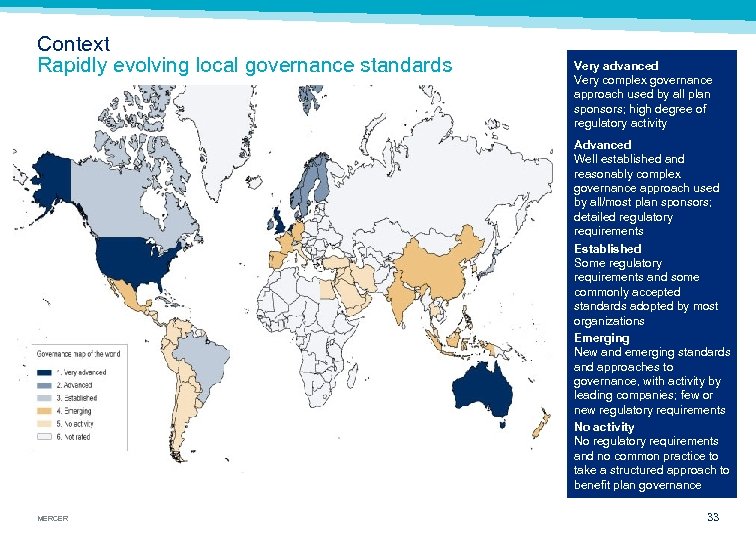
Context Rapidly evolving local governance standards Very advanced Very complex governance approach used by all plan sponsors; high degree of regulatory activity Advanced Well established and reasonably complex governance approach used by all/most plan sponsors; detailed regulatory requirements Established Some regulatory requirements and some commonly accepted standards adopted by most organizations Emerging New and emerging standards and approaches to governance, with activity by leading companies; few or new regulatory requirements No activity No regulatory requirements and no common practice to take a structured approach to benefit plan governance MERCER 33
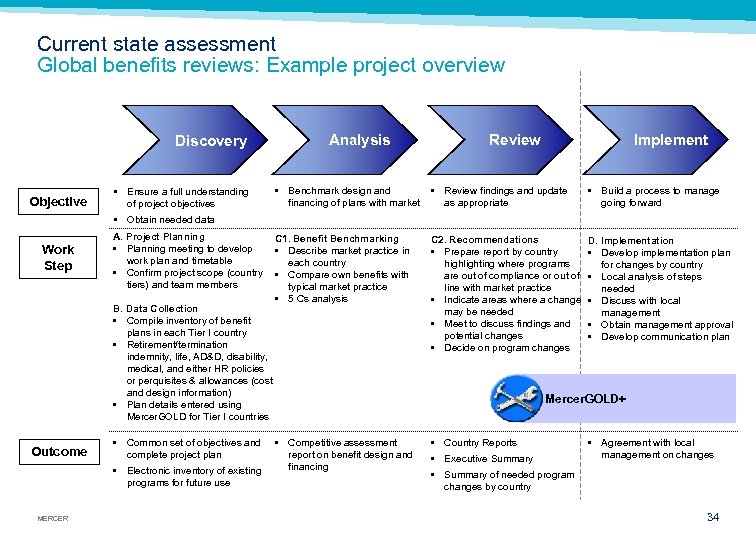
Current state assessment Global benefits reviews: Example project overview Discovery Objective • Ensure a full understanding of project objectives Analysis Review Implement • Benchmark design and financing of plans with market • Review findings and update as appropriate • Build a process to manage going forward C 1. Benefit Benchmarking • Describe market practice in each country • Compare own benefits with typical market practice • 5 Cs analysis C 2. Recommendations • Prepare report by country highlighting where programs are out of compliance or out of line with market practice • Indicate areas where a change may be needed • Meet to discuss findings and potential changes • Decide on program changes D. Implementation • Develop implementation plan for changes by country • Local analysis of steps needed • Discuss with local management • Obtain management approval • Develop communication plan • Obtain needed data Work Step A. Project Planning • Planning meeting to develop work plan and timetable • Confirm project scope (country tiers) and team members B. Data Collection • Compile inventory of benefit plans in each Tier I country • Retirement/termination indemnity, life, AD&D, disability, medical, and either HR policies or perquisites & allowances (cost and design information) • Plan details entered using Mercer. GOLD for Tier I countries Outcome • Common set of objectives and complete project plan • Electronic inventory of existing programs for future use MERCER Mercer. GOLD+ • Competitive assessment report on benefit design and financing • Country Reports • Executive Summary • Agreement with local management on changes • Summary of needed program changes by country 34
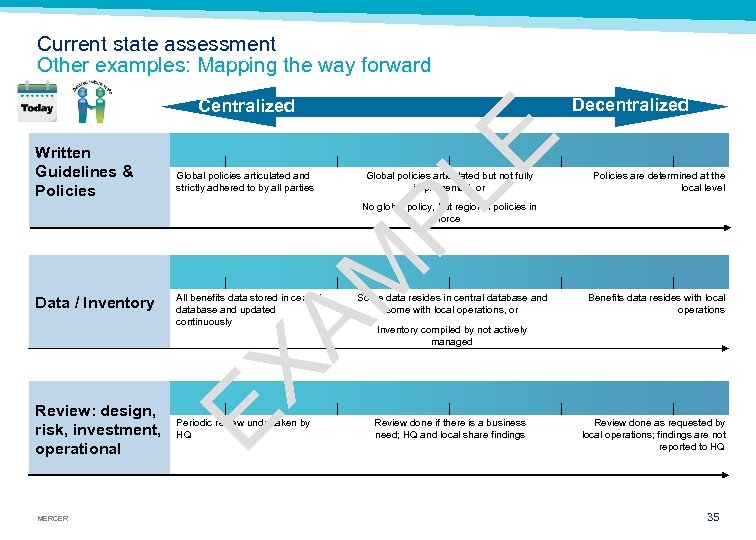
Current state assessment Other examples: Mapping the way forward Decentralized Written Guidelines & Policies Global policies articulated and strictly adhered to by all parties PL E Centralized Global policies articulated but not fully implemented, or Policies are determined at the local level AM No global policy, but regional policies in force All benefits data stored in central database and updated continuously EX Data / Inventory Review: design, risk, investment, operational MERCER Periodic review undertaken by HQ Some data resides in central database and some with local operations, or Benefits data resides with local operations Inventory compiled by not actively managed Review done if there is a business need; HQ and local share findings Review done as requested by local operations; findings are not reported to HQ 35

EXPANDING INTO A NEW COUNTRY MERCER
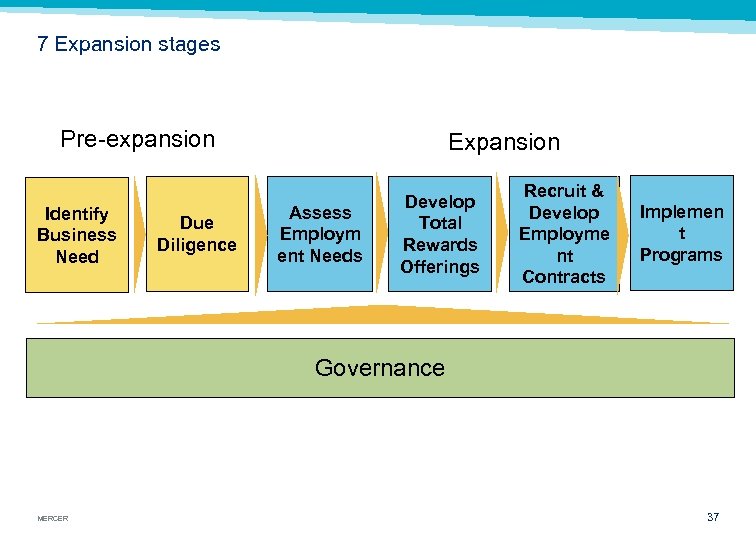
7 Expansion stages Pre expansion Identify Business Need Due Diligence Expansion Assess Employm ent Needs Develop Total Rewards Offerings Recruit & Develop Employme nt Contracts Implemen t Programs Governance MERCER 37
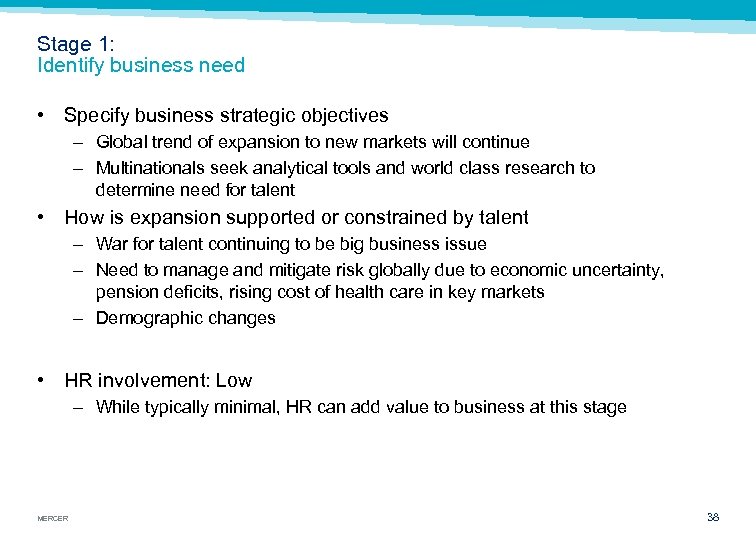
Stage 1: Identify business need • Specify business strategic objectives – Global trend of expansion to new markets will continue – Multinationals seek analytical tools and world class research to determine need for talent • How is expansion supported or constrained by talent – War for talent continuing to be big business issue – Need to manage and mitigate risk globally due to economic uncertainty, pension deficits, rising cost of health care in key markets – Demographic changes • HR involvement: Low – While typically minimal, HR can add value to business at this stage MERCER 38
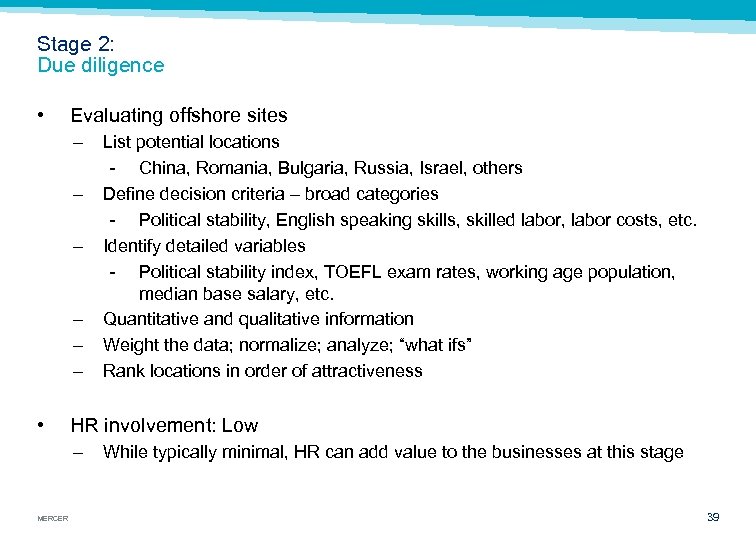
Stage 2: Due diligence • Evaluating offshore sites – – – • HR involvement: Low – MERCER List potential locations China, Romania, Bulgaria, Russia, Israel, others Define decision criteria – broad categories Political stability, English speaking skills, skilled labor, labor costs, etc. Identify detailed variables Political stability index, TOEFL exam rates, working age population, median base salary, etc. Quantitative and qualitative information Weight the data; normalize; analyze; “what ifs” Rank locations in order of attractiveness While typically minimal, HR can add value to the businesses at this stage 39
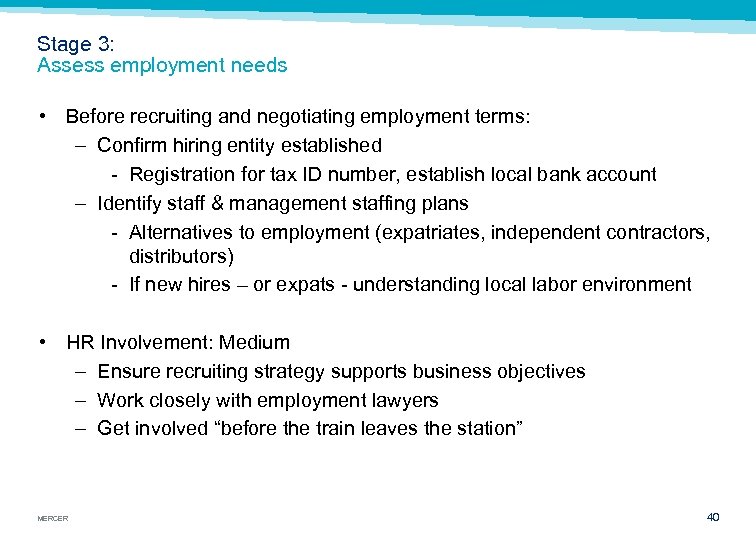
Stage 3: Assess employment needs • Before recruiting and negotiating employment terms: – Confirm hiring entity established Registration for tax ID number, establish local bank account – Identify staff & management staffing plans Alternatives to employment (expatriates, independent contractors, distributors) If new hires – or expats understanding local labor environment • HR Involvement: Medium – Ensure recruiting strategy supports business objectives – Work closely with employment lawyers – Get involved “before the train leaves the station” MERCER 40
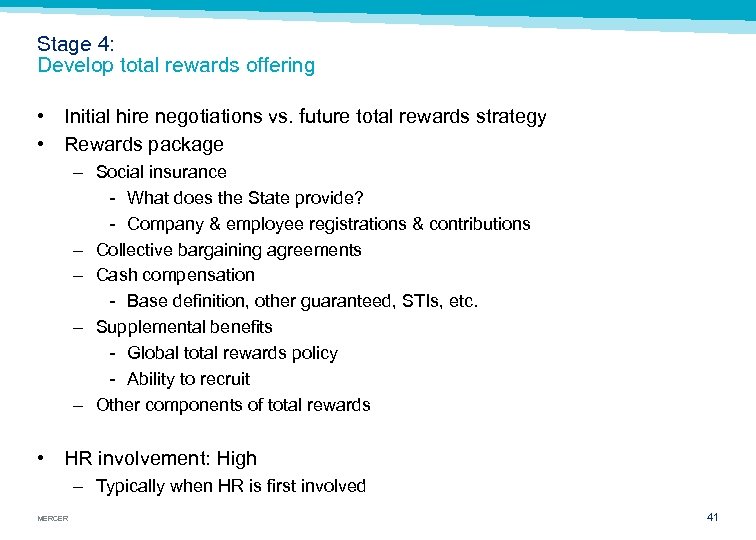
Stage 4: Develop total rewards offering • Initial hire negotiations vs. future total rewards strategy • Rewards package – Social insurance What does the State provide? Company & employee registrations & contributions – Collective bargaining agreements – Cash compensation Base definition, other guaranteed, STIs, etc. – Supplemental benefits Global total rewards policy Ability to recruit – Other components of total rewards • HR involvement: High – Typically when HR is first involved MERCER 41
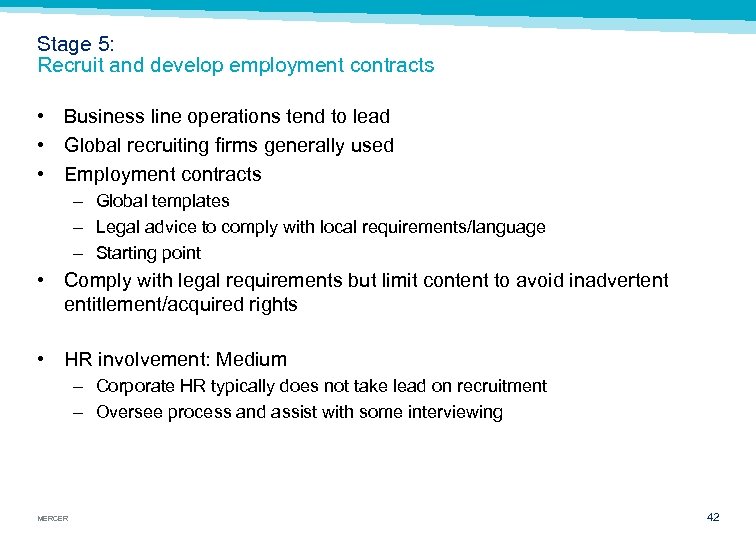
Stage 5: Recruit and develop employment contracts • Business line operations tend to lead • Global recruiting firms generally used • Employment contracts – Global templates – Legal advice to comply with local requirements/language – Starting point • Comply with legal requirements but limit content to avoid inadvertent entitlement/acquired rights • HR involvement: Medium – Corporate HR typically does not take lead on recruitment – Oversee process and assist with some interviewing MERCER 42
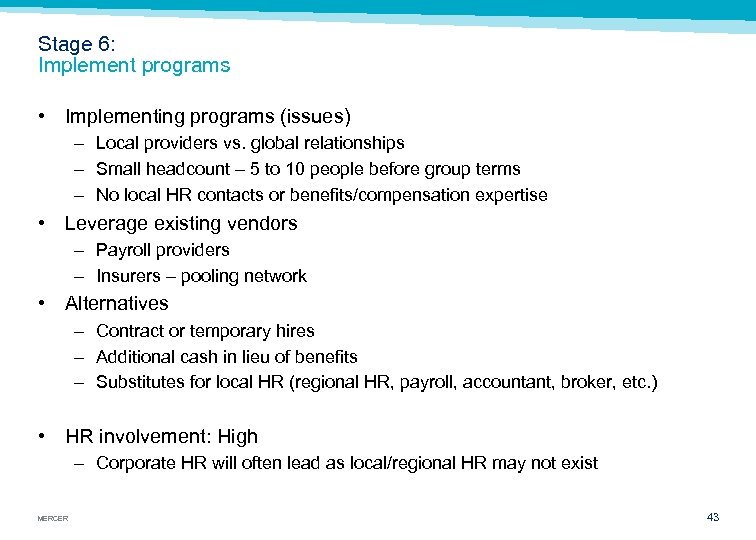
Stage 6: Implement programs • Implementing programs (issues) – Local providers vs. global relationships – Small headcount – 5 to 10 people before group terms – No local HR contacts or benefits/compensation expertise • Leverage existing vendors – Payroll providers – Insurers – pooling network • Alternatives – Contract or temporary hires – Additional cash in lieu of benefits – Substitutes for local HR (regional HR, payroll, accountant, broker, etc. ) • HR involvement: High – Corporate HR will often lead as local/regional HR may not exist MERCER 43
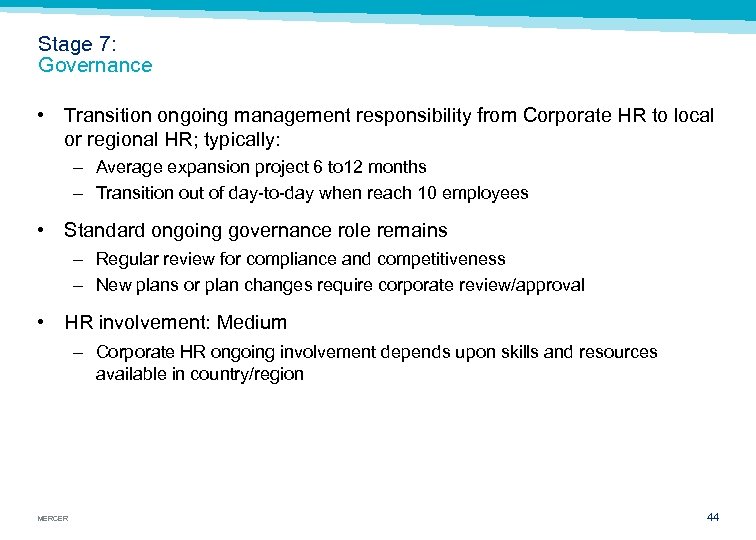
Stage 7: Governance • Transition ongoing management responsibility from Corporate HR to local or regional HR; typically: – Average expansion project 6 to 12 months – Transition out of day to day when reach 10 employees • Standard ongoing governance role remains – Regular review for compliance and competitiveness – New plans or plan changes require corporate review/approval • HR involvement: Medium – Corporate HR ongoing involvement depends upon skills and resources available in country/region MERCER 44

GLOBAL BENEFITS MANAGEMENT EMERGING THEMES MERCER
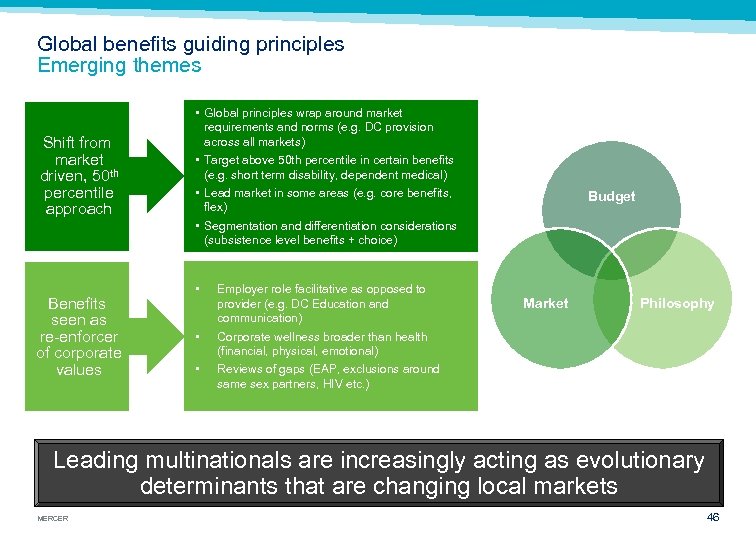
Global benefits guiding principles Emerging themes Shift from market driven, 50 th percentile approach Benefits seen as re enforcer of corporate values • Global principles wrap around market requirements and norms (e. g. DC provision across all markets) • Target above 50 th percentile in certain benefits (e. g. short term disability, dependent medical) • Lead market in some areas (e. g. core benefits, flex) • Segmentation and differentiation considerations (subsistence level benefits + choice) • Employer role facilitative as opposed to provider (e. g. DC Education and communication) • Corporate wellness broader than health (financial, physical, emotional) • Budget Reviews of gaps (EAP, exclusions around same sex partners, HIV etc. ) Market Philosophy Leading multinationals are increasingly acting as evolutionary determinants that are changing local markets MERCER 46

MERCER
Скачать презентацию Charting Your Course For Global Expansion Understanding The
1f1b54b84969f33019b6786da3b5c903.ppt