 Скачать презентацию CHARTER SCHOOLS and small group discussion Brette Kaplan
38ca26a810cb69c48a8efb384a88e627.ppt
- Количество слайдов: 54



CHARTER SCHOOLS and small group discussion Brette Kaplan, Esq. bkaplan@bruman. com Julia Martin, Esq. jmartin@bruman. com Steven Spillan, Esq. sspillan@bruman. com Brustein & Manasevit, PLLC Fall Forum 2013
Brustein & Manasevit, PLLC Agenda • Introduction • Charter Schools: Background and Policy Trends • Special issues for charters • Funding allocations • CSGP Assurances • Demographics • Facilities • Operator Fraud • Group discussion 2
Brustein & Manasevit, PLLC CHARTER SCHOOLS Background and Policy Trends 3
Brustein & Manasevit, PLLC 4 What is a Charter School? • Generally: • A non-sectarian, publicly funded, independent public school of choice • Operates under a contract or charter from the State’s chartering agency • Exempt from certain State and local regulations • But not civil rights, audit, health and safety, or charter requirements • Admits students based on parent choice and/or lottery • May operate as its own LEA, or as part of another LEA • Governed by ESEA Sec. 5210(1)
Brustein & Manasevit, PLLC 5 Who are Key Parties for Charters? • Authorizer • Created/assigned by State charter school laws • Tasks: • • Approve charter applications and renewals Set requirements of charter Oversee schools and monitor compliance Close schools if needed • Types: • IHEs • Independent boards • Non-for-profit organizations • Mayors or municipalities • LEAs • SEAs
Brustein & Manasevit, PLLC 6 Who are Key Parties for Charters? • Operator • May be group of parents/teachers/community members, may be a Charter Management Organization (CMO) or Educational Management Organization (EMO) • May be for-profit or non-profit • Teachers • May be unionized or non-unionized • Depending on status, charter may contract separately with teachers • Students • Enroll based on choice or lottery system • Charter may not be selective
Brustein & Manasevit, PLLC 7 How are Charter Schools Autonomous? • May develop and set own policies regarding: • Length of school day, week, or year • Amount of instructional time for individual subjects • Use of specific curricula, materials, or instructional methods • Use of tutoring programs • Budget decisions • Staffing decisions and policies • May offer pay-for-performance, other incentives
Brustein & Manasevit, PLLC 8 How are Charters Held Accountable? • Required to meet ALL federal and State education standards, including: • Academic achievement standards • Health and safety requirements • Civil Rights requirements (ADA, Title VI, Title IX, Section 504, IDEA, etc. ) • Federal and State audit and fiscal requirements • Other requirements as outlined in chartering document
Brustein & Manasevit, PLLC 9 National Trend: Growth • First charters in Minnesota in 1992 • As of 2012 elections, operate in 42 States and DC • Latest additions: Georgia and Washington • Only eight States don’t have charters (AL, KY, MT, NE, ND, SD, VT, WY) • More than 5, 000 charter schools nationwide • In 2012 -13 school year alone, over 500 new charter schools • 80% increase in number of students since 2007 -08 • Charters serve about 2. 3 million students (3% of total) • In 100 cities, charters serve 10% of students or more
Brustein & Manasevit, PLLC 10 Policy Trend: Push to Remove Caps • Currently 25 States (including DC) limit number of charters • Some States considering increasing/lifting caps • Federal legislative proposals offer grant preference to States with no caps • Different types of caps: • Number of schools/charters • Number or share of students • Limit to annual growth in number of schools/students • Why remove caps? • Allows growth to meet demand • Allows competition in charter “market” • Why keep caps? • Incentivize closure of unsuccessful models/schools
Brustein & Manasevit, PLLC 11 Policy Trend: Push for More Authorizers • More than 1, 000 chartering authorities nationally • 850 are LEAs, authorizing 52% of charters • Why add authorizers? • Process moves more quickly, creates more charters • Removes bias (? ) • Why limit authorizers? • Simplifies process • Allows for more quality control
Brustein & Manasevit, PLLC 12 Policy Trend: Parent Trigger Laws • Generally: • Allow parents to petition to transform a failing public school • Transformation usually involves transition to charters • Rarely used • Seven States have parent trigger laws (LA, MS, CT, TX, IN, OH, CA) • Has only been successfully used in CA • LAUSD, April 2013 • Follows two blocked attempts • Why use parent triggers? • Gives parents a voice • Why restrict? • “Triggered” schools often taken over by for-profit CMOs • Have high failure rates • Can allow schools to circumvent teachers unions • Disruption for students
Brustein & Manasevit, PLLC 13 Policy Trend: Unionization • Staff at most charter schools not currently unionized • About 12% of charters have union presence • In four States (AK, HI, IA, MD), 100% of charter schools are unionized • Nine States have no unionized charters: NC, NH, NV, OK, SC, TN, UT, VA • Nineteen States require some or all charter school teachers to be bound by the district collective bargaining agreements or personnel policies • BUT push from unions to get charter teachers to join • Staff at organization running 13 charters in Chicago voted earlier this year to unionize
Brustein & Manasevit, PLLC 14 Federal Policy Trends • Republicans • Democrats • See charters as an option • Charters as part of “school in healthy school choice” system (along ecosystem with vouchers, homeschooling) • Generally supportive of • Market-based: competition charters from charters drives • But not a solution for all improvement in other students (especially rural schools students) • Money should “follow the child”
Brustein & Manasevit, PLLC 15 Federal Policy Trends • Empowering Parents through Quality Charter Schools Act (H. R. 2218, 112 th Congress) • Consolidates existing funding streams for “flexibility” • States must detail how they will ensure equity for students with disabilities • Gives priority in funding to States that: • • • Repeal charter caps Increase number of authorizers Support online and hybrid charters Provide funding for charters comparable to other public schools Use charter transformation as option in interventions • New money for charter school facilities • Passed House of Representatives in Sept. 2011 with bipartisan support • Likely model for future legislation
Brustein & Manasevit, PLLC SPECIAL ISSUES For Charter Schools 16
Brustein & Manasevit, PLLC 17 FUNDING ALLOCATIONS For Charter Schools
Brustein & Manasevit, PLLC 18 ESEA Allocations • Charter as an LEA vs. Charter as part of a larger LEA • Either way, subject to Title I funding formula • Title I funding based on poverty and enrollment data from previous years • What about new or expanding charters? • NCLB included provisions (§ 5206), clarified in recent guidance (September 23, 2013)
Brustein & Manasevit, PLLC 19 ESEA Allocations • § 5206: • Charters in their first year of operation; or • Charters undergoing significant expansion • Must receive full amount to which it is entitled within 5 months of • Opening; or • When the expansions began
Brustein & Manasevit, PLLC 20 ESEA Allocations • Determining “prior-year” base amount and hold harmless for newly opened charters: • Calculate initial allocation under each formula BEFORE application of hold harmless • This becomes “prior year” • Based on derived formula count compared to population data, determine hold harmless percentage • Multiply initial allocation for each formula by hold harmless percentage to determine hold harmless amount
Brustein & Manasevit, PLLC 21 ESEA Allocations • Determining “prior year” and hold harmless for significantly expanding charters • Compare current year formula count with prior year formula count and calculate the percentage increase • Increase prior year allocation under each formula by that percentage to determine “prior year” base amount
Brustein & Manasevit, PLLC 22 ESEA Allocations • To qualify for § 5206 allocations: • 120 -day notice • Establish eligibility • Provide data needed to reasonably estimate allocation amount • Provide actual enrollment data
Brustein & Manasevit, PLLC 23 IDEA Allocations • Charters as LEAs vs. Charters within larger LEA • Entitled to same IDEA funds as other LEAs and public schools • LEA Charters must: • Establish eligibility • Submit local plan to SEA • Develop appropriate policies and procedures • Have sufficient capacity and resources to provide FAPE
Brustein & Manasevit, PLLC 24 IDEA Allocations • Charters within an LEA must: • Fit within ESEA definition of a charter school • Be a non-profit entity • Comply with any federal enrollment data requirements • Submit to LEA: • Eligibility information • Enrollment data • Other necessary documentation
Brustein & Manasevit, PLLC ASSURANCES In the Charter School Grant Program 25
Brustein & Manasevit, PLLC 26 CSP Assurance • New assurances added to CSP application • Language in FY 2010 Consolidated Appropriations Act • Issues for FY 2010 Grant Recipients • Possible problems for future applicants
Brustein & Manasevit, PLLC 27 CSP Assurance 3 A • Each authorized charter school in the State operates under a legally binding charter or performance contract between itself and the school’s authorized public chartering agency which must: • Describe the obligations and responsibilities of the school and the public chartering agency; • Conduct annual, timely, and independent audits of the school’s financial statements that are filed with the school’s authorized public chartering agency; and • Demonstrate improved student academic achievement.
Brustein & Manasevit, PLLC 28 CSP Assurance 3 B • Authorized public chartering agencies use increases in student academic achievement for all groups of students as the most important factor when determining to renew or revoke a school’s charter
Brustein & Manasevit, PLLC 29 CSP Assurance 3 B • Increased student achievement across all subgroups: • Economically disadvantaged students; • Students from major racial and ethnic groups; • Students with disabilities; and • Students with limited English proficiency
Brustein & Manasevit, PLLC 30 CSP Assurances: Common Problems • State policymaking/approval procedures • Process vs. speed • Internal political obstacles • Charter school authorizers vs. CMOs
Brustein & Manasevit, PLLC DEMOGRAPHIC ISSUES For Charter Schools 31
Brustein & Manasevit, PLLC 32 GAO Report: Students with Disabilities • Attend charter schools at much lower rates • GAO Report: Additional Federal Attention Needed to Protect Access for Students with Disabilities (June 2012) • http: //www. gao. gov/assets/600/591435. pdf • GAO Report to Congress found that in 2009 -10, students with disabilities made up: • 11. 1% of total school-age population • 11. 2% of traditional public school population • 8. 2% of charter school population • Up from 7. 7% in 2008 -09 • Varies by State • In NH, students with disabilities made up 6% of charter school population; 13% overall • In IA, MN, NV, NM, OH, PA, VA, WY – about the same as % of total population
Brustein & Manasevit, PLLC 33 GAO Report: Students with Disabilities • Why? • GAO doesn’t know • Possible explanations: • Placement by charter/LEA • Location of schools • Parent preference/student need • School capacity/resources • Funding
Brustein & Manasevit, PLLC 34 Special Education – CRPE Report • Why the Gap? Special Education and New York City Charter Schools • September 2013 CRPE Report • Examined why the disparity in special education enrollment rates in traditional public and charter schools exist • 3 -4% enrollment gap
Brustein & Manasevit, PLLC 35 Special Education – CRPE Report • Findings • Students with disabilities (especially those with autism and speech or language impairment) are likely to apply to charter schools in kindergarten • Gap grows considerably from K-3 rd grade • Charters less likely to classify students • Students transferring between charter and district schools • Charters not refusing to admit or pushing out students with special needs • Gap occurs mostly with subjective categories of student disabilities • Emotional disability and special learning disability • Mobility among special education students regardless of attending a charter or traditional public school
Brustein & Manasevit, PLLC 36 English Language Learners • GAO: Education Needs to Further Examine Data Collection on English Language Learners in Charter Schools (July 17, 2013) • http: //www. gao. gov/products/GAO-13 -655 R • Goal: Compare ELL enrollment in charter schools and traditional public schools • Looked at ED’s data from 2010 -11 school year • GAO Report to Congress addressed: ① Quality of ED’s data on ELLs in charter schools; and ② Efforts taken by ED to improve collection of ELL data from charter school
Brustein & Manasevit, PLLC 37 English Language Learners • GAO unable to compare ELL enrollment in charter schools and traditional public schools • Unreliable & incomplete data • For over 1/3 of charter schools, field reporting ELLs enrolled in ELL programs left blank
Brustein & Manasevit, PLLC 38 English Language Learners Problems: ① No “data steward” • Office responsible for overseeing data quality ② Definitional issue • Dataset is count of ELLs enrolled in “English language instruction educational programs” • Not a simple count of all ELLs ③ Charter Schools may have not submitted data to states • States have difficulty obtaining data from charter schools • Some charters missing other data suggesting boarder problem with charter school reporting
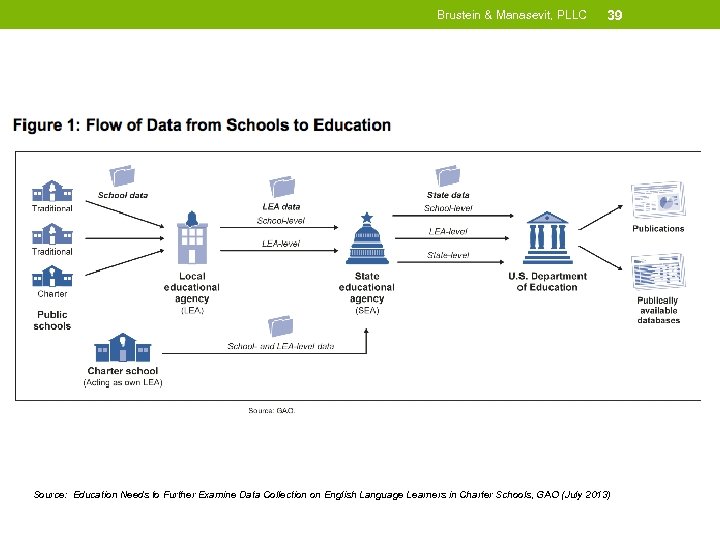
Brustein & Manasevit, PLLC 39 Source: Education Needs to Further Examine Data Collection on English Language Learners in Charter Schools, GAO (July 2013)
Brustein & Manasevit, PLLC 40 English Language Learners Planned Fixes • Beginning in school year 2013 -14, ED plans to collect new school-level data on all ELLs regardless of enrollment in a “program” • New school-level data will have a “data steward” and will receive regular data quality reviews • Guidance for Reporting Charter School Entities (July 2013) • http: //www 2. ed. gov/about/inits/ed/edfacts/eden/ess/13 -14 -charter- workbook. doc
Brustein & Manasevit, PLLC 41 English Language Learners GAO’s Recommendations ① ED conduct a systematic evaluation of other important datasets to determine the extent of charter school nonreporting ② ED explore whether collecting LEA-level and SEA-level counts for ELLs enrolled in “English language instruction educational programs” can be phased out if the data quality problems are not addressed.
Brustein & Manasevit, PLLC FACILITIES And Issues for Charter Schools 42
Brustein & Manasevit, PLLC 43 Facilities Generally • Charters sometimes struggle to find appropriate facilities • Traditional public schools built with local tax and bond revenues • Charters often lack access to some or all of those sources of funds or significant “start-up” money • Varies by State – some have dedicated grant or bond programs for charter school facilities • Increased facilities costs • Have to retrofit existing buildings • Money on rent/renovations takes funds away from instruction • On average, charters spend 10% of operating budget on facilities • Banks reluctant to lend money to schools with 3 - or 5 -year charters • If they can get loans, interest rates are high
Brustein & Manasevit, PLLC 44 Facilities Generally • Charters face several practical and compliance problems with their facilities: • No gym or library • Lack of properly outfitted computer/science labs • No kitchens to serve free or reduced-price school lunch program meals • Not accessible for students with disabilities • Money for rent/renovations takes away funds intended for instruction • Charters often occupy less desirable/purpose-built facilities equity issues
Brustein & Manasevit, PLLC 45 Sharing District Facilities • Some States have “right of first refusal” policy (like DC) • Charters can request any vacant or underused public buildings, allowed to occupy unless district has a valid reason to say no • Small charters sometimes share space with traditional public schools (“co-location”) • E. g. one floor or a set of classrooms • Allows use of otherwise empty space • BUT creates conflict/confusion between schools’ staff over: • Use of common areas • Shared utility/maintenance costs • Responsibilities for supervising students in common areas • Other areas where schools’ policies/practices differ
Brustein & Manasevit, PLLC 46 Charters and Church Space • More common in some States than others • TX: 23 new charters in past 3 years, 16 to charters with religious ties • Compliance issues: • Is church directly benefiting from taxpayer dollars? • Outside of rent agreements • Through in-kind benefits or use of charter facilities/equipment • Is the charter engaging in faith-based instruction? • Are faculty/staff shared with church? • Is the school part of the church? • May need a separate, non-profit entity to operate school • Requires explicit guidelines for use of funds, frequent monitoring
Brustein & Manasevit, PLLC 47 Facilities Fraud • Usually involve “circular lease agreements” • San Antonio, TX • Charter superintendent used school facilities grant to buy a building (former church) • Then leased building back to school • Chester, PA • Charter school founder bought school buildings • Sold them to non-profit charter “support” organization for $50. 7 million • Leased from organization to school, school received rent reimbursement from State
Brustein & Manasevit, PLLC Facilities Fraud • Oakland, CA • Charter director owned building, charged rent to charter school • Director was both “lessor” and “lessee” on lease • Earned $280, 000 annually in State-reimbursable rent for facility • Moral of the story: include facility/rent arrangement in monitoring protocols! 48
Brustein & Manasevit, PLLC OPERATOR FRAUD In Charter Schools 49
Brustein & Manasevit, PLLC 50 Recent Charter “Bad Actors” • Pennsylvania Auditor General: • August 2013: State’s largest charter school pocketed $1. 2 million “in improper lease-reimbursement payments. ” • Found similar problems at six other charter schools in March 2013 • 11 area schools were not complying with state laws and regulations
Brustein & Manasevit, PLLC 51 Recent Charter “Bad Actors” • Four charter schools in a Pennsylvania network: • Loaned $3. 3 million to CMO • Made $1. 5 million in lease payments to CMO and CMOcontrolled property-management entities • $6. 3 million in administrative fees paid to CMO in 2012 • The network’s combined real-estate holdings increased from $13. 34 million in 2011 to $23. 15 million in 2012
Brustein & Manasevit, PLLC 52 Recent Charter “Bad Actors” • Texas charter school recently accused of: • Funneling of $5. 3 million in federal funds to questionable destinations, including “hotels, cruises and travel packages” • Six-figure salaries • Real estate scheme involving a management company and the charter school • NYC Charter Network • Zero tolerance policy for children with “special needs or behavior problems” • Suspended 22% of its students at least once during the 2010 -11 school year – “far above the 3% average” of other elementary schools in the district
Brustein & Manasevit, PLLC 53 Disclaimer • This presentation is intended solely to provide general information and does not constitute legal advice. Attendance at the presentation or later review of these printed materials does not create an attorney-client relationship with Brustein & Manasevit, PLLC. You should not take any action based upon any information in this presentation without first consulting legal counsel familiar with your particular circumstances.
Brustein & Manasevit, PLLC GROUP DISCUSSION 54
Скачать презентацию CHARTER SCHOOLS and small group discussion Brette Kaplan
38ca26a810cb69c48a8efb384a88e627.ppt