


 Скачать презентацию Charmonium and charmed tetraquarks A Valcarce University of
9d03b32720e58b9598a003a547749274.ppt
- Количество слайдов: 16
 Charmonium and charmed tetraquarks A. Valcarce, University of Salamanca (Spain) J. Vijande, University of Valencia (Spain) N. Barnea, E. Weissman, The Hebrew University (Israel) Frascati, October 2007 Charmonium & charmed tetraquarks 1
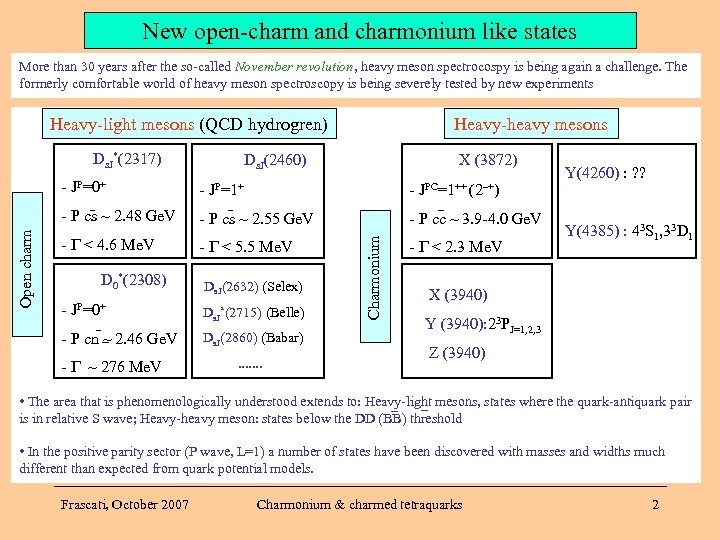 New open-charm and charmonium like states More than 30 years after the so-called November revolution, heavy meson spectrocospy is being again a challenge. The formerly comfortable world of heavy meson spectroscopy is being severely tested by new experiments Heavy-light mesons (QCD hydrogren) Heavy-heavy mesons X (3872) - JP=1+ - JPC=1++ (2–+) - P cs ~ 2. 48 Ge. V - P cs ~ 2. 55 Ge. V - P cc ~ 3. 9 -4. 0 Ge. V - < 4. 6 Me. V - < 5. 5 Me. V D 0*(2308) Ds. J(2632) (Selex) - JP=0+ Ds. J*(2715) (Belle) - P cn ~ 2. 46 Ge. V Ds. J(2860) (Babar) - ~ 276 Me. V . . . . Charmonium Ds. J(2460) - JP=0+ Open charm Ds. J*(2317) - < 2. 3 Me. V Y(4260) : ? ? Y(4385) : 43 S 1, 33 D 1 X (3940) Y (3940): 23 PJ=1, 2, 3 Z (3940) • The area that is phenomenologically understood extends to: Heavy-light mesons, states where the quark-antiquark pair – – is in relative S wave; Heavy-heavy meson: states below the DD (BB) threshold • In the positive parity sector (P wave, L=1) a number of states have been discovered with masses and widths much different than expected from quark potential models. Frascati, October 2007 Charmonium & charmed tetraquarks 2
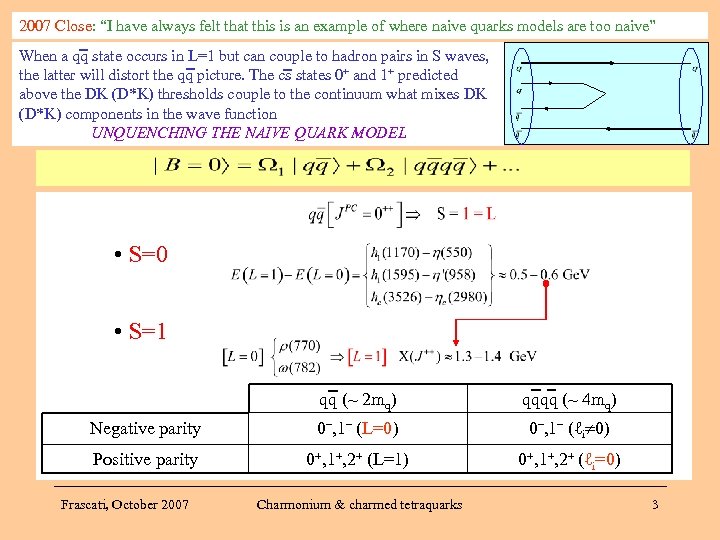 2007 Close: “I have always felt that this is an example of where naive quarks models are too naive” When a qq state occurs in L=1 but can couple to hadron pairs in S waves, the latter will distort the qq picture. The cs states 0+ and 1+ predicted above the DK (D*K) thresholds couple to the continuum what mixes DK (D*K) components in the wave function UNQUENCHING THE NAIVE QUARK MODEL • S=0 • S=1 qq (~ 2 mq) qqqq (~ 4 mq) Negative parity 0–, 1– (L=0) 0–, 1– (ℓi 0) Positive parity 0+, 1+, 2+ (L=1) 0+, 1+, 2+ (ℓi=0) Frascati, October 2007 Charmonium & charmed tetraquarks 3
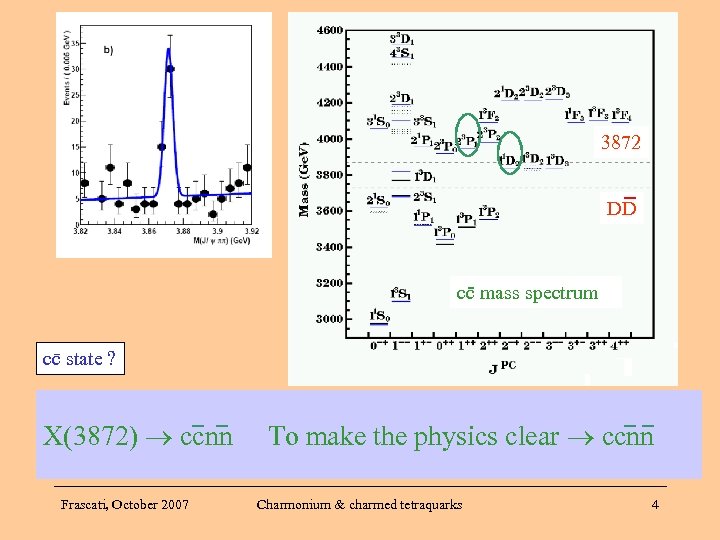 Belle, Phys. Rev. Lett. 91, 262001 (2003) B+ K+ X(3872) K+ + -J/ CDF, D 0, . . pp PDG, M = 3871. 2 ± 0. 5 Me. V; < 2. 3 Me. V 3872 m. D + m. D* = (3870. 3 ± 2. 0)Me. V M = (+0. 9 ± 2. 0)Me. V Production properties very similar to ’(23 S 1) Seen in J/ C = + Belle rules out 0++ and 0–+, favors 1++ DD ++ or 2–+ CDF only allows for 1 cc mass spectrum cc state ? 2–+: is a spin-singlet D wave while J/ is a spin-triplet S wave, so in the NR limit the E 1 transition 2–+ J/ is forbidden. D and S radial wave functions are orthogonal what prohibits also M 1 X(3872) ccnn To make the physics clear ccnn 1++: Expected larger mass and width ( r. J/ violates isospin). Frascati, October 2007 Charmonium & charmed tetraquarks 4
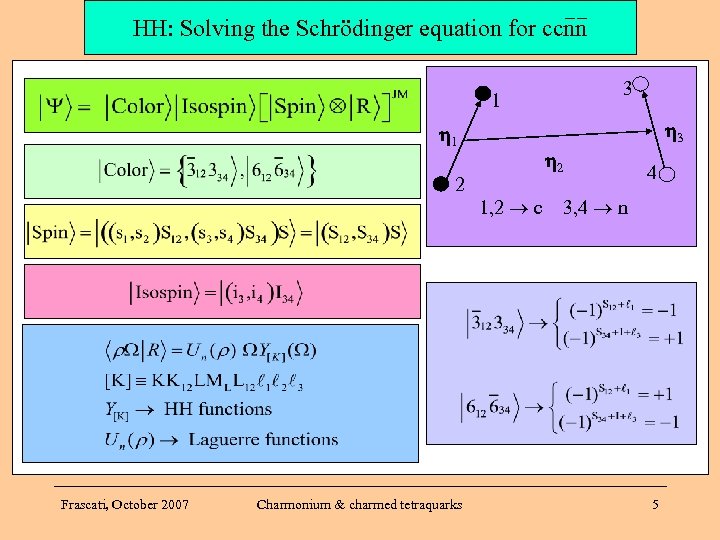 –– HH: Solving the Schrödinger equation for ccnn 3 1 3 1 2 2 1, 2 c Frascati, October 2007 Charmonium & charmed tetraquarks 4 3, 4 n 5
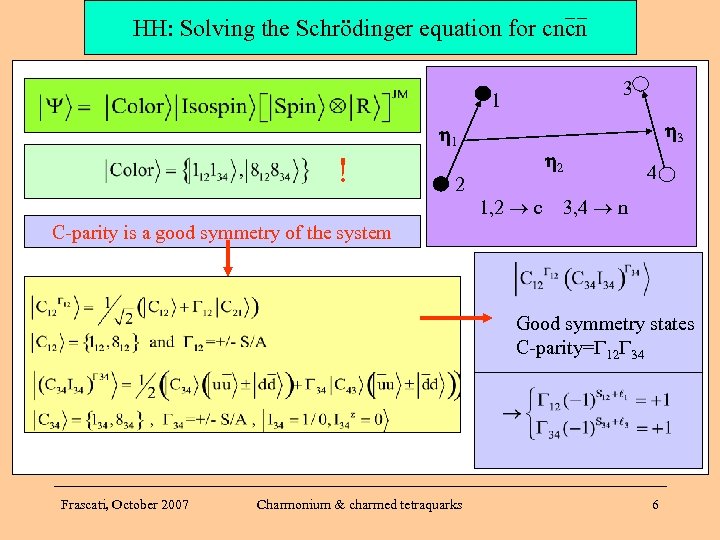 –– HH: Solving the Schrödinger equation for cncn 3 1 3 1 ! 2 2 1, 2 c 4 3, 4 n C-parity is a good symmetry of the system Good symmetry states C-parity= 12 34 Frascati, October 2007 Charmonium & charmed tetraquarks 6
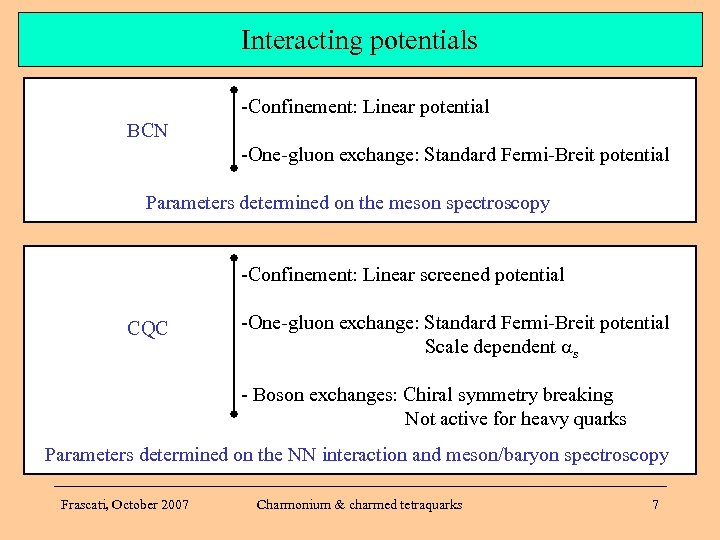 Interacting potentials -Confinement: Linear potential BCN -One-gluon exchange: Standard Fermi-Breit potential Parameters determined on the meson spectroscopy -Confinement: Linear screened potential CQC -One-gluon exchange: Standard Fermi-Breit potential Scale dependent as - Boson exchanges: Chiral symmetry breaking Not active for heavy quarks Parameters determined on the NN interaction and meson/baryon spectroscopy Frascati, October 2007 Charmonium & charmed tetraquarks 7
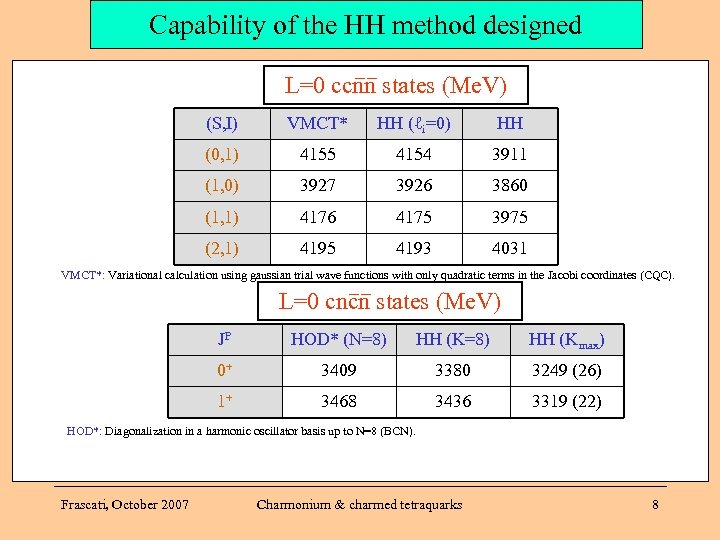 Capability of the HH method designed –– L=0 ccnn states (Me. V) (S, I) VMCT* HH (ℓi=0) HH (0, 1) 4155 4154 3911 (1, 0) 3927 3926 3860 (1, 1) 4176 4175 3975 (2, 1) 4195 4193 4031 VMCT*: Variational calculation using gaussian trial wave functions with only quadratic terms in the Jacobi coordinates (CQC). –– L=0 cncn states (Me. V) JP HOD* (N=8) HH (Kmax) 0+ 3409 3380 3249 (26) 1+ 3468 3436 3319 (22) HOD*: Diagonalization in a harmonic oscillator basis up to N=8 (BCN). Frascati, October 2007 Charmonium & charmed tetraquarks 8
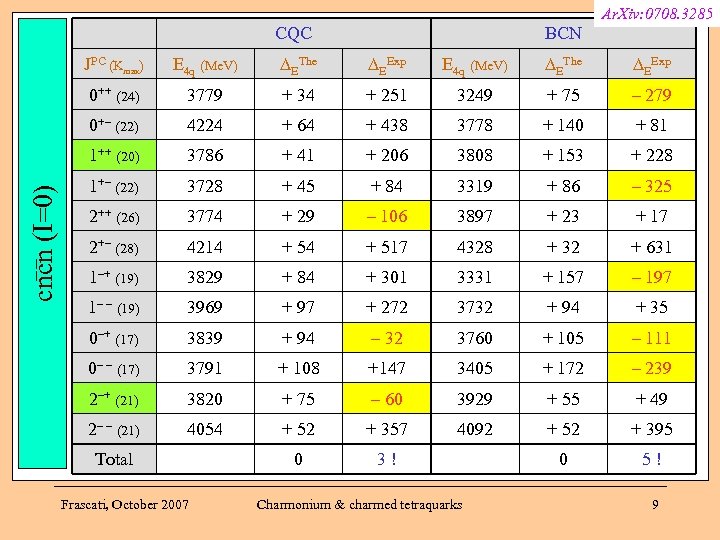 Ar. Xiv: 0708. 3285 CQC BCN E 4 q (Me. V) EThe EExp 0++ (24) 3779 + 34 + 251 3249 + 75 – 279 0+– (22) 4224 + 64 + 438 3778 + 140 + 81 1++ (20) –– cncn (I=0) JPC (Kmax) 3786 + 41 + 206 3808 + 153 + 228 1+– (22) 3728 + 45 + 84 3319 + 86 – 325 2++ (26) 3774 + 29 – 106 3897 + 23 + 17 2+– (28) 4214 + 517 4328 + 32 + 631 1–+ (19) 3829 + 84 + 301 3331 + 157 – 197 1– – (19) 3969 + 97 + 272 3732 + 94 + 35 0–+ (17) 3839 + 94 – 32 3760 + 105 – 111 0– – (17) 3791 + 108 +147 3405 + 172 – 239 2–+ (21) 3820 + 75 – 60 3929 + 55 + 49 2– – (21) 4054 + 52 + 357 4092 + 52 + 395 0 3 ! 0 5 ! Total Frascati, October 2007 Charmonium & charmed tetraquarks 9
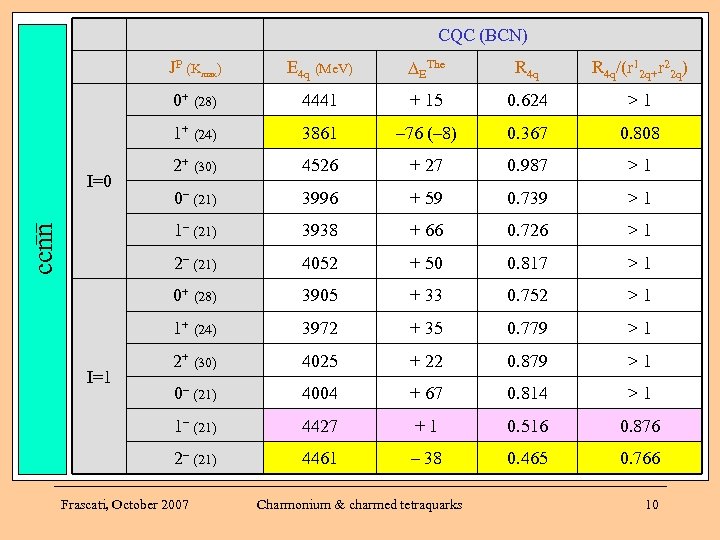 CQC (BCN) JP (Kmax) R 4 q/(r 12 q+r 22 q) 4441 + 15 0. 624 > 1 3861 – 76 (– 8) 0. 367 0. 808 2+ (30) 4526 + 27 0. 987 > 1 0– (21) 3996 + 59 0. 739 > 1 1– (21) 3938 + 66 0. 726 > 1 2– (21) 4052 + 50 0. 817 > 1 0+ (28) 3905 + 33 0. 752 > 1 1+ (24) 3972 + 35 0. 779 > 1 2+ (30) 4025 + 22 0. 879 > 1 0– (21) 4004 + 67 0. 814 > 1 1– (21) 4427 + 1 0. 516 0. 876 2– (21) –– ccnn R 4 q 1+ (24) I=1 EThe 0+ (28) I=0 E 4 q (Me. V) 4461 – 38 0. 465 0. 766 Frascati, October 2007 Charmonium & charmed tetraquarks 10
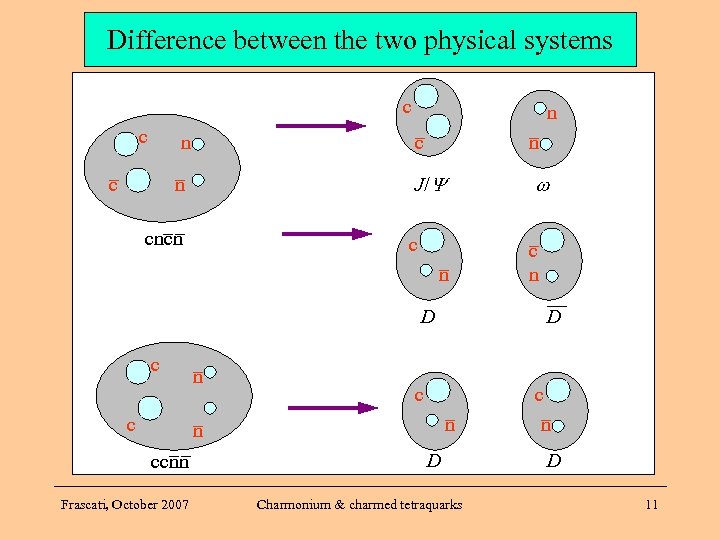 Difference between the two physical systems c c n n – n – c J/ c – c n –– cncn – n — D D c c – n – n –– ccnn Frascati, October 2007 D Charmonium & charmed tetraquarks c – n D 11
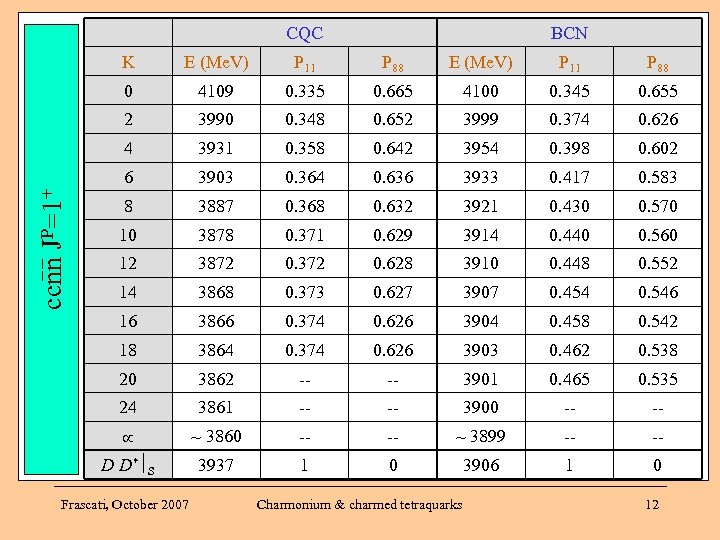 CQC BCN P 11 P 88 E (Me. V) P 11 P 88 4109 0. 335 0. 665 4100 0. 345 0. 655 2 3990 0. 348 0. 652 3999 0. 374 0. 626 4 3931 0. 358 0. 642 3954 0. 398 0. 602 6 –– E (Me. V) 0 3903 0. 364 0. 636 3933 0. 417 0. 583 8 3887 0. 368 0. 632 3921 0. 430 0. 570 10 3878 0. 371 0. 629 3914 0. 440 0. 560 12 3872 0. 372 0. 628 3910 0. 448 0. 552 14 3868 0. 373 0. 627 3907 0. 454 0. 546 16 3866 0. 374 0. 626 3904 0. 458 0. 542 18 3864 0. 374 0. 626 3903 0. 462 0. 538 20 3862 -- -- 3901 0. 465 0. 535 24 3861 -- -- 3900 -- -- ~ 3860 -- -- ~ 3899 -- -- D D * S ccnn JP=1+ K 3937 1 0 3906 1 0 Frascati, October 2007 Charmonium & charmed tetraquarks 12
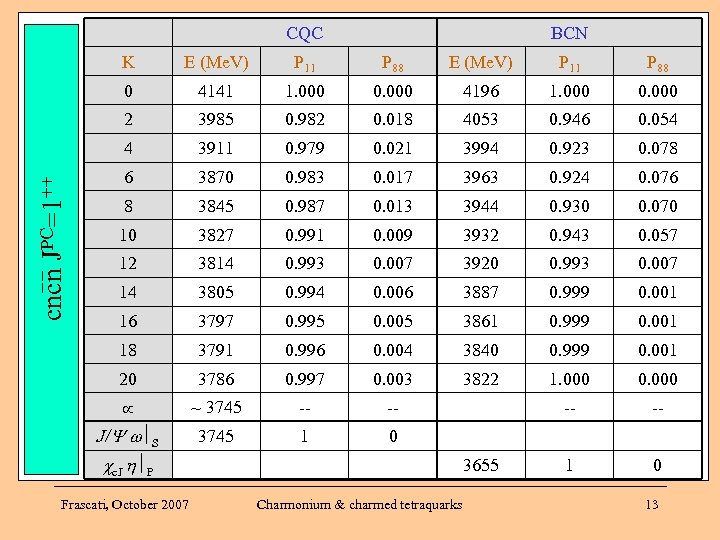 CQC BCN P 11 P 88 E (Me. V) P 11 P 88 4141 1. 000 0. 000 4196 1. 000 0. 000 2 3985 0. 982 0. 018 4053 0. 946 0. 054 4 –– E (Me. V) 0 3911 0. 979 0. 021 3994 0. 923 0. 078 6 3870 0. 983 0. 017 3963 0. 924 0. 076 8 3845 0. 987 0. 013 3944 0. 930 0. 070 10 3827 0. 991 0. 009 3932 0. 943 0. 057 12 3814 0. 993 0. 007 3920 0. 993 0. 007 14 3805 0. 994 0. 006 3887 0. 999 0. 001 16 3797 0. 995 0. 005 3861 0. 999 0. 001 18 3791 0. 996 0. 004 3840 0. 999 0. 001 20 3786 0. 997 0. 003 3822 1. 000 0. 000 ~ 3745 -- -- J/ S cncn JPC=1++ K 3745 1 0 c. J P Frascati, October 2007 3655 Charmonium & charmed tetraquarks 13
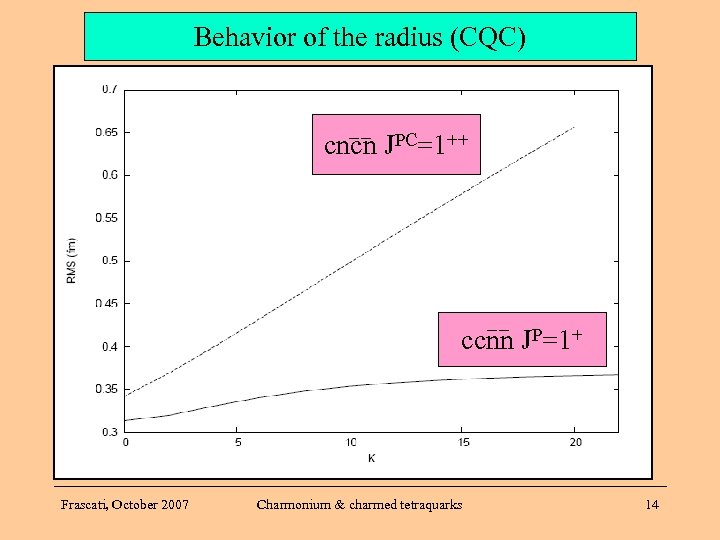 Behavior of the radius (CQC) –– cncn JPC=1++ –– ccnn JP=1+ Frascati, October 2007 Charmonium & charmed tetraquarks 14
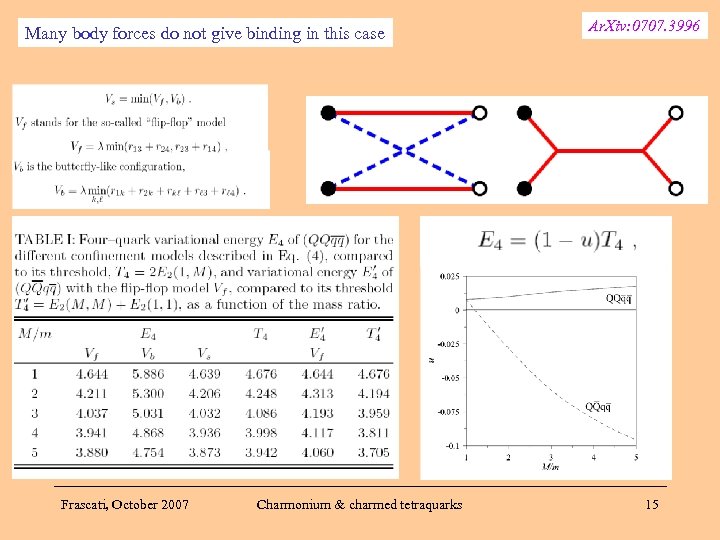 Many body forces do not give binding in this case Frascati, October 2007 Charmonium & charmed tetraquarks Ar. Xiv: 0707. 3996 15
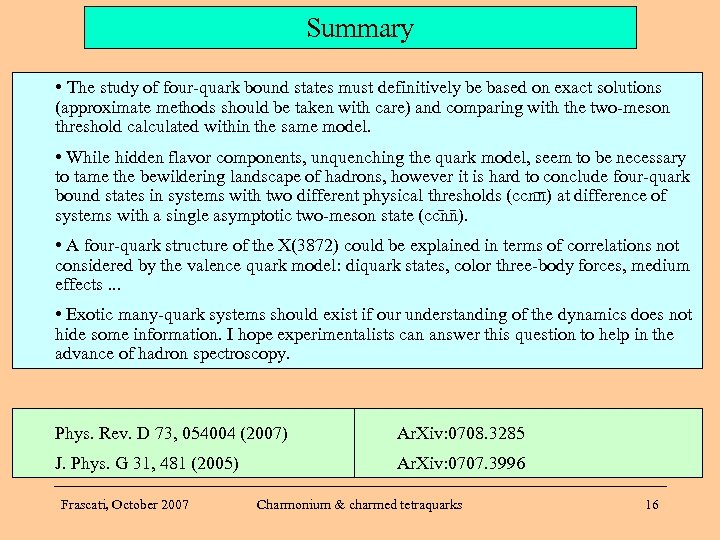 Summary • The study of four-quark bound states must definitively be based on exact solutions (approximate methods should be taken with care) and comparing with the two-meson threshold calculated within the same model. • While hidden flavor components, unquenching the quark model, seem to be necessary to tame the bewildering landscape of hadrons, however it is hard to conclude four-quark bound states in systems with two different physical thresholds (ccnn) at difference of systems with a single asymptotic two-meson state (ccnn). • A four-quark structure of the X(3872) could be explained in terms of correlations not considered by the valence quark model: diquark states, color three-body forces, medium effects. . . • Exotic many-quark systems should exist if our understanding of the dynamics does not hide some information. I hope experimentalists can answer this question to help in the advance of hadron spectroscopy. Phys. Rev. D 73, 054004 (2007) Ar. Xiv: 0708. 3285 J. Phys. G 31, 481 (2005) Ar. Xiv: 0707. 3996 Frascati, October 2007 Charmonium & charmed tetraquarks 16