 Скачать презентацию Charm Tutorial Presented by Laxmikant V Kale Kumaresh
2dd81943cfcce96cb84ef4151324c593.ppt
- Количество слайдов: 78



Charm++ Tutorial Presented by: Laxmikant V. Kale Kumaresh Pattabiraman Chee Wai Lee
Overview Introduction – Developing parallel applications – Virtualization – Message Driven Execution Charm++ Features – Chares and Chare Arrays – Parameter Marshalling – Examples Tools – Live. Viz – Parallel Debugger – Projections More Charm++ features – Structured Dagger Construct – Adaptive MPI – Load Balancing Conclusion 2
Outline Introduction Charm++ features – Chares and Chare Arrays – Parameter Marshalling – Examples Tools – Live. Viz – Parallel Debugger – Projections More Charm++ Features – Structured Dagger Construct – Adaptive MPI – Load Balancing Conclusion 3
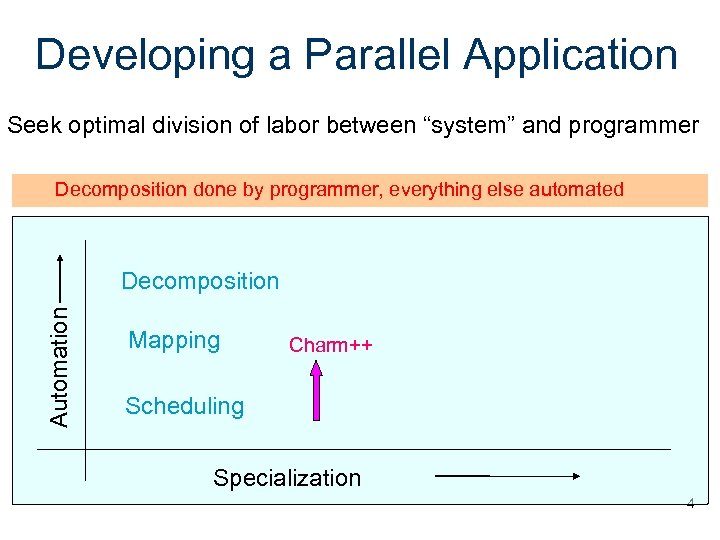
Developing a Parallel Application Seek optimal division of labor between “system” and programmer Decomposition done by programmer, everything else automated Automation Decomposition Mapping Charm++ Scheduling Specialization 4
Virtualization: Object-based Decomposition Divide the computation into a large number of pieces – Independent of number of processors – Typically larger than number of processors Let the system map objects to processors 5
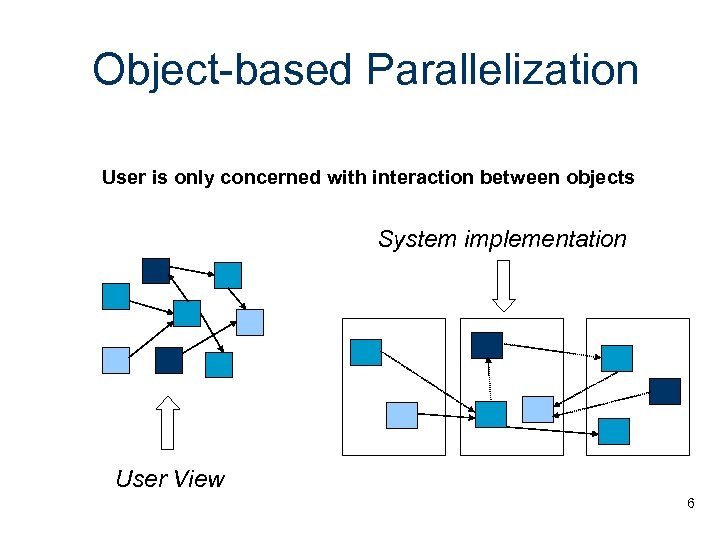
Object-based Parallelization User is only concerned with interaction between objects System implementation User View 6
Message-Driven Execution Objects communicate asynchronously through remote method invocation Encourages non-deterministic execution Benefits: – Communication latency tolerance – Logical structure for scheduling 7
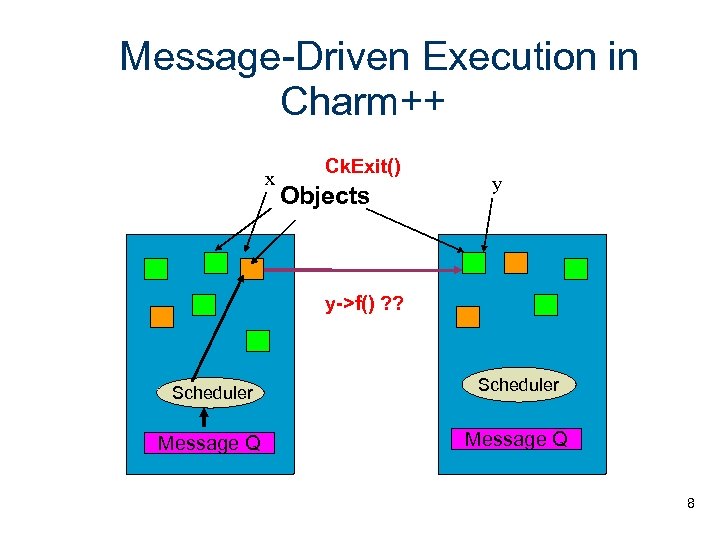
Message-Driven Execution in Charm++ x Ck. Exit() Objects y y->f() ? ? Scheduler Message Q 8
Other Charm++ Characteristics Methods execute one at a time No need for locks Expressing flow of control may be difficult 9
Outline Introduction Charm++ features – Chares and Chare Arrays – Parameter Marshalling – Examples Tools – Live. Viz – Parallel Debugger – Projections More Charm++ Features – Structured Dagger Construct – Adaptive MPI – Load Balancing Conclusion 10
Chares – Concurrent Objects Can be dynamically created on any available processor Can be accessed from remote processors Send messages to each other asynchronously Contain “entry methods” 11
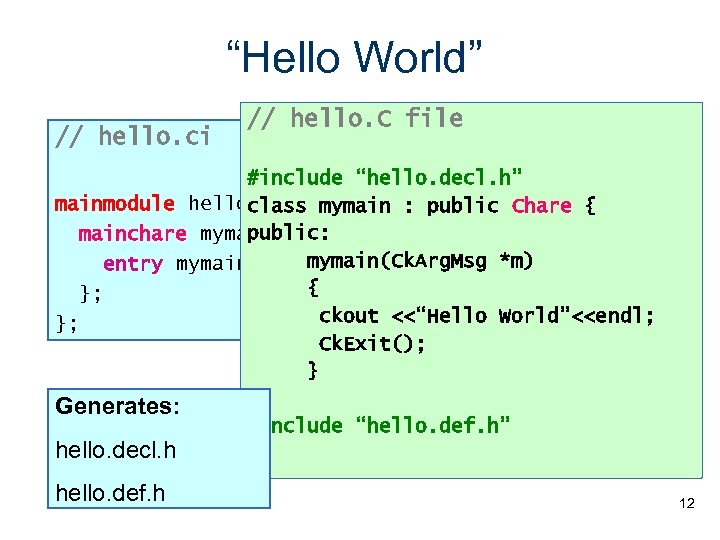
“Hello World” // hello. ci // hello. C file #include “hello. decl. h” mainmodule helloclass mymain : public Chare { { public: mainchare mymain { mymain(Ck. Arg. Msg *m) entry mymain(Ck. Arg. Msg *m); { }; ckout <<“Hello World”<<endl; }; Ck. Exit(); } }; Generates: #include “hello. def. h” hello. decl. h hello. def. h 12
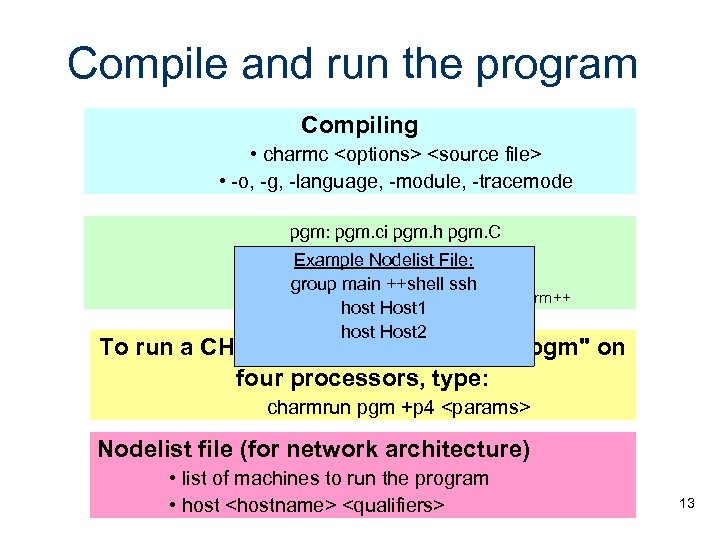
Compile and run the program Compiling • charmc <options> <source file> • -o, -g, -language, -module, -tracemode pgm: pgm. ci pgm. h pgm. C Examplecharmc pgm. ci Nodelist File: charmc pgm. C group main ++shell ssh charmc –o pgm. o –language charm++ host Host 1 host Host 2 To run a CHARM++ program named ``pgm'' on four processors, type: charmrun pgm +p 4 <params> Nodelist file (for network architecture) • list of machines to run the program • host <hostname> <qualifiers> 13
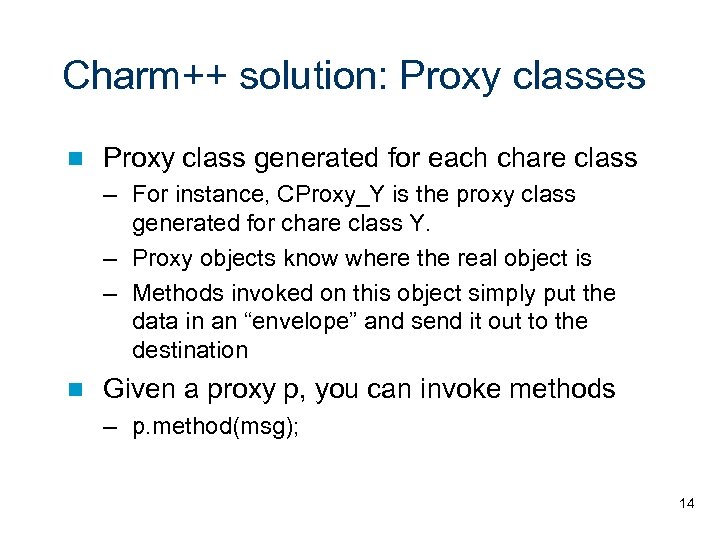
Charm++ solution: Proxy classes Proxy class generated for each chare class – For instance, CProxy_Y is the proxy class generated for chare class Y. – Proxy objects know where the real object is – Methods invoked on this object simply put the data in an “envelope” and send it out to the destination Given a proxy p, you can invoke methods – p. method(msg); 14
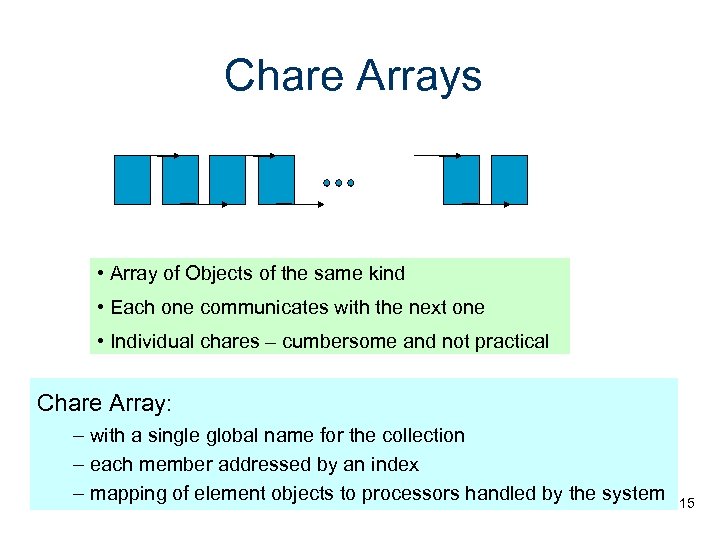
Chare Arrays • Array of Objects of the same kind • Each one communicates with the next one • Individual chares – cumbersome and not practical Chare Array: – with a single global name for the collection – each member addressed by an index – mapping of element objects to processors handled by the system 15
![Chare Arrays A [0] A [1] A [2] A [3] A [. . ]](https://present5.com/presentation/2dd81943cfcce96cb84ef4151324c593/image-16.jpg "Chare Arrays A [0] A [1] A [2] A [3] A [. . ]")
Chare Arrays A [0] A [1] A [2] A [3] A [. . ] User’s view System view A [0] A [1] 16
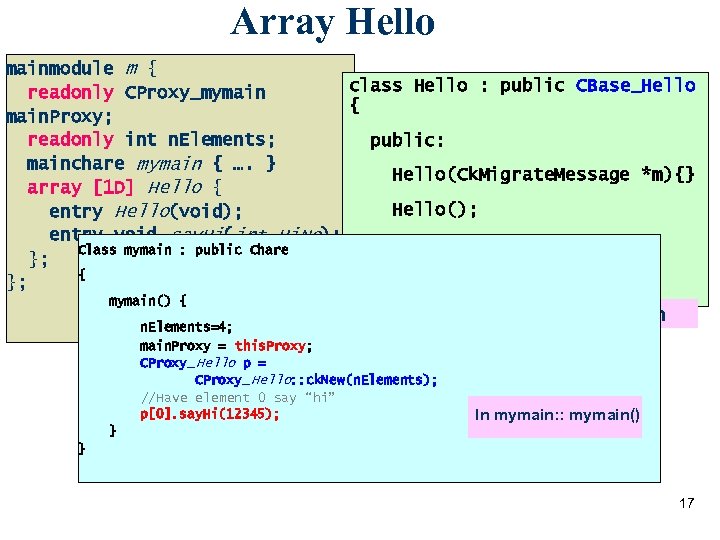
Array Hello mainmodule m { class Hello : public CBase_Hello readonly CProxy_mymain { main. Proxy; readonly int n. Elements; public: mainchare mymain { …. } Hello(Ck. Migrate. Message *m){} array [1 D] Hello { Hello(); entry Hello(void); entry void say. Hi(int Hi. No); void say. Hi(int hi. No); Class mymain : public Chare }; { }; }; mymain() { (. ci) file n. Elements=4; main. Proxy = this. Proxy; CProxy_ Hello p = CProxy_ Hello: : ck. New(n. Elements); //Have element 0 say “hi” p[0]. say. Hi(12345); Class Declaration In mymain: : mymain() } } 17
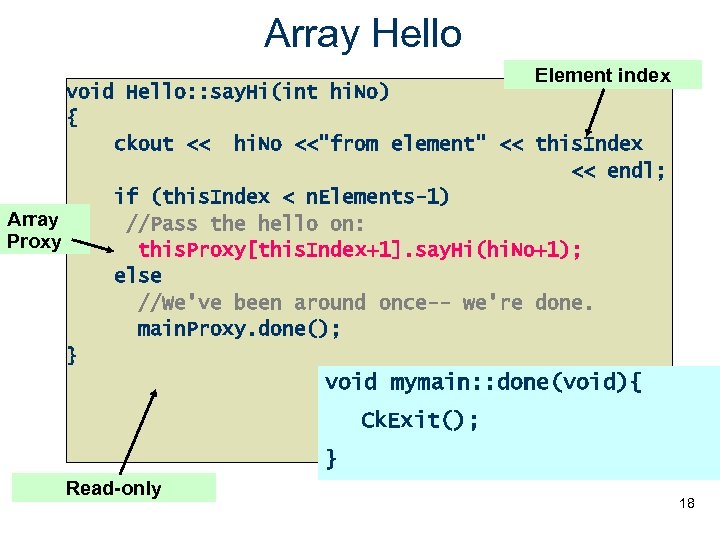
Array Hello Element index void Hello: : say. Hi(int hi. No) { ckout << hi. No <<"from element" << this. Index << endl; if (this. Index < n. Elements-1) Array //Pass the hello on: Proxy this. Proxy[this. Index+1]. say. Hi(hi. No+1); else //We've been around once-- we're done. main. Proxy. done(); } void mymain: : done(void){ Ck. Exit(); } Read-only 18
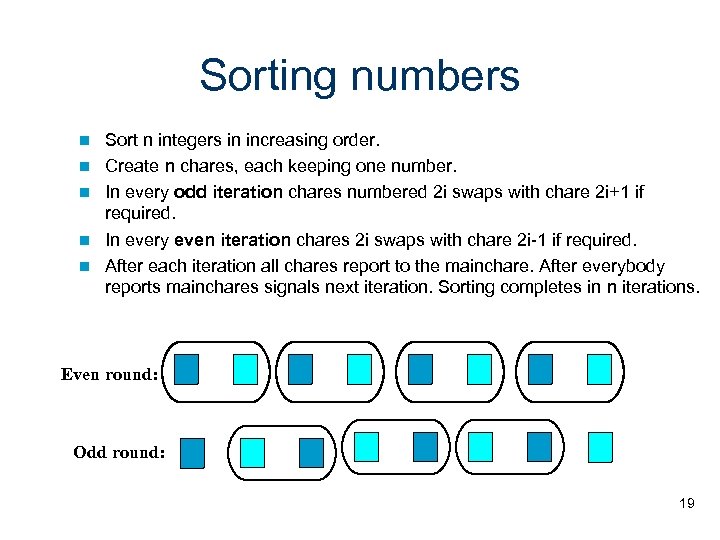
Sorting numbers Sort n integers in increasing order. Create n chares, each keeping one number. In every odd iteration chares numbered 2 i swaps with chare 2 i+1 if required. In every even iteration chares 2 i swaps with chare 2 i-1 if required. After each iteration all chares report to the mainchare. After everybody reports mainchares signals next iteration. Sorting completes in n iterations. Even round: Odd round: 19
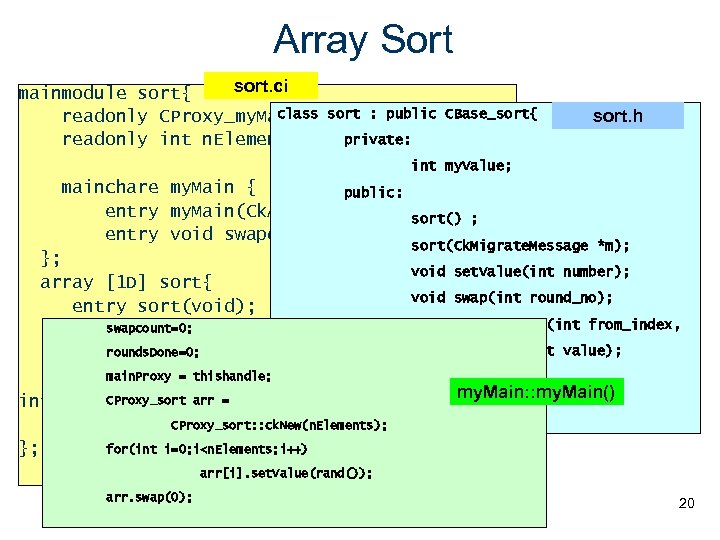
Array Sort sort. ci mainmodule sort{ class sort : public readonly CProxy_my. Main main. Proxy; private: readonly int n. Elements; CBase_sort{ sort. h int my. Value; mainchare my. Main { public: entry my. Main(Ck. Arg. Msg *m); entry void swapdone(void); sort() ; sort(Ck. Migrate. Message *m); }; void set. Value(int number); array [1 D] sort{ void swap(int round_no); entry sort(void); void swapcount=0; entry void set. Value(int myvalue); swap. Receive(int from_index, int value); rounds. Done=0; entry void swap(int round_no); main. Proxy thishandle; }; entry void= swap. Receive(int from_index, my. Main: : my. Main() CProxy_sort arr = int value); CProxy_sort: : ck. New(n. Elements); }; for(int i=0; i<n. Elements; i++) }; arr[i]. set. Value(rand()); arr. swap(0); 20
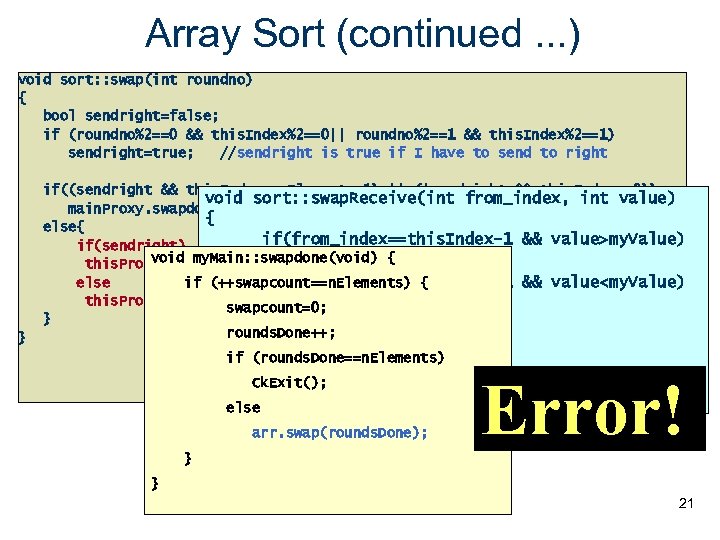
Array Sort (continued. . . ) void sort: : swap(int roundno) { bool sendright=false; if (roundno%2==0 && this. Index%2==0|| roundno%2==1 && this. Index%2==1) sendright=true; //sendright is true if I have to send to right } if((sendright && this. Index==n. Elements-1) || (!sendright && this. Index==0)) void sort: : swap. Receive(int from_index, int value) main. Proxy. swapdone(); { else{ if(from_index==this. Index-1 && value>my. Value) if(sendright) void my. Main: : swapdone(void) { my. Value=value; this. Proxy[this. Index+1]. swap. Receive(this. Index, my. Value); else if(from_index==this. Index+1 && value<my. Value) if (++swapcount==n. Elements) { this. Proxy[this. Index-1]. swap. Receive(this. Index, my. Value); my. Value=value; swapcount=0; } main. Proxy. swapdone(); rounds. Done++; } if (rounds. Done==n. Elements) Ck. Exit(); else arr. swap(rounds. Done); Error!! } } 21
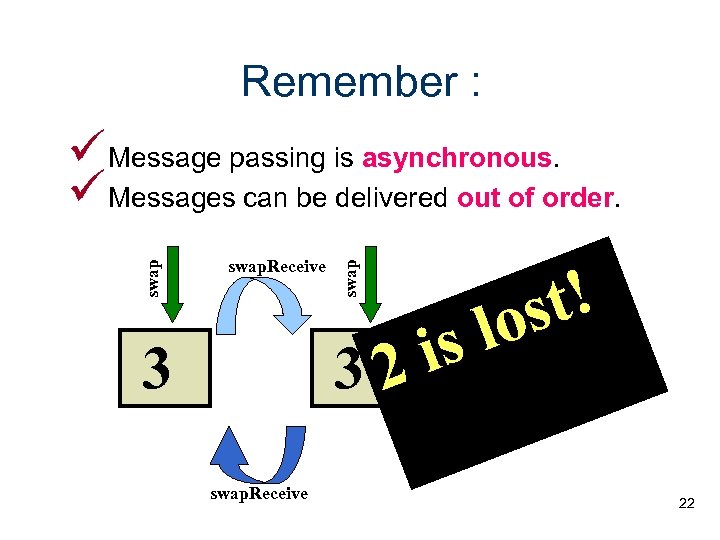
Remember : swap. Receive swap Message passing is asynchronous. Messages can be delivered out of order. is 3 22 3 swap. Receive t! os l 22
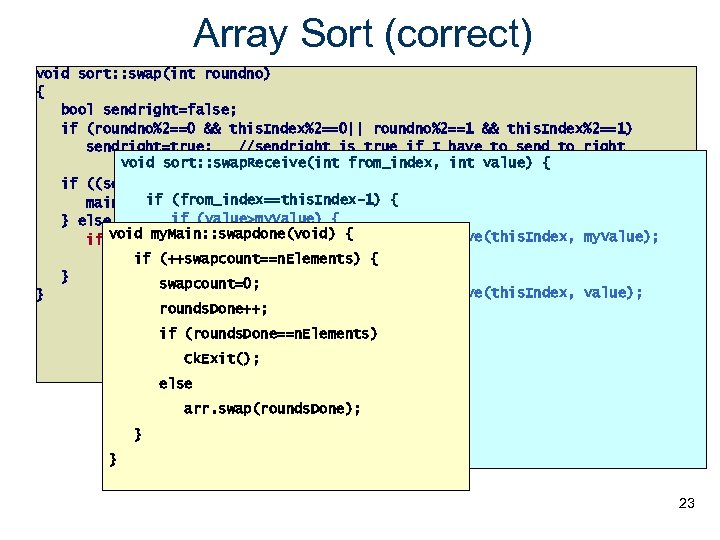
Array Sort (correct) void sort: : swap(int roundno) { bool sendright=false; if (roundno%2==0 && this. Index%2==0|| roundno%2==1 && this. Index%2==1) sendright=true; //sendright is true if I have to send to right void sort: : swap. Receive(int from_index, int value) { if ((sendright && this. Index==n. Elements-1) || (!sendright && this. Index==0)) if (from_index==this. Index-1) { main. Proxy. swapdone(); if (value>my. Value) { } else { this. Proxy[this. Index-1]. swap. Receive(this. Index, my. Value); if void my. Main: : swapdone(void) { (sendright) my. Value=value; this. Proxy[this. Index+1]. swap. Receive(this. Index, my. Value); if (++swapcount==n. Elements) { } else { } swapcount=0; this. Proxy[this. Index-1]. swap. Receive(this. Index, value); } rounds. Done++; } } if (rounds. Done==n. Elements) Ck. Exit(); if (from_index==this. Index+1) else my. Value=value; }} arr. swap(rounds. Done); main. Proxy. swapdone(); } 23
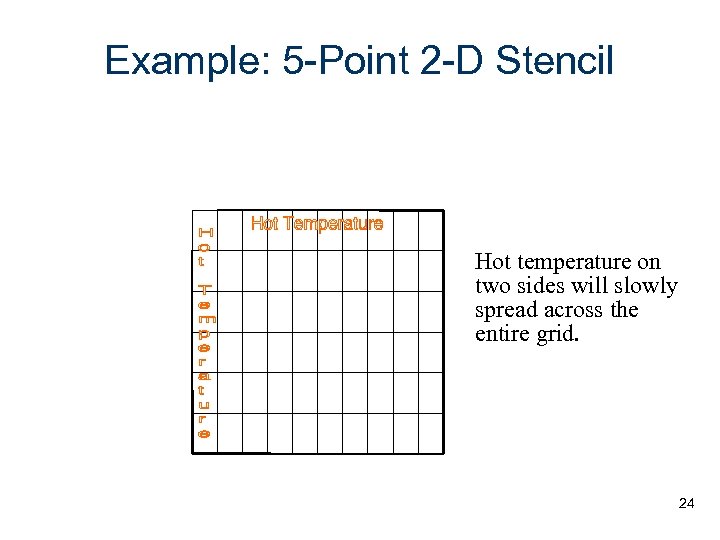
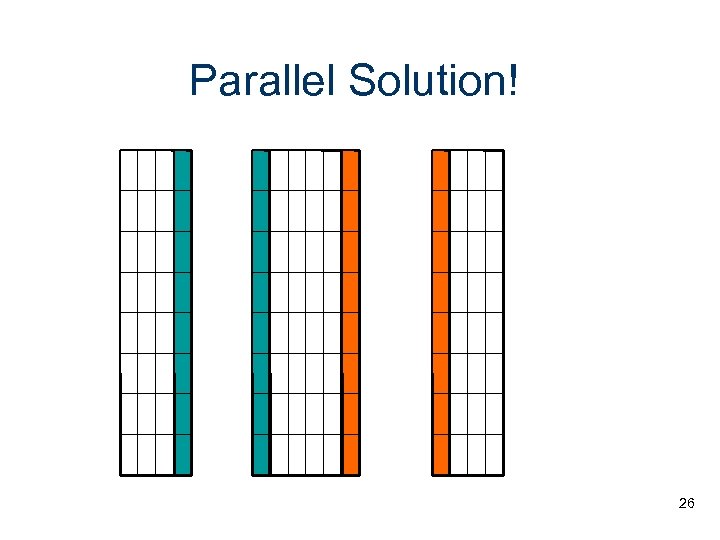
Example: 5 -Point 2 -D Stencil Hot temperature on two sides will slowly spread across the entire grid. 24
Example: 5 -Point 2 -D Stencil Input: 2 D array of values with boundary condition In each iteration, each array element is computed as the average of itself and its neighbors (5 points) Iterations are repeated till some threshold difference value is reached 25
Parallel Solution! 26
Parallel Solution! Slice up the 2 D array into sets of columns Chare = computations in one set At the end of each iteration – Chares exchange boundaries – Determine maximum change in computation Output result at each step or when threshold is reached 27
Arrays as Parameters Array cannot be passed as pointer Specify the length of the array in the interface file – – entry void bar(int n, double arr[n]) n is size of arr[] 28
![Stencil Code void Ar 1: : do. Work(int senders. ID, int n, double arr[])](https://present5.com/presentation/2dd81943cfcce96cb84ef4151324c593/image-29.jpg "Stencil Code void Ar 1: : do. Work(int senders. ID, int n, double arr[])")
Stencil Code void Ar 1: : do. Work(int senders. ID, int n, double arr[]) { max. Change = 0. 0; if (senders. ID == this. Index-1) { leftmsg = 1; } //set boolean to indicate we received the left message else if (senders. ID == this. Index+1) { rightmsg = 1; } //set boolean to indicate we received the right message // Rest of the code on a following slide … } 29
Reduction Apply a single operation (add, max, min, . . . ) to data items scattered across many processors Collect the result in one place Reduce x across all elements – contribute(sizeof(x), &x, Ck. Reduction: : sum_int); Must create and register a callback function that will receive the final value, in main chare 30
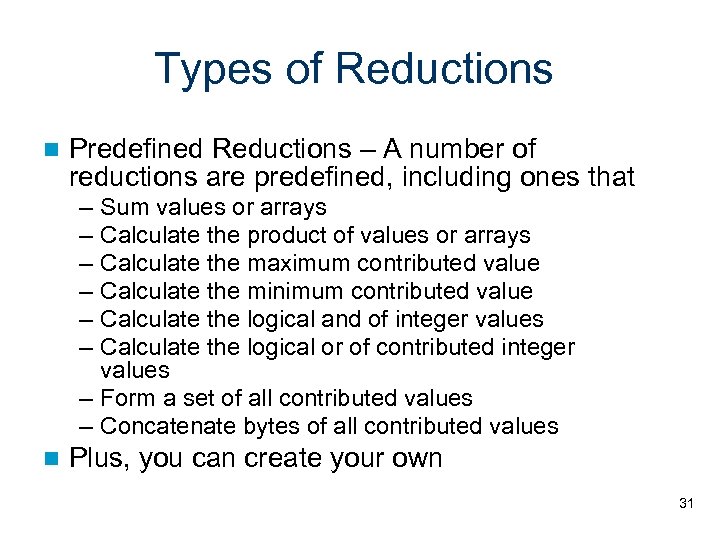
Types of Reductions Predefined Reductions – A number of reductions are predefined, including ones that – – – Sum values or arrays Calculate the product of values or arrays Calculate the maximum contributed value Calculate the minimum contributed value Calculate the logical and of integer values Calculate the logical or of contributed integer values – Form a set of all contributed values – Concatenate bytes of all contributed values Plus, you can create your own 31
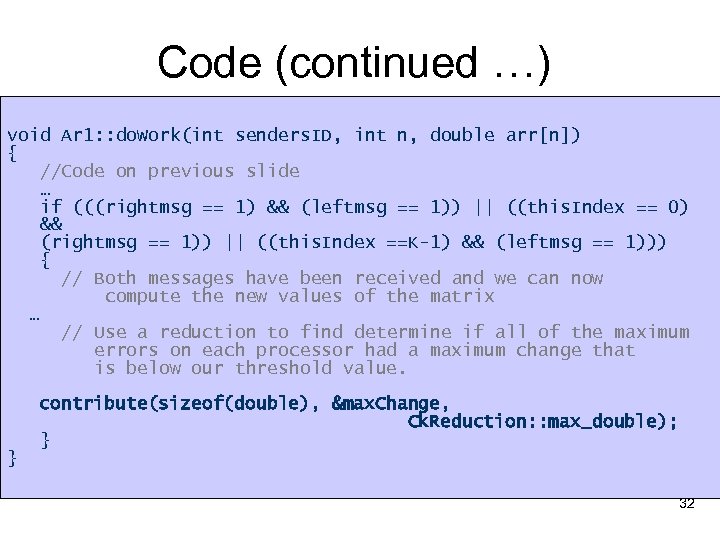
Code (continued …) void Ar 1: : do. Work(int senders. ID, int n, double arr[n]) { //Code on previous slide … if (((rightmsg == 1) && (leftmsg == 1)) || ((this. Index == 0) && (rightmsg == 1)) || ((this. Index ==K-1) && (leftmsg == 1))) { // Both messages have been received and we can now compute the new values of the matrix … // Use a reduction to find determine if all of the maximum errors on each processor had a maximum change that is below our threshold value. } contribute(sizeof(double), &max. Change, Ck. Reduction: : max_double); } 32
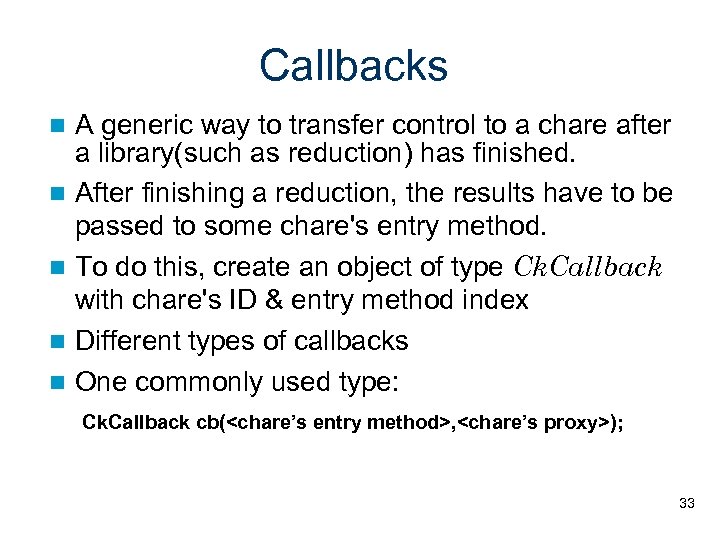
Callbacks A generic way to transfer control to a chare after a library(such as reduction) has finished. After finishing a reduction, the results have to be passed to some chare's entry method. To do this, create an object of type Ck. Callback with chare's ID & entry method index Different types of callbacks One commonly used type: Ck. Callback cb(<chare’s entry method>, <chare’s proxy>); 33
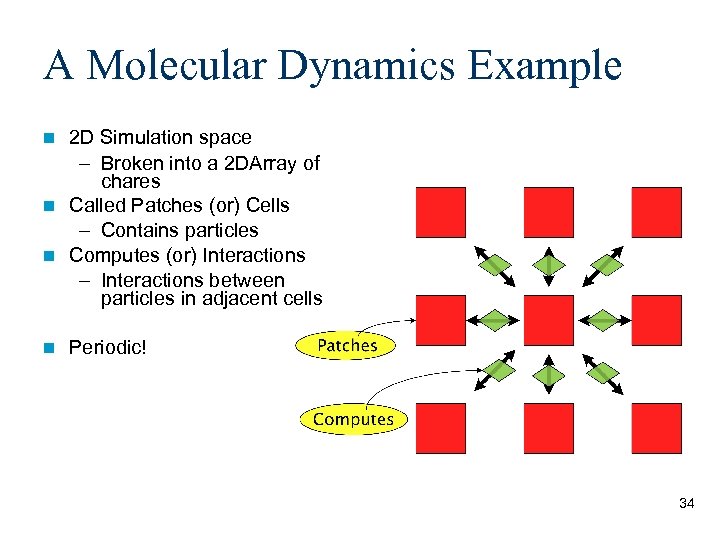
A Molecular Dynamics Example 2 D Simulation space – Broken into a 2 DArray of chares Called Patches (or) Cells – Contains particles Computes (or) Interactions – Interactions between particles in adjacent cells Periodic! 34
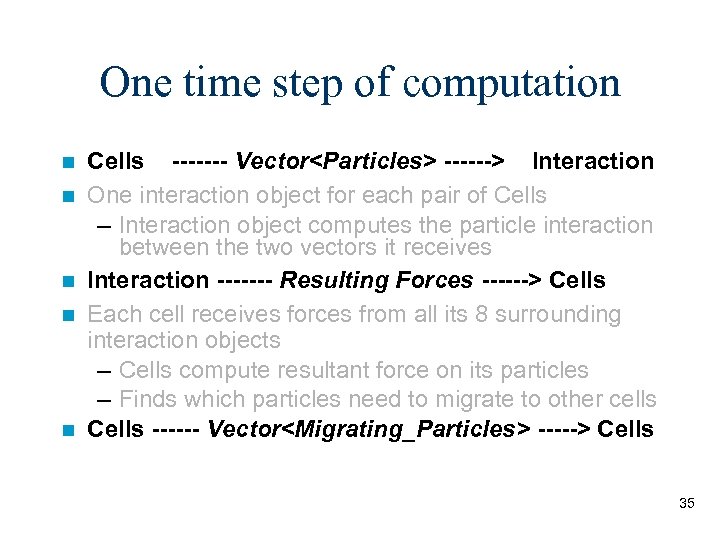
One time step of computation Cells ------- Vector<Particles> ------> Interaction One interaction object for each pair of Cells – Interaction object computes the particle interaction between the two vectors it receives Interaction ------- Resulting Forces ------> Cells Each cell receives forces from all its 8 surrounding interaction objects – Cells compute resultant force on its particles – Finds which particles need to migrate to other cells Cells ------ Vector<Migrating_Particles> -----> Cells 35
![Now, some code. . // cell. ci module cell { array [2 D] Cell](https://present5.com/presentation/2dd81943cfcce96cb84ef4151324c593/image-36.jpg "Now, some code. . // cell. ci module cell { array [2 D] Cell")
Now, some code. . // cell. ci module cell { array [2 D] Cell { entry Cell(); entry void start(); entry void update. Forces(Ck. Vec<Particle> particles); entry void update. Particles(Ck. Vec<Particle> updates); entry void request. Next. Frame(live. Viz. Request. Msg *m); }; array [4 D] Interaction { // Sparse Array entry Interaction(); entry void interact(Ck. Vec<Particle>, int i, int j); }; -----------------------------Spare Array – Insertion For each pair of adjacent cells (x 1, y 1) and (x 2, y 2) interaction. Array( x 1, y 1, x 2, y 2 ). insert( /* proc number */ ); 36
Outline Introduction Charm++ features – Chares and Chare Arrays – Parameter Marshalling – Examples Tools – Live. Viz – Parallel Debugger – Projections More Charm++ Features – Structured Dagger Construct – Adaptive MPI – Load Balancing Conclusion 37
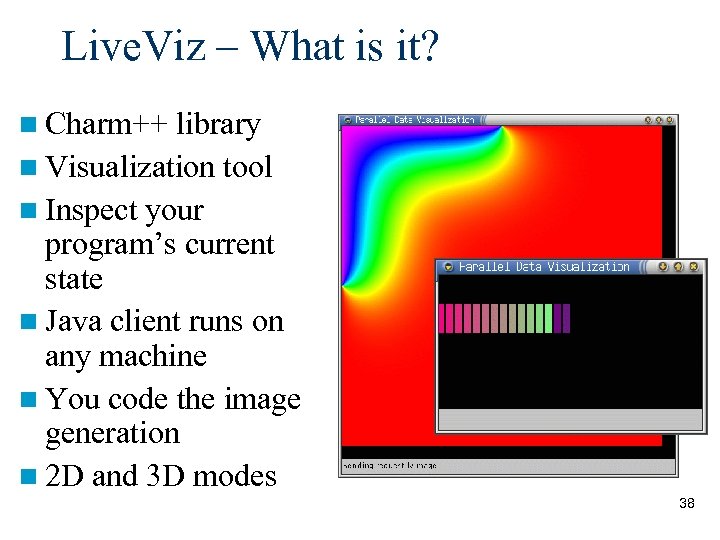
Live. Viz – What is it? Charm++ library Visualization tool Inspect your program’s current state Java client runs on any machine You code the image generation 2 D and 3 D modes 38
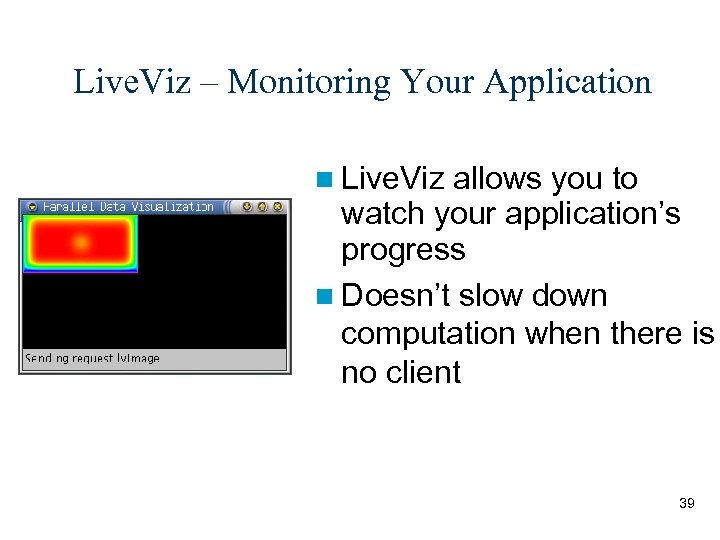
Live. Viz – Monitoring Your Application Live. Viz allows you to watch your application’s progress Doesn’t slow down computation when there is no client 39
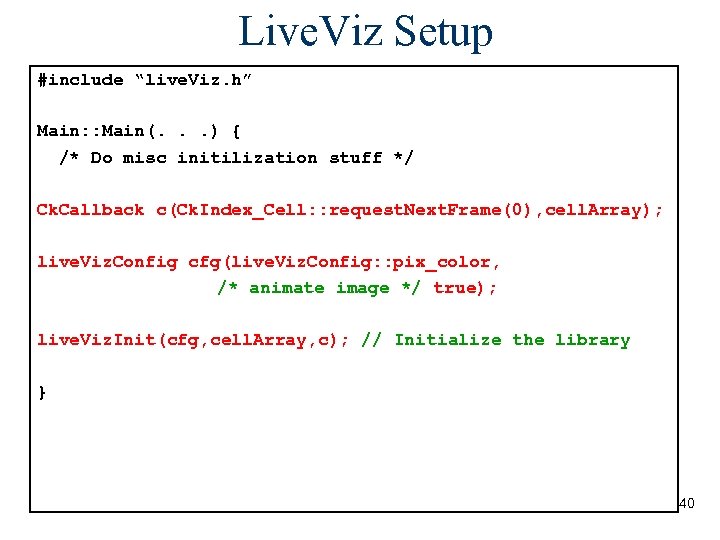
Live. Viz Setup “live. Viz. h” #include <live. Viz. Poll. h> Main: : Main(. . . ) { void main: : main(. . . ) { /* // Do misc initilization stuff */ Ck. Callback c(Ck. Index_Cell: : request. Next. Frame(0), cell. Array); live. Viz. Config cfg(live. Viz. Config: : pix_color, /* animate image */ true); live. Viz. Init(cfg, cell. Array, c); // Initialize the library } // Now create the (empty) jacobi 2 D array work = CProxy_matrix: : ck. New(0); // Distribute work to the array, filling it as you do } 40
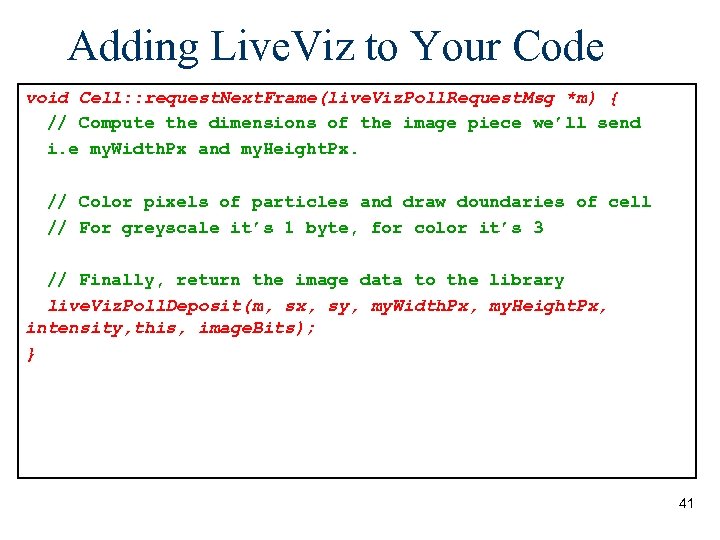
Adding Live. Viz to Your Code void Cell: : request. Next. Frame(live. Viz. Poll. Request. Msg *m) { // Compute the dimensions of the image piece we’ll send i. e my. Width. Px and my. Height. Px. // Color pixels of particles and draw doundaries of cell // For greyscale it’s 1 byte, for color it’s 3 // Finally, return the image data to the library live. Viz. Poll. Deposit(m, sx, sy, my. Width. Px, my. Height. Px, intensity, this, image. Bits); } 41
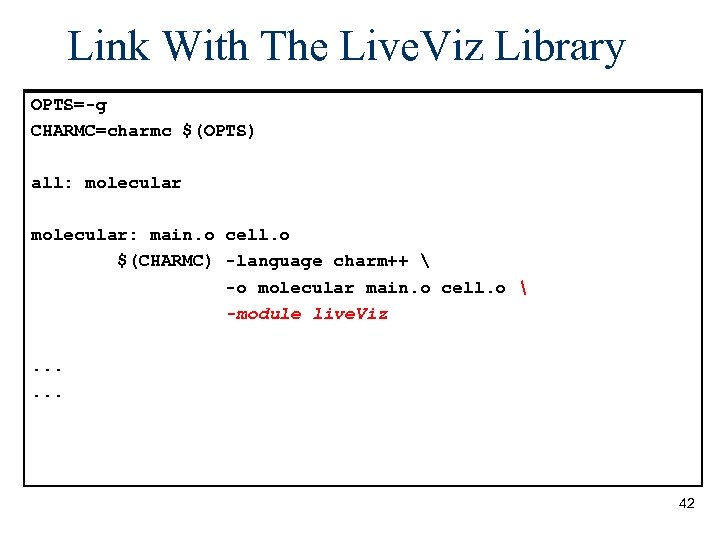
Link With The Live. Viz Library OPTS=-g CHARMC=charmc $(OPTS) LB=-module Refine. LB all: molecular OBJS = jacobi 2 d. o molecular: main. o cell. o all: jacobi 2 d $(CHARMC) -language charm++ -o molecular main. o cell. o jacobi 2 d: $(OBJS) -module live. Viz $(CHARMC) -language charm++ -o jacobi 2 d $(OBJS) $(LB) –lm. . . jacobi 2 d. o: jacobi 2 d. C jacobi 2 d. decl. h $(CHARMC) -c jacobi 2 d. C 42
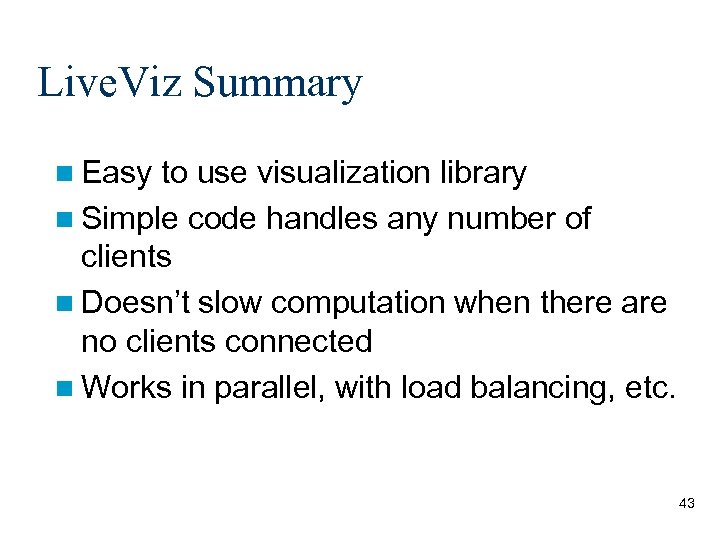
Live. Viz Summary Easy to use visualization library Simple code handles any number of clients Doesn’t slow computation when there are no clients connected Works in parallel, with load balancing, etc. 43
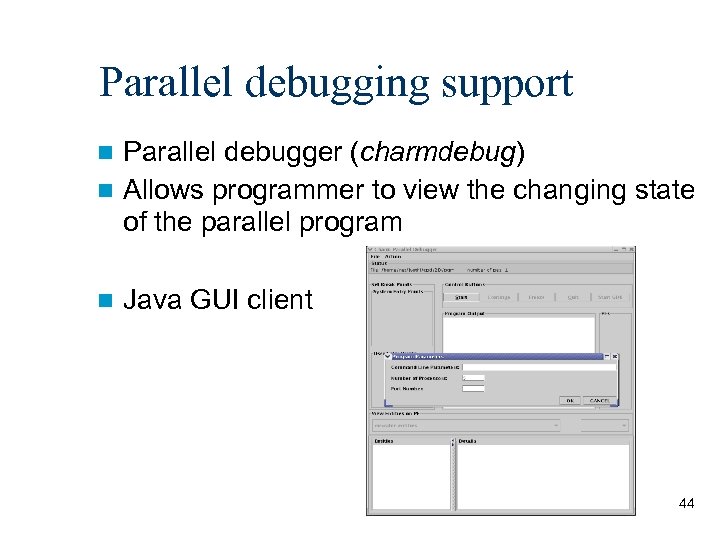
Parallel debugging support Parallel debugger (charmdebug) Allows programmer to view the changing state of the parallel program Java GUI client 44
Debugger features Provides a means to easily access and view the major programmer visible entities, including objects and messages in queues, during program execution Provides an interface to set and remove breakpoints on remote entry points, which capture the major programmer-visible control flows 45
Debugger features (contd. ) Provides the ability to freeze and unfreeze the execution of selected processors of the parallel program, which allows a consistent snapshot Provides a way to attach a sequential debugger (like GDB) to a specific subset of processes of the parallel program during execution, which keeps a manageable number of sequential debugger windows open 46
Alternative debugging support Uses gdb for debugging • Runs each node under gdb in an xterm window, prompting the user to begin execution Charm program has to be compiled using ‘-g’ and run with ‘++debug’ as a command-line option. 47
Projections: Quick Introduction Projections is a tool used to analyze the performance of your application The tracemode option is used when you build your application to enable tracing You get one log file per processor, plus a separate file with global information These files are read by Projections so you can use the Projections views to analyze performance 48
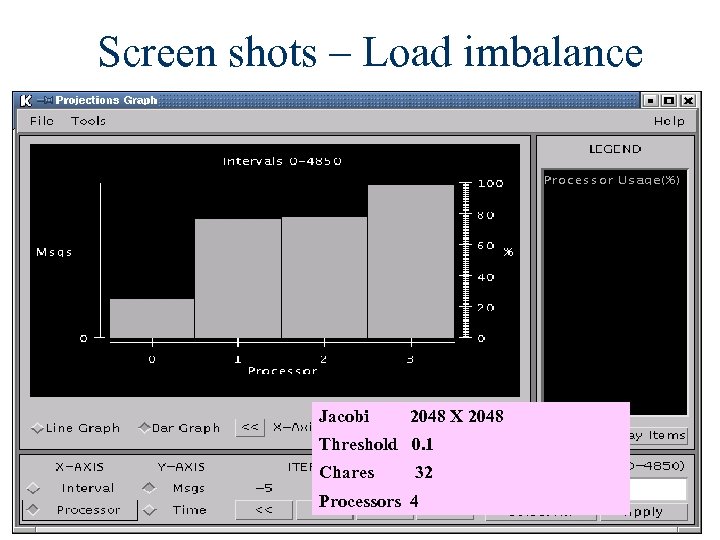
Screen shots – Load imbalance Jacobi 2048 X 2048 Threshold 0. 1 Chares 32 Processors 4 49
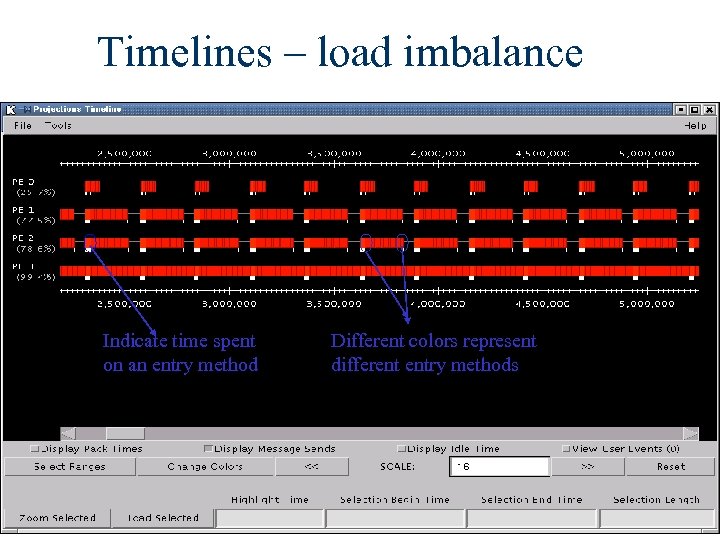
Timelines – load imbalance Indicate time spent on an entry method Different colors represent different entry methods 50
Outline Introduction Charm++ features – Chares and Chare Arrays – Parameter Marshalling – Examples Tools – Live. Viz – Parallel Debugger – Projections More Charm++ Features – Structured Dagger Construct – Adaptive MPI – Load Balancing Conclusion 51
Structured Dagger Motivation: – Keeping flags & buffering manually can complicate code in charm++ model. – Considerable overhead in the form of thread creation and synchronization 52
Advantages Reduce the complexity of program development – Facilitate a clear expression of flow of control Take advantage of adaptive messagedriven execution – Without adding significant overhead 53
What is it? A coordination language built on top of Charm++ – Structured notation for specifying intra-process control dependences in message-driven programs Allows easy expression of dependences among messages, computations and also among computations within the same object using various structured constructs 54
Structured Dagger Constructs To Be Covered in Advanced Charm++ Session atomic {code} overlap {code} when <entrylist> {code} if/else/for/while foreach 55
![Stencil Example Using Structured Dagger stencil. ci array[1 D] Ar 1 { … entry](https://present5.com/presentation/2dd81943cfcce96cb84ef4151324c593/image-56.jpg "Stencil Example Using Structured Dagger stencil. ci array[1 D] Ar 1 { … entry")
Stencil Example Using Structured Dagger stencil. ci array[1 D] Ar 1 { … entry void Get. Messages () { when rightmsg. Entry(), leftmsg. Entry() { atomic { Ck. Printf(“Got both left and right messages n”); do. Work(right, left); } } }; entry void rightmsg. Entry(); entry void leftmsg. Entry(); … }; 56
AMPI = Adaptive MPI Motivation: – Typical MPI implementations are not suitable for the new generation parallel applications • Dynamically varying: load shifting, adaptive refinement – Some legacy codes in MPI can be easily ported and run fast in current new machines – Facilitate those who are familiar with MPI 57
What is it? An MPI implementation built on Charm++ (MPI with virtualization) To provide benefits of Charm++ Runtime System to standard MPI programs – Load Balancing, Checkpointing, Adaptability to dynamic number of physical processors 58
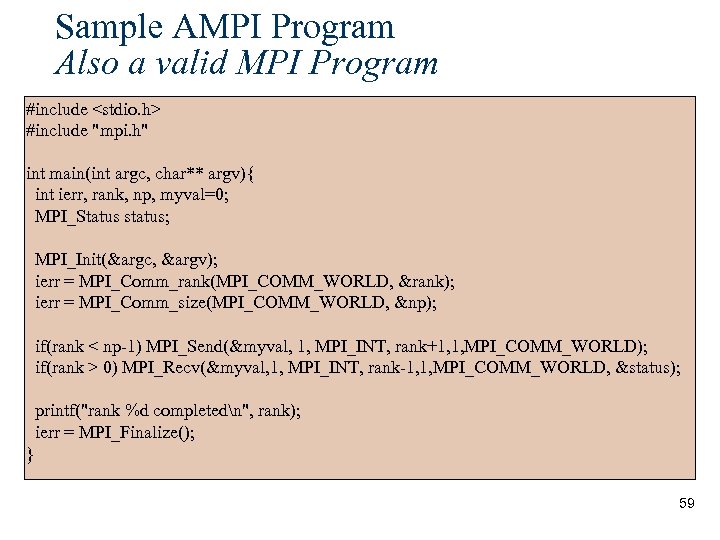
Sample AMPI Program Also a valid MPI Program #include <stdio. h> #include "mpi. h" int main(int argc, char** argv){ int ierr, rank, np, myval=0; MPI_Status status; MPI_Init(&argc, &argv); ierr = MPI_Comm_rank(MPI_COMM_WORLD, &rank); ierr = MPI_Comm_size(MPI_COMM_WORLD, &np); if(rank < np-1) MPI_Send(&myval, 1, MPI_INT, rank+1, 1, MPI_COMM_WORLD); if(rank > 0) MPI_Recv(&myval, 1, MPI_INT, rank-1, 1, MPI_COMM_WORLD, &status); printf("rank %d completedn", rank); ierr = MPI_Finalize(); } 59
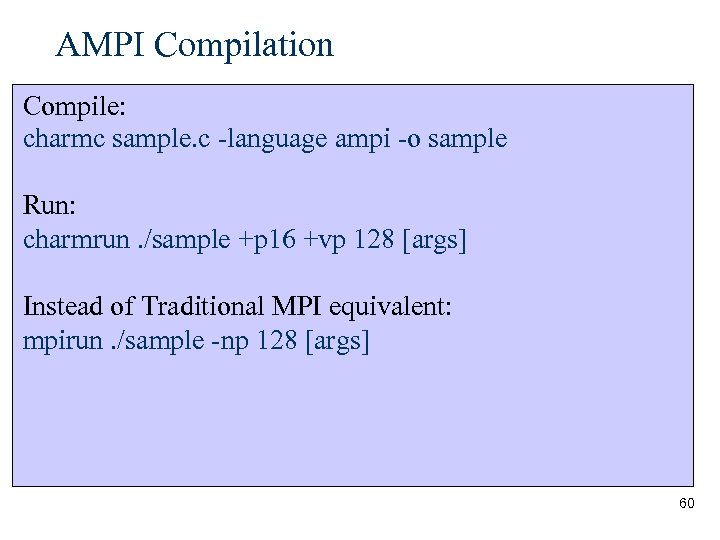
AMPI Compilation Compile: charmc sample. c -language ampi -o sample Run: charmrun. /sample +p 16 +vp 128 [args] Instead of Traditional MPI equivalent: mpirun. /sample -np 128 [args] 60
Comparison to Native MPI • AMPI Performance – Similar to Native MPI – Not utilizing any other features of AMPI(load balancing, etc. ) • AMPI Flexibility – AMPI runs on any # of Physical Processors (eg 19, 33, 105). Native MPI needs cube #. 61
Current AMPI Capabilities Automatic checkpoint/restart mechanism – Robust implementation available Load Balancing and “process” Migration MPI 1. 1 compliant, Most of MPI 2 implemented Interoperability – With Frameworks – With Charm++ Performance visualization 62
Load Balancing Goal: higher processor utilization Object migration allows us to move the work load among processors easily Measurement-based Load Balancing Two approaches to distributing work: • Centralized • Distributed Principle of Persistence 63
Migration Array objects can migrate from one processor to another Migration creates a new object on the destination processor while destroying the original Need a way of packing an object into a message, then unpacking it on the receiving processor 64
PUP is a framework for packing and unpacking migratable objects into messages To migrate, must implement pack/unpack or pup method Pup method combines 3 functions – Data structure traversal : compute message size, in bytes – Pack : write object into message – Unpack : read object out of message 65
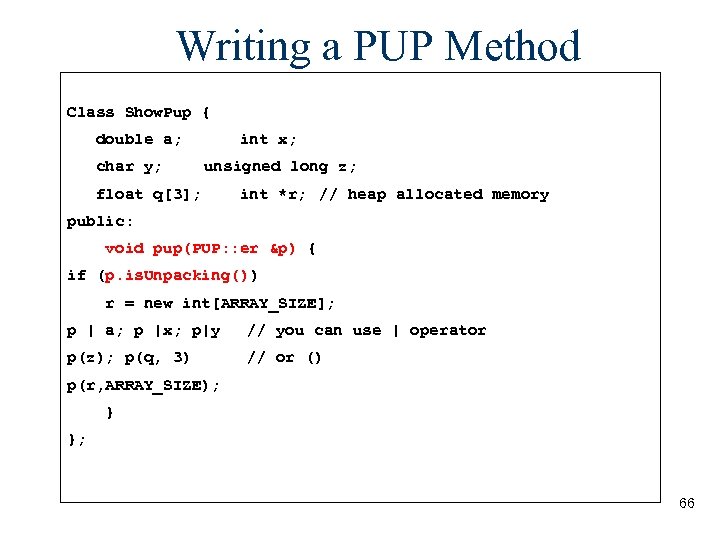
Writing a PUP Method Class Show. Pup { double a; char y; int x; unsigned long z; float q[3]; int *r; // heap allocated memory public: void pup(PUP: : er &p) { if (p. is. Unpacking()) r = new int[ARRAY_SIZE]; p | a; p |x; p|y // you can use | operator p(z); p(q, 3) // or () p(r, ARRAY_SIZE); } }; 66
The Principle of Persistence Big Idea: the past predicts the future Patterns of communication and computation remain nearly constant By measuring these patterns we can improve our load balancing techniques 67
Centralized Load Balancing Uses information about activity on all processors to make load balancing decisions Advantage: Global information gives higher quality balancing Disadvantage: Higher communication costs and latency Algorithms: Greedy, Refine, Recursive Bisection, Metis 68
Neighborhood Load Balancing Load balances among a small set of processors (the neighborhood) Advantage: Lower communication costs Disadvantage: Could leave a system which is poorly balanced globally Algorithms: Neighbor. LB, Workstation. LB 69
When to Re-balance Load? Default: Load balancer will migrate when needed Programmer Control: At. Sync load balancing At. Sync method: enable load balancing at specific point – Object ready to migrate – Re-balance if needed – At. Sync() called when your chare is ready to be load balanced • load balancing may not start right away – Resume. From. Sync() called when load balancing for this chare has finished 70
Using a Load Balancer link a LB module – -module <strategy> – Refine. LB, Neighbor. LB, Greedy. Comm. LB, others… – Every. LB will include all load balancing strategies compile time option (specify default balancer) – -balancer Refine. LB runtime option – +balancer Refine. LB 71
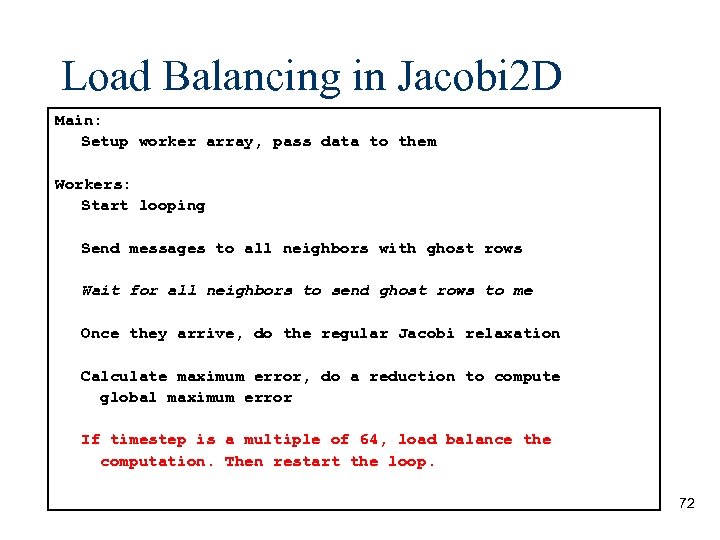
Load Balancing in Jacobi 2 D Main: Setup worker array, pass data to them Workers: Start looping Send messages to all neighbors with ghost rows Wait for all neighbors to send ghost rows to me Once they arrive, do the regular Jacobi relaxation Calculate maximum error, do a reduction to compute global maximum error If timestep is a multiple of 64, load balance the computation. Then restart the loop. 72
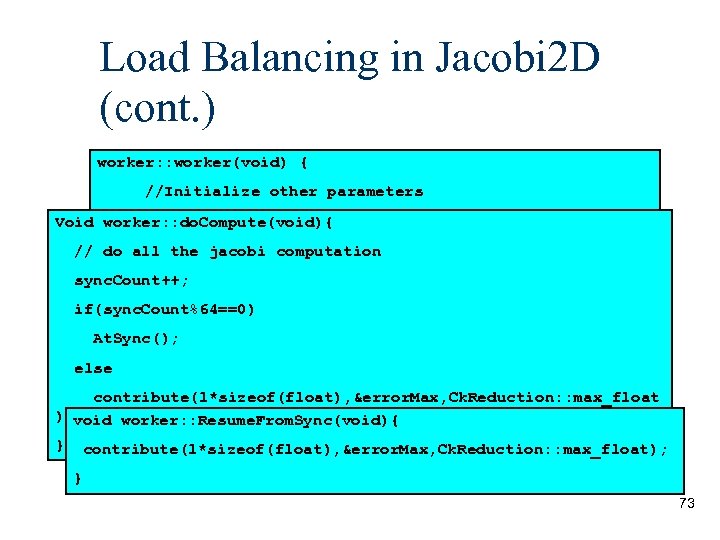
Load Balancing in Jacobi 2 D (cont. ) worker: : worker(void) { //Initialize other parameters Void worker: : do. Compute(void){ uses. At. Sync=Cmi. True; // } all the jacobi computation do sync. Count++; if(sync. Count%64==0) At. Sync(); else contribute(1*sizeof(float), &error. Max, Ck. Reduction: : max_float ); void worker: : Resume. From. Sync(void){ } contribute(1*sizeof(float), &error. Max, Ck. Reduction: : max_float); } 73
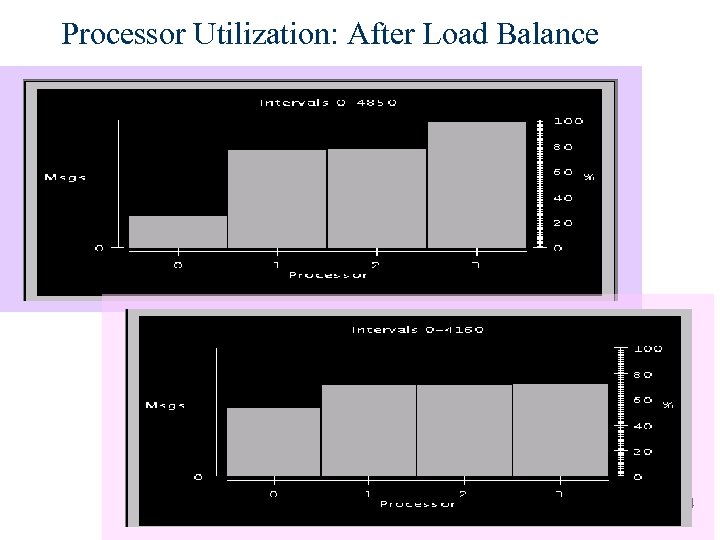
Processor Utilization: After Load Balance 74
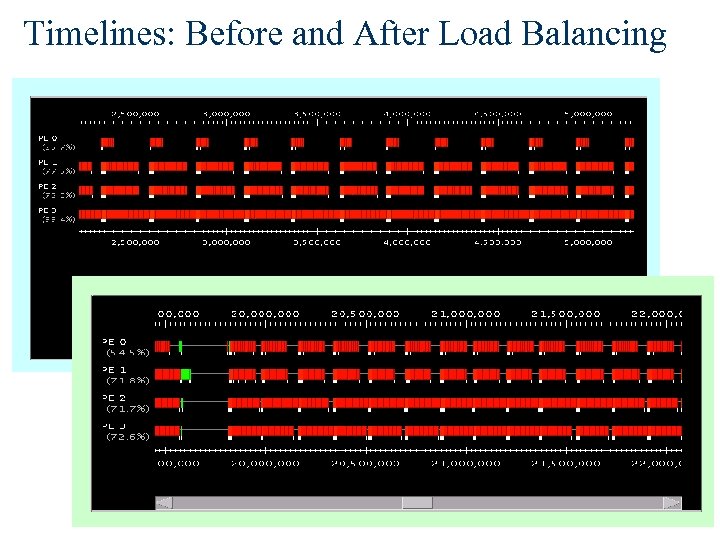
Timelines: Before and After Load Balancing 75
Advanced Features Groups Node Groups Priorities Entry Method Attributes Communications Optimization Checkpoint/Restart 76
Conclusions Better Software Engineering – Logical Units decoupled from number of processors – Adaptive overlap between computation and communication – Automatic load balancing and profiling Powerful Parallel Tools – Projections – Parallel Debugger – Live. Viz 77
More Information http: //charm. cs. uiuc. edu – Manuals – Papers – Download files – FAQs ppl@cs. uiuc. edu 78
Скачать презентацию Charm Tutorial Presented by Laxmikant V Kale Kumaresh
2dd81943cfcce96cb84ef4151324c593.ppt