


 Скачать презентацию Charm Production In Au Au d Au and
0bc2ae6c94a1cf986c86cf4b10ef9241.ppt
- Количество слайдов: 24
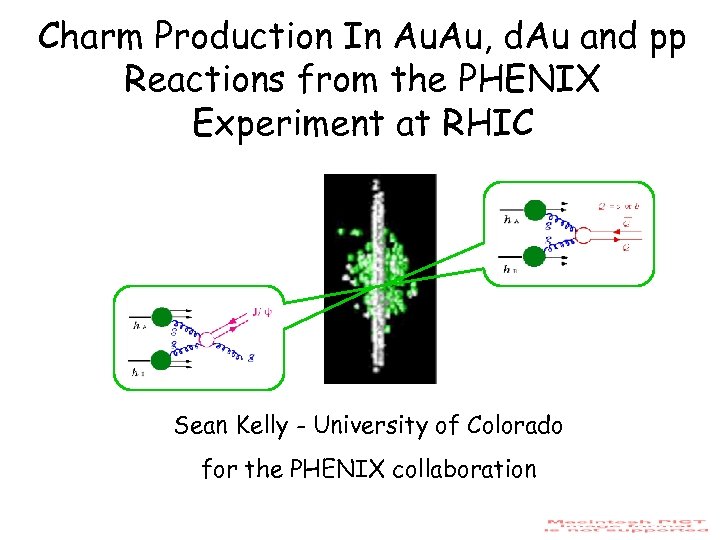 Charm Production In Au. Au, d. Au and pp Reactions from the PHENIX Experiment at RHIC Sean Kelly - University of Colorado for the PHENIX collaboration
 Brazil China University of São Paulo, São Paulo Academia Sinica, Taipei, Taiwan China Institute of Atomic Energy, Beijing Peking University, Beijing France LPC, University de Clermont-Ferrand, Clermont-Ferrand Dapnia, CEA Saclay, Gif-sur-Yvette IPN-Orsay, Universite Paris Sud, CNRS-IN 2 P 3, Orsay LLR, Ecòle Polytechnique, CNRS-IN 2 P 3, Palaiseau SUBATECH, Ecòle des Mines at Nantes, Nantes Germany University of Münster, Münster Hungary Central Research Institute for Physics (KFKI), Budapest Debrecen University, Debrecen Eötvös Loránd University (ELTE), Budapest India Banaras Hindu University, Banaras Bhabha Atomic Research Centre, Bombay Israel Weizmann Institute, Rehovot Japan Center for Nuclear Study, University of Tokyo, Tokyo Hiroshima University, Higashi-Hiroshima KEK, Institute for High Energy Physics, Tsukuba Kyoto University, Kyoto Nagasaki Institute of Applied Science, Nagasaki RIKEN, Institute for Physical and Chemical Research, Wako RIKEN-BNL Research Center, Upton, NY USA Rikkyo University, Tokyo, Japan Tokyo Institute of Technology, Tokyo University of Tsukuba, Tsukuba Waseda University, Tokyo S. Korea Cyclotron Application Laboratory, KAERI, Seoul Kangnung National University, Kangnung Korea University, Seoul Myong Ji University, Yongin City System Electronics Laboratory, Seoul Nat. University, Seoul Yonsei University, Seoul Russia Institute of High Energy Physics, Protovino Joint Institute for Nuclear Research, Dubna Kurchatov Institute, Moscow PNPI, St. Petersburg Nuclear Physics Institute, St. Petersburg State Technical University, St. Petersburg Sweden Lund University, Lund 12 Countries; 58 Institutions; 480 Participants* *as of January 2004 Abilene Christian University, Abilene, TX Brookhaven National Laboratory, Upton, NY University of California - Riverside, CA University of Colorado, Boulder, CO Columbia University, Nevis Laboratories, Irvington, NY Florida State University, Tallahassee, FL Florida Technical University, Melbourne, FL Georgia State University, Atlanta, GA University of Illinois Urbana Champaign, Urbana-Champaign, IL Iowa State University and Ames Laboratory, Ames, IA Los Alamos National Laboratory, Los Alamos, NM Lawrence Livermore National Laboratory, Livermore, CA University of New Mexico, Albuquerque, NM New Mexico State University, Las Cruces, NM Dept. of Chemistry, Stony Brook Univ. , Stony Brook, NY Dept. Phys. and Astronomy, Stony Brook Univ. , Stony Brook, NY Oak Ridge National Laboratory, Oak Ridge, TN University of Tennessee, Knoxville, TN Vanderbilt University, Nashville, TN
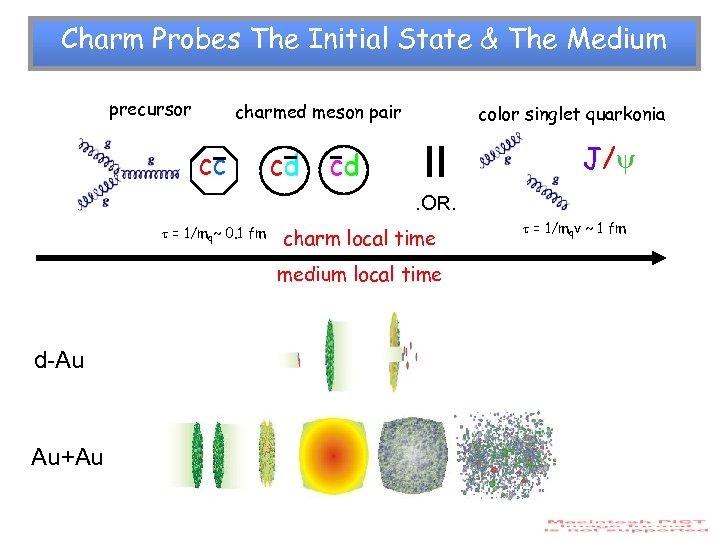 Charm Probes The Initial State & The Medium precursor charmed meson pair cc cd color singlet quarkonia J/ cd. OR. = 1/mq~ 0. 1 fm charm local time medium local time d-Au Au+Au = 1/mqv ~ 1 fm
 Outline PHENIX Data • Single Electron Spectra (pp, d. Au, Au. Au) • Electron v 2 The PHYSICS These Data Address • Nuclear modifications to total charm production • Nuclear modifications to the charm spectrum • Charm dynamics in mediu, do charm quarks flow ?
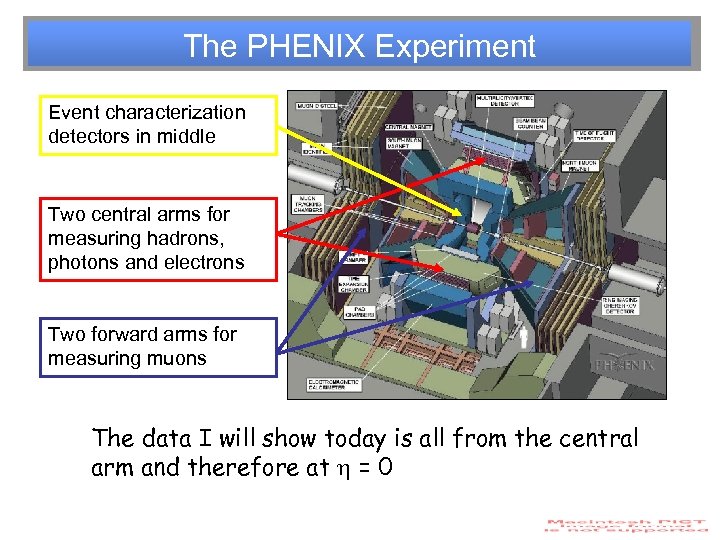 The PHENIX Experiment At RHIC The PHENIX Experiment Event characterization detectors in middle Two central arms for measuring hadrons, photons and electrons Two forward arms for measuring muons The data I will show today is all from the central arm and therefore at = 0
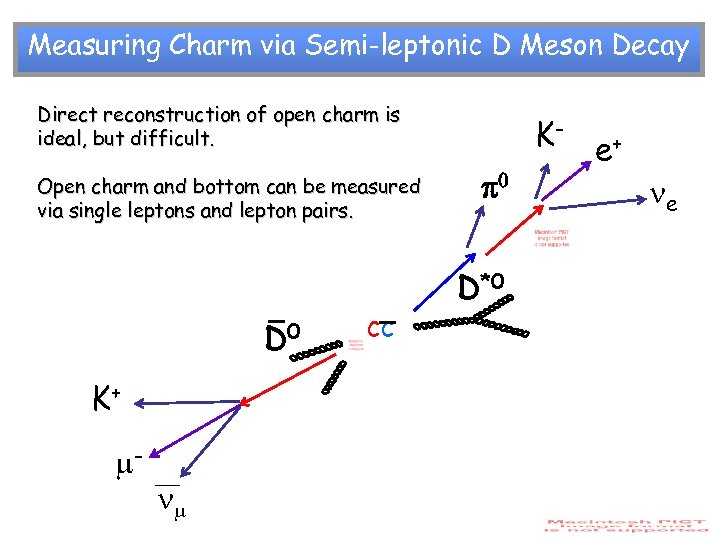 Measuring Charm via Semi-leptonic D Meson Decay Direct reconstruction of open charm is ideal, but difficult. Open charm and bottom can be measured via single leptons and lepton pairs. D 0 K+ m- nm cc p 0 D*0 K- e+ ne
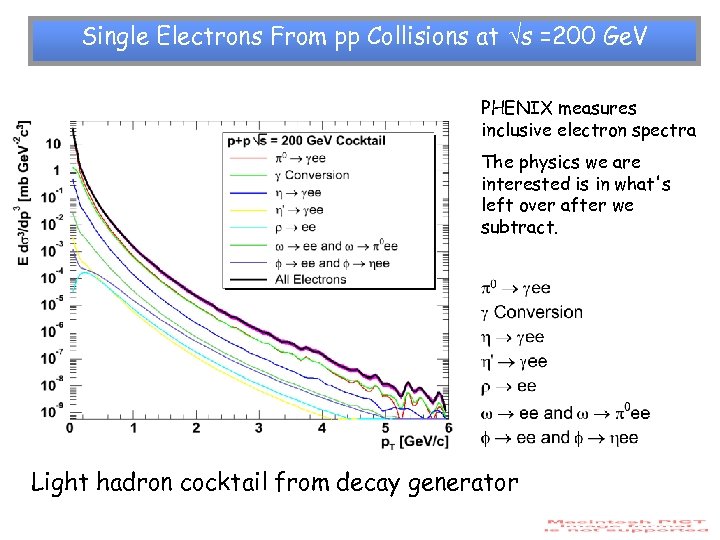 Single Electrons From pp Collisions at s =200 Ge. V PHENIX measures inclusive electron spectra The physics we are interested is in what's left over after we subtract. Light hadron cocktail from decay generator
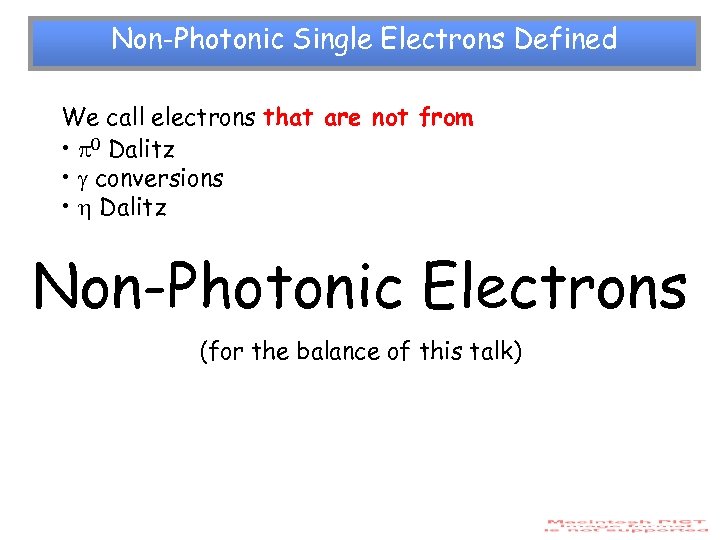 Non-Photonic Single Electrons Defined We call electrons that are not from • 0 Dalitz • conversions • Dalitz Non-Photonic Electrons (for the balance of this talk)
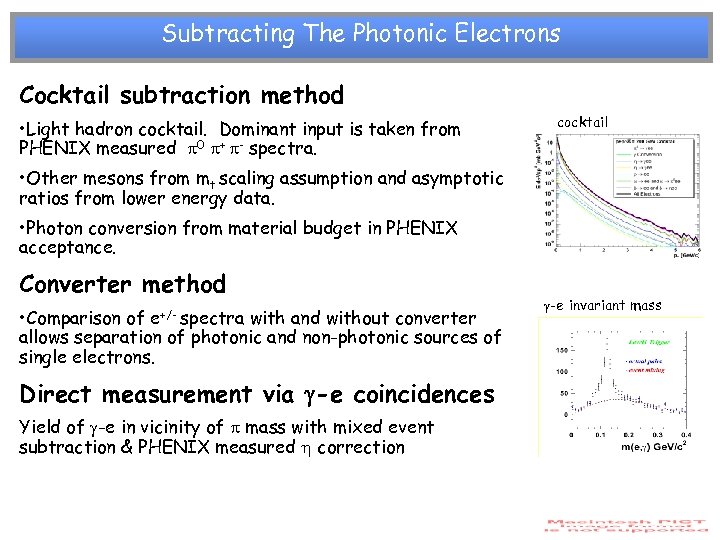 Subtracting The Photonic Electrons Cocktail subtraction method • Light hadron cocktail. Dominant input is taken from PHENIX measured 0 + - spectra. cocktail • Other mesons from mt scaling assumption and asymptotic ratios from lower energy data. • Photon conversion from material budget in PHENIX acceptance. Converter method • Comparison of e+/- spectra with and without converter allows separation of photonic and non-photonic sources of single electrons. Direct measurement via -e coincidences Yield of -e in vicinity of mass with mixed event subtraction & PHENIX measured correction -e invariant mass
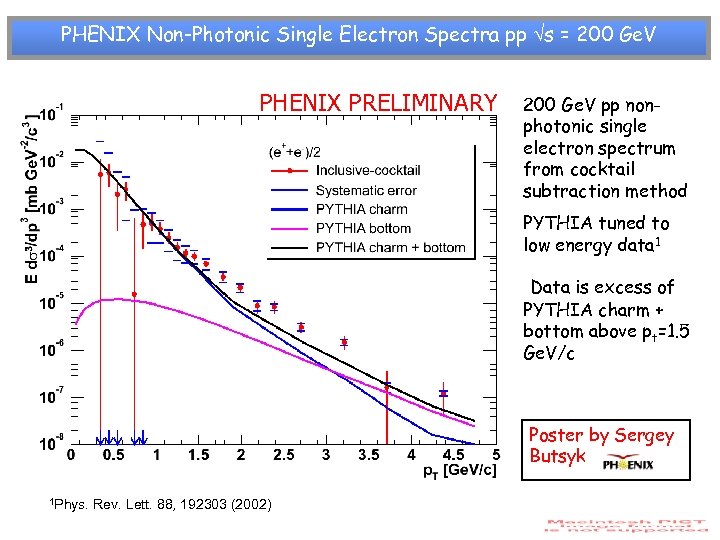 PHENIX Non-Photonic Single Electron Spectra pp s = 200 Ge. V PHENIX PRELIMINARY 200 Ge. V pp nonphotonic single electron spectrum from cocktail subtraction method PYTHIA tuned to low energy data 1 Data is excess of PYTHIA charm + bottom above pt=1. 5 Ge. V/c Poster by Sergey Butsyk 1 Phys. Rev. Lett. 88, 192303 (2002)
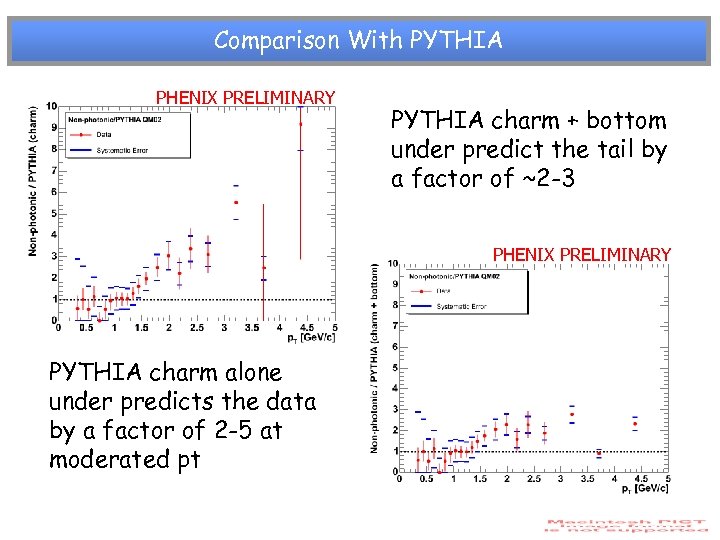 Comparison With PYTHIA PHENIX PRELIMINARY PYTHIA charm + bottom under predict the tail by a factor of ~2 -3 PHENIX PRELIMINARY PYTHIA charm alone under predicts the data by a factor of 2 -5 at moderated pt
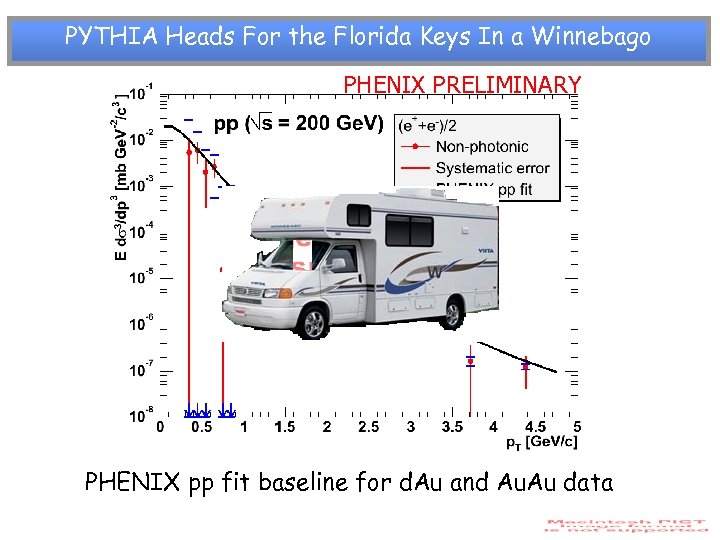 PYTHIA Heads For the Florida Keys In a Winnebago PHENIX PRELIMINARY PHENIX pp fit baseline for d. Au and Au. Au data
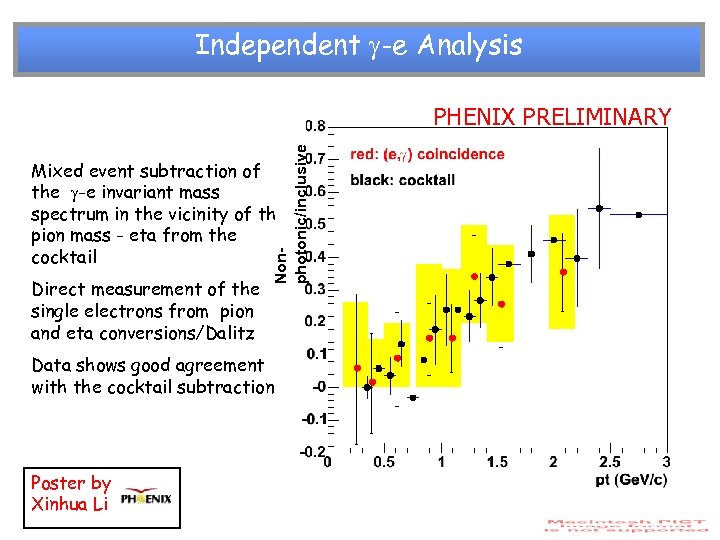 Independent -e Analysis Nonphotonic/inclusive PHENIX PRELIMINARY Mixed event subtraction of the -e invariant mass spectrum in the vicinity of the pion mass - eta from the cocktail Direct measurement of the single electrons from pion and eta conversions/Dalitz Data shows good agreement with the cocktail subtraction Poster by Xinhua Li
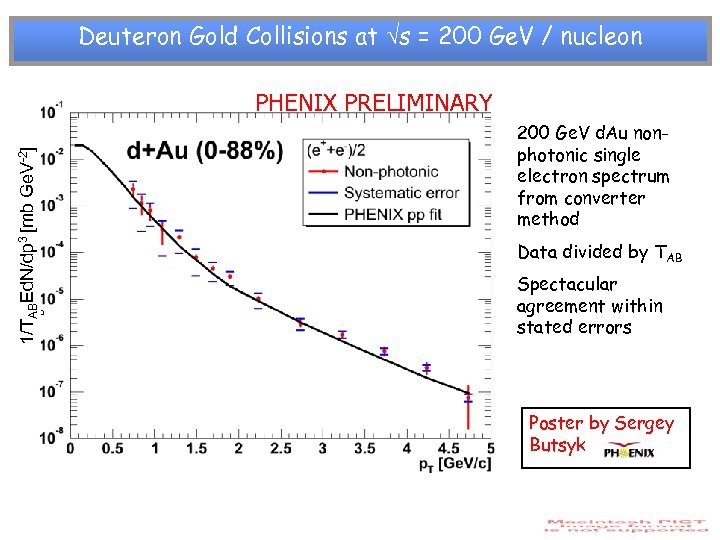 Deuteron Gold Collisions at s = 200 Ge. V / nucleon B 1/TABEd. N/dp 3 [mb Ge. V-2] PHENIX PRELIMINARY 200 Ge. V d. Au nonphotonic single electron spectrum from converter method Data divided by TAB Spectacular agreement within stated errors Poster by Sergey Butsyk
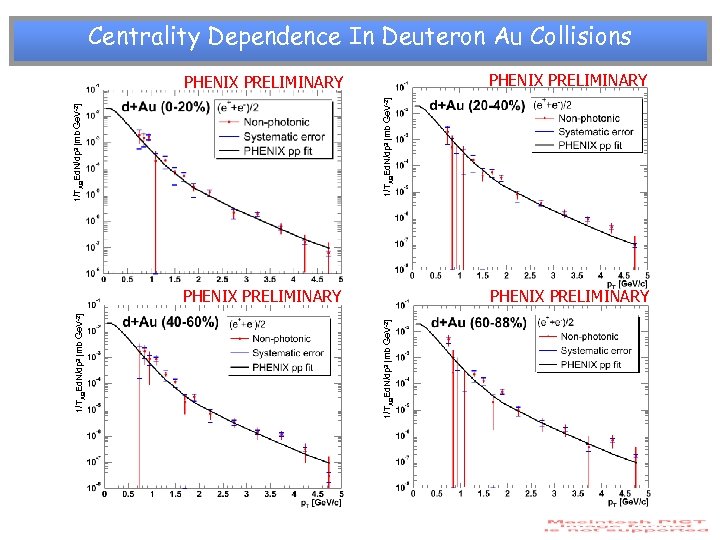 Centrality Dependence In Deuteron Au Collisions PHENIX PRELIMINARY 3 -2 1/TAB Ed. N/dp [mb Ge. V ] 1/TAB Ed. N/dp 3 [mb Ge. V-2] PHENIX PRELIMINARY 1/TABEd. N/dp 3 [mb Ge. V-2] 1/TAB 3 -2 1/TAB Ed. N/dp [mb Ge. V ] PHENIX PRELIMINARY
![Ge. V-2] Single Electron Spectra Au+Au s = 200 Ge. V ABEd. N/dp 3](https://present5.com/presentation/0bc2ae6c94a1cf986c86cf4b10ef9241/image-16.jpg "Ge. V-2] Single Electron Spectra Au+Au s = 200 Ge. V ABEd. N/dp 3") Ge. V-2] Single Electron Spectra Au+Au s = 200 Ge. V ABEd. N/dp 3 [mb 200 Ge. V Au+Au nonphotonic single electron spectrum from converter method A 1/T Data is divided by TAA and overlaid with PHENIX pp fit At low pt the pp fit is in good agreement Poster by Takashi Hachiya
Ge. V-2] Single Electron Spectra Au+Au s = 200 Ge. V ABEd. N/dp 3 [mb 200 Ge. V Au+Au nonphotonic single electron spectrum from converter method A 1/T Data is divided by TAA and overlaid with PHENIX pp fit At low pt the pp fit is in good agreement Poster by Takashi Hachiya
![1/TAA 1/TABEd. N/dp 3 [mb Ge. V-2] AA 1/TAB 1/T Ed. N/dp 3 [mb](https://present5.com/presentation/0bc2ae6c94a1cf986c86cf4b10ef9241/image-17.jpg "1/TAA 1/TABEd. N/dp 3 [mb Ge. V-2] AA 1/TAB 1/T Ed. N/dp 3 [mb") 1/TAA 1/TABEd. N/dp 3 [mb Ge. V-2] AA 1/TAB 1/T Ed. N/dp 3 [mb Ge. V-2] AA 3 -2 1/TABEd. N/dp 3 [mb Ge. V-2] ABEd. N/dp [mb Ge. V ] 1/T 3 -2 1/TAAABEd. N/dp [mb Ge. V ] 3 -2 1/TAB 1/TAA Ed. N/dp [mb Ge. V ] Centrality Dependence Au+Au
1/TAA 1/TABEd. N/dp 3 [mb Ge. V-2] AA 1/TAB 1/T Ed. N/dp 3 [mb Ge. V-2] AA 3 -2 1/TABEd. N/dp 3 [mb Ge. V-2] ABEd. N/dp [mb Ge. V ] 1/T 3 -2 1/TAAABEd. N/dp [mb Ge. V ] 3 -2 1/TAB 1/TAA Ed. N/dp [mb Ge. V ] Centrality Dependence Au+Au
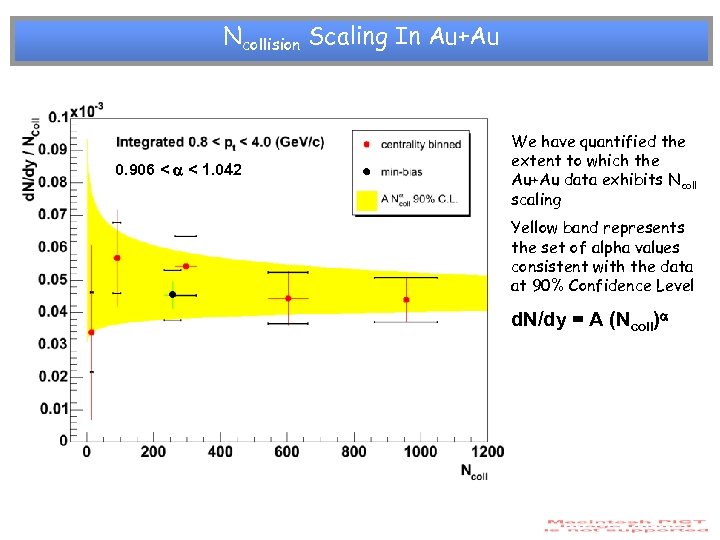 Ncollision Scaling In Au+Au 0. 906 < < 1. 042 We have quantified the extent to which the Au+Au data exhibits Ncoll scaling Yellow band represents the set of alpha values consistent with the data at 90% Confidence Level d. N/dy = A (Ncoll)
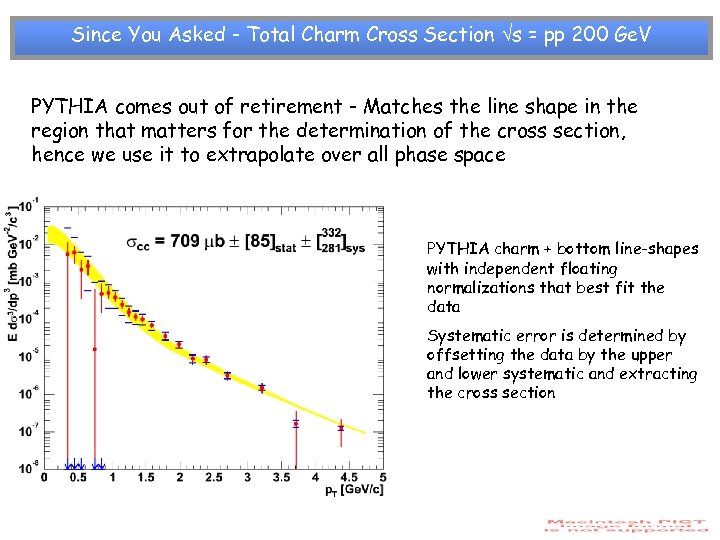 Since You Asked - Total Charm Cross Section s = pp 200 Ge. V PYTHIA comes out of retirement - Matches the line shape in the region that matters for the determination of the cross section, hence we use it to extrapolate over all phase space N PHENIX PRELIMINARY PYTHIA charm + bottom line-shapes with independent floating normalizations that best fit the data Systematic error is determined by offsetting the data by the upper and lower systematic and extracting the cross section
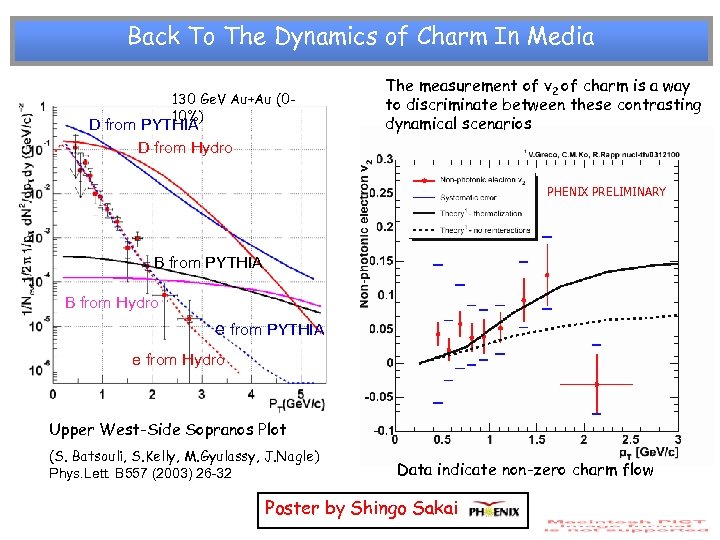 Back To The Dynamics of Charm In Media 130 Ge. V Au+Au (010%) D from PYTHIA D from Hydro The measurement of v 2 of charm is a way to discriminate between these contrasting dynamical scenarios PHENIX PRELIMINARY B from PYTHIA B from Hydro e from PYTHIA e from Hydro Upper West-Side Sopranos Plot (S. Batsouli, S. Kelly, M. Gyulassy, J. Nagle) Phys. Lett. B 557 (2003) 26 -32 Data indicate non-zero charm flow Poster by Shingo Sakai
 Summary & Conclusions PHENIX has measured inclusive single electrons in pp, d+Au, and Au+Au at 200 Ge. V/nucleon. The measured yield of non-photonic electrons is consistent with binary scaling in d+Au and Au+Au collisions. Indicating no strong enhancement or suppression of the charm cross section in nuclear systems. We are statistics limited regarding the presence of spectral modifications in the Au+Au data. With anticipated Run 4 statistics the indications for spectral modifications in Au+Au and v 2 should be definitive. Run 4 is the run for closed and open charm physics in Au+Au collisions.
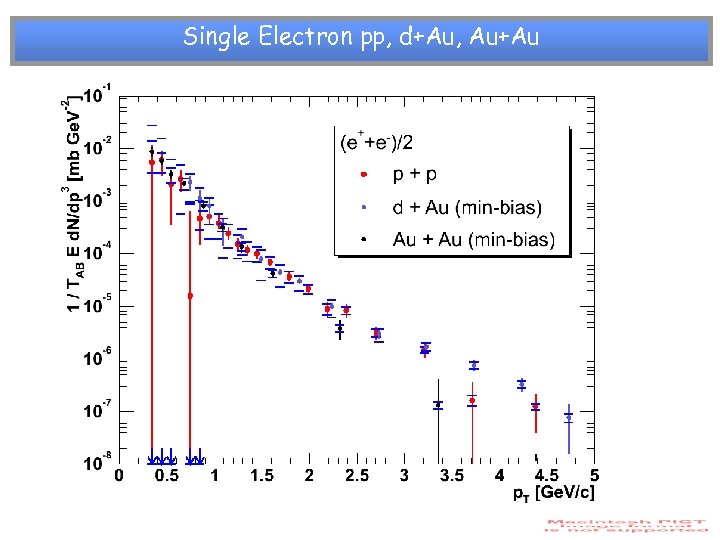 Single Electron pp, d+Au, Au+Au
 Backup
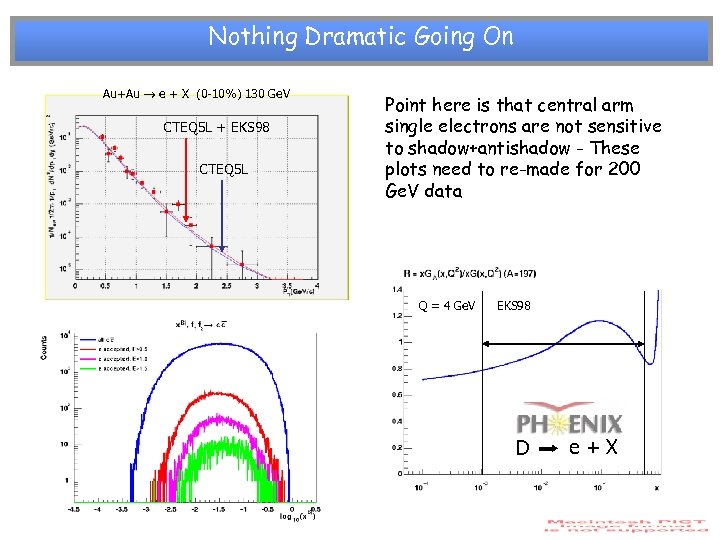 Nothing Dramatic Going On Au+Au e + X (0 -10%) 130 Ge. V CTEQ 5 L + EKS 98 CTEQ 5 L Point here is that central arm single electrons are not sensitive to shadow+antishadow - These plots need to re-made for 200 Ge. V data Q = 4 Ge. V EKS 98 D e+X