


 Скачать презентацию Charged Particle Multiplicity at Mid Rapidity in Au-Au
083eea403ffed005b031745e69f9bf2e.ppt
- Количество слайдов: 27
 Charged Particle Multiplicity at Mid. Rapidity in Au-Au Collisions at RHIC David Silvermyr Div. of Cosmic and Subatomic Physics Lund University
 Outline Predictions for d. Nch/dh at mid-rapidity Detectors used in this analysis Multiplicity analysis @ 130 Ge. V Energy scaling of charged particle multiplicities, from AGS to RHIC Multiplicity results @ 200 Ge. V, predictions for LHC.
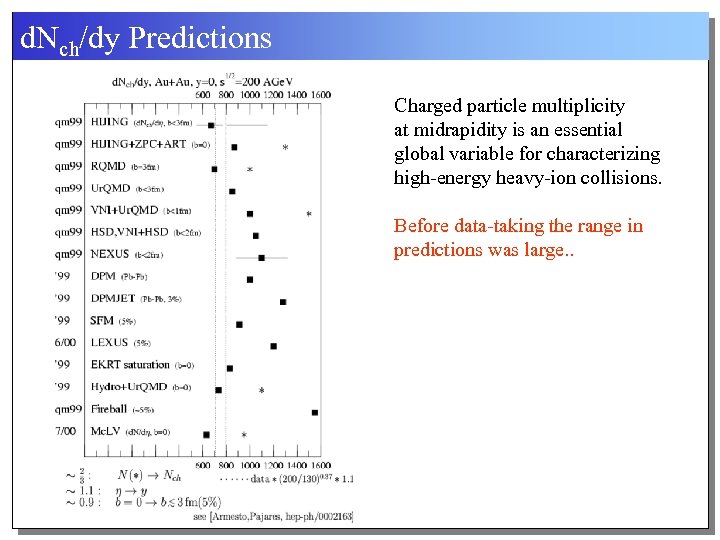 d. Nch/dy Predictions Charged particle multiplicity at midrapidity is an essential global variable for characterizing high-energy heavy-ion collisions. Before data-taking the range in predictions was large. .
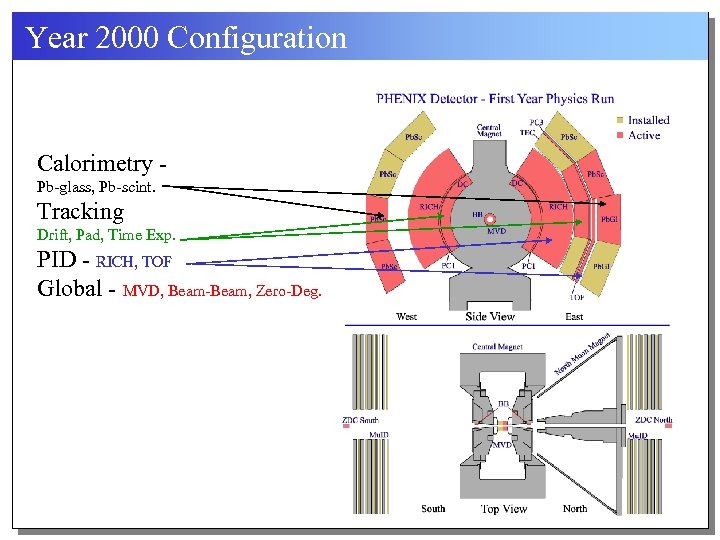 Year 2000 Configuration Calorimetry Pb-glass, Pb-scint. Tracking Drift, Pad, Time Exp. PID - RICH, TOF Global - MVD, Beam-Beam, Zero-Deg.
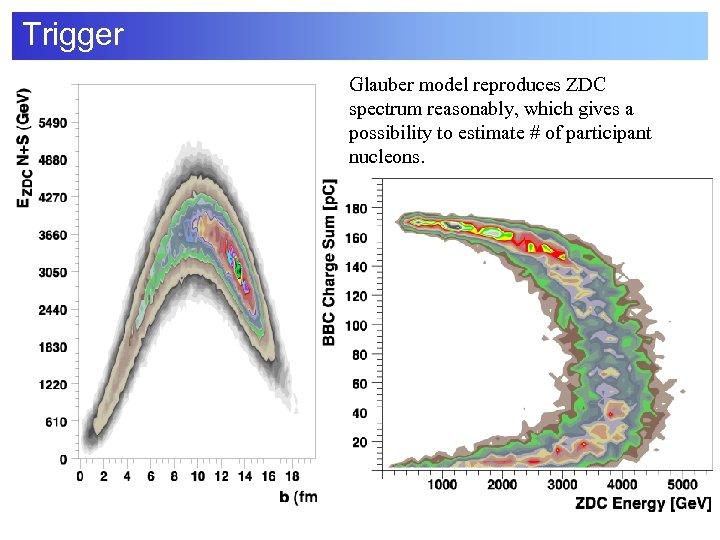 Trigger Glauber model reproduces ZDC spectrum reasonably, which gives a possibility to estimate # of participant nucleons.
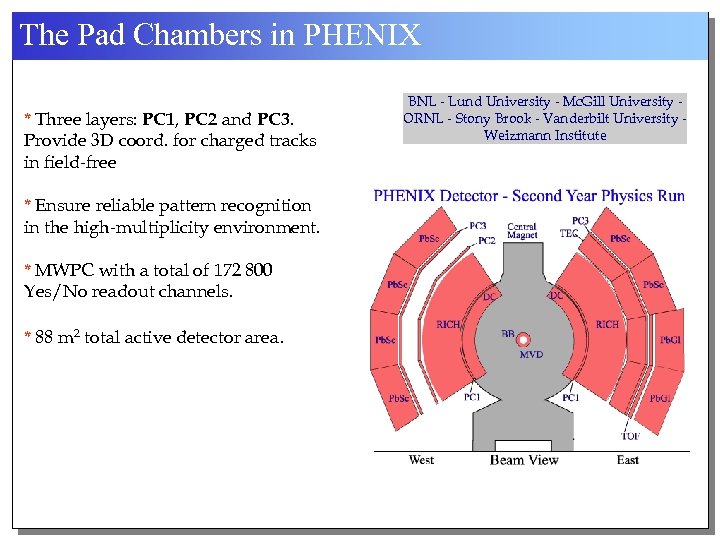 The Pad Chambers in PHENIX * Three layers: PC 1, PC 2 and PC 3. Provide 3 D coord. for charged tracks in field-free * Ensure reliable pattern recognition in the high-multiplicity environment. * MWPC with a total of 172 800 Yes/No readout channels. * 88 m 2 total active detector area. BNL - Lund University - Mc. Gill University ORNL - Stony Brook - Vanderbilt University Weizmann Institute
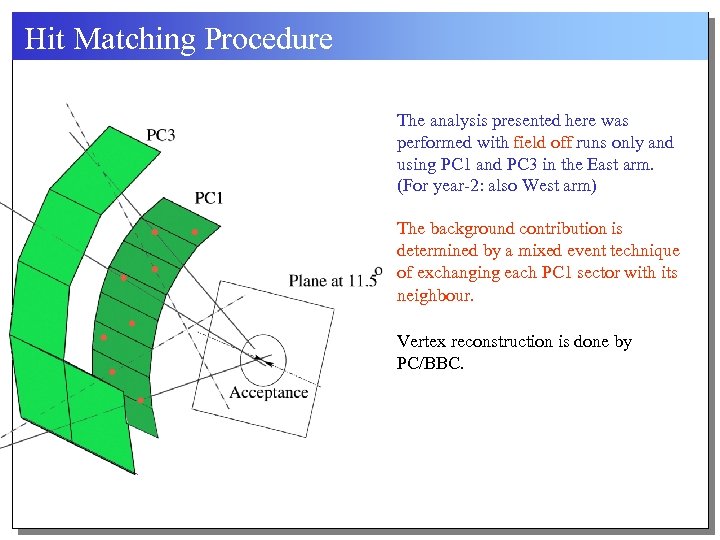 Hit Matching Procedure The analysis presented here was performed with field off runs only and using PC 1 and PC 3 in the East arm. (For year-2: also West arm) The background contribution is determined by a mixed event technique of exchanging each PC 1 sector with its neighbour. Vertex reconstruction is done by PC/BBC.
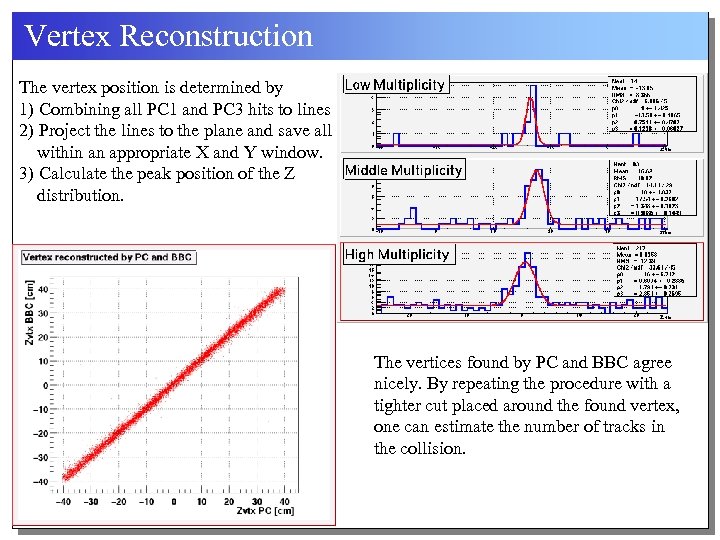 Vertex Reconstruction The vertex position is determined by 1) Combining all PC 1 and PC 3 hits to lines 2) Project the lines to the plane and save all within an appropriate X and Y window. 3) Calculate the peak position of the Z distribution. The vertices found by PC and BBC agree nicely. By repeating the procedure with a tighter cut placed around the found vertex, one can estimate the number of tracks in the collision.
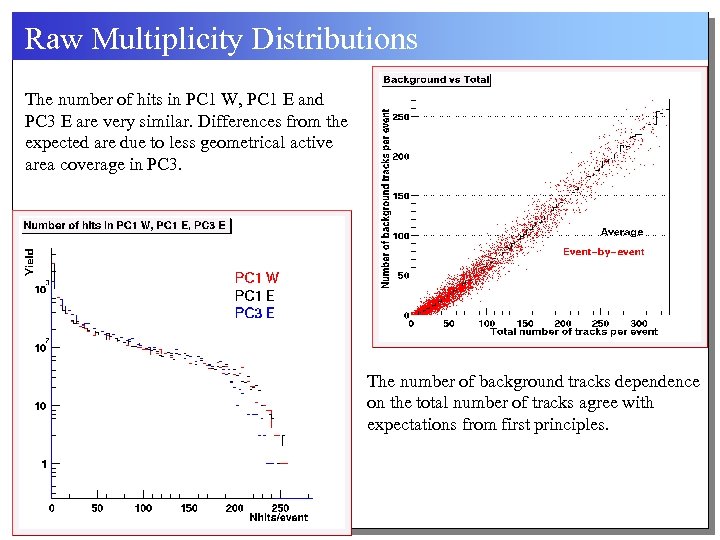 Raw Multiplicity Distributions The number of hits in PC 1 W, PC 1 E and PC 3 E are very similar. Differences from the expected are due to less geometrical active area coverage in PC 3. The number of background tracks dependence on the total number of tracks agree with expectations from first principles.
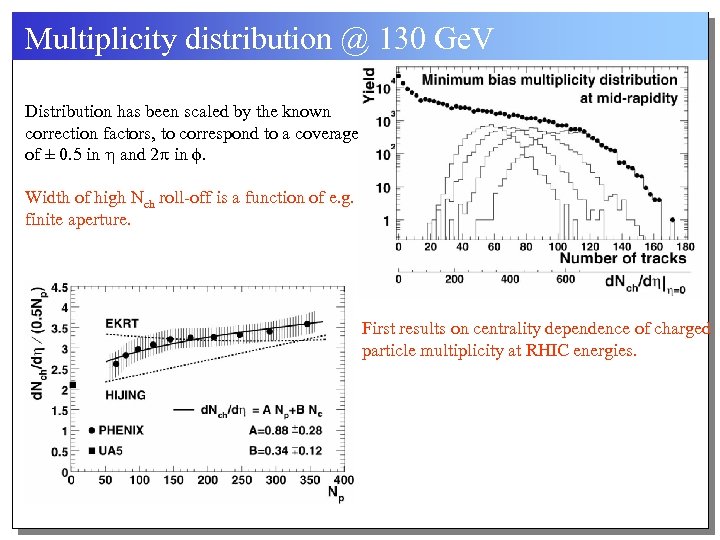 Multiplicity distribution @ 130 Ge. V Distribution has been scaled by the known correction factors, to correspond to a coverage of ± 0. 5 in h and 2 p in f. Width of high Nch roll-off is a function of e. g. finite aperture. First results on centrality dependence of charged particle multiplicity at RHIC energies.
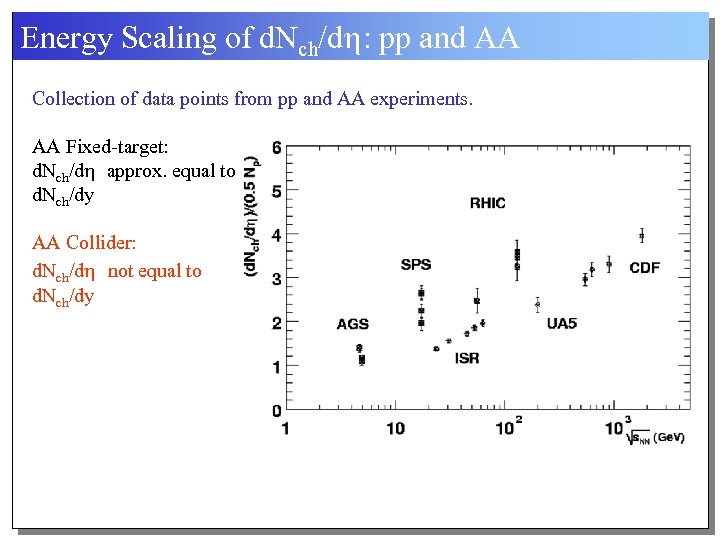 Energy Scaling of d. Nch/dh: pp and AA Collection of data points from pp and AA experiments. AA Fixed-target: d. Nch/dh approx. equal to d. Nch/dy AA Collider: d. Nch/dh not equal to d. Nch/dy
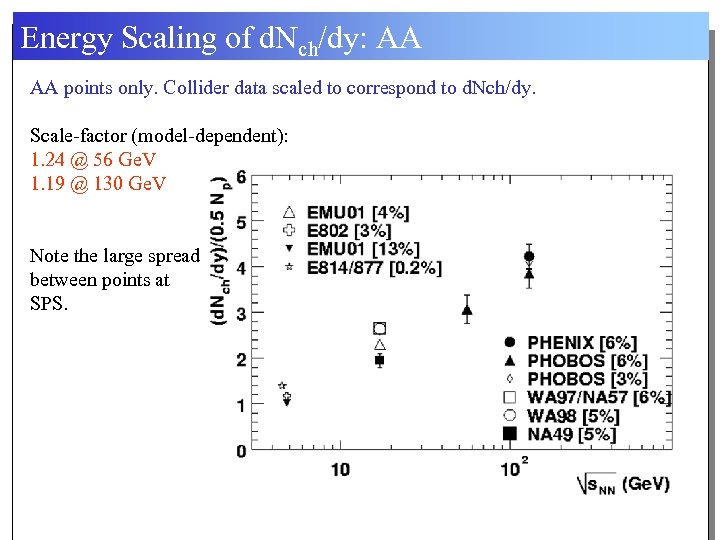 Energy Scaling of d. Nch/dy: AA AA points only. Collider data scaled to correspond to d. Nch/dy. Scale-factor (model-dependent): 1. 24 @ 56 Ge. V 1. 19 @ 130 Ge. V Note the large spread between points at SPS.
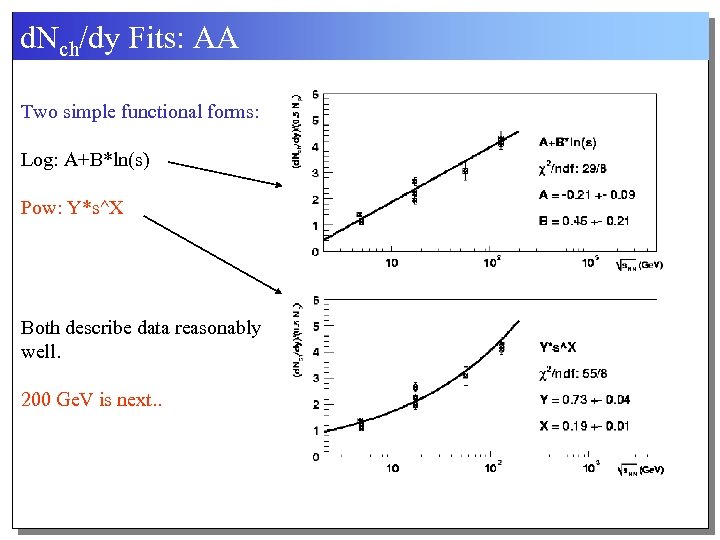 d. Nch/dy Fits: AA Two simple functional forms: Log: A+B*ln(s) Pow: Y*s^X Both describe data reasonably well. 200 Ge. V is next. .
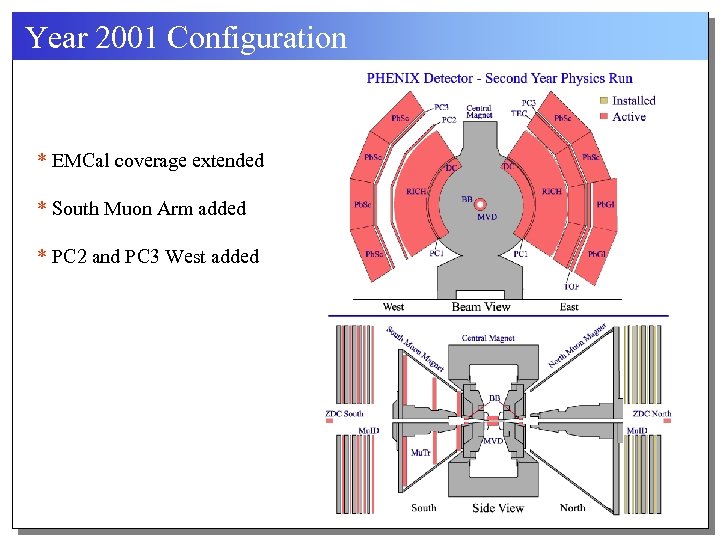 Year 2001 Configuration * EMCal coverage extended * South Muon Arm added * PC 2 and PC 3 West added
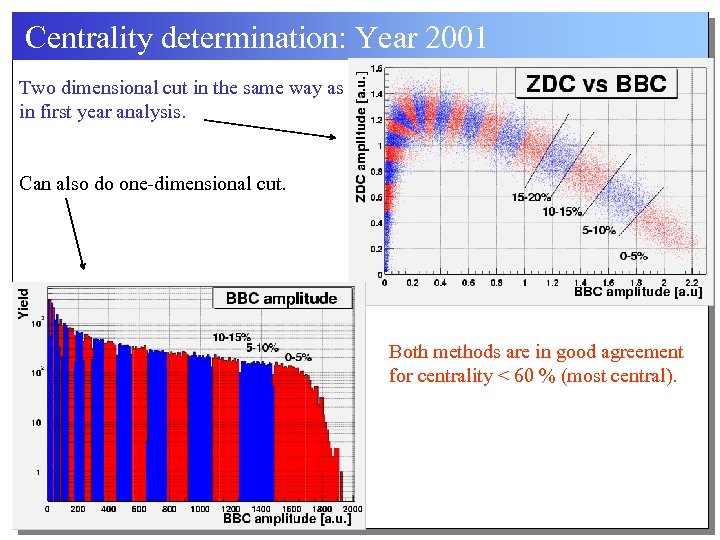 Centrality determination: Year 2001 Two dimensional cut in the same way as in first year analysis. Can also do one-dimensional cut. Both methods are in good agreement for centrality < 60 % (most central).
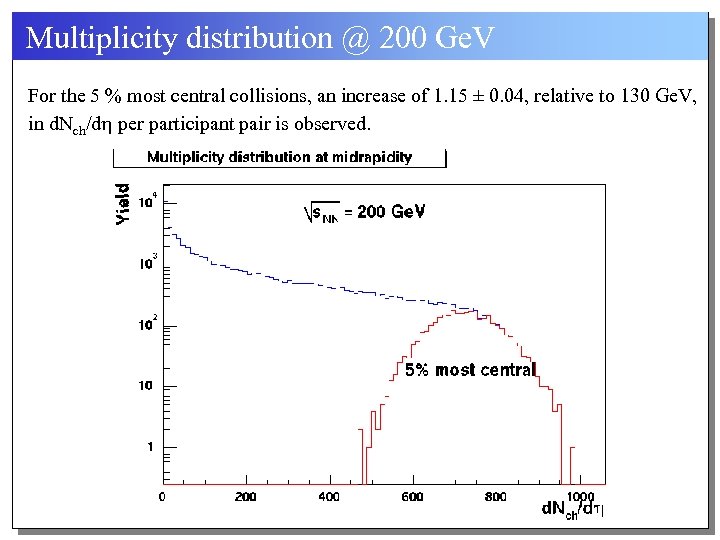 Multiplicity distribution @ 200 Ge. V For the 5 % most central collisions, an increase of 1. 15 ± 0. 04, relative to 130 Ge. V, in d. Nch/dh per participant pair is observed.
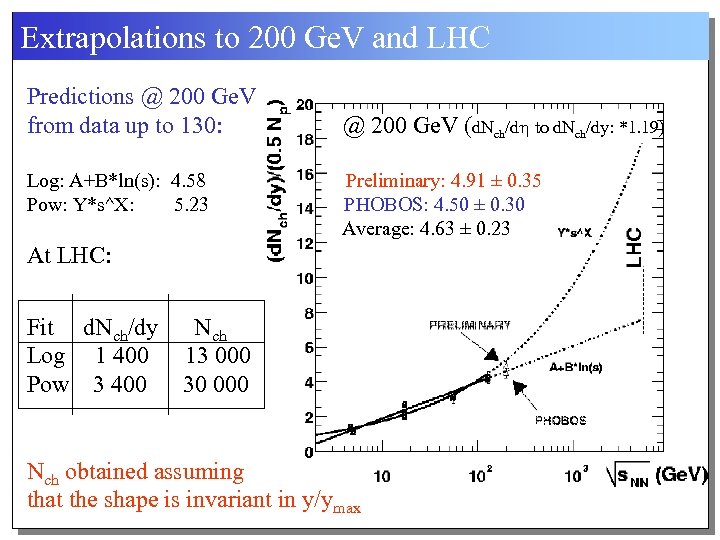 Extrapolations to 200 Ge. V and LHC Predictions @ 200 Ge. V from data up to 130: Log: A+B*ln(s): 4. 58 Pow: Y*s^X: 5. 23 @ 200 Ge. V (d. Nch/dh to d. Nch/dy: *1. 19) Preliminary: 4. 91 ± 0. 35 PHOBOS: 4. 50 ± 0. 30 Average: 4. 63 ± 0. 23 At LHC: Fit d. Nch/dy Log 1 400 Pow 3 400 Nch 13 000 30 000 Nch obtained assuming that the shape is invariant in y/ymax
 Summary d. Nch/dh analysis at mid-rapidity performed for 200 Ge. V and 130 Ge. V. Increase in d. Nch/dh per participant pair from 130 to 200 Ge. V of a factor 1. 15 ± 0. 04 Logarithmic scaling with s. NN for d. Nch/dy per participant pair describes the data up to 200 Ge. V. If the scaling holds to LHC energies, d. Nch/dy at mid-rapidity will be about 1400 and the total charged particle multiplicity about 13000.
 The PHENIX Collaboration A strongly international venture: è nations 11 Brazil, China, France, Germany, India, Israel, Japan, South Korea, Russia, Sweden, United States è institutions 51
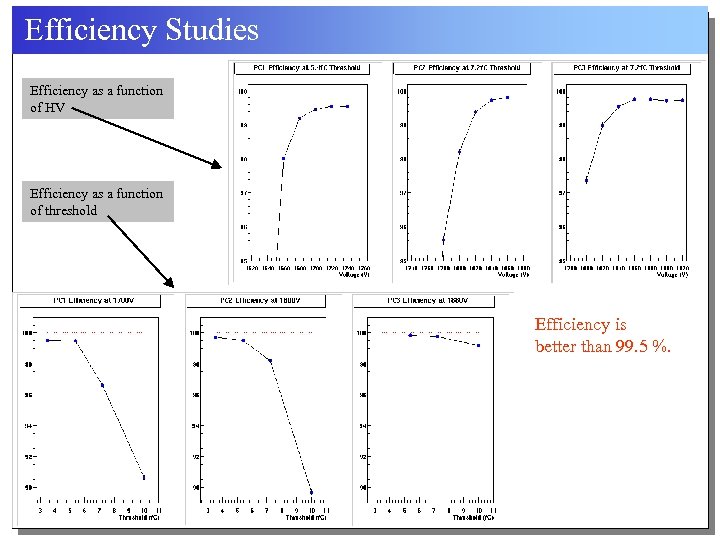 Efficiency Studies Efficiency as a function of HV Efficiency as a function of threshold Efficiency is better than 99. 5 %.
 Binominal Broadening Suppose there are N particles in every event in | h | < 1, full azimuth. Our acceptance covers a fraction p (0 < p < 1) of this interval. On average, we thus see n = N*p in our acceptance, but not in every event. Our variance in n is given by s 2 = N*p*(1 -p) Thus when rescaling to the full acceptance we get N ± 1/p*(N*p*(1 -p))1/2 i. e. a broadening. .
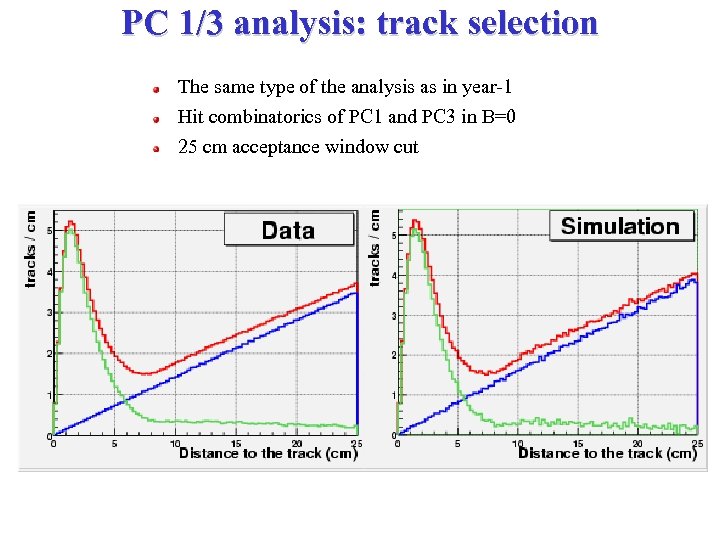 PC 1/3 analysis: track selection The same type of the analysis as in year-1 Hit combinatorics of PC 1 and PC 3 in B=0 25 cm acceptance window cut
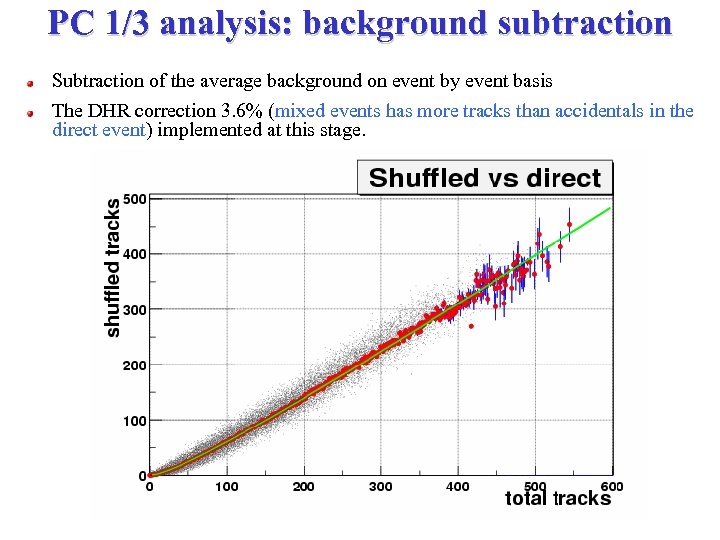 PC 1/3 analysis: background subtraction Subtraction of the average background on event by event basis The DHR correction 3. 6% (mixed events has more tracks than accidentals in the direct event) implemented at this stage.
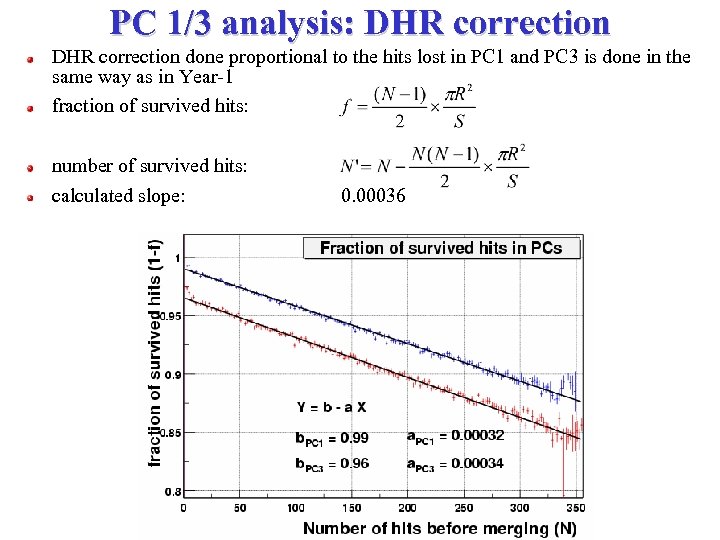 PC 1/3 analysis: DHR correction done proportional to the hits lost in PC 1 and PC 3 is done in the same way as in Year-1 fraction of survived hits: number of survived hits: calculated slope: 0. 00036
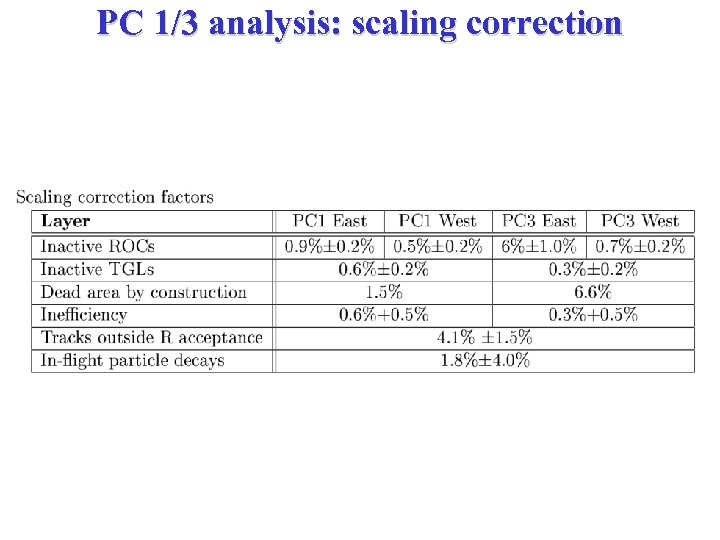 PC 1/3 analysis: scaling correction
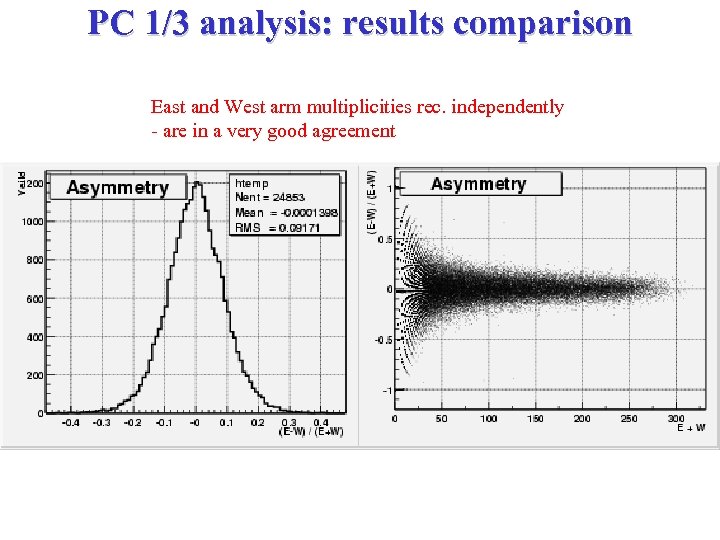 PC 1/3 analysis: results comparison East and West arm multiplicities rec. independently - are in a very good agreement
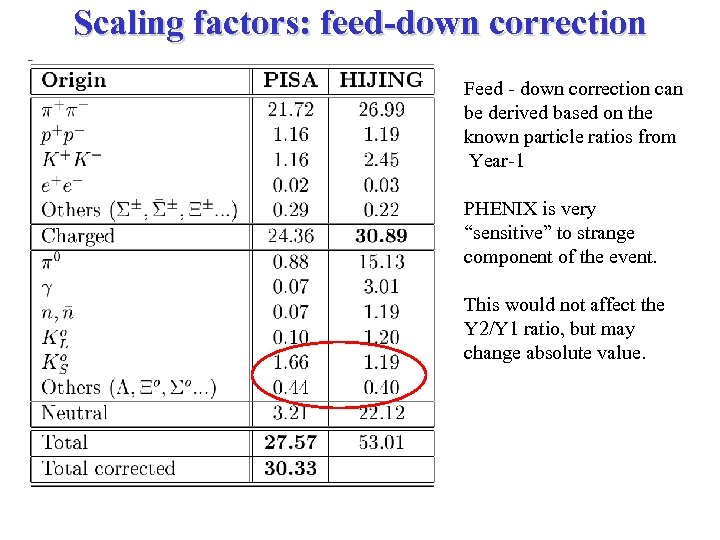 Scaling factors: feed-down correction Feed - down correction can be derived based on the known particle ratios from Year-1 PHENIX is very “sensitive” to strange component of the event. This would not affect the Y 2/Y 1 ratio, but may change absolute value.