 Скачать презентацию Charge-Transfer Fluorescence of Phenylpyrrole PP and Pyrrolobenzonitrile PBN
298fcc62974a90543000c81d7e150c3c.ppt
- Количество слайдов: 1



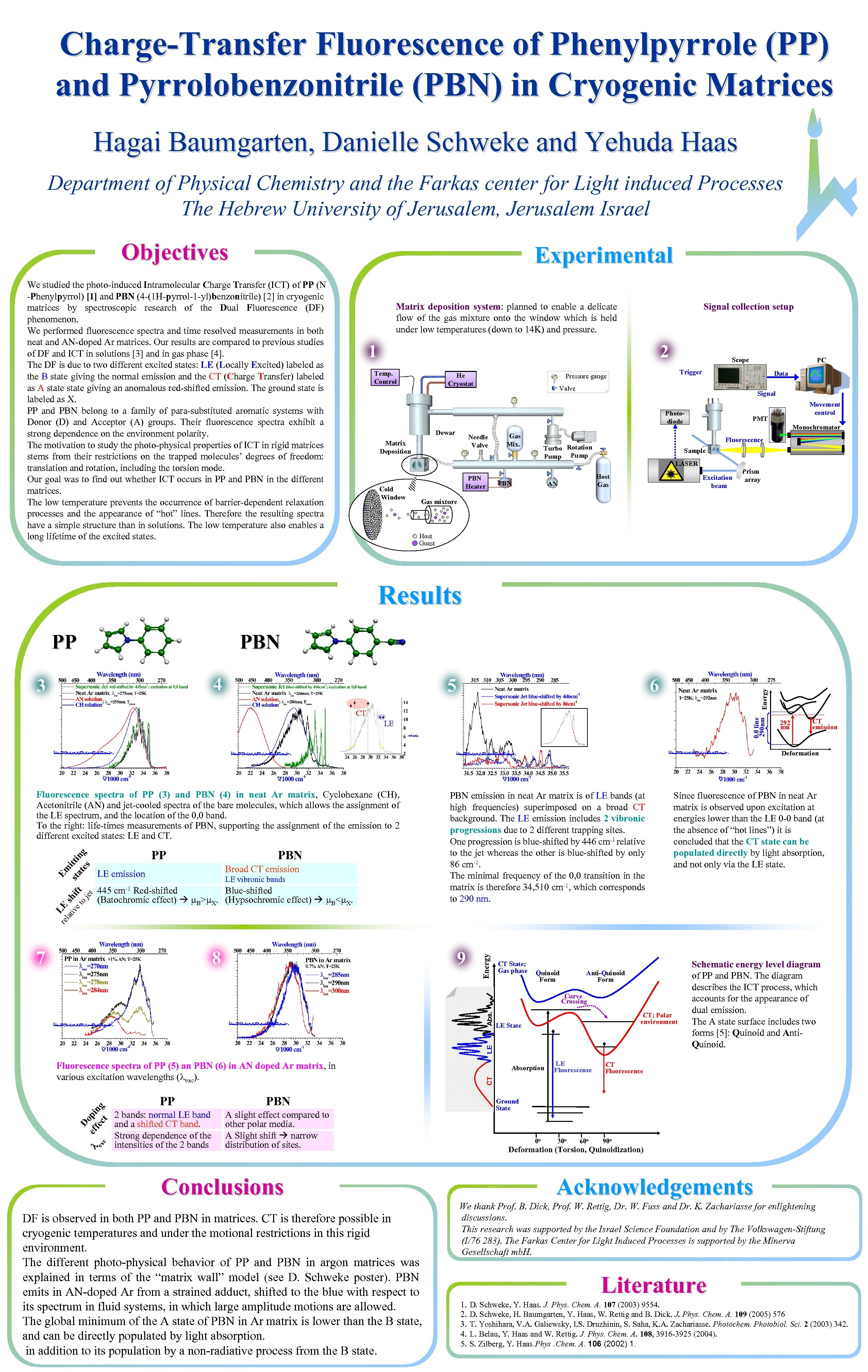
Charge-Transfer Fluorescence of Phenylpyrrole (PP) and Pyrrolobenzonitrile (PBN) in Cryogenic Matrices Hagai Baumgarten, Danielle Schweke and Yehuda Haas Department of Physical Chemistry and the Farkas center for Light induced Processes The Hebrew University of Jerusalem, Jerusalem Israel Objectives Experimental We studied the photo-induced Intramolecular Charge Transfer (ICT) of PP (N -Phenylpyrrol) [1] and PBN (4 -(1 H-pyrrol-1 -yl)benzonitrile) [2] in cryogenic matrices by spectroscopic research of the Dual Fluorescence (DF) phenomenon. We performed fluorescence spectra and time resolved measurements in both neat and AN-doped Ar matrices. Our results are compared to previous studies of DF and ICT in solutions [3] and in gas phase [4]. The DF is due to two different excited states: LE (Locally Excited) labeled as the B state giving the normal emission and the CT (Charge Transfer) labeled as A state giving an anomalous red-shifted emission. The ground state is labeled as X. PP and PBN belong to a family of para-substituted aromatic systems with Donor (D) and Acceptor (A) groups. Their fluorescence spectra exhibit a strong dependence on the environment polarity. The motivation to study the photo-physical properties of ICT in rigid matrices stems from their restrictions on the trapped molecules’ degrees of freedom: translation and rotation, including the torsion mode. Our goal was to find out whether ICT occurs in PP and PBN in the different matrices. The low temperature prevents the occurrence of barrier-dependent relaxation processes and the appearance of “hot” lines. Therefore the resulting spectra have a simple structure than in solutions. The low temperature also enables a long lifetime of the excited states. Matrix deposition system: planned to enable a delicate flow of the gas mixture onto the window which is held under low temperatures (down to 14 K) and pressure. Signal collection setup 1 2 Temp. Control He Cryostat Scope Trigger Pressure gauge Data Valve Signal Photodiode Dewar Needle Valve Matrix Deposition Cold Window PC PBN Heater Gas Mix. Monochromator Sample LASER Host Gas AN PMT Fluorescence Turbo Rotation Pump PBN Movement control Excitation beam Prism array Gas mixture Host Guest Results PBN 4 3 5 6 Energy PP 0, 0 line 290 nm CT LE 292 nm CT emission Deformation Em sta itti te ng s PP PBN Broad CT emission LE vibronic bands re LE lat s iv hi e t ft o jet 445 cm-1 Red-shifted Blue-shifted (Batochromic effect) m. B>m. X. (Hypsochromic effect) m. B<m. X. 7 8 PBN emission in neat Ar matrix is of LE bands (at high frequencies) superimposed on a broad CT background. The LE emission includes 2 vibronic progressions due to 2 different trapping sites. One progression is blue-shifted by 446 cm-1 relative to the jet whereas the other is blue-shifted by only 86 cm-1. The minimal frequency of the 0, 0 transition in the matrix is therefore 34, 510 cm-1, which corresponds to 290 nm. 9 Energy Fluorescence spectra of PP (3) and PBN (4) in neat Ar matrix, Cyclohexane (CH), Acetonitrile (AN) and jet-cooled spectra of the bare molecules, which allows the assignment of the LE spectrum, and the location of the 0, 0 band. To the right: life-times measurements of PBN, supporting the assignment of the emission to 2 different excited states: LE and CT. CT State; Gas phase Quinoid Form Since fluorescence of PBN in neat Ar matrix is observed upon excitation at energies lower than the LE 0 -0 band (at the absence of “hot lines”) it is concluded that the CT state can be populated directly by light absorption, and not only via the LE state. Anti-Quinoid Form CT; Polar environment LE State LE Abs. Curve Crossing l ex c ef Do pi fe ng ct Fluorescence spectra of PP (5) an PBN (6) in AN doped Ar matrix, in various excitation wavelengths (lexc). PP 2 bands: normal LE band a shifted CT band. Strong dependence of the intensities of the 2 bands PBN CT Fluorescence Ground State A slight effect compared to other polar media. A Slight shift narrow distribution of sites. 0 o 30 o 60 o 90 o Deformation (Torsion, Quinoidization) Conclusions DF is observed in both PP and PBN in matrices. CT is therefore possible in cryogenic temperatures and under the motional restrictions in this rigid environment. The different photo-physical behavior of PP and PBN in argon matrices was explained in terms of the “matrix wall” model (see D. Schweke poster). PBN emits in AN-doped Ar from a strained adduct, shifted to the blue with respect to its spectrum in fluid systems, in which large amplitude motions are allowed. The global minimum of the A state of PBN in Ar matrix is lower than the B state, and can be directly populated by light absorption. in addition to its population by a non-radiative process from the B state. LE Fluorescence CT Absorption Schematic energy level diagram of PP and PBN. The diagram describes the ICT process, which accounts for the appearance of dual emission. The A state surface includes two forms [5]: Quinoid and Anti. Quinoid. Acknowledgements We thank Prof. B. Dick, Prof. W. Rettig, Dr. W. Fuss and Dr. K. Zachariasse for enlightening discussions. This research was supported by the Israel Science Foundation and by The Volkswagen-Stiftung (I/76 283). The Farkas Center for Light Induced Processes is supported by the Minerva Gesellschaft mb. H. Literature 1. 2. 3. 4. 5. D. Schweke, Y. Haas. J. Phys. Chem. A. 107 (2003) 9554. D. Schweke, H. Baumgarten, Y. Haas, W. Rettig and B. Dick. J. Phys. Chem. A. 109 (2005) 576 T. Yoshihara, V. A. Galiewsky, I. S. Druzhinin, S. Saha, K. A. Zachariasse. Photochem. Photobiol. Sci. 2 (2003) 342. L. Belau, Y. Haas and W. Rettig. J. Phys. Chem. A. 108, 3916 -3925 (2004). S. Zilberg, Y. Haas. Phys. Chem. A. 106 (2002) 1.
Скачать презентацию Charge-Transfer Fluorescence of Phenylpyrrole PP and Pyrrolobenzonitrile PBN
298fcc62974a90543000c81d7e150c3c.ppt