


 Скачать презентацию Characterization of the livestock production system and potential
766acf60e1efbad679e748466d434080.ppt
- Количество слайдов: 25
 Characterization of the livestock production system and potential of feed-based interventions in Adama and Arsi Negelle Districts Ethiopian Livestock Feed Project, Beef Team
 INTRODUCTION What is FEAST? A tool to assess feed resource availability and use at site-level A systematic and rapid method Broadens feed assessment to determine: § whether livestock is an important livelihood strategy § importance of feed relative to other problems on the farm Helps in the design of site-specific strategies for feed supply & utilization through technical and organizational interventions FEAST is still under refinement
 OBJECTIVES The Objectives were to: gain an understanding of the overall production system with a particular focus on the livestock feeding practices of farmers in Adama & Arsi Negele Districts identify key areas of intervention that could improve livestock productivity in the districts
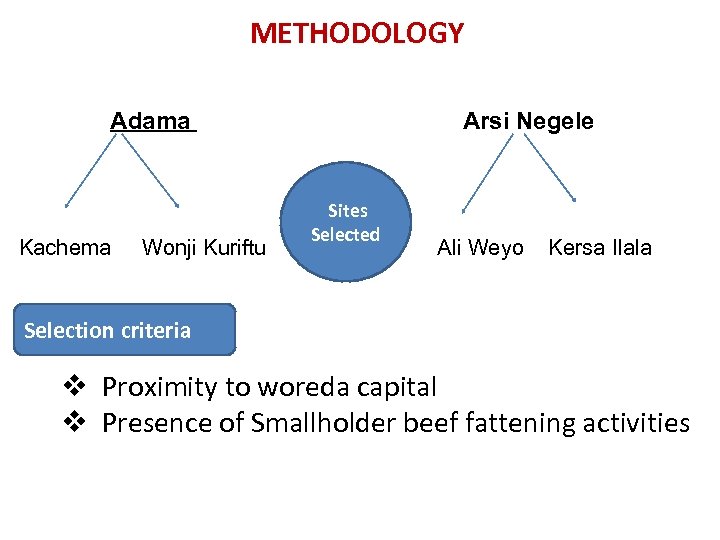
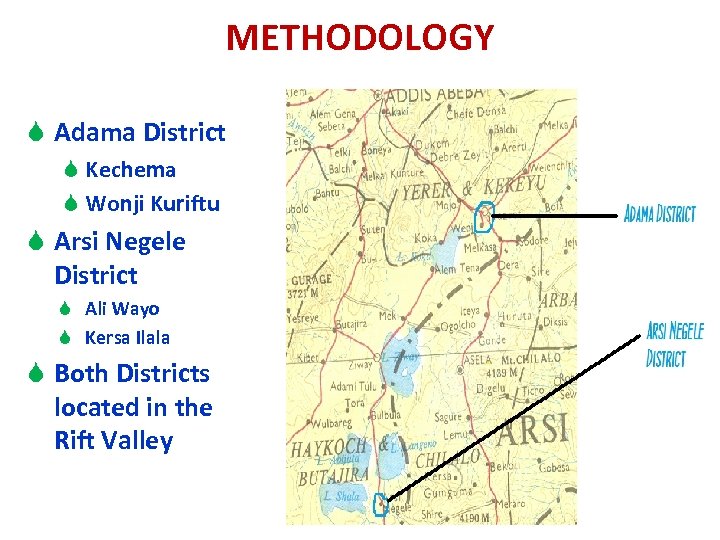 METHODOLOGY Adama District Kechema Wonji Kuriftu Arsi Negele District Ali Wayo Kersa Ilala Both Districts located in the Rift Valley

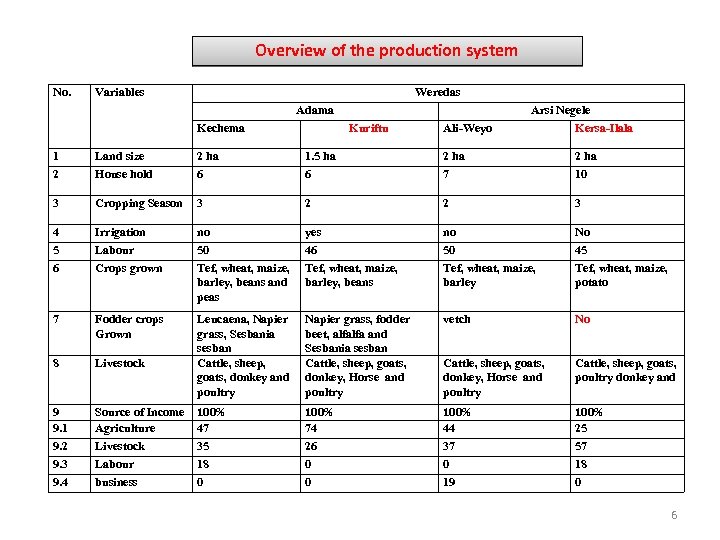 Overview of the production system No. Variables Weredas Adama Kechema Kuriftu Ali-Weyo Arsi Negele Kersa-Ilala 1 2 Land size House hold 2 ha 6 1. 5 ha 6 2 ha 7 2 ha 10 3 Cropping Season 3 2 2 3 4 5 Irrigation Labour no 50 yes 46 no 50 No 45 6 Crops grown Tef, wheat, maize, barley, beans and peas Tef, wheat, maize, barley, beans Tef, wheat, maize, barley Tef, wheat, maize, potato 7 Fodder crops Grown No Livestock Napier grass, fodder beet, alfalfa and Sesbania sesban Cattle, sheep, goats, donkey, Horse and poultry vetch 8 Leucaena, Napier grass, Sesbania sesban Cattle, sheep, goats, donkey and poultry Cattle, sheep, goats, donkey, Horse and poultry Cattle, sheep, goats, poultry donkey and 9 9. 1 9. 2 9. 3 9. 4 Source of Income Agriculture Livestock Labour business 100% 47 35 18 0 100% 74 26 0 0 100% 44 37 0 19 100% 25 57 18 0 6
 METHODOLOGY Adama Kachema Wonji Kuriftu Arsi Negele Sites Selected Ali Weyo Kersa Ilala Selection criteria v Proximity to woreda capital v Presence of Smallholder beef fattening activities
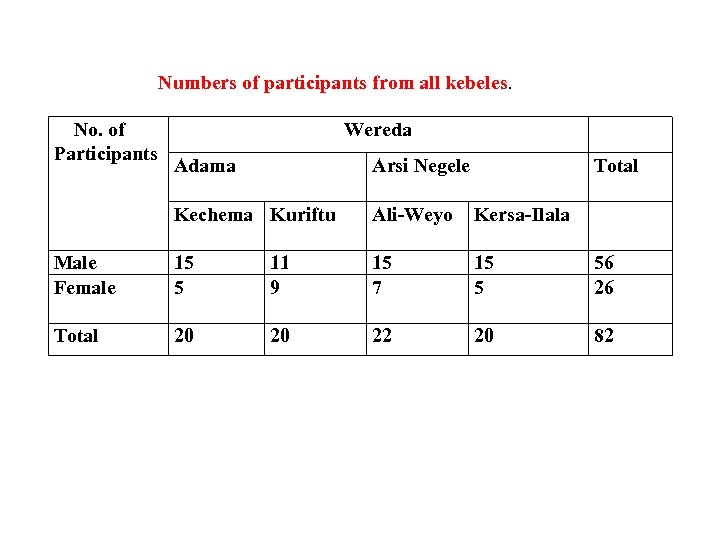 Numbers of participants from all kebeles. No. of Participants Wereda Adama Arsi Negele Total Kechema Kuriftu Ali-Weyo Kersa-Ilala Male Female 15 5 11 9 15 7 15 5 56 26 Total 20 20 22 20 82
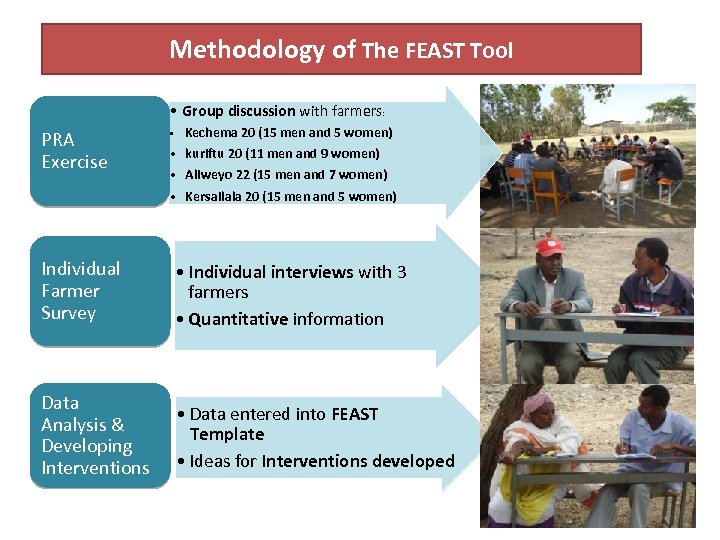 Methodology of The FEAST Tool • Group discussion with farmers: PRA Exercise • Kechema 20 (15 men and 5 women) • kuriftu 20 (11 men and 9 women) • Aliweyo 22 (15 men and 7 women) • Kersa. Ilala 20 (15 men and 5 women) Individual Farmer Survey • Individual interviews with 3 farmers • Quantitative information Data Analysis & Developing Interventions • Data entered into FEAST Template • Ideas for Interventions developed 9
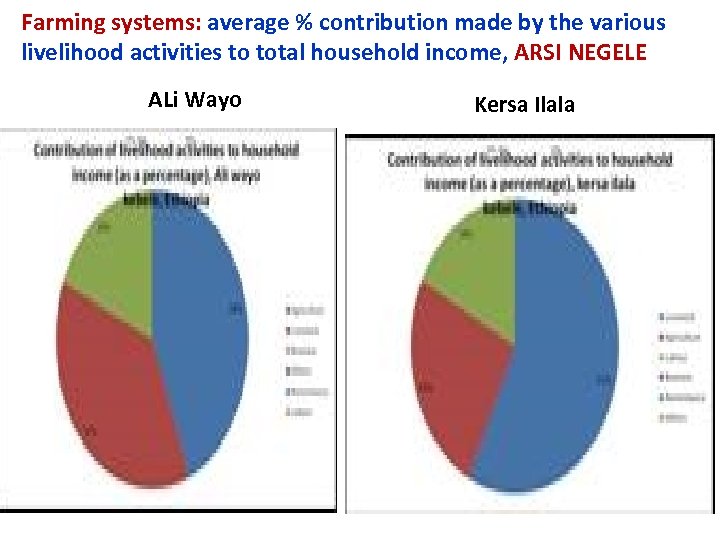 Farming systems: average % contribution made by the various livelihood activities to total household income, ARSI NEGELE ALi Wayo Kersa Ilala
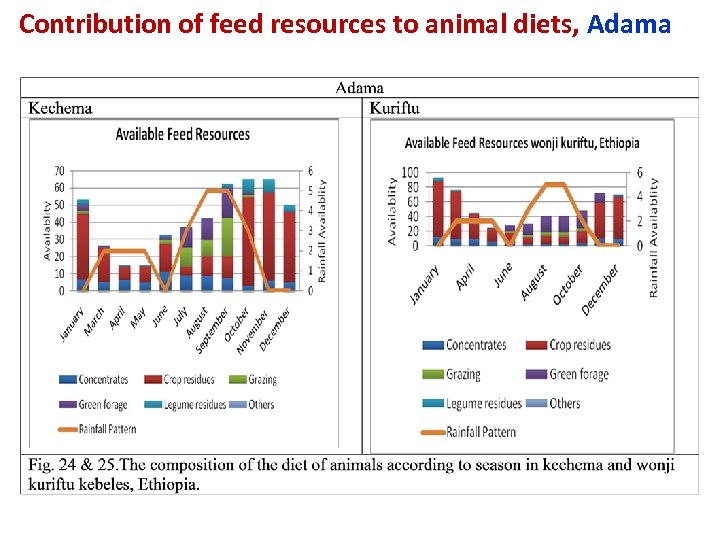 Contribution of feed resources to animal diets, Adama
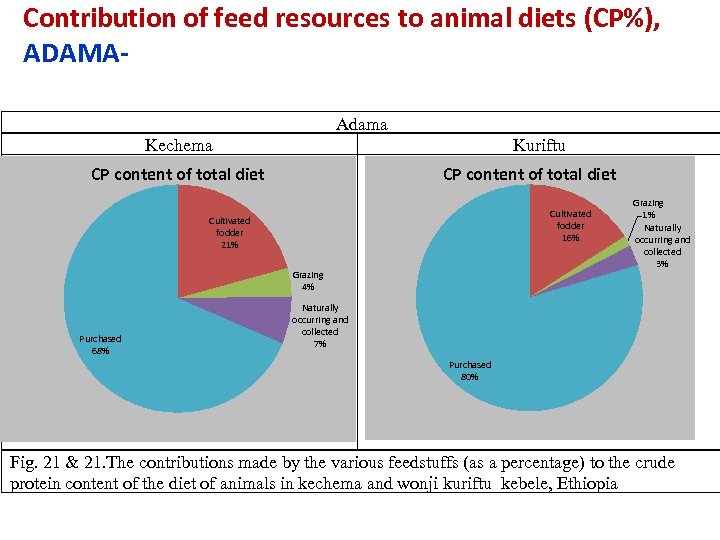 Contribution of feed resources to animal diets (CP%), ADAMAAdama Kechema Kuriftu CP content of total diet Cultivated fodder 16% Cultivated fodder 21% Grazing 4% Purchased 68% Grazing 1% Naturally occurring and collected 3% Naturally occurring and collected 7% Purchased 80% Fig. 21 & 21. The contributions made by the various feedstuffs (as a percentage) to the crude protein content of the diet of animals in kechema and wonji kuriftu kebele, Ethiopia
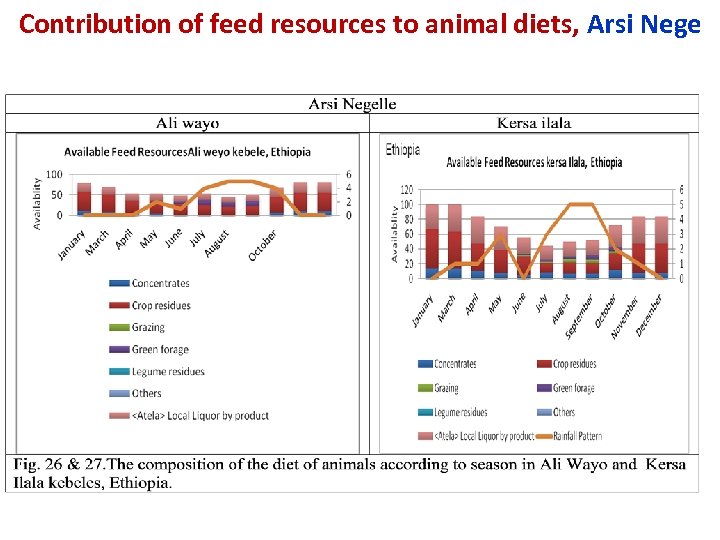 Contribution of feed resources to animal diets, Arsi Nege
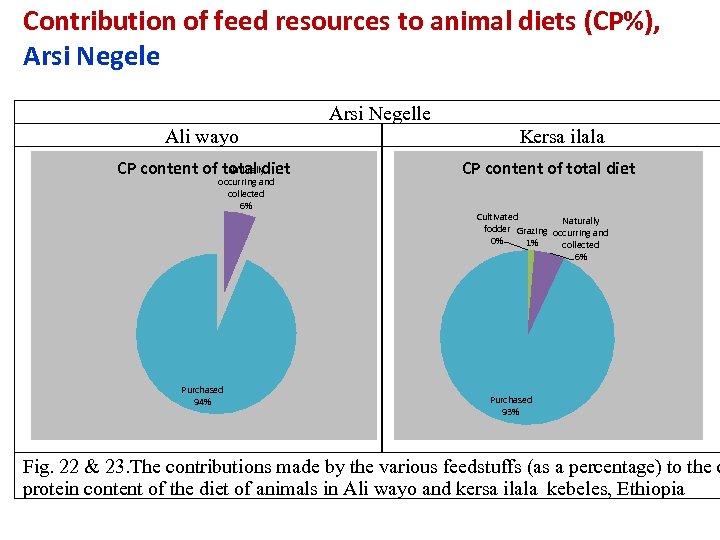 Contribution of feed resources to animal diets (CP%), Arsi Negele Arsi Negelle Ali wayo Naturally CP content of total diet occurring and collected 6% Purchased 94% Kersa ilala CP content of total diet Cultivated Naturally fodder Grazing occurring and 0% 1% collected 6% Purchased 93% Fig. 22 & 23. The contributions made by the various feedstuffs (as a percentage) to the c protein content of the diet of animals in Ali wayo and kersa ilala kebeles, Ethiopia
 Feed Resource Availability & Seasonality In kechema kebele the straw is usually fed as a whole fibre without any form of processing or manipulation prior to feeding and some times by mixing with concentrates In wonji kuriftu the straw is fed by mixing with purchased concentrate feed. But in both kebeles of Arsi Negelle district the straw is usually fed by mixing with
 Feed Resource Availability & Seasonality Cultivated forages Cultivated fodder as component of diet, ME and CP for kechema and kuriftu kebeles comprising approximately of 24% and 27%; 19% and 24%; 21% and 16; respectively. But in Arsi Negele district (Ali wayo and kersa ilala) there is no cultivated fodder.
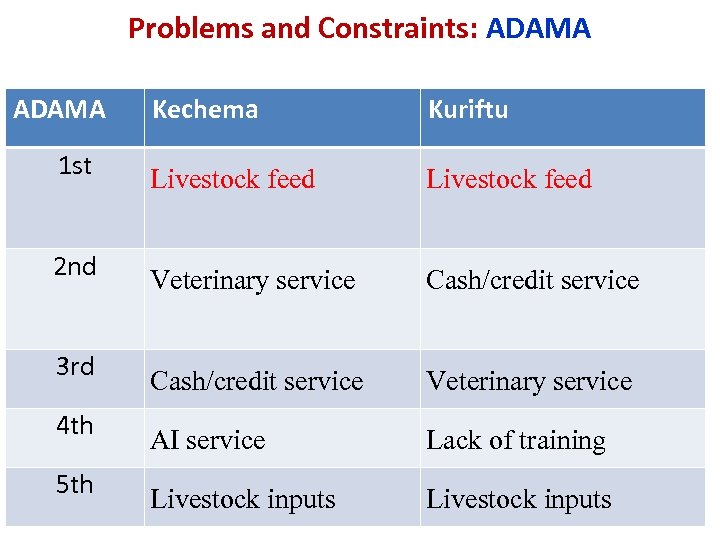 Problems and Constraints: ADAMA Kechema Kuriftu 1 st Livestock feed 2 nd Veterinary service Cash/credit service 3 rd Cash/credit service Veterinary service 4 th AI service Lack of training 5 th Livestock inputs
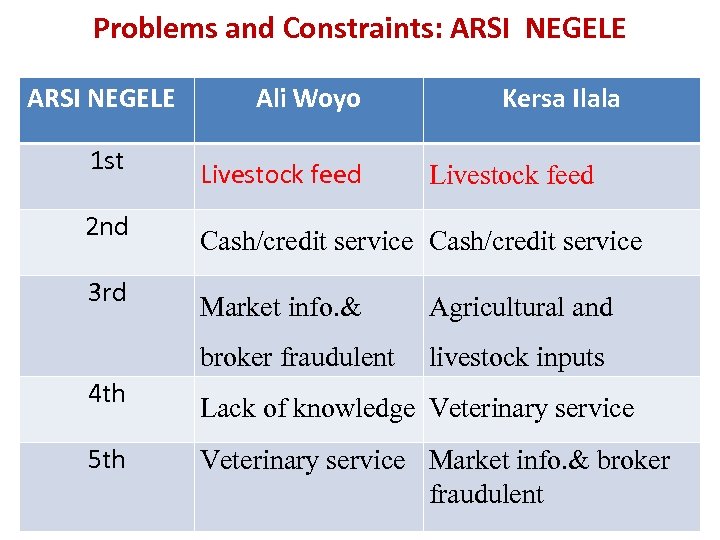 Problems and Constraints: ARSI NEGELE Ali Woyo Kersa Ilala 1 st Livestock feed 2 nd Cash/credit service 3 rd Market info. & Agricultural and broker fraudulent livestock inputs 4 th 5 th Livestock feed Lack of knowledge Veterinary service Market info. & broker fraudulent
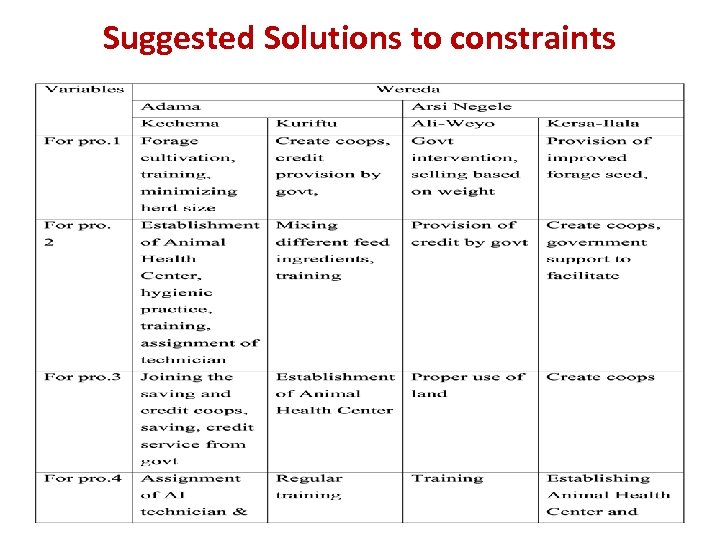 Suggested Solutions to constraints
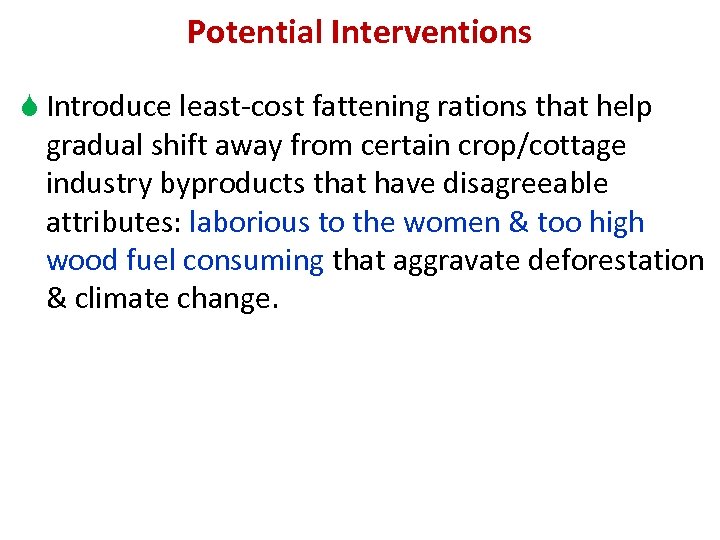 Potential Interventions Introduce least-cost fattening rations that help gradual shift away from certain crop/cottage industry byproducts that have disagreeable attributes: laborious to the women & too high wood fuel consuming that aggravate deforestation & climate change.
 Limitations of the study • In using quick questioners some questions were found ambiguous, e. g. sale of livestock and livestock products. • In the selection procedure of three individuals for interview the selection might be fair if it is purposive rather than random. Besides, the sample size of only three respondents looks too small to represent the real situation.
 Limitations of the study • The reliance on farmer estimates for calculating animal intake from grazing and intake from collected green fodder is a possible source of inaccuracy. • Farmers do give a rough estimate of the weight of crop residue but in the FEAST software space is not reserved in which the data was supposed to be filled in. As a result, the data analysis output shows zero value. This actually appears to be a temporary problem.
 The Way Forward • The current beef production level is definitely below consumption levels & market demands. • The major impediment has been shortage of animal feed both in quantity and quality. For example, the fattening business in the kebeles is dependent upon crop residues & local liquor byproducts, all of which are unsustainable in supply. • There is a need to intensify efforts on extension in aspects of efficient utilization of feed resources; improved livestock management; veterinary service, to mention just a few. • Regardless of its considerable promise to the farming community and the national economy at large, farmers must be trained in beef fattening techniques, such as home mixing of low-cost fattening rations; etc.
 Lessons Learnt • Women who had been isolated from community discussions were now observed to have equal or even better knowledge, zeal, willingness to learn and actively participated in debates of the PRA exercise. • Participation of the farmers in group discussions regarding their own problems increased their awareness on various issues, what to expect from input supplies, credit services, market information, etc. • The discussion forum served as an efficient experience-sharing platform. • The participation of District Agriculture Offices and the Kebele DAs benefited them a lot on how to probe the problems of the farmers.
 ~END~ THANK YOU