



 CHAPTER V GROWTH AND GROWTH POLICY 1
 Determinants of GDP Growth In Neoclassic Theory GDP volume and growth are determined by: a) Savings rate b) Rate of population growth c) Rate of technical progress v A key determinant of growth is technology v However, a country needs not to invent new technology v It can grow by ‘borrowing’ technology and by investing in physical and human capita 1 2
 1. THE ENDOGENOUS GROWTH Background Neo-classical growth theory dominated economic thought from 1950 to 1980 The Neo-classical growth theory illustrates that: Ø Growth depends on capital and labour growth and factor productivity Ø In steady state there are zero growth of per capita savings and growth of per capita output By 1980 s dissatisfaction arose with neo-classical theory v Development in developed countries did not support the neo-classical growth theory v Savings rates and growth were positively correlated across developed countries 3 v So, endogenous growth theory was developed
 According to Neo-classical theory: v Steady-state is achieved at a point where savings and investment requirement lines cross v So long saving is more than minimum investment requirement, the economy grows, because capital is added to the economy v Development process reaches steady state and stops v Investment requirement line has a constant positive slope, but savings line flatten out in long run, so investment requirement line and savings curve are guaranteed to cross 4
 Endogenous growth theory (Figure -1) v Modifies the shape of the production function v It denies law of diminishing marginal return v It assumes constant marginal product of capital v Saving is everywhere greater than required investment v Savings curve no longer flattens out v Production and savings curve are straight lines v Higher is the savings rate, bigger is the gap between saving and investment and faster is growth (Figure -1) 5
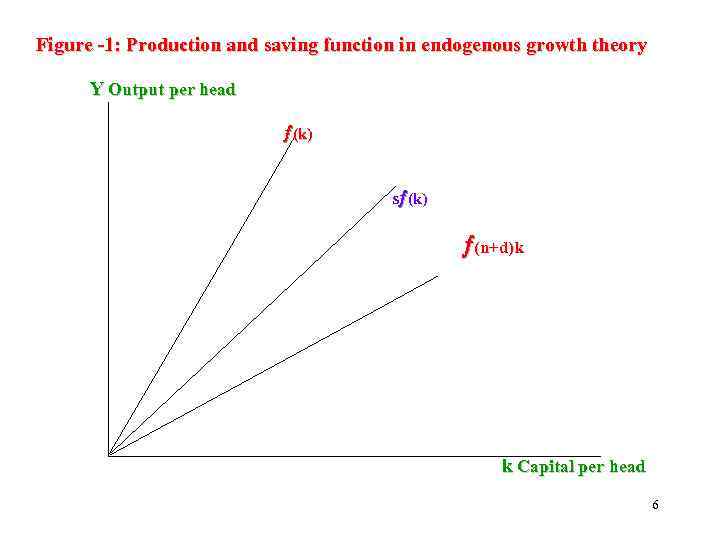 Figure -1: Production and saving function in endogenous growth theory Y Output per head (k) s (k) (n+d)k k Capital per head 6
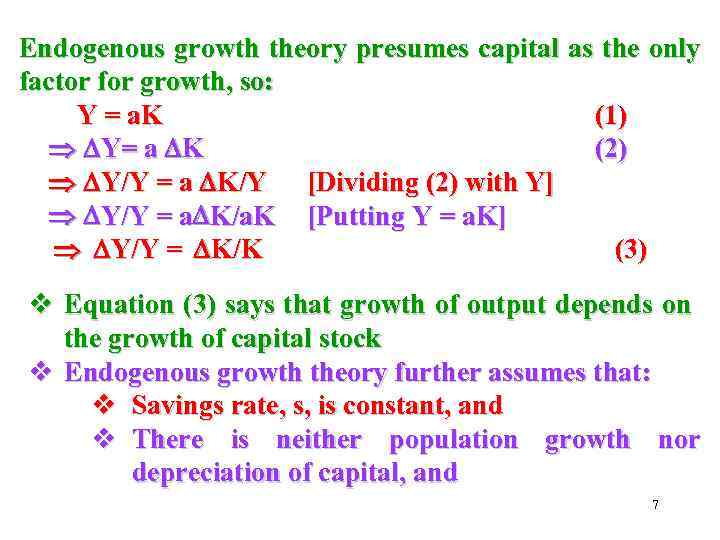 Endogenous growth theory presumes capital as the only factor for growth, so: Y = a. K (1) Y= a K (2) Y/Y = a K/Y [Dividing (2) with Y] Y/Y = a K/a. K [Putting Y = a. K] Y/Y = K/K (3) v Equation (3) says that growth of output depends on the growth of capital stock v Endogenous growth theory further assumes that: v Savings rate, s, is constant, and v There is neither population growth nor depreciation of capital, and 7
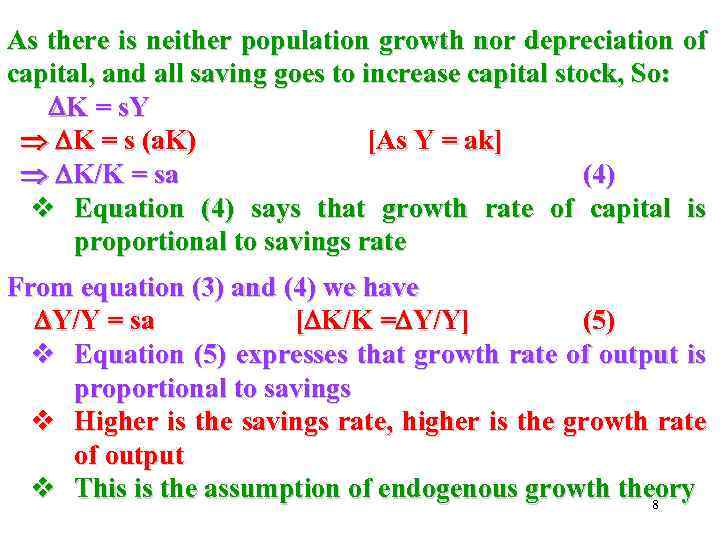 As there is neither population growth nor depreciation of capital, and all saving goes to increase capital stock, So: K = s. Y K = s (a. K) [As Y = ak] K/K = sa (4) v Equation (4) says that growth rate of capital is proportional to savings rate From equation (3) and (4) we have Y/Y = sa [ K/K = Y/Y] (5) v Equation (5) expresses that growth rate of output is proportional to savings v Higher is the savings rate, higher is the growth rate of output v This is the assumption of endogenous growth theory 8
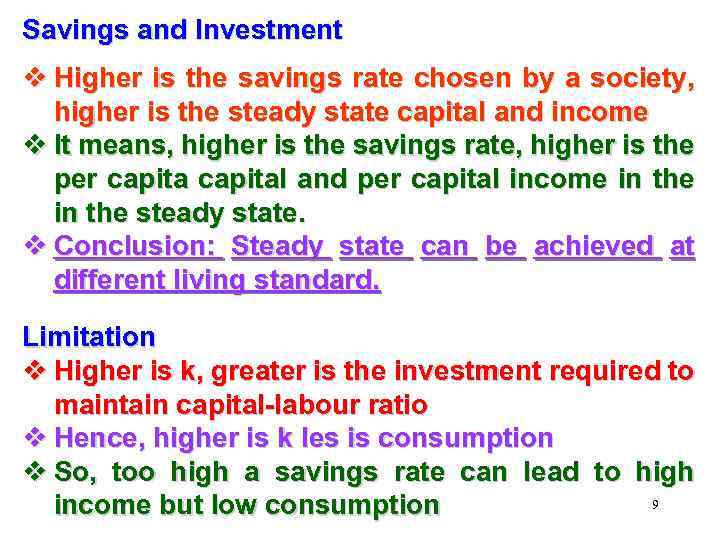 Savings and Investment v Higher is the savings rate chosen by a society, higher is the steady state capital and income v It means, higher is the savings rate, higher is the per capital and per capital income in the steady state. v Conclusion: Steady state can be achieved at different living standard. Limitation v Higher is k, greater is the investment required to maintain capital-labour ratio v Hence, higher is k les is consumption v So, too high a savings rate can lead to high 9 income but low consumption
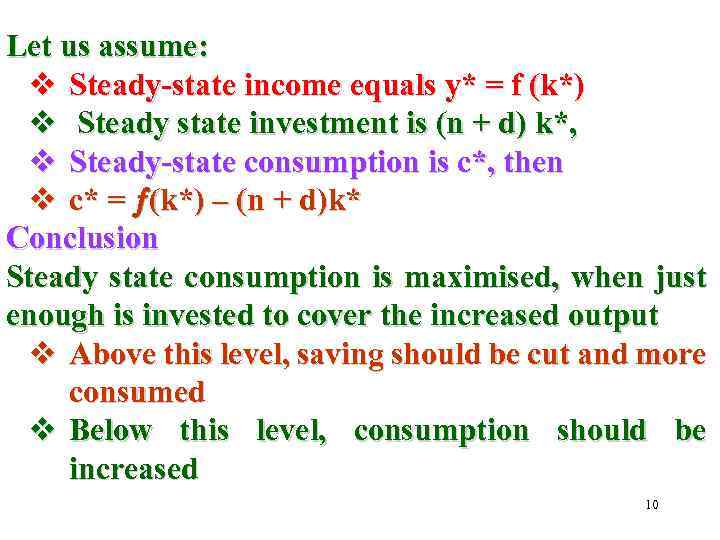 Let us assume: v Steady-state income equals y* = f (k*) v Steady state investment is (n + d) k*, v Steady-state consumption is c*, then v c* = (k*) – (n + d)k* Conclusion Steady state consumption is maximised, when just enough is invested to cover the increased output v Above this level, saving should be cut and more consumed v Below this level, consumption should be increased 10
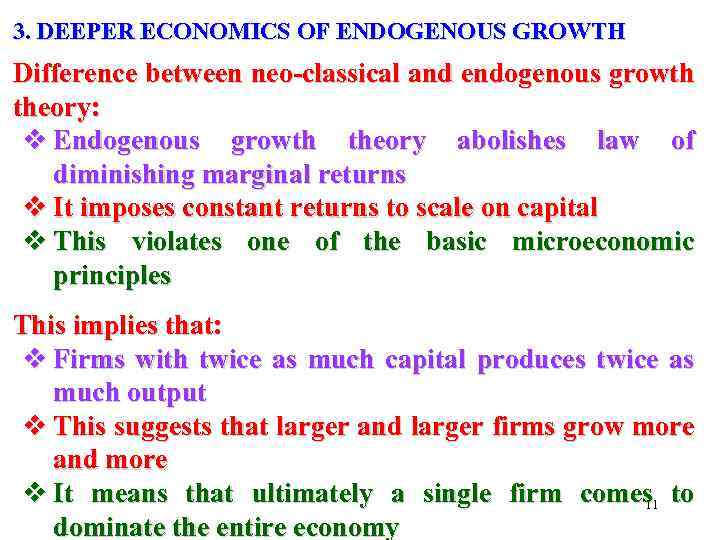 3. DEEPER ECONOMICS OF ENDOGENOUS GROWTH Difference between neo-classical and endogenous growth theory: v Endogenous growth theory abolishes law of diminishing marginal returns v It imposes constant returns to scale on capital v This violates one of the basic microeconomic principles This implies that: v Firms with twice as much capital produces twice as much output v This suggests that larger and larger firms grow more and more v It means that ultimately a single firm comes to 11 dominate the entire economy
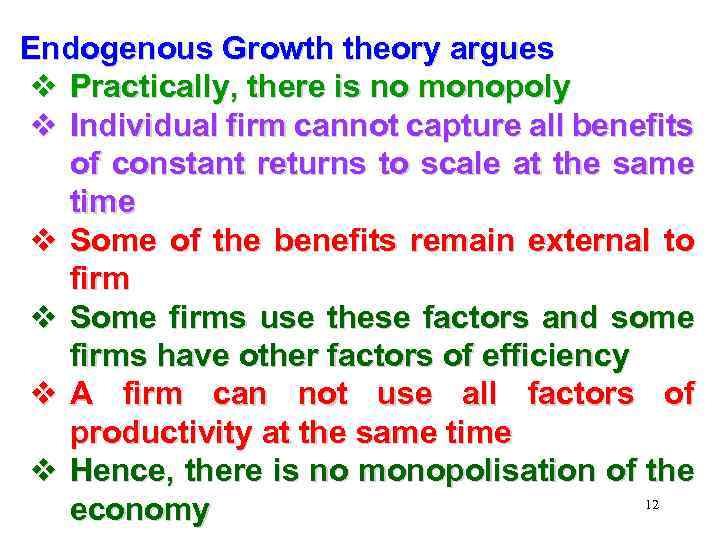 Endogenous Growth theory argues v Practically, there is no monopoly v Individual firm cannot capture all benefits of constant returns to scale at the same time v Some of the benefits remain external to firm v Some firms use these factors and some firms have other factors of efficiency v A firm can not use all factors of productivity at the same time v Hence, there is no monopolisation of the 12 economy
 Further endogenous growth theory separates different capitals: v There are not only new machines but new ways of doing things v Some firms assume technological advantage because of research v Some assume unforeseen (unexpected) opportunity v Benefits of new machines can be copied v But benefits of new methods and new ideas can not be copied easily 13 v Hence monopolisation is hold up
 4. CONVERGENCE v Endogenous growth theory assumes that higher savings rate leads to higher growth rate v Countries those invest more grow faster v However, impact of higher investment on growth is transitory v Country with higher investment achieves higher per capita income v But afterward growth rate slows down v Endogenous growth theory predicts convergence for economies v It predicts all economies should reach same steady state and same per capita income 14 ultimately
 For Endogenous growth theory says: v Economies converge and converge conditionally v Those save and invest more converses fast v Those save and invest les converses slowly v Hence, international differences in growth rates and per capita income sustain in the time being v But growth rate of faster growing countries slows down v The growth rate of slowly growing countries goes up v Ultimately all economies should reach same steady state and same per capita income 15
 Endogenous growth theory remarks that: Till 1980 s v Convergence was taking place at a rate of 2% annually v India’s income level was 5% of USA in 90 s v Hence, it was concluded that India would achieve the US level in 151 years However, the period of convergence could be shorten considerably by: v Increasing savings rate, and labour productivity in India v Some of such options are discussed below 16
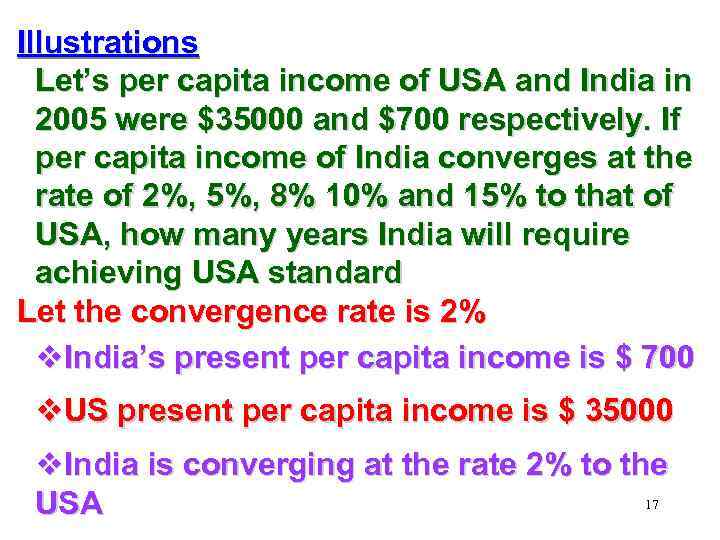 Illustrations Let’s per capita income of USA and India in 2005 were $35000 and $700 respectively. If per capita income of India converges at the rate of 2%, 5%, 8% 10% and 15% to that of USA, how many years India will require achieving USA standard Let the convergence rate is 2% v. India’s present per capita income is $ 700 v. US present per capita income is $ 35000 v. India is converging at the rate 2% to the 17 USA
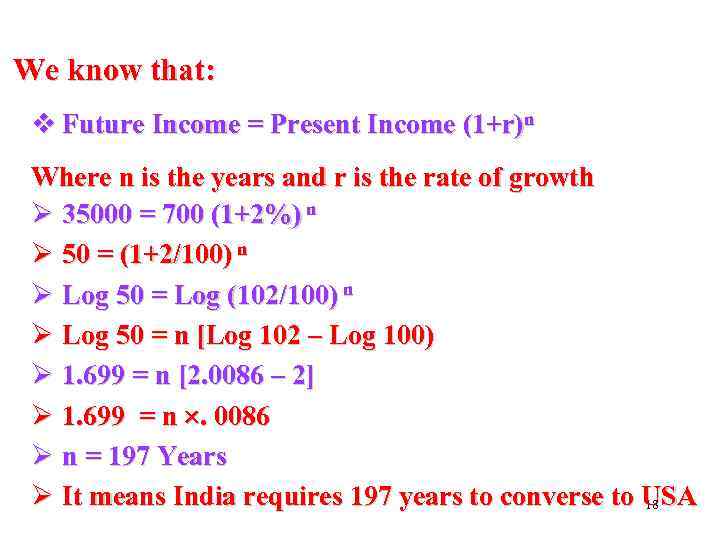 We know that: v Future Income = Present Income (1+r)n Where n is the years and r is the rate of growth Ø 35000 = 700 (1+2%) n Ø 50 = (1+2/100) n Ø Log 50 = Log (102/100) n Ø Log 50 = n [Log 102 – Log 100) Ø 1. 699 = n [2. 0086 – 2] Ø 1. 699 = n . 0086 Ø n = 197 Years Ø It means India requires 197 years to converse to USA 18
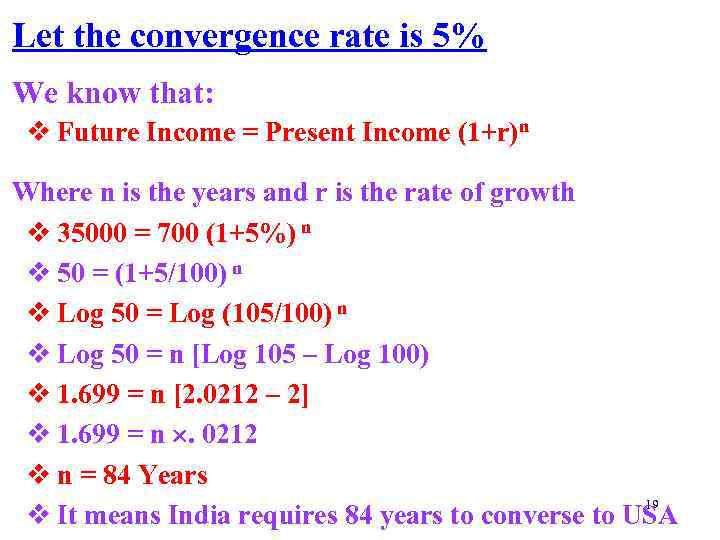 Let the convergence rate is 5% We know that: v Future Income = Present Income (1+r)n Where n is the years and r is the rate of growth v 35000 = 700 (1+5%) n v 50 = (1+5/100) n v Log 50 = Log (105/100) n v Log 50 = n [Log 105 – Log 100) v 1. 699 = n [2. 0212 – 2] v 1. 699 = n . 0212 v n = 84 Years 19 v It means India requires 84 years to converse to USA
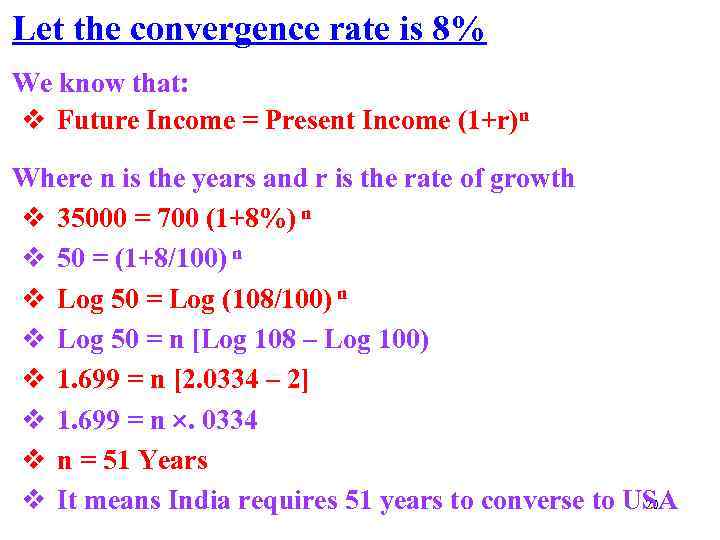 Let the convergence rate is 8% We know that: v Future Income = Present Income (1+r)n Where n is the years and r is the rate of growth v 35000 = 700 (1+8%) n v 50 = (1+8/100) n v Log 50 = Log (108/100) n v Log 50 = n [Log 108 – Log 100) v 1. 699 = n [2. 0334 – 2] v 1. 699 = n . 0334 v n = 51 Years 20 v It means India requires 51 years to converse to USA
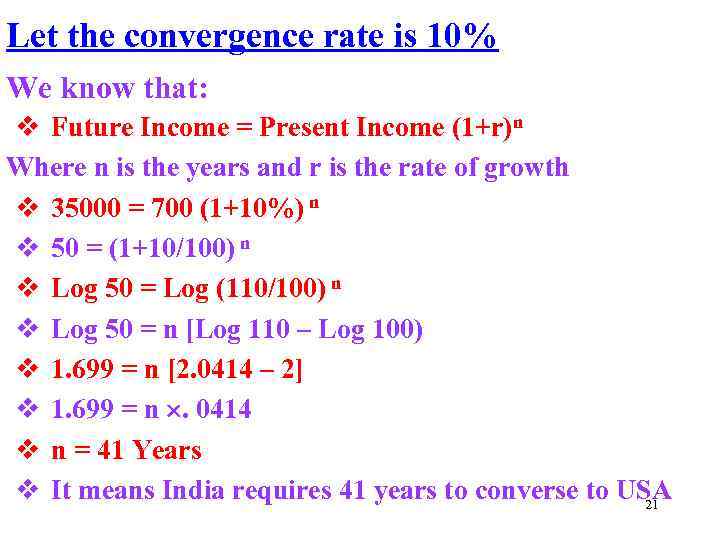 Let the convergence rate is 10% We know that: v Future Income = Present Income (1+r)n Where n is the years and r is the rate of growth v 35000 = 700 (1+10%) n v 50 = (1+10/100) n v Log 50 = Log (110/100) n v Log 50 = n [Log 110 – Log 100) v 1. 699 = n [2. 0414 – 2] v 1. 699 = n . 0414 v n = 41 Years v It means India requires 41 years to converse to USA 21
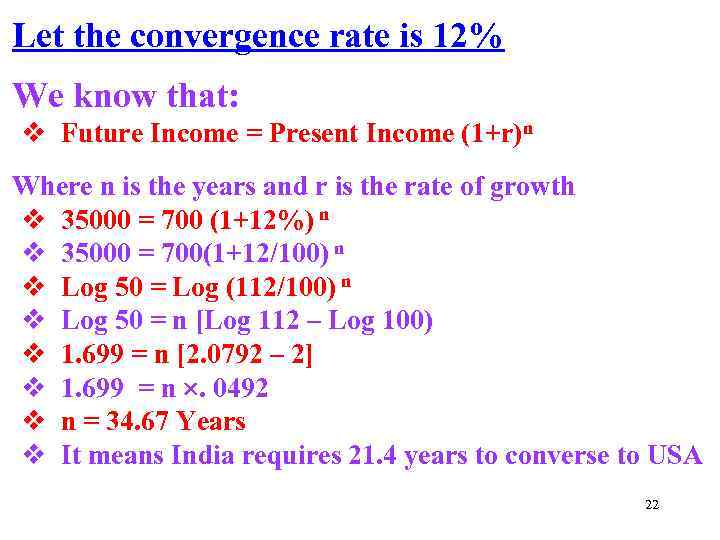 Let the convergence rate is 12% We know that: v Future Income = Present Income (1+r)n Where n is the years and r is the rate of growth v 35000 = 700 (1+12%) n v 35000 = 700(1+12/100) n v Log 50 = Log (112/100) n v Log 50 = n [Log 112 – Log 100) v 1. 699 = n [2. 0792 – 2] v 1. 699 = n . 0492 v n = 34. 67 Years v It means India requires 21. 4 years to converse to USA 22
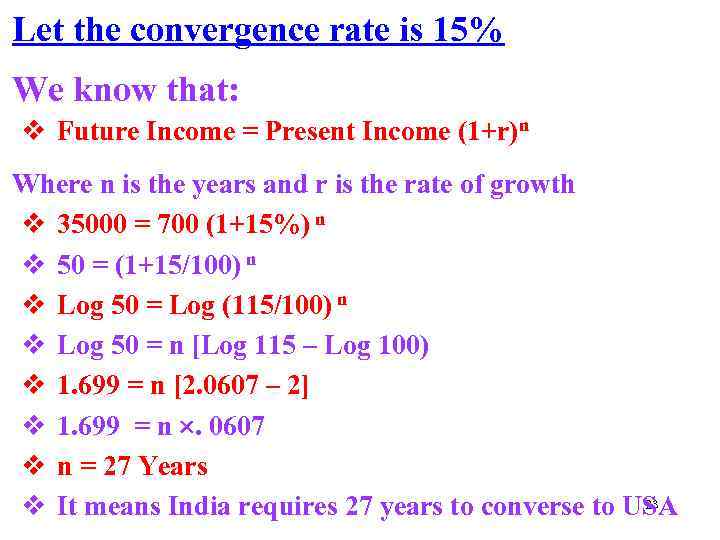 Let the convergence rate is 15% We know that: v Future Income = Present Income (1+r)n Where n is the years and r is the rate of growth v 35000 = 700 (1+15%) n v 50 = (1+15/100) n v Log 50 = Log (115/100) n v Log 50 = n [Log 115 – Log 100) v 1. 699 = n [2. 0607 – 2] v 1. 699 = n . 0607 v n = 27 Years 23 v It means India requires 27 years to converse to USA
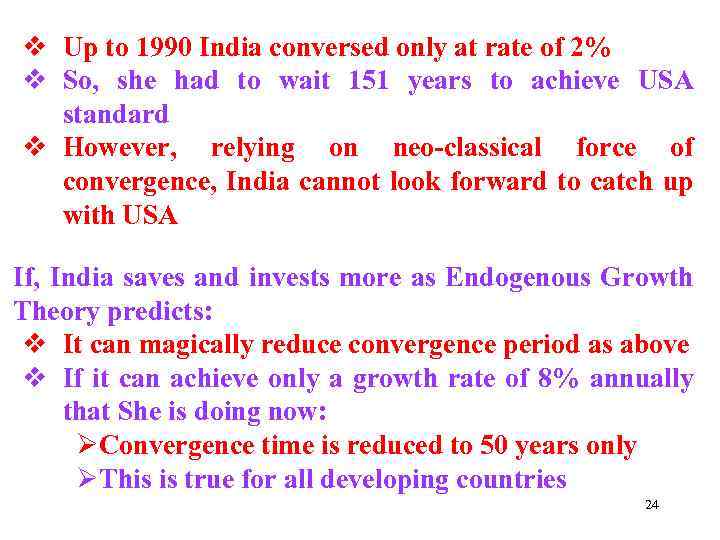 v Up to 1990 India conversed only at rate of 2% v So, she had to wait 151 years to achieve USA standard v However, relying on neo-classical force of convergence, India cannot look forward to catch up with USA If, India saves and invests more as Endogenous Growth Theory predicts: v It can magically reduce convergence period as above v If it can achieve only a growth rate of 8% annually that She is doing now: ØConvergence time is reduced to 50 years only ØThis is true for all developing countries 24
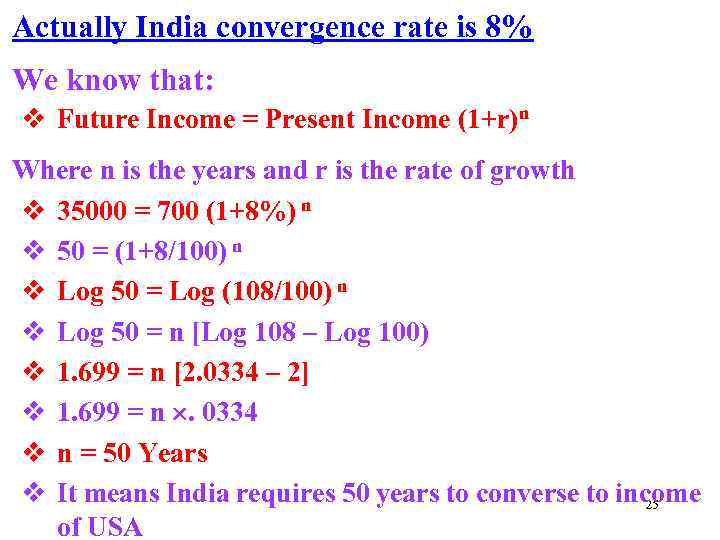 Actually India convergence rate is 8% We know that: v Future Income = Present Income (1+r)n Where n is the years and r is the rate of growth v 35000 = 700 (1+8%) n v 50 = (1+8/100) n v Log 50 = Log (108/100) n v Log 50 = n [Log 108 – Log 100) v 1. 699 = n [2. 0334 – 2] v 1. 699 = n . 0334 v n = 50 Years v It means India requires 50 years to converse to income 25 of USA
 5. GROWTH TRAPS AND TWO SECTOR MODELS v To explain no-growth and high growth, neoclassical and endogenous growth theories is used v There are two kinds of investment opportunities v Some investments follow the law of diminishing marginal product v Some follow rule of constant marginal product v So, society must choose investment in sectors that follow constant marginal product 26
 v Societies investing in research and development have ongoing growth v Because it helps developing technology for growth v Societies that direct investment toward physical capital may have higher output in the short run but at the price of lower long-run growth Least developed countries v Low-income causes les savings v Les savings do not meet capital requirement for growth v So, growth rate remains low, which leads to low a steady growth state v At high income savings and investments are more than the capital requirement 27 v It leads to ongoing growth
 6. PULATION GROWTH AND ECONOMIC GROWTH Regarding population growth one oldest view is that: v Population growth functions against achievement of high incomes Solow’s growth model predicts that v High population growth (n) means lower income (and lower steady growth state) v Because high population growth means less capital per worker Rich Countries v With rising incomes birth rates fall v Rich countries are approaching zero population growth 28
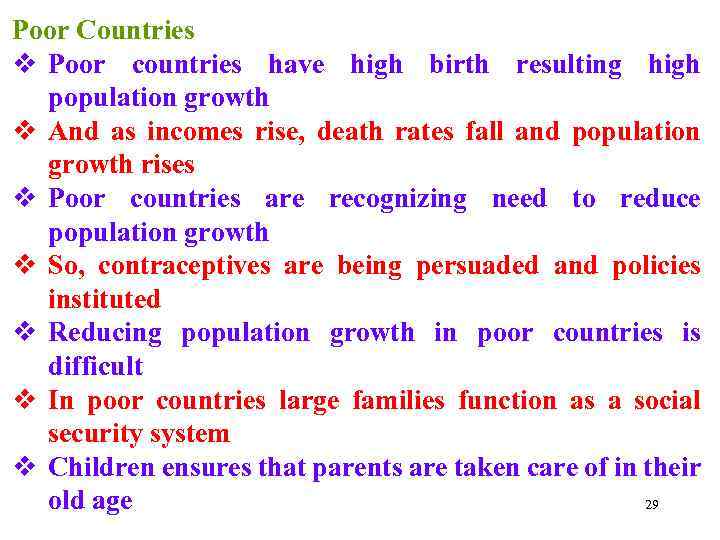 Poor Countries v Poor countries have high birth resulting high population growth v And as incomes rise, death rates fall and population growth rises v Poor countries are recognizing need to reduce population growth v So, contraceptives are being persuaded and policies instituted v Reducing population growth in poor countries is difficult v In poor countries large families function as a social security system v Children ensures that parents are taken care of in their 29 old age
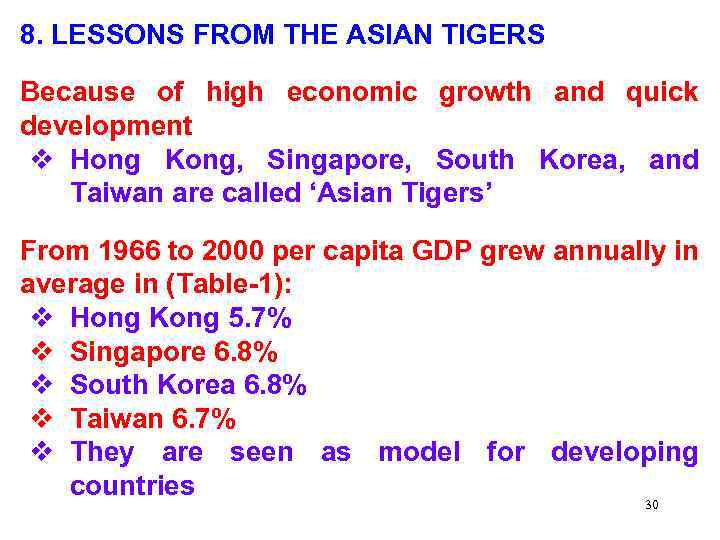 8. LESSONS FROM THE ASIAN TIGERS Because of high economic growth and quick development v Hong Kong, Singapore, South Korea, and Taiwan are called ‘Asian Tigers’ From 1966 to 2000 per capita GDP grew annually in average in (Table-1): v Hong Kong 5. 7% v Singapore 6. 8% v South Korea 6. 8% v Taiwan 6. 7% v They are seen as model for developing countries 30
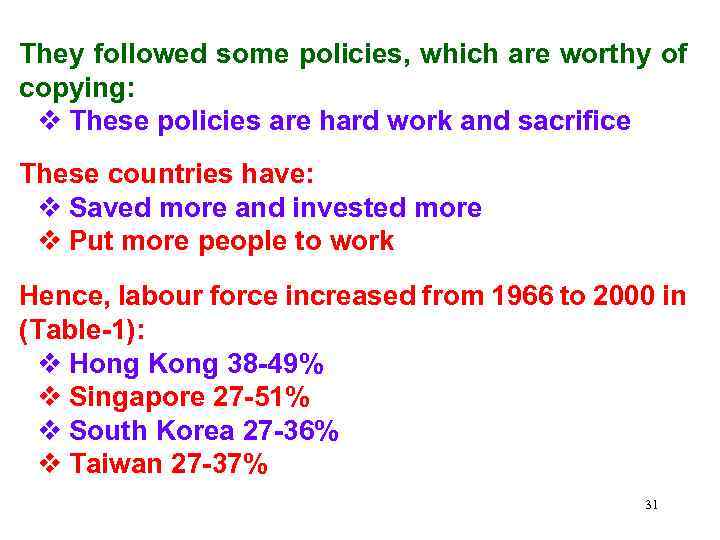 They followed some policies, which are worthy of copying: v These policies are hard work and sacrifice These countries have: v Saved more and invested more v Put more people to work Hence, labour force increased from 1966 to 2000 in (Table-1): v Hong Kong 38 -49% v Singapore 27 -51% v South Korea 27 -36% v Taiwan 27 -37% 31
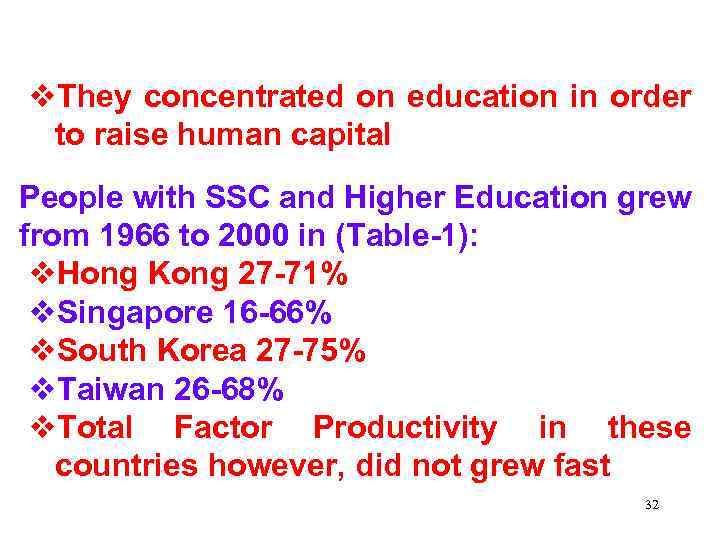 v. They concentrated on education in order to raise human capital People with SSC and Higher Education grew from 1966 to 2000 in (Table-1): v. Hong Kong 27 -71% v. Singapore 16 -66% v. South Korea 27 -75% v. Taiwan 26 -68% v. Total Factor Productivity in these countries however, did not grew fast 32
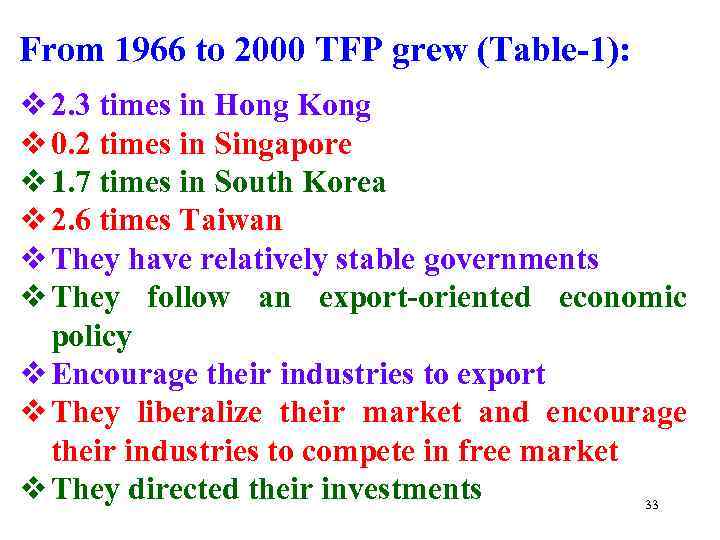 From 1966 to 2000 TFP grew (Table-1): v 2. 3 times in Hong Kong v 0. 2 times in Singapore v 1. 7 times in South Korea v 2. 6 times Taiwan v They have relatively stable governments v They follow an export-oriented economic policy v Encourage their industries to export v They liberalize their market and encourage their industries to compete in free market v They directed their investments 33
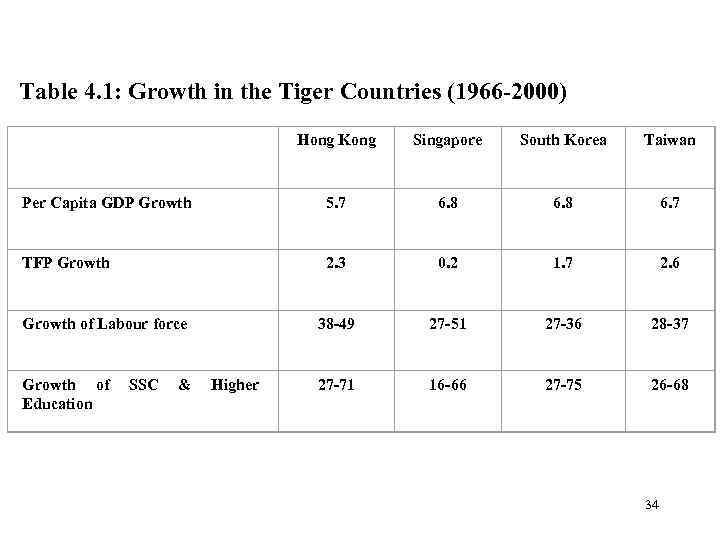 Table 4. 1: Growth in the Tiger Countries (1966 -2000) Hong Kong Singapore South Korea Taiwan Per Capita GDP Growth 5. 7 6. 8 6. 7 TFP Growth 2. 3 0. 2 1. 7 2. 6 Growth of Labour force 38 -49 27 -51 27 -36 28 -37 Growth of SSC & Higher Education 27 -71 16 -66 27 -75 26 -68 34
 v They have encouraged foreign investment to bring in new technologies v The Tigers Countries have achieved something extraordinary in human history v Their high growth rate transformed them from poorest countries to rich countries This is done in the old-fashioned way v Through saving, investment, hard work of the labour force and competition 35
 9. THE GROWTH OF POOR COUNTRIES v Growth of Bangladesh illustrates a striking problem v Till 1990 it had actually no economic growth v This is true also for: Burma, Nepal, Ghana, etc v Income in these is so low that much of the population lives under subsistence v So, savings are very low v From 1960 to 1985 investment in Bangladesh was only 4. 6% of GDP v In the same time, it was 36. 6% to 24% in Japan and USA respectively 36
 What to do v Population growth in poor countries was much higher than in Japan & USA- It must be reduced v They must invest in human capital v They have hostile climates foreign investment – It must be liberalized v Enabling economic and legal environment foreign investment must be ascertained v Repatriate investments and profits must be guaranteed foreign investments v Export must be discouraged 37
 Questions v Describe the factors on which the growth of the economy depends? v Explain indigenous growth theory. v Explain the relationship between output and savings according to indigenous growth theory. v What is the deeper significance of indigenous growth theory? v What is meant by two-sector model of the economy in indigenous growth theory? v Discuss the factors those determine the convergence of the economies. v Lets per capital annual income of USA is $60000 and of Bangladesh is $700. Let the economy of Bangladesh grows in average at the rate of 6%. How many years will Bangladesh require to the economy standard USA if the economy of USA stagnates? v Explain theoretical lesson from the ‘Asian Tiger Countries’. v Explain the impact of rate of population growth on economic growth of a developing economy. 38
 End of the Chapter Thank You Very Much For Patient Listening 39