


 Скачать презентацию CHAPTER V FREE TRADE AGREEMENTS European Free
052227cf886dc6b9a431ed0c1229321c.ppt
- Количество слайдов: 56
 CHAPTER V FREE TRADE AGREEMENTS ¨ European Free Trade Agreements & Common Market – European Free Trade Association – Central European Free Trade Agreement – European Union ¨ United States Free Trade Agreements Copyright(c) 2012 Dr. Chase C. Rhee 1
 Differences between Free Trade Area and Common Market t In Free Trade Area § § t Free movement of product, service, & capital No free movement of labor Separate external tariff & trade policy Separate fiscal & economic policy In Common Market § § Free movement of product, service, & capital Free movement of labor Common external tariff & trade policy Coordinated fiscal and economic policy Copyright(c) 2012 Dr. Chase C. Rhee 2
 European Free Trade Association (EFTA) ¨ The oldest free trade Agreement or Area ¨ Stockholm Convention in 1960 ¨ Many members left EFTA to join European Economic Community (EEC), which later EC and EU ¨ Current members: Iceland, Norway, Switzerland, and Liechtenstein ¨ EFTA & EU created European Economic Area (EEA) of 300 million consumers in 1994 Copyright(c) 2012 Dr. Chase C. Rhee 3
 Central European Free Trade Agreement (CEFTA) ¨ Signed in 1992 in Poland ¨ Former members: – Poland (left 2004) – Hungary (left 2004) – Czech Republic (left 2004) – Slovakia (left 2004) – Slovenia (left 2004) – Romania (left 2007) – Bulgaria (left 2007) Copyright(c) 2012 Dr. Chase C. Rhee 4
 Central European Free Trade Agreement (CEFTA) ¨ Current Members – Albania (joined 2007) – Bosnia & Herzegovina (joined 2007) – Macedonia (joined 2006) – Moldova (joined 2007) – Montenegro (joined 2007) – Serbia (joined 2007) – Kosovo (joined 2007) * Croatia joined 2003 but left 2013 to join EU Copyright(c) 2012 Dr. Chase C. Rhee 5
 European Union (EU) ¨ European Economic Community (EEC) – first proposed by French foreign minister, – – – Robert Schuman in his speech on May 9, 1950 in Paris, Europe Day created in 1958 by the Treaty of Rome of 1957 as Customs Union (same external tariffs) composed of 6 countries: Belgium, Germany, France, Luxembourg, Italy, & the Netherlands Denmark, Ireland, and U. K. joined 1973 Greece joined 1981 Spain and Portugal joined 1986. 12 members On January 1, 1993, the single European market entered into force as a common market Copyright(c) 2012 Dr. Chase C. Rhee 6
 European Union (EU) ¨ European Community (EC) – EEC officially renamed European Community (EC), when European Union (EU) was formed, even though it had been used before as extension of EEC because it covered wider area than economic policy – EC fully integrated into EU ¨ European Union (EU) – Created by Treaty on European Union ( Maastricht Treaty) signed in Maastricht on February 7, 1992 by all 12 members and entered into force on November 1, 1993 – Ultimate goal for a political union Copyright(c) 2012 Dr. Chase C. Rhee 7
 European Union (EU) ¨ European Union (EU) – In 1995, Sweden, Finland, and Austria joined the E. U. Membership increased to 15 – In 2004, 10 countries joined the EU. Membership increased to 25 • Cyprus, Czech Republic, Estonia, Hungary, Latvia, Lithuania, Malta, Poland, Slovak Republic, and Slovenia – In 2007: Bulgaria & Romania joined & membership increased to 27 – In 2013, Croatia joined as 28 th member – Brexit (British exit): 2016 referendum vote with 51. 9% approval. U. K. started the withdrawal process in March 2017 to leave by April 2019 – 510 million people Copyright(c) 2012 Dr. Chase C. Rhee 8
 European Union ¨ Euro – In 1999, the single currency, Euro, was born. – In 2002, 11 members replaced their currency with Euro notes and coins – 1/1/2011: 17 countries, – 1/1/2014: 18 countries (Latvia), – 1/1/2015: 19 countries (Lithuania) Copyright(c) 2012 Dr. Chase C. Rhee 9
 European Union ¨ Non-euro area (non-eurozone) countries – – – – – Bulgaria (BGN, nb, Bulgarian Lev) Croatia (HRK, kn, Croatian Kuna) Czech Republic (CZK, Kc, Czech Koruna) Denmark (DKK, kr , Danish Krone) Hungary (HUF, Ft, Hungarian Forint) Poland (PLN, zt, Polish Zloty) Romania (RON, lei, Romanian Leu) Sweden (SEK, Kr, Swidish Krona) United Kingdom (GBP, £, Bristish Pound) Copyright(c) 2012 Dr. Chase C. Rhee 10
 Common Markets ¨ European Union ¨ Central American Common Market ¨ Andean Common Market ¨ Caribbean Community and Common Market ¨ Economic Community of West African States Copyright(c) 2012 Dr. Chase C. Rhee 11
 United States Free Trade Agreements ¨ ¨ ¨ ¨ U. S. - Israel Free Trade Area Agreement (IFTA) U. S. - Canada Free Trade Agreement (CFTA) North American Free Trade Agreement (NAFTA) U. S. - Jordan Free Trade Agreement (JFTA) U. S. - Singapore Free Trade Agreement (SFTA) U. S. - Chile Free Trade Agreement (UCFTA) U. S. - Australia Free Trade Agreement (UAFTA) U. S. - Morocco Free Trade Agreement (UMFTA) U. S. –Central American-Dominican Free Trade Agreement (CAFTA-DR) U. S. -Bahrain Free Trade Agreement (UBTA) U. S-Oman Free Trade Agreement (OFTA) U. S. -Peru Trade Promotion Agreement (PTPA) U. S-Korea Free Trade Agreement (UKFTA) U. S. -Colombia Trade Promotion Agreement (UCTPA) U. S. -Panama Trade Promotion Agreement (UPATPA) Free Trade Agreements Withdrawn or Under Negotiation Copyright(c) 2012 Dr. Chase C. Rhee 12
 U. S. -Israel Free Trade Agreement ¨ Phase-in Period: 9/1/85 -1/1/95 ¨ Israeli Products § The growth, product or manufacture of Israel § If imported materials are used, • Substantially transformed into a new, different article of commerce or • Minimum 35% value added in Israel, West Bank, Gaza Strip or Qualifying Industrial Zone (QIZ) § Directly imported from Israel, West Bank, Gaza Strip or QIZ into the U. S. § Identified by "IL" in “Special” Subcoulmn of the HTSUS Copyright(c) 2012 Dr. Chase C. Rhee 13
 U. S. -Israel Free Trade Agreement ¨ Certificate of Origin Form A must accompany the shipment, but not required to be filed at the time of entry ¨ Under the amended FTA in 1996, duty- free treatment is also allowed for products of § West Bank § Gaza Strip § Qualifying Industrial Zone (QIZ): • Duty-free area encompassing portions of territories of Israel and Jordan, Israel and Egypt • Designated by U. S. Trade Rep as a QIZ Copyright(c) 2012 Dr. Chase C. Rhee 14
 U. S. -Canada Free Trade Agreement t t 1/1/89 -1/1/98 Replaced by NAFTA since 1994 Copyright(c) 2012 Dr. Chase C. Rhee 15
 North American Free Trade Agreement(NAFTA) ¨ ¨ Signed August 1992 by Trade Ministers of Mexico, USA & Canada Took effect 1/1/94 • Yukon of Alaska to Yukatan of Mexico • 370 million people & $ 6 trillion GNP • Imports and exports $254 billion in 1992 Copyright(c) 2012 Dr. Chase C. Rhee 16
 North American Free Trade Agreement(NAFTA) Elimination of tariff and non-tariff barriers ¨ § 15 -year phase- out period for tariffs by three time tables • 1 st reduction 50% of items: Immed. Eff. Date • 2 nd reduction 15% of items: 1 st thru 5 th years • 3 rd reduction 35% of items: 6 th thru 15 th years Copyright(c) 2012 Dr. Chase C. Rhee 17
 North American Free Trade Agreement(NAFTA) ¨ Impact of NAFTA – – – Labor-intensive industries to Mexico Environment-sensitive industries to Mexico U. S. -owned factories in Asia for timesensitive products to Mexico Increased exports among members Increased investments in NAFTA countries by non-NAFTA countries due to NAFTA rules of origin High paying jobs created will more than offset the losses of low paying jobs in the U. S. Copyright(c) 2012 Dr. Chase C. Rhee 18
 North American Free Trade Agreement(NAFTA) ¨ General Rules of Origin § Wholly obtained or produced in NAFTA region § Produced entirely in the NAFTA region exclusively from originating materials § If goods incorporate non-originating parts (imported materials), • A tariff classification change alone due to substantial transformation Copyright(c) 2012 Dr. Chase C. Rhee 19
 North American Free Trade Agreement(NAFTA) ¨ General Rules of Origin (Continued) • A tariff classification change plus a minimum Regional Value Content (RVC) requirement. 50% for net cost method and 60% for transaction value method • If no tariff classification change, a minimum RVC requirement, 50% for net cost or 60% for transaction value method § Directly imported from a member country § Identified by MX or CA in “Special” subcolumn of the HTSUS § Importer must possess a NAFTA Certificate of Origin Copyright(c) 2012 Dr. Chase C. Rhee 20
 North American Free Trade Agreement(NAFTA) Special Provisions of the Rules-of. Origin ¨ § Automobiles: • 1/1/94 -1/1/1998: No less than 50% under Net Cost • 1/1/98 -1/1/2002: 56% for 15 or fewer passengers, 55% for 16 or more passengers • After 1/1/2002: 62. 5% for 15 or fewer passengers, 60% for 16 or more passengers Copyright(c) 2012 Dr. Chase C. Rhee 21
 North American Free Trade Agreement(NAFTA) ¨ Special Provisions of the Rules-of- Origin (continued) § Textiles: Yarn forward process consisting of 3 steps § Yarn-->Fabrics-->Garments • Yarn must be made in North America § Computers: Main circuitry (motherboard) from member countries § Television: Picture tube from member countries Copyright(c) 2012 Dr. Chase C. Rhee 22
 North American Free Trade Agreement(NAFTA) ¨ Method of Calculating Value-Added Percentage § Transaction Value method: RVC=(TVVNM)/TV x 100, 60% or more, VNM: Value of Non-originating Materials § Net Cost method: RVC=(NC-VNM)/NC x 100, 50% or more. Costs excluded: Promotion & Marketing, After sale service, Royalties, Shipping & Packing, Nonallowable interest Copyright(c) 2012 Dr. Chase C. Rhee 23
 U. S. –Jordan Free Trade Agreement t t Took effect December 17, 2001 Major Elements § Elimination of tariffs within 10 years § Free trade in services § Protection of intellectual property rights § Promotion of liberalized trade environment for e-commerce § Provisions on environmental principles: Sustainable development § Provisions on labor: Full implementation of national laws & commitment to Int’l Labor Organization (ILO)’s core labor standards § Transparency in dispute settlement procedures Copyright(c) 2012 Dr. Chase C. Rhee 24
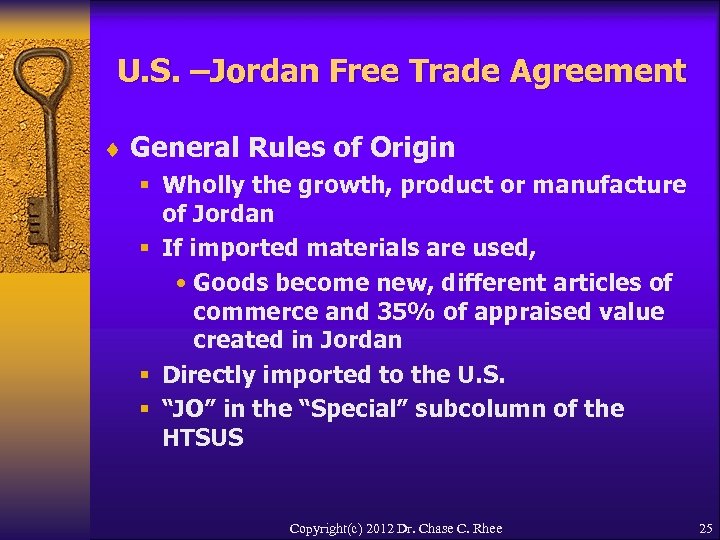 U. S. –Jordan Free Trade Agreement ¨ General Rules of Origin § Wholly the growth, product or manufacture of Jordan § If imported materials are used, • Goods become new, different articles of commerce and 35% of appraised value created in Jordan § Directly imported to the U. S. § “JO” in the “Special” subcolumn of the HTSUS Copyright(c) 2012 Dr. Chase C. Rhee 25
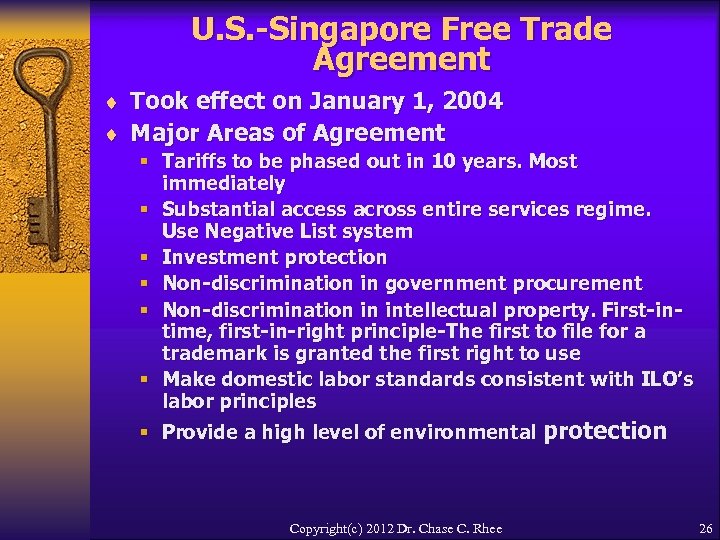 U. S. -Singapore Free Trade Agreement ¨ Took effect on January 1, 2004 ¨ Major Areas of Agreement § Tariffs to be phased out in 10 years. Most immediately § Substantial access across entire services regime. Use Negative List system § Investment protection § Non-discrimination in government procurement § Non-discrimination in intellectual property. First-intime, first-in-right principle-The first to file for a trademark is granted the first right to use § Make domestic labor standards consistent with ILO’s labor principles § Provide a high level of environmental protection Copyright(c) 2012 Dr. Chase C. Rhee 26
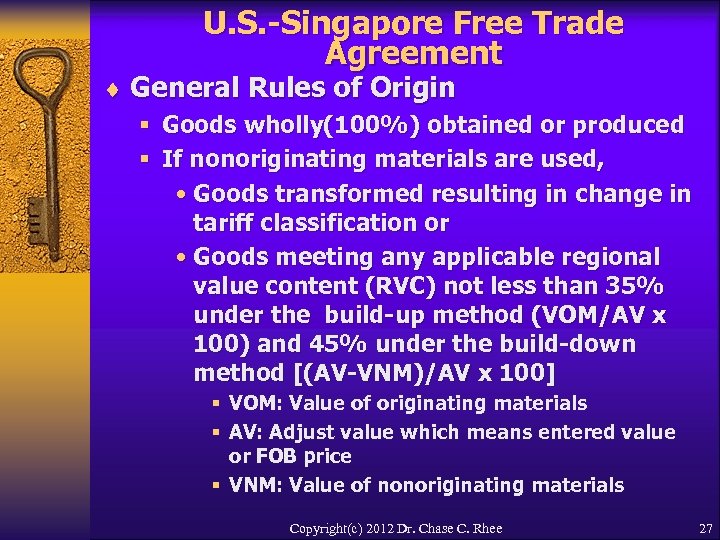 U. S. -Singapore Free Trade Agreement ¨ General Rules of Origin § Goods wholly(100%) obtained or produced § If nonoriginating materials are used, • Goods transformed resulting in change in tariff classification or • Goods meeting any applicable regional value content (RVC) not less than 35% under the build-up method (VOM/AV x 100) and 45% under the build-down method [(AV-VNM)/AV x 100] § VOM: Value of originating materials § AV: Adjust value which means entered value or FOB price § VNM: Value of nonoriginating materials Copyright(c) 2012 Dr. Chase C. Rhee 27
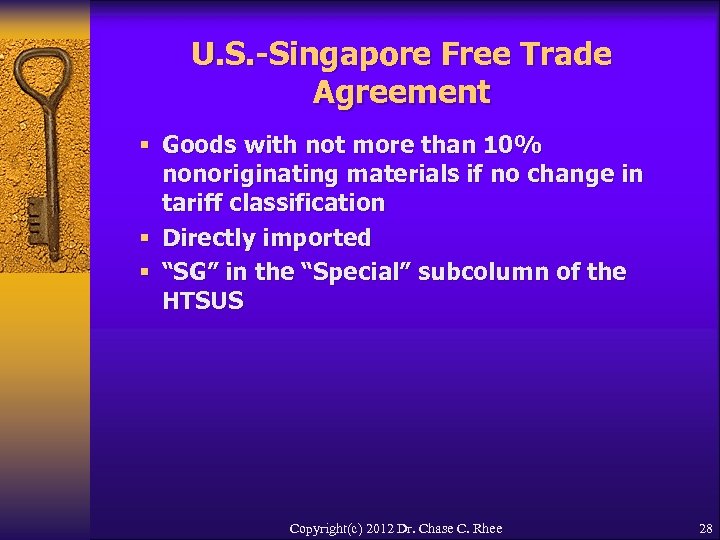 U. S. -Singapore Free Trade Agreement § Goods with not more than 10% nonoriginating materials if no change in tariff classification § Directly imported § “SG” in the “Special” subcolumn of the HTSUS Copyright(c) 2012 Dr. Chase C. Rhee 28
 US-Chile Free Trade Agreement ¨ Took effect on January 1, 2004 ¨ Major Areas of Agreement § Tariffs to be phased out in 12 years. 85% immediately § Substantial market access to entire service regime. Use Negative List system § Protection of all forms of investments § Non-discrimination in intellectual property. First-intime, first-in-right principle. Chilean government ensures that its agencies use only legitimate computer software § Non-discrimination in government procurement § Make domestic labor laws consistent with the ILO’s labor principles § Provide a high level of environmental protection Copyright(c) 2012 Dr. Chase C. Rhee 29
 US-Chile Free Trade Agreement ¨ General Rules of Origin § Goods wholly(100%) obtained or produced § If nonoriginating materials are used, • Goods transformed resulting in change in tariff classification or • Goods meeting any applicable regional value content § Directly imported § “CL” in the “Special” subcolumn of the HTSUS Copyright(c) 2012 Dr. Chase C. Rhee 30
 U. S. -Australia Free Trade Agreement ¨ Took effect on January 1, 2005 ¨ Major Areas of Agreement § Tariffs to be phased out in 10 years. 99% § § § immediately National and most-favored treatment for all sectors of services Protection of investments Non-discrimination in government procurement Protection of intellectual property rights Make domestic labor laws consistent with the ILO’s labor principles Provide a high level of environmental protection Copyright(c) 2012 Dr. Chase C. Rhee 31
 U. S. -Australia Free Trade Agreement ¨ General Rules of Origin § Goods wholly(100%) obtained or produced § If nonoriginating materials are used, • Goods transformed resulted in change in tariff classification or • Goods meeting any applicable regional value content § Directly imported § “AU” in the “Special” subcolumn of the HTSUS Copyright(c) 2012 Dr. Chase C. Rhee 32
 U. S. -Morocco Free Trade Agreement ¨ Took effect on January 1, 2006 ¨ Major areas of agreements § 95% of products duty-free immediately & § § remaining products in 9 years National treatment of each other’s goods Duties on agricultural goods to be phased out in 18 years. Use tariff-rate Quotas (TROs). No export subsidies Allowed safeguard measures Strong protection for labor & environment Copyright(c) 2012 Dr. Chase C. Rhee 33
 U. S. -Morocco Free Trade Agreement ¨ General Rules of Origin § A good wholly the growth, product or manufacture of Morroco or the U. A. (UMFTA country) § A new or different article of commerce that has been grown, produced or manufactured the UMFTA country if value of materials & direct costs of processing not less than 35% § A good covered by a product specific rule § “MA” in the “Special” subcolumn of the HTSUS Copyright(c) 2012 Dr. Chase C. Rhee 34
 Dominican Republic-Central America -U. S. Free Trade Agreement (DRCAFTA) ¨ Members – Dominican Republic – Costa Rica – El Salvador – Guatemala – Honduras – Nicaragua – United States ¨ Signed by trade ministers of 7 nations in August 2004. Copyright(c) 2012 Dr. Chase C. Rhee 35
 Dominican Republic-Central America -U. S. Free Trade Agreement (DRCAFTA) ¨ Rolling Admissions – El Salvador on March 1, 2006 – Honduras on April 1, 2006 – Nicaragua on April 1, 2006 – Guatemala on July 1, 2006 – Dominican Republic on March 1, 2007 – Costa Rica: Approved by referendum on October 8, 2007 & admitted 1/1/2009 Copyright(c) 2012 Dr. Chase C. Rhee 36
 Dominican Republic-Central America-U. S. Free Trade Agreement (DR-CAFTA) ¨ Major Areas of Agreement § 80% of U. S. products duty free immediately and remaining products in 10 years. DR-CAFTA product already duty free under CBI or GSP § National treatment § Agriculture: Tariff-rate quotas only and no export subsidies § Safeguard measures for agriculture & textile § Strong protection of labor and environment § Strong protection for U. S. investors & mechanism for investor-state disputes § Open and fair government procurement § Yarn-forward rule for textiles Copyright(c) 2012 Dr. Chase C. Rhee 37
 Dominican Republic-Central America -U. S. Free Trade Agreement (DRCAFTA) ¨ General Rules of Origin § Good wholly obtained or produced in FTA countries § If nonoriginating material used, • Applicable change in tariff classification or • Applicable regional value content § Good produced exclusively from originating materials § Identified by “P” or “P+” in the subcolumn of the HTSUS Copyright(c) 2012 Dr. Chase C. Rhee 38
 U. S. -Bahrain Free Trade Agreement ¨ Entered into force on August 1, 2006 ¨ Major Areas of Agreement § 100% of industrial and consumer goods & § § § 98% of agricultural goods duty free immediately and others in 10 years National treatment Agriculture: Tariff-rate quota only and no export subsidies Safeguard measures for textile & apparel Strong protection of labor and environment Strong protections for U. S. investors including a mechanism for investor-state disputes Copyright(c) 2012 Dr. Chase C. Rhee 39
 U. S. -Bahrain Free Trade Agreement (BFTA) ¨ Major Areas of Agreement (continued) § No discrimination against U. S. firms in Bahraini government purchases § Yarn forwarding rules for textiles § Substantial market access for entire services regime by using “negative system” § Requires each government to prohibit bribery and establish appropriate criminal penalties to punish violators Copyright(c) 2012 Dr. Chase C. Rhee 40
 U. S. -Bahrain Free Trade Agreement ¨ General Rules of Origin § Wholly the growth, product or manufacture § New or different article of commerce if value created in UBFTA not less than 35% of the appraised value § A good covered by a product-specific rule & each of nonoriginating materials undergoes an applicable change in tariff classification § Directly imported in the U. S. or Bahrain § Identified by “BH” in the “Special” subcolumn of the HTSUS Copyright(c) 2012 Dr. Chase C. Rhee 41
 U. S. -Oman Free Trade Agreement ¨ Signed by Pres. Bush on 9/26/06 ¨ Entered into force on 1/1/09. Took more than 2 years to enact regulations by Oman ¨ Immediate duty-free for most industrial and consumer goods, and 87% of agricultural products ¨ Remaining products tariffs phase out within 10 years Copyright(c) 2012 Dr. Chase C. Rhee 42
 U. S. -Oman Free Trade Agreement ¨ General Rules of Origin – Wholly the growth, product or manufacture of Oman or the U. S. – Substantially transformed products with change in tariff classification and – Not less than 35% created in Oman – Directly imported – “OM” in the “Special” subcolumn of the HTSUS Copyright(c) 2012 Dr. Chase C. Rhee 43
 U. S. -Peru Trade Promotion Agreement ¨ Signed by Pres. Bush on 12/14/07 ¨ Entered into force on 2/1/09 ¨ Immediate duty free for 80% of consumer & industrial goods. Remaining goods in 10 years ¨ Immediate duty free for 2/3 of agricultural products. Remaining products in 15 -17 years Copyright(c) 2012 Dr. Chase C. Rhee 44
 U. S. -Peru Trade Promotion Agreement ¨ General Rules of Origin – Wholly obtained or produced in a member country – Substantially transformed with change in tariff classification or – Applicable regional value content – “PE” in the “Special” subcolumn of the HTSUS Copyright(c) 2012 Dr. Chase C. Rhee 45
 U. S. -Korea Free Trade Agreement ¨ Concluded on 6/30/2007 ¨ Ratified by U. S. congress on 10/12/2011 & by Korean congress on 11/22/2011 ¨ Took effect on 3/15/2012 ¨ The largest FTA after NAFTA of 1994 ¨ Korea is the 15 th largest economy in the world and 7 th largest trading partner of the U. S. Copyright(c) 2012 Dr. Chase C. Rhee 46
 U. S. -Korea Free Trade Agreement ¨ Major areas of agreement – Almost 80% of goods became duty-free on the 1 st day – – – and 95% duty-free in 5 years Most remaining duties will be free in 10 years High level of openness of services sector Strong protection for investors through international arbitration system instead of other country’s legal system Equal treatment for government procurements Protection of workers’ rights & enforcement of labor laws Protection of environments Copyright(c) 2012 Dr. Chase C. Rhee 47
 U. S. -Korea Free Trade Agreement ¨ General rules of origin – Good wholly obtained or produced entirely in the territory of Korea or the U. S. or both. – Good produced entirely in the territory and, • Nonoriginating materials undergo tariff classification change and/or • Good otherwise satisfies any applicable regional value content – Produced exclusively from originating materials – Value of nonoriginating materials doe not exceed 10% of the adjusted value – For textile or apparel, total weight of nonoriginating fibers and yarns does not exceed 7% of total weight of component. Otherwise, yarn-forward rule for most cases Copyright(c) 2012 Dr. Chase C. Rhee 48
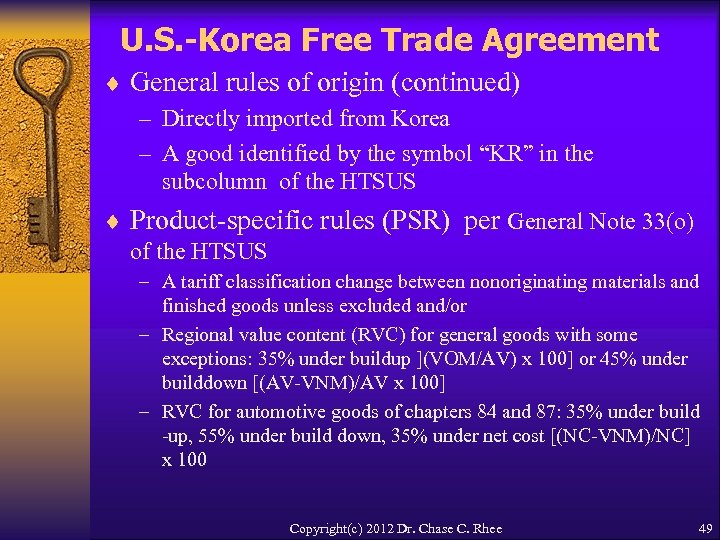 U. S. -Korea Free Trade Agreement ¨ General rules of origin (continued) – Directly imported from Korea – A good identified by the symbol “KR” in the subcolumn of the HTSUS ¨ Product-specific rules (PSR) per General Note 33(o) of the HTSUS – A tariff classification change between nonoriginating materials and finished goods unless excluded and/or – Regional value content (RVC) for general goods with some exceptions: 35% under buildup ](VOM/AV) x 100] or 45% under builddown [(AV-VNM)/AV x 100] – RVC for automotive goods of chapters 84 and 87: 35% under build -up, 55% under build down, 35% under net cost [(NC-VNM)/NC] x 100 Copyright(c) 2012 Dr. Chase C. Rhee 49
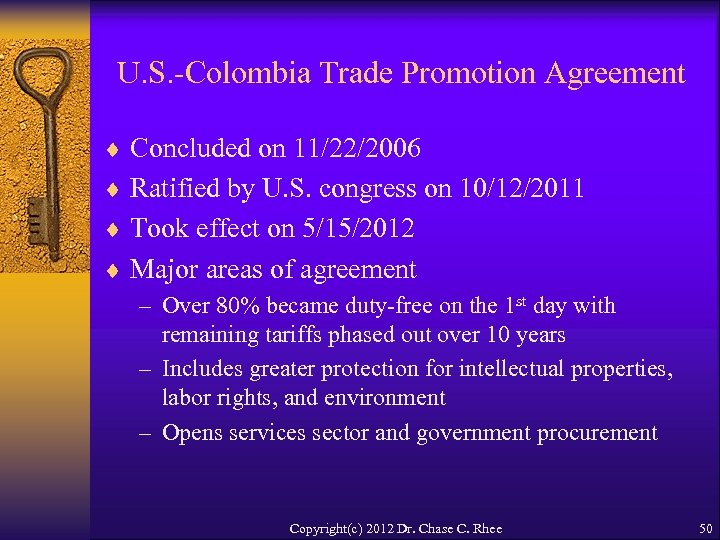 U. S. -Colombia Trade Promotion Agreement ¨ Concluded on 11/22/2006 ¨ Ratified by U. S. congress on 10/12/2011 ¨ Took effect on 5/15/2012 ¨ Major areas of agreement – Over 80% became duty-free on the 1 st day with remaining tariffs phased out over 10 years – Includes greater protection for intellectual properties, labor rights, and environment – Opens services sector and government procurement Copyright(c) 2012 Dr. Chase C. Rhee 50
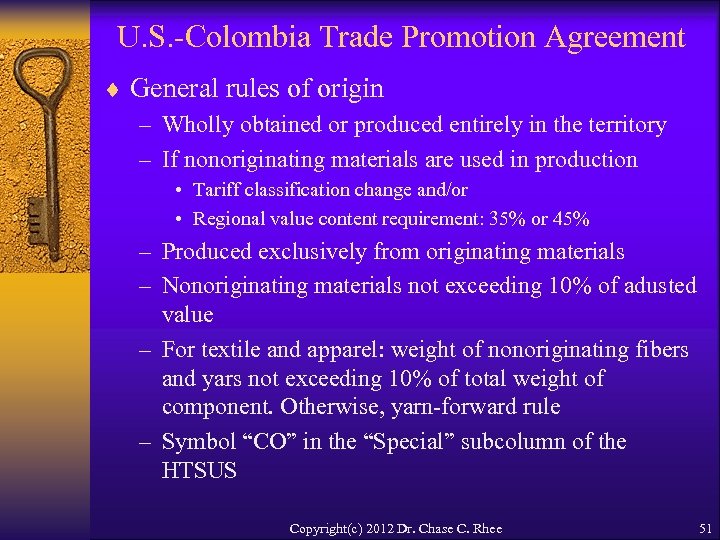 U. S. -Colombia Trade Promotion Agreement ¨ General rules of origin – Wholly obtained or produced entirely in the territory – If nonoriginating materials are used in production • Tariff classification change and/or • Regional value content requirement: 35% or 45% – Produced exclusively from originating materials – Nonoriginating materials not exceeding 10% of adusted value – For textile and apparel: weight of nonoriginating fibers and yars not exceeding 10% of total weight of component. Otherwise, yarn-forward rule – Symbol “CO” in the “Special” subcolumn of the HTSUS Copyright(c) 2012 Dr. Chase C. Rhee 51
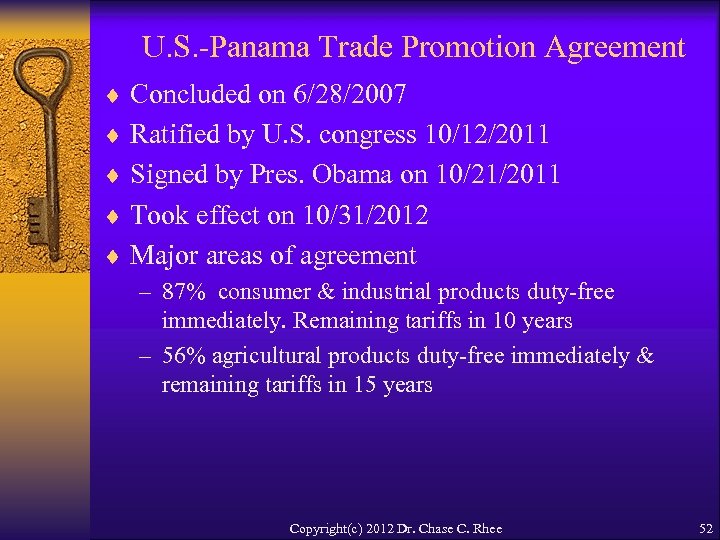 U. S. -Panama Trade Promotion Agreement ¨ Concluded on 6/28/2007 ¨ Ratified by U. S. congress 10/12/2011 ¨ Signed by Pres. Obama on 10/21/2011 ¨ Took effect on 10/31/2012 ¨ Major areas of agreement – 87% consumer & industrial products duty-free immediately. Remaining tariffs in 10 years – 56% agricultural products duty-free immediately & remaining tariffs in 15 years Copyright(c) 2012 Dr. Chase C. Rhee 52
 U. S. -Panama Trade Promotion Agreement ¨ Major Areas of Agreement (cont. ) – Significant infrastructure opportunities in Panama – – – Canal Expansion project Level playing field for U. S. investors Protection for intellectual property rights Protection of labor rights and environment Fair & open government procurement Open & competitive telecommunications market Copyright(c) 2012 Dr. Chase C. Rhee 53
 U. S. -Panama Trade Promotion Agreement ¨ General Rules of Origin ¨ A good wholly obtained or produced in Panama or the U. S. ¨ Each of nonoriginating materials used in the production of the goods undergoes an applicable change in tariff classification or ¨ A good which satisfies any regional value requirement ¨ Symbol “PA” in the “Special” subcolumn of the HTSUS Copyright(c) 2012 Dr. Chase C. Rhee 54
 Free Trade Agreement Withdrawn ¨ Trans-Pacific Partnership (TPP) – Signed on February 4, 2016 by trade ministers of 12 countries of Australia, Brunei, Canada, Chile, Japan, Malaysia, Mexico, New Zealand, Peru, Singapore, United States, and Vietnam. – 7 years of negotiations. Represents roughly 40% of the world's economic output. – U. S. withdrew on January 24, 2017 by President Donald Trump on his first day in office. – To take effect, it needs to be ratified by Feb. 2018 by at least six countries that account for 85% of the group's economic output. Impossible without U. S. Copyright(c) 2012 Dr. Chase C. Rhee 55
 Free Trade Agreement Under Negotiation ¨ Transatlantic Trade and Investment Partnership (TTIP) – Free trade agreement being negotiated between the United States and the European Union to cut tariffs and regulatory barriers. – Negotiations launched in June 2013. Copyright(c) 2012 Dr. Chase C. Rhee 56