 Скачать презентацию Chapter Two Using Objects Chapter Goals
a93b2b2d4d59b8529ebf11407e9e0f59.ppt
- Количество слайдов: 114



Chapter Two: Using Objects
Chapter Goals • To learn about variables • To understand the concepts of classes and objects • To be able to call methods • To learn about parameters and return values • To implement test programs • To be able to browse the API documentation • To realize the difference between objects and object references • To write programs that display simple shapes
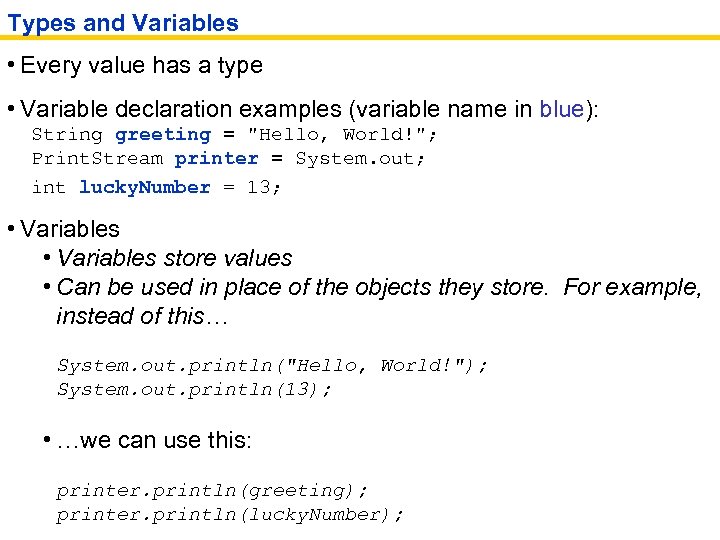
Types and Variables • Every value has a type • Variable declaration examples (variable name in blue): String greeting = "Hello, World!"; Print. Stream printer = System. out; int lucky. Number = 13; • Variables store values • Can be used in place of the objects they store. For example, instead of this… System. out. println("Hello, World!"); System. out. println(13); • …we can use this: printer. println(greeting); printer. println(lucky. Number);
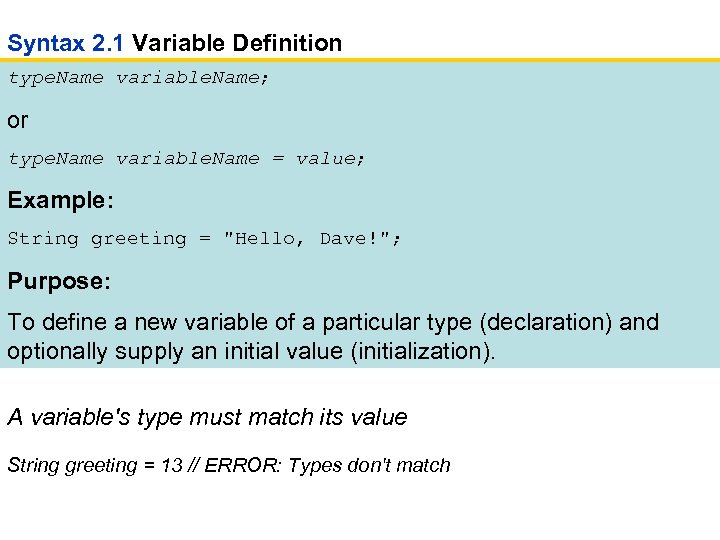
Syntax 2. 1 Variable Definition type. Name variable. Name; or type. Name variable. Name = value; Example: String greeting = "Hello, Dave!"; Purpose: To define a new variable of a particular type (declaration) and optionally supply an initial value (initialization). A variable's type must match its value String greeting = 13 // ERROR: Types don't match
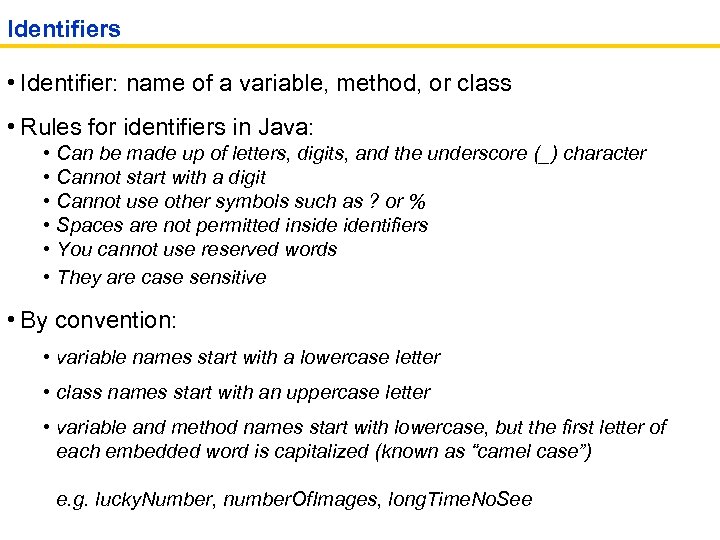
Identifiers • Identifier: name of a variable, method, or class • Rules for identifiers in Java: • Can be made up of letters, digits, and the underscore (_) character • Cannot start with a digit • Cannot use other symbols such as ? or % • Spaces are not permitted inside identifiers • You cannot use reserved words • They are case sensitive • By convention: • variable names start with a lowercase letter • class names start with an uppercase letter • variable and method names start with lowercase, but the first letter of each embedded word is capitalized (known as “camel case”) e. g. lucky. Number, number. Of. Images, long. Time. No. See
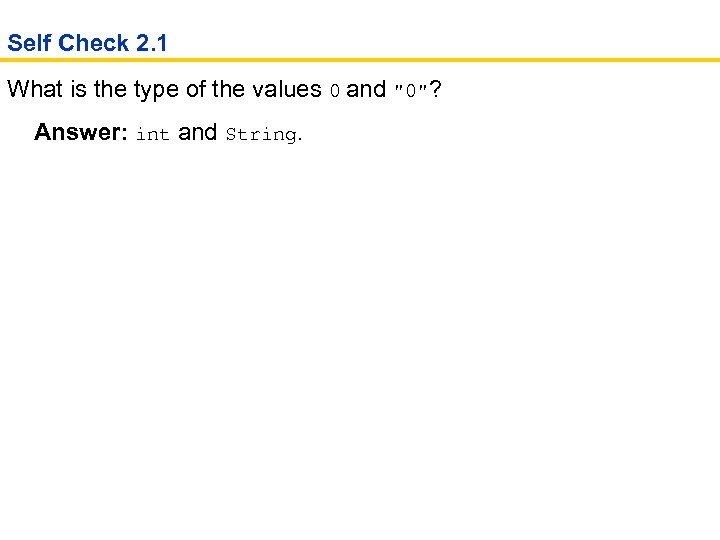
Self Check 2. 1 What is the type of the values 0 and "0"? Answer: int and String.
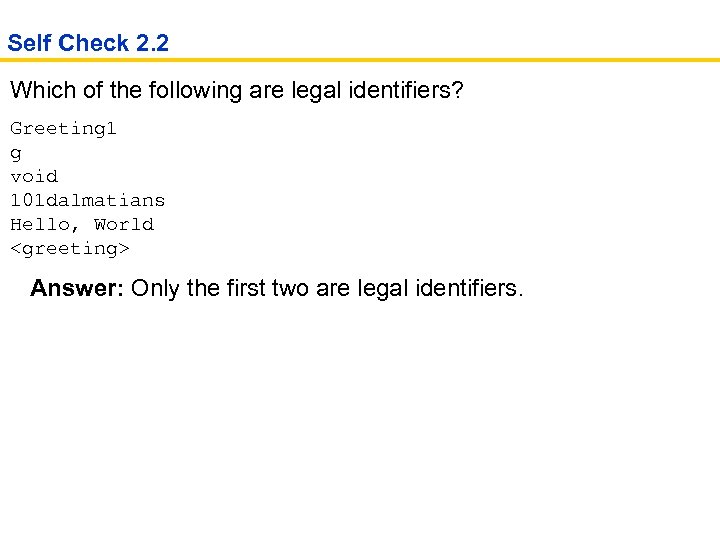
Self Check 2. 2 Which of the following are legal identifiers? Greeting 1 g void 101 dalmatians Hello, World <greeting> Answer: Only the first two are legal identifiers.
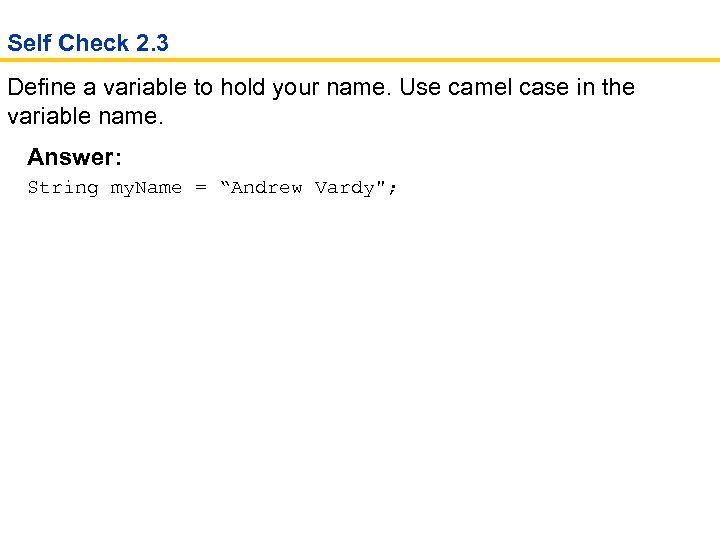
Self Check 2. 3 Define a variable to hold your name. Use camel case in the variable name. Answer: String my. Name = “Andrew Vardy";
The Assignment Operator • Assignment operator: = • Used to either change the value of a variable or initialize the variable • Initialization: Giving a variable its initial value • Not used as a statement about equality
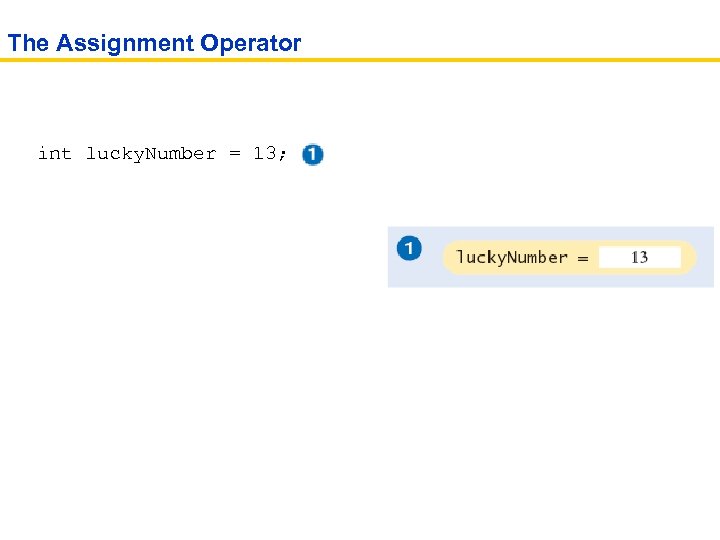
The Assignment Operator int lucky. Number = 13;
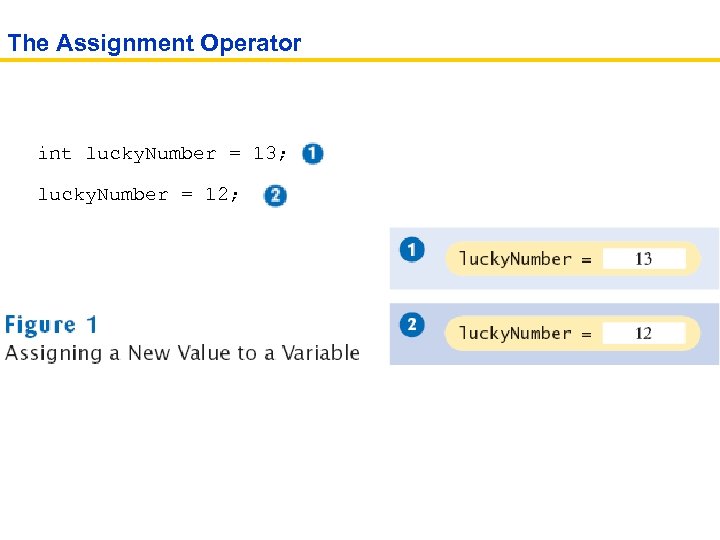
The Assignment Operator int lucky. Number = 13; lucky. Number = 12;
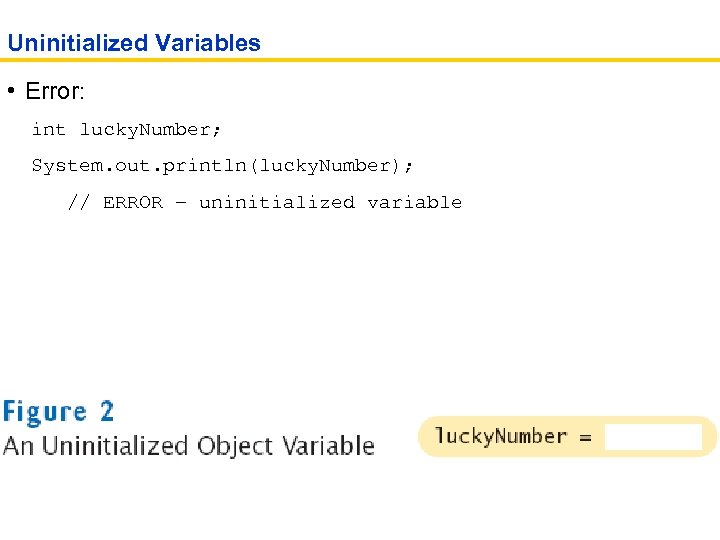
Uninitialized Variables • Error: int lucky. Number; System. out. println(lucky. Number); // ERROR – uninitialized variable
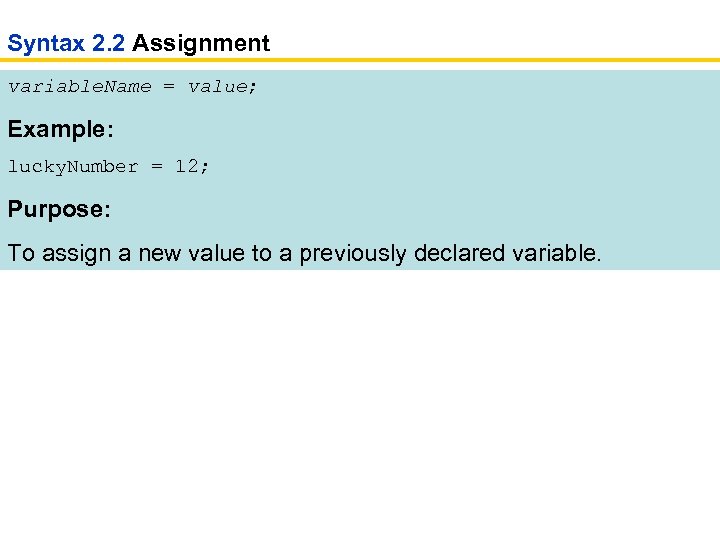
Syntax 2. 2 Assignment variable. Name = value; Example: lucky. Number = 12; Purpose: To assign a new value to a previously declared variable.
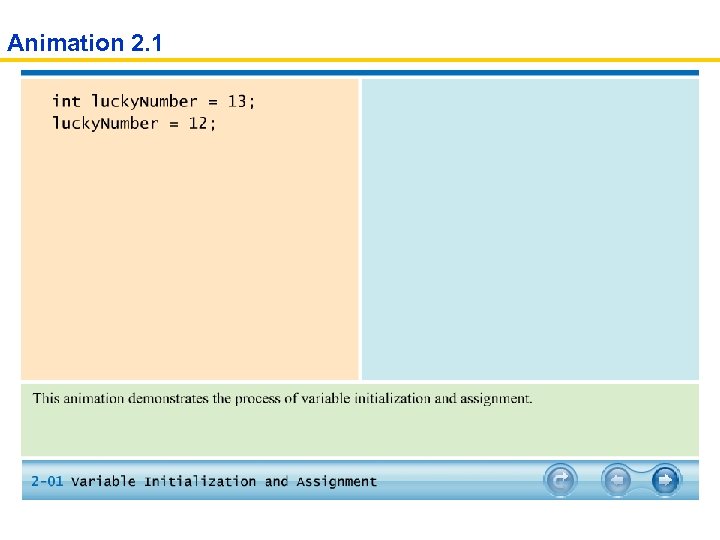
Animation 2. 1
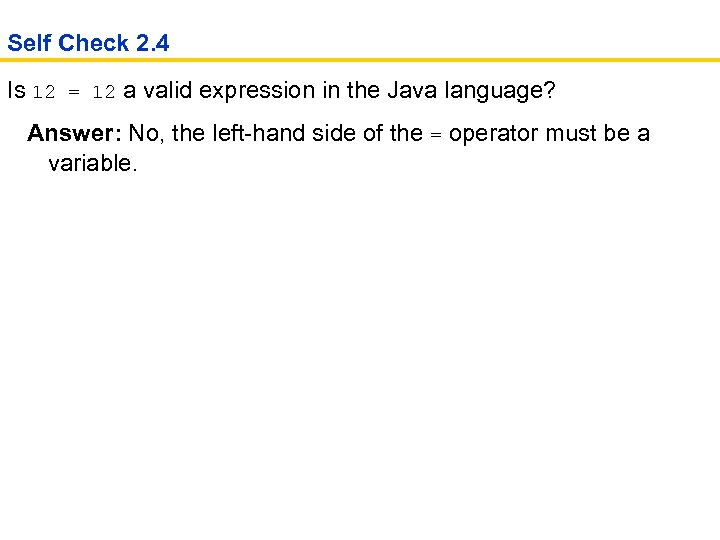
Self Check 2. 4 Is 12 = 12 a valid expression in the Java language? Answer: No, the left-hand side of the = operator must be a variable.
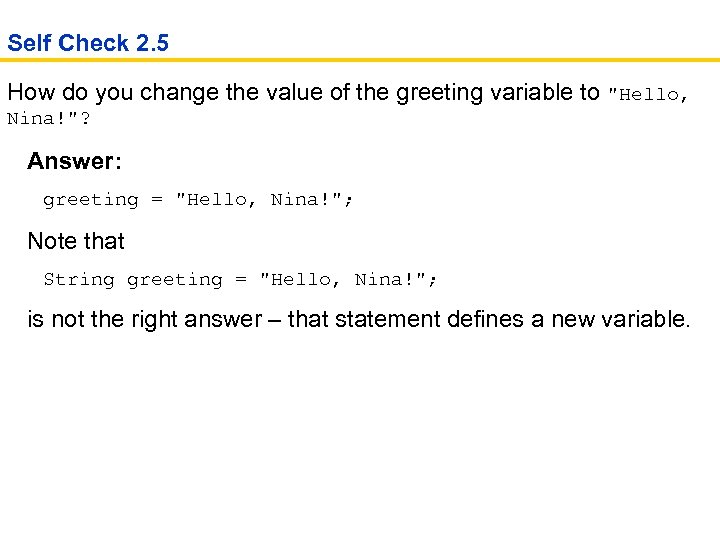
Self Check 2. 5 How do you change the value of the greeting variable to "Hello, Nina!"? Answer: greeting = "Hello, Nina!"; Note that String greeting = "Hello, Nina!"; is not the right answer – that statement defines a new variable.
Objects and Classes • Object: entity that you can manipulate in your programs (by calling methods) • Each object belongs to a class: • For example, System. out belongs to the class Print. Stream • "Hello, World!" belongs to the class String
Methods • Method: Sequence of instructions that accesses the data of an object • You manipulate objects by calling their methods • Class: Set of objects with the same behaviour • The class of an object determines which methods are legal for that object String greeting = "Hello"; greeting. println() // Error greeting. length() // OK • Public Interface: Specifies the methods (and public variables) that a class offers for your use
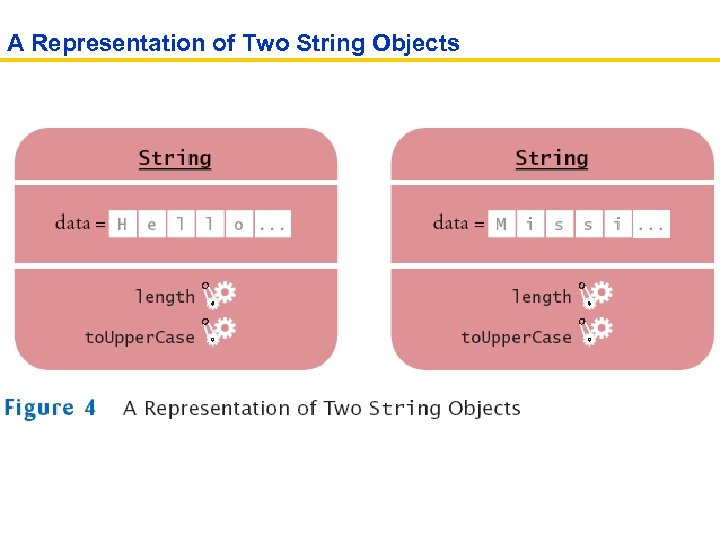
A Representation of Two String Objects
String Methods • length: counts the number of characters in a string String greeting = "Hello, World!"; int n = greeting. length(); // sets n to 13 • to. Upper. Case: creates another String object that contains the characters of the original string, with lowercase letters converted to uppercase String river = "Mississippi"; String big. River = river. to. Upper. Case(); // sets big. River to "MISSISSIPPI" • When applying a method to an object, make sure the method is defined in the appropriate class (i. e. the method must be part of the class’s public interface) System. out. length(); // This method call is an error
Self Check 2. 6 Assume that river has been defined as follows: String river = “Mississippi!”; How can you compute the length of the string "Mississippi"? Answer: river. length() or "Mississippi". length()
Self Check 2. 7 How can you print out the uppercase version of "Hello, World!"? Assume that greeting has been defined as follows: String greeting = “Hello, World!”; Answer: System. out. println(greeting. to. Upper. Case());
Self Check 2. 8 Assume that river has been defined as follows: String river = “Mississippi!”; Is it legal to call river. println()? Why or why not? Answer: It is not legal. The variable river has type String. The println method is not a method of the String class.
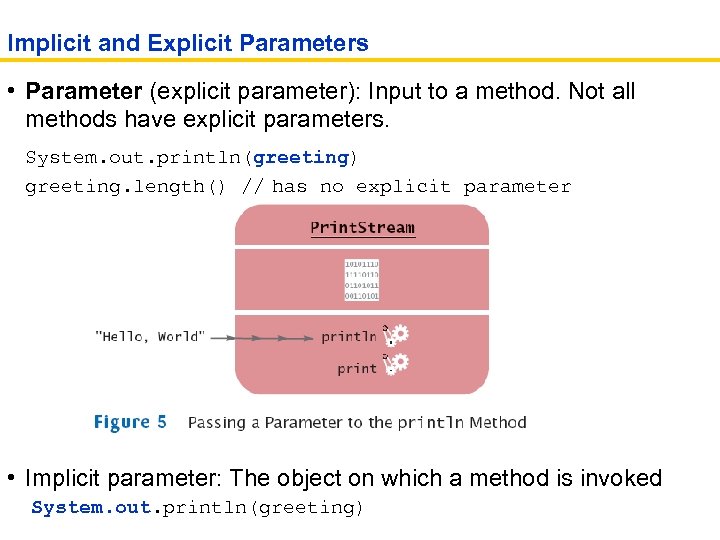
Implicit and Explicit Parameters • Parameter (explicit parameter): Input to a method. Not all methods have explicit parameters. System. out. println(greeting) greeting. length() // has no explicit parameter • Implicit parameter: The object on which a method is invoked System. out. println(greeting)
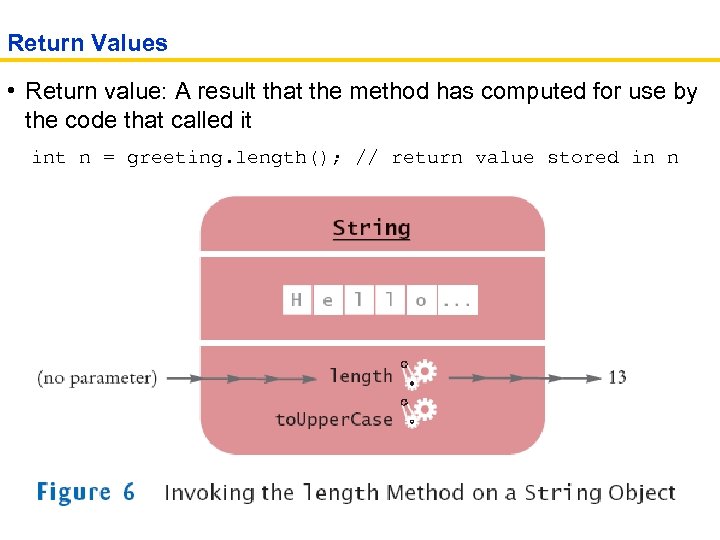
Return Values • Return value: A result that the method has computed for use by the code that called it int n = greeting. length(); // return value stored in n
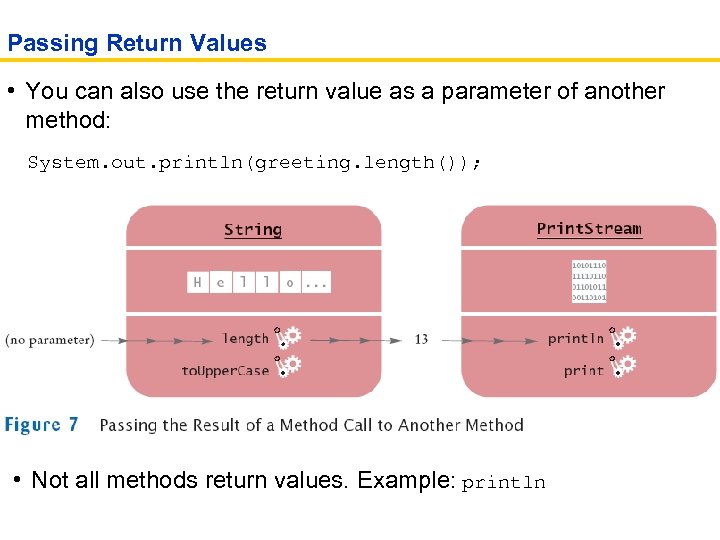
Passing Return Values • You can also use the return value as a parameter of another method: System. out. println(greeting. length()); • Not all methods return values. Example: println
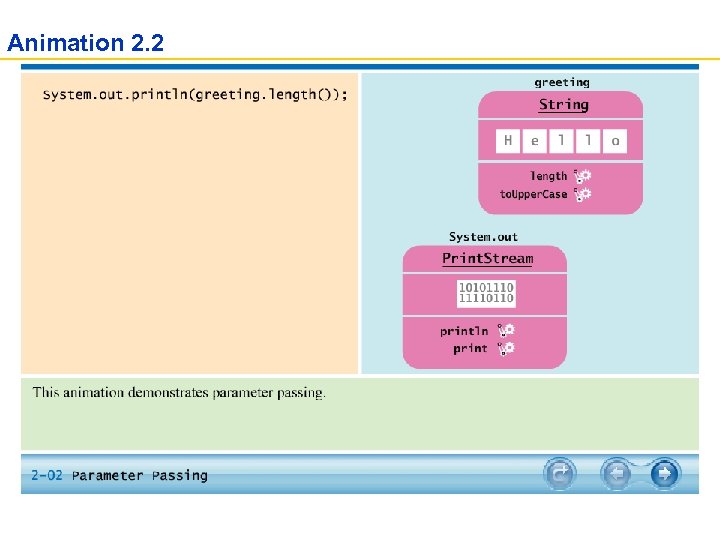
Animation 2. 2
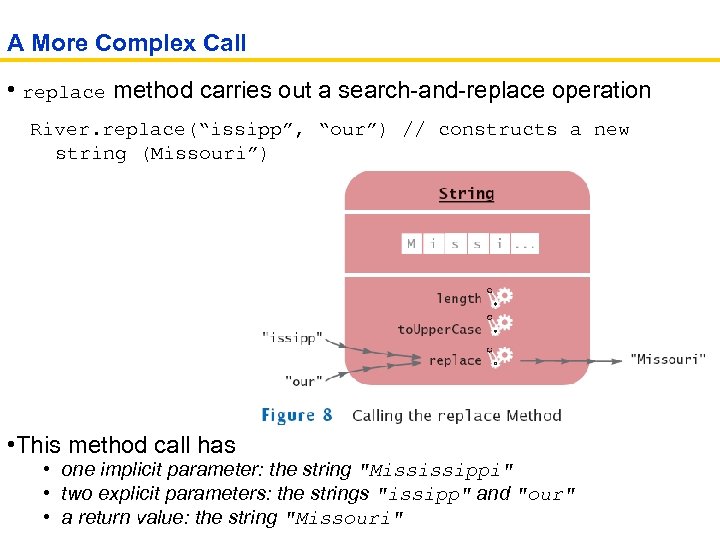
A More Complex Call • replace method carries out a search-and-replace operation River. replace(“issipp”, “our”) // constructs a new string (Missouri”) • This method call has • one implicit parameter: the string "Mississippi" • two explicit parameters: the strings "issipp" and "our" • a return value: the string "Missouri"
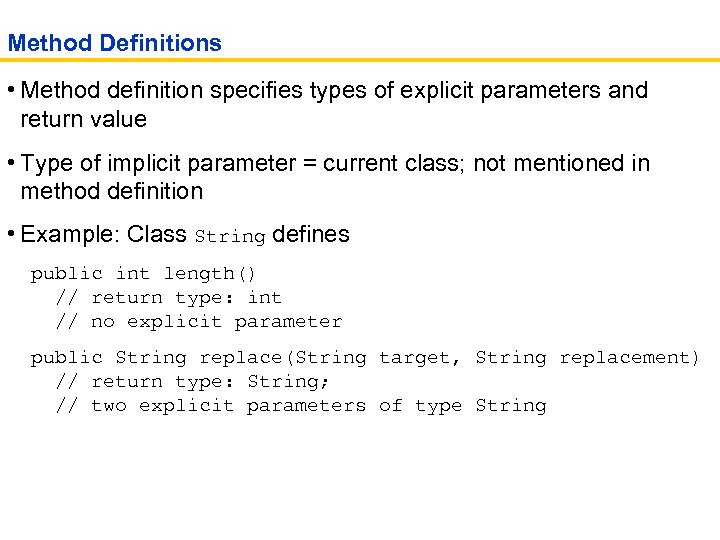
Method Definitions • Method definition specifies types of explicit parameters and return value • Type of implicit parameter = current class; not mentioned in method definition • Example: Class String defines public int length() // return type: int // no explicit parameter public String replace(String target, String replacement) // return type: String; // two explicit parameters of type String
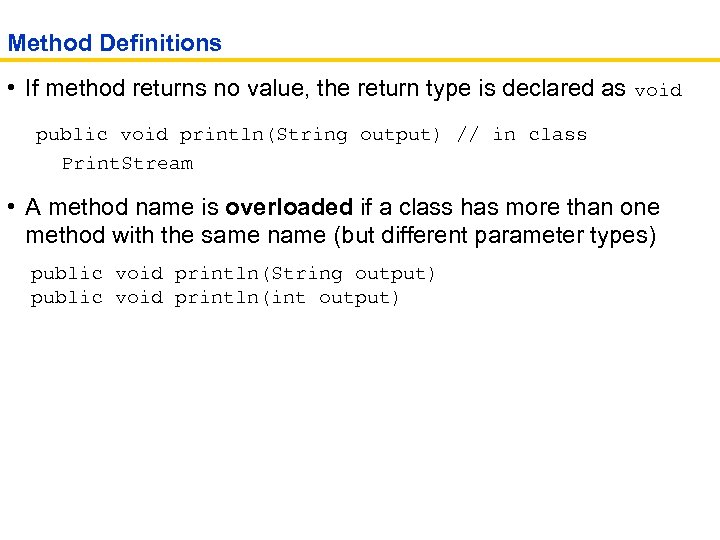
Method Definitions • If method returns no value, the return type is declared as void public void println(String output) // in class Print. Stream • A method name is overloaded if a class has more than one method with the same name (but different parameter types) public void println(String output) public void println(int output)
Self Check 2. 9 Assume that river has been defined as follows: String river = “Mississippi!”; What are the implicit parameters, explicit parameters, and return values in the method call river. length()? Answer: The implicit parameter is river. There is no explicit parameter. The return value is 11.
Self Check 2. 10 What is the result of the call river. replace("p", "s")? Answer: "Missississi".
Self Check 2. 11 Assume that greeting has been defined as follows: String greeting = “Hello, World!”; What is the result of the call greeting. replace("World", "Dave"). length()? Answer: 12.
Self Check 2. 12 How is the to. Upper. Case method defined in the String class? Answer: As public String to. Upper. Case(), with no explicit parameter and return type String.
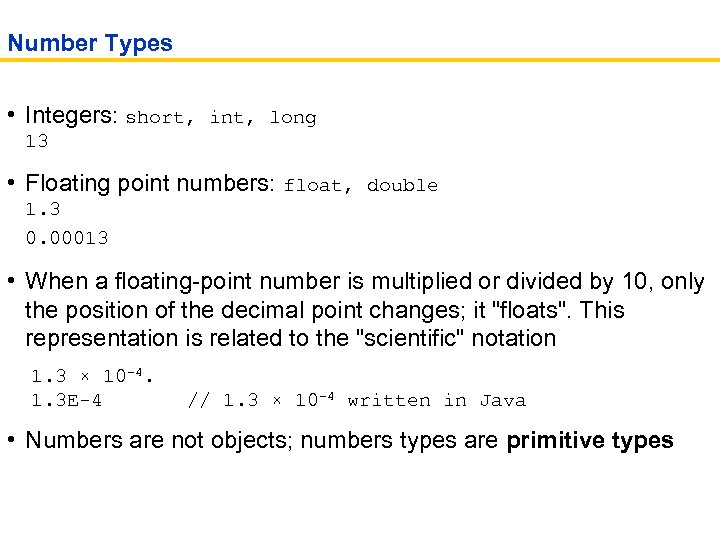
Number Types • Integers: short, int, long 13 • Floating point numbers: float, double 1. 3 0. 00013 • When a floating-point number is multiplied or divided by 10, only the position of the decimal point changes; it "floats". This representation is related to the "scientific" notation 1. 3 × 10 -4. 1. 3 E-4 // 1. 3 × 10 -4 written in Java • Numbers are not objects; numbers types are primitive types
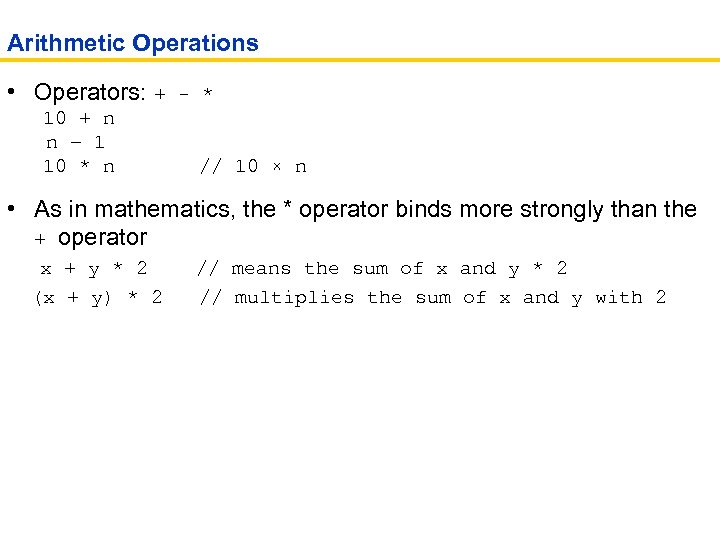
Arithmetic Operations • Operators: + - * 10 + n n – 1 10 * n // 10 × n • As in mathematics, the * operator binds more strongly than the + operator x + y * 2 // means the sum of x and y * 2 (x + y) * 2 // multiplies the sum of x and y with 2
Self Check 2. 13 Which number type would you use for storing the area of a circle? Answer: double.
Self Check 2. 14 Why is the expression 13. println() an error? Answer: An int is not an object, and you cannot call a method on it.
Self Check 2. 15 Write an expression to compute the average of the values x and y. Answer: (x + y) * 0. 5
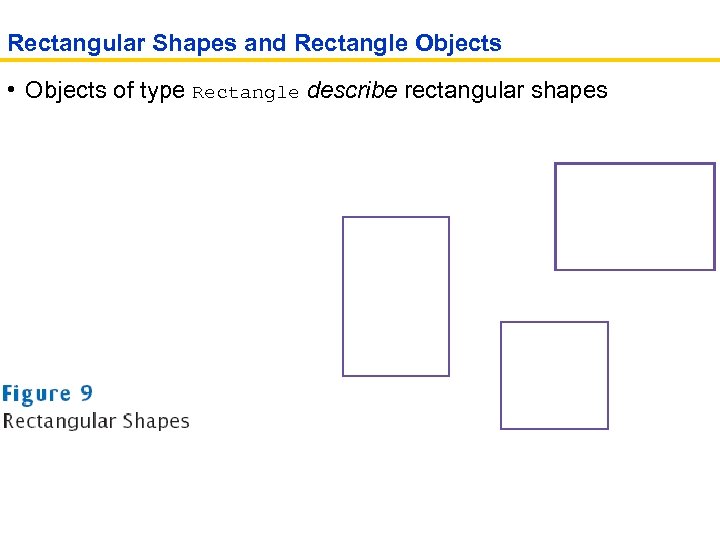
Rectangular Shapes and Rectangle Objects • Objects of type Rectangle describe rectangular shapes
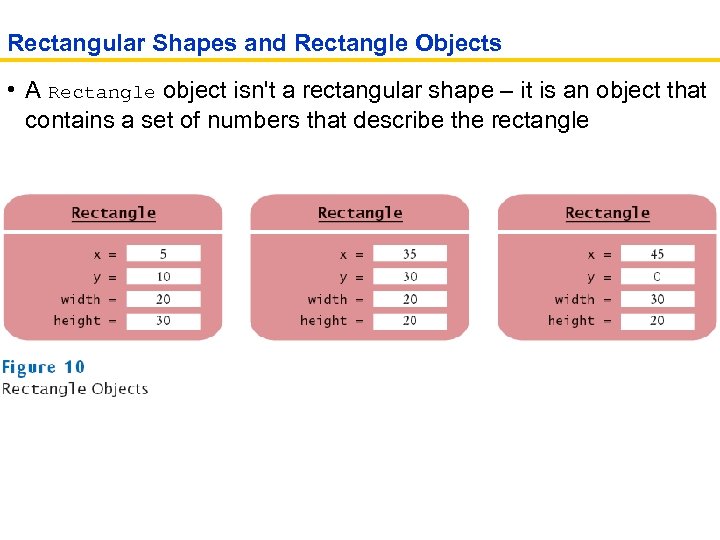
Rectangular Shapes and Rectangle Objects • A Rectangle object isn't a rectangular shape – it is an object that contains a set of numbers that describe the rectangle
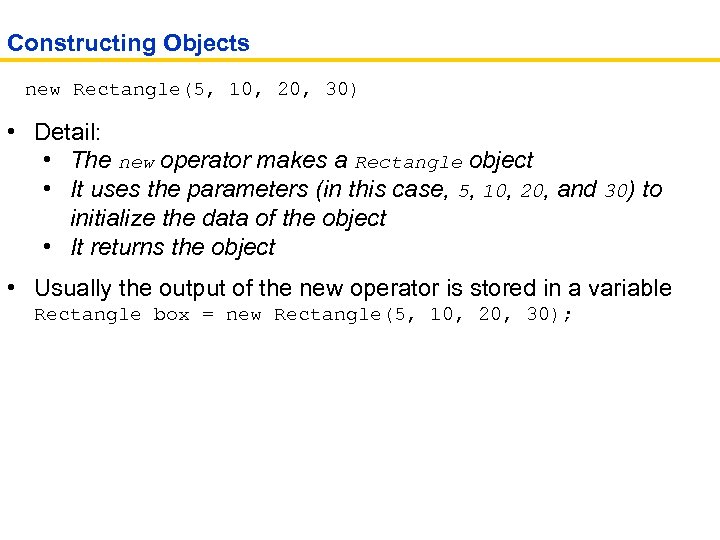
Constructing Objects new Rectangle(5, 10, 20, 30) • Detail: • The new operator makes a Rectangle object • It uses the parameters (in this case, 5, 10, 20, and 30) to initialize the data of the object • It returns the object • Usually the output of the new operator is stored in a variable Rectangle box = new Rectangle(5, 10, 20, 30);
Constructing Objects • The process of creating a new object is called construction • The four values 5, 10, 20, and 30 are called the construction parameters • Some classes let you construct objects in multiple ways new Rectangle() // constructs a rectangle with its top left corner // at the origin (0, 0), width 0, and height 0
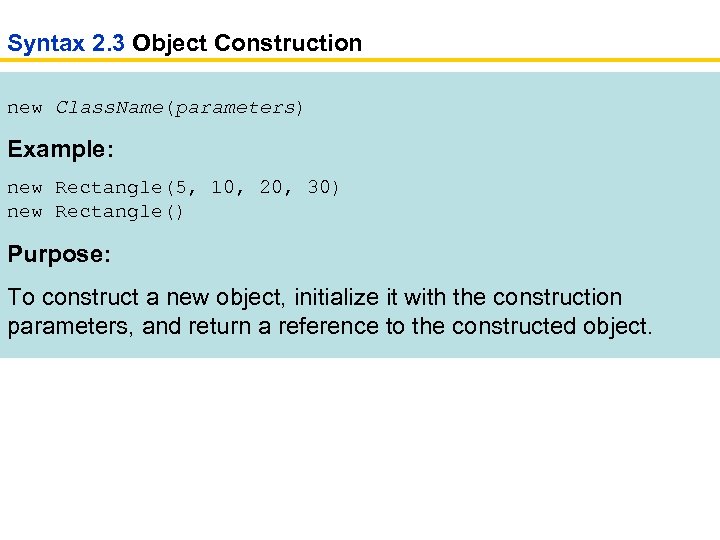
Syntax 2. 3 Object Construction new Class. Name(parameters) Example: new Rectangle(5, 10, 20, 30) new Rectangle() Purpose: To construct a new object, initialize it with the construction parameters, and return a reference to the constructed object.
Self Check 2. 16 How do you construct a square with center (100, 100) and side length 20? Answer: new Rectangle(90, 20, 20)
Self Check 2. 17 What does the following statement print? System. out. println(new Rectangle(). get. Width()); Answer: 0
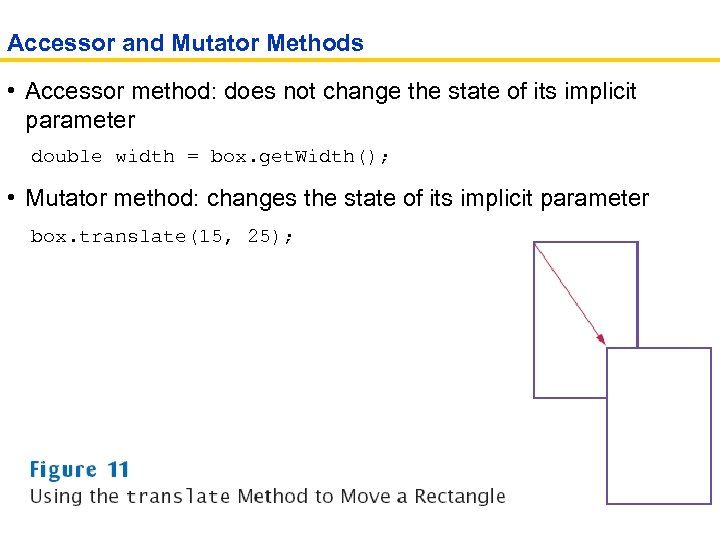
Accessor and Mutator Methods • Accessor method: does not change the state of its implicit parameter double width = box. get. Width(); • Mutator method: changes the state of its implicit parameter box. translate(15, 25);

Self Check 2. 18 Is the to. Upper. Case method of the String class an accessor or a mutator? Answer: An accessor – it doesn't modify the original string but returns a new string with uppercase letters.
Self Check 2. 19 Which call to translate is needed to move the box rectangle so that its top-left corner is the origin (0, 0)? Answer: box. translate(-5, -10), provided the method is called immediately after storing the new rectangle into box.
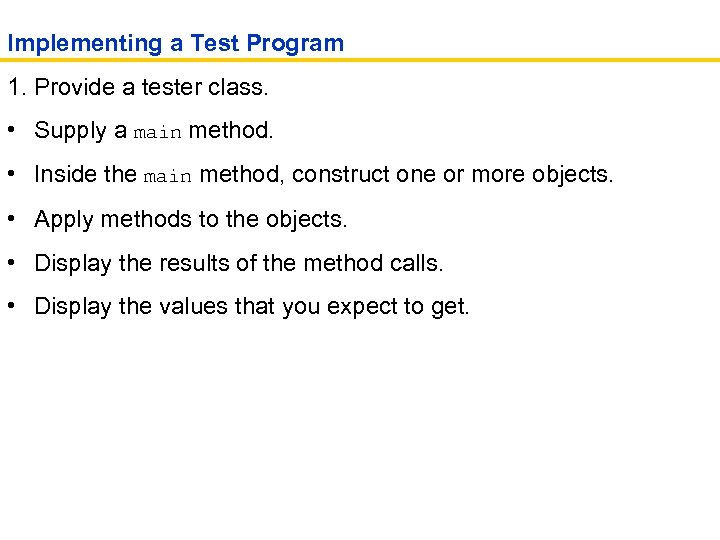
Implementing a Test Program 1. Provide a tester class. • Supply a main method. • Inside the main method, construct one or more objects. • Apply methods to the objects. • Display the results of the method calls. • Display the values that you expect to get.
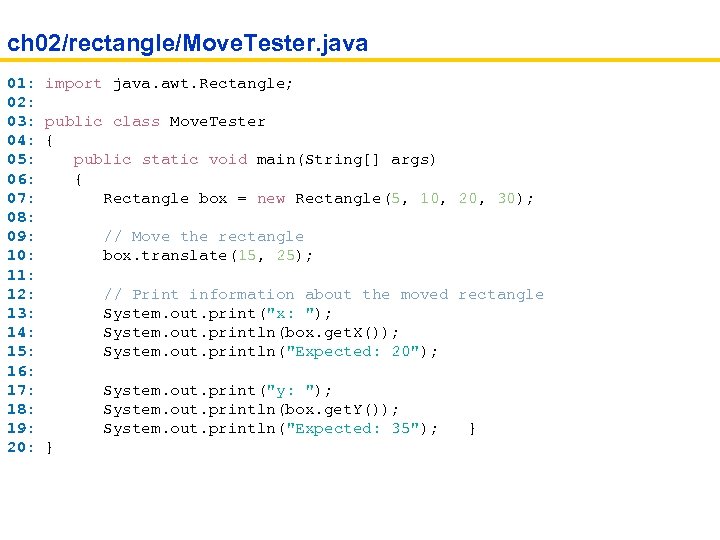
ch 02/rectangle/Move. Tester. java 01: import java. awt. Rectangle; 02: 03: public class Move. Tester 04: { 05: public static void main(String[] args) 06: { 07: Rectangle box = new Rectangle(5, 10, 20, 30); 08: 09: // Move the rectangle 10: box. translate(15, 25); 11: 12: // Print information about the moved rectangle 13: System. out. print("x: "); 14: System. out. println(box. get. X()); 15: System. out. println("Expected: 20"); 16: 17: System. out. print("y: "); 18: System. out. println(box. get. Y()); 19: System. out. println("Expected: 35"); } 20: }
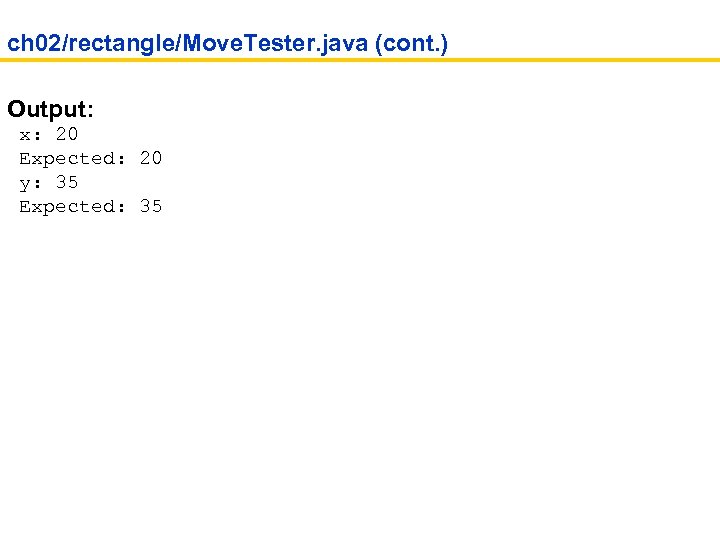
ch 02/rectangle/Move. Tester. java (cont. ) Output: x: 20 Expected: 20 y: 35 Expected: 35
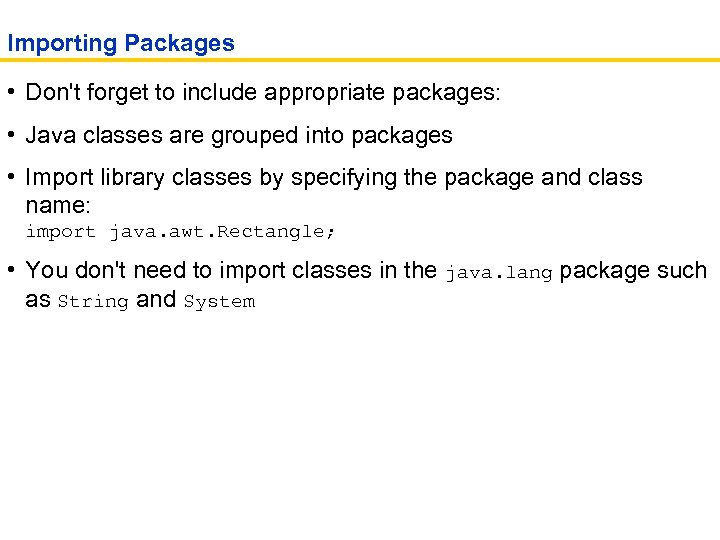
Importing Packages • Don't forget to include appropriate packages: • Java classes are grouped into packages • Import library classes by specifying the package and class name: import java. awt. Rectangle; • You don't need to import classes in the java. lang package such as String and System
Syntax 2. 4 Importing a Class from a Package import package. Name. Class. Name; Example: import java. awt. Rectangle; Purpose: To import a class from a package for use in a program.
Self Check 2. 20 Suppose we had called box. translate(25, 15) instead of box. translate(15, 25). What are the expected outputs? Answer: x: 30, y: 25
Self Check 2. 21 Why doesn't the Move. Tester program print the width and height of the rectangle? Answer: Because the translate method doesn't modify the shape of the rectangle.
Self Check 2. 22 The Random class is defined in the java. util package. What do you need to do in order to use that class in your program? Answer: Add the statement import java. util. Random; at the top of your program.
The API Documentation • API: Application Programming Interface • Lists classes and methods in the Java library • http: //java. sun. com/javase/6/docs/api/index. html
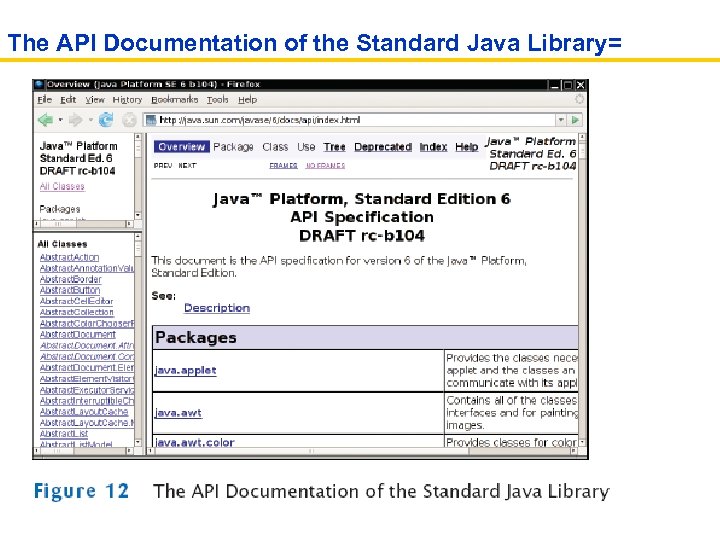
The API Documentation of the Standard Java Library=
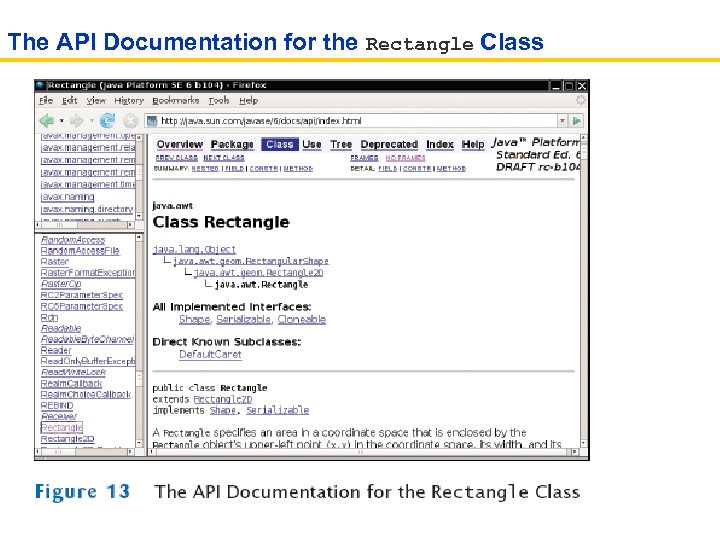
The API Documentation for the Rectangle Class
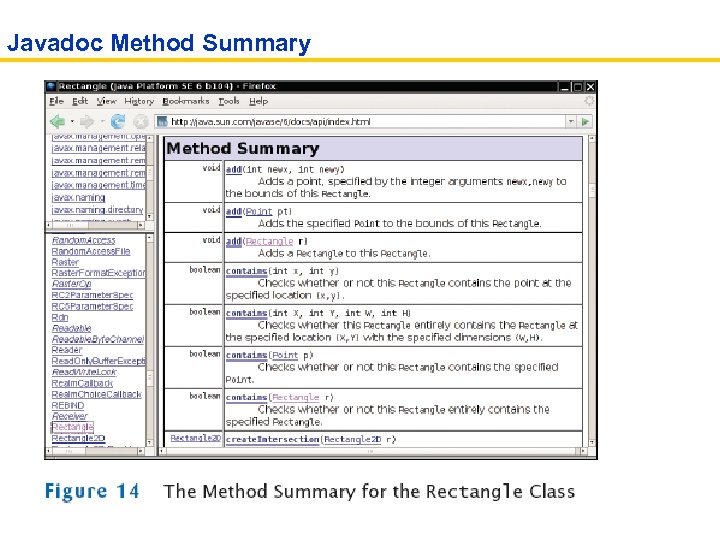
Javadoc Method Summary
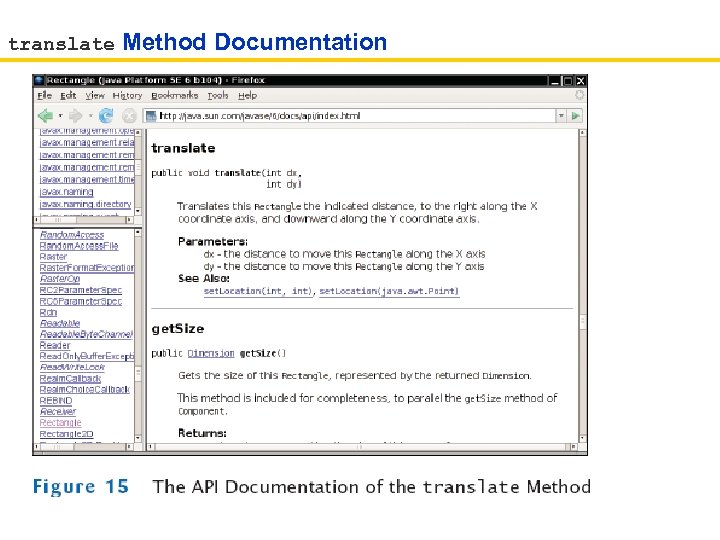
translate Method Documentation
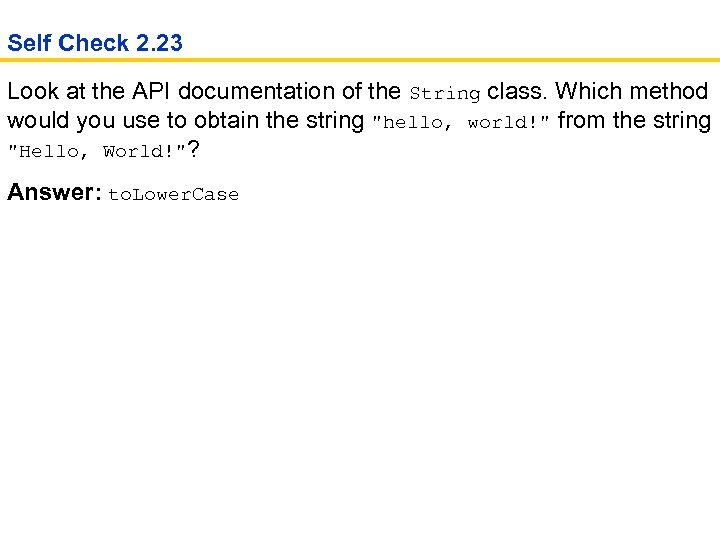
Self Check 2. 23 Look at the API documentation of the String class. Which method would you use to obtain the string "hello, world!" from the string "Hello, World!"? Answer: to. Lower. Case
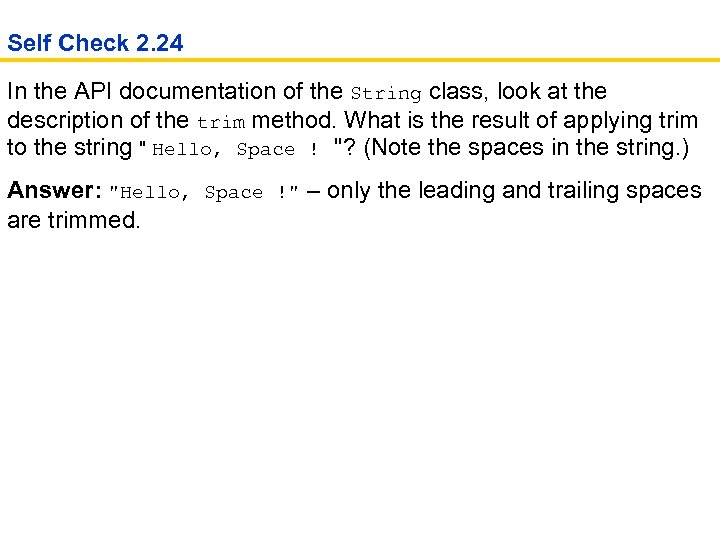
Self Check 2. 24 In the API documentation of the String class, look at the description of the trim method. What is the result of applying trim to the string " Hello, Space ! "? (Note the spaces in the string. ) Answer: "Hello, Space !" – only the leading and trailing spaces are trimmed.
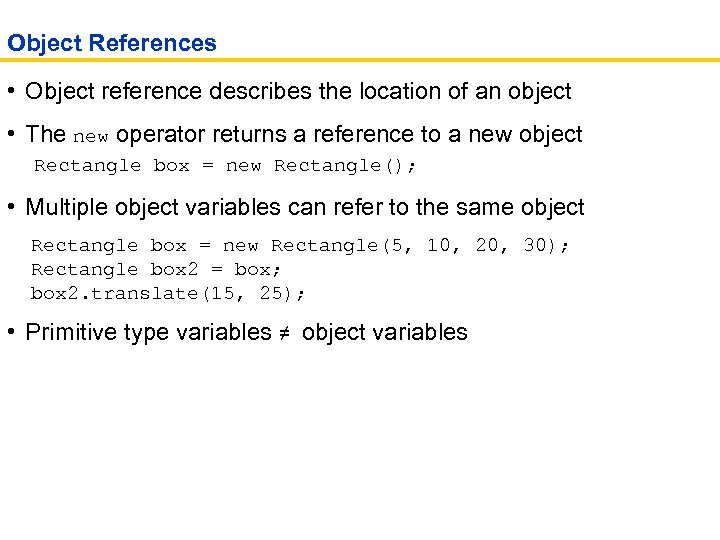
Object References • Object reference describes the location of an object • The new operator returns a reference to a new object Rectangle box = new Rectangle(); • Multiple object variables can refer to the same object Rectangle box = new Rectangle(5, 10, 20, 30); Rectangle box 2 = box; box 2. translate(15, 25); • Primitive type variables ≠ object variables
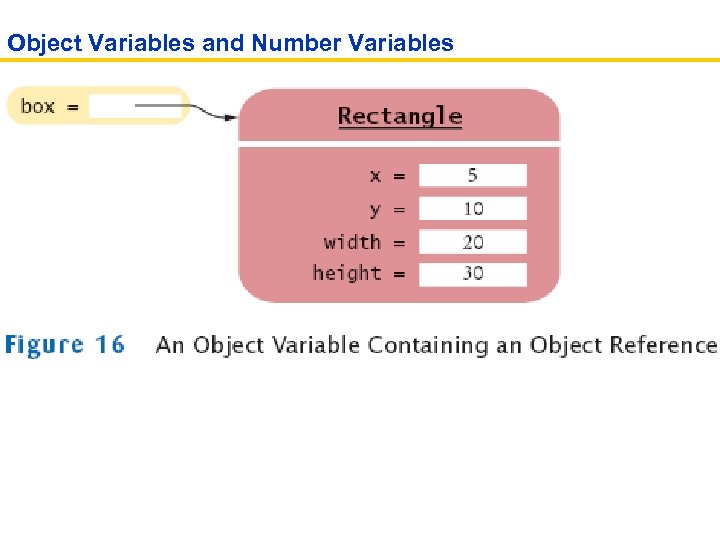
Object Variables and Number Variables
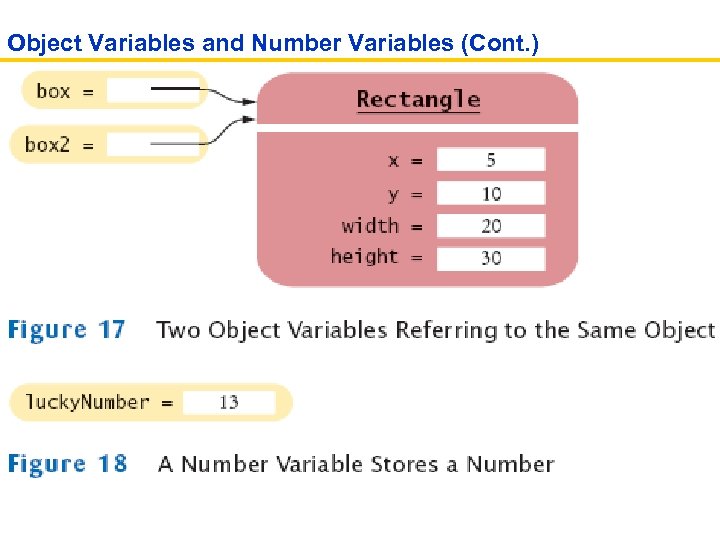
Object Variables and Number Variables (Cont. )
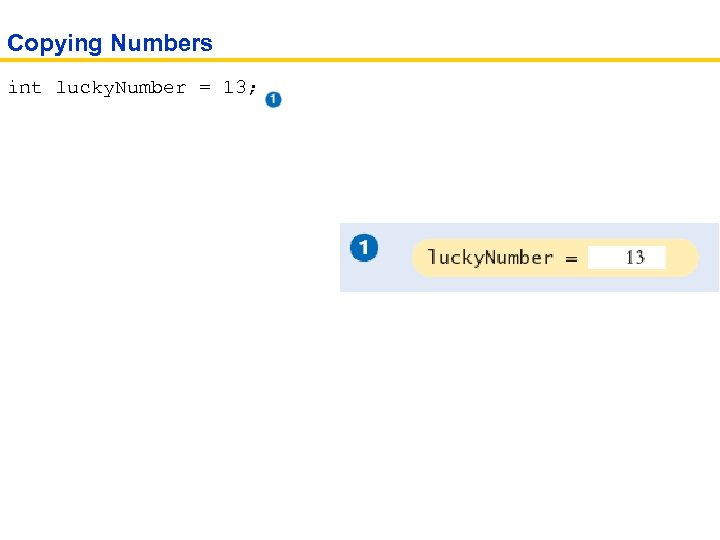
Copying Numbers int lucky. Number = 13;
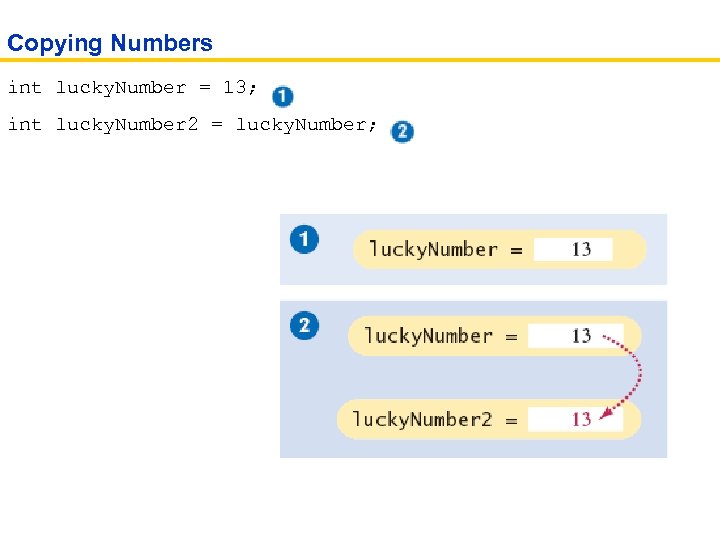
Copying Numbers int lucky. Number = 13; int lucky. Number 2 = lucky. Number;
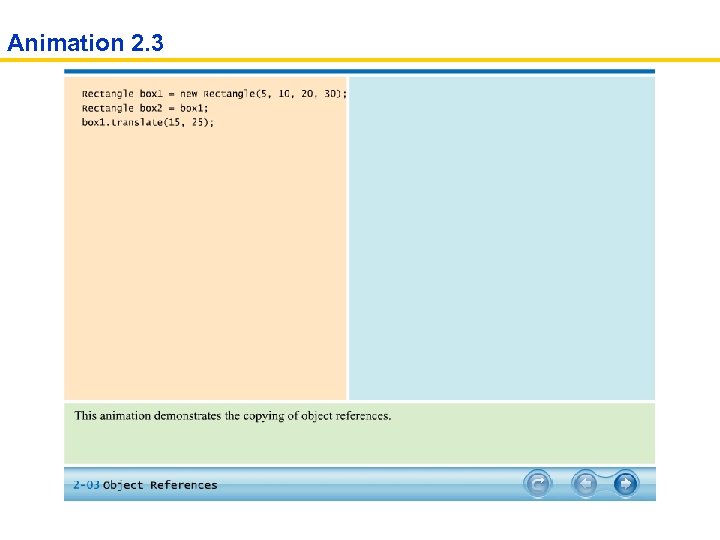
Animation 2. 3
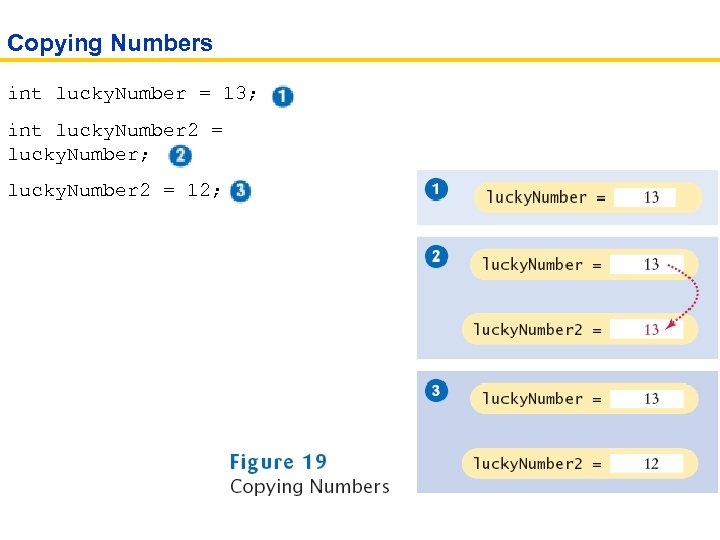
Copying Numbers int lucky. Number = 13; int lucky. Number 2 = lucky. Number; lucky. Number 2 = 12;
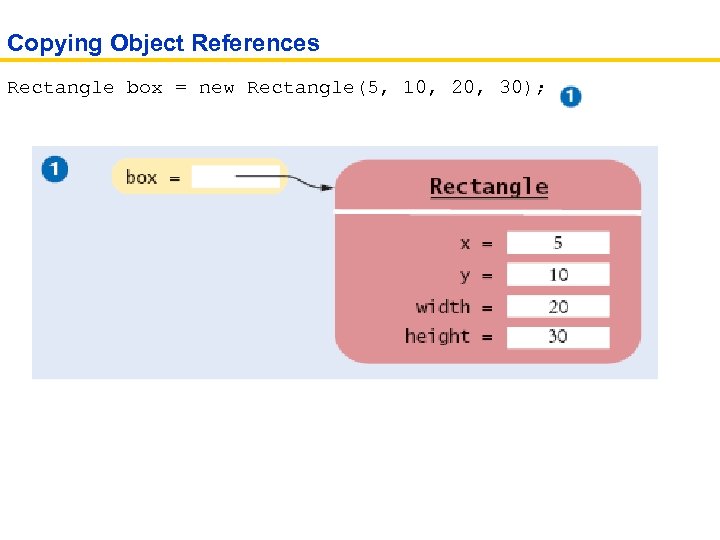
Copying Object References Rectangle box = new Rectangle(5, 10, 20, 30);
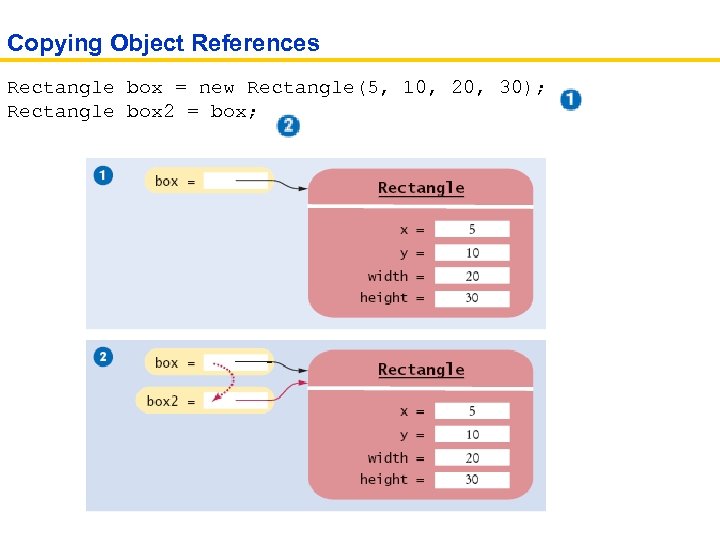
Copying Object References Rectangle box = new Rectangle(5, 10, 20, 30); Rectangle box 2 = box;
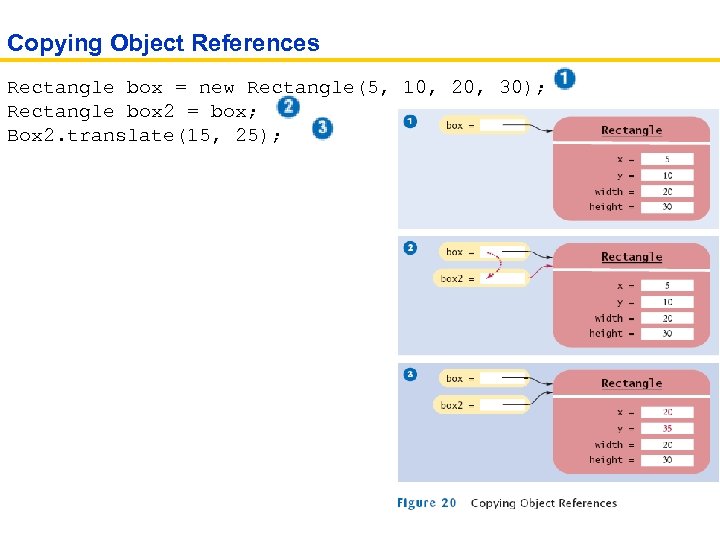
Copying Object References Rectangle box = new Rectangle(5, 10, 20, 30); Rectangle box 2 = box; Box 2. translate(15, 25);
Self Check 2. 25 What is the effect of the assignment greeting 2 = greeting? Answer: Now greeting and greeting 2 both refer to the same String object.
Self Check 2. 26 After calling greeting 2. to. Upper. Case(), what are the contents of greeting and greeting 2? Answer: Both variables still refer to the same string, and the string has not been modified. Recall that the to. Upper. Case method constructs a new string that contains uppercase characters, leaving the original string unchanged.
Mainframes – When Dinosaurs Ruled the Earth
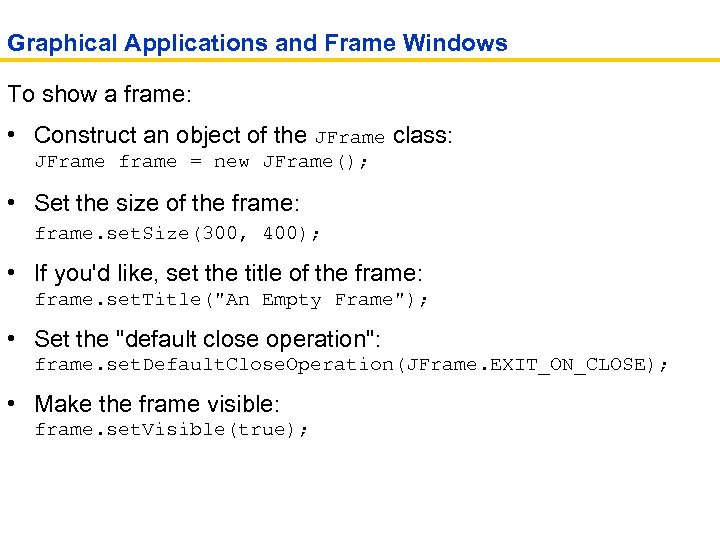
Graphical Applications and Frame Windows To show a frame: • Construct an object of the JFrame class: JFrame frame = new JFrame(); • Set the size of the frame: frame. set. Size(300, 400); • If you'd like, set the title of the frame: frame. set. Title("An Empty Frame"); • Set the "default close operation": frame. set. Default. Close. Operation(JFrame. EXIT_ON_CLOSE); • Make the frame visible: frame. set. Visible(true);
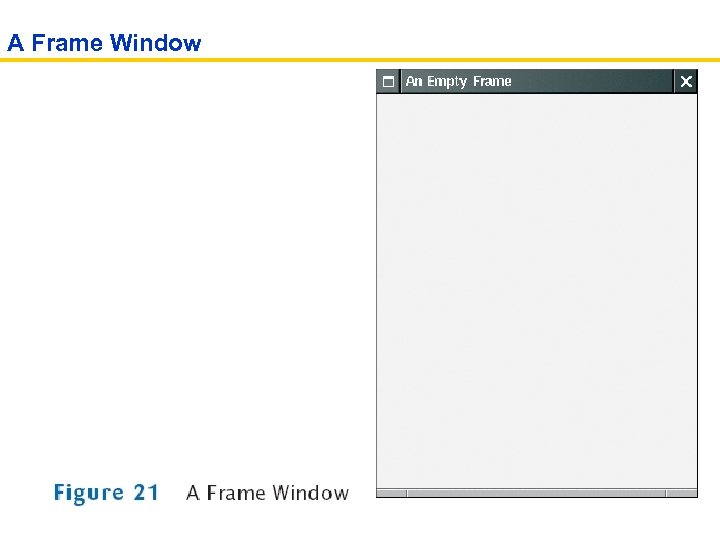
A Frame Window
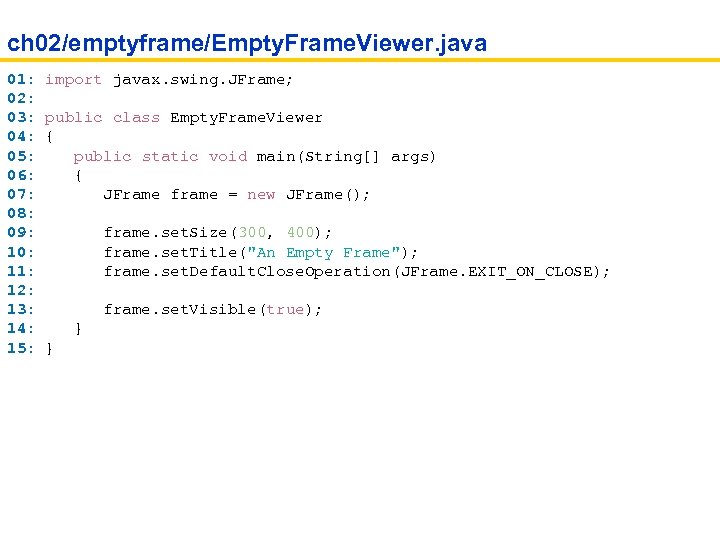
ch 02/emptyframe/Empty. Frame. Viewer. java 01: import javax. swing. JFrame; 02: 03: public class Empty. Frame. Viewer 04: { 05: public static void main(String[] args) 06: { 07: JFrame frame = new JFrame(); 08: 09: frame. set. Size(300, 400); 10: frame. set. Title("An Empty Frame"); 11: frame. set. Default. Close. Operation(JFrame. EXIT_ON_CLOSE); 12: 13: frame. set. Visible(true); 14: } 15: }
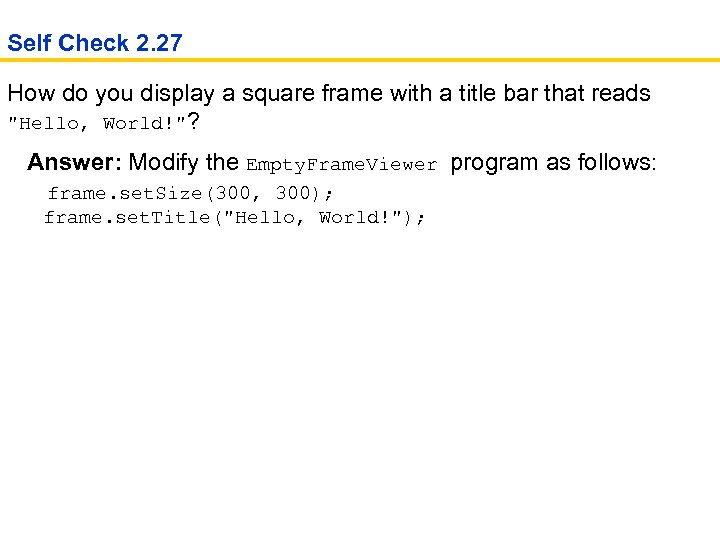
Self Check 2. 27 How do you display a square frame with a title bar that reads "Hello, World!"? Answer: Modify the Empty. Frame. Viewer program as follows: frame. set. Size(300, 300); frame. set. Title("Hello, World!");
Self Check 2. 28 How can a program display two frames at once? Answer: Construct two JFrame objects, set each of their sizes, and call set. Visible(true) on each of them.
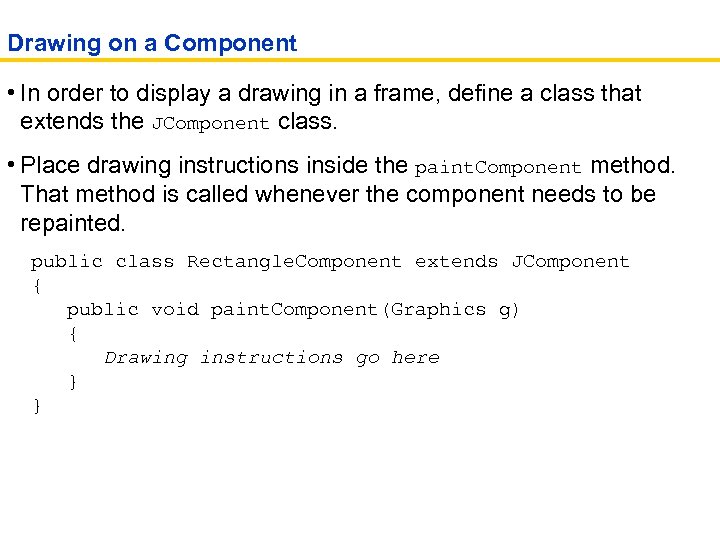
Drawing on a Component • In order to display a drawing in a frame, define a class that extends the JComponent class. • Place drawing instructions inside the paint. Component method. That method is called whenever the component needs to be repainted. public class Rectangle. Component extends JComponent { public void paint. Component(Graphics g) { Drawing instructions go here } }
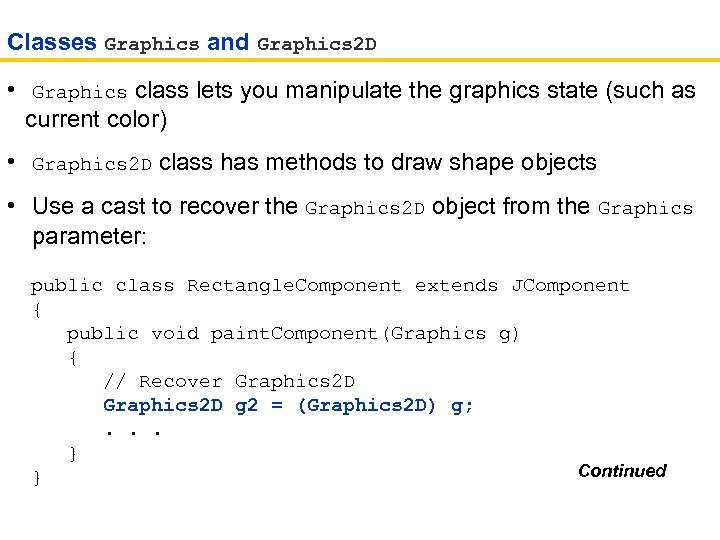
Classes Graphics and Graphics 2 D • Graphics class lets you manipulate the graphics state (such as current color) • Graphics 2 D class has methods to draw shape objects • Use a cast to recover the Graphics 2 D object from the Graphics parameter: public class Rectangle. Component extends JComponent { public void paint. Component(Graphics g) { // Recover Graphics 2 D g 2 = (Graphics 2 D) g; . . . } Continued }
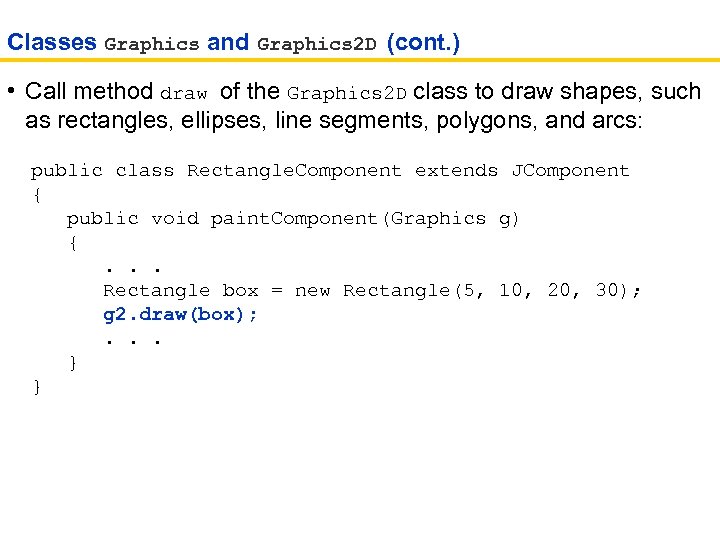
Classes Graphics and Graphics 2 D (cont. ) • Call method draw of the Graphics 2 D class to draw shapes, such as rectangles, ellipses, line segments, polygons, and arcs: public class Rectangle. Component extends JComponent { public void paint. Component(Graphics g) { . . . Rectangle box = new Rectangle(5, 10, 20, 30); g 2. draw(box); . . . } }
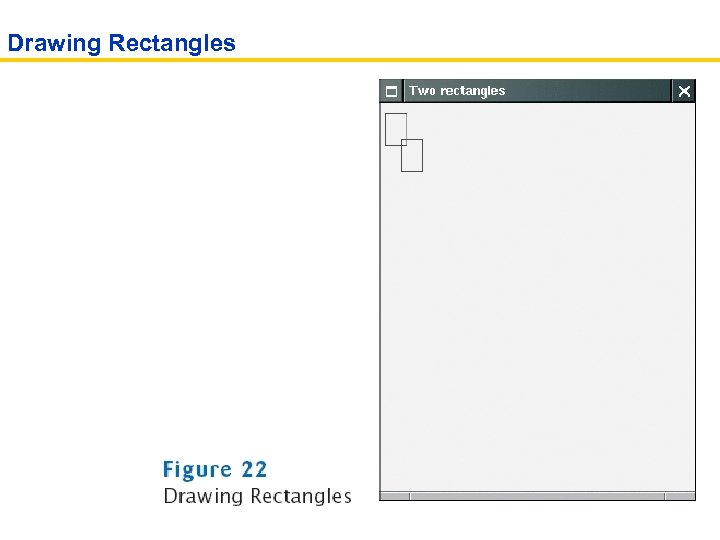
Drawing Rectangles
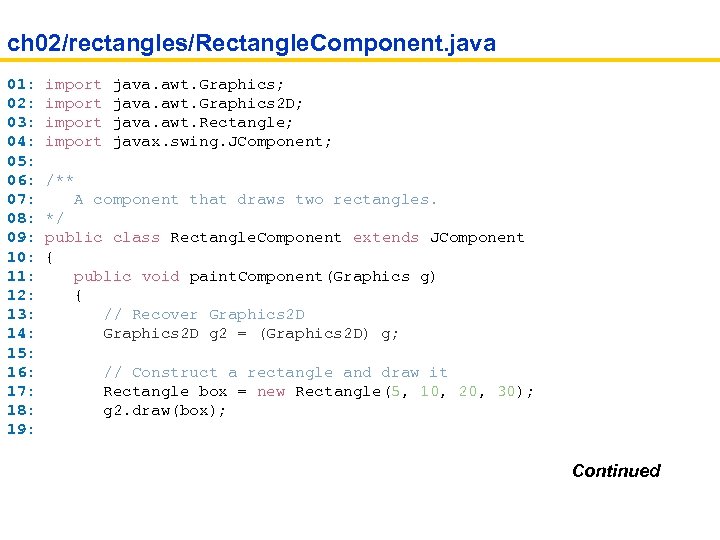
ch 02/rectangles/Rectangle. Component. java 01: import java. awt. Graphics; 02: import java. awt. Graphics 2 D; 03: import java. awt. Rectangle; 04: import javax. swing. JComponent; 05: 06: /** 07: A component that draws two rectangles. 08: */ 09: public class Rectangle. Component extends JComponent 10: { 11: public void paint. Component(Graphics g) 12: { 13: // Recover Graphics 2 D 14: Graphics 2 D g 2 = (Graphics 2 D) g; 15: 16: // Construct a rectangle and draw it 17: Rectangle box = new Rectangle(5, 10, 20, 30); 18: g 2. draw(box); 19: Continued
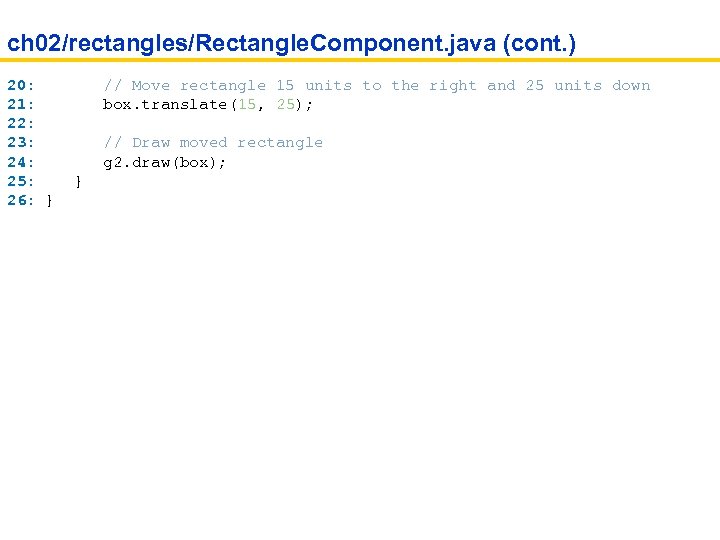
ch 02/rectangles/Rectangle. Component. java (cont. ) 20: // Move rectangle 15 units to the right and 25 units down 21: box. translate(15, 25); 22: 23: // Draw moved rectangle 24: g 2. draw(box); 25: } 26: }
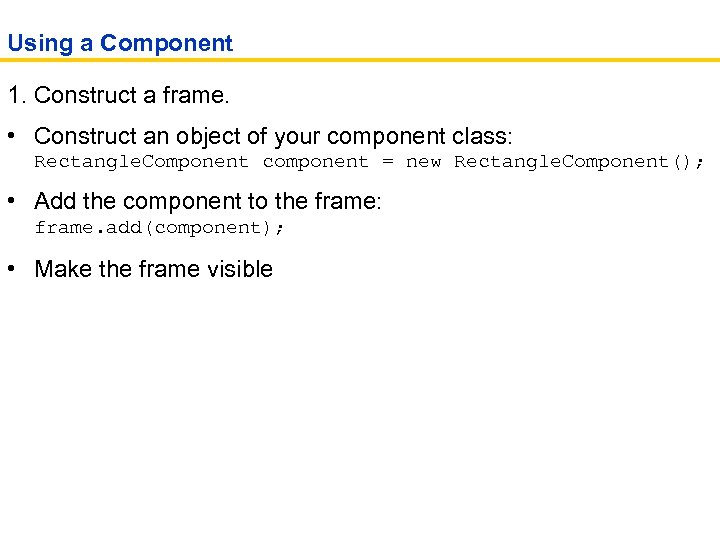
Using a Component 1. Construct a frame. • Construct an object of your component class: Rectangle. Component component = new Rectangle. Component(); • Add the component to the frame: frame. add(component); • Make the frame visible
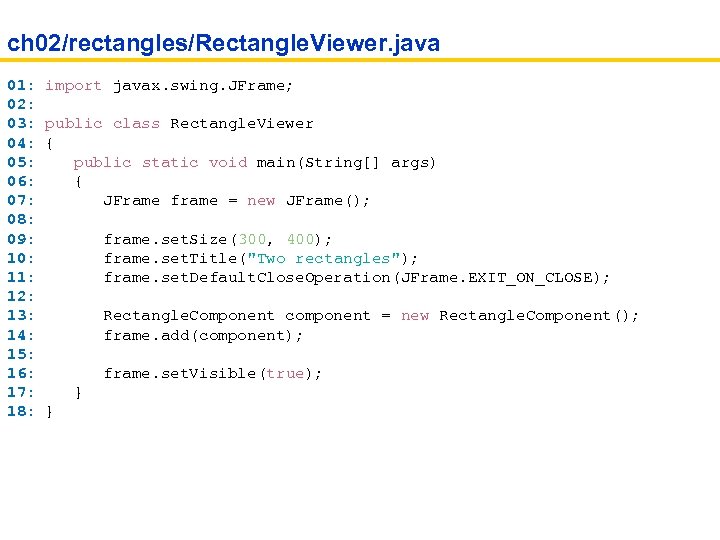
ch 02/rectangles/Rectangle. Viewer. java 01: import javax. swing. JFrame; 02: 03: public class Rectangle. Viewer 04: { 05: public static void main(String[] args) 06: { 07: JFrame frame = new JFrame(); 08: 09: frame. set. Size(300, 400); 10: frame. set. Title("Two rectangles"); 11: frame. set. Default. Close. Operation(JFrame. EXIT_ON_CLOSE); 12: 13: Rectangle. Component component = new Rectangle. Component(); 14: frame. add(component); 15: 16: frame. set. Visible(true); 17: } 18: }
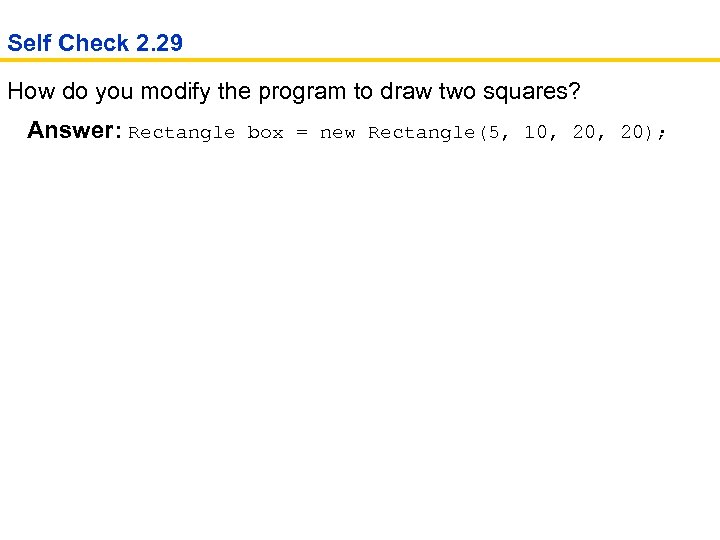
Self Check 2. 29 How do you modify the program to draw two squares? Answer: Rectangle box = new Rectangle(5, 10, 20);
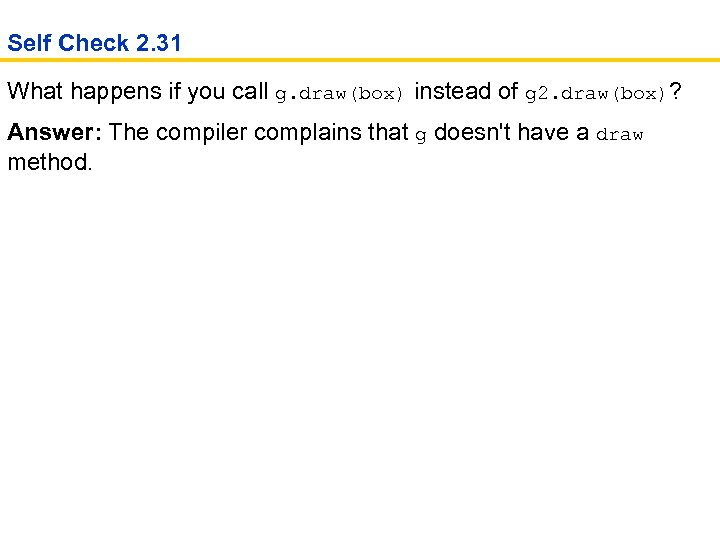
Self Check 2. 31 What happens if you call g. draw(box) instead of g 2. draw(box)? Answer: The compiler complains that g doesn't have a draw method.
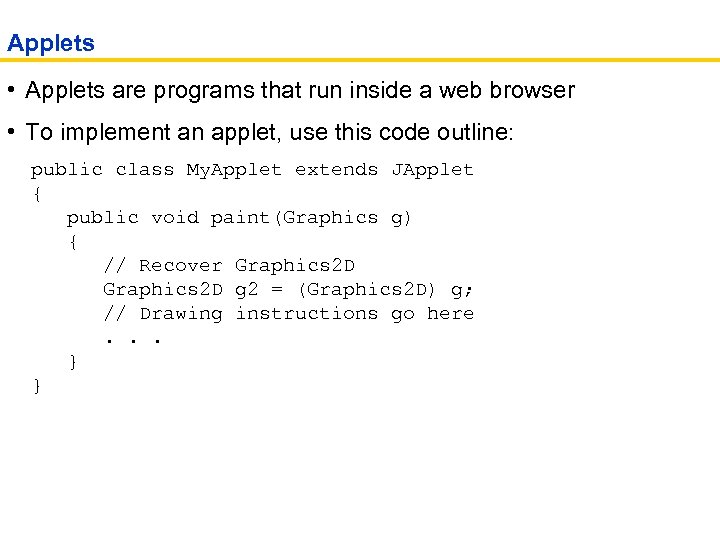
Applets • Applets are programs that run inside a web browser • To implement an applet, use this code outline: public class My. Applet extends JApplet { public void paint(Graphics g) { // Recover Graphics 2 D g 2 = (Graphics 2 D) g; // Drawing instructions go here . . . } }
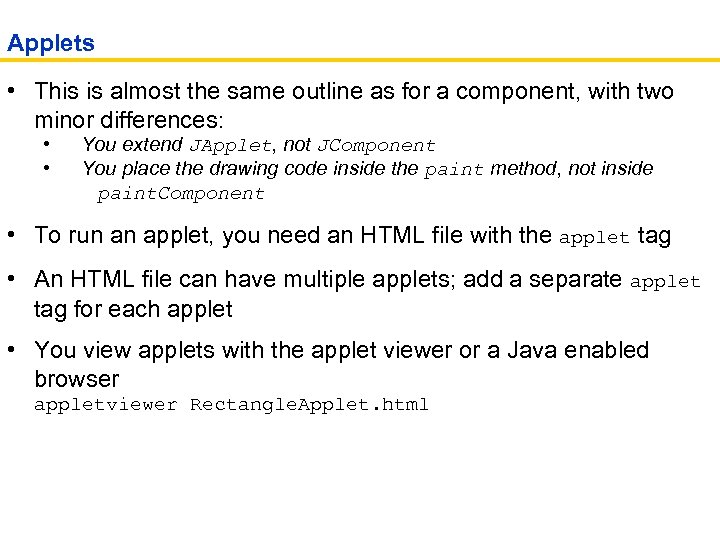
Applets • This is almost the same outline as for a component, with two minor differences: • You extend JApplet, not JComponent • You place the drawing code inside the paint method, not inside paint. Component • To run an applet, you need an HTML file with the applet tag • An HTML file can have multiple applets; add a separate applet tag for each applet • You view applets with the applet viewer or a Java enabled browser appletviewer Rectangle. Applet. html
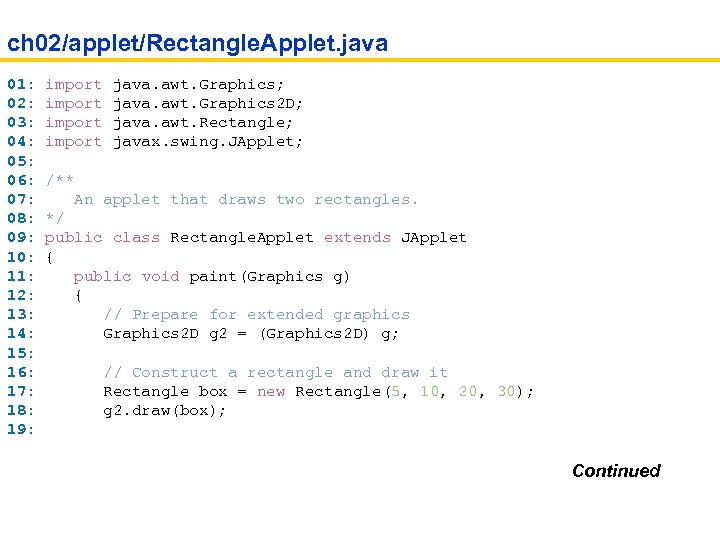
ch 02/applet/Rectangle. Applet. java 01: import java. awt. Graphics; 02: import java. awt. Graphics 2 D; 03: import java. awt. Rectangle; 04: import javax. swing. JApplet; 05: 06: /** 07: An applet that draws two rectangles. 08: */ 09: public class Rectangle. Applet extends JApplet 10: { 11: public void paint(Graphics g) 12: { 13: // Prepare for extended graphics 14: Graphics 2 D g 2 = (Graphics 2 D) g; 15: 16: // Construct a rectangle and draw it 17: Rectangle box = new Rectangle(5, 10, 20, 30); 18: g 2. draw(box); 19: Continued
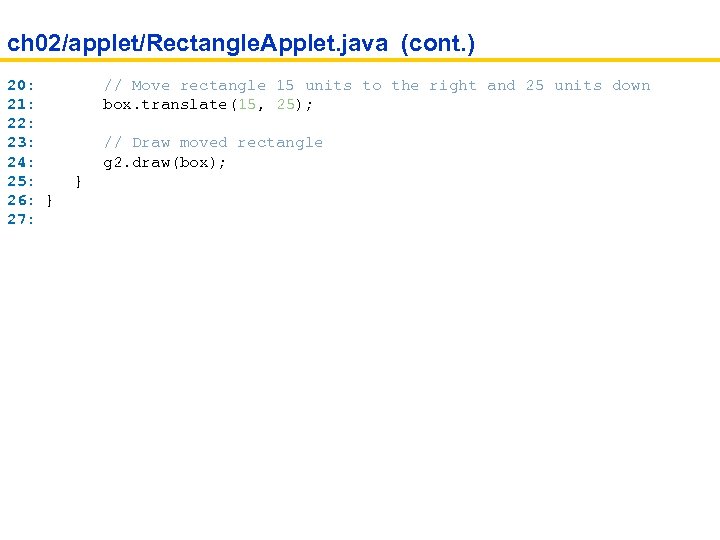
ch 02/applet/Rectangle. Applet. java (cont. ) 20: // Move rectangle 15 units to the right and 25 units down 21: box. translate(15, 25); 22: 23: // Draw moved rectangle 24: g 2. draw(box); 25: } 26: } 27:
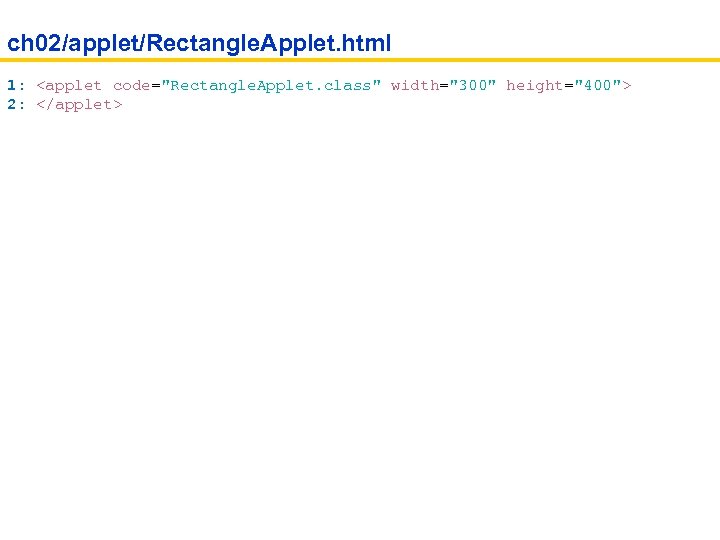
ch 02/applet/Rectangle. Applet. html 1: <applet code="Rectangle. Applet. class" width="300" height="400"> 2: </applet>
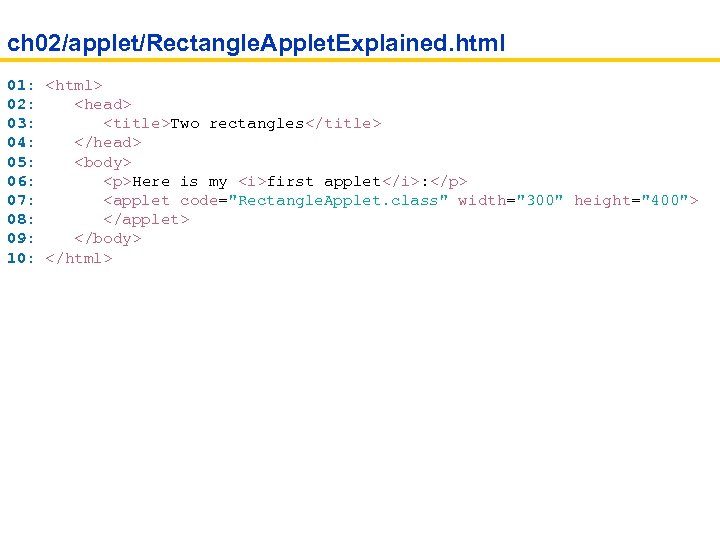
ch 02/applet/Rectangle. Applet. Explained. html 01: <html> 02: <head> 03: <title>Two rectangles</title> 04: </head> 05: <body> 06: <p>Here is my <i>first applet</i>: </p> 07: <applet code="Rectangle. Applet. class" width="300" height="400"> 08: </applet> 09: </body> 10: </html>
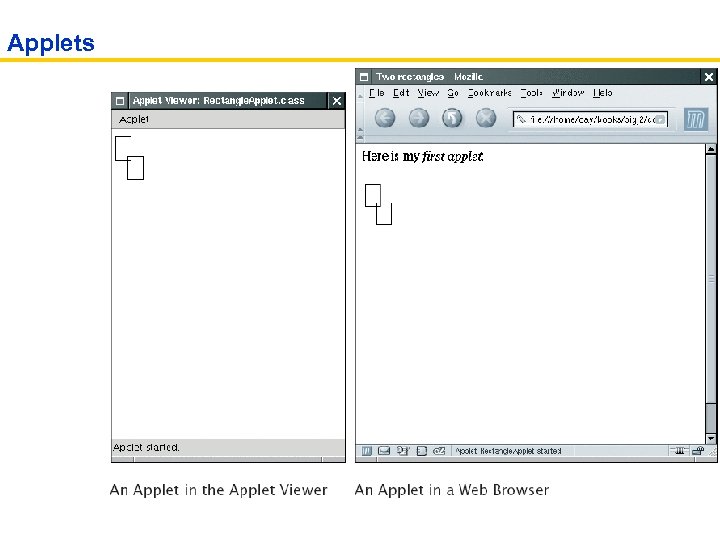
Applets
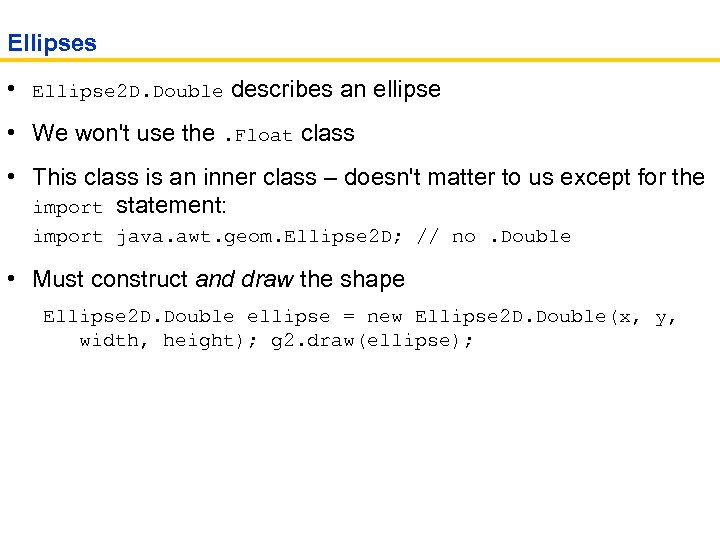
Ellipses • Ellipse 2 D. Double describes an ellipse • We won't use the. Float class • This class is an inner class – doesn't matter to us except for the import statement: import java. awt. geom. Ellipse 2 D; // no. Double • Must construct and draw the shape Ellipse 2 D. Double ellipse = new Ellipse 2 D. Double(x, y, width, height); g 2. draw(ellipse);
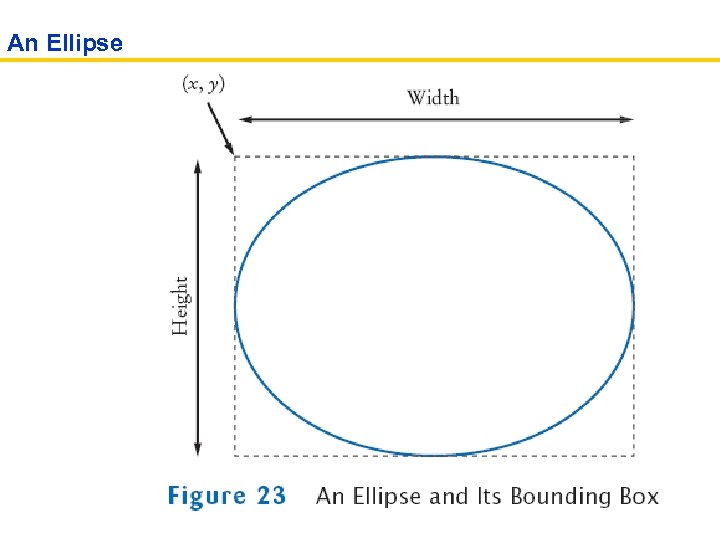
An Ellipse
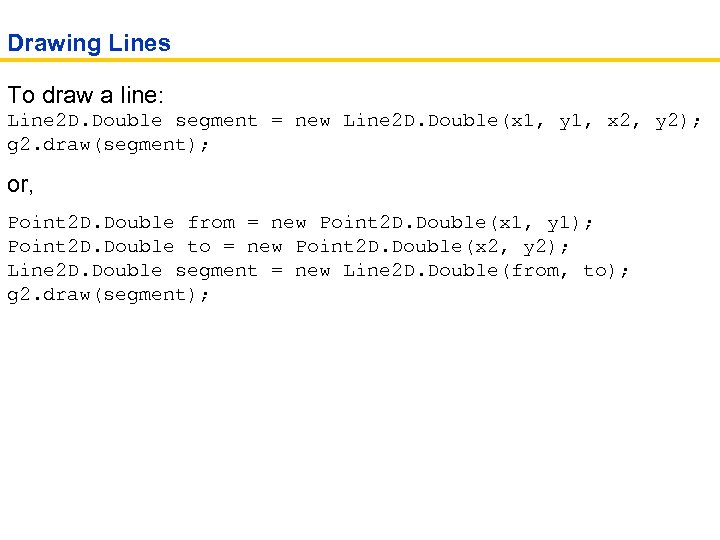
Drawing Lines To draw a line: Line 2 D. Double segment = new Line 2 D. Double(x 1, y 1, x 2, y 2); g 2. draw(segment); or, Point 2 D. Double from = new Point 2 D. Double(x 1, y 1); Point 2 D. Double to = new Point 2 D. Double(x 2, y 2); Line 2 D. Double segment = new Line 2 D. Double(from, to); g 2. draw(segment);
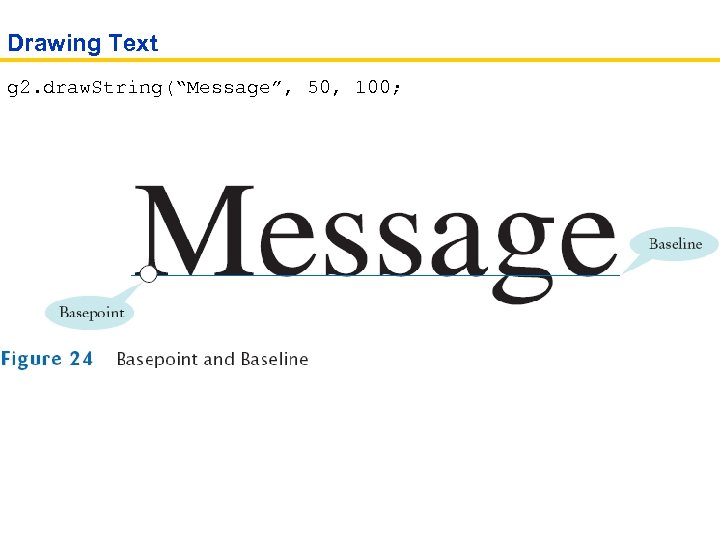
Drawing Text g 2. draw. String(“Message”, 50, 100;
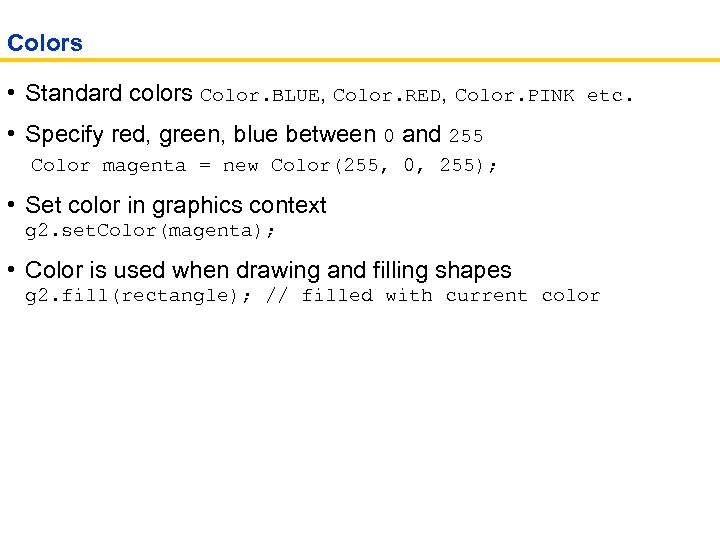
Colors • Standard colors Color. BLUE, Color. RED, Color. PINK etc. • Specify red, green, blue between 0 and 255 Color magenta = new Color(255, 0, 255); • Set color in graphics context g 2. set. Color(magenta); • Color is used when drawing and filling shapes g 2. fill(rectangle); // filled with current color
Predefined Colors and Their RGB Values
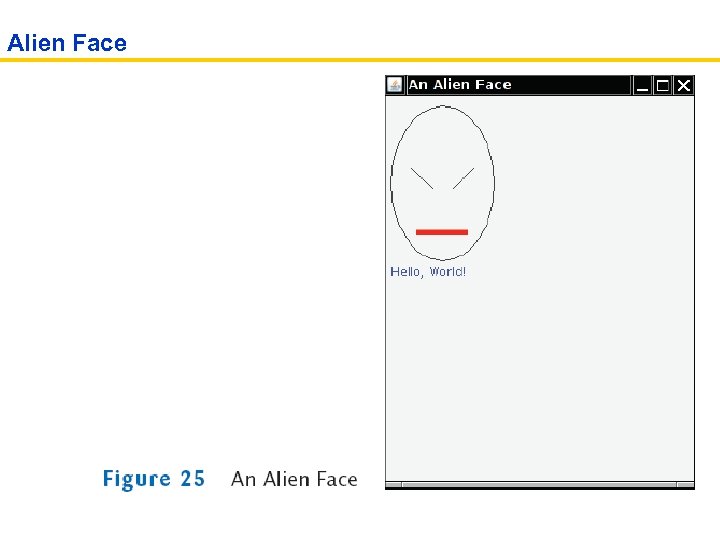
Alien Face
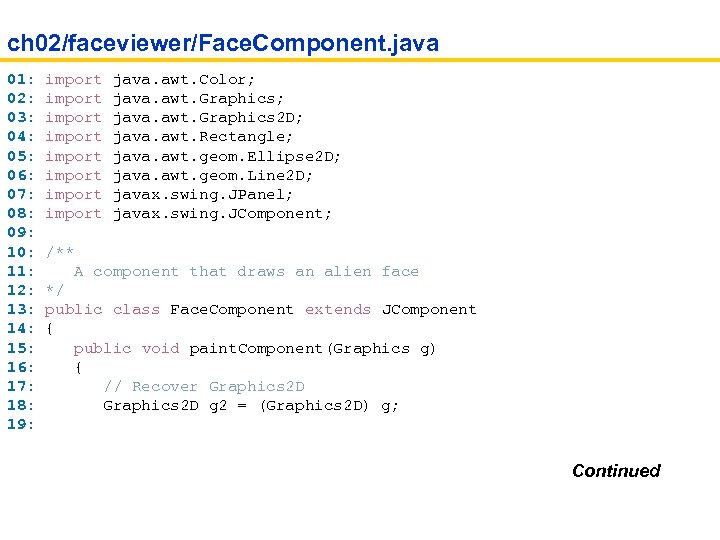
ch 02/faceviewer/Face. Component. java 01: import java. awt. Color; 02: import java. awt. Graphics; 03: import java. awt. Graphics 2 D; 04: import java. awt. Rectangle; 05: import java. awt. geom. Ellipse 2 D; 06: import java. awt. geom. Line 2 D; 07: import javax. swing. JPanel; 08: import javax. swing. JComponent; 09: 10: /** 11: A component that draws an alien face 12: */ 13: public class Face. Component extends JComponent 14: { 15: public void paint. Component(Graphics g) 16: { 17: // Recover Graphics 2 D 18: Graphics 2 D g 2 = (Graphics 2 D) g; 19: Continued
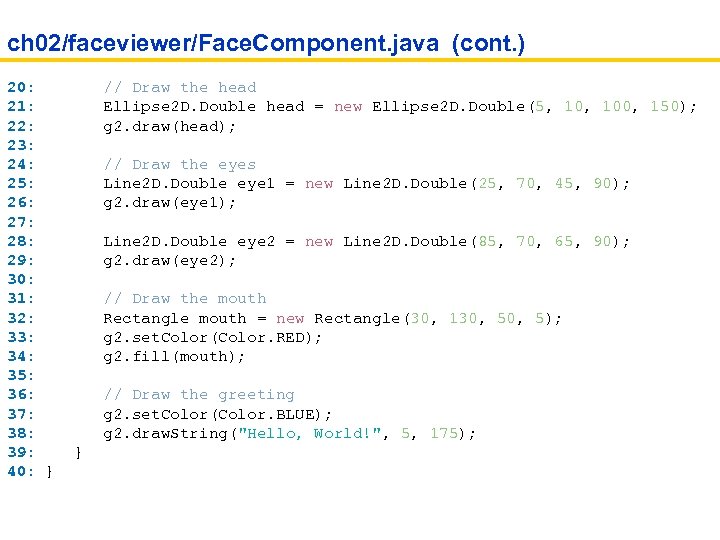
ch 02/faceviewer/Face. Component. java (cont. ) 20: // Draw the head 21: Ellipse 2 D. Double head = new Ellipse 2 D. Double(5, 100, 150); 22: g 2. draw(head); 23: 24: // Draw the eyes 25: Line 2 D. Double eye 1 = new Line 2 D. Double(25, 70, 45, 90); 26: g 2. draw(eye 1); 27: 28: Line 2 D. Double eye 2 = new Line 2 D. Double(85, 70, 65, 90); 29: g 2. draw(eye 2); 30: 31: // Draw the mouth 32: Rectangle mouth = new Rectangle(30, 130, 5); 33: g 2. set. Color(Color. RED); 34: g 2. fill(mouth); 35: 36: // Draw the greeting 37: g 2. set. Color(Color. BLUE); 38: g 2. draw. String("Hello, World!", 5, 175); 39: } 40: }
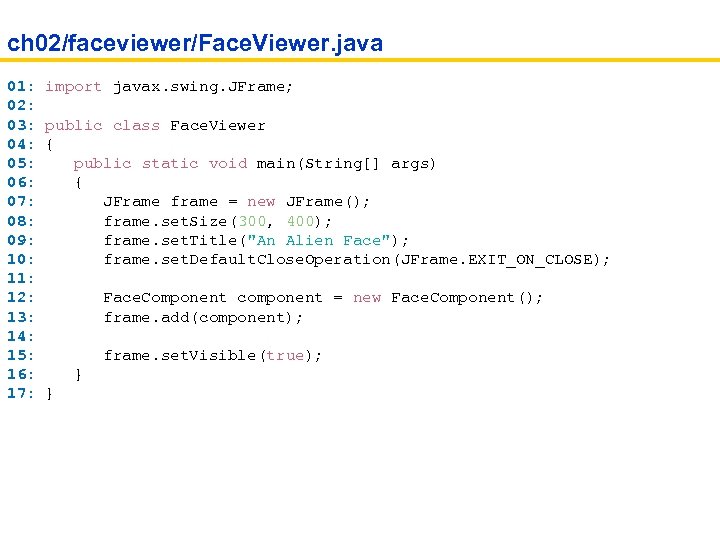
ch 02/faceviewer/Face. Viewer. java 01: import javax. swing. JFrame; 02: 03: public class Face. Viewer 04: { 05: public static void main(String[] args) 06: { 07: JFrame frame = new JFrame(); 08: frame. set. Size(300, 400); 09: frame. set. Title("An Alien Face"); 10: frame. set. Default. Close. Operation(JFrame. EXIT_ON_CLOSE); 11: 12: Face. Component component = new Face. Component(); 13: frame. add(component); 14: 15: frame. set. Visible(true); 16: } 17: }
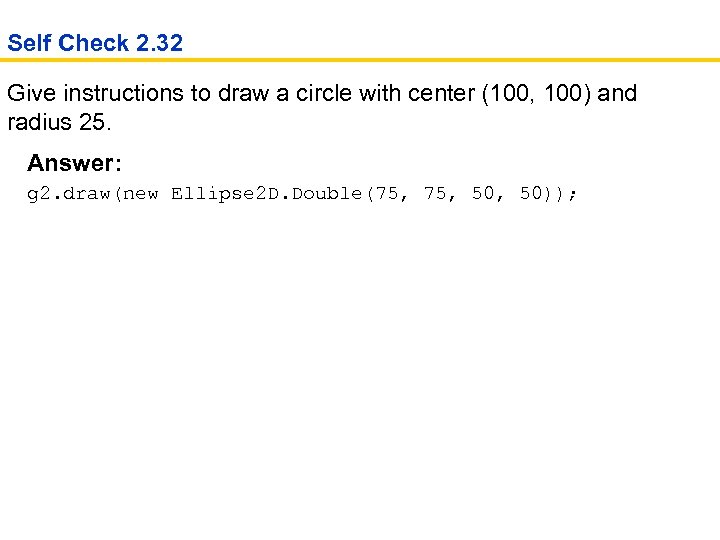
Self Check 2. 32 Give instructions to draw a circle with center (100, 100) and radius 25. Answer: g 2. draw(new Ellipse 2 D. Double(75, 50, 50));
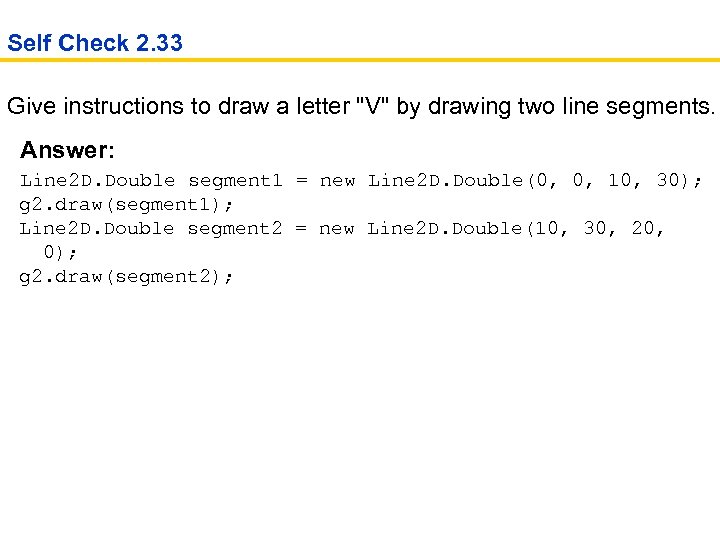
Self Check 2. 33 Give instructions to draw a letter "V" by drawing two line segments. Answer: Line 2 D. Double segment 1 = new Line 2 D. Double(0, 0, 10, 30); g 2. draw(segment 1); Line 2 D. Double segment 2 = new Line 2 D. Double(10, 30, 20, 0); g 2. draw(segment 2);
Self Check 2. 34 Give instructions to draw a string consisting of the letter "V". Answer: g 2. draw. String("V", 0, 30);
Self Check 2. 35 What are the RGB color values of Color. BLUE? Answer: 0, 0, and 255
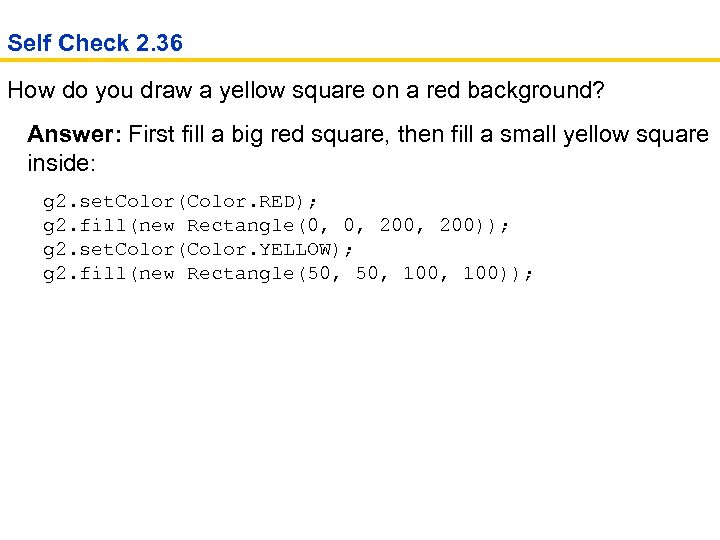
Self Check 2. 36 How do you draw a yellow square on a red background? Answer: First fill a big red square, then fill a small yellow square inside: g 2. set. Color(Color. RED); g 2. fill(new Rectangle(0, 0, 200)); g 2. set. Color(Color. YELLOW); g 2. fill(new Rectangle(50, 100, 100));
Скачать презентацию Chapter Two Using Objects Chapter Goals
a93b2b2d4d59b8529ebf11407e9e0f59.ppt