


 Скачать презентацию Chapter Two Supply and Demand Chapter Outline
609d20ed80d6313e7fba07a4862368ed.ppt
- Количество слайдов: 41
 Chapter Two Supply and Demand
 Chapter Outline 1. 2. 3. 4. 5. 6. Demand. Supply. Market Equilibrium. Shocking the Equilibrium. Effects of Government Interventions. When to Use the Supply-and. Demand Model. © 2009 Pearson Addison-Wesley. All rights reserved. 2
 Demand: determinants of demand. § The following factors determine the demand for a good: w Price of the good w Tastes w Information w Prices of related goods Complements and substitutes w Income w Government rules and regulations w Other © 2009 Pearson Addison-Wesley. All rights reserved. 3
 Demand: the demand curve § Quantity demanded - the amount of a good that consumers are willing to buy at a given price, holding constant the other factors that influence purchases. § Demand curve - the quantity demanded at each possible price, holding constant the other factors that influence purchases © 2009 Pearson Addison-Wesley. All rights reserved. 4
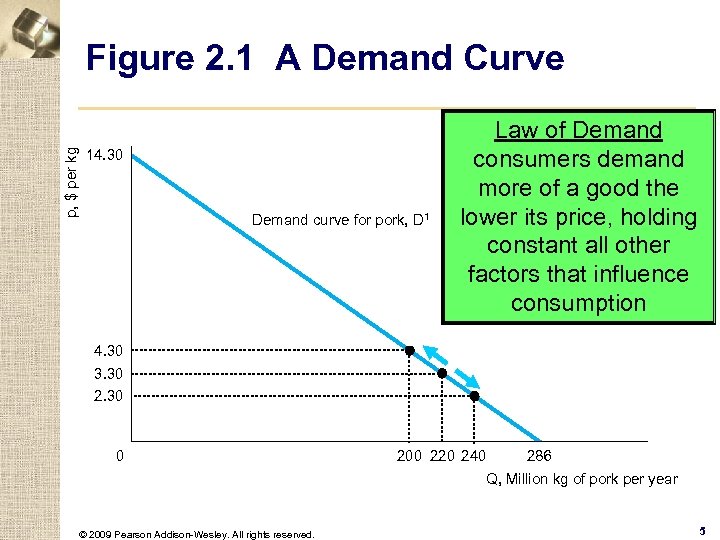 p, $ per kg Figure 2. 1 A Demand Curve 14. 30 Demand curve for pork, D 1 Law of Demand consumers demand more of a good the lower its price, holding constant all other factors that influence consumption 4. 30 3. 30 2. 30 0 200 220 240 286 Q, Million kg of pork per year © 2009 Pearson Addison-Wesley. All rights reserved. 5
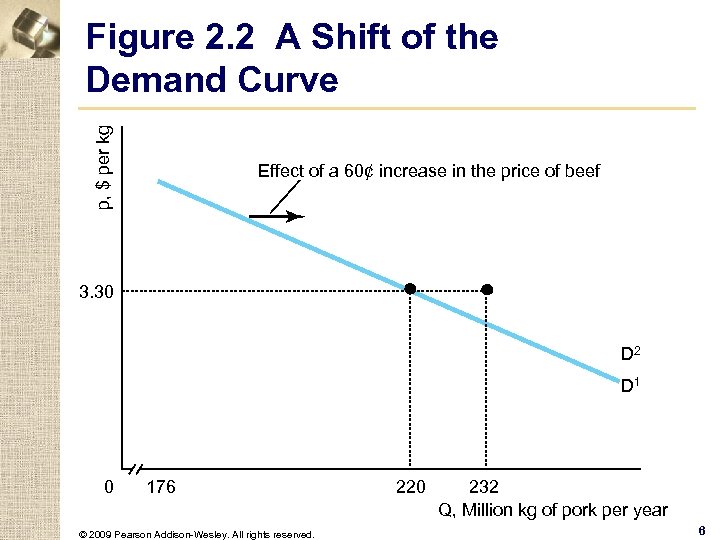 p, $ per kg Figure 2. 2 A Shift of the Demand Curve Effect of a 60¢ increase in the price of beef 3. 30 D 2 D 1 0 176 © 2009 Pearson Addison-Wesley. All rights reserved. 220 232 Q, Million kg of pork per year 6
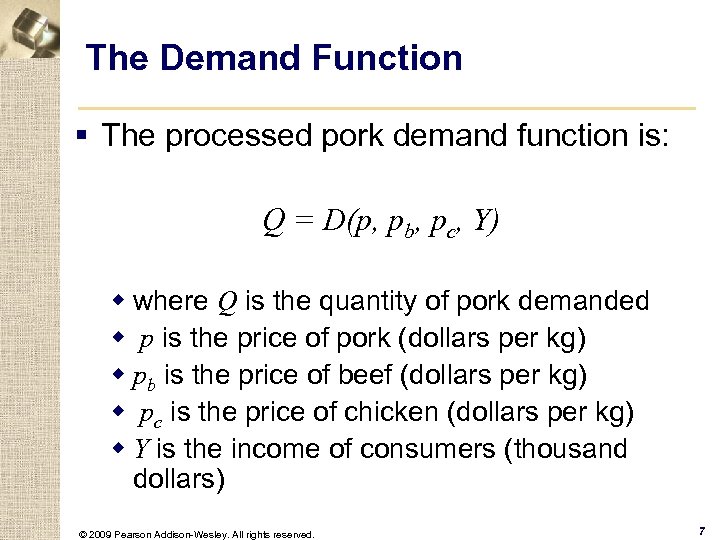 The Demand Function § The processed pork demand function is: Q = D(p, pb, pc, Y) w where Q is the quantity of pork demanded w p is the price of pork (dollars per kg) w pb is the price of beef (dollars per kg) w pc is the price of chicken (dollars per kg) w Y is the income of consumers (thousand dollars) © 2009 Pearson Addison-Wesley. All rights reserved. 7
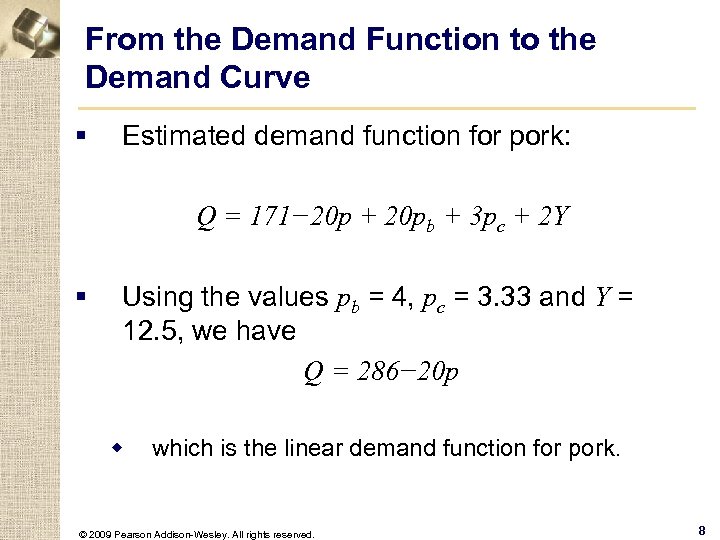 From the Demand Function to the Demand Curve § Estimated demand function for pork: Q = 171− 20 p + 20 pb + 3 pc + 2 Y § Using the values pb = 4, pc = 3. 33 and Y = 12. 5, we have Q = 286− 20 p w which is the linear demand function for pork. © 2009 Pearson Addison-Wesley. All rights reserved. 8
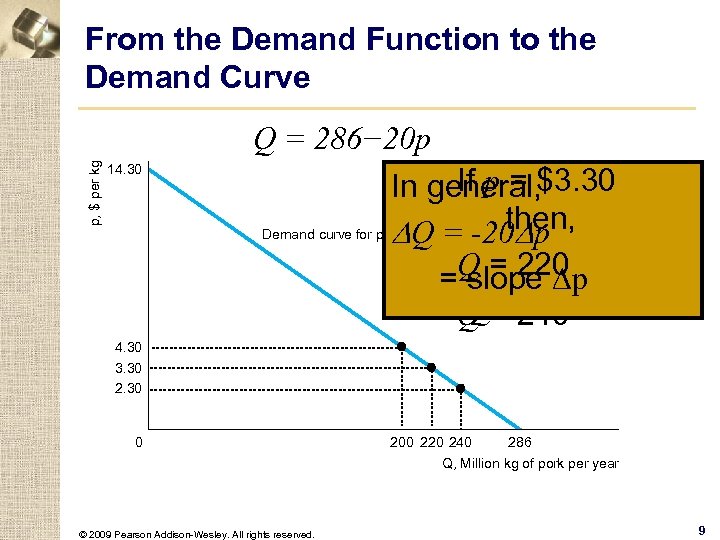 From the Demand Function to the Demand Curve p, $ per kg Q = 286− 20 p 14. 30 If. Ifpp= = 0, then by If p increases In general, $3. 30 If p decreases $1 (to Demand curve for pork, D by $1 DQ = -20 Dp 286 $4. 30) Qthen, (to = then, Q =$2. 30) then, 220 = slope Dp Q = 200 Q = 240 1 4. 30 3. 30 2. 30 0 © 2009 Pearson Addison-Wesley. All rights reserved. 200 220 240 286 Q, Million kg of pork per year 9
 Solved Problem 2. 1 § How much would the price have to fall for consumers to be willing to buy 1 million more kg of pork per year? © 2009 Pearson Addison-Wesley. All rights reserved. 10
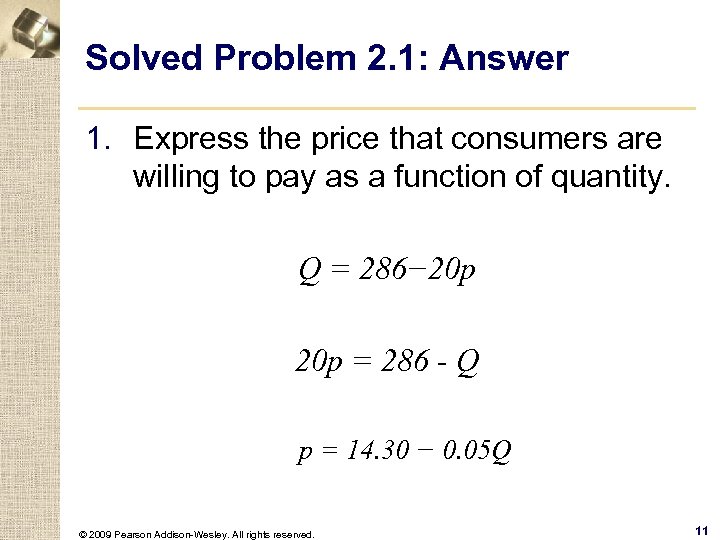 Solved Problem 2. 1: Answer 1. Express the price that consumers are willing to pay as a function of quantity. Q = 286− 20 p = 286 - Q p = 14. 30 − 0. 05 Q © 2009 Pearson Addison-Wesley. All rights reserved. 11
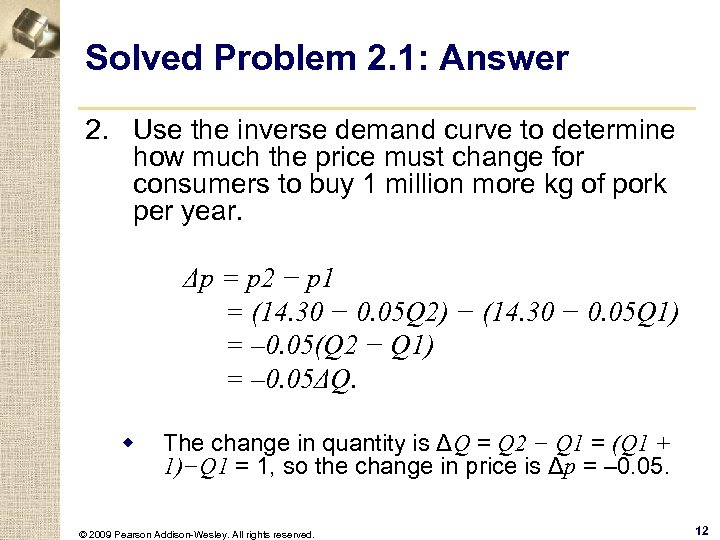 Solved Problem 2. 1: Answer 2. Use the inverse demand curve to determine how much the price must change for consumers to buy 1 million more kg of pork per year. Δp = p 2 − p 1 = (14. 30 − 0. 05 Q 2) − (14. 30 − 0. 05 Q 1) = – 0. 05(Q 2 − Q 1) = – 0. 05ΔQ. w The change in quantity is ΔQ = Q 2 − Q 1 = (Q 1 + 1)−Q 1 = 1, so the change in price is Δp = – 0. 05. © 2009 Pearson Addison-Wesley. All rights reserved. 12
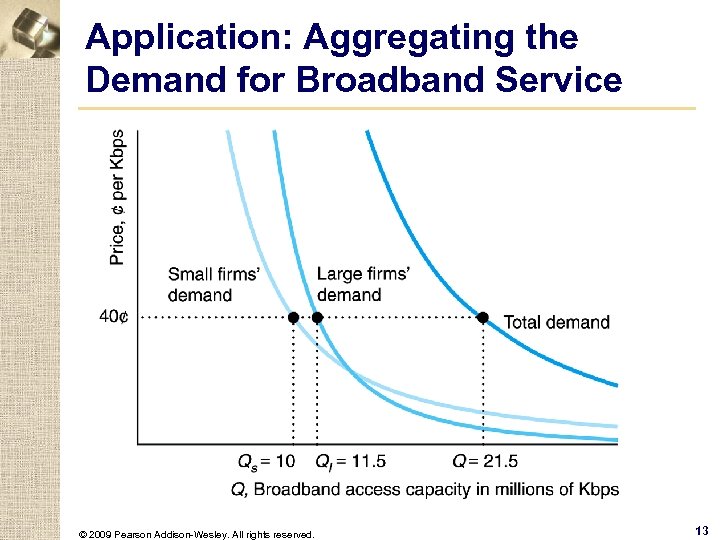 Application: Aggregating the Demand for Broadband Service © 2009 Pearson Addison-Wesley. All rights reserved. 13
 Supply: determinants of supply. § The following factors determine the supply for a good: w Price of the good w Costs w Government rules and regulations © 2009 Pearson Addison-Wesley. All rights reserved. 14
 Supply: the demand curve § Quantity supplied - the amount of a good that firms want to sell at a given price, holding constant other factors that influence firms’ supply decisions, such as costs and government actions § Supply curve - the quantity supplied at each possible price, holding constant the other factors that influence firms’ supply decisions © 2009 Pearson Addison-Wesley. All rights reserved. 15
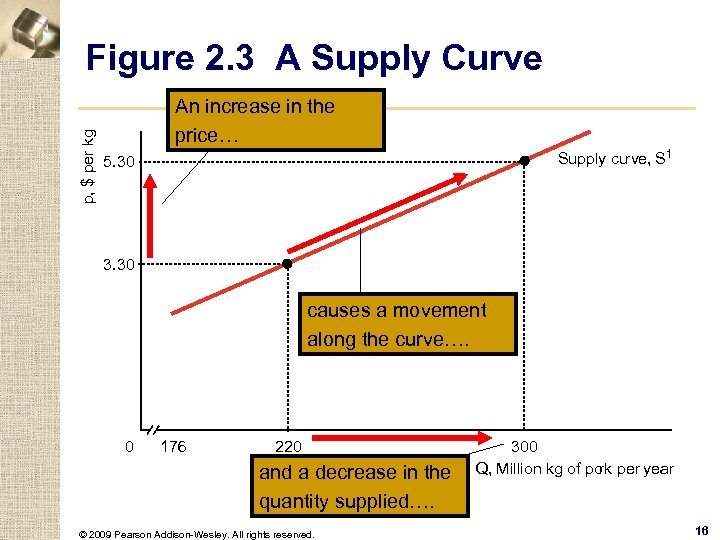 p, $ per kg Figure 2. 3 A Supply Curve An increase in the price… Supply curve, S 1 5. 30 3. 30 causes a movement along the curve…. 0 176 220 and a decrease in the quantity supplied…. © 2009 Pearson Addison-Wesley. All rights reserved. 300 Q, Million kg of po per year rk 16
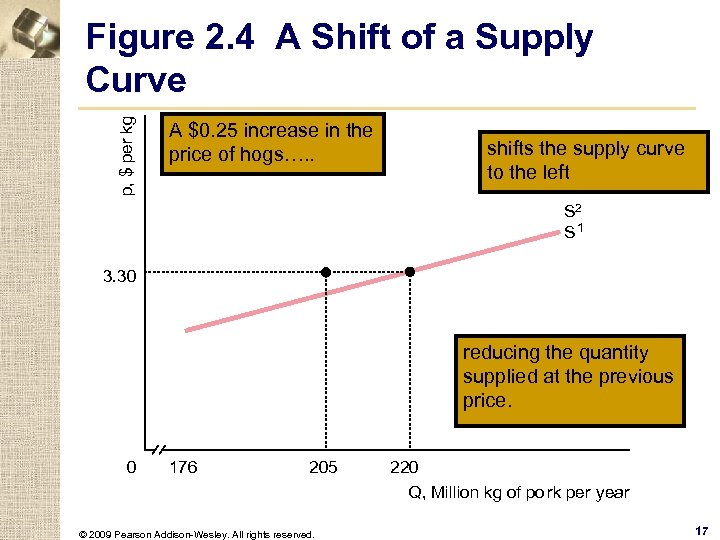 p, $ per kg Figure 2. 4 A Shift of a Supply Curve A $0. 25 increase in the price of hogs…. . shifts the supply curve to the left S 2 S 1 3. 30 reducing the quantity supplied at the previous price. 0 176 205 © 2009 Pearson Addison-Wesley. All rights reserved. 220 Q, Million kg of po rk per year 17
 The Supply Function § The processed pork supply function is: Q = S(p, ph) w where Q is the quantity of pork supplied w p is the price of pork (dollars per kg) w ph is the price of a hog (dollars per kg) © 2009 Pearson Addison-Wesley. All rights reserved. 18
 From the Supply Function to the Supply Curve § Estimated demand function for pork: Q = 178 + 40 p− 60 ph § Using the values ph = $1. 50 per kg Q = 88 + 40 p. § What happens to the quantity supplied if the price of processed pork increases by Δp = p 2−p 1? © 2009 Pearson Addison-Wesley. All rights reserved. 19
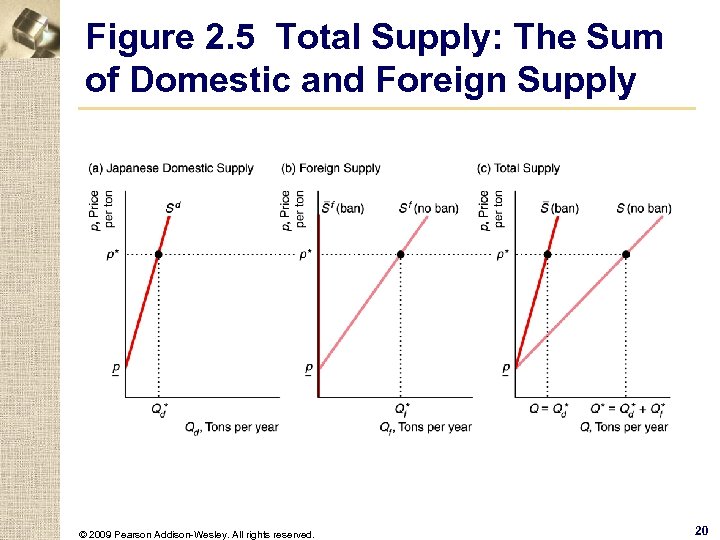 Figure 2. 5 Total Supply: The Sum of Domestic and Foreign Supply © 2009 Pearson Addison-Wesley. All rights reserved. 20
 Solved Problem 2. 2 § How does a quota set by the United States on foreign steel imports of Q affect the total American supply curve for steel given the domestic supply, Sd in panel a of the graph, and foreign supply, Sf in panel b? © 2009 Pearson Addison-Wesley. All rights reserved. 21
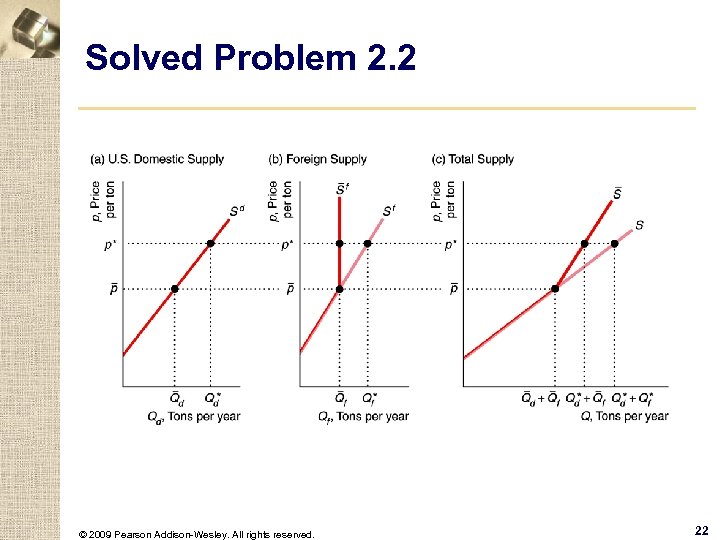 Solved Problem 2. 2 © 2009 Pearson Addison-Wesley. All rights reserved. 22
 Market Equilibrium § Equilibrium - a situation in which no one wants to change his or her behavior. w excess demand the amount by which the quantity demanded exceeds the quantity supplied at a specified price. w excess supply the amount by which the quantity supplied is greater than the quantity demanded at a specified price © 2009 Pearson Addison-Wesley. All rights reserved. 23
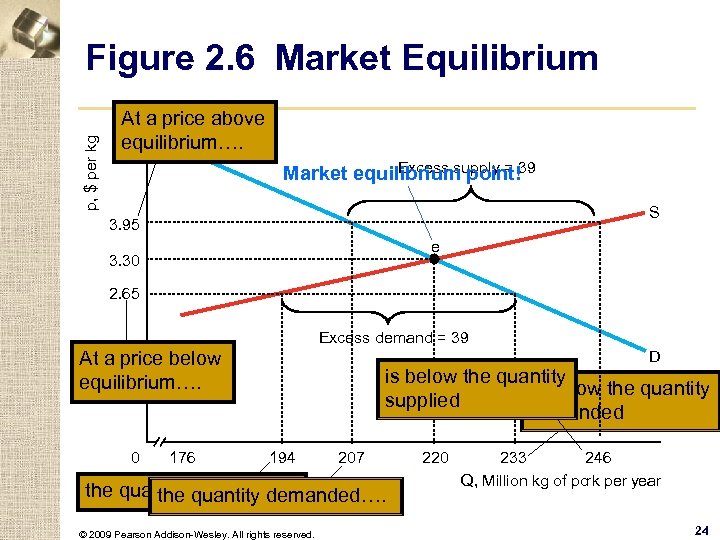 p, $ per kg Figure 2. 6 Market Equilibrium At a price above equilibrium…. Excess supply = Market equilibrium point!39 S 3. 95 e 3. 30 2. 65 Excess demand = 39 At a price below equilibrium…. 0 176 D is below the quantity supplied demanded 194 207 the quantity demanded…. the supplied…. © 2009 Pearson Addison-Wesley. All rights reserved. 220 233 246 Q, Million kg of pork per year 24
 Using Math to Determine the Equilibrium § Demand: Qd = 286 − 20 p § Supply: Qs = 88 + 40 p § Equilibrium: Qd = Q s 286 − 20 p = 88 + 40 p 60 p = 198 P = $3. 30 Q = 286 – 20(3. 3) = 220 © 2009 Pearson Addison-Wesley. All rights reserved. 25
 Equilibrium: Practice Problem § The demand function for a good is Q = a−bp, and the supply function is Q = c + ep, where a, b, c, and e are positive constants. Solve for the equilibrium price and quantity in terms of these four constants. © 2009 Pearson Addison-Wesley. All rights reserved. 26
 Shocking the Equilibrium The equilibrium changes only if a shock occurs that shifts the demand curve or the supply curve. These curves shift if one of the variables we were holding constant changes. © 2009 Pearson Addison-Wesley. All rights reserved. 27
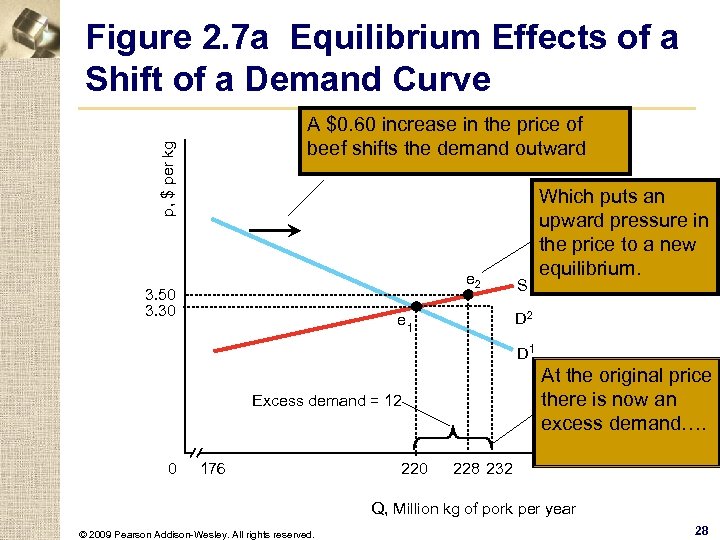 Figure 2. 7 a Equilibrium Effects of a Shift of a Demand Curve p, $ per kg A $0. 60 increase in the price of beef shifts the demand outward e 2 3. 50 3. 30 S Which puts an upward pressure in the price to a new equilibrium. D 2 e 1 D 1 At the original price there is now an excess demand…. Excess demand = 12 0 176 220 228 232 Q, Million kg of pork per year © 2009 Pearson Addison-Wesley. All rights reserved. 28
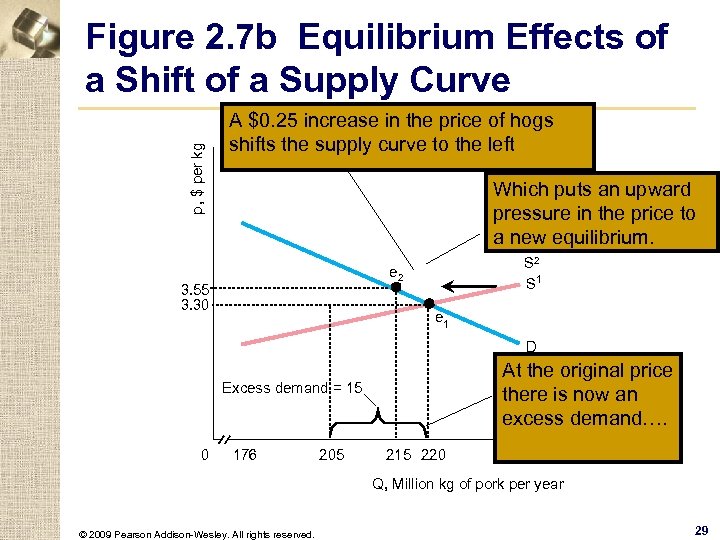 p, $ per kg Figure 2. 7 b Equilibrium Effects of a Shift of a Supply Curve A $0. 25 increase in the price of hogs shifts the supply curve to the left Which puts an upward pressure in the price to a new equilibrium. S 2 S 1 e 2 3. 55 3. 30 e 1 D At the original price there is now an excess demand…. Excess demand = 15 0 176 205 215 220 Q, Million kg of pork per year © 2009 Pearson Addison-Wesley. All rights reserved. 29
 Solved Problem 2. 3 § Mathematically, how does the equilibrium price of pork vary as the price of hogs changes if the variables that affect demand are held constant at their typical values? © 2009 Pearson Addison-Wesley. All rights reserved. 30
 Solved Problem 2. 3: Solution 1. Solve for the equilibrium price of pork in terms of the price of hogs. Qd = 286− 20 p Qs = 178 + 40 p− 60 ph 286− 20 p = 178 + 40 p− 60 ph 60 p = 108 – 60 ph p = 1. 8 – ph 2. Show the equilibrium price of pork varies with the price of hogs. w Since Δp = Δph, any increase in the price of hogs causes an equal increase in the price of processed pork. © 2009 Pearson Addison-Wesley. All rights reserved. 31
 Solved Problem 2. 4 § In the first few weeks after the U. S. ban, the quantity of beef sold in Japan fell substantially, and the price rose. In contrast, three weeks after the first discovery, the U. S. price in January 2004 fell by about 15% and the quantity sold increased by 43% over the last week in October 2003. Use supply-anddemand diagrams to explain why these events occurred. © 2009 Pearson Addison-Wesley. All rights reserved. 32
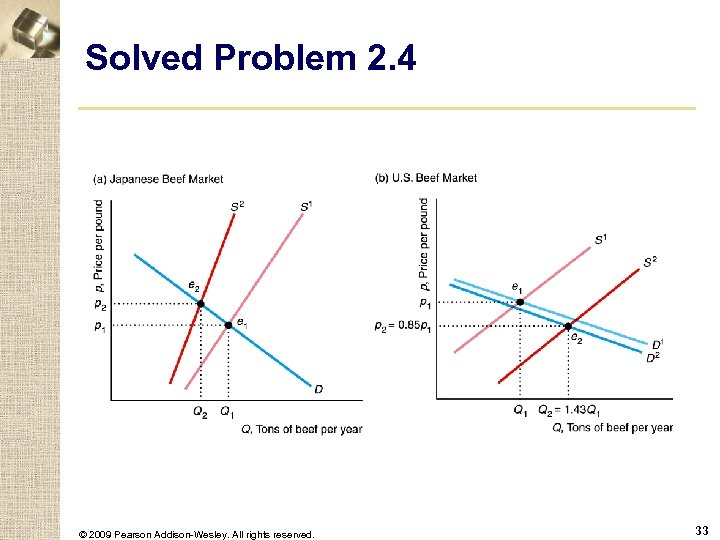 Solved Problem 2. 4 © 2009 Pearson Addison-Wesley. All rights reserved. 33
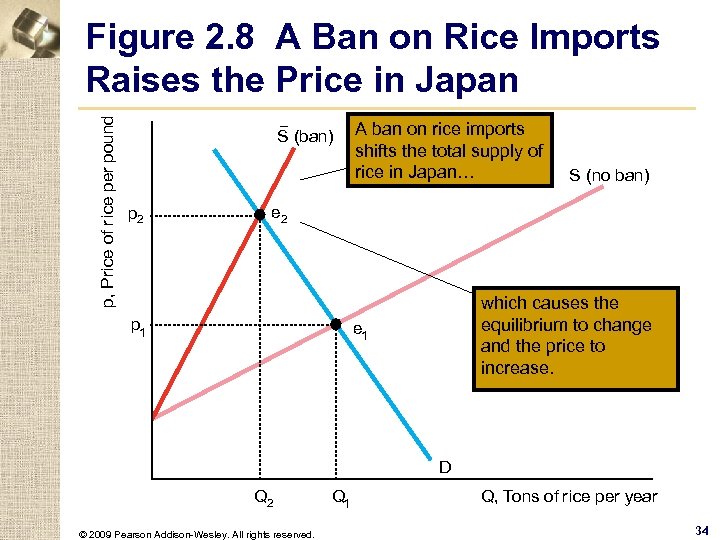 p, Price of r ice per pound Figure 2. 8 A Ban on Rice Imports Raises the Price in Japan – S (ban) p 2 A ban on rice imports shifts the total supply of rice in Japan… S (no ban) e 2 p 1 which causes the equilibrium to change and the price to increase. e 1 D Q 2 © 2009 Pearson Addison-Wesley. All rights reserved. Q 1 Q, Tons of rice per year 34
 Solved Problem 2. 5 § What is the effect of a United States quota on steel of Q on the equilibrium in the U. S. steel market? Hint: The answer depends on whether the quota binds (is low enough to affect the equilibrium). © 2009 Pearson Addison-Wesley. All rights reserved. 35
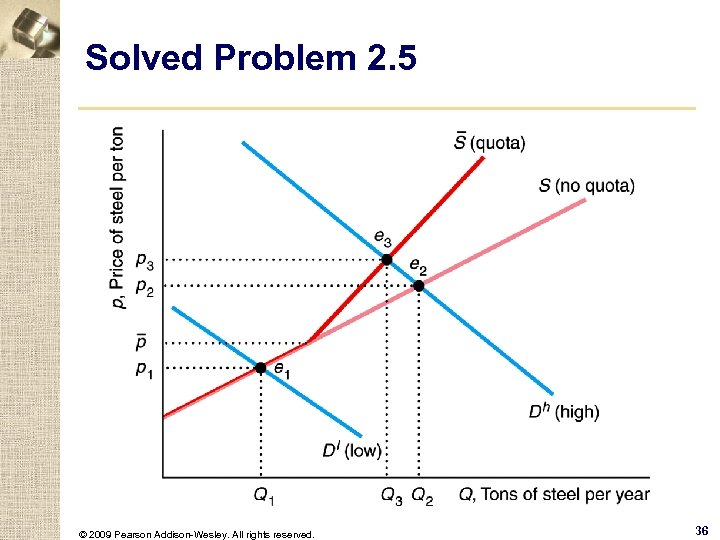 Solved Problem 2. 5 © 2009 Pearson Addison-Wesley. All rights reserved. 36
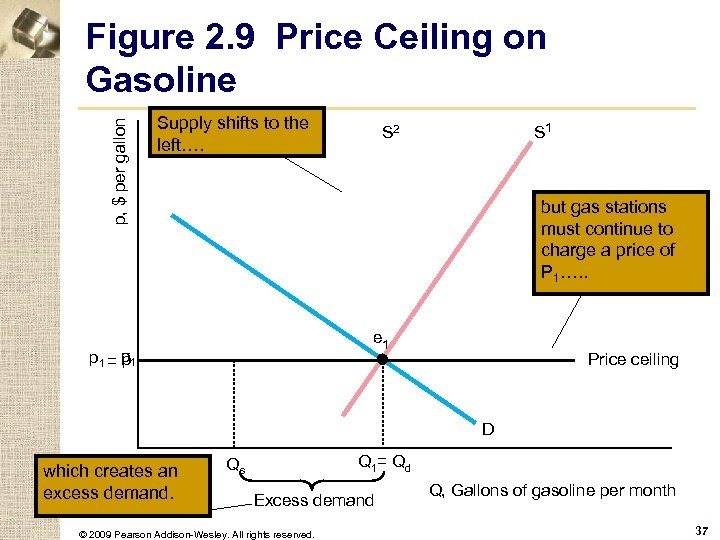 p, $ per gallon Figure 2. 9 Price Ceiling on Gasoline Supply shifts to the left…. S 1 S 2 but gas stations must continue to charge a price of P 1…. . e 1 – p 1 = p 1 p Price ceiling D which creates an excess demand. Q 1= Qd Qs Excess demand © 2009 Pearson Addison-Wesley. All rights reserved. Q, Gallons of gasoline per month 37
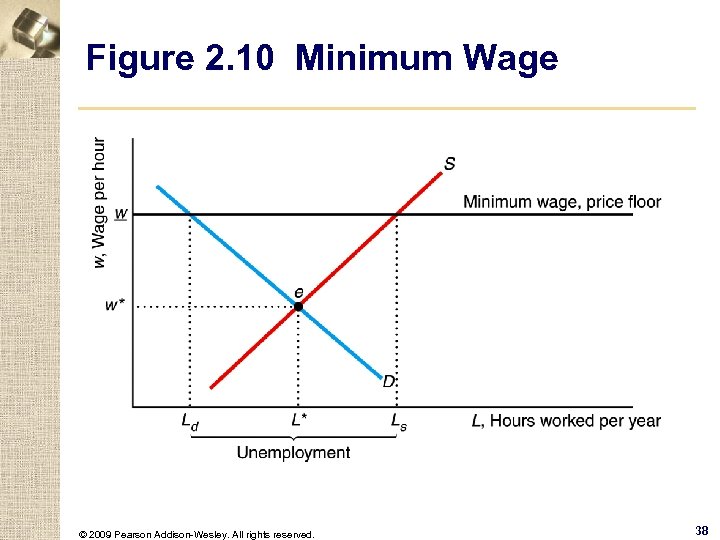 Figure 2. 10 Minimum Wage © 2009 Pearson Addison-Wesley. All rights reserved. 38
 Why Supply Need Not Equal Demand § The quantity that firms want to sell and the quantity that consumers want to buy at a given price need not equal the actual quantity that is bought and sold. w Example: price ceiling. © 2009 Pearson Addison-Wesley. All rights reserved. 39
 Perfectly competitive markets § Everyone is a price taker. § Firms sell identical products. § Everyone has full information about the price and quality of goods. § Costs of trading are low. © 2009 Pearson Addison-Wesley. All rights reserved. 40
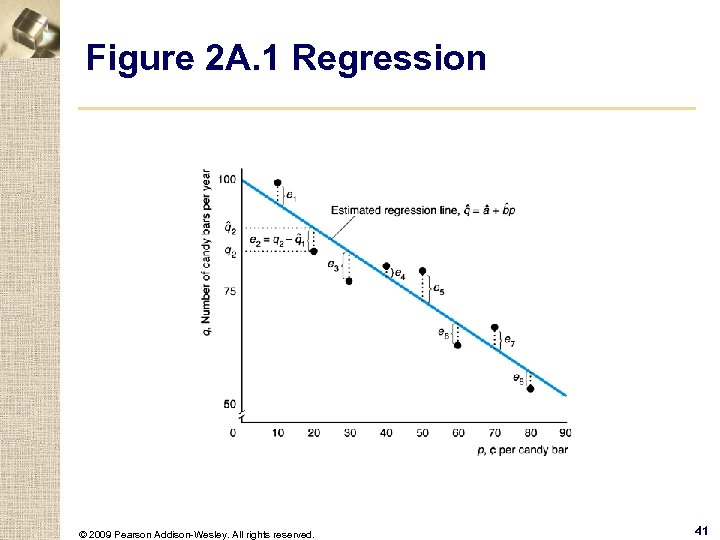 Figure 2 A. 1 Regression © 2009 Pearson Addison-Wesley. All rights reserved. 41