


 Скачать презентацию Chapter Twenty Foreign and Military Policy Kinds
623daacc30cd067495f37c7887ab120e.ppt
- Количество слайдов: 22
 Chapter Twenty Foreign and Military Policy
 Kinds of Foreign Policy • Majoritarian politics: foreign policy is perceived to confer widespread benefits, impose widespread costs (war, alliances) • Interest group politics: identifiable groups are pitted against one another for costs, benefits (tariffs) • Client politics: Benefits go to an identifiable group, without apparent costs to any distinct group (policy toward Israel) Copyright © Houghton Mifflin Company. All rights reserved. 20 | 2
 The President and Congress • The president is the commander-in-chief – but Congress appropriates the money • The president appoints ambassadors – but Senate confirms them • The president negotiates treaties – but the Senate must ratify them with a twothirds vote Copyright © Houghton Mifflin Company. All rights reserved. 20 | 3
 The President and Congress • Only Congress can regulate commerce with other nations and declare war • But Americans think that the president is in charge and history confirms that belief Copyright © Houghton Mifflin Company. All rights reserved. 20 | 4
 Presidential Power • Presidents have been relatively strong in foreign affairs • And yet presidents have been comparatively weak in foreign affairs by the standards of other nations • Treaties signed by the president are little more than a promise to try to get the Senate to act Copyright © Houghton Mifflin Company. All rights reserved. 20 | 5
 The Courts and Foreign Policy • The Supreme Court has ruled that the federal government has foreign and military policy powers beyond those specifically mentioned in the Constitution • The Supreme Court is reluctant to intervene in Congress-president disputes about war powers Copyright © Houghton Mifflin Company. All rights reserved. 20 | 6
 Checks on Presidential Power • Congress has control of the purse strings • Congress also limits the president’s ability to give military or economic aid to other countries • Oversight: House and Senate intelligence committees must be fully informed; including covert operations Copyright © Houghton Mifflin Company. All rights reserved. 20 | 7
 War Powers Act of 1973 • All commitments of troops in hostile situations must be reported within forty-eight hours • Only a sixty-day commitment of troops can be made unless there is a declaration of war or a specific statutory authorization • Every president since the passage of the War Powers Act has sent troops abroad without congressional approval • Presidents deny that the War Powers Act is constitutional Copyright © Houghton Mifflin Company. All rights reserved. 20 | 8
 National Security Council (NSC) • Chaired by the president and includes the vice president, secretaries of state and defense – usually includes the director of the CIA, chair of Joint Chiefs of Staff, and attorney general • The goal is to present various perspectives, facilitate presidential decision making, and implement presidential decisions Copyright © Houghton Mifflin Company. All rights reserved. 20 | 9
 Foreign Policy and Public Opinion • The public tends to support the president in crises • Military casualties often lead the public to support escalation, so fighting will end more quickly • Since World War II, the public has generally felt the U. S. should play an important international role Copyright © Houghton Mifflin Company. All rights reserved. 20 | 10
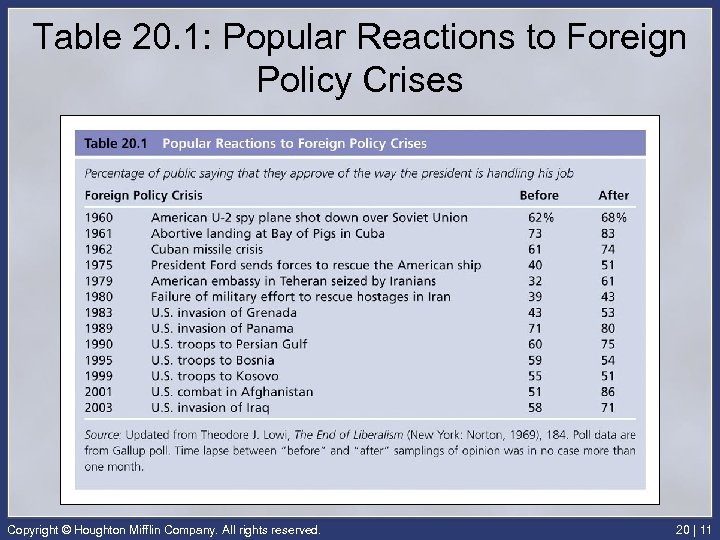 Table 20. 1: Popular Reactions to Foreign Policy Crises Copyright © Houghton Mifflin Company. All rights reserved. 20 | 11
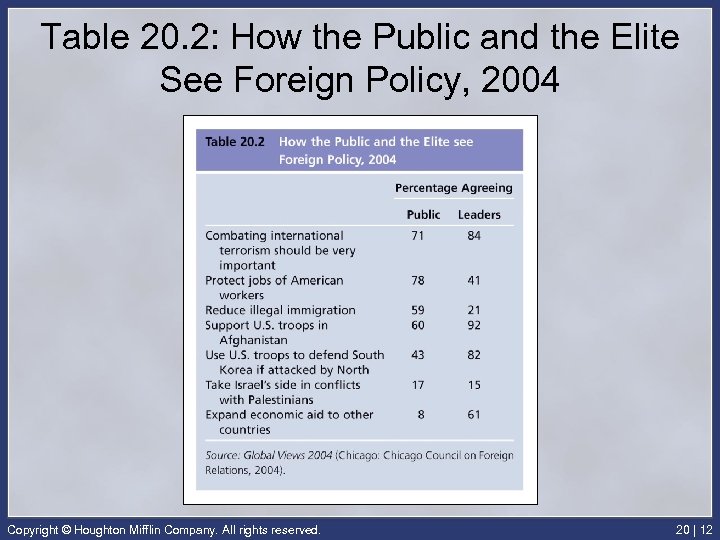 Table 20. 2: How the Public and the Elite See Foreign Policy, 2004 Copyright © Houghton Mifflin Company. All rights reserved. 20 | 12
 Worldviews • Worldview (or paradigm): comprehensive mental picture of world issues • Isolationism paradigm (1920 s– 1930 s): opposes getting involved in wars • Containment (anti-appeasement) paradigm (1940 s– 1960 s): postwar policy to resist Soviet expansionism Copyright © Houghton Mifflin Company. All rights reserved. 20 | 13
 Worldviews • Disengagement (Vietnam) paradigm (1970 s, continuing): reaction to military defeat and the political disaster of Vietnam • Human rights: prevent genocide--the mass murder of people, usually because of their race or ethnicity Copyright © Houghton Mifflin Company. All rights reserved. 20 | 14
 The Defense Budget • Changes in spending reflect public opinion and general support for a large military • The demise of the U. S. S. R. generated a debate about cutting costs • Desert Storm (1991) and Kosovo (1999) demonstrated that the U. S. would have to use military force • With Kosovo, it also became clear that cuts had impaired the military’s ability to conduct a sustained campaign Copyright © Houghton Mifflin Company. All rights reserved. 20 | 15
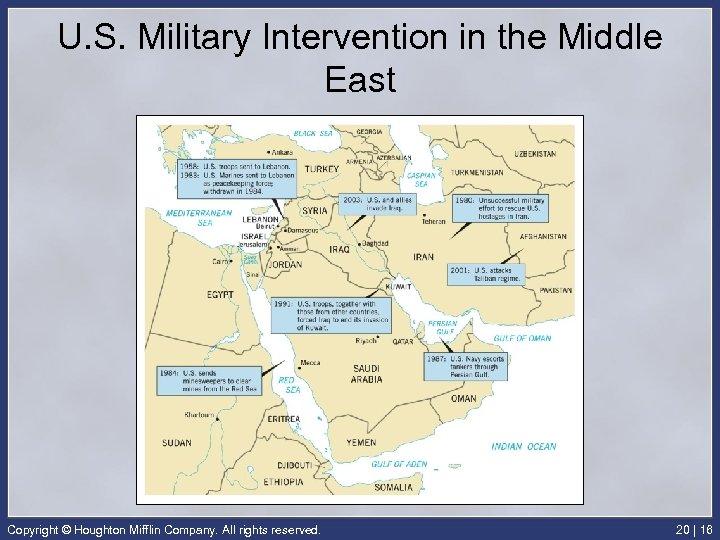 U. S. Military Intervention in the Middle East Copyright © Houghton Mifflin Company. All rights reserved. 20 | 16
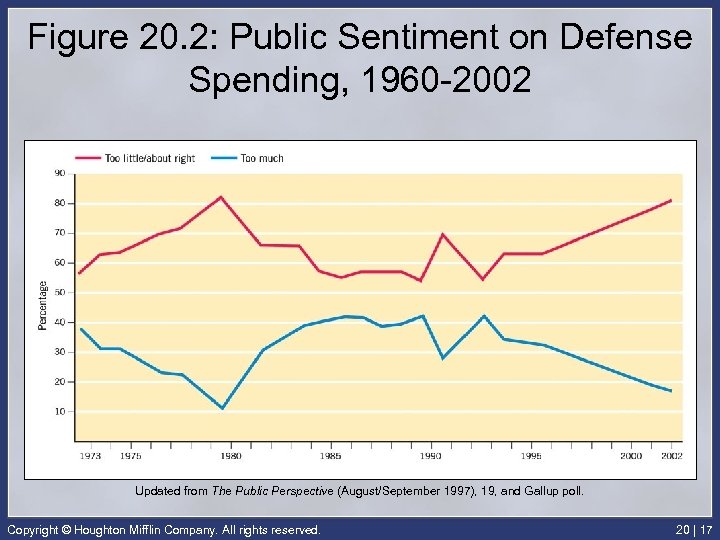 Figure 20. 2: Public Sentiment on Defense Spending, 1960 -2002 Updated from The Public Perspective (August/September 1997), 19, and Gallup poll. Copyright © Houghton Mifflin Company. All rights reserved. 20 | 17
 What We Pay For • Personnel: an all-volunteer force was instituted after Vietnam • Big ticket items may result in cost overruns—the difference between actual costs and estimated costs • Small ticket items: The problem is getting small equipment (e. g. , a coffeemaker) that will fit into an odd space (e. g. , a plane) Copyright © Houghton Mifflin Company. All rights reserved. 20 | 18
 What We Pay For • Readiness: client politics makes readiness a low priority (after building equipment and maintaining bases) • Bases: the system for locating/maintaining military bases was purely client politics Copyright © Houghton Mifflin Company. All rights reserved. 20 | 19
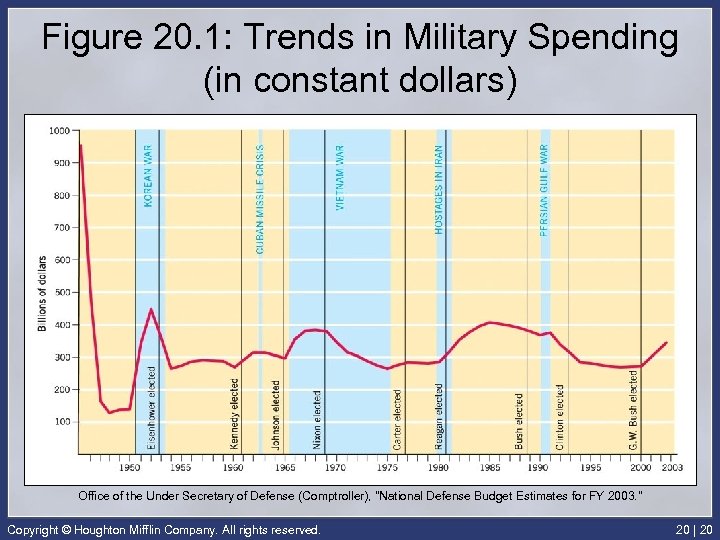 Figure 20. 1: Trends in Military Spending (in constant dollars) Office of the Under Secretary of Defense (Comptroller), "National Defense Budget Estimates for FY 2003. " Copyright © Houghton Mifflin Company. All rights reserved. 20 | 20
 Decision Making • Department of Defense: Secretary of Defense is a civilian, as are secretaries of army, navy, air force • Joint Chiefs of Staff (JCS): composed of uniformed head of each service • The chain of command runs from the president to the Secretary of Defense to unified and specified commands Copyright © Houghton Mifflin Company. All rights reserved. 20 | 21
 Terrorism • Since 9/11, foreign policy has had to focus on terrorism and what to do with nations that have harbored terrorists • Superpower status in a unipolar world still leaves the U. S. vulnerable both here and abroad to terrorist attacks Copyright © Houghton Mifflin Company. All rights reserved. 20 | 22