


 Скачать презентацию Chapter Three Working With Financial Statements 2003
e120c82844586f5ec643d8e5f0b73027.ppt
- Количество слайдов: 29
 Chapter Three Working With Financial Statements © 2003 The Mc. Graw-Hill Companies, Inc. All rights reserved.
 3. 1 Key Concepts and Skills • Understand sources and uses of cash and the Statement of Cash Flows • Know how to standardize financial statements for comparison purposes • Know how to compute and interpret important financial ratios • Be able to compute and interpret the Du Pont Identity • Understand the problems and pitfalls in financial statement analysis Mc. Graw-Hill/Irwin © 2003 The Mc. Graw-Hill Companies, Inc. All rights reserved.
 3. 2 Chapter Outline • Cash Flow and Financial Statements: A Closer Look • Standardized Financial Statements • Ratio Analysis • The Du Pont Identity • Using Financial Statement Information Mc. Graw-Hill/Irwin © 2003 The Mc. Graw-Hill Companies, Inc. All rights reserved.
 3. 3 Sources and Uses • Sources – Cash inflow – occurs when we “sell” something – Decrease in asset account – Increase in liability or equity account • Uses – Cash outflow – occurs when we “buy” something – Increase in asset account – Decrease in liability or equity account Mc. Graw-Hill/Irwin © 2003 The Mc. Graw-Hill Companies, Inc. All rights reserved.
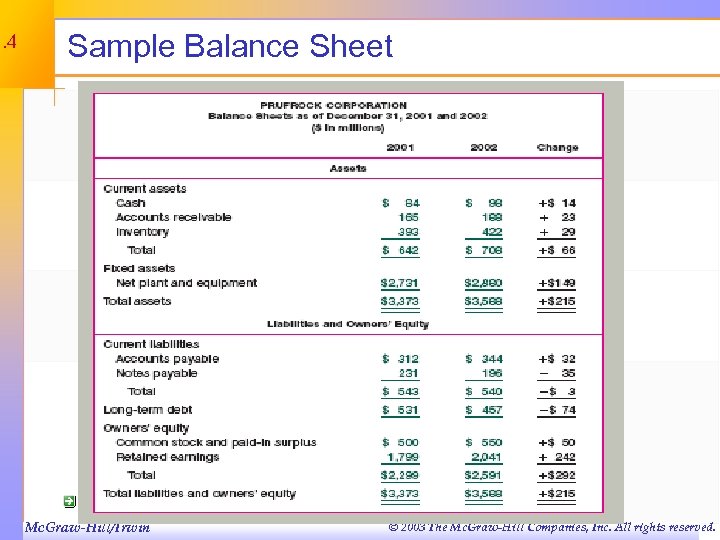 3. 4 Sample Balance Sheet Mc. Graw-Hill/Irwin © 2003 The Mc. Graw-Hill Companies, Inc. All rights reserved.
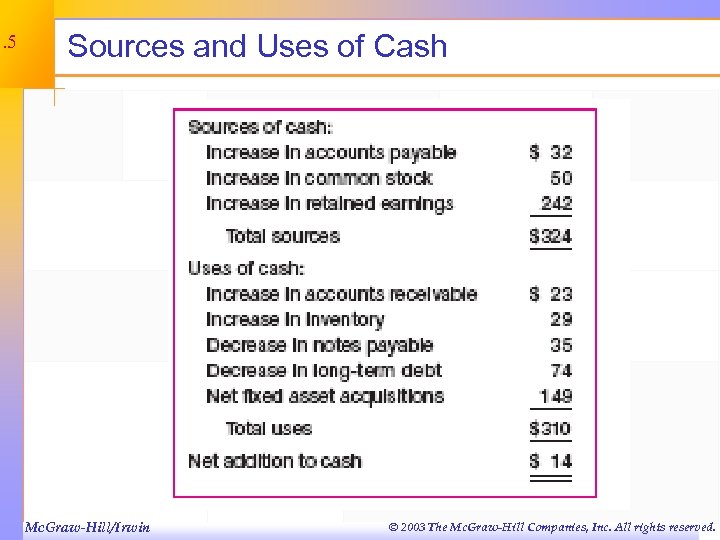 3. 5 Sources and Uses of Cash Mc. Graw-Hill/Irwin © 2003 The Mc. Graw-Hill Companies, Inc. All rights reserved.
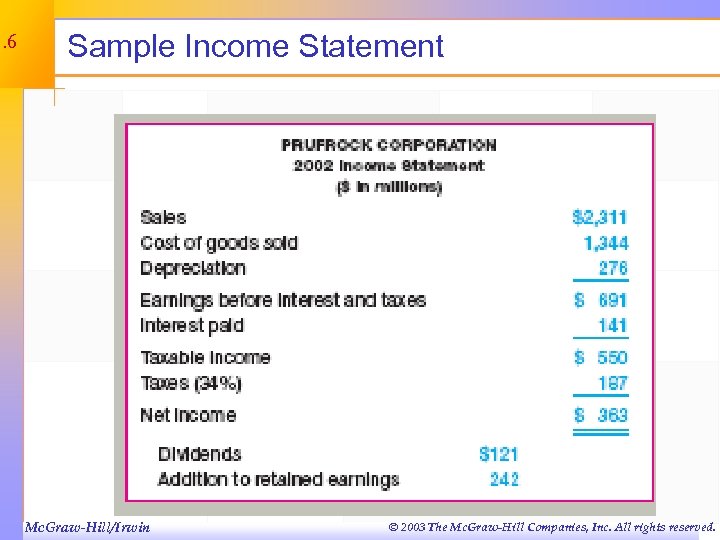 3. 6 Sample Income Statement Mc. Graw-Hill/Irwin © 2003 The Mc. Graw-Hill Companies, Inc. All rights reserved.
 3. 7 Statement of Cash Flows • Statement that summarizes the sources and uses of cash • Changes divided into three major categories – Operating Activity – includes net income and changes in most current accounts – Investment Activity – includes changes in fixed assets – Financing Activity – includes changes in notes payable, long-term debt and equity accounts as well as dividends Mc. Graw-Hill/Irwin © 2003 The Mc. Graw-Hill Companies, Inc. All rights reserved.
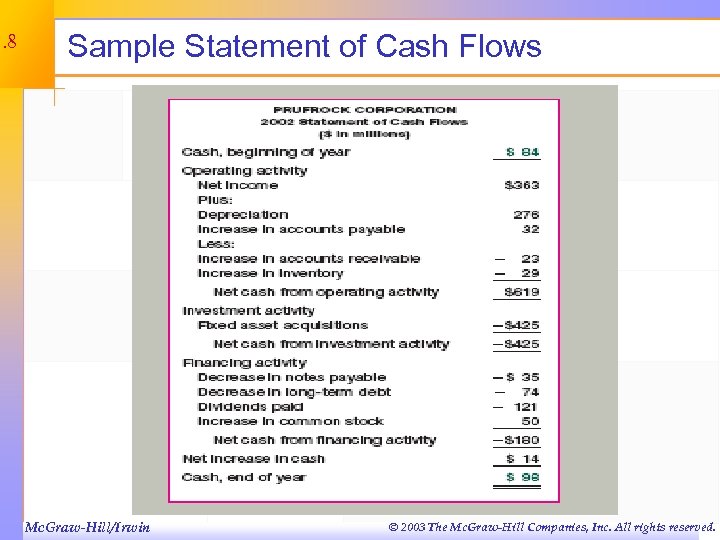 3. 8 Sample Statement of Cash Flows Mc. Graw-Hill/Irwin © 2003 The Mc. Graw-Hill Companies, Inc. All rights reserved.
 3. 9 Standardized Financial Statements • Common-Size Balance Sheets – Compute all accounts as a percent of total assets • Common-Size Income Statements – Compute all line items as a percent of sales • Standardized statements make it easier to compare financial information, particularly as the company grows • They are also useful for comparing companies of different sizes, particularly within the same industry Mc. Graw-Hill/Irwin © 2003 The Mc. Graw-Hill Companies, Inc. All rights reserved.
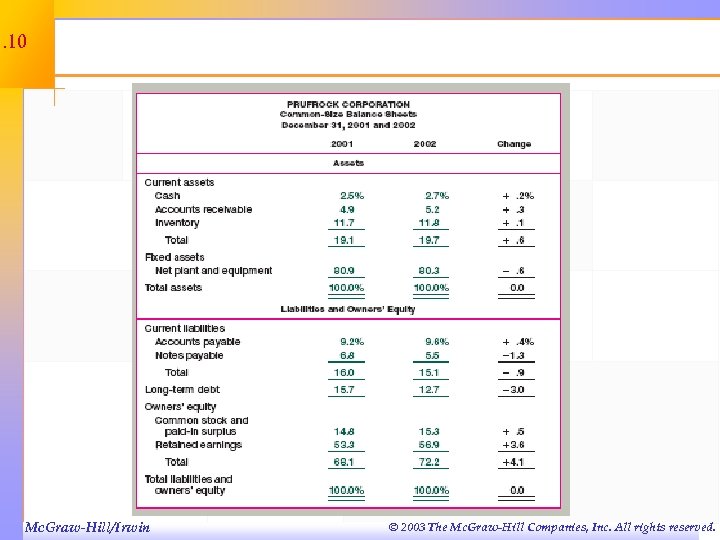 3. 10 Mc. Graw-Hill/Irwin © 2003 The Mc. Graw-Hill Companies, Inc. All rights reserved.
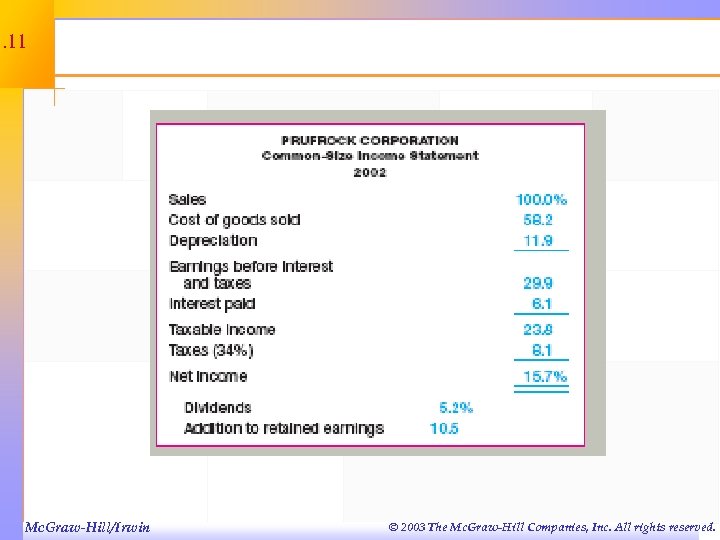 3. 11 Mc. Graw-Hill/Irwin © 2003 The Mc. Graw-Hill Companies, Inc. All rights reserved.
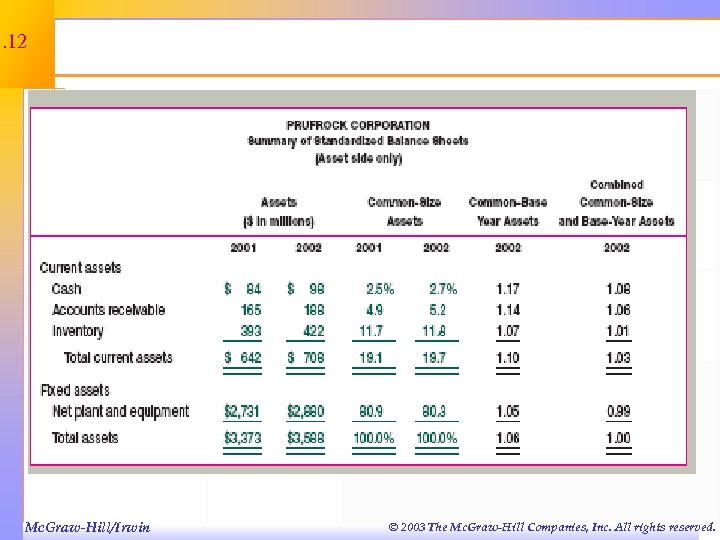 3. 12 Mc. Graw-Hill/Irwin © 2003 The Mc. Graw-Hill Companies, Inc. All rights reserved.
 3. 13 Ratio Analysis • Ratios also allow for better comparison through time or between companies • As we look at each ratio, ask yourself what the ratio is trying to measure and why is that information important • Ratios are used both internally and externally Mc. Graw-Hill/Irwin © 2003 The Mc. Graw-Hill Companies, Inc. All rights reserved.
 3. 14 Categories of Financial Ratios • Short-term solvency or liquidity ratios • Long-term solvency or financial leverage ratios • Asset management or turnover ratios • Profitability ratios • Market value ratios Mc. Graw-Hill/Irwin © 2003 The Mc. Graw-Hill Companies, Inc. All rights reserved.
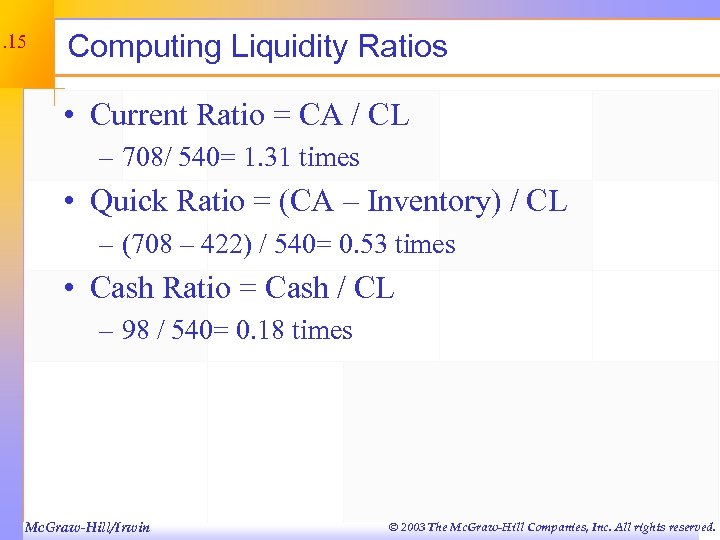 3. 15 Computing Liquidity Ratios • Current Ratio = CA / CL – 708/ 540= 1. 31 times • Quick Ratio = (CA – Inventory) / CL – (708 – 422) / 540= 0. 53 times • Cash Ratio = Cash / CL – 98 / 540= 0. 18 times Mc. Graw-Hill/Irwin © 2003 The Mc. Graw-Hill Companies, Inc. All rights reserved.
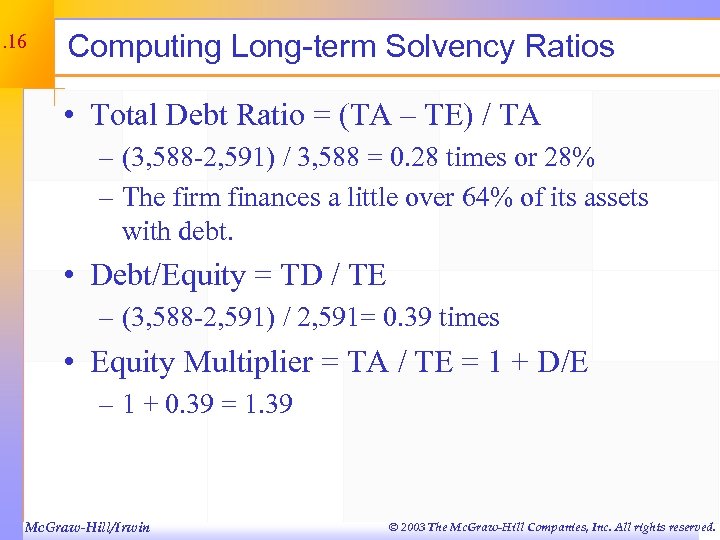 3. 16 Computing Long-term Solvency Ratios • Total Debt Ratio = (TA – TE) / TA – (3, 588 -2, 591) / 3, 588 = 0. 28 times or 28% – The firm finances a little over 64% of its assets with debt. • Debt/Equity = TD / TE – (3, 588 -2, 591) / 2, 591= 0. 39 times • Equity Multiplier = TA / TE = 1 + D/E – 1 + 0. 39 = 1. 39 Mc. Graw-Hill/Irwin © 2003 The Mc. Graw-Hill Companies, Inc. All rights reserved.
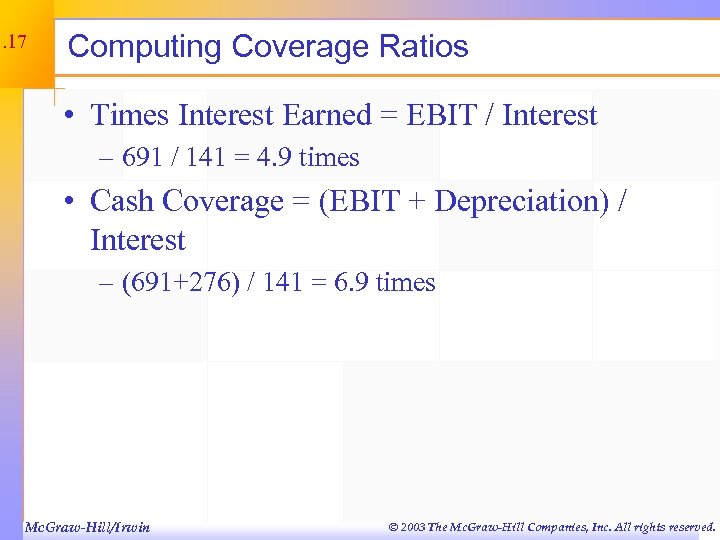 3. 17 Computing Coverage Ratios • Times Interest Earned = EBIT / Interest – 691 / 141 = 4. 9 times • Cash Coverage = (EBIT + Depreciation) / Interest – (691+276) / 141 = 6. 9 times Mc. Graw-Hill/Irwin © 2003 The Mc. Graw-Hill Companies, Inc. All rights reserved.
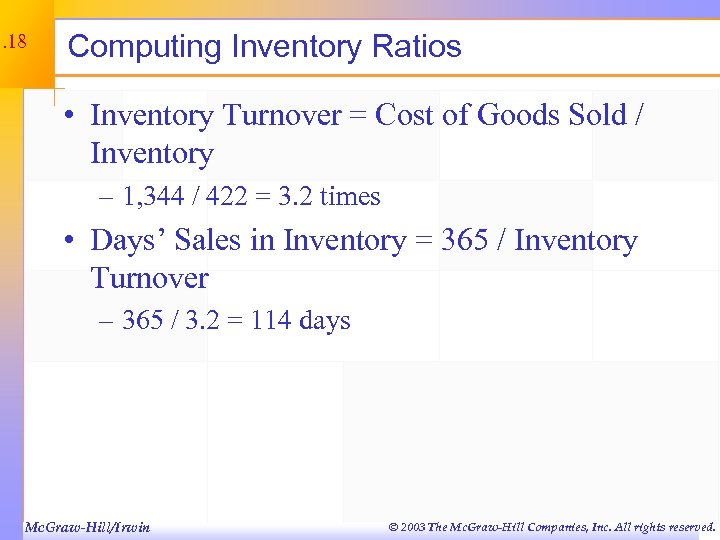 3. 18 Computing Inventory Ratios • Inventory Turnover = Cost of Goods Sold / Inventory – 1, 344 / 422 = 3. 2 times • Days’ Sales in Inventory = 365 / Inventory Turnover – 365 / 3. 2 = 114 days Mc. Graw-Hill/Irwin © 2003 The Mc. Graw-Hill Companies, Inc. All rights reserved.
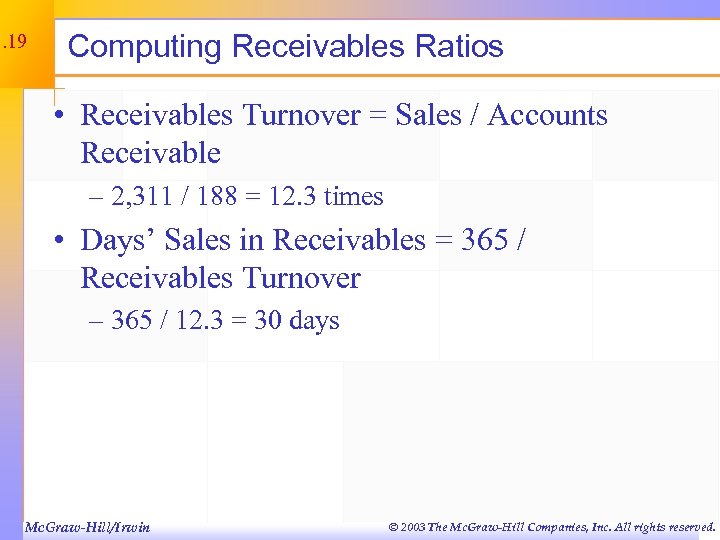 3. 19 Computing Receivables Ratios • Receivables Turnover = Sales / Accounts Receivable – 2, 311 / 188 = 12. 3 times • Days’ Sales in Receivables = 365 / Receivables Turnover – 365 / 12. 3 = 30 days Mc. Graw-Hill/Irwin © 2003 The Mc. Graw-Hill Companies, Inc. All rights reserved.
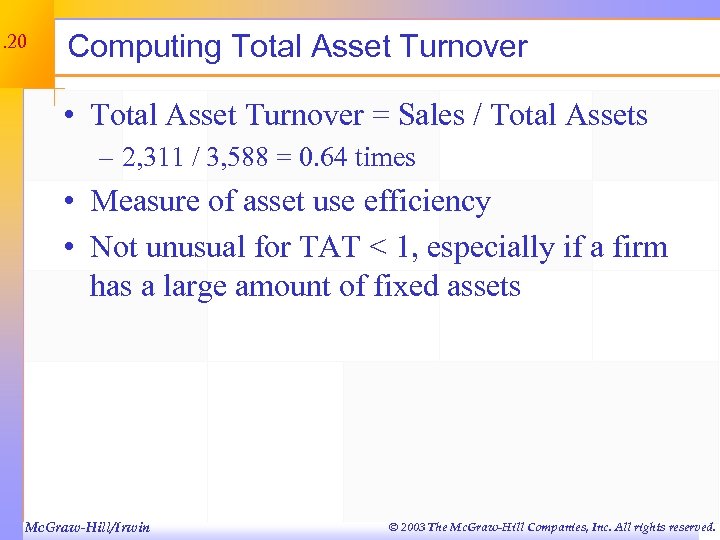 3. 20 Computing Total Asset Turnover • Total Asset Turnover = Sales / Total Assets – 2, 311 / 3, 588 = 0. 64 times • Measure of asset use efficiency • Not unusual for TAT < 1, especially if a firm has a large amount of fixed assets Mc. Graw-Hill/Irwin © 2003 The Mc. Graw-Hill Companies, Inc. All rights reserved.
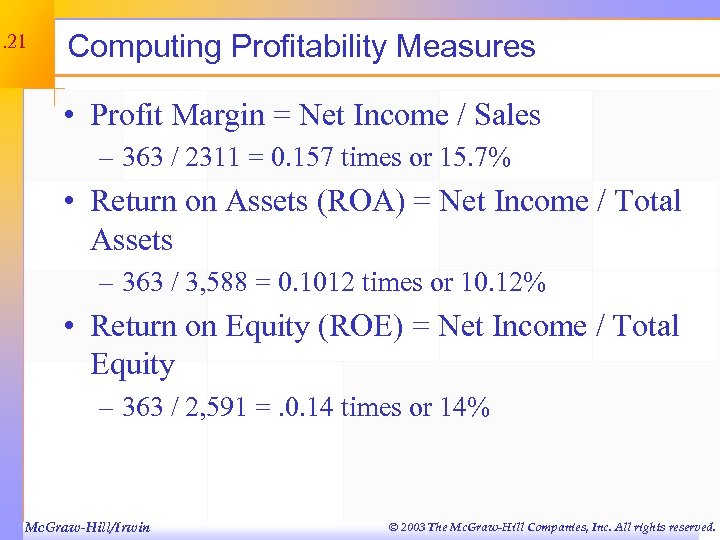 3. 21 Computing Profitability Measures • Profit Margin = Net Income / Sales – 363 / 2311 = 0. 157 times or 15. 7% • Return on Assets (ROA) = Net Income / Total Assets – 363 / 3, 588 = 0. 1012 times or 10. 12% • Return on Equity (ROE) = Net Income / Total Equity – 363 / 2, 591 =. 0. 14 times or 14% Mc. Graw-Hill/Irwin © 2003 The Mc. Graw-Hill Companies, Inc. All rights reserved.
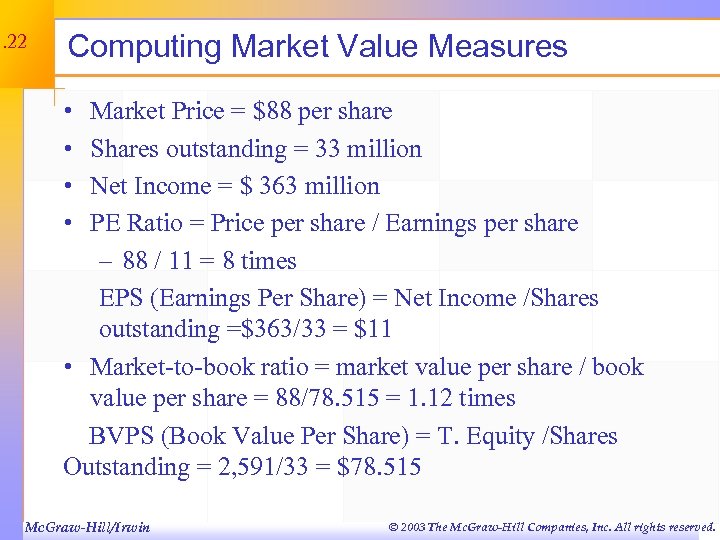 3. 22 Computing Market Value Measures • • Market Price = $88 per share Shares outstanding = 33 million Net Income = $ 363 million PE Ratio = Price per share / Earnings per share – 88 / 11 = 8 times EPS (Earnings Per Share) = Net Income /Shares outstanding =$363/33 = $11 • Market-to-book ratio = market value per share / book value per share = 88/78. 515 = 1. 12 times BVPS (Book Value Per Share) = T. Equity /Shares Outstanding = 2, 591/33 = $78. 515 Mc. Graw-Hill/Irwin © 2003 The Mc. Graw-Hill Companies, Inc. All rights reserved.
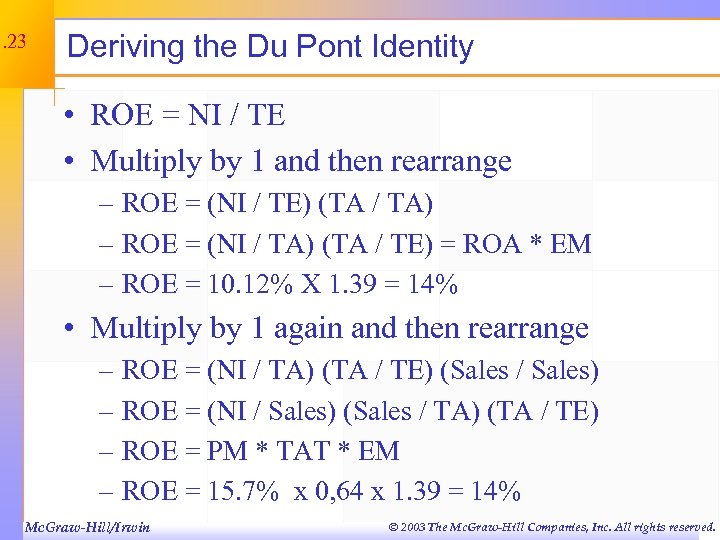 3. 23 Deriving the Du Pont Identity • ROE = NI / TE • Multiply by 1 and then rearrange – ROE = (NI / TE) (TA / TA) – ROE = (NI / TA) (TA / TE) = ROA * EM – ROE = 10. 12% X 1. 39 = 14% • Multiply by 1 again and then rearrange – ROE = (NI / TA) (TA / TE) (Sales / Sales) – ROE = (NI / Sales) (Sales / TA) (TA / TE) – ROE = PM * TAT * EM – ROE = 15. 7% x 0, 64 x 1. 39 = 14% Mc. Graw-Hill/Irwin © 2003 The Mc. Graw-Hill Companies, Inc. All rights reserved.
 3. 24 Using the Du Pont Identity • ROE = PM * TAT * EM – Profit margin is a measure of the firm’s operating efficiency – how well does it control costs – Total asset turnover is a measure of the firm’s asset use efficiency – how well does it manage its assets – Equity multiplier is a measure of the firm’s financial leverage Mc. Graw-Hill/Irwin © 2003 The Mc. Graw-Hill Companies, Inc. All rights reserved.
 3. 25 Why Evaluate Financial Statements? • Internal uses – Performance evaluation – compensation and comparison between divisions – Planning for the future – guide in estimating future cash flows • External uses – Creditors – Suppliers – Customers – Stockholders Mc. Graw-Hill/Irwin © 2003 The Mc. Graw-Hill Companies, Inc. All rights reserved.
 3. 26 Benchmarking • Ratios are not very helpful by themselves; they need to be compared to something • Time-Trend Analysis – Used to see how the firm’s performance is changing through time – Internal and external uses • Peer Group Analysis – Compare to similar companies or within industries – SIC and NAICS codes Mc. Graw-Hill/Irwin © 2003 The Mc. Graw-Hill Companies, Inc. All rights reserved.
 3. 27 Potential Problems • There is no underlying theory, so there is no way to know which ratios are most relevant • Benchmarking is difficult for diversified firms • Globalization and international competition makes comparison more difficult because of differences in accounting regulations • Varying accounting procedures, i. e. FIFO vs. LIFO • Different fiscal years • Extraordinary events Mc. Graw-Hill/Irwin © 2003 The Mc. Graw-Hill Companies, Inc. All rights reserved.
 3. 28 Quick Quiz • What is the Statement of Cash Flows and how do you determine sources and uses of cash? • How do you standardize balance sheets and income statements and why is standardization useful? • What are the major categories of ratios and how do you compute specific ratios within each category? • What are some of the problems associated with financial statement analysis? Mc. Graw-Hill/Irwin © 2003 The Mc. Graw-Hill Companies, Inc. All rights reserved.