


 Скачать презентацию Chapter Thirty-Four Information Technology Information Technologies u
fffbc2de9a78c42e1a8fded01bed1897.ppt
- Количество слайдов: 62
 Chapter Thirty-Four Information Technology
 Information Technologies u Computers, answering machines, FAXes, pagers, cellular phones, … u Many provide strong complementarities. u E. g. email is useful only if lots of people use it -- a network externality. u And computers are more useful if many people use the same software.
 Information Technologies u But then switching technologies becomes very costly -- lock-in. u E. g. Microsoft Windows. u How do markets operate when there are switching costs or network externalities?
 Competition & Switching Costs u Producer’s cost per month of providing a network service is c per customer. u Customer’s switching cost is s. u Producer offers a one month discount, d. u Rate of interest is r.
 Competition & Switching Costs u All producers set the same nondiscounted price of p per month. u When is switching producers rational for a customer?
 Competition & Switching Costs u Cost of not switching is
 Competition & Switching Costs u Cost of not switching is u Cost from switching is
 Competition & Switching Costs u Cost of not switching is u Cost from switching is u Switch if
 Competition & Switching Costs u Cost of not switching is u Cost from switching is u Switch u I. e. if if
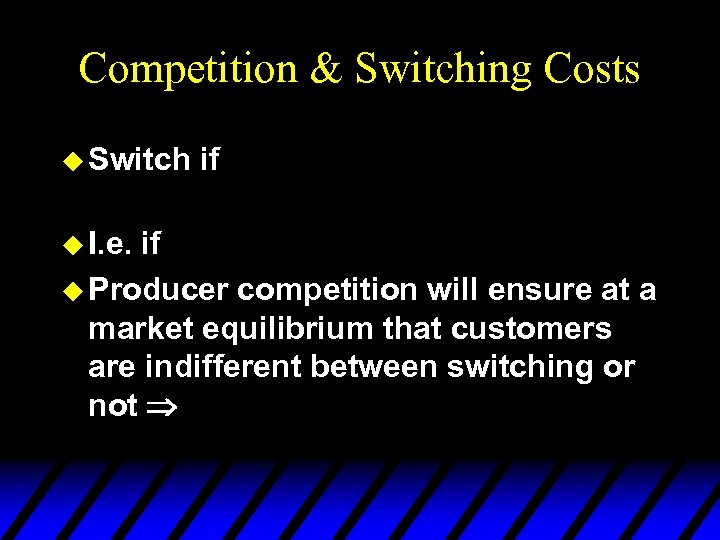 Competition & Switching Costs u Switch u I. e. if if u Producer competition will ensure at a market equilibrium that customers are indifferent between switching or not
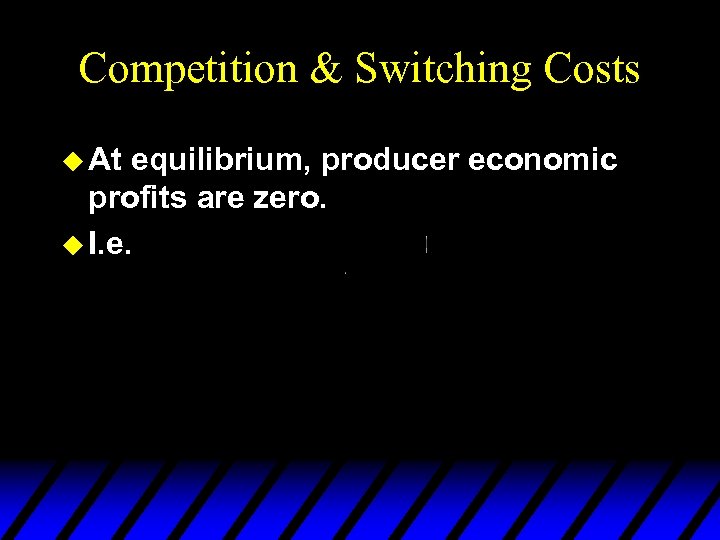 Competition & Switching Costs u At equilibrium, producer economic profits are zero. u I. e.
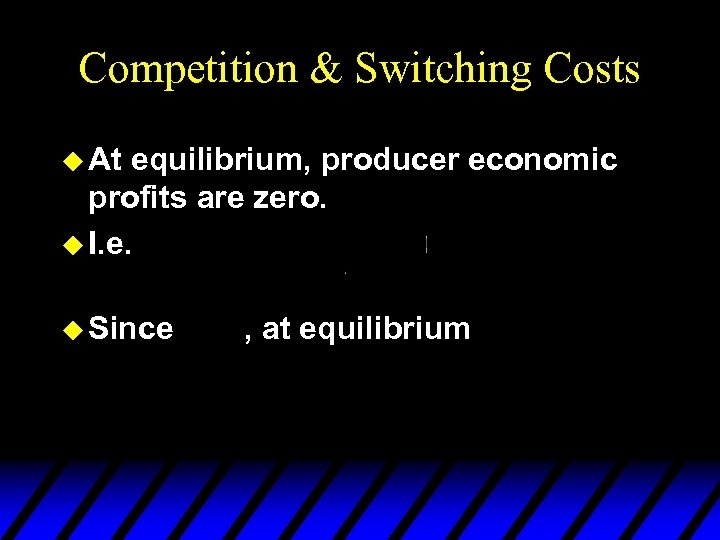 Competition & Switching Costs u At equilibrium, producer economic profits are zero. u I. e. u Since , at equilibrium
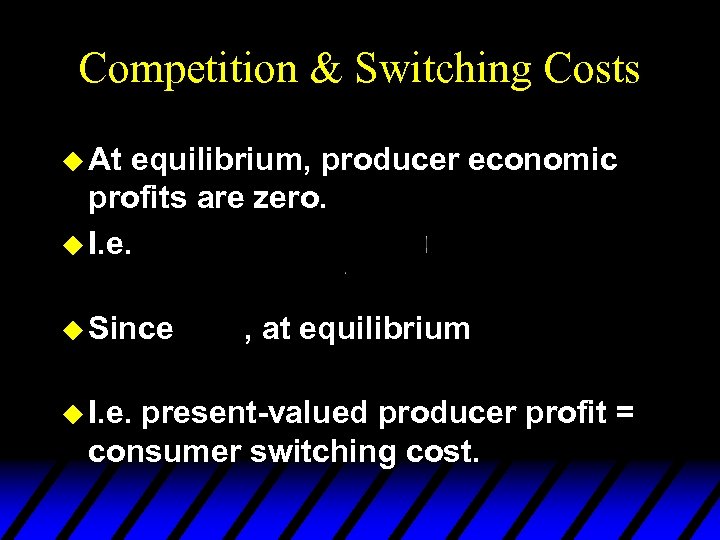 Competition & Switching Costs u At equilibrium, producer economic profits are zero. u I. e. u Since u I. e. , at equilibrium present-valued producer profit = consumer switching cost.
 Competition & Network Externalities u Individuals 1, …, 1000. u Each can buy one unit of a good providing a network externality. u Person v values a unit of the good at nv, where n is the number of persons who buy the good.
 Competition & Network Externalities u Individuals 1, …, 1000. u Each can buy one unit of a good providing a network externality. u Person v values a unit of the good at nv, where n is the number of persons who buy the good. u At a price p, what is the quantity demanded of the good?
 Competition & Network Externalities u If v is the marginal buyer, valuing the good at nv = p, then all buyers v’ > v value the good more, and so buy it. u Quantity demanded is n = 1000 - v. u So inverse demand is p = n(1000 -n).
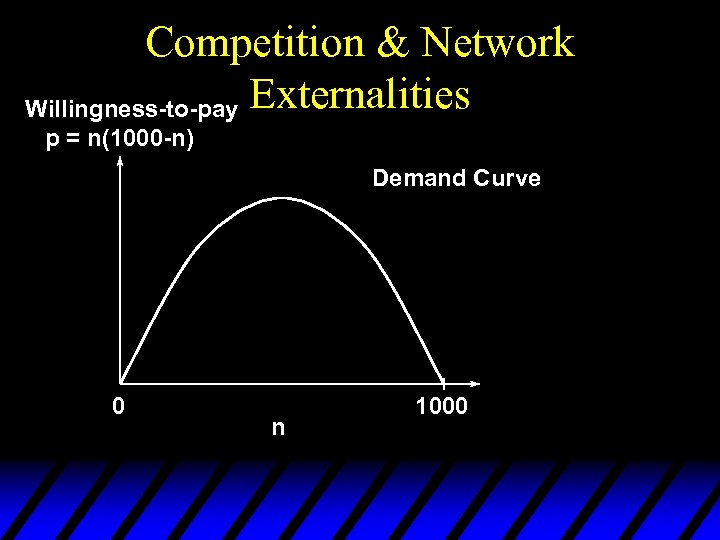 Competition & Network Willingness-to-pay Externalities p = n(1000 -n) Demand Curve 0 n 1000
 Competition & Network Externalities u Suppose all suppliers have the same marginal production cost, c.
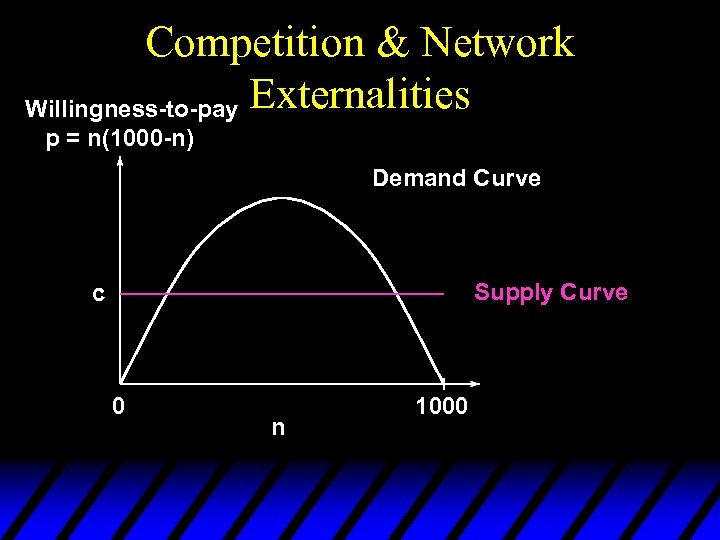 Competition & Network Willingness-to-pay Externalities p = n(1000 -n) Demand Curve Supply Curve c 0 n 1000
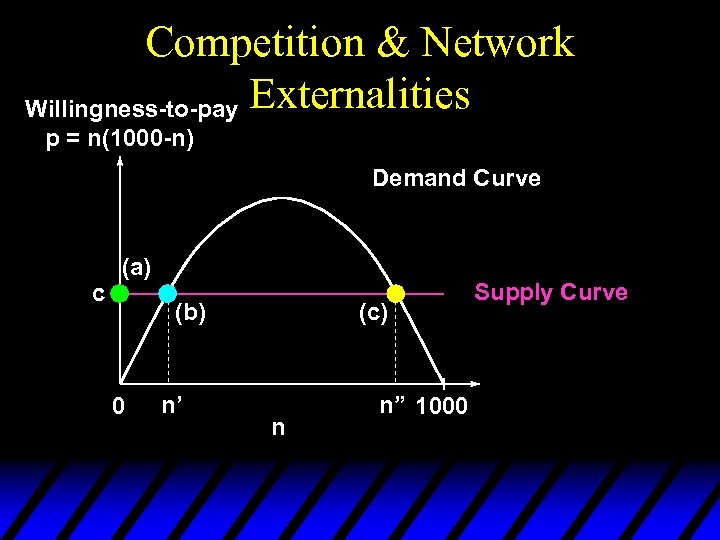
 Competition & Network Externalities u What are the market equilibria?
 Competition & Network Externalities u What are the market equilibria? u (a) No buyer buys, no seller supplies. – If n = 0, then value nv = 0 for all buyers v, so no buyer buys. – If no buyer buys, then no seller supplies.
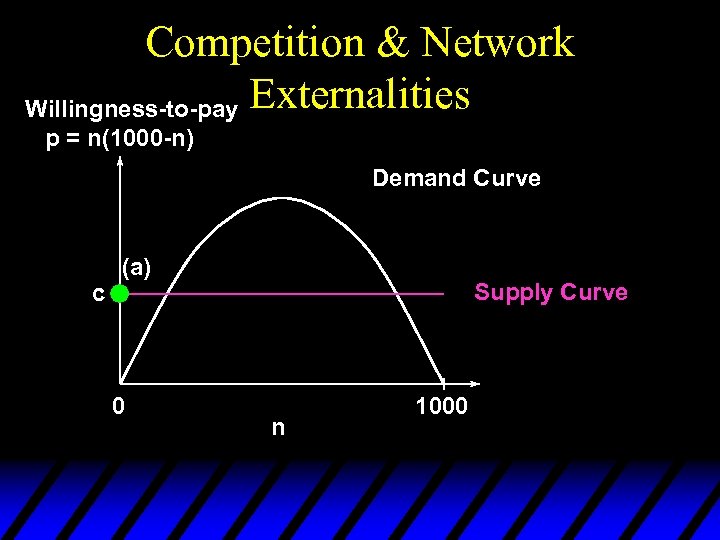 Competition & Network Willingness-to-pay Externalities p = n(1000 -n) Demand Curve c (a) 0 Supply Curve n 1000
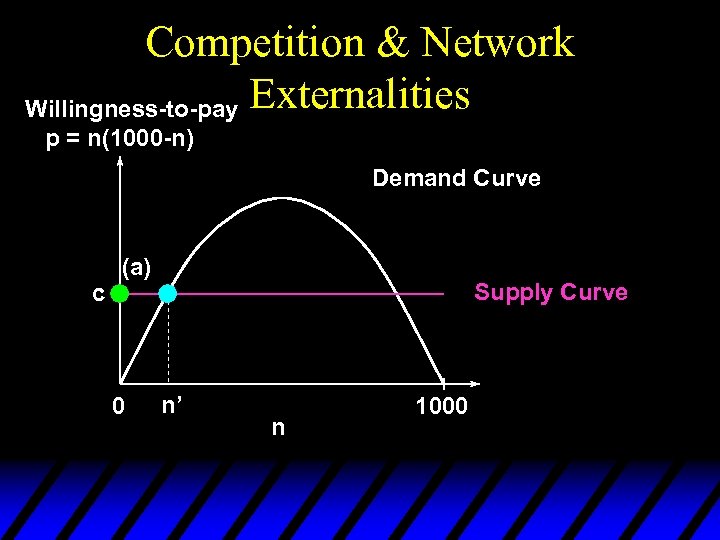 Competition & Network Willingness-to-pay Externalities p = n(1000 -n) Demand Curve c (a) 0 Supply Curve n’ n 1000
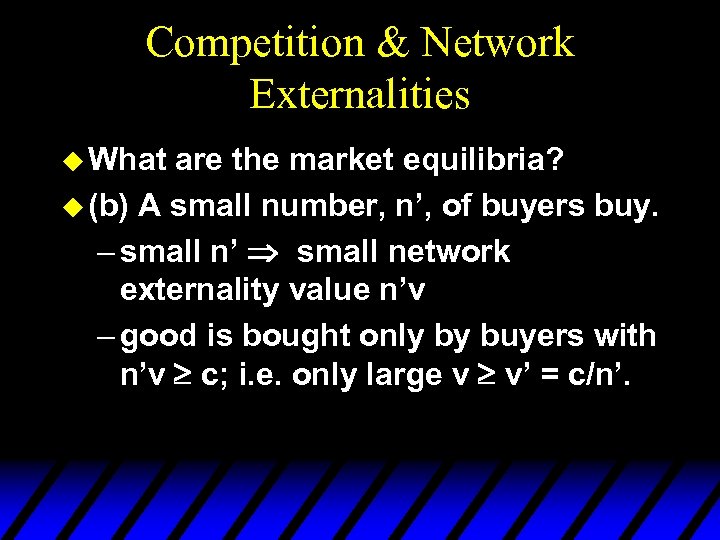 Competition & Network Externalities u What are the market equilibria? u (b) A small number, n’, of buyers buy. – small n’ small network externality value n’v – good is bought only by buyers with n’v c; i. e. only large v v’ = c/n’.
 Competition & Network Willingness-to-pay Externalities p = n(1000 -n) Demand Curve c (a) (b) 0 n’ (c) n n” 1000 Supply Curve
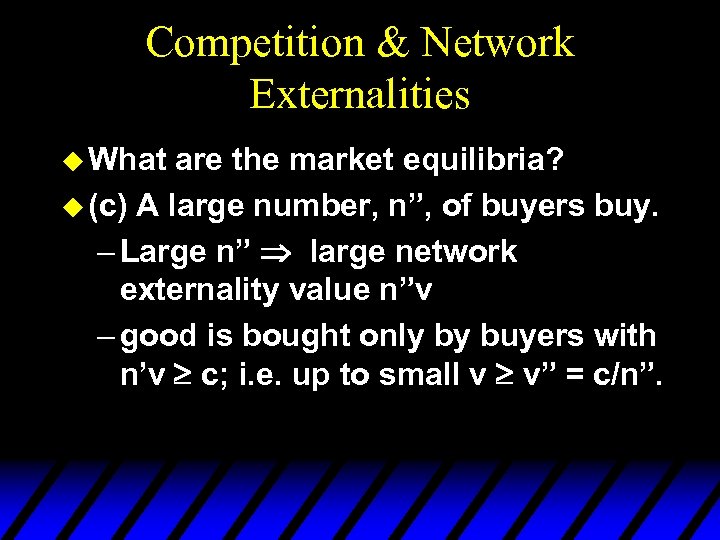 Competition & Network Externalities u What are the market equilibria? u (c) A large number, n”, of buyers buy. – Large n” large network externality value n”v – good is bought only by buyers with n’v c; i. e. up to small v v” = c/n”.
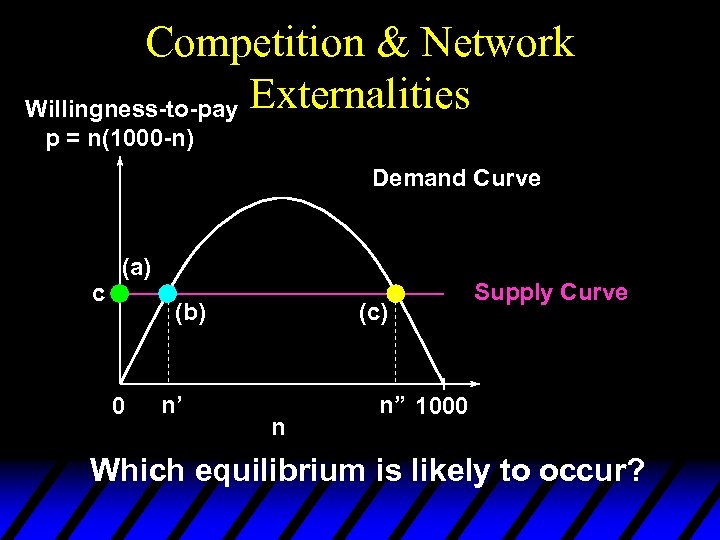 Competition & Network Willingness-to-pay Externalities p = n(1000 -n) Demand Curve c (a) (b) 0 n’ (c) n Supply Curve n” 1000 Which equilibrium is likely to occur?
 Competition & Network Externalities u Suppose the market expands whenever willingness-to-pay exceeds marginal production cost, c.
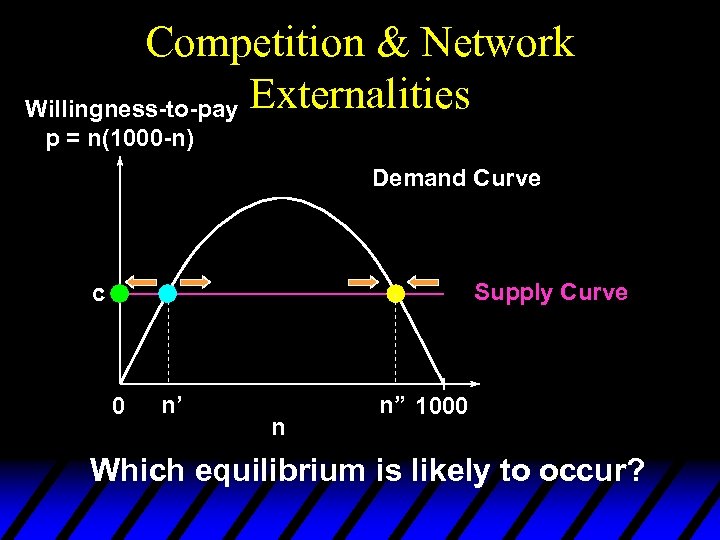 Competition & Network Willingness-to-pay Externalities p = n(1000 -n) Demand Curve Supply Curve c 0 n’ n n” 1000 Which equilibrium is likely to occur?
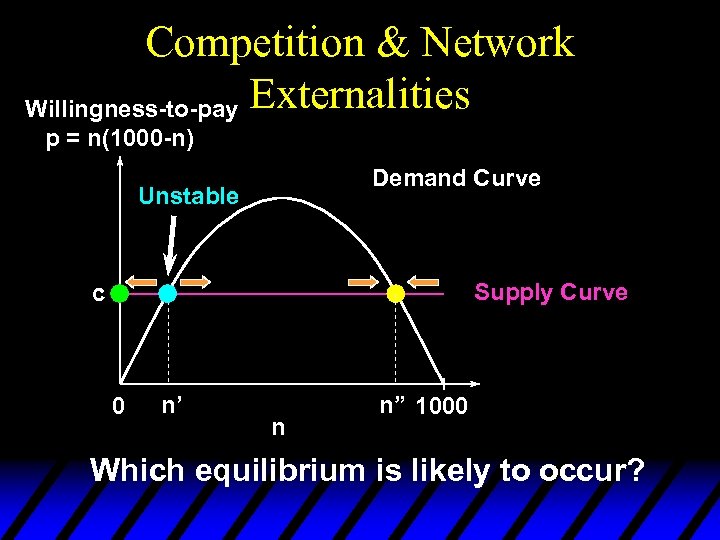 Competition & Network Willingness-to-pay Externalities p = n(1000 -n) Demand Curve Unstable Supply Curve c 0 n’ n n” 1000 Which equilibrium is likely to occur?
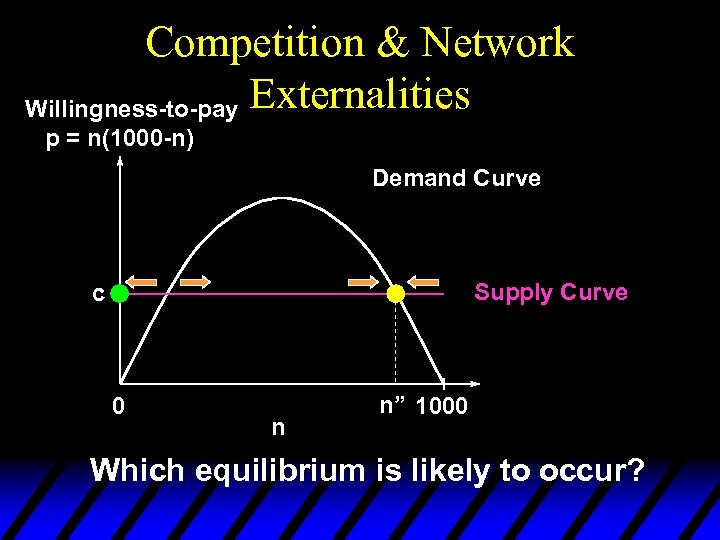 Competition & Network Willingness-to-pay Externalities p = n(1000 -n) Demand Curve Supply Curve c 0 n n” 1000 Which equilibrium is likely to occur?
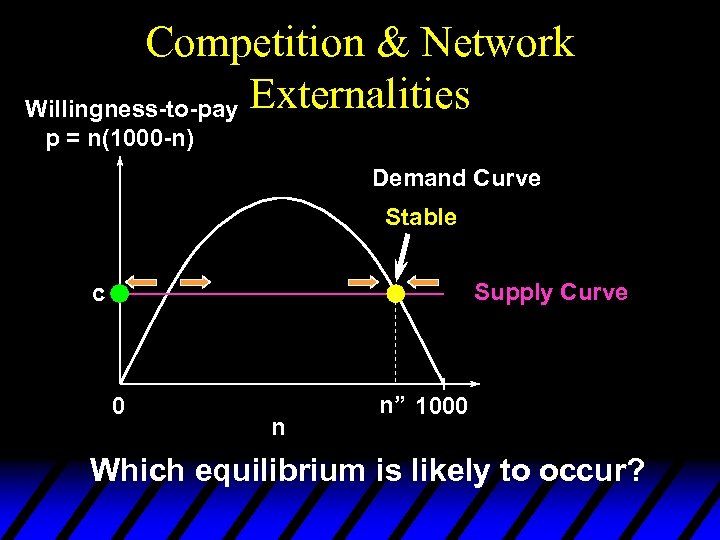 Competition & Network Willingness-to-pay Externalities p = n(1000 -n) Demand Curve Stable Supply Curve c 0 n n” 1000 Which equilibrium is likely to occur?
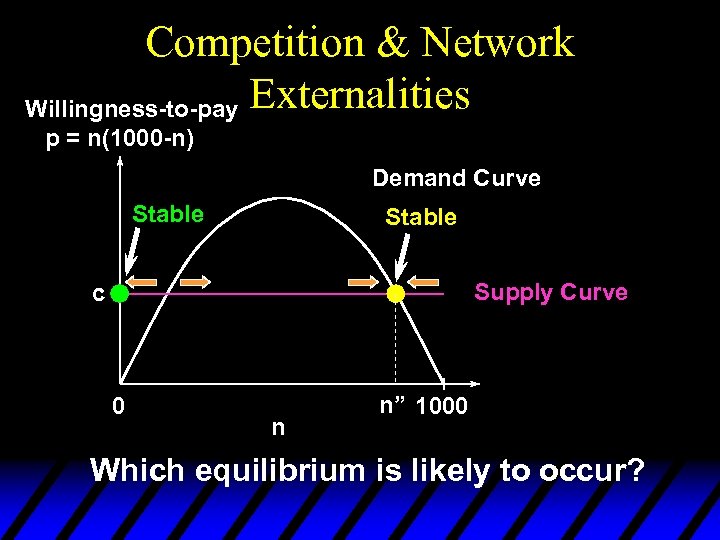 Competition & Network Willingness-to-pay Externalities p = n(1000 -n) Demand Curve Stable Supply Curve c 0 n n” 1000 Which equilibrium is likely to occur?
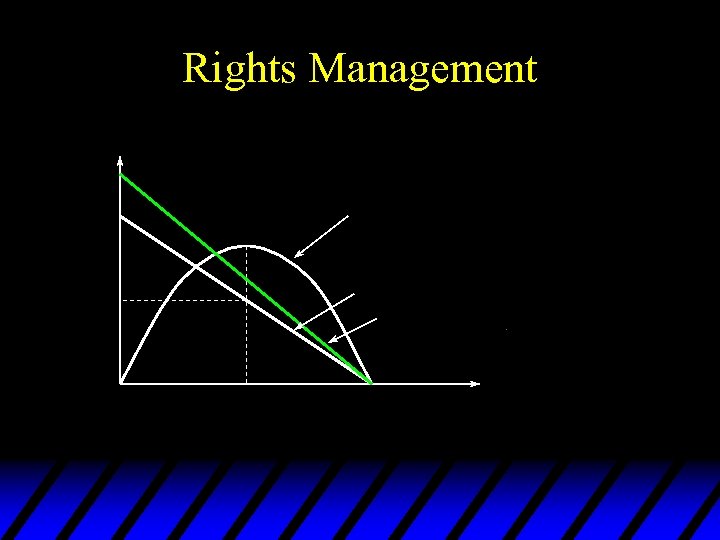
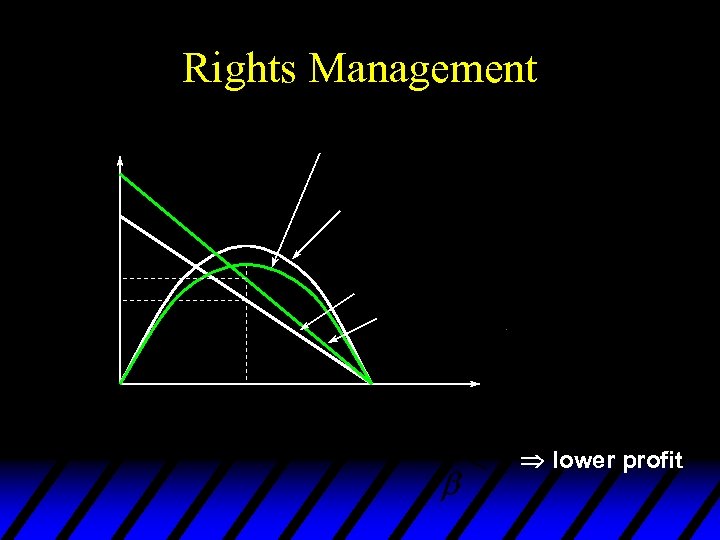
 Rights Management u Should a good be vsold outright, vlicensed for production by others, or vrented? u How is the ownership right of the good to be managed?
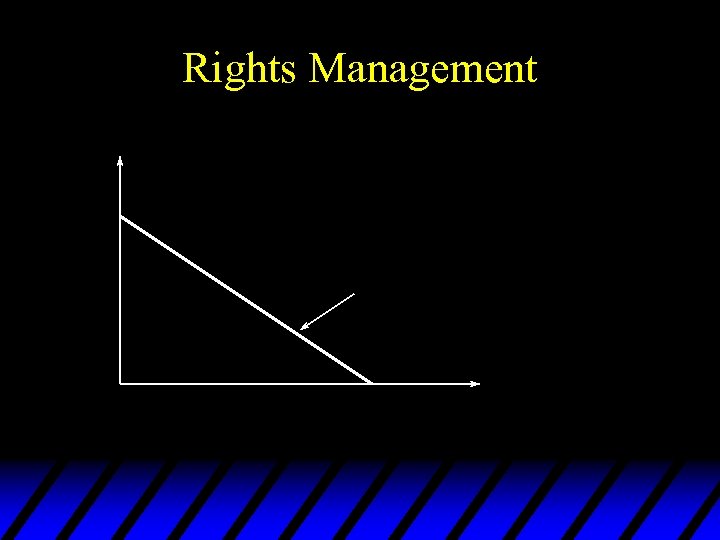
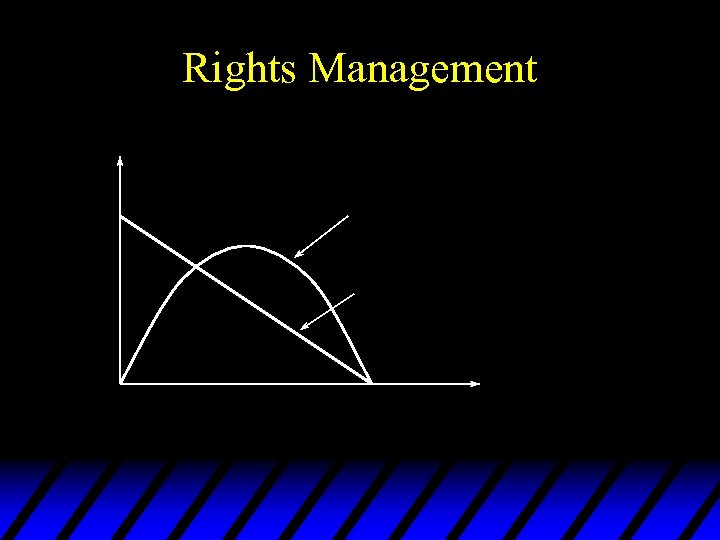
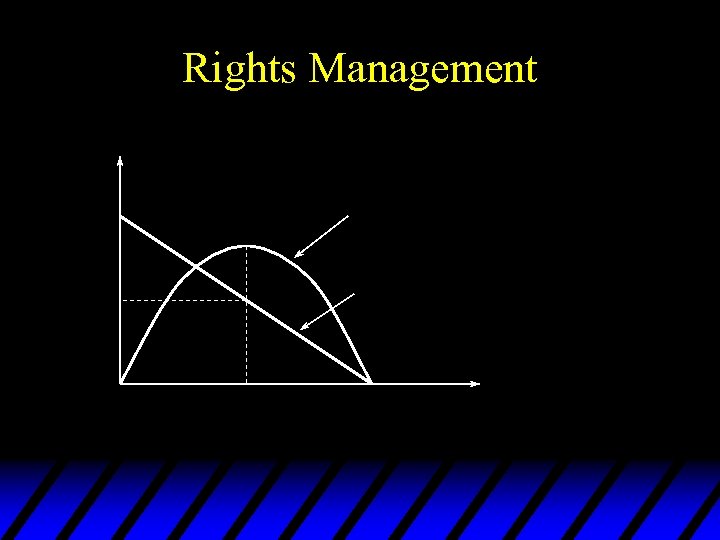
 Rights Management u Suppose production costs are negligible. u Market demand is p(y). u The firm wishes to
 Rights Management
 Rights Management
 Rights Management
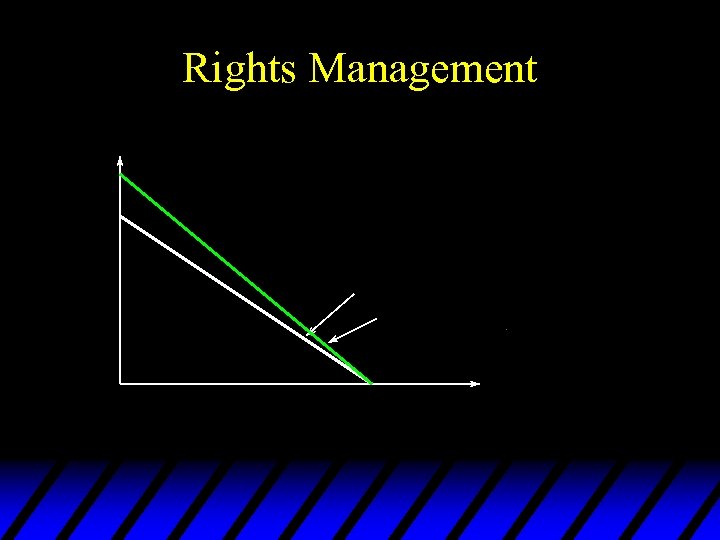
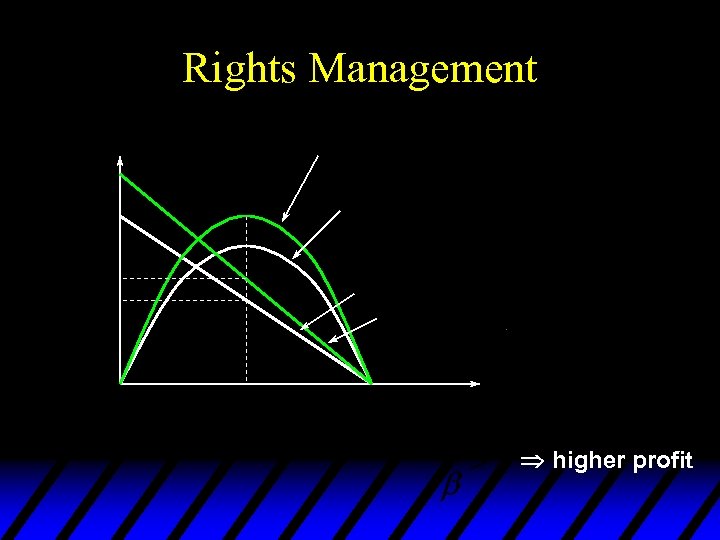
 Rights Management u The rights owner now allows a free trial period. This causes – an increase in consumption
 Rights Management u The rights owner now allows a free trial period. This causes – an increase in consumption and a decrease in sales per unit of consumption
 Rights Management u The rights owner now allows a free trial period. This causes – increase in value to all users increase in willingness-to-pay;
 Rights Management
 Rights Management u The firm’s problem is now to
 Rights Management u The u This firm’s problem is now to problem must have the same solution as
 Rights Management u The u This firm’s problem is now to problem must have the same solution as u So
 Rights Management
 Rights Management higher profit
 Rights Management lower profit
 Sharing Intellectual Property u Produce a lot for direct sales, or only a little for multiple rentals? u Lending books, software. u Renting tools, videos etc. u Sell movies directly, or only sell to video rental stores, or pay-per-view? u When is selling for rental more profitable than selling for personal use only?
 Sharing Intellectual Property u. F is the fixed cost of designing the good. u c is the constant marginal cost of copying the good. u p(y) is the market demand. u Direct sales problem is to
 Sharing Intellectual Property u. F is the fixed cost of designing the good. u c is the constant marginal cost of copying the good. u p(y) is the market demand. u Direct sales problem is to
 Sharing Intellectual Property u Is selling for rental more profitable? u Each rental unit is used by k > 1 consumers. u So y units sold x = ky consumption units.
 Sharing Intellectual Property u Is selling for rental more profitable? u Each rental unit is used by k > 1 consumers. u So y units sold x = ky consumption units. u Marginal consumer’s willingness-topay is p(x) = p(ky).
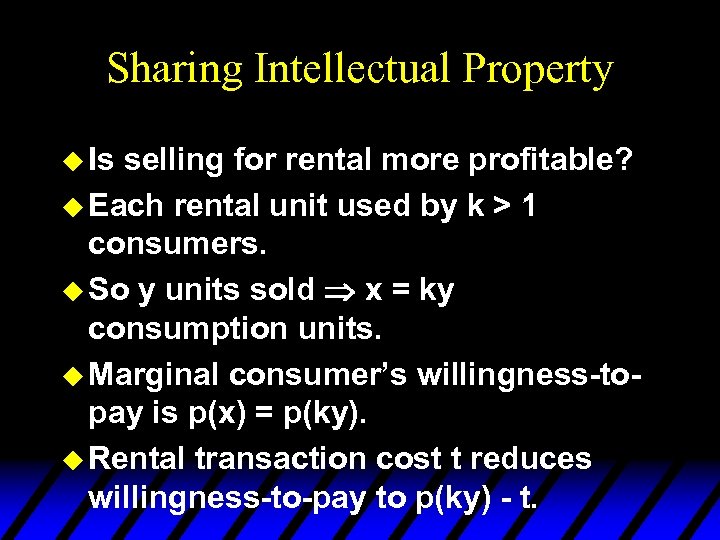 Sharing Intellectual Property u Is selling for rental more profitable? u Each rental unit used by k > 1 consumers. u So y units sold x = ky consumption units. u Marginal consumer’s willingness-topay is p(x) = p(ky). u Rental transaction cost t reduces willingness-to-pay to p(ky) - t.
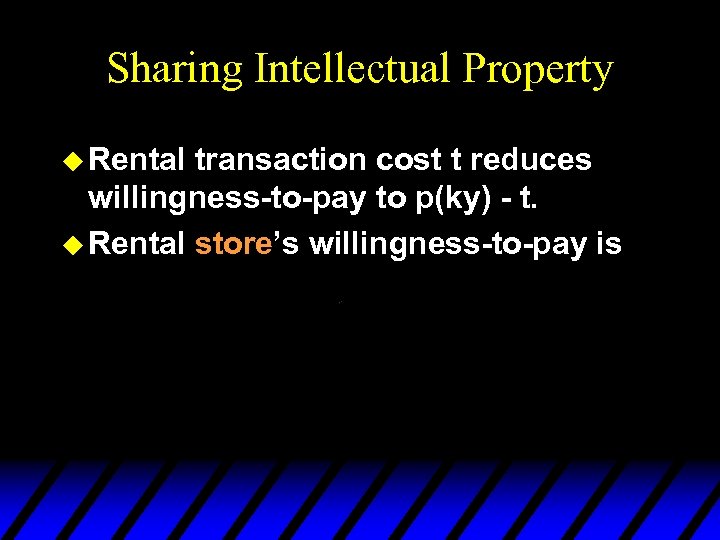 Sharing Intellectual Property u Rental transaction cost t reduces willingness-to-pay to p(ky) - t. u Rental store’s willingness-to-pay is
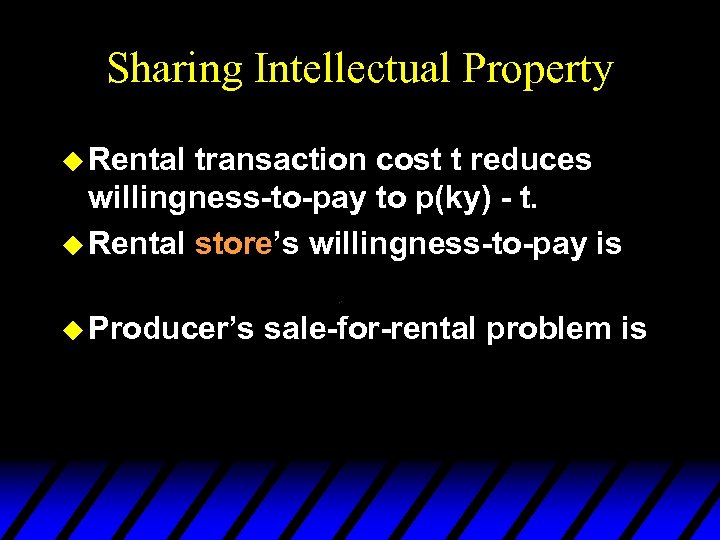 Sharing Intellectual Property u Rental transaction cost t reduces willingness-to-pay to p(ky) - t. u Rental store’s willingness-to-pay is u Producer’s sale-for-rental problem is
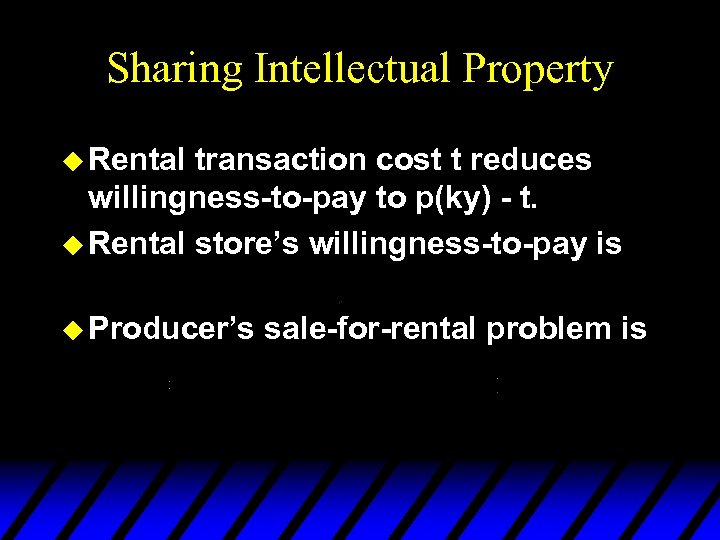 Sharing Intellectual Property u Rental transaction cost t reduces willingness-to-pay to p(ky) - t. u Rental store’s willingness-to-pay is u Producer’s sale-for-rental problem is
 Sharing Intellectual Property u Rental transaction cost t reduces willingness-to-pay to p(ky) - t. u Rental store’s willingness-to-pay is u Producer’s sale-for-rental problem is
 Sharing Intellectual Property is the same problem as the direct sale problem except for the marginal costs.
 Sharing Intellectual Property is the same problem as the direct sale problem except for the marginal costs. Direct sale is better for the producer if
 Sharing Intellectual Property u Direct u I. e. if sale is better for the producer if
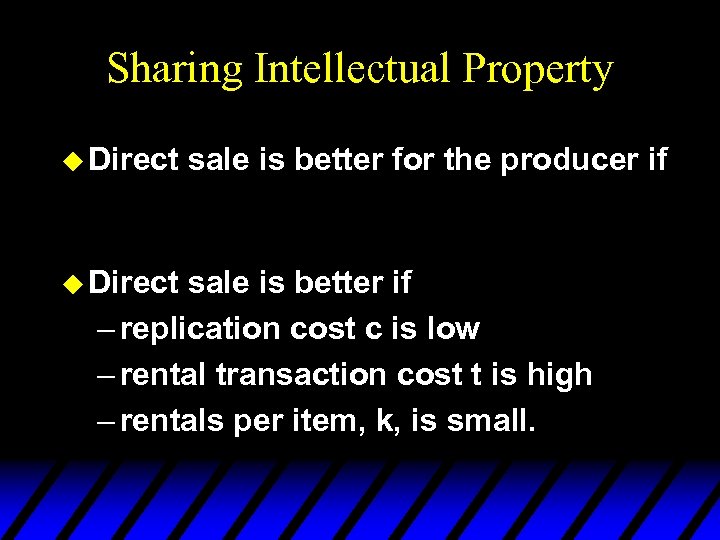 Sharing Intellectual Property u Direct sale is better for the producer if sale is better if – replication cost c is low – rental transaction cost t is high – rentals per item, k, is small.