


 Скачать презентацию CHAPTER THIRTEEN MARKETING CHANNELS AND LOGISTICS MANAGEMENT Text
c08037bc5412525a69204dd95658ef8f.ppt
- Количество слайдов: 80
 CHAPTER THIRTEEN MARKETING CHANNELS AND LOGISTICS MANAGEMENT Text by Profs. Gene Boone & David Kurtz Multimedia Presentation by Prof. Milton Pressley The University of New Orleans Copyright © 2001 by Harcourt, Inc. All rights reserved. 1
 CHAPTER OBJECTIVES • • • Describe the roles that marketing channels and logistics play in marketing strategy Describe the various types of distribution channels available to marketers Outline the major channel strategy decisions Describe the concept of management, conflict, and cooperation within the marketing channel Identify and compare the major components of a physical distribution system 2 Copyright © 2001 by Harcourt, Inc. All rights reserved.
 CHAPTER OBJECTIVES • • Outline the suboptimization problem in logistics Explain the impact of transportation deregulation on logistics activities Compare the major transportation alternatives on the basis of speed, dependability, costs, frequency of shipments, availability in different locations, and flexibility and handling products Discuss how transportation intermediaries and combined transportation modes can improve physical distribution 3 Copyright © 2001 by Harcourt, Inc. All rights reserved.
 STRATEGIC IMPLICATIONS: THE ROLE OF MARKETING CHANNELS IN MARKETING STRATEGY • • Channels provide the means by which the firm moves the goods and services it produces to ultimate users Channels perform four important functions. They: • • Facilitate the exchange process by cutting the number of contacts necessary Adjust for discrepancies in the market’s assortment of goods and services via sorting Standardize payment terms, delivery schedules, prices, and purchase lots Facilitate searches by both buyers and sellers 4 © Photo. Disc Copyright © 2001 by Harcourt, Inc. All rights reserved.
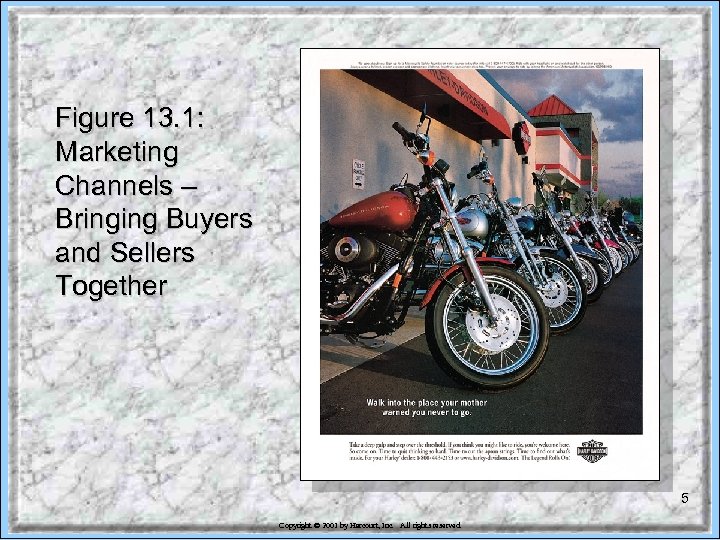 Figure 13. 1: Marketing Channels – Bringing Buyers and Sellers Together 5 Copyright © 2001 by Harcourt, Inc. All rights reserved.
 1 -800 -flowers. com One Marketing Channel for Flower Buyers 6 Copyright © 2001 by Harcourt, Inc. All rights reserved.
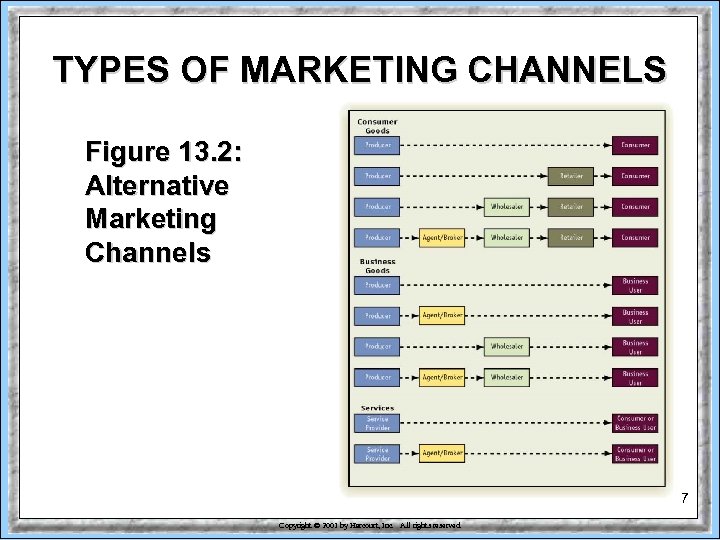 TYPES OF MARKETING CHANNELS Figure 13. 2: Alternative Marketing Channels 7 Copyright © 2001 by Harcourt, Inc. All rights reserved.
 TYPES OF MARKETING CHANNELS • • • Marketing channel: system of marketing institutions that promotes the physical flow of goods and services, along with ownership title, from producers to consumer or business user; also called a distribution channel Marketing intermediary: wholesaler or retailer that operates between producers and consumers or business users; also called a middleman Wholesaler: marketing intermediary that takes title to goods and then distributes these goods further; also called a jobber or distributor 8 © Photo. Disc Copyright © 2001 by Harcourt, Inc. All rights reserved.
 U. S. Food. Service A Wholesaler Is a Marketing Intermediary 9 Copyright © 2001 by Harcourt, Inc. All rights reserved.
 TYPES OF MARKETING CHANNELS • • Logistics: process of coordinating the flow of information, goods, and services among members of the distribution channel Physical distribution: activities to achieve efficient movement of finished goods from the end of the production line to the consumer 10 © Photo. Disc Copyright © 2001 by Harcourt, Inc. All rights reserved.
 Direct Selling • • Direct channel: marketing channel that moves goods directly from a producer to ultimate user Direct selling: strategy designed to establish direct sales contract between producer and final user © Photo. Disc 11 Copyright © 2001 by Harcourt, Inc. All rights reserved.
 Figure 13. 3: Avon: Using Direct Selling as a Marketing Strategy 12 Copyright © 2001 by Harcourt, Inc. All rights reserved.
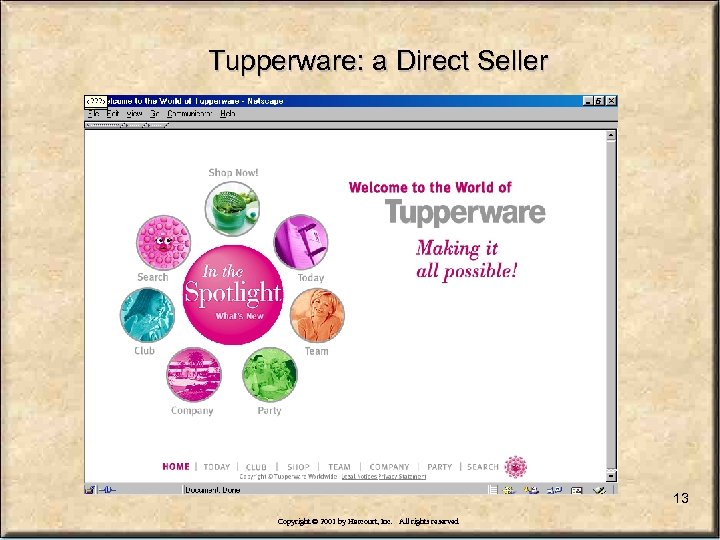 Tupperware: a Direct Seller 13 Copyright © 2001 by Harcourt, Inc. All rights reserved.
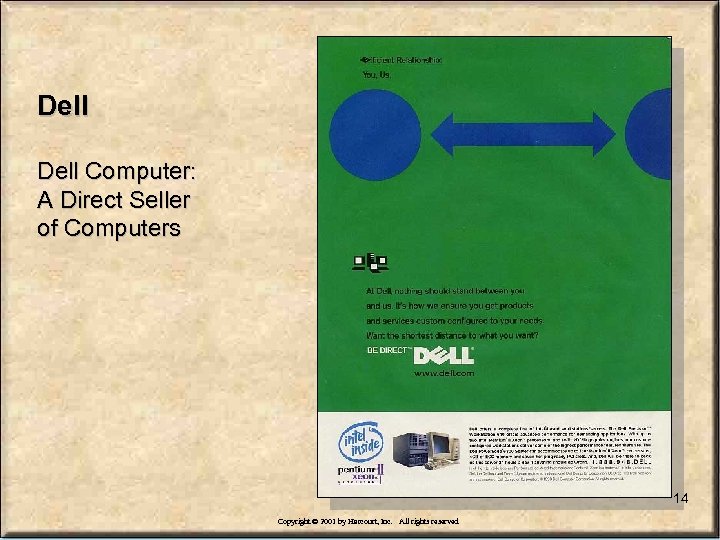 Dell Computer: A Direct Seller of Computers 14 Copyright © 2001 by Harcourt, Inc. All rights reserved.
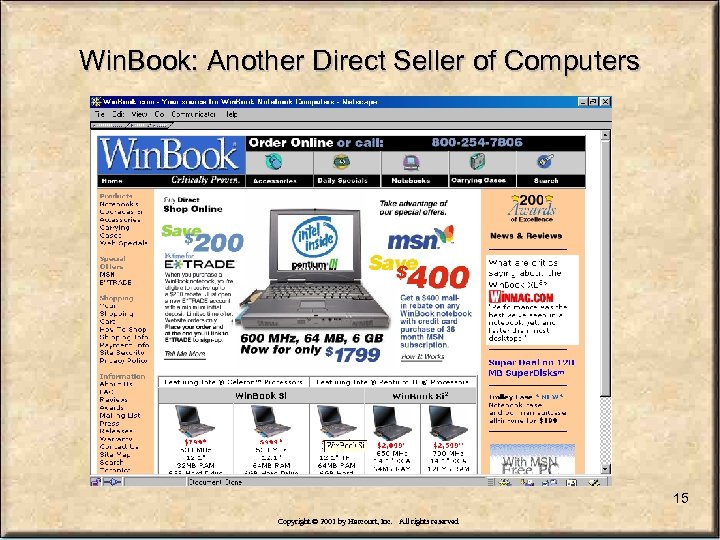 Win. Book: Another Direct Seller of Computers 15 Copyright © 2001 by Harcourt, Inc. All rights reserved.
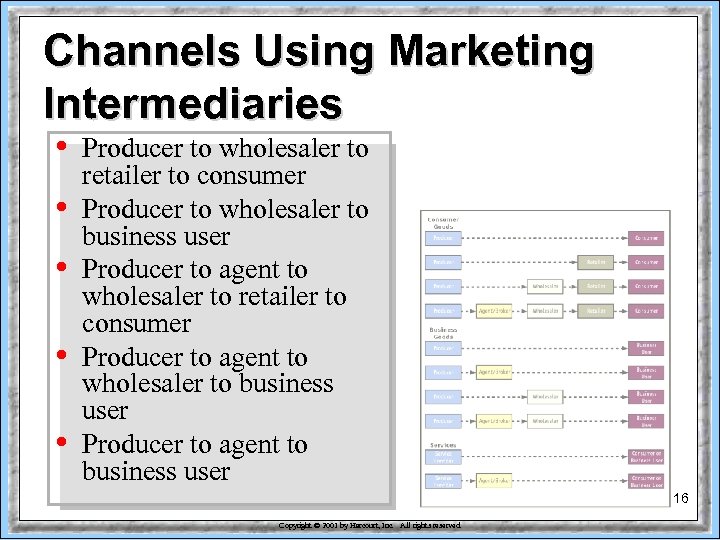 Channels Using Marketing Intermediaries • • • Producer to wholesaler to retailer to consumer Producer to wholesaler to business user Producer to agent to wholesaler to retailer to consumer Producer to agent to wholesaler to business user Producer to agent to business user 16 Copyright © 2001 by Harcourt, Inc. All rights reserved.
 DUAL DISTRIBUTION • Dual distribution: network that moves products to a firm’s target market through more than one marketing channel 17 © Photo. Disc Copyright © 2001 by Harcourt, Inc. All rights reserved.
 Class Discussion What, if any, problems exist when dual channels are utilized? 18 Copyright © 2001 by Harcourt, Inc. All rights reserved.
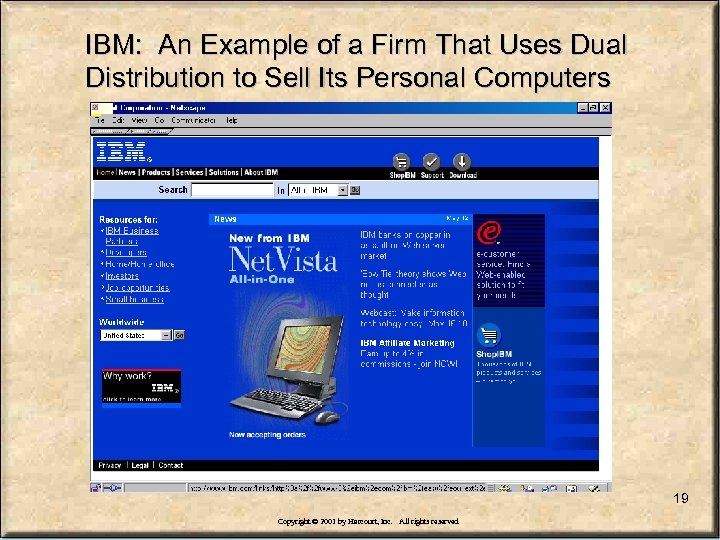 IBM: An Example of a Firm That Uses Dual Distribution to Sell Its Personal Computers 19 Copyright © 2001 by Harcourt, Inc. All rights reserved.
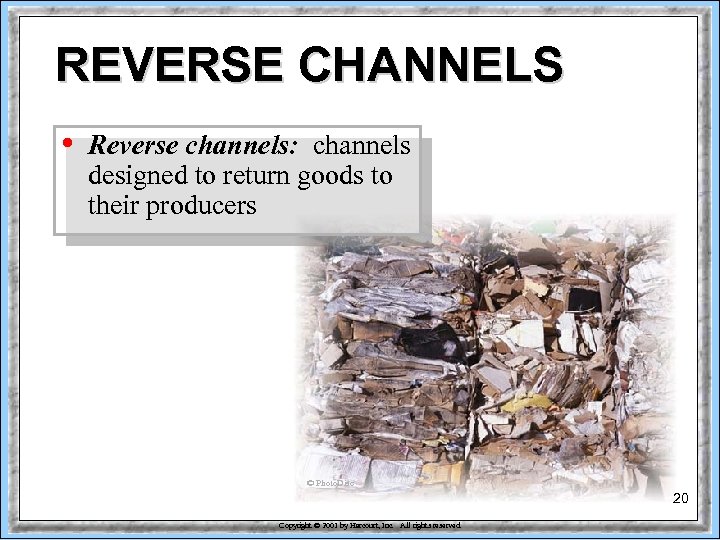 REVERSE CHANNELS • Reverse channels: channels designed to return goods to their producers © Photo. Disc 20 Copyright © 2001 by Harcourt, Inc. All rights reserved.
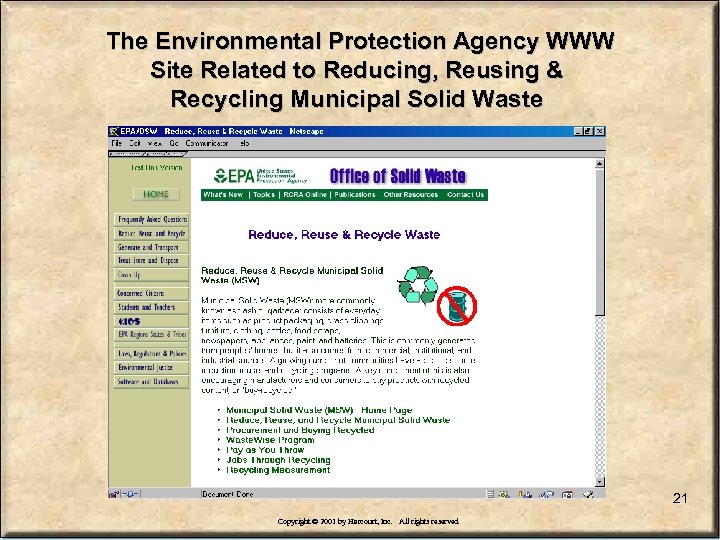 The Environmental Protection Agency WWW Site Related to Reducing, Reusing & Recycling Municipal Solid Waste 21 Copyright © 2001 by Harcourt, Inc. All rights reserved.
 CHANNEL STRATEGY DECISIONS Selection of a Marketing Channel • Factors which impact the selection of a marketing channel include: • Market factors • Product factors • Organizational factors • Competitive factors 22 Copyright © 2001 by Harcourt, Inc. All rights reserved.
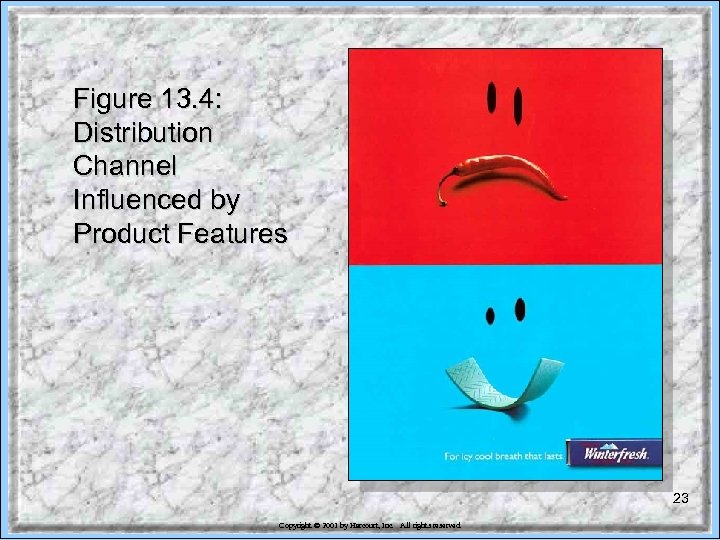 Figure 13. 4: Distribution Channel Influenced by Product Features 23 Copyright © 2001 by Harcourt, Inc. All rights reserved.
 Cold Care Tissue The Product Factor of Low Product Unit Values Typically Causes Firms to Use Longer Marketing Channels 24 Copyright © 2001 by Harcourt, Inc. All rights reserved.
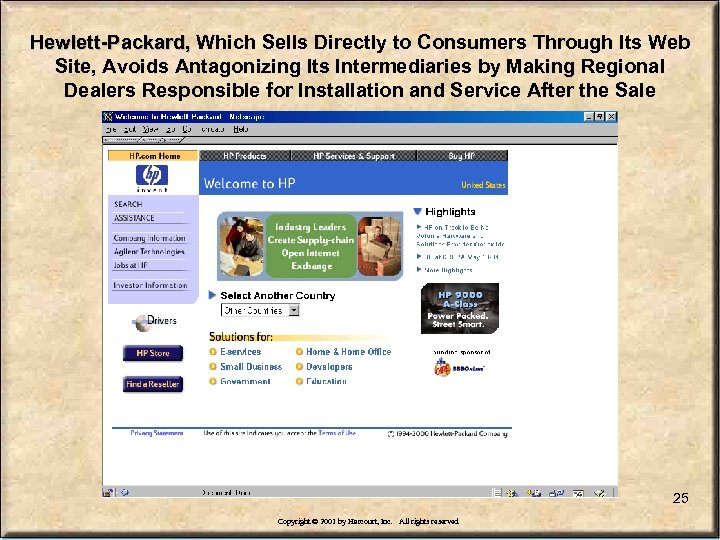 Hewlett-Packard, Which Sells Directly to Consumers Through Its Web Site, Avoids Antagonizing Its Intermediaries by Making Regional Dealers Responsible for Installation and Service After the Sale 25 Copyright © 2001 by Harcourt, Inc. All rights reserved.
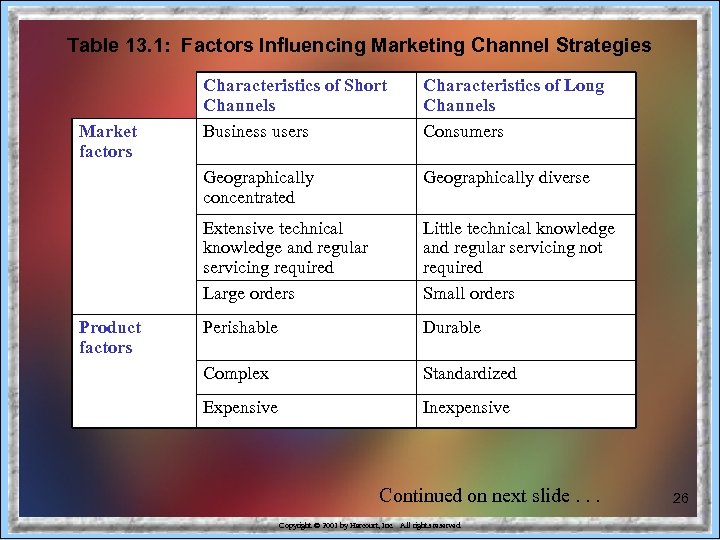 Table 13. 1: Factors Influencing Marketing Channel Strategies Product factors Characteristics of Long Channels Consumers Geographically concentrated Market factors Characteristics of Short Channels Business users Geographically diverse Extensive technical knowledge and regular servicing required Large orders Little technical knowledge and regular servicing not required Small orders Perishable Durable Complex Standardized Expensive Inexpensive Continued on next slide. . . Copyright © 2001 by Harcourt, Inc. All rights reserved. 26
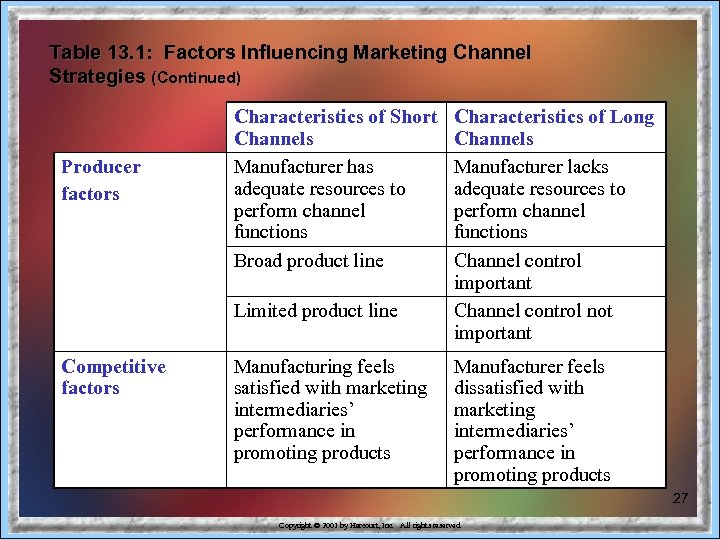 Table 13. 1: Factors Influencing Marketing Channel Strategies (Continued) Producer factors Characteristics of Short Channels Manufacturer has adequate resources to perform channel functions Broad product line Limited product line Competitive factors Manufacturing feels satisfied with marketing intermediaries’ performance in promoting products Characteristics of Long Channels Manufacturer lacks adequate resources to perform channel functions Channel control important Channel control not important Manufacturer feels dissatisfied with marketing intermediaries’ performance in promoting products 27 Copyright © 2001 by Harcourt, Inc. All rights reserved.
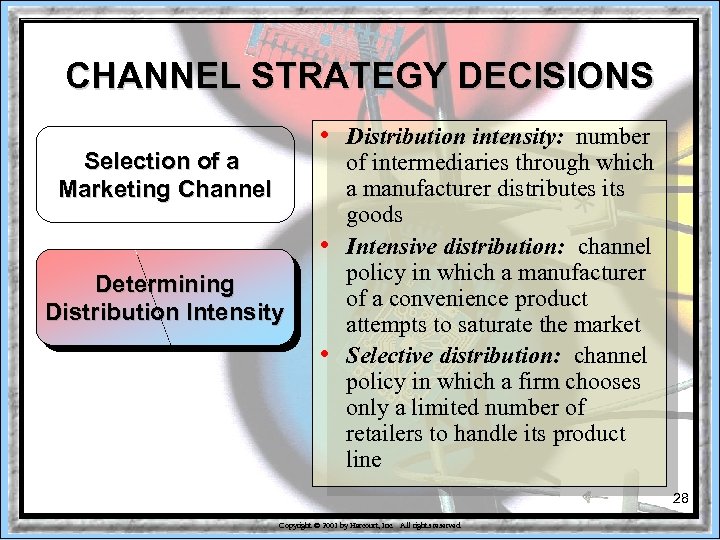 CHANNEL STRATEGY DECISIONS • Selection of a Marketing Channel • Determining Distribution Intensity • Distribution intensity: number of intermediaries through which a manufacturer distributes its goods Intensive distribution: channel policy in which a manufacturer of a convenience product attempts to saturate the market Selective distribution: channel policy in which a firm chooses only a limited number of retailers to handle its product line 28 Copyright © 2001 by Harcourt, Inc. All rights reserved.
 Schick Warner-Lambert Uses an Intensive Distribution Strategy for Its Shaving Products 29 Copyright © 2001 by Harcourt, Inc. All rights reserved.
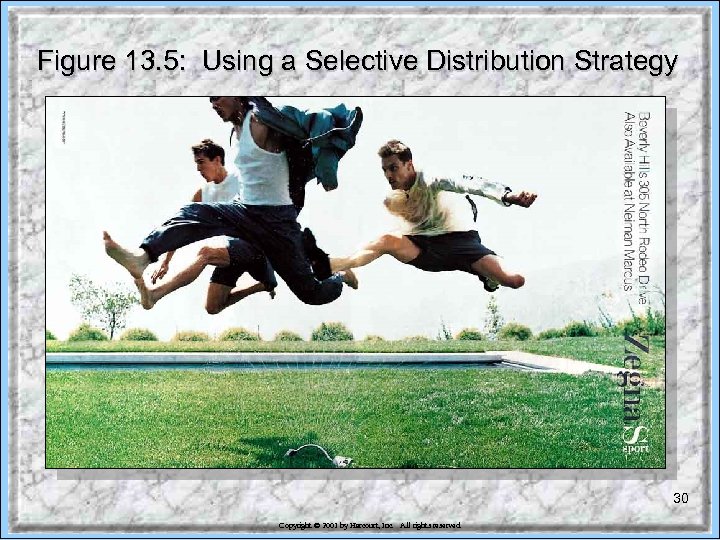 Figure 13. 5: Using a Selective Distribution Strategy 30 Copyright © 2001 by Harcourt, Inc. All rights reserved.
 CHANNEL STRATEGY DECISIONS Selection of a Marketing Channel • Determining Distribution Intensity Exclusive distribution: channel policy in which a firm grants exclusive rights to a single wholesaler or retailer to sell its products and a particular geographic area 31 Copyright © 2001 by Harcourt, Inc. All rights reserved.
 Redken Exclusive Distribution Used for Redken Hair. Care Products 32 Copyright © 2001 by Harcourt, Inc. All rights reserved.
 CHANNEL STRATEGY DECISIONS • Selection of a Marketing Channel Determining Distribution Intensity Legal problems of exclusive distribution • Exclusive-dealing agreement: arrangement between manufacturer and e-marketing intermediary that prohibits the intermediary from handling competing product lines • Closed sales territories: exclusive geographic selling region of a distributor 33 Copyright © 2001 by Harcourt, Inc. All rights reserved.
 CHANNEL STRATEGY DECISIONS Selection of a Marketing Channel • Legal problems of exclusive distribution (continued) Determining Distribution Intensity • Tying agreement: Arrangement that requires a marketing intermediary to carry items other than those they want to sell 34 Copyright © 2001 by Harcourt, Inc. All rights reserved.
 CHANNEL STRATEGY DECISIONS Selection of a Marketing Channel • Determining Distribution Intensity Who Should Perform Channel Functions? Fundamental principle that governs channel decisions: Channel members can shift responsibilities for the performance of certain marketing functions, but they cannot eliminate central functions 35 Copyright © 2001 by Harcourt, Inc. All rights reserved.
 CHANNEL MANAGEMENT AND LEADERSHIP • Channel Captain: a dominant and controlling member of a marketing channel © Photo. Disc Copyright © 2001 by Harcourt, Inc. All rights reserved. 36
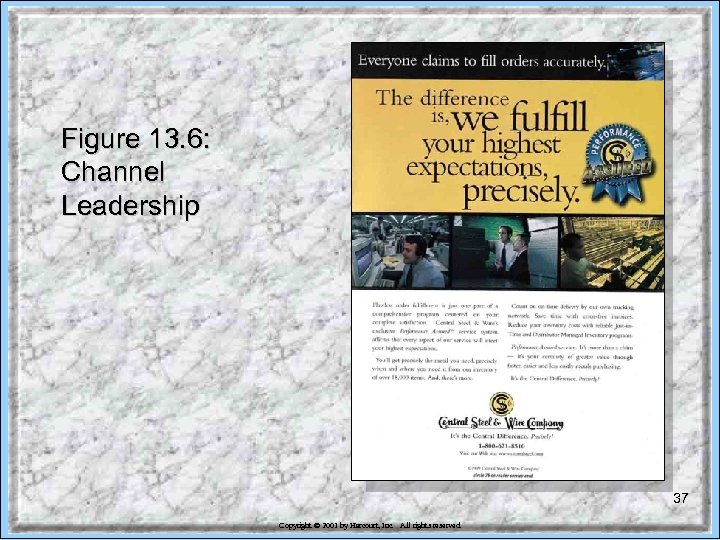 Figure 13. 6: Channel Leadership 37 Copyright © 2001 by Harcourt, Inc. All rights reserved.
 Channel Conflict Horizontal Conflict • Vertical Conflict The Gray Market • Most often, horizontal conflict causes sparks between different types of marketing intermediaries that handle similar products Sometimes results from disagreements among channel members at the same level 38 © Photo. Disc Copyright © 2001 by Harcourt, Inc. All rights reserved.
 Channel Conflict Horizontal Conflict Vertical Conflict The Gray Market • • Channel members at different levels find many reasons for disputes Example: when retailers develop private brands to compete with producers’ brands or when producers establish their own retail outlets or WWW Sites 39 © Photo. Disc Copyright © 2001 by Harcourt, Inc. All rights reserved.
 Channel Conflict Horizontal Conflict Vertical Conflict The Gray Market • • Grey Good: product made abroad under license from a U. S. firm and then sold in the U. S. market in competition with that firm’s own domestic output Viewed by producers as undesired competition 40 © Photo. Disc Copyright © 2001 by Harcourt, Inc. All rights reserved.
 Achieving Channel Cooperation • • Channel Cooperation, achieved via effective cooperation among channel members, is the desired antidote to channel conflict It is Best achieved when all channel members regard themselves as components of the same organization 41 Copyright © 2001 by Harcourt, Inc. All rights reserved.
 VERTICAL MARKETING SYSTEMS • Vertical marketing system (VMS): planned channel system designed to improve distribution efficiency and cost effectiveness by integrating various functions throughout the distribution chain 42 © Photo. Disc Copyright © 2001 by Harcourt, Inc. All rights reserved.
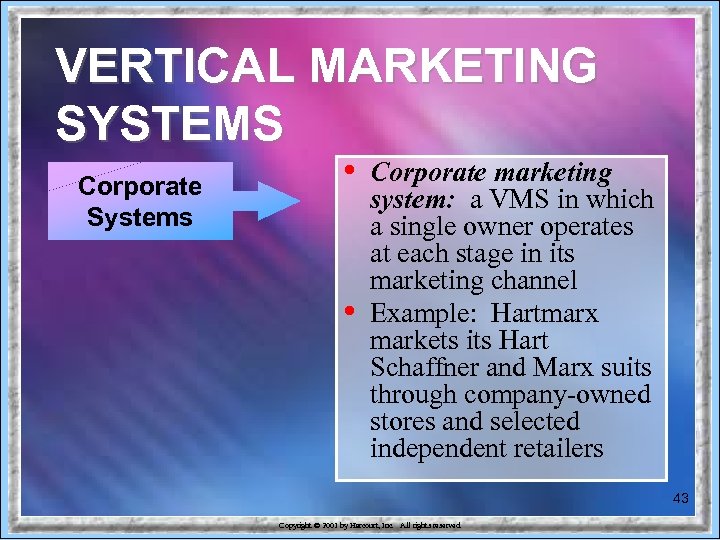 VERTICAL MARKETING SYSTEMS Corporate Systems • • Corporate marketing system: a VMS in which a single owner operates at each stage in its marketing channel Example: Hartmarx markets its Hart Schaffner and Marx suits through company-owned stores and selected independent retailers 43 Copyright © 2001 by Harcourt, Inc. All rights reserved.
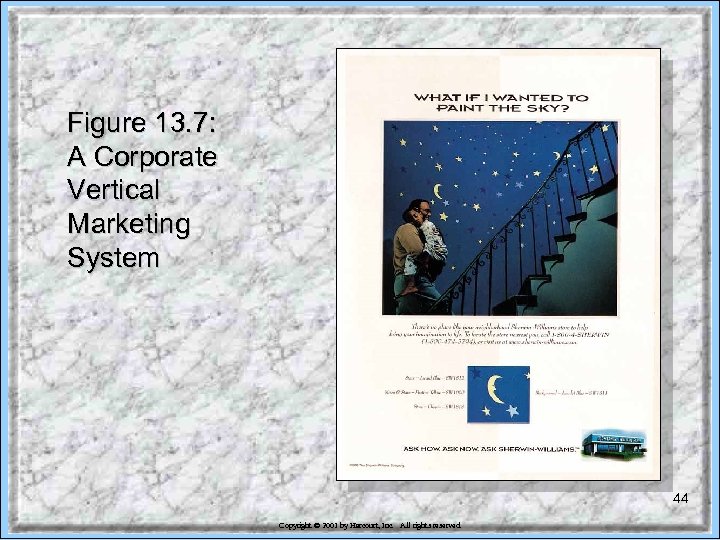 Figure 13. 7: A Corporate Vertical Marketing System 44 Copyright © 2001 by Harcourt, Inc. All rights reserved.
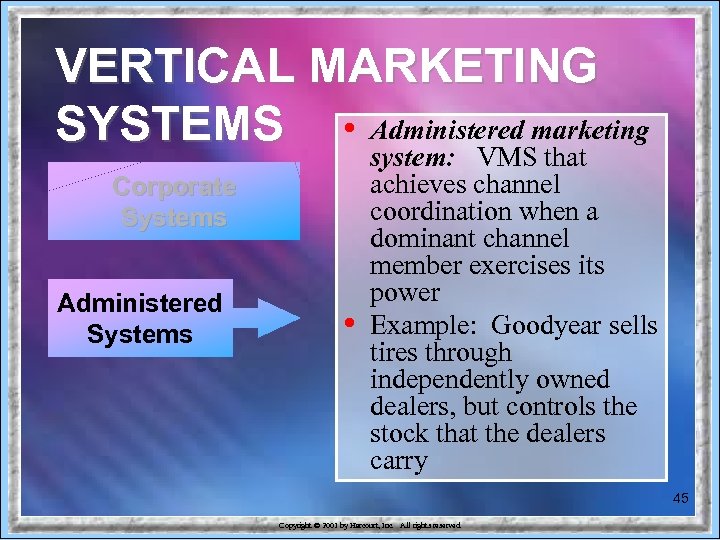 VERTICAL MARKETING SYSTEMS • Administered marketing Corporate Systems Administered Systems • system: VMS that achieves channel coordination when a dominant channel member exercises its power Example: Goodyear sells tires through independently owned dealers, but controls the stock that the dealers carry 45 Copyright © 2001 by Harcourt, Inc. All rights reserved.
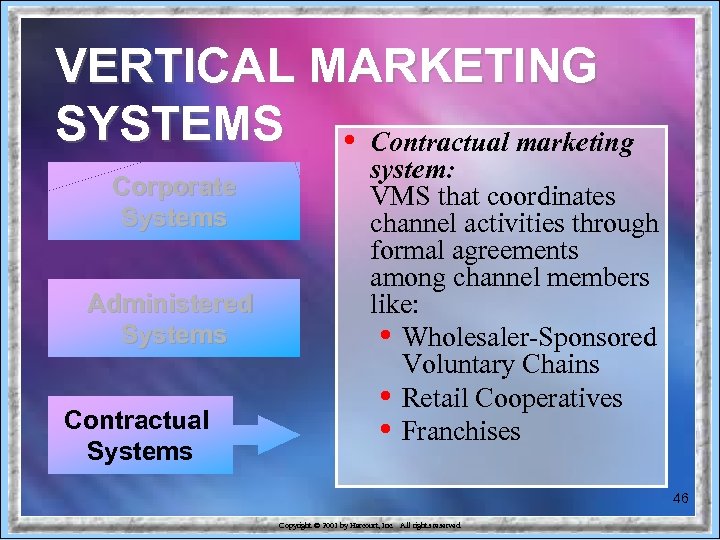 VERTICAL MARKETING SYSTEMS • Contractual marketing Corporate Systems Administered Systems Contractual Systems system: VMS that coordinates channel activities through formal agreements among channel members like: • Wholesaler-Sponsored Voluntary Chains • Retail Cooperatives • Franchises 46 Copyright © 2001 by Harcourt, Inc. All rights reserved.
 Figure 13. 8: Duraclean – A Franchised Cleaning and Maintenance Service 47 Copyright © 2001 by Harcourt, Inc. All rights reserved.
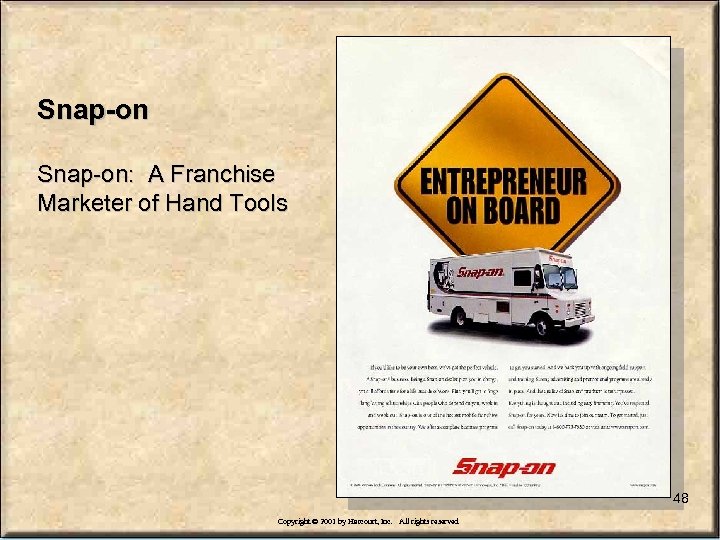 Snap-on: A Franchise Marketer of Hand Tools 48 Copyright © 2001 by Harcourt, Inc. All rights reserved.
 THE ROLE OF LOGISTICS IN DISTRIBUTION STRATEGY • Supply (value) chain: sequence of suppliers that contributes to the creation and delivery of a good or service © Photo. Disc 49 Copyright © 2001 by Harcourt, Inc. All rights reserved.
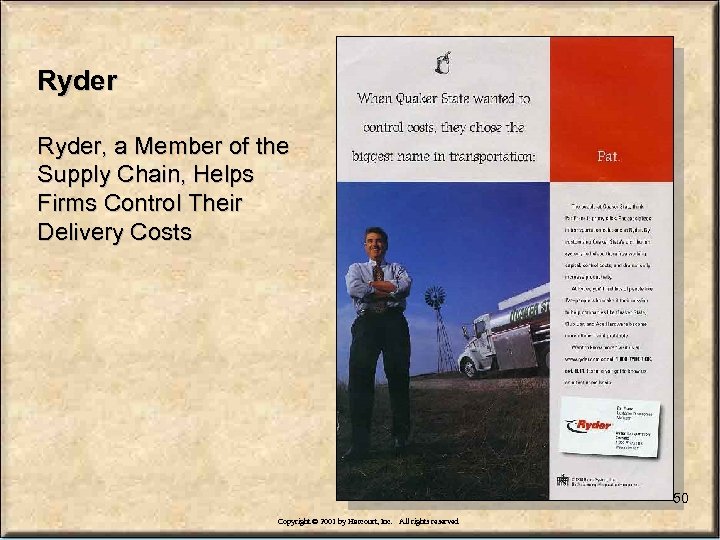 Ryder, a Member of the Supply Chain, Helps Firms Control Their Delivery Costs 50 Copyright © 2001 by Harcourt, Inc. All rights reserved.
 THE ROLE OF LOGISTICS IN DISTRIBUTION STRATEGY • Enterprise resource planning: software system that moves data among a firm’s units 51 © Photo. Disc Copyright © 2001 by Harcourt, Inc. All rights reserved.
 Logistical Cost Control • Third party (contract) logistics firm: company that specializes in handling logistics activities for other firms © Photo. Disc 52 Copyright © 2001 by Harcourt, Inc. All rights reserved.
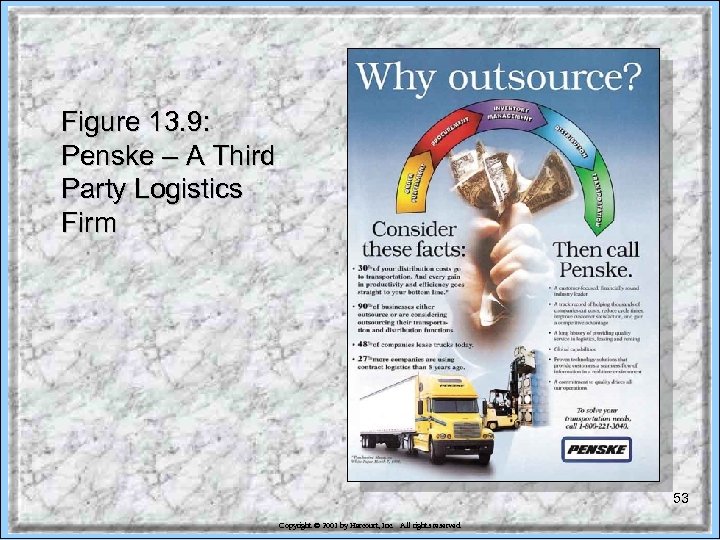 Figure 13. 9: Penske – A Third Party Logistics Firm 53 Copyright © 2001 by Harcourt, Inc. All rights reserved.
 BAX Global A Specialized Logistics Firm 54 Copyright © 2001 by Harcourt, Inc. All rights reserved.
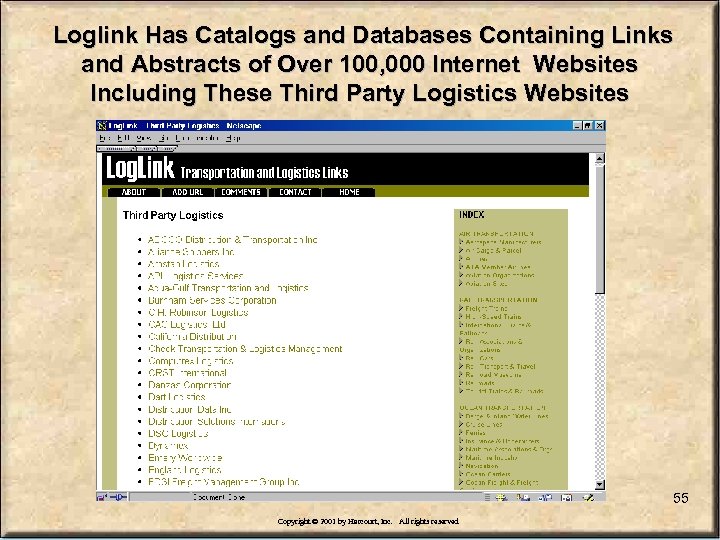 Loglink Has Catalogs and Databases Containing Links and Abstracts of Over 100, 000 Internet Websites Including These Third Party Logistics Websites 55 Copyright © 2001 by Harcourt, Inc. All rights reserved.
 PHYSICAL DISTRIBUTION • • System: Organized group of components linked according to a plan for achieving specific objectives A company’s physical distribution system contains the following elements: • • • Customer Service Transportation Inventory Control Protective packaging and materials handling Order Processing Warehousing 56 © Photo. Disc Copyright © 2001 by Harcourt, Inc. All rights reserved.
 The Problem of Suboptimization • Suboptimization: condition that results when individual operations achieve their objectives but interfere with progress toward broader organizational goals 57 Copyright © 2001 by Harcourt, Inc. All rights reserved.
 Customer Service Standards • Customer Service Standard: statement of goals and acceptable performance for the quality of service that a firm expects to deliver to its customers © Photo. Disc 58 Copyright © 2001 by Harcourt, Inc. All rights reserved.
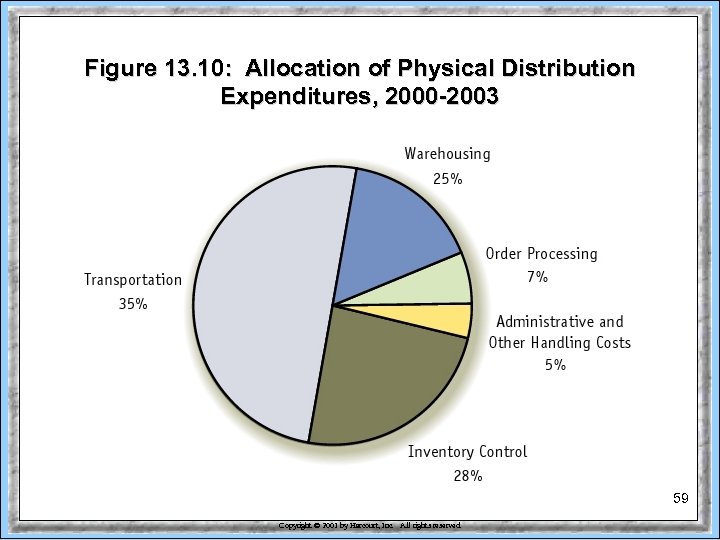 Figure 13. 10: Allocation of Physical Distribution Expenditures, 2000 -2003 59 Copyright © 2001 by Harcourt, Inc. All rights reserved.
 Transportation • • Class Rate: standard transportation rate established for shipments of a specific commodity between any pair of destinations Commodity Rate: special, favorable transportation rate granted by a carrier to a selected shipper as a reward for either business or a large quantity shipment © Photo. Disc 60 Copyright © 2001 by Harcourt, Inc. All rights reserved.
 Transportation • • Began in 1977 with removal of air cargo carrier regulation 1978: Airline Deregulation Act Transportation Deregulation Classes of Carriers • 1980: Motor Carrier Act and Staggers Rail act deregulated trucking and railroad industries Major Modes of Transportation 61 Copyright © 2001 by Harcourt, Inc. All rights reserved.
 Transportation • • Common carriers move freight via all modes of transportation for the general public Contract carriers do not serve the general public Transportation Deregulation Classes of Carriers • Private carriers do not offer services for hire, but provide transportation services solely for internally generated freight Major Modes of Transportation 62 Copyright © 2001 by Harcourt, Inc. All rights reserved.
 Transportation • • • Railroads Motor Carriers Water Carriers Pipelines Air Freight Transportation Deregulation Classes of Carriers • • Freight Forwarders and Supplemental Carriers Intermodal Coordination Major Modes of Transportation 63 Copyright © 2001 by Harcourt, Inc. All rights reserved.
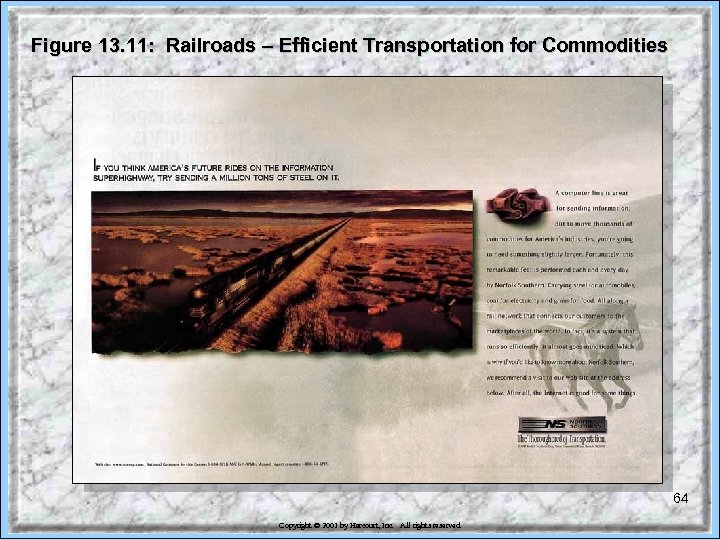 Figure 13. 11: Railroads – Efficient Transportation for Commodities 64 Copyright © 2001 by Harcourt, Inc. All rights reserved.
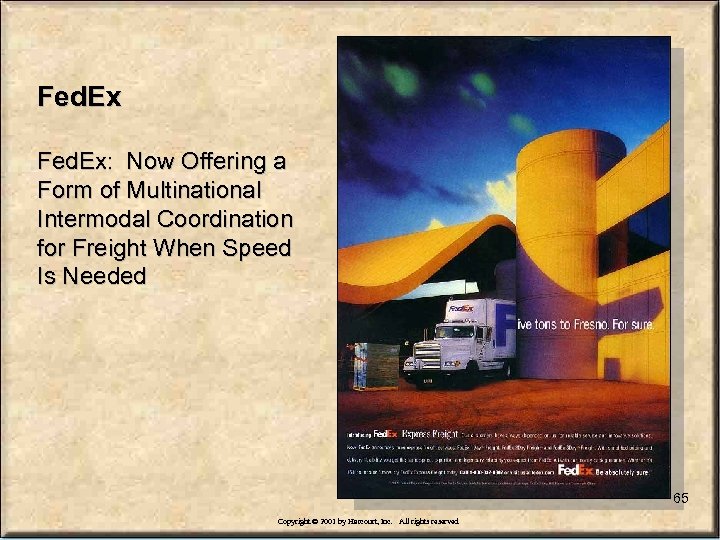 Fed. Ex: Now Offering a Form of Multinational Intermodal Coordination for Freight When Speed Is Needed 65 Copyright © 2001 by Harcourt, Inc. All rights reserved.
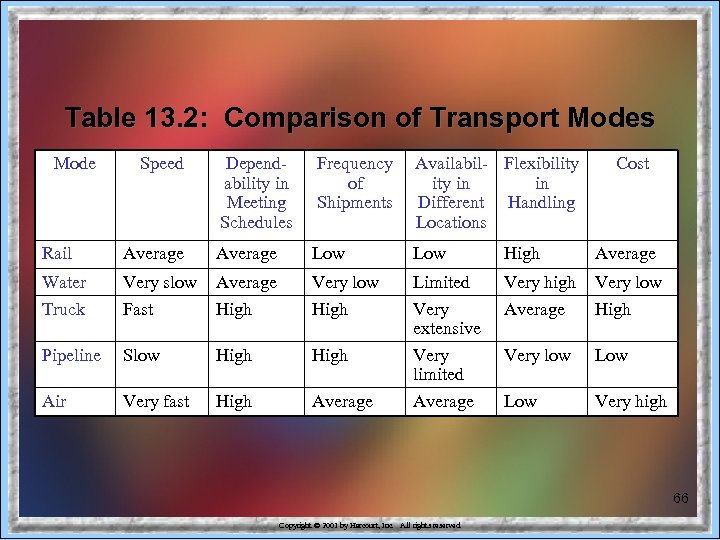 Table 13. 2: Comparison of Transport Modes Mode Speed Dependability in Meeting Schedules Frequency of Shipments Availabil- Flexibility in in Different Handling Locations Cost Rail Average Low High Average Water Truck Very slow Fast Average High Very low High Very high Average Very low High Pipeline Slow High Very low Low Air Very fast High Average Limited Very extensive Very limited Average Low Very high 66 Copyright © 2001 by Harcourt, Inc. All rights reserved.
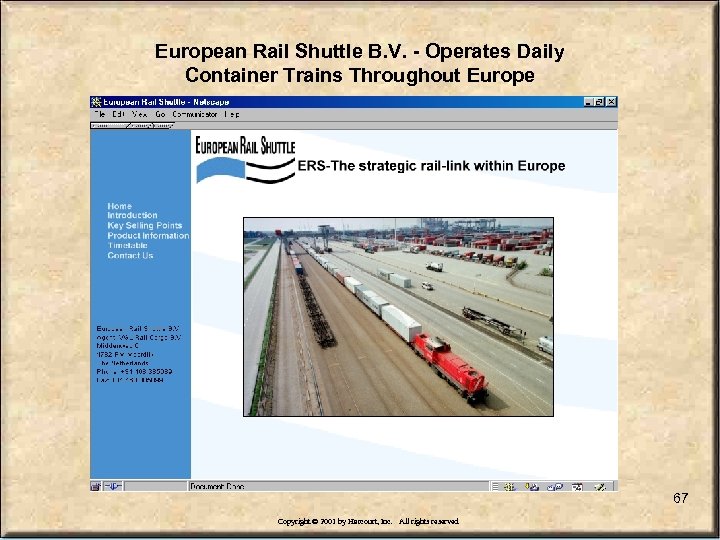 European Rail Shuttle B. V. - Operates Daily Container Trains Throughout Europe 67 Copyright © 2001 by Harcourt, Inc. All rights reserved.
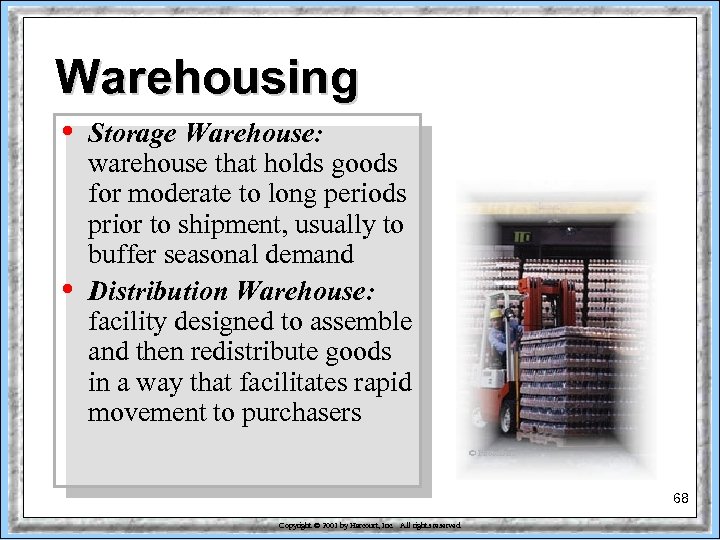 Warehousing • • Storage Warehouse: warehouse that holds goods for moderate to long periods prior to shipment, usually to buffer seasonal demand Distribution Warehouse: facility designed to assemble and then redistribute goods in a way that facilitates rapid movement to purchasers © Photo. Disc 68 Copyright © 2001 by Harcourt, Inc. All rights reserved.
 Warehousing Automated Warehouse Technology • Distribution costs can be cut and customer service improved by automating warehouse systems © Photo. Disc 69 Copyright © 2001 by Harcourt, Inc. All rights reserved.
 Figure 13. 12: Goods Moving Through a Break-Bulk Distribution Center 70 Copyright © 2001 by Harcourt, Inc. All rights reserved.
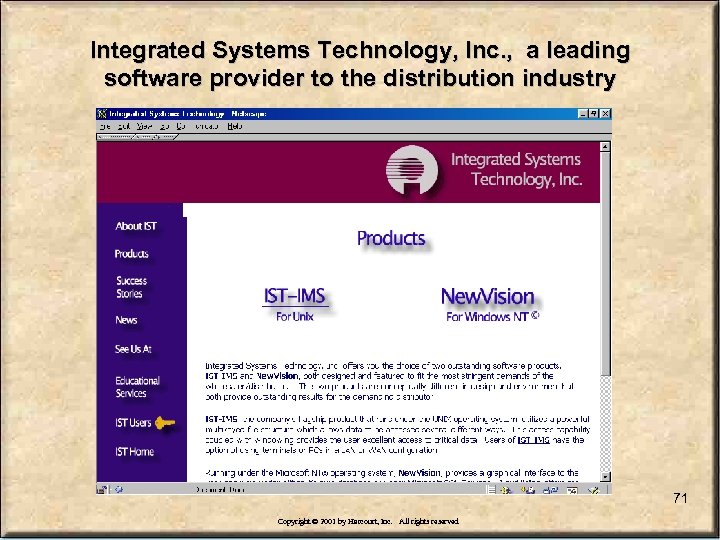 Integrated Systems Technology, Inc. , a leading software provider to the distribution industry 71 Copyright © 2001 by Harcourt, Inc. All rights reserved.
 Warehousing Warehouse Locations • • Major logistics decision involving the number and location(s) of storage facilities Two cost categories influence the choice: • Warehousing and materials-handling costs • Delivery costs from warehouse to customers © Photo. Disc 72 Copyright © 2001 by Harcourt, Inc. All rights reserved.
 Inventory Control Systems • • Important since firms need to maintain enough inventory to meet customer demand without incurring unneeded costs for carrying excess inventory Some firms attempt to keep inventory levels under control by implementing just-in-time (JIT) production © Photo. Disc 73 Copyright © 2001 by Harcourt, Inc. All rights reserved.
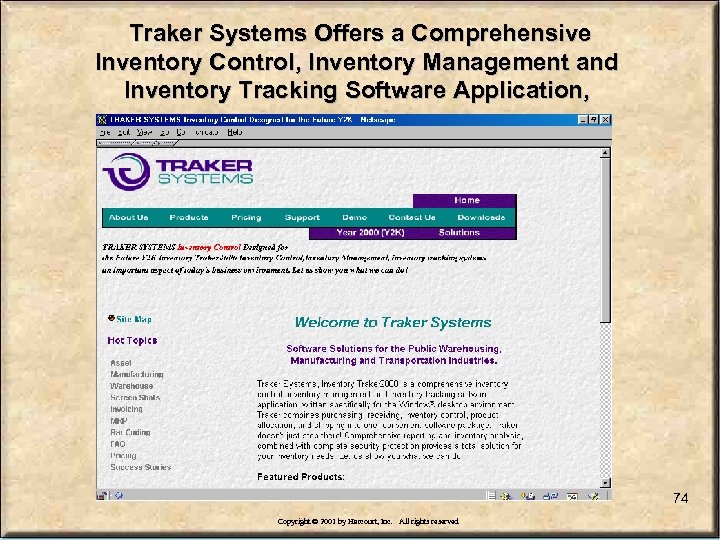 Traker Systems Offers a Comprehensive Inventory Control, Inventory Management and Inventory Tracking Software Application, 74 Copyright © 2001 by Harcourt, Inc. All rights reserved.
 Order Processing • Stockout: order for a product that is unavailable for shipment or sale © Photo. Disc 75 Copyright © 2001 by Harcourt, Inc. All rights reserved.
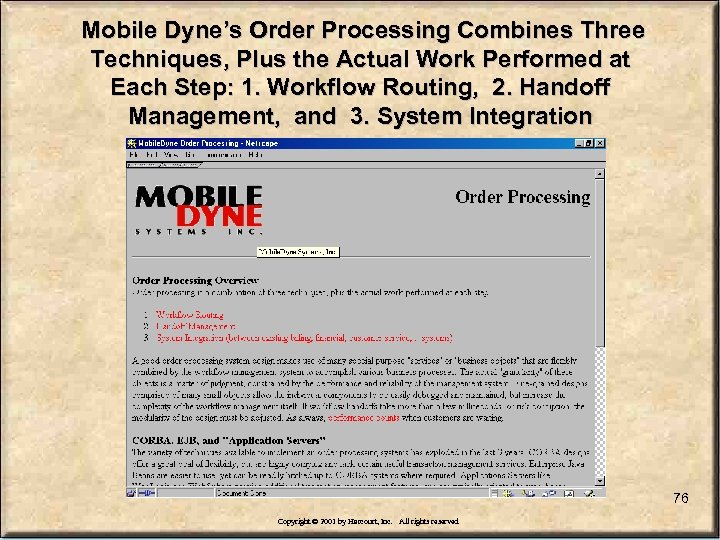 Mobile Dyne’s Order Processing Combines Three Techniques, Plus the Actual Work Performed at Each Step: 1. Workflow Routing, 2. Handoff Management, and 3. System Integration 76 Copyright © 2001 by Harcourt, Inc. All rights reserved.
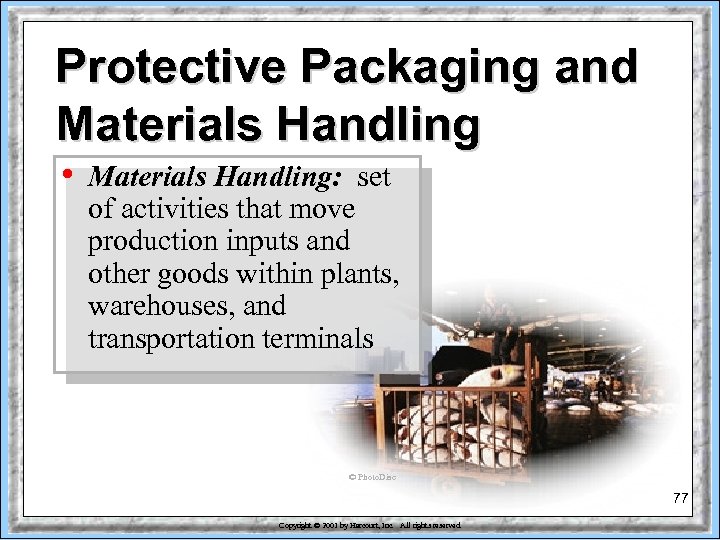 Protective Packaging and Materials Handling • Materials Handling: set of activities that move production inputs and other goods within plants, warehouses, and transportation terminals © Photo. Disc 77 Copyright © 2001 by Harcourt, Inc. All rights reserved.
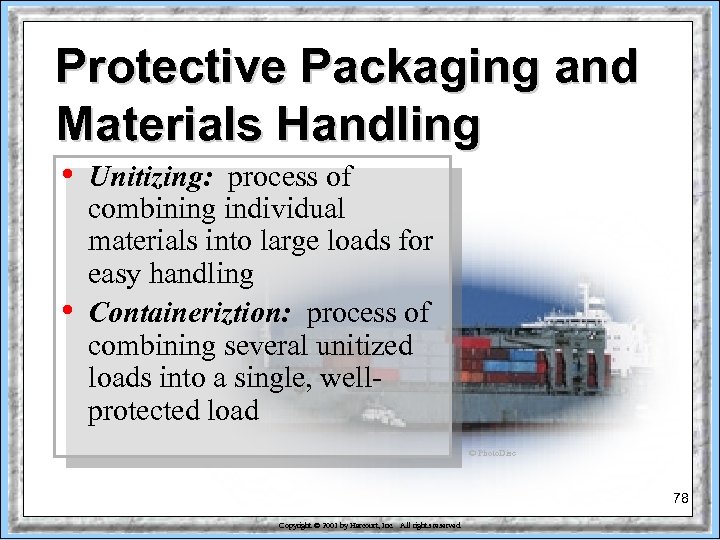 Protective Packaging and Materials Handling • • Unitizing: process of combining individual materials into large loads for easy handling Containeriztion: process of combining several unitized loads into a single, wellprotected load © Photo. Disc 78 Copyright © 2001 by Harcourt, Inc. All rights reserved.
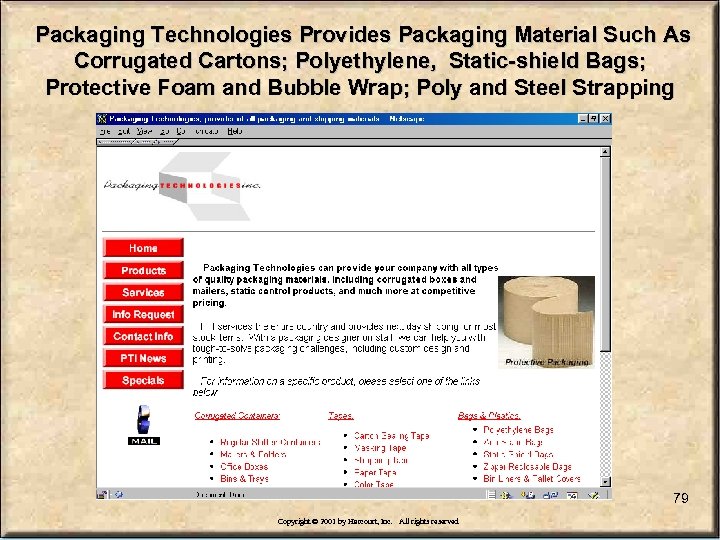 Packaging Technologies Provides Packaging Material Such As Corrugated Cartons; Polyethylene, Static-shield Bags; Protective Foam and Bubble Wrap; Poly and Steel Strapping 79 Copyright © 2001 by Harcourt, Inc. All rights reserved.
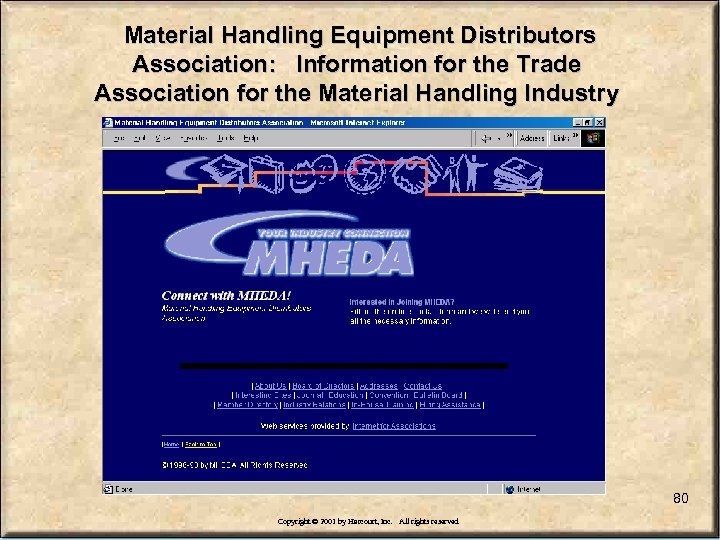 Material Handling Equipment Distributors Association: Information for the Trade Association for the Material Handling Industry 80 Copyright © 2001 by Harcourt, Inc. All rights reserved.