


 Скачать презентацию Chapter Ten Questionnaire Form Design 10
50646573d7357608b26f93d79e8e4c86.ppt
- Количество слайдов: 32
 Chapter Ten Questionnaire & Form Design
 10 -2 Questionnaire Definition & Objectives n n A questionnaire is a formalized set of questions for obtaining information from respondents. It must translate the information needed into a set of specific questions that the respondents can and will answer. A questionnaire must uplift, motivate, and encourage the respondent to become involved in the interview, to cooperate, and to complete the interview. A questionnaire should minimize response error.
 10 -3 Is the Question Necessary? n If there is no satisfactory use for the data resulting from a question, that question should be eliminated.
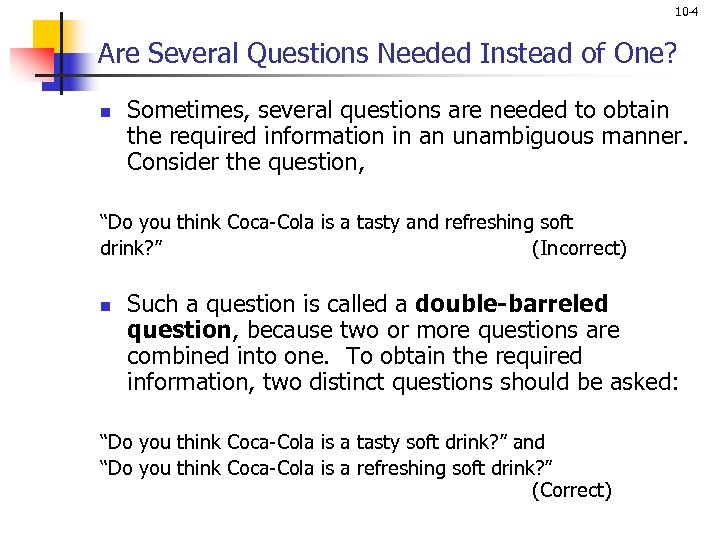 10 -4 Are Several Questions Needed Instead of One? n Sometimes, several questions are needed to obtain the required information in an unambiguous manner. Consider the question, “Do you think Coca-Cola is a tasty and refreshing soft drink? ” (Incorrect) n Such a question is called a double-barreled question, because two or more questions are combined into one. To obtain the required information, two distinct questions should be asked: “Do you think Coca-Cola is a tasty soft drink? ” and “Do you think Coca-Cola is a refreshing soft drink? ” (Correct)
 10 -5 Is the Respondent Informed? n n In situations where not all respondents are likely to be informed about the topic of interest, filter questions that measure familiarity and past experience should be asked before questions about the topics themselves. A “don't know” option appears to reduce uninformed responses without reducing the response rate.
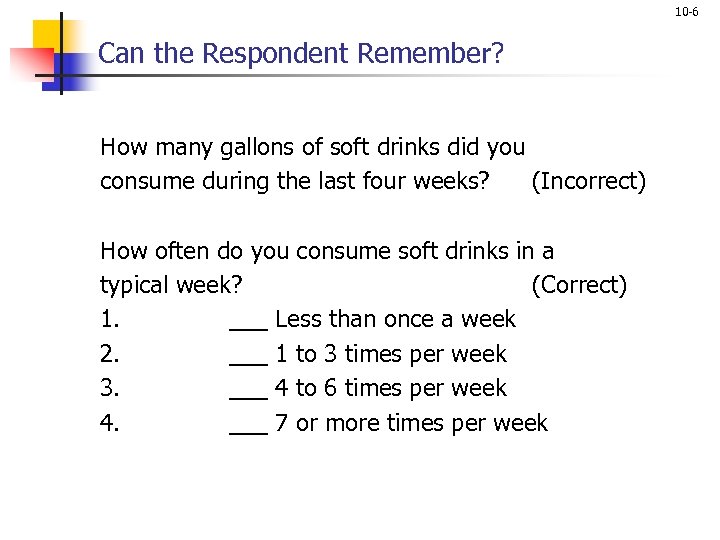 10 -6 Can the Respondent Remember? How many gallons of soft drinks did you consume during the last four weeks? (Incorrect) How often do you consume soft drinks in a typical week? (Correct) 1. ___ Less than once a week 2. ___ 1 to 3 times per week 3. ___ 4 to 6 times per week 4. ___ 7 or more times per week
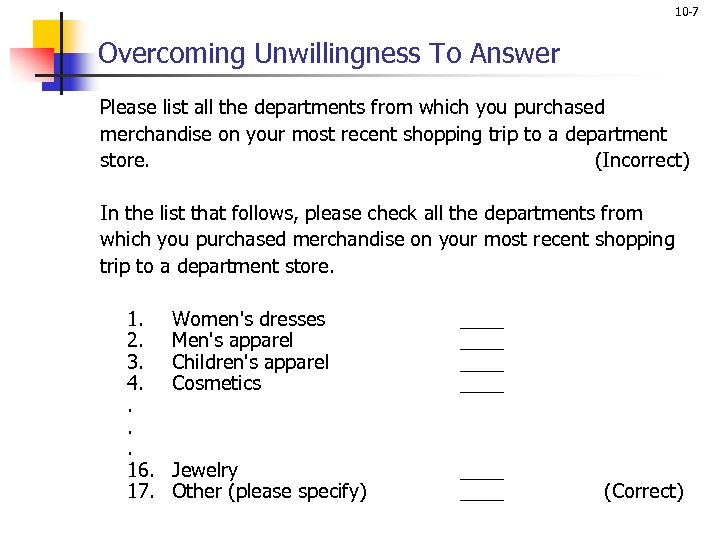 10 -7 Overcoming Unwillingness To Answer Please list all the departments from which you purchased merchandise on your most recent shopping trip to a department store. (Incorrect) In the list that follows, please check all the departments from which you purchased merchandise on your most recent shopping trip to a department store. 1. 2. 3. 4. . 16. 17. Women's dresses Men's apparel Children's apparel Cosmetics ____ Jewelry Other (please specify) ____ (Correct)
 Overcoming Unwillingness To Answer 10 -8 Increasing the Willingness of Respondents n n n Place sensitive topics at the end of the questionnaire. Preface the question with a statement that the behavior of interest is common. Ask the question using the third-person technique: phrase the question as if it referred to other people. Hide the question in a group of other questions which respondents are willing to answer. The entire list of questions can then be asked quickly. Provide response categories rather than asking for specific figures. Use randomized techniques.
 Choosing Question Structure 10 -9 Unstructured Questions n Unstructured questions are open-ended questions that respondents answer in their own words. Do you intend to buy a new car within the next six months? _________________
 Choosing Question Structure 10 -10 Structured Questions n Structured questions specify the set of response alternatives and the response format. A structured question may be multiple-choice, dichotomous, or a scale.
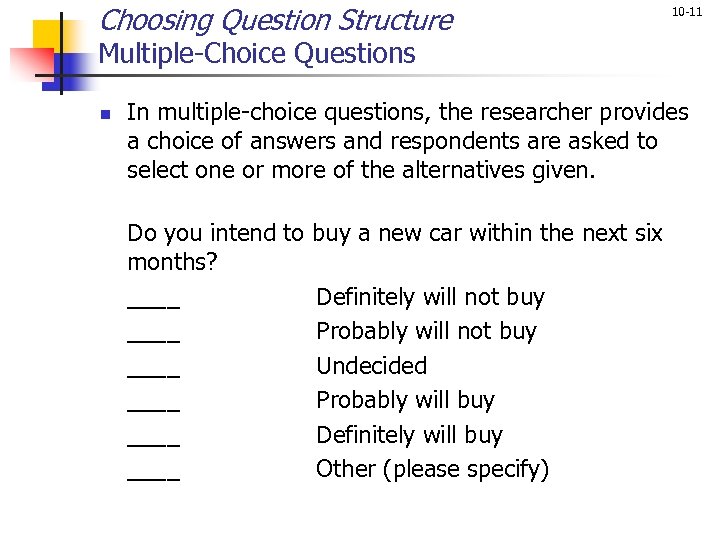 Choosing Question Structure 10 -11 Multiple-Choice Questions n In multiple-choice questions, the researcher provides a choice of answers and respondents are asked to select one or more of the alternatives given. Do you intend to buy a new car within the next six months? ____ Definitely will not buy ____ Probably will not buy ____ Undecided ____ Probably will buy ____ Definitely will buy ____ Other (please specify)
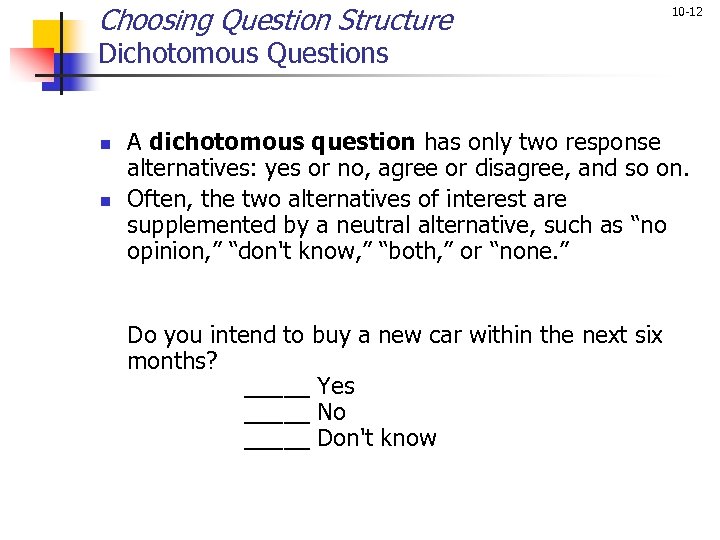 Choosing Question Structure 10 -12 Dichotomous Questions n n A dichotomous question has only two response alternatives: yes or no, agree or disagree, and so on. Often, the two alternatives of interest are supplemented by a neutral alternative, such as “no opinion, ” “don't know, ” “both, ” or “none. ” Do you intend to buy a new car within the next six months? _____ Yes _____ No _____ Don't know
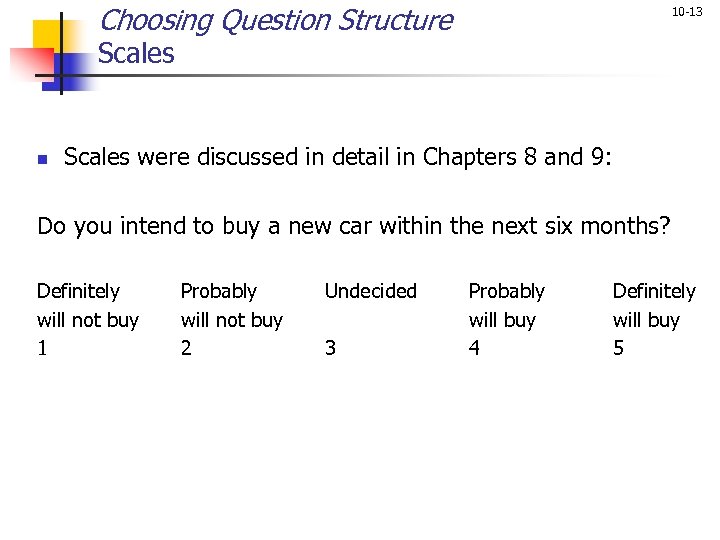 Choosing Question Structure 10 -13 Scales n Scales were discussed in detail in Chapters 8 and 9: Do you intend to buy a new car within the next six months? Definitely will not buy 1 Probably will not buy 2 Undecided 3 Probably will buy 4 Definitely will buy 5
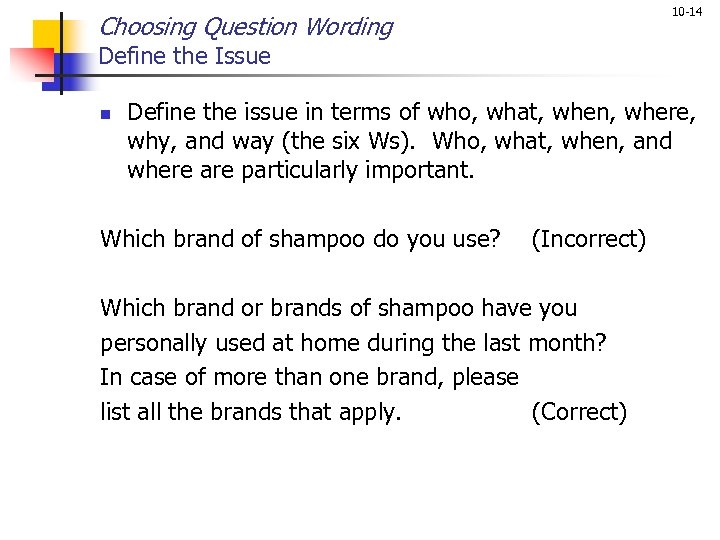 10 -14 Choosing Question Wording Define the Issue n Define the issue in terms of who, what, when, where, why, and way (the six Ws). Who, what, when, and where are particularly important. Which brand of shampoo do you use? (Incorrect) Which brand or brands of shampoo have you personally used at home during the last month? In case of more than one brand, please list all the brands that apply. (Correct)
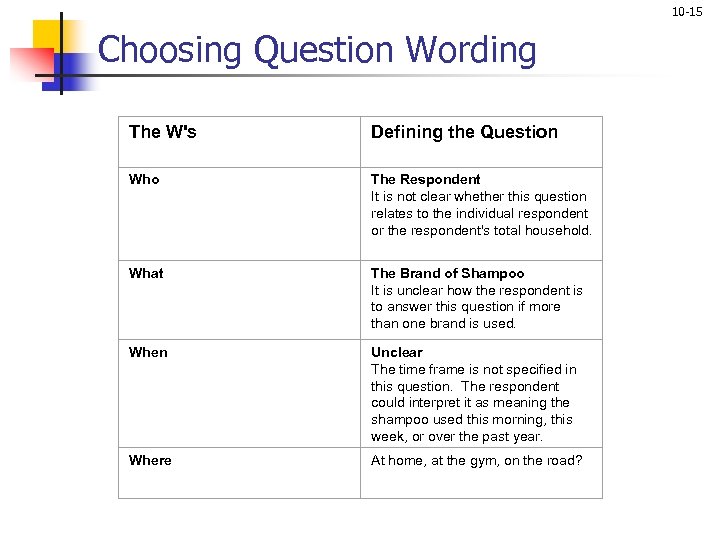 10 -15 Choosing Question Wording The W's Defining the Question Who The Respondent It is not clear whether this question relates to the individual respondent or the respondent's total household. What The Brand of Shampoo It is unclear how the respondent is to answer this question if more than one brand is used. When Unclear The time frame is not specified in this question. The respondent could interpret it as meaning the shampoo used this morning, this week, or over the past year. Where At home, at the gym, on the road?
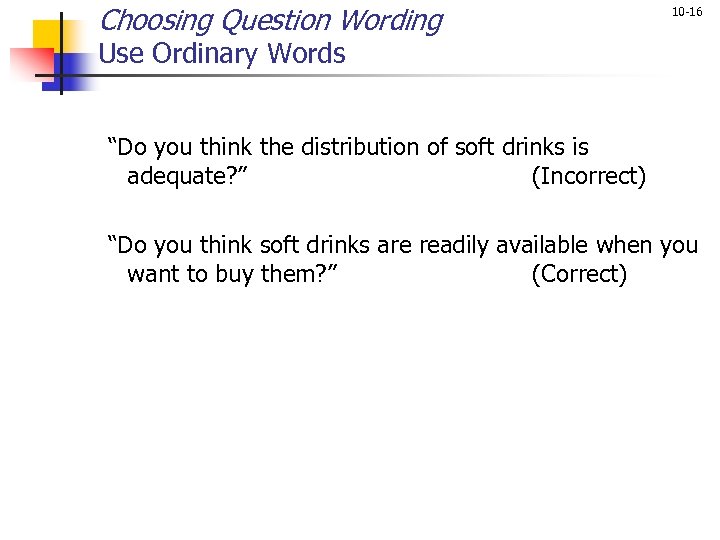 Choosing Question Wording 10 -16 Use Ordinary Words “Do you think the distribution of soft drinks is adequate? ” (Incorrect) “Do you think soft drinks are readily available when you want to buy them? ” (Correct)
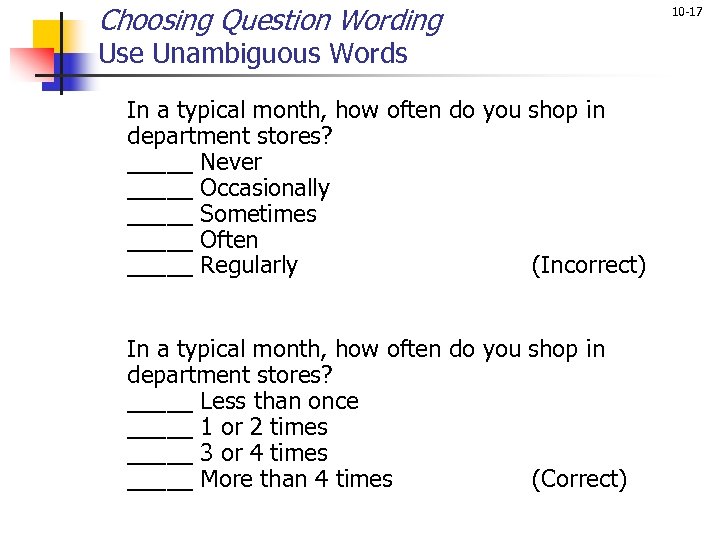 Choosing Question Wording Use Unambiguous Words In a typical month, how often do you shop in department stores? _____ Never _____ Occasionally _____ Sometimes _____ Often _____ Regularly (Incorrect) In a typical month, how often do you shop in department stores? _____ Less than once _____ 1 or 2 times _____ 3 or 4 times _____ More than 4 times (Correct) 10 -17
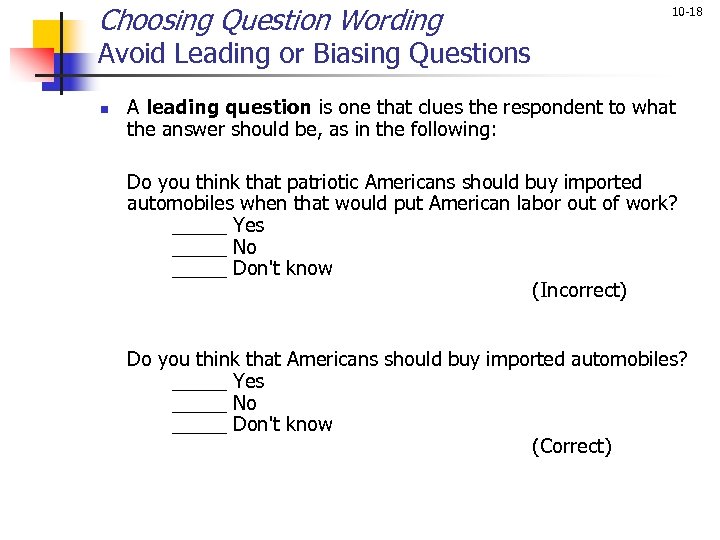 Choosing Question Wording 10 -18 Avoid Leading or Biasing Questions n A leading question is one that clues the respondent to what the answer should be, as in the following: Do you think that patriotic Americans should buy imported automobiles when that would put American labor out of work? _____ Yes _____ No _____ Don't know (Incorrect) Do you think that Americans should buy imported automobiles? _____ Yes _____ No _____ Don't know (Correct)
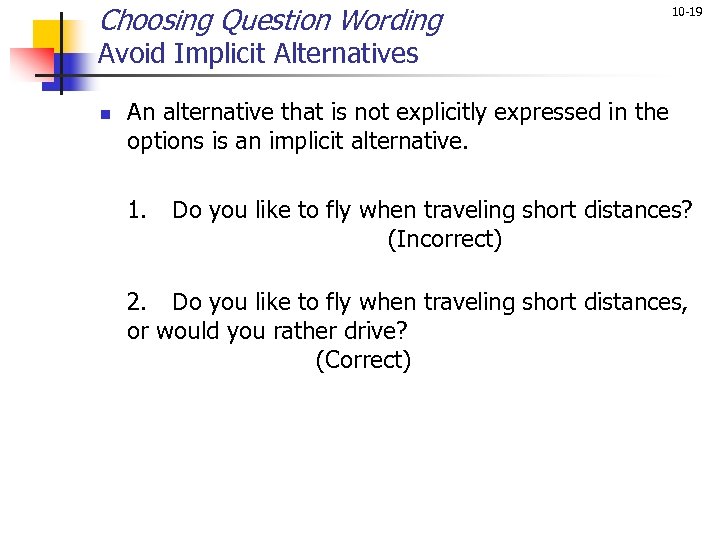 Choosing Question Wording 10 -19 Avoid Implicit Alternatives n An alternative that is not explicitly expressed in the options is an implicit alternative. 1. Do you like to fly when traveling short distances? (Incorrect) 2. Do you like to fly when traveling short distances, or would you rather drive? (Correct)
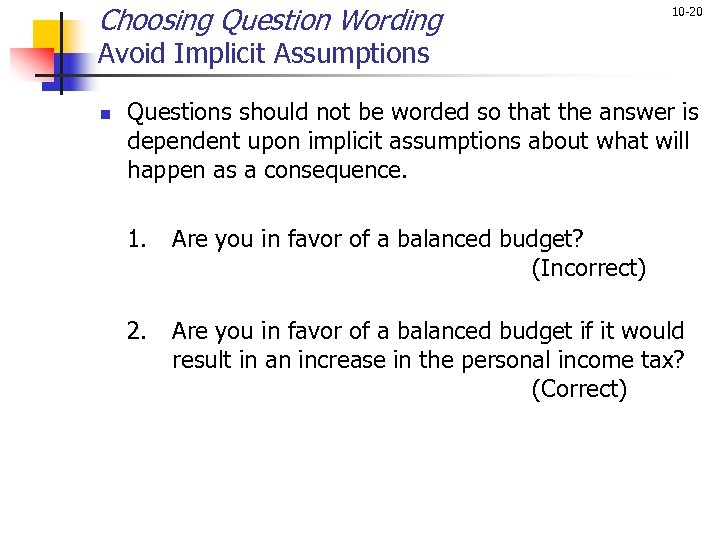 Choosing Question Wording 10 -20 Avoid Implicit Assumptions n Questions should not be worded so that the answer is dependent upon implicit assumptions about what will happen as a consequence. 1. Are you in favor of a balanced budget? (Incorrect) 2. Are you in favor of a balanced budget if it would result in an increase in the personal income tax? (Correct)
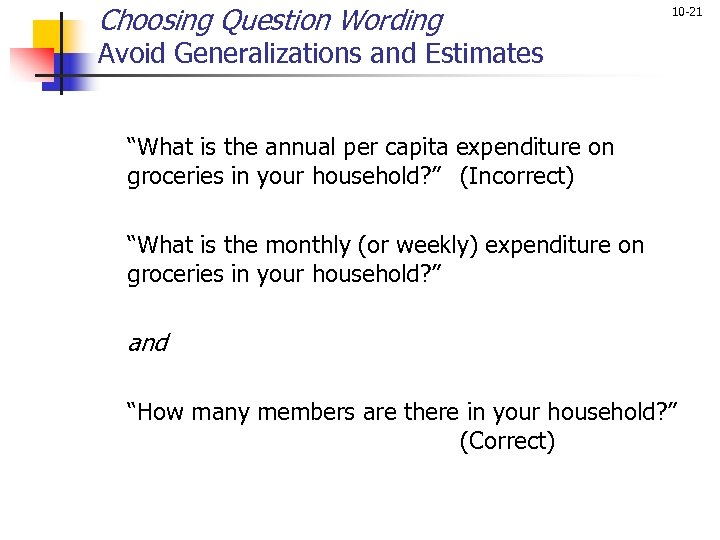 Choosing Question Wording 10 -21 Avoid Generalizations and Estimates “What is the annual per capita expenditure on groceries in your household? ” (Incorrect) “What is the monthly (or weekly) expenditure on groceries in your household? ” and “How many members are there in your household? ” (Correct)
 Choosing Question Wording 10 -22 Dual Statements: Positive and Negative n Questions that are in the form of statements should be worded both positively and negatively.
 10 -23 Determining the Order of Questions Opening Questions n The opening questions should be interesting, simple, and non-threatening. Type of Information n As a general guideline, basic information should be obtained first, followed by classification, and, finally, identification information. Difficult Questions n Difficult questions or questions which are sensitive, embarrassing, complex, or dull, should be placed late in the sequence.
 10 -24 Form and Layout n n Divide a questionnaire into several parts. The questions in each part should be numbered, particularly when branching questions are used. The questionnaires should preferably be precoded. The questionnaires themselves should be numbered serially.
 10 -25 Reproduction of the Questionnaire n n n n The questionnaire should be reproduced on good-quality paper and have a professional appearance. Questionnaires should take the form of a booklet rather than a number of sheets of paper clipped or stapled together. Each question should be reproduced on a single page (or double -page spread). Vertical response columns should be used for individual questions. Grids are useful when there a number of related questions which use the same set of response categories. The tendency to crowd questions together to make the questionnaire look shorter should be avoided. Directions or instructions for individual questions should be placed as close to the questions as possible.
 10 -26 Pretesting refers to the testing of the questionnaire on a small sample of respondents to identify and eliminate potential problems. n n A questionnaire should not be used in the field survey without adequate pretesting. All aspects of the questionnaire should be tested, including question content, wording, sequence, form and layout, question difficulty, and instructions. The respondents for the pretest and for the actual survey should be drawn from the same population. Pretests are best done by personal interviews, even if the actual survey is to be conducted by mail, telephone, or electronic means, because interviewers can observe respondents' reactions and attitudes.
 10 -27 Pretesting n n n After the necessary changes have been made, another pretest could be conducted by mail, telephone, or electronic means if those methods are to be used in the actual survey. A variety of interviewers should be used for pretests. The pretest sample size varies from 15 to 30 respondents for each wave. Protocol analysis and debriefing are two commonly used procedures in pretesting. Finally, the responses obtained from the pretest should be coded analyzed.
 10 -28 Observational Forms Department Store Project n Who: Purchasers, browsers, males, females, parents with children, or children alone. n What: Products/brands considered, products/brands purchased, size, price of package inspected, or influence of children or other family members. n When: Day, hour, date of observation. n Where: Inside the store, checkout counter, or type of department within the store. n Why: Influence of price, brand name, package size, promotion, or family members on the purchase. n Way: Personal observer disguised as sales clerk, undisguised personal observer, hidden camera, or obtrusive mechanical device.
 10 -29
 10 -30
 10 -31
 10 -32