


 Скачать презентацию Chapter Ten Currency Interest INTERNATIONAL Rate Swaps
86f9e8dc20f114eafe6945d693760bea.ppt
- Количество слайдов: 34
 Chapter Ten Currency & Interest INTERNATIONAL Rate Swaps 10 FINANCIAL MANAGEMENT Chapter Objective: This chapter discusses currency and interest rate swaps, which are relatively new instruments for hedging long-term interest rate risk and foreign exchange risk. EUN / RESNICK Second Edition
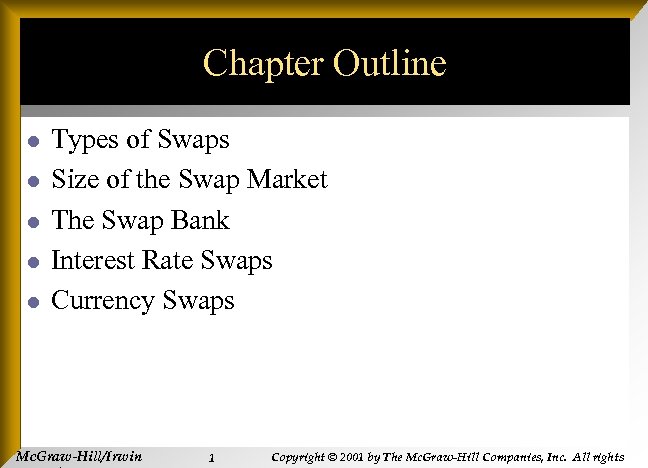 Chapter Outline l l l Types of Swaps Size of the Swap Market The Swap Bank Interest Rate Swaps Currency Swaps Mc. Graw-Hill/Irwin 1 Copyright © 2001 by The Mc. Graw-Hill Companies, Inc. All rights
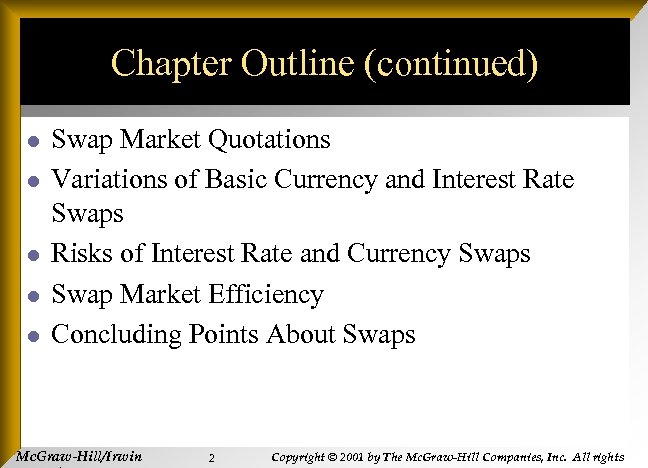 Chapter Outline (continued) l l l Swap Market Quotations Variations of Basic Currency and Interest Rate Swaps Risks of Interest Rate and Currency Swaps Swap Market Efficiency Concluding Points About Swaps Mc. Graw-Hill/Irwin 2 Copyright © 2001 by The Mc. Graw-Hill Companies, Inc. All rights
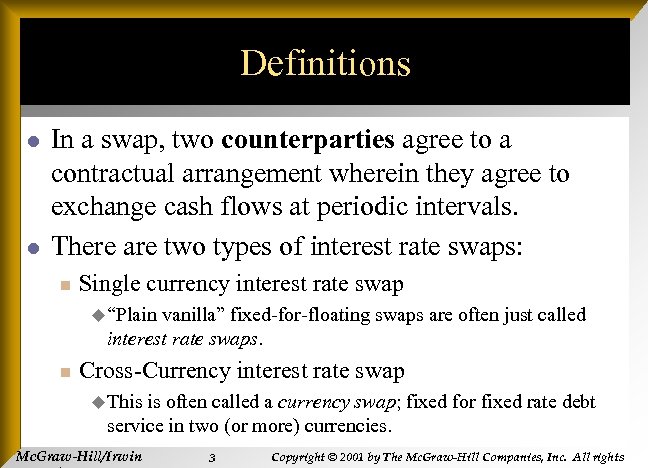 Definitions l l In a swap, two counterparties agree to a contractual arrangement wherein they agree to exchange cash flows at periodic intervals. There are two types of interest rate swaps: n Single currency interest rate swap u “Plain vanilla” fixed-for-floating swaps are often just called interest rate swaps. n Cross-Currency interest rate swap u This is often called a currency swap; fixed for fixed rate debt service in two (or more) currencies. Mc. Graw-Hill/Irwin 3 Copyright © 2001 by The Mc. Graw-Hill Companies, Inc. All rights
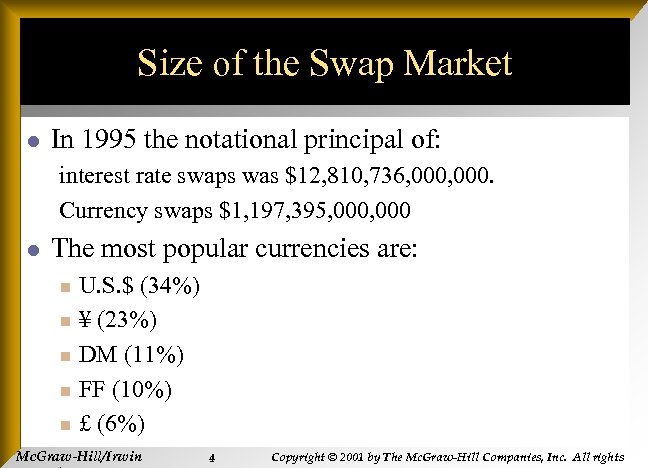 Size of the Swap Market l In 1995 the notational principal of: interest rate swaps was $12, 810, 736, 000. Currency swaps $1, 197, 395, 000 l The most popular currencies are: n n n U. S. $ (34%) ¥ (23%) DM (11%) FF (10%) £ (6%) Mc. Graw-Hill/Irwin 4 Copyright © 2001 by The Mc. Graw-Hill Companies, Inc. All rights
 The Swap Bank l l A swap bank is a generic term to describe a financial institution that facilitates swaps between counterparties. The swap bank can serve as either a broker or a dealer. n n As a broker, the swap bank matches counterparties but does not assume any of the risks of the swap. As a dealer, the swap bank stands ready to accept either side of a currency swap, and then later lay off their risk, or match it with a counterparty. Mc. Graw-Hill/Irwin 5 Copyright © 2001 by The Mc. Graw-Hill Companies, Inc. All rights
 An Example of an Interest Rate Swap l l Consider this example of a “plain vanilla” interest rate swap. Bank A is a AAA-rated international bank located in the U. K. who wishes to raise $10, 000 to finance floating-rate Eurodollar loans. n n Bank A is considering issuing 5 -year fixed-rate Eurodollar bonds at 10 percent. It would make more sense to for the bank to issue floating-rate notes at LIBOR to finance floating-rate Eurodollar loans. Mc. Graw-Hill/Irwin 6 Copyright © 2001 by The Mc. Graw-Hill Companies, Inc. All rights
 An Example of an Interest Rate Swap l Firm B is a BBB-rated U. S. company. It needs $10, 000 to finance an investment with a fiveyear economic life. n n n Firm B is considering issuing 5 -year fixed-rate Eurodollar bonds at 11. 75 percent. Alternatively, firm B can raise the money by issuing 5 year FRNs at LIBOR + ½ percent. Firm B would prefer to borrow at a fixed rate. Mc. Graw-Hill/Irwin 7 Copyright © 2001 by The Mc. Graw-Hill Companies, Inc. All rights
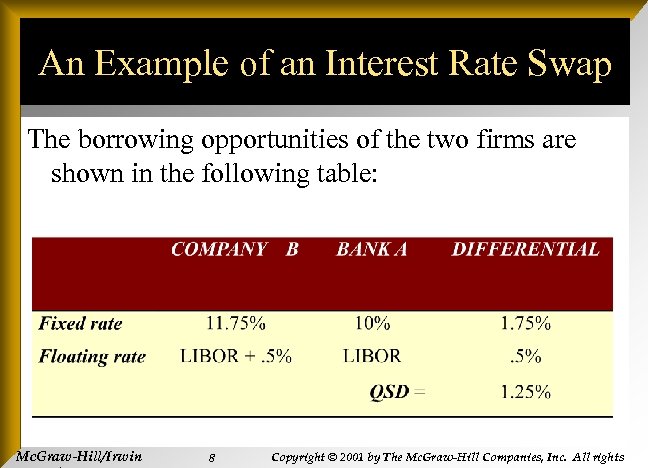 An Example of an Interest Rate Swap The borrowing opportunities of the two firms are shown in the following table: Mc. Graw-Hill/Irwin 8 Copyright © 2001 by The Mc. Graw-Hill Companies, Inc. All rights
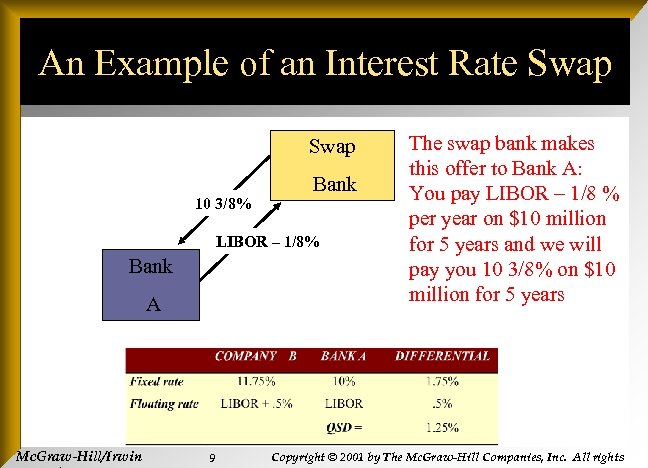 An Example of an Interest Rate Swap 10 3/8% Bank LIBOR – 1/8% Bank A Mc. Graw-Hill/Irwin 9 The swap bank makes this offer to Bank A: You pay LIBOR – 1/8 % per year on $10 million for 5 years and we will pay you 10 3/8% on $10 million for 5 years Copyright © 2001 by The Mc. Graw-Hill Companies, Inc. All rights
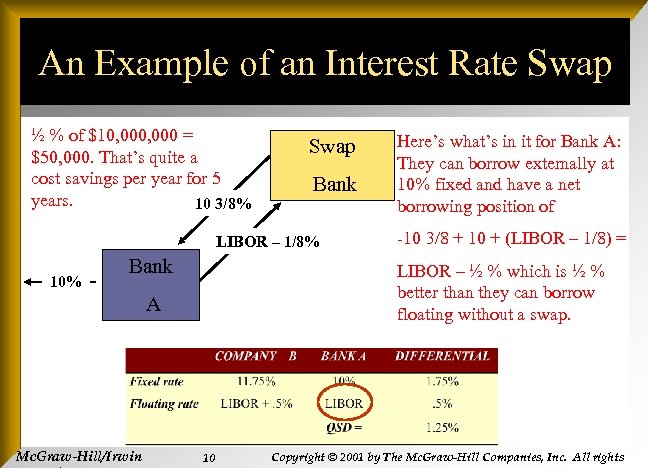 An Example of an Interest Rate Swap ½ % of $10, 000 = $50, 000. That’s quite a cost savings per year for 5 years. 10 3/8% Swap Bank LIBOR – 1/8% 10% Bank -10 3/8 + 10 + (LIBOR – 1/8) = LIBOR – ½ % which is ½ % better than they can borrow floating without a swap. A Mc. Graw-Hill/Irwin Here’s what’s in it for Bank A: They can borrow externally at 10% fixed and have a net borrowing position of 10 Copyright © 2001 by The Mc. Graw-Hill Companies, Inc. All rights
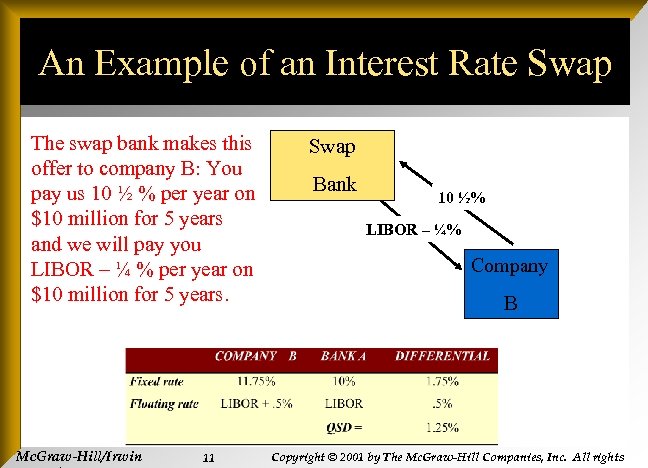 An Example of an Interest Rate Swap The swap bank makes this offer to company B: You pay us 10 ½ % per year on $10 million for 5 years and we will pay you LIBOR – ¼ % per year on $10 million for 5 years. Mc. Graw-Hill/Irwin 11 Swap Bank 10 ½% LIBOR – ¼% Company B Copyright © 2001 by The Mc. Graw-Hill Companies, Inc. All rights
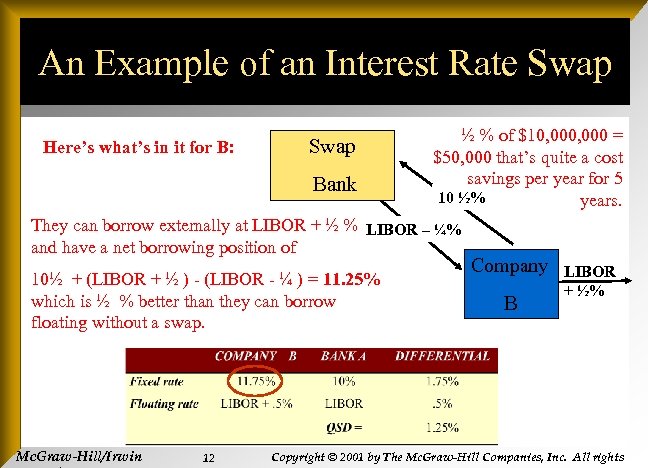 An Example of an Interest Rate Swap Here’s what’s in it for B: Swap Bank ½ % of $10, 000 = $50, 000 that’s quite a cost savings per year for 5 10 ½% years. They can borrow externally at LIBOR + ½ % LIBOR – ¼% and have a net borrowing position of 10½ + (LIBOR + ½ ) - (LIBOR - ¼ ) = 11. 25% which is ½ % better than they can borrow floating without a swap. Mc. Graw-Hill/Irwin 12 Company B LIBOR + ½% Copyright © 2001 by The Mc. Graw-Hill Companies, Inc. All rights
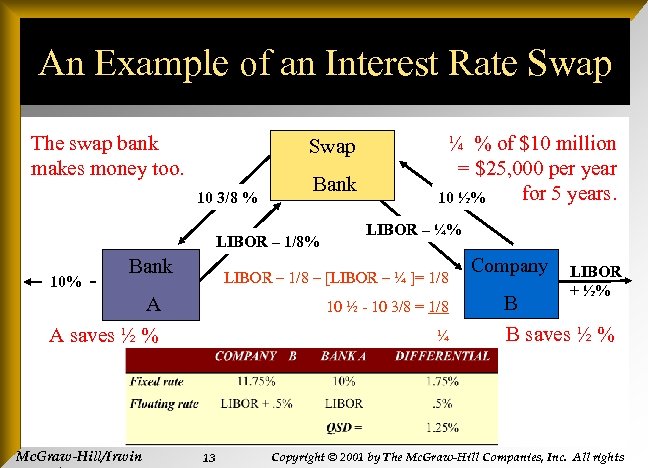 An Example of an Interest Rate Swap The swap bank makes money too. Swap 10 3/8 % Bank LIBOR – 1/8% 10% Bank LIBOR – ¼% LIBOR – 1/8 – [LIBOR – ¼ ]= 1/8 A A saves ½ % Mc. Graw-Hill/Irwin ¼ % of $10 million = $25, 000 per year for 5 years. 10 ½% 10 ½ - 10 3/8 = 1/8 ¼ 13 Company B LIBOR + ½% B saves ½ % Copyright © 2001 by The Mc. Graw-Hill Companies, Inc. All rights
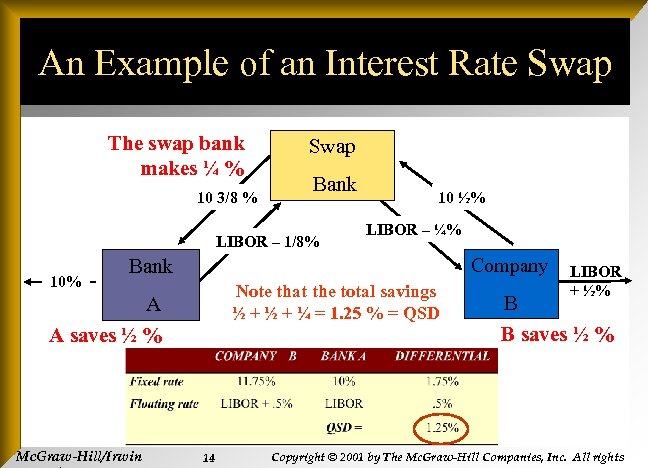 An Example of an Interest Rate Swap The swap bank makes ¼ % 10 3/8 % Swap Bank LIBOR – 1/8% 10 ½% LIBOR – ¼% Company Bank Note that the total savings ½ + ¼ = 1. 25 % = QSD A A saves ½ % Mc. Graw-Hill/Irwin B LIBOR + ½% B saves ½ % 14 Copyright © 2001 by The Mc. Graw-Hill Companies, Inc. All rights
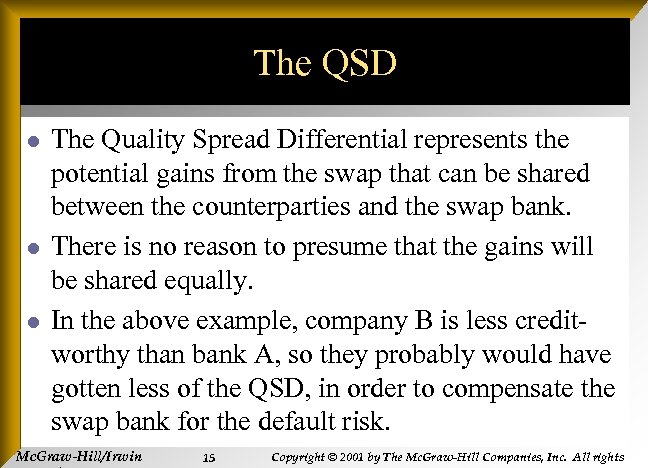 The QSD l l l The Quality Spread Differential represents the potential gains from the swap that can be shared between the counterparties and the swap bank. There is no reason to presume that the gains will be shared equally. In the above example, company B is less creditworthy than bank A, so they probably would have gotten less of the QSD, in order to compensate the swap bank for the default risk. Mc. Graw-Hill/Irwin 15 Copyright © 2001 by The Mc. Graw-Hill Companies, Inc. All rights
 An Example of a Currency Swap l l Suppose a U. S. MNC wants to finance a £ 10, 000 expansion of a British plant. They could borrow dollars in the U. S. where they are well known and exchange for dollars for pounds. n l This will give them exchange rate risk: financing a sterling project with dollars. They could borrow pounds in the international bond market, but pay a lot since they are not as well known abroad. Mc. Graw-Hill/Irwin 16 Copyright © 2001 by The Mc. Graw-Hill Companies, Inc. All rights
 An Example of a Currency Swap l l If they can find a British MNC with a mirrorimage financing need they may both benefit from a swap. If the exchange rate is S 0($/£) = $1. 60/£, the U. S. firm needs to find a British firm wanting to finance dollar borrowing in the amount of $16, 000. Mc. Graw-Hill/Irwin 17 Copyright © 2001 by The Mc. Graw-Hill Companies, Inc. All rights
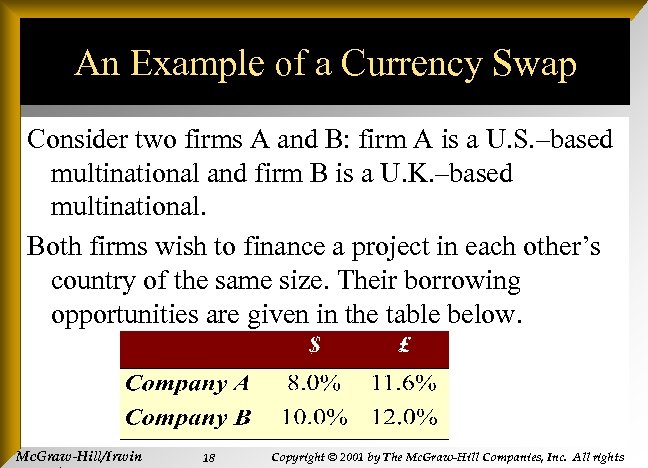 An Example of a Currency Swap Consider two firms A and B: firm A is a U. S. –based multinational and firm B is a U. K. –based multinational. Both firms wish to finance a project in each other’s country of the same size. Their borrowing opportunities are given in the table below. Mc. Graw-Hill/Irwin 18 Copyright © 2001 by The Mc. Graw-Hill Companies, Inc. All rights
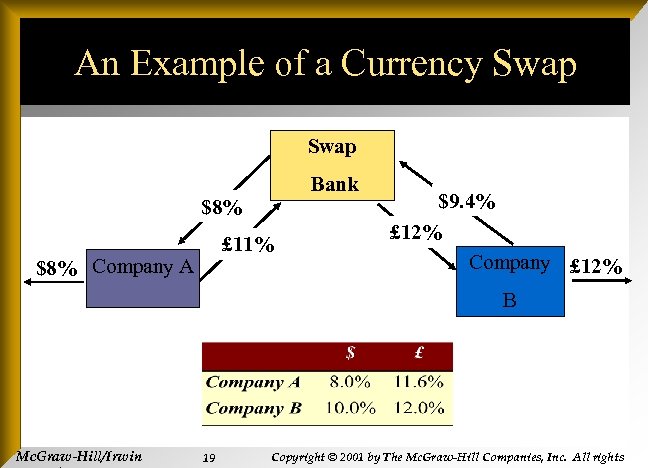 An Example of a Currency Swap Bank $8% £ 11% $8% Company A $9. 4% £ 12% Company £ 12% B Mc. Graw-Hill/Irwin 19 Copyright © 2001 by The Mc. Graw-Hill Companies, Inc. All rights
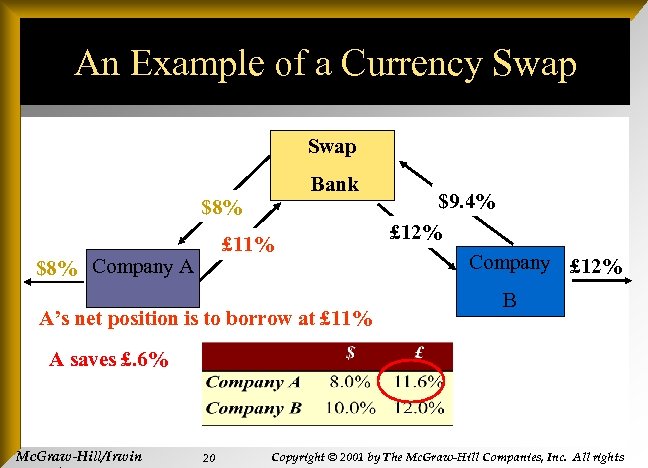 An Example of a Currency Swap Bank $8% £ 11% $8% Company A A’s net position is to borrow at £ 11% $9. 4% £ 12% Company £ 12% B A saves £. 6% Mc. Graw-Hill/Irwin 20 Copyright © 2001 by The Mc. Graw-Hill Companies, Inc. All rights
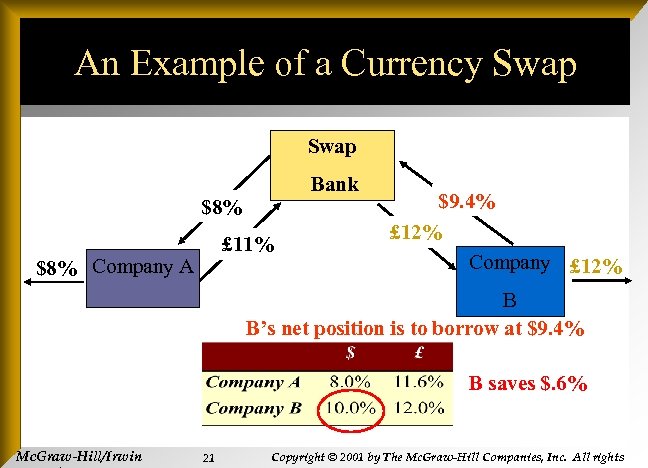 An Example of a Currency Swap Bank $8% £ 11% $8% Company A $9. 4% £ 12% Company £ 12% B B’s net position is to borrow at $9. 4% B saves $. 6% Mc. Graw-Hill/Irwin 21 Copyright © 2001 by The Mc. Graw-Hill Companies, Inc. All rights
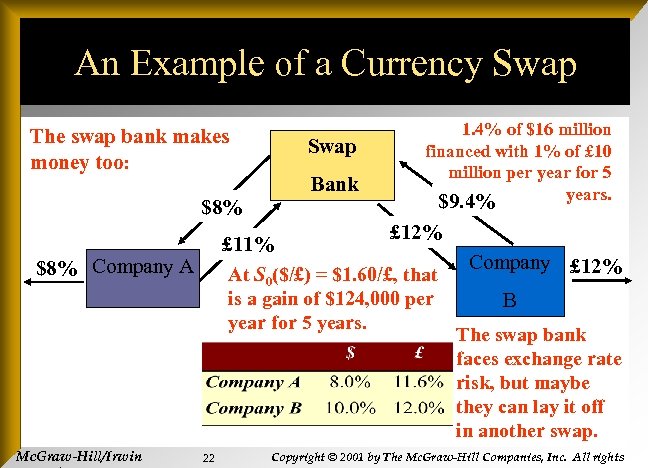 An Example of a Currency Swap The swap bank makes money too: $8% Bank £ 12% £ 11% At S 0($/£) = $1. 60/£, that is a gain of $124, 000 per year for 5 years. $8% Company A Mc. Graw-Hill/Irwin Swap 1. 4% of $16 million financed with 1% of £ 10 million per year for 5 years. $9. 4% 22 Company £ 12% B The swap bank faces exchange rate risk, but maybe they can lay it off in another swap. Copyright © 2001 by The Mc. Graw-Hill Companies, Inc. All rights
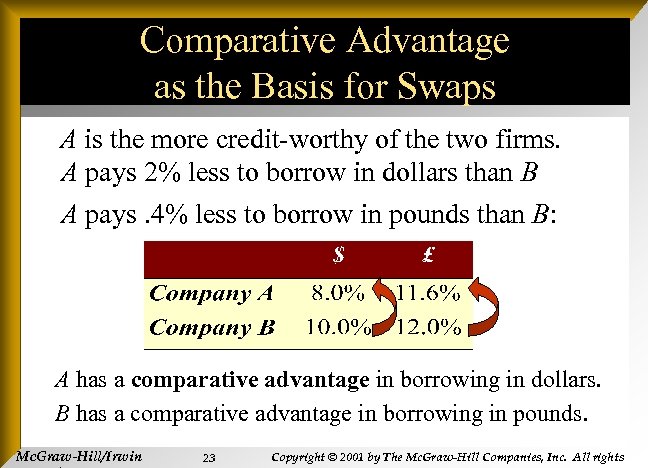 Comparative Advantage as the Basis for Swaps A is the more credit-worthy of the two firms. A pays 2% less to borrow in dollars than B A pays. 4% less to borrow in pounds than B: A has a comparative advantage in borrowing in dollars. B has a comparative advantage in borrowing in pounds. Mc. Graw-Hill/Irwin 23 Copyright © 2001 by The Mc. Graw-Hill Companies, Inc. All rights
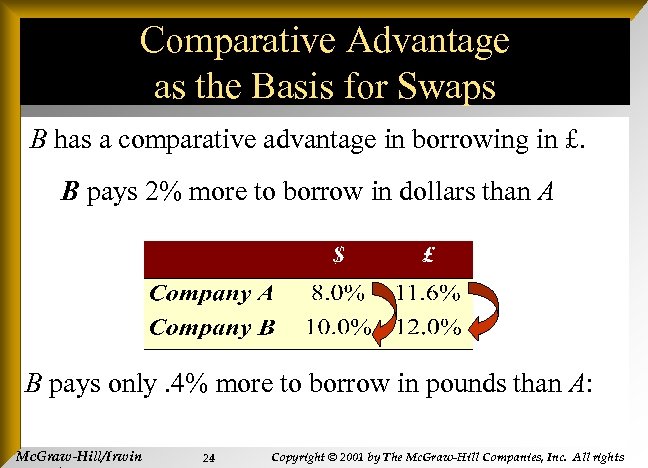 Comparative Advantage as the Basis for Swaps B has a comparative advantage in borrowing in £. B pays 2% more to borrow in dollars than A B pays only. 4% more to borrow in pounds than A: Mc. Graw-Hill/Irwin 24 Copyright © 2001 by The Mc. Graw-Hill Companies, Inc. All rights
 Comparative Advantage as the Basis for Swaps A has a comparative advantage in borrowing in dollars. B has a comparative advantage in borrowing in pounds. If they borrow according to their comparative advantage and then swap, there will be gains for both parties. Mc. Graw-Hill/Irwin 25 Copyright © 2001 by The Mc. Graw-Hill Companies, Inc. All rights
 Swap Market Quotations l l l Swap banks will tailor the terms of interest rate and currency swaps to customers’ needs They also make a market in “plain vanilla” swaps and provide quotes for these. Since the swap banks are dealers for these swaps, there is a bid-ask spread. For example, 6. 60 — 6. 85 means the swap bank will pay fixed-rate DM payments at 6. 60% against receiving dollar LIBOR or it will receive fixed-rate DM payments at 6. 85% against receiving dollar LIBOR. Mc. Graw-Hill/Irwin 26 Copyright © 2001 by The Mc. Graw-Hill Companies, Inc. All rights
 Variations of Basic Currency and Interest Rate Swaps l Currency Swaps n n l Interest Rate Swaps n n l fixed for floating for floating amortizing zero-for floating For a swap to be possible, a QSD must exist. Beyond that, creativity is the only limit. Mc. Graw-Hill/Irwin 27 Copyright © 2001 by The Mc. Graw-Hill Companies, Inc. All rights
 Risks of Interest Rate and Currency Swaps l Interest Rate Risk n l Basis Risk n l Interest rates might move against the swap bank after it has only gotten half of a swap on the books, or if it has an unhedged position. If the floating rates of the two counterparties are not pegged to the same index. Exchange rate Risk n In the example of a currency swap given earlier, the swap bank would be worse off if the pound appreciated. Mc. Graw-Hill/Irwin 28 Copyright © 2001 by The Mc. Graw-Hill Companies, Inc. All rights
 Risks of Interest Rate and Currency Swaps (continued) l Credit Risk n l Mismatch Risk n l This is the major risk faced by a swap dealer—the risk that a counter party will default on its end of the swap. It’s hard to find a counterparty that wants to borrow the right amount of money for the right amount of time. Sovereign Risk n The risk that a country will impose exchange rate restrictions that will interfere with performance on the swap. Mc. Graw-Hill/Irwin 29 Copyright © 2001 by The Mc. Graw-Hill Companies, Inc. All rights
 Pricing a Swap l l A swap is a derivative security so it can be priced in terms of the underlying assets: How to: n n Plain vanilla fixed for floating swap gets valued just like a bond. Currency swap gets valued just like a nest of currency futures. Mc. Graw-Hill/Irwin 30 Copyright © 2001 by The Mc. Graw-Hill Companies, Inc. All rights
 Swap Market Efficiency l l Swaps offer market completeness and that has accounted for their existence and growth. Swaps assist in tailoring financing to the type desired by a particular borrower. Since not all types of debt instruments are available to all types of borrowers, both counterparties can benefit (as well as the swap dealer) through financing that is more suitable for their asset maturity structures. Mc. Graw-Hill/Irwin 31 Copyright © 2001 by The Mc. Graw-Hill Companies, Inc. All rights
 Concluding Remarks l l l The growth of the swap market has been astounding. Swaps are off-the-books transactions. Swaps have become an important source of revenue and risk for banks Mc. Graw-Hill/Irwin 32 Copyright © 2001 by The Mc. Graw-Hill Companies, Inc. All rights
 End Chapter Ten Mc. Graw-Hill/Irwin 33 Copyright © 2001 by The Mc. Graw-Hill Companies, Inc. All rights