


 Скачать презентацию CHAPTER SEVENTEEN THE VALUATION OF COMMON STOCK
8abd561e83d2f43c0d6d65c581954fc2.ppt
- Количество слайдов: 44
 CHAPTER SEVENTEEN THE VALUATION OF COMMON STOCK
 CAPITALIZATION OF INCOME METHOD n THE INTRINSIC VALUE OF A STOCK • represented by present value of the income stream
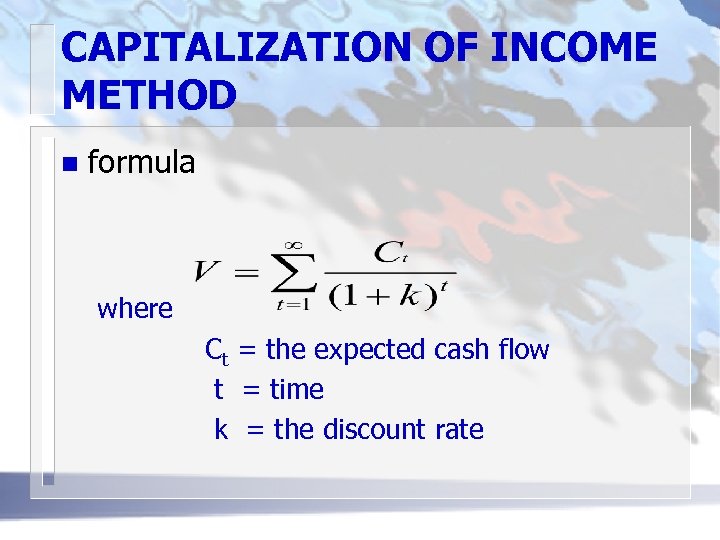 CAPITALIZATION OF INCOME METHOD n formula where Ct = the expected cash flow t = time k = the discount rate
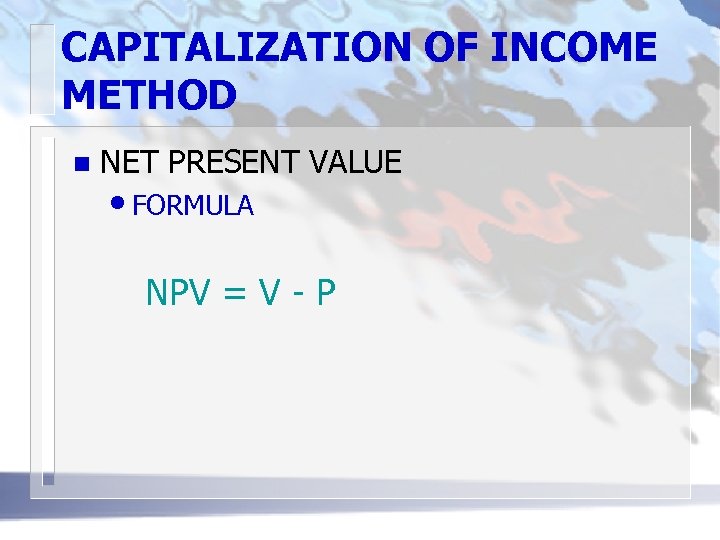 CAPITALIZATION OF INCOME METHOD n NET PRESENT VALUE • FORMULA NPV = V - P
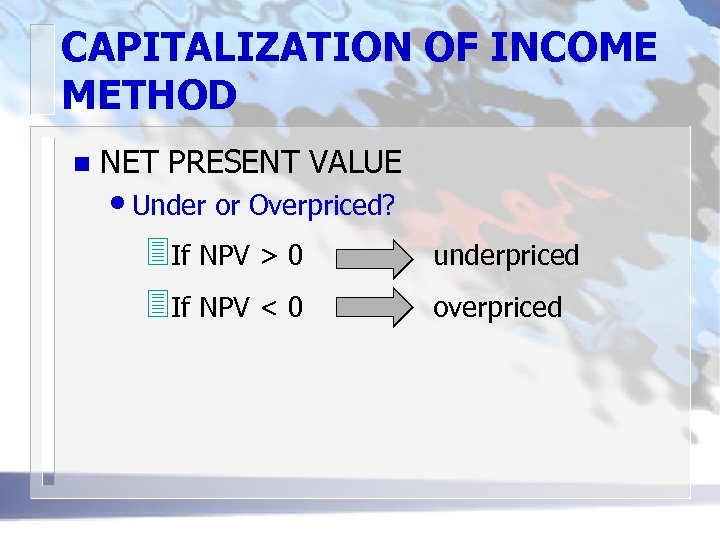 CAPITALIZATION OF INCOME METHOD n NET PRESENT VALUE • Under or Overpriced? 3 If NPV > 0 3 If NPV < 0 underpriced overpriced
 CAPITALIZATION OF INCOME METHOD n INTERNAL RATE OF RETURN(IRR) • set NPV = 0, solve for IRR, or • the IRR is the discount rate that makes the NPV = 0
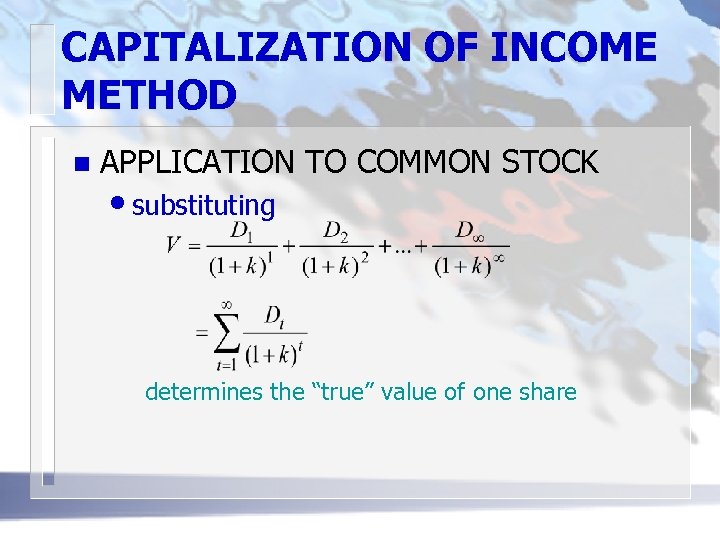 CAPITALIZATION OF INCOME METHOD n APPLICATION TO COMMON STOCK • substituting determines the “true” value of one share
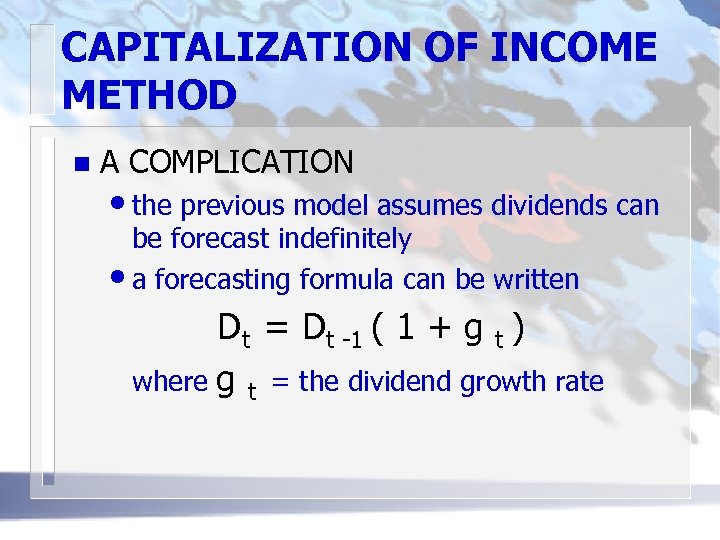 CAPITALIZATION OF INCOME METHOD n A COMPLICATION • the previous model assumes dividends can be forecast indefinitely • a forecasting formula can be written Dt = Dt -1 ( 1 + g t ) where g t = the dividend growth rate
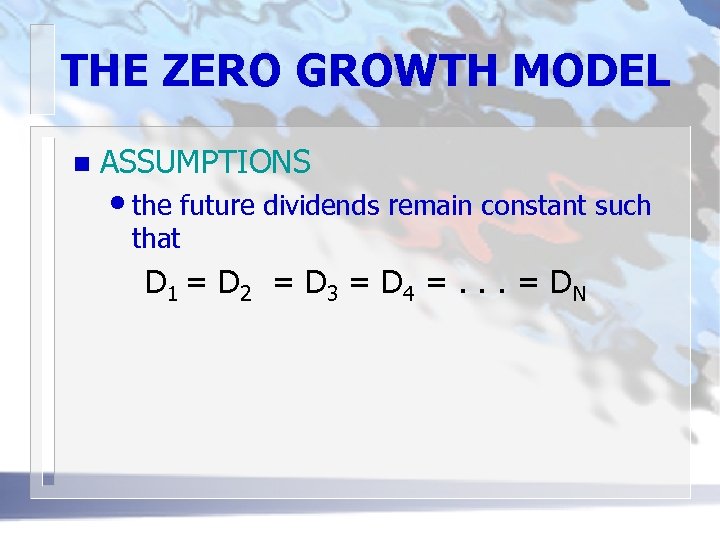 THE ZERO GROWTH MODEL n ASSUMPTIONS • the future dividends remain constant such that D 1 = D 2 = D 3 = D 4 =. . . = D N
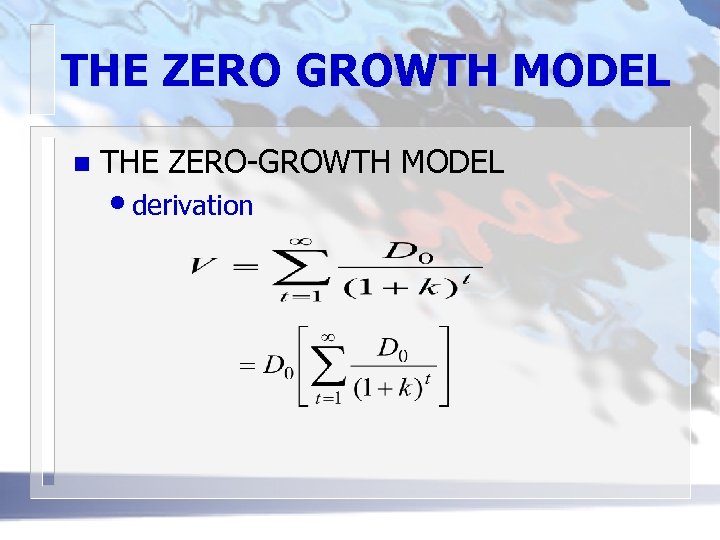 THE ZERO GROWTH MODEL n THE ZERO-GROWTH MODEL • derivation
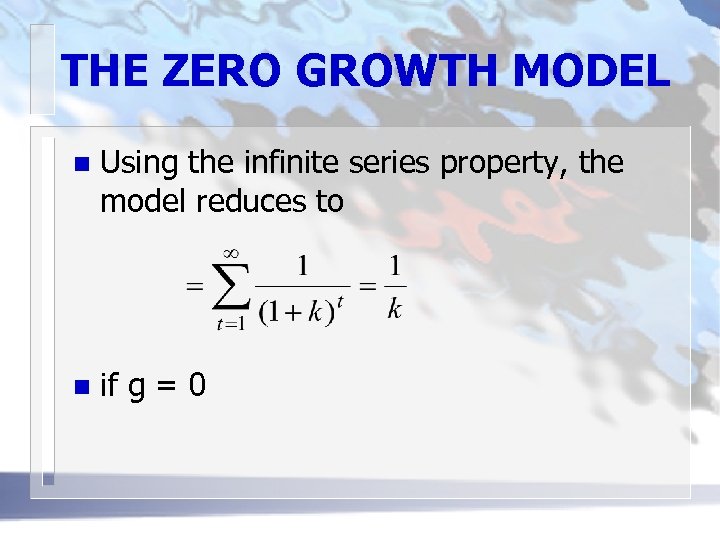 THE ZERO GROWTH MODEL n Using the infinite series property, the model reduces to n if g = 0
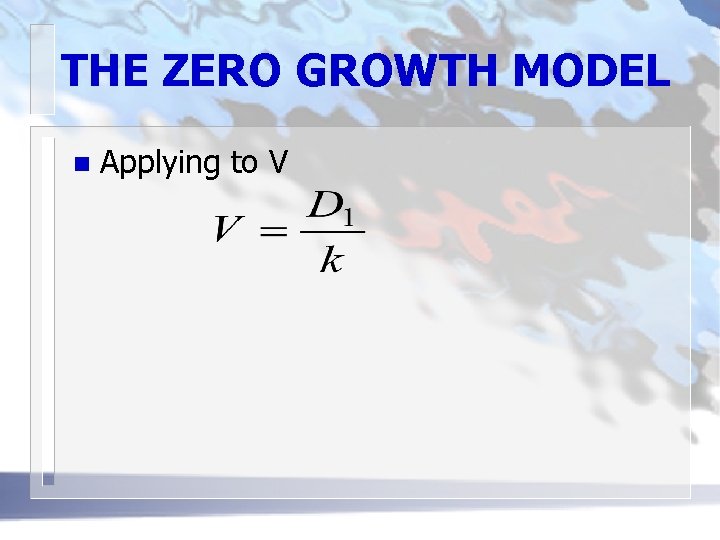 THE ZERO GROWTH MODEL n Applying to V
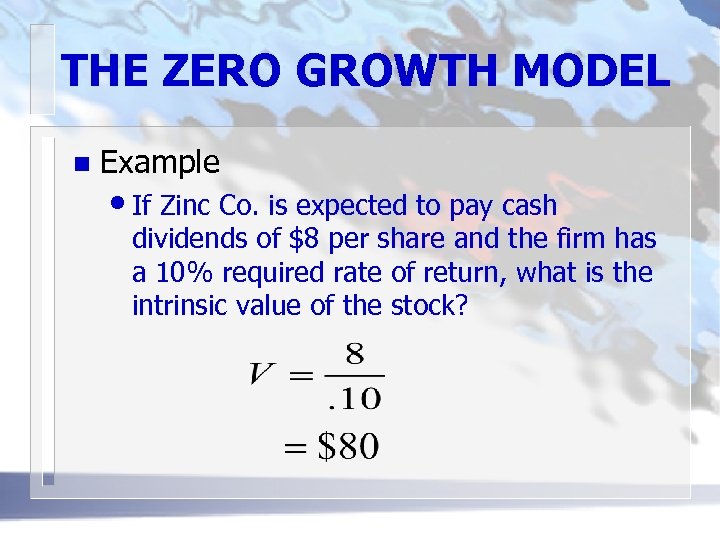 THE ZERO GROWTH MODEL n Example • If Zinc Co. is expected to pay cash dividends of $8 per share and the firm has a 10% required rate of return, what is the intrinsic value of the stock?
 THE ZERO GROWTH MODEL n Example(continued) If the current market price is $65, the stock is underpriced. Recommendation: BUY
 CONSTANT GROWTH MODEL n ASSUMPTIONS: • Dividends are expected to grow at a fixed rate, g such that D 0 (1 + g) = D 1 and D 1 (1 + g) = D 2 or D 2 = D 0 (1 + g)2
 CONSTANT GROWTH MODEL n In General Dt = D 0 (1 + g)t
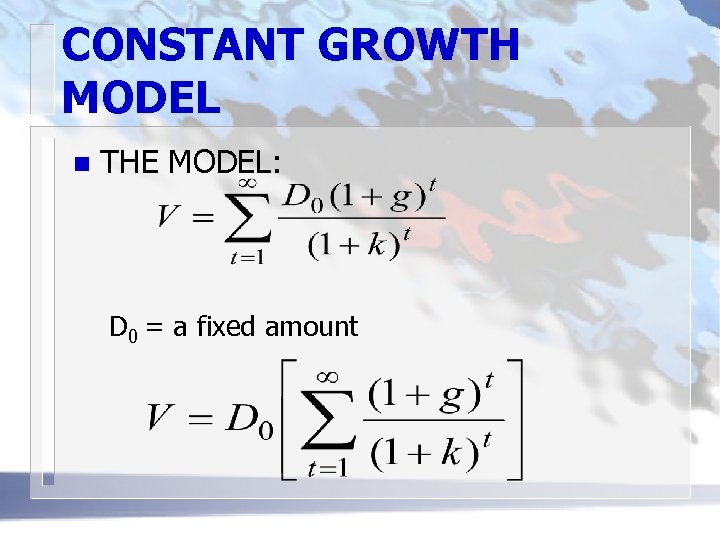 CONSTANT GROWTH MODEL n THE MODEL: D 0 = a fixed amount
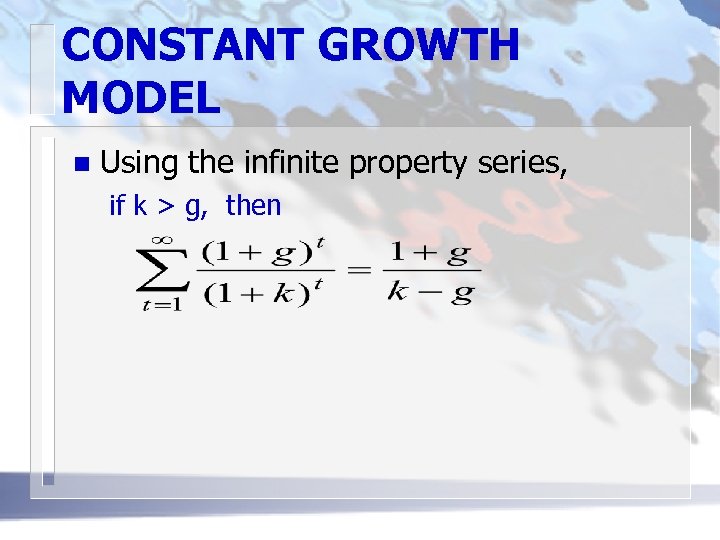 CONSTANT GROWTH MODEL n Using the infinite property series, if k > g, then
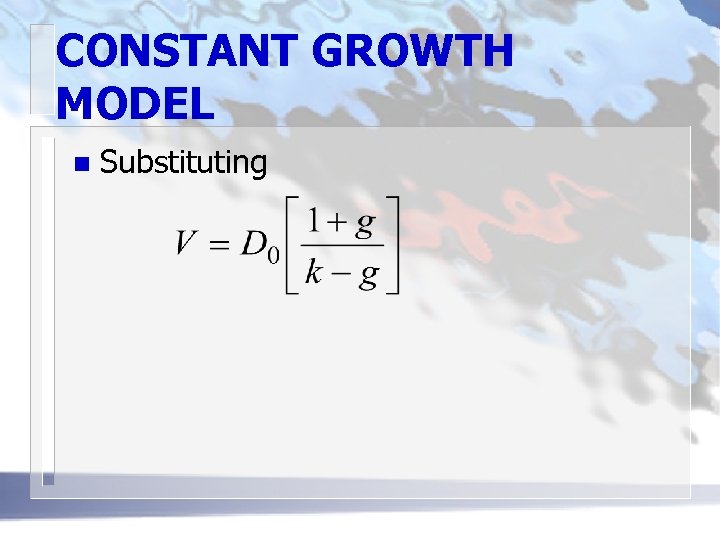 CONSTANT GROWTH MODEL n Substituting
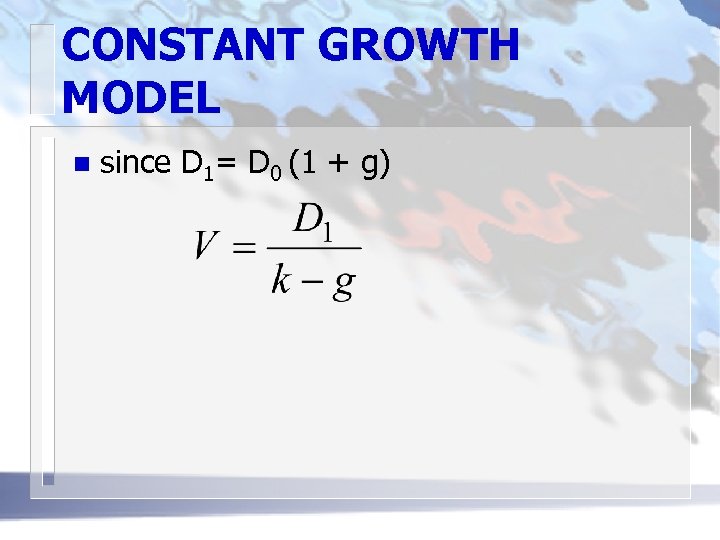 CONSTANT GROWTH MODEL n since D 1= D 0 (1 + g)
 THE MULTIPLE-GROWTH MODEL n ASSUMPTION: n Model Methodology • future dividend growth is not constant • to find present value of forecast stream of dividends • divide stream into parts • each representing a different value for g
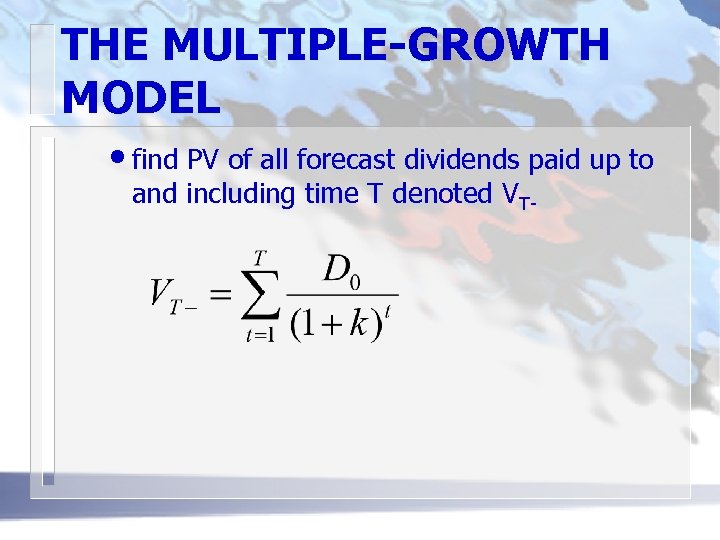 THE MULTIPLE-GROWTH MODEL • find PV of all forecast dividends paid up to and including time T denoted VT-
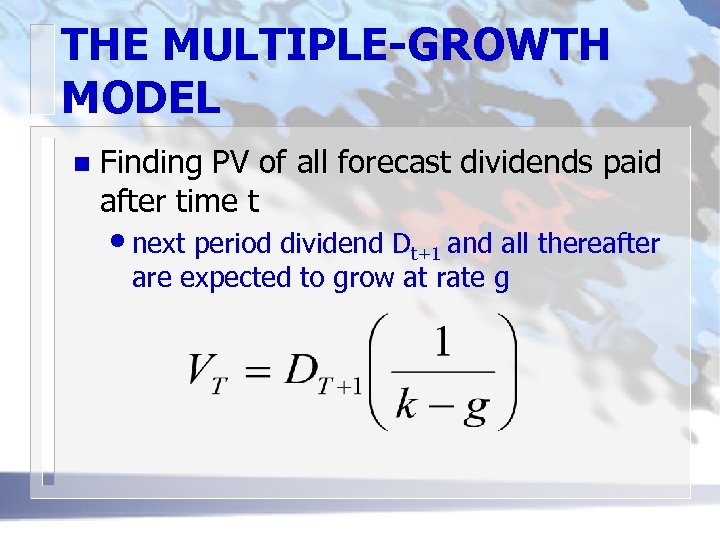 THE MULTIPLE-GROWTH MODEL n Finding PV of all forecast dividends paid after time t • next period dividend Dt+1 and all thereafter are expected to grow at rate g
 THE MULTIPLE-GROWTH MODEL
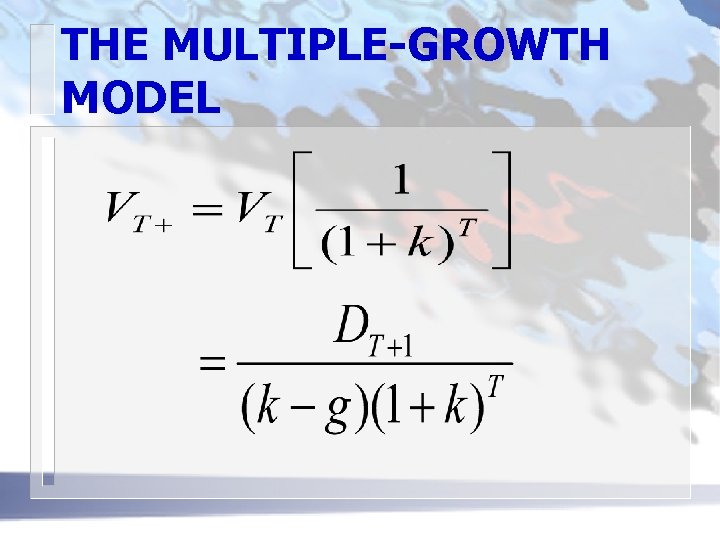
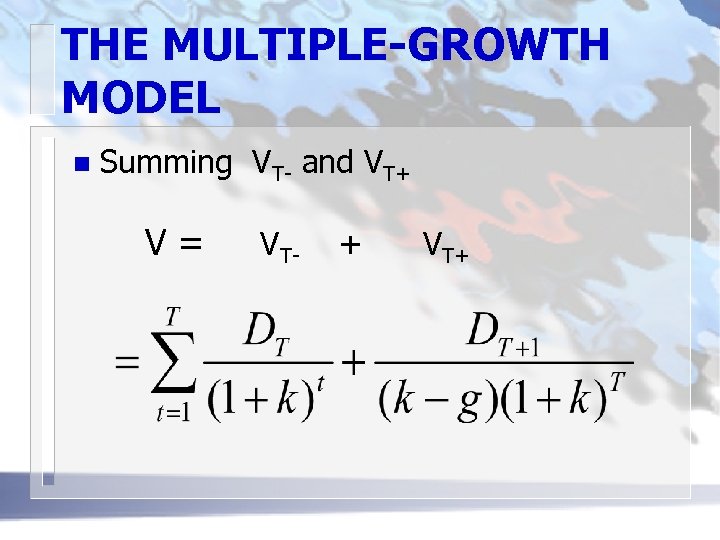 THE MULTIPLE-GROWTH MODEL n Summing VT- and VT+ V= VT- + VT+
 MODELS BASED ON P/E RATIO n PRICE-EARNINGS RATIO MODEL • Many investors prefer the earnings multiplier approach since they feel they are ultimately entitled to receive a firm’s earnings
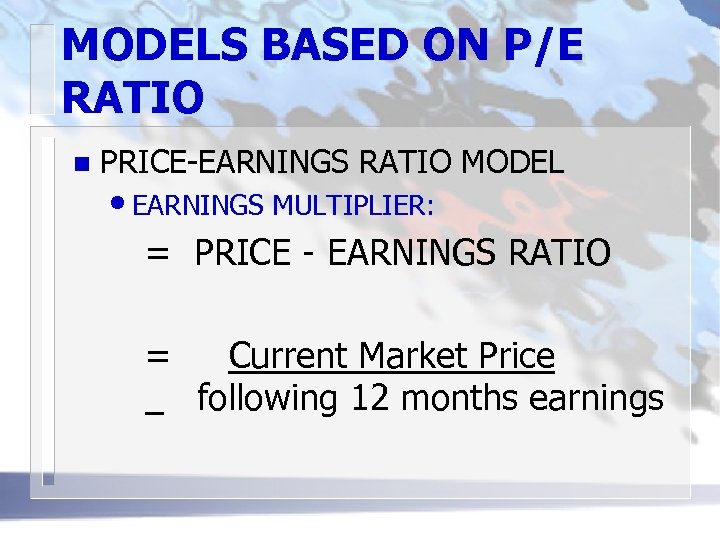 MODELS BASED ON P/E RATIO n PRICE-EARNINGS RATIO MODEL • EARNINGS MULTIPLIER: = PRICE - EARNINGS RATIO = Current Market Price following 12 months earnings
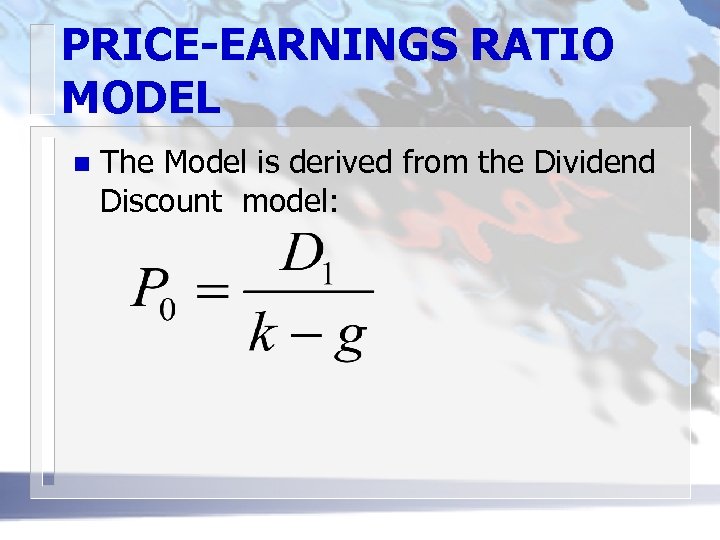 PRICE-EARNINGS RATIO MODEL n The Model is derived from the Dividend Discount model:
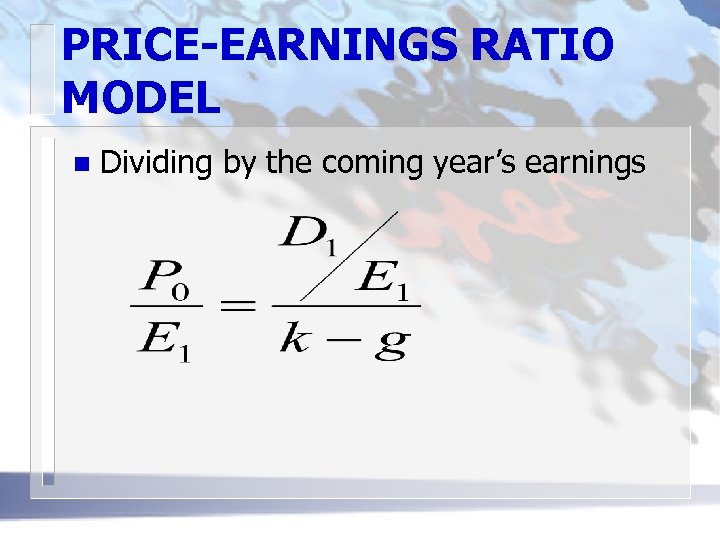 PRICE-EARNINGS RATIO MODEL n Dividing by the coming year’s earnings
 PRICE-EARNINGS RATIO MODEL n The P/E Ratio is a function of • the expected payout ratio ( D 1 / E 1 ) • the required return (k) • the expected growth rate of dividends (g)
 THE ZERO-GROWTH MODEL n ASSUMPTIONS: 3 dividends remain fixed 3100% payout ration to assure zero-growth
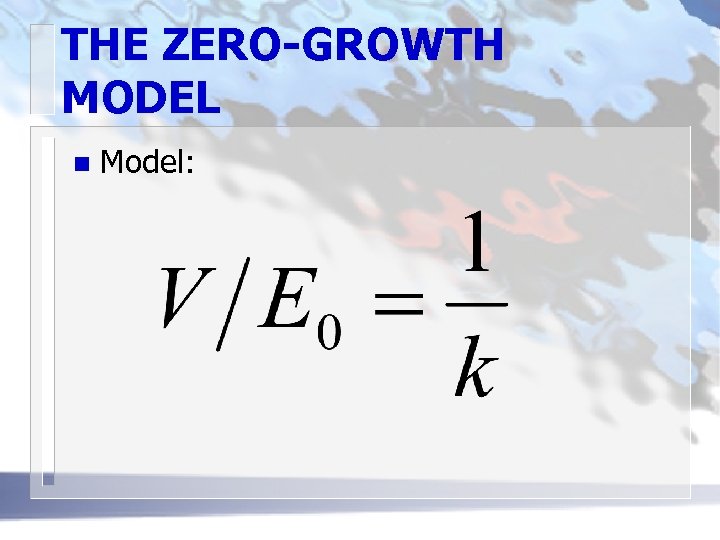 THE ZERO-GROWTH MODEL n Model:
 THE CONSTANT-GROWTH MODEL n ASSUMPTIONS: 3 growth rate in dividends is constant 3 earnings per share is constant 3 payout ratio is constant
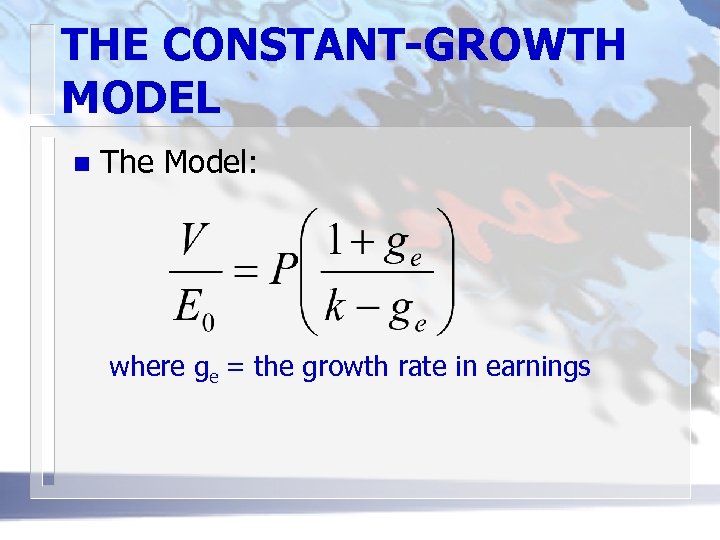 THE CONSTANT-GROWTH MODEL n The Model: where ge = the growth rate in earnings
 SOURCES OF EARNINGS GROWTH n What causes growth? 3 assume no new capital added 3 retained earnings use to pay firm’s new investment 3 If pt = the payout ratio in year t 31 -pt = the retention ratio
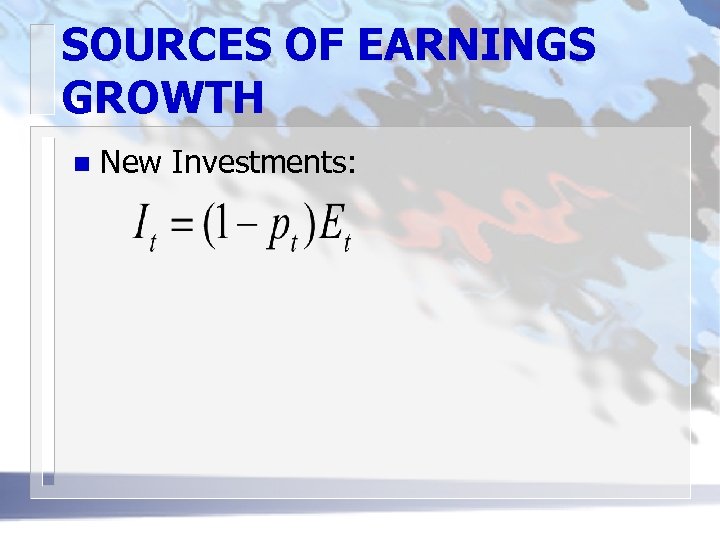 SOURCES OF EARNINGS GROWTH n New Investments:
 SOURCES OF EARNINGS GROWTH n What about the return on equity? Let rt = return on equity in time t rt I t is added to earnings per share in year t+1 and thereafter
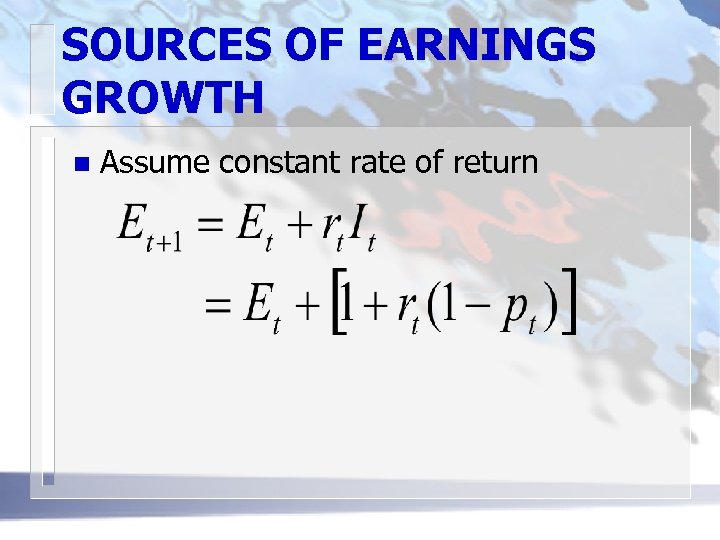 SOURCES OF EARNINGS GROWTH n Assume constant rate of return
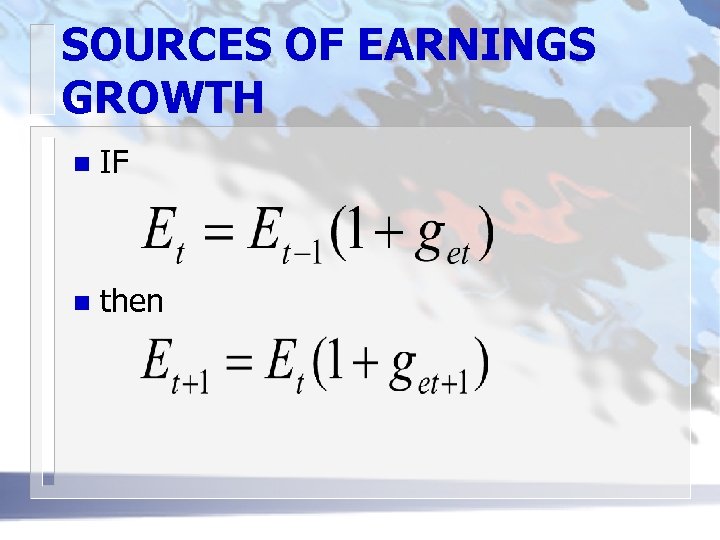 SOURCES OF EARNINGS GROWTH n IF n then
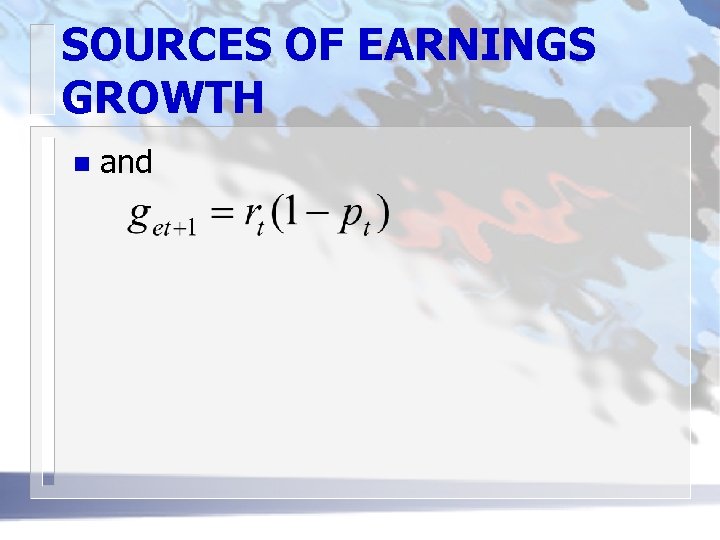 SOURCES OF EARNINGS GROWTH n and
 SOURCES OF EARNINGS GROWTH n If the growth rate in earnings per share get+1 is constant, then rt and pt are constant
 SOURCES OF EARNINGS GROWTH n Growth rate depends on • the retention ratio • average return on equity
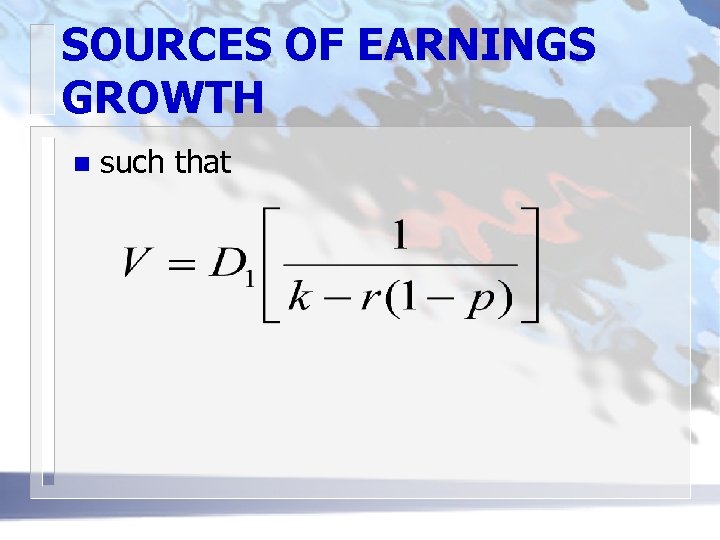 SOURCES OF EARNINGS GROWTH n such that
 END OF CHAPTER 17