


 Скачать презентацию Chapter Seven Wages and Employment in a Single
de37bfc97ca3511bce0b5c343eb2ba93.ppt
- Количество слайдов: 31
 Chapter Seven Wages and Employment in a Single Labour Market Created by: Erica Morrill, M. Ed Fanshawe College © 2002 Mc. Graw-Hill Ryerson Ltd. 1
 Chapter Focus ® Equilibrium in a single labour market ® Imperfect competition ® Payroll taxes ® Monopsony ® Minimum wage © 2002 Mc. Graw-Hill Ryerson Ltd. 2
 Competitive Firm’s Demand ® Assumptions : ® homogeneous type of labour ® price taker and wage taker ® Supply is perfectly elastic (horizontal) at the wage rate ® Firms can employ all the labour they need at the market wage rate ® Market wage rate is set by the aggregate labour market © 2002 Mc. Graw-Hill Ryerson Ltd. 3
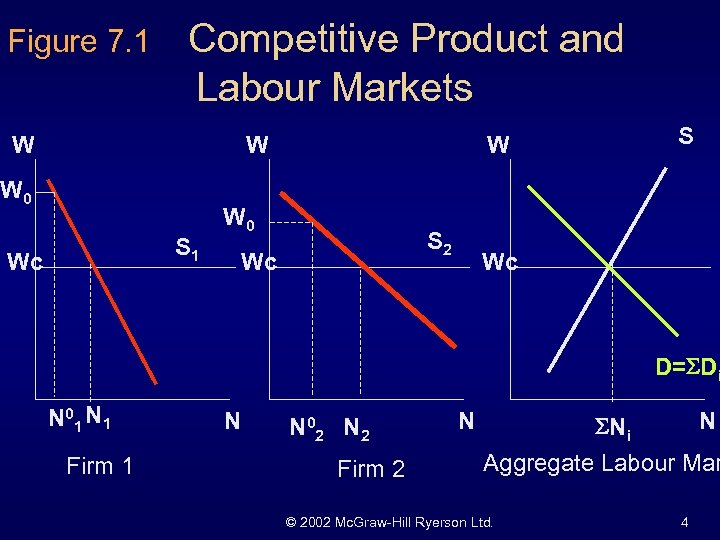 Figure 7. 1 Competitive Product and Labour Markets W W W 0 S 1 Wc S W W 0 S 2 Wc Wc D= Di N 01 N 1 Firm 1 N N 02 N 2 Firm 2 N N Ni Aggregate Labour Mar © 2002 Mc. Graw-Hill Ryerson Ltd. 4
 Short-Run ® A firm may have to raise its wages to attract additional workers ® dynamic ® monopsony Short-run labour supply curve is upward sloping © 2002 Mc. Graw-Hill Ryerson Ltd. 5
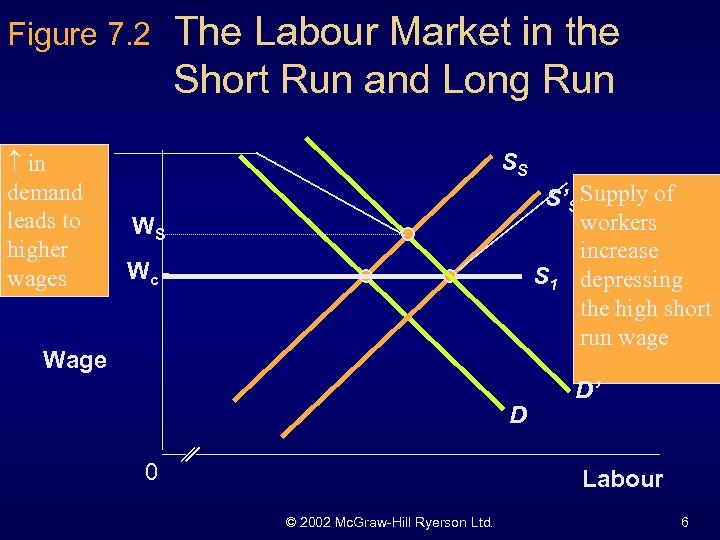 Figure 7. 2 in demand leads to higher wages The Labour Market in the Short Run and Long Run SS S’S Supply of workers increase S 1 depressing the high short run wage WS Wc Wage D 0 D’ Labour © 2002 Mc. Graw-Hill Ryerson Ltd. 6
 Short-run and Long-run Labour Supply ® Long run ® Temporary wage increases above norm are consistent with the firm being a competitive buyer of labour ® Short-run wage increases can be a market signal ® ensures that market forces operate in the longer run © 2002 Mc. Graw-Hill Ryerson Ltd. 7
 Equilibrium in a Competitive Market ® Market-clearing model (neoclassical) for markets with homogeneous workers and homogeneous jobs wages will be equalized across workers ® absences of “involuntary unemployment” ® no queues for jobs or rationing of jobs ® © 2002 Mc. Graw-Hill Ryerson Ltd. 8
 In Reality…. ® The market-clearing model is not entirely true Wages do not adjust quickly to clear the market ® Involuntary unemployment is frequent ® Large wage differentials exist across homogeneous workers and jobs. ® ® However, it still serves as a useful approximation of market theory © 2002 Mc. Graw-Hill Ryerson Ltd. 9
 Imperfect Competition ® Monopoly ® is the industry ® Effects of hiring more labour ® marginal physical product of labour falls ® marginal revenue falls ® Sells more output only by lowering the product price © 2002 Mc. Graw-Hill Ryerson Ltd. 10
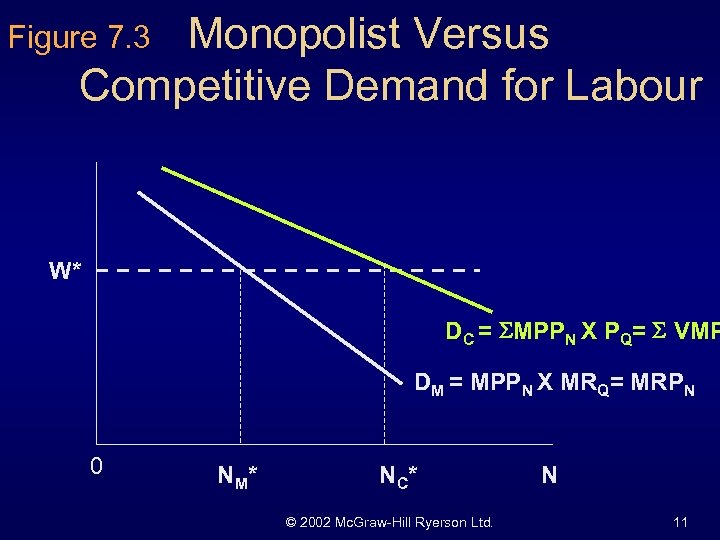 Monopolist Versus Competitive Demand for Labour Figure 7. 3 W* DC = MPPN X PQ= VMP DM = MPPN X MRQ= MRPN 0 N M* N C* © 2002 Mc. Graw-Hill Ryerson Ltd. N 11
 Product Market Structure and Departure from Market Wages ® Monopolist ® earns higher profits and labour may be able to appropriate some of these profits ® may be less cost conscious and may yield to wage demands ® sensitive to public image pay higher wages to buy good image ® large firms pay higher wages © 2002 Mc. Graw-Hill Ryerson Ltd. 12
 Oligopoly in the Product Market ® Few firms ® Similar products ® Action of one firm affects the others ® May depart from Market wages because; earn above normal profits which may be captured by workers ® larger firms and may pay above-market wages for reasons related to size ® © 2002 Mc. Graw-Hill Ryerson Ltd. 13
 Monopolistic Competition in the Product Market ® Many small firms with differentiated products giving the firm some discretion in price setting ® competitive in the labour market ® paying market wages ® no economic rents (high profits yielding higher wages) ® no large size factors leading to higher wages © 2002 Mc. Graw-Hill Ryerson Ltd. 14
 Working with Supply and Demand ® Simulating the effects of a policy change on equilibrium ® Incidence of a unit payroll tax © 2002 Mc. Graw-Hill Ryerson Ltd. 15
 Unit Payroll Tax ® Tax levied on employers ® Proportional to the firm’s payroll ® CPP/QPP ® Workers’ compensation ® unemployment insurance ® health insurance ® Often considered “job killers” © 2002 Mc. Graw-Hill Ryerson Ltd. 16
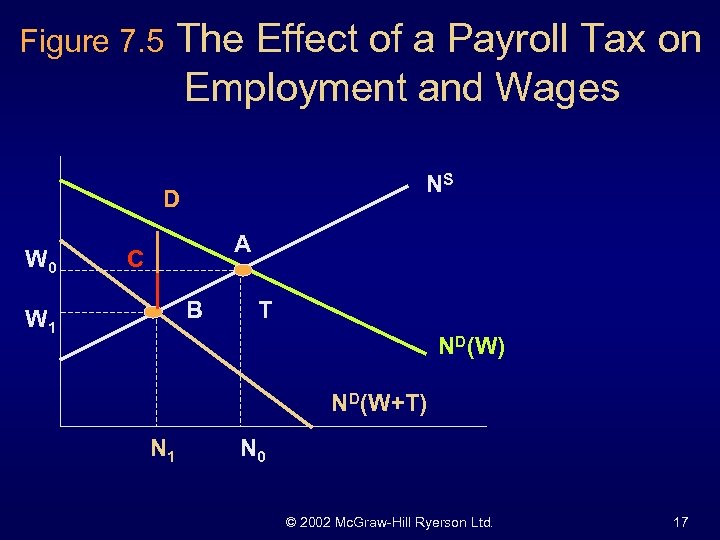 Figure 7. 5 The Effect of a Payroll Tax on Employment and Wages NS D W 0 A C B W 1 T ND(W) ND(W+T) N 1 N 0 © 2002 Mc. Graw-Hill Ryerson Ltd. 17
 Characteristics of a Monopsony ® Large relative to the size of the labour market ® Influences wage ® Raises wages to attract labour ® Will not lose all of its work force if decreases wages ® Upward-sloping labour supply schedule © 2002 Mc. Graw-Hill Ryerson Ltd. 18
 Monopsony ® Average cost is the wage rate ® Marginal cost is the new wage plus the cost of paying the higher wage to existing workers ® Marginal cost is higher than average cost ® Profit Maximization when MC=VMP © 2002 Mc. Graw-Hill Ryerson Ltd. 19
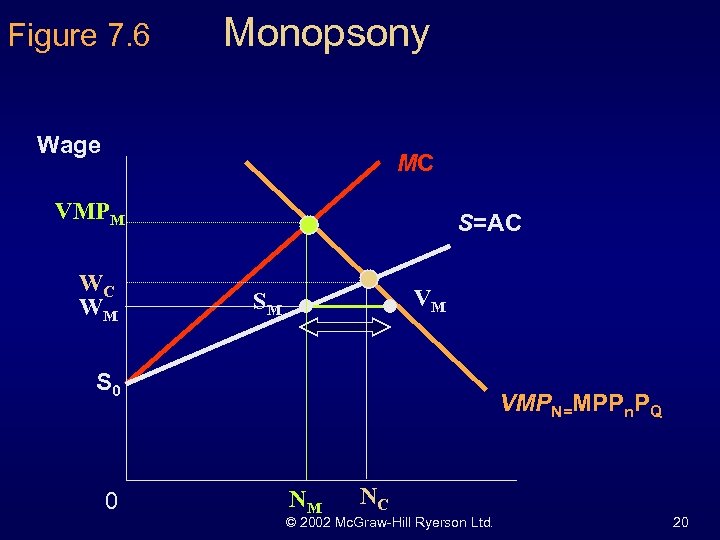 Figure 7. 6 Monopsony Wage MC VMPM WC WM S=AC VM SM S 0 0 VMPN=MPPn. PQ NM NC © 2002 Mc. Graw-Hill Ryerson Ltd. 20
 Implications of a Monopsony ® Employment is lower than a competitive situation ® Restricts employment because hiring additional labour is costly ® Higher wages must be paid to intramarginal workers © 2002 Mc. Graw-Hill Ryerson Ltd. 21
 Characteristics of Monopsonists ® Some inelasticity of supply of labour ® Most firms have an element of monopsony power in short run ® Long run costly problems of recruitment, turnover and morale issues ® Examples of monopsony in long run: would be a one industry town in an isolated region ® if workers have specialized skills that are useful mainly in a specific firm ® © 2002 Mc. Graw-Hill Ryerson Ltd. 22
 Perfect Monopsonistic Wage Differentiation ® Existing workers receive wages greater when a monopsony raises the wage rate ® seller’s surplus or economic rent ® Monopsonist may try to retain some of this seller’s surplus by differentiating it’s work force © 2002 Mc. Graw-Hill Ryerson Ltd. 23
 Perfect Monopsonistic Wage Differentiation ® Supply schedule equal to the average cost and marginal cost ® Does not have to pay existing workers any more than their reservation wage ® Monopsonists may try to conceal higher wages or use nonwage mechanisms to attract additional labour © 2002 Mc. Graw-Hill Ryerson Ltd. 24
 Imperfect Monopsonistic Wage Differentiation ® Monopsonists differentiate between groups of workers ® different types of labour can be separated ® there are different supply elasticities © 2002 Mc. Graw-Hill Ryerson Ltd. 25
 Minimum Wage Legislation: Impact on Competitive Labour Market ® Adverse employment effect ® Firms employ less labour at a higher cost ® Higher wage encourages more people to seek work ® Magnitude of adverse employment effect depends on the elasticity of the demand for labour © 2002 Mc. Graw-Hill Ryerson Ltd. 26
 Minimum Wage: Offsetting Factors ® Labour could increase… ® if there is exogenous increase in demand for output ® if there is an increase in the demand for labour substitutes © 2002 Mc. Graw-Hill Ryerson Ltd. 27
 Minimum Wage Legislation: Impact on Monopsony ® minimum wage (or other form of price fixing) may increase employment ® reduces monopsony profits ® depends on the extent to which monopsony is associated with workers who are paid below minimum wage © 2002 Mc. Graw-Hill Ryerson Ltd. 28
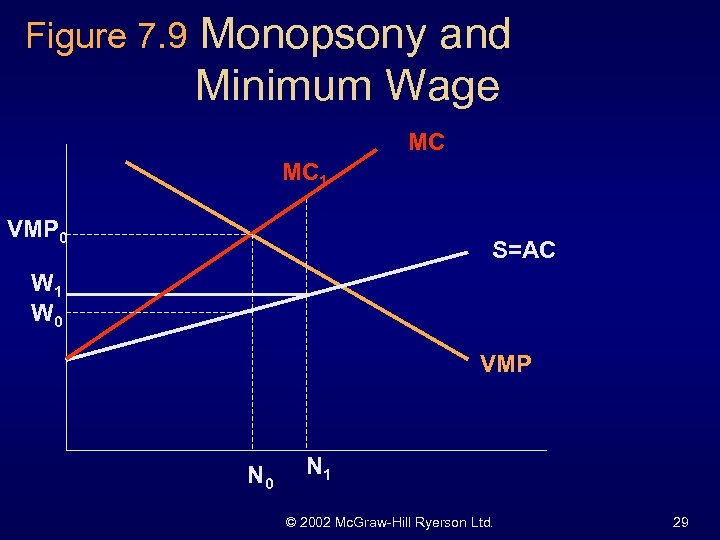 Figure 7. 9 Monopsony and Minimum Wage MC MC 1 VMP 0 S=AC W 1 W 0 VMP N 0 N 1 © 2002 Mc. Graw-Hill Ryerson Ltd. 29
 Minimum Wage ® Reduces employment in competitive labour markets ® Increases employment in monopsonistic labour market ® Theory Short-run effects are small ® Disemployment effects are higher in long-run ® © 2002 Mc. Graw-Hill Ryerson Ltd. 30
 End of Chapter Seven © 2002 Mc. Graw-Hill Ryerson Ltd. Chapter 7 -31