


 Скачать презентацию Chapter Nine Ø Adult Sexual Relationships Agenda
49d79a5997743e45f64ab8ddd387bd71.ppt
- Количество слайдов: 57
 Chapter Nine Ø Adult Sexual Relationships
 Agenda Ø Discuss Dating: Fun or Serious Business? Ø Discuss Marriage: Happy Ever After? Ø Review Same-Sex Relationships Ø Discuss Divorce: Whose Fault or No-Fault? Ø Review Sexuality in Elderly Relationships Ø Discuss Adult Sexual Relationships in Other Places
 Self Reflection Exercise: What am I Looking for in a Sexual Partner? Ø Complete the handout privately. Ø Don’t share your results with others.
 Dating: Fun or Serious Business? Ø Types of Dating and How Do We Meet? Ø Interracial Dating Ø Dating after Divorce or Widowhood Ø Sexuality in Dating Relationships Ø Sexuality in Elderly Relationships Ø Cohabitation
 Dating: Introduction Ø Dating is a way to discover and compare qualities in search of the best partner Ø Dating has recreational value Ø Dating provides companionship, emotional support, possibly economic support Ø Factors related to those who date: better physical & emotional health, higher selfesteem, sex-role identity Ø Can be difficult for homosexuals to find dates
 Dating Trends Ø Many different levels of commitment Ø Those with more free time (college students) tend to date more Ø Traditional dating has been replaced by more casual dating, with less chaperoned time Ø It is difficult to initiate dating, and this may worsen as people get older and have less ways of meeting people
 Interracial Dating Ø 25% of college students reported currently being in an interracial relationship Ø 50% would be open to dating someone of another race Ø African Americans are more open to interracial dating than Caucasians v. More exposure to white culture v. More Caucasians available
 Dating After Divorce or Widowhood Ø Dating environment is different than when they dated before marriage Ø Widowhood is an obstacle in finding another partner Ø Fewer social opportunities to find a partner Ø May decide to cohabitate, rather than remarry Ø Older men more likely to date if socially active and relatively young Ø Older women more apt if healthy and mobile
 Sexuality in Dating Relationships Ø In college, “hooking up” is becoming more common Ø Some couples abstain from sex Ø If one person in a couple is a virgin, they are more likely to abstain if it is a female virgin than a male virgin Ø The woman’s past sexual experience more strongly predicts a couple’s sexual behavior
 Cohabitation
 Class Discussion: Cohabitation Ø Why do you think that cohabitation has become more common? Ø Why do you think people choose to cohabit? Why do others chose not to cohabit? Ø Are there circumstances in which you would choose to cohabit?
 Cohabitation: Issues & Trends Ø Has increased in recent years; stage of courtship Ø 40% of U. S. couples cohabitate Ø In the early 1990 s, more than half of 1 st marriages began with cohabitation Ø Cohabitating couples are twice as likely to be of different races than married couples Ø Common-law marriage – if a couple lives together for a certain length of time; 13 states Ø Half of cohabitating couples break up within one year or less Ø Those who eventually marry are more likely to divorce; even more with long cohabitations
 Cohabitation: Advantages & Disadvantages Ø Advantages: learn more about each other without legal or economic ties, more realistic than dating Ø Disadvantages: unsupportive family, cut off from friends
 Cohabitation: Why Increased Relationship Failure? Ø Couples develop as separate individuals Ø “Playing house” without the real marital pressures; financial pressures Ø Type of people that are more likely to cohabit may be more likely to get divorce if faced with marital problems Ø The need to “test” the relationship likely means a couple is not ready
 Cohabitation in Other Cultures Ø Less common in traditional cultures v. Asian societies v. Islamic societies Ø Most western countries have many cohabitating couples v. France v. Sweden
 Marriage Ø Ø Ø Marital Satisfaction Marital Sex Over time Marriage in Later Life Extramarital Affairs Marriage in Other Cultures
 Class Discussion: Marriage Expectations Ø Would you ever like to get married? If so, at what age would you like to marry? Ø What area would you like to live in? City? State? Suburban or Rural? What type of house? Ø Would you ever want any children? If so, why and how many? If not, why not? Ø If you want children, how long will you wait before you have them? Ø Will you keep your name if you marry? Would you like your partner to change his or her name? Explain. Ø Will you maintain a career outside the home during your marriage? Would you like your spouse to? Ø What would be the division of labor in your household?
 View Video: “Making Marriage Last”
 Marriage: Trends Ø 93% in the U. S. say a happy marriage is an important life goal Ø Women are more likely to marry older men v. Want to be taken care of, wealth, power Ø Men are more likely to marry younger women v. Want conception, pregnancy, beauty Ø Age at first marriage (in 2002); increasing v. Men: 27 v. Women: 25
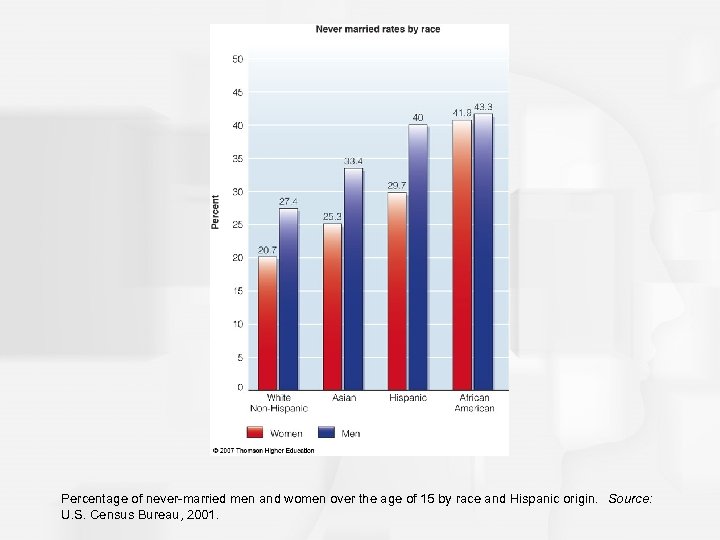 Percentage of never-married men and women over the age of 15 by race and Hispanic origin. Source: U. S. Census Bureau, 2001.
 Marital Satisfaction Factors Ø In general: self-disclosure, physical & emotional intimacy, personality similarities v. For men: frequency of pleasurable activities done together v. For women: frequency of pleasurable activities focused on emotional closeness Ø Quality of spousal friendship influences satisfaciton. Ø Marriage quality peaks in the first few years, declines to midlife, rises again v. Couples usually put more effort into the marriage in the beginning
 Factors Affecting Commitment Ø Satisfaction and comittment are different issues: couples may remain married even if they are unhappy with their relationship. Ø Marriages last longer when both: vhave a positive marital attitude, vview their partner as their best friend, vlike their partner as a person, vbelieve marriage is a long-term commitment
 Impact of Marriage Ø Married couples tend to be happier, healthier, and live longer Ø Health benefits mostly for men v. Wives monitor husband’s health v. Wives have many role responsibilities
 Having Children or Remaining Childless Ø Relationship quality is impacted by timing of having children Ø Children decrease relationship time Ø Married couples with children tend to have lower marital satisfaction than those without Ø Satisfaction decreases as the number of children increases Ø Satisfaction is high before kids, declines until kids are teens, increases when kids leave
 Marital Sex: Changes Over Time Ø Passion is high early in marriages, but slowly dissipates Ø 40% married couples have intercourse 2+ times/week; 50% do so a few times/month Ø Most couples experience a decrease in intercourse over time, mostly due to marital pressures (children, jobs, housework, money) Ø Positive correlation between frequency & satisfaction with sex life
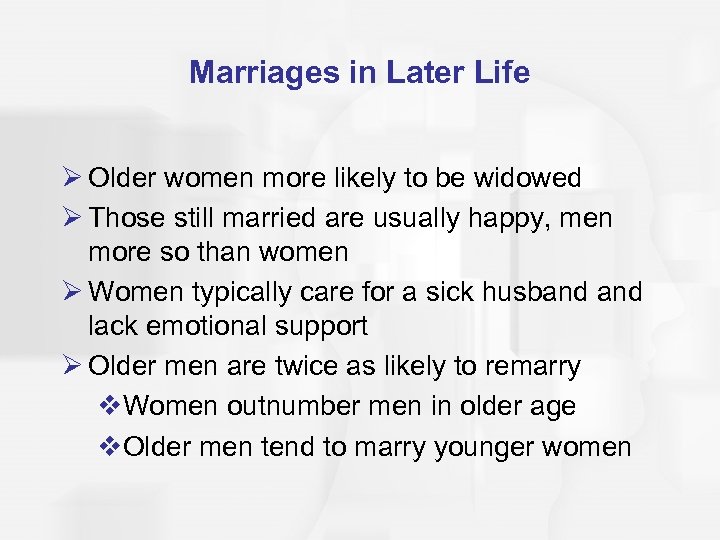 Marriages in Later Life Ø Older women more likely to be widowed Ø Those still married are usually happy, men more so than women Ø Women typically care for a sick husband lack emotional support Ø Older men are twice as likely to remarry v. Women outnumber men in older age v. Older men tend to marry younger women
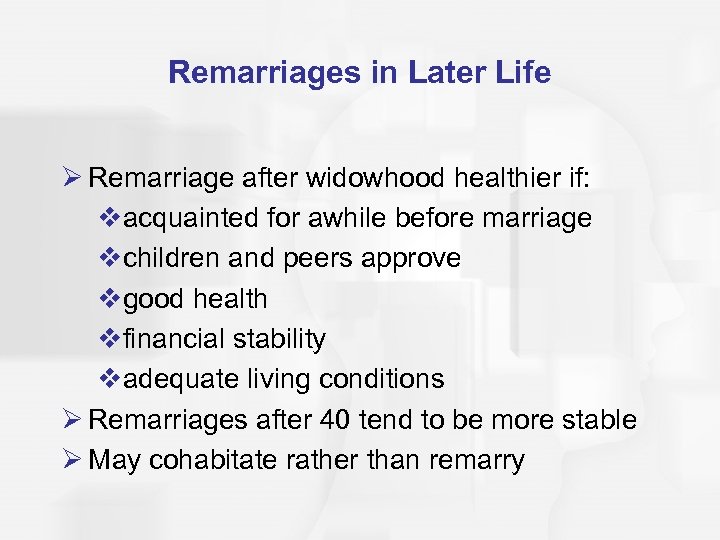 Remarriages in Later Life Ø Remarriage after widowhood healthier if: vacquainted for awhile before marriage vchildren and peers approve vgood health vfinancial stability vadequate living conditions Ø Remarriages after 40 tend to be more stable Ø May cohabitate rather than remarry
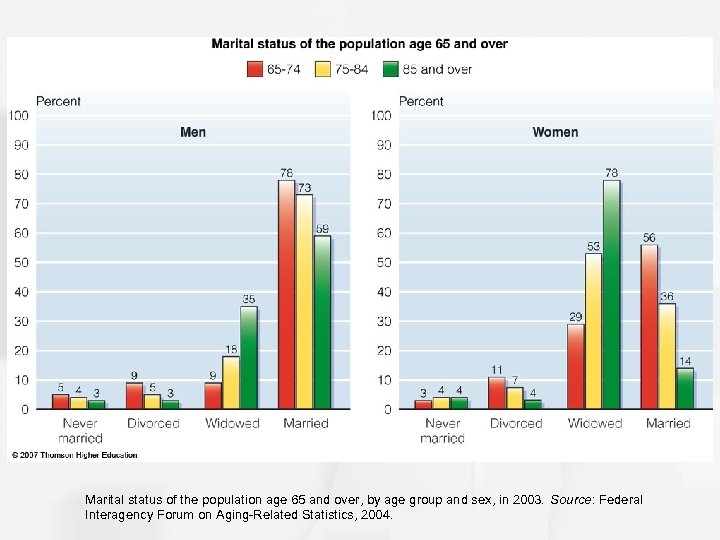 Marital status of the population age 65 and over, by age group and sex, in 2003. Source: Federal Interagency Forum on Aging-Related Statistics, 2004.
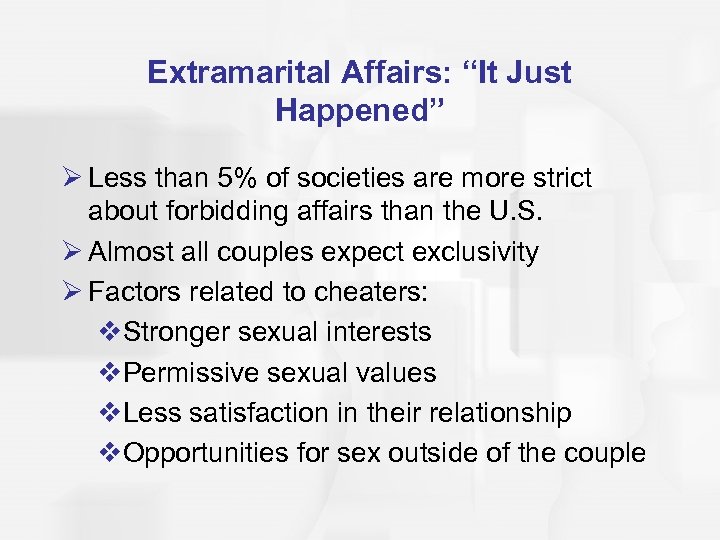 Extramarital Affairs: “It Just Happened” Ø Less than 5% of societies are more strict about forbidding affairs than the U. S. Ø Almost all couples expect exclusivity Ø Factors related to cheaters: v. Stronger sexual interests v. Permissive sexual values v. Less satisfaction in their relationship v. Opportunities for sex outside of the couple
 Extramarital Affairs: Attitudes Ø 75% of Americans believed extramarital sex was intolerable Ø 20% of women, 15 -35% of men reported extramarital sex
 Process of Developing an Affair Ø Become emotionally close to someone Ø Keep relationship secret Ø Start to do things together; “dating” Ø Sexual and emotional affair
 Extramarital Affairs: Issues & Trends Ø Married couples are the most deceptive about sex outside of the relationship Ø Women more likely disturbed by emotional infidelity; tend to engage in emotional affairs; tend to have affairs when older Ø Men more likely disturbed by sexual infidelity; tend to engage in sexual affairs; typically when younger Ø 90%+ affairs due to emotional needs not met
 Open Marriages: Sexual Advertising Ø Comarital sex – consenting of married couples to sexually exchange partners v. Swingers/Polyamorists Ø About 3 million swingers in the U. S. Ø Many support groups, internet contacts Ø Swingers tend to be white, middle-class, middle-aged church goers Ø Often have “safe-sex” circles
 Marriages in Other Cultures Ø Some countries do not have dating systems Ø All societies have marriage customs, though they vary among all societies Ø Arranged marriages still exist v 60% of marriages worldwide arranged v. Japanese business class, Iran, rural China Ø Courtship may be ritualized v. Yaruros of Venezuela, Hottentots of South Africa Ø Extramarital sex is forbidden in many cultures, but is often tolerated v. Typically tolerance is for men, not women
 Types of Marriages in Other Cultures Ø Polygamy – having more than one spouse Ø Polygyny – having more than one wife v. Common in Africa and the Middle East; Mormon fundamentalist groups in the U. S. v. Wives have lower fertility rates v. Men gain prestige & power, women gain protection of a wealthy man Ø Polyandry – having more than one husband v. Less common than polygyny v. Usually to keep inheritance together Ø Consanguineous marriages – woman marries a relative to maintain family property
 Same-Sex Relationships Ø Sexuality in Same-Sex Relationships Ø Same-Sex Marriage Ø Same-Sex Relationships in Other Cultures
 View Video: Marriage Ammendment
 Same-Sex Marriage: Issues & Trends Ø Same-sex marriage isn’t linked to procreation, which the U. S. attempts to guard Ø Same-sex marriages may be more unstable due to pressures of social disapproval Ø Domestic partner acts – benefits are granted if a couple lives together
 Sexuality in Same-Sex Relationships Ø Usually the emotionally expressive partner maintains the sex life, for lesbians & gay men Ø Some lesbians have trouble initiating sex v. May be due to female social pressures Ø Gay men have less troubles initiating sex and are more sexually active than lesbians v. May be due to longer love making for lesbians, biology, females’ comfort initiating, men use sex for expressing feelings
 Same-Sex Marriage: Legal Issues Ø Defense of Marriage Act (1996) – veach state can recognize or deny any same-sex marriages vspouse is referred to as the other sex Ø Vermont (2000) passed a civil union statute Ø Massachusetts (2004) gave full marriage rights to same sex couples Ø 7 states (CA, CT, DC, HI, ME, NJ, VT) grant legal status to same-sex couples
 Same-Sex Relationships in Other Cultures Ø Netherlands, Belgium, Canada, & Spain are the only Western countries that have currently legalized same-sex marriage Ø Australia provides equal rights Ø Accepted in France Ø Ireland lacks support
 Divorce Ø Why do People Get Divorced? Ø Divorce & Sex Ø Adjusting to Divorce
 Divorce: Issues Ø While it is reported that the divorce rate is 50% in U. S. , this is a misrepresentation of the likelihood of divorce! Ø No-fault divorce – makes divorce easier and more acceptable Ø Covenant marriages – restrictive rules & regulations for ending a marriage Ø Couples have many reasons for staying together, even though unhappy: vchildren, religion, lack initiative
 Divorce: Trends Ø Divorce rates are highest in teen women and decline with age Ø Early marriages have a greater risk of divorce Ø Typically, divorce occurs early in a marriage; median was 7. 1 years in 1988 Ø Interracial marriages have high divorce rates Ø Typically one partner wants the divorce (75% of the time female’s initiate), the other is shocked
 Why Do People Get Divorced? Ø Social Factors Ø Predisposing Factors Ø Relationship Factors Ø Divorce and Sex Ø Adjusting to Divorce Ø Divorce in Other Cultures
 Divorce: Social Factors Ø Accessibility and low cost Ø Equitable division of marital assets Ø More acceptable in U. S. society Ø Religious groups are less opposed than in the past
 Predisposing Factors for Divorce Ø Marry at a young age, emotional immaturity Ø Marry because of an unplanned pregnancy Ø Have more than five children Ø Short interval from marriage and children Ø Protestant (vs. Catholic or Jewish) Ø No religious affiliation Ø Prior divorce; divorced parents
 Relationship Factors in Divorce Ø Communication problems v. Avoidance, v. Demand & withdrawal v. Lack constructive communication Ø Women feel unloved, belittled, & criticized Ø Men feel neglected and that they have incompatible interests, values & goals Ø Both sexes reported loss of sexual interest
 Divorce and Sex Ø The older a person at divorce, the less sexual behavior afterwards Ø As religiousness increases, the likelihood of having another sexual partner decreases Ø Liberal attitudes & no children increase the likelihood of having another sexual partner Ø Men are more likely to find another partner
 Adjusting to Divorce Ø For some, it can be emotionally & physically painful Ø Women have increased depression, men have poorer physical & mental health Ø Older people experience more psychological problems Ø Divorced people have less in common with their married friends
 Adjusting to Divorce Ø Women’s incomes tend to decline Ø 20% of divorced fathers with children don’t provide assistance Ø Some women’s careers may improve Ø Most divorced individuals adjust well, and 75% remarry Ø Typically 4 years between divorce & remarriage Ø Men are more likely to remarry than women
 Divorce in Other Cultures Ø In most societies, divorce is relatively simple and accepted Ø Not so in mostly Roman Catholic countries Ø Easier for men to obtain a divorce in some countries v. Egypt, Israel Ø Many reasons for divorce, though different patterns in different societies
 Sexuality in Elderly Relationships
 View Video: “Love, Intimacy, and Sexuality (Growing Old in a New Age)”
 Sexuality in Elderly Relationships: Issues and Trends Ø Society links sexuality with youth, though most elderly are sexually interested and active Ø 50% of 60 years+ Americans report sex is as good, or better than, when they were younger Ø Frequency of intercourse declines with age Ø Sex once/month, or more – about 50% of those 60+; 40% wanted it more often
 Elderly Relationships: Sexual Behavior Ø Most common behaviors over 80: touching, masturbation, sexual intercourse Ø No differences related to sexual orientation Ø Preferences may change: less intercourse and more oral sex Ø Factors related to sexual maintenance: age, physical health, medications, satisfaction in life, partner availability
 Difficulties Ø Most common sexual problem for elderly women: lack of tenderness & sexual contact Ø Discontinuance of intercourse in a marriage is typically due to the male’s refusal or inability; erectile problems due to a variety of reasons