


 Скачать презентацию CHAPTER NINE Methods and Tools of Research This
b9af57badbcc12ef3f80fce018fd8680.ppt
- Количество слайдов: 49
 CHAPTER NINE Methods and Tools of Research This multimedia product and its contents are protected under copyright law. The following are prohibited by law: • Any public performance or display, including transmission of any image over a network; • Preparation of any derivative work, including the extraction, in whole or in part, of any images; • Any rental, lease, or lending of the program. Copyright © Allyn & Bacon 2008
 Scales ► Nominal (gender, race) ► Ordinal (rank) ► Interval (Exams, scores, Likert type) ► Ratio (Age, height, number of) Copyright © Allyn & Bacon 2008
 Important Elements § Validity § Reliability § Economy § Interest (motivating, interesting) Copyright © Allyn & Bacon 2008
 Reliability ► Refers to the extent to which assessments are consistent. ► If you weigh five pounds of potatoes in the morning, and the scale is reliable, the same scale should register five pounds for the potatoes an hour later
 Types of reliability ► Test-retest ► Parallel or equivalent forms ► Internal consistency § Split halves § Kuder Richardson (is a measure of internal consistency reliability for measures with dichotomous choices) § Cronbach’s alpha (Cronbach's alpha is used for non-dichotomous continuous measures) ► Inter-scorer or inter-rater reliability ► Standard error of measurement or
 Difference between Validity & Reliability ► If a test is reliable it is accurate but we don’t know it measures what we want to measure. ► If a test is valid we know it measures what we want it to measure. Copyright © Allyn & Bacon 2008
 So ► Even if a test is reliable, it may not be valid ► If a test is not reliable it cannot be valid ► If a test is valid, it is almost always reliable.
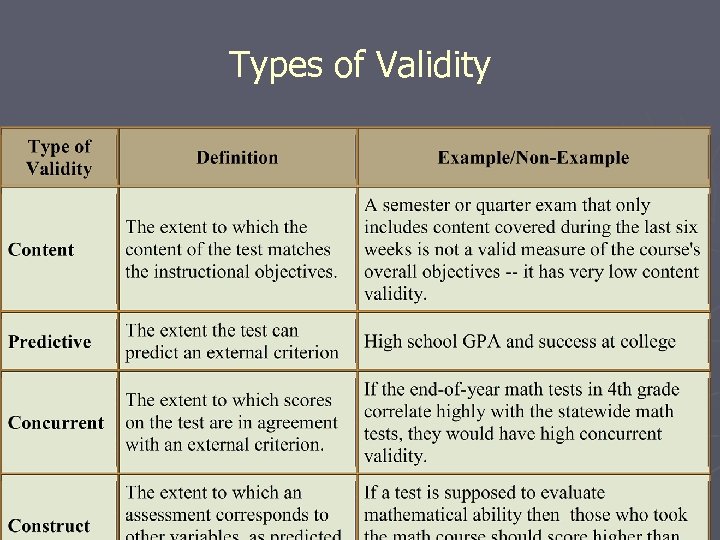 Types of Validity
 Types of tests and inventories ► Achievement tests ► Aptitude tests ► Interest inventories ► Personality inventories ► Projectile Devices § Association § Completion § Role-playing § Creative or constructive Copyright © Allyn & Bacon 2008
 Achievement tests ► Most tests used in schools ► Used in placing, advancing, and retaining students ► Diagnostics ► Standardized tests (compare schools & districts) IGAP, CAT Copyright © Allyn & Bacon 2008
 Aptitude tests ► To predict future achievement in a particular field ► We cannot measure capacity or aptitude but we can measure performance in unplanned learning ► Example, music aptitude test, reading readiness, Copyright © Allyn & Bacon 2008
 IQ tests ► Aptitude tests are limited to a particular field like music, math, . . . etc ► IQ is general ability to learn fast and to learn mentally difficult tasks ► Stanford-Binet, WAIS, WPPSI, WISC_R Copyright © Allyn & Bacon 2008
 Interest inventories ► Kuder Preference Record ► Strong-Campbell Interest Inventory (type of jobs interested) Copyright © Allyn & Bacon 2008
 Personality inventories ► Self-report Problem ? Individuals’ inability or unwillingness to report their own reactions or their own attitudes = Low validity Implicit Measures Copyright © Allyn & Bacon 2008
 Projective Devices ► Association Tests The respondent is asked to indicate what he/she thinks when presented with a picture , cartoon, ink blot, word, or phrase. Copyright © Allyn & Bacon 2008
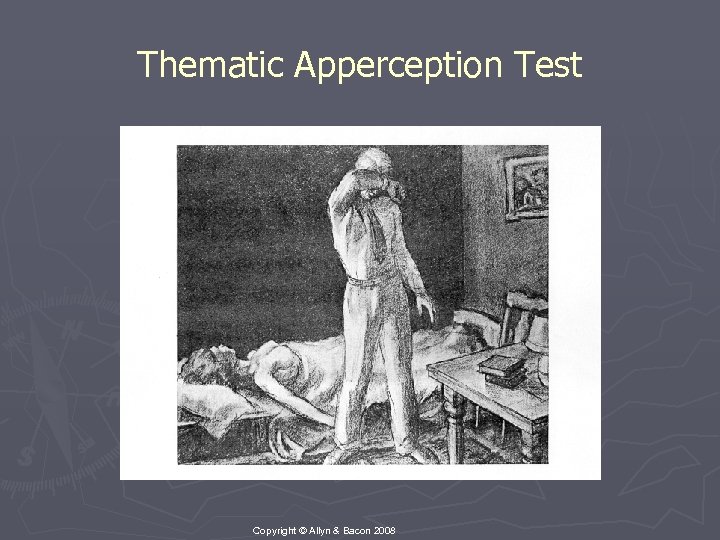 Thematic Apperception Test Copyright © Allyn & Bacon 2008
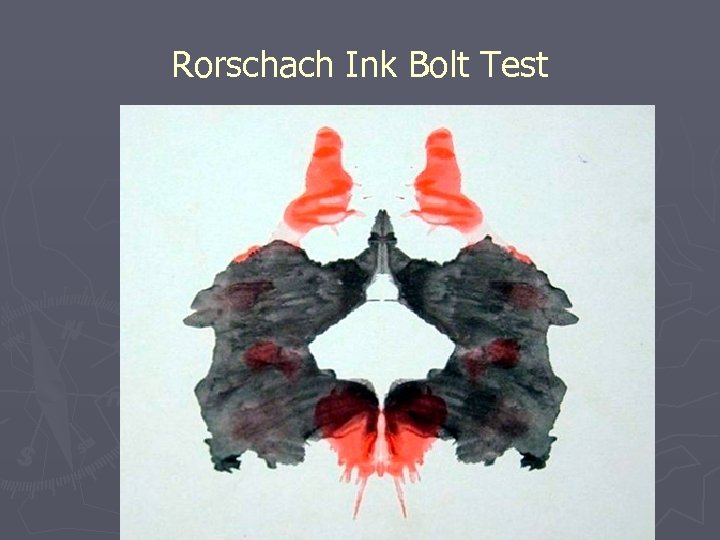 Rorschach Ink Bolt Test Copyright © Allyn & Bacon 2008
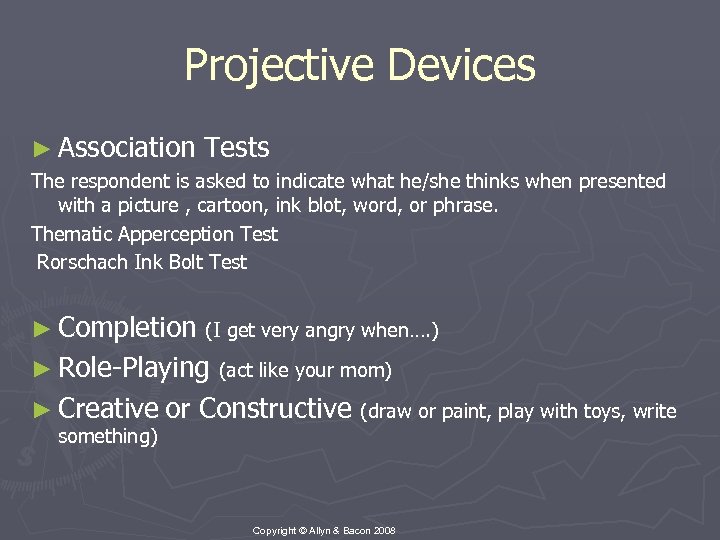 Projective Devices ► Association Tests The respondent is asked to indicate what he/she thinks when presented with a picture , cartoon, ink blot, word, or phrase. Thematic Apperception Test Rorschach Ink Bolt Test ► Completion (I get very angry when…. ) ► Role-Playing (act like your mom) ► Creative or something) Constructive (draw or paint, play with toys, write Copyright © Allyn & Bacon 2008
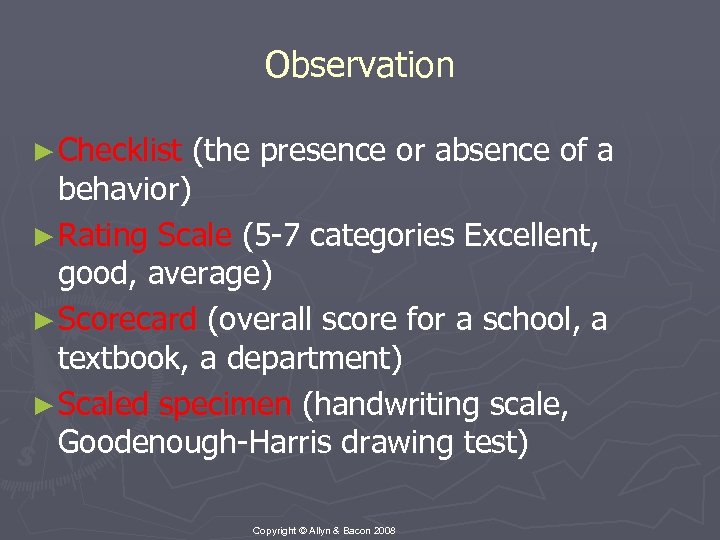 Observation ► Checklist (the presence or absence of a behavior) ► Rating Scale (5 -7 categories Excellent, good, average) ► Scorecard (overall score for a school, a textbook, a department) ► Scaled specimen (handwriting scale, Goodenough-Harris drawing test) Copyright © Allyn & Bacon 2008
 Attitude assessment (opinionnaire) Copyright © Allyn & Bacon 2008
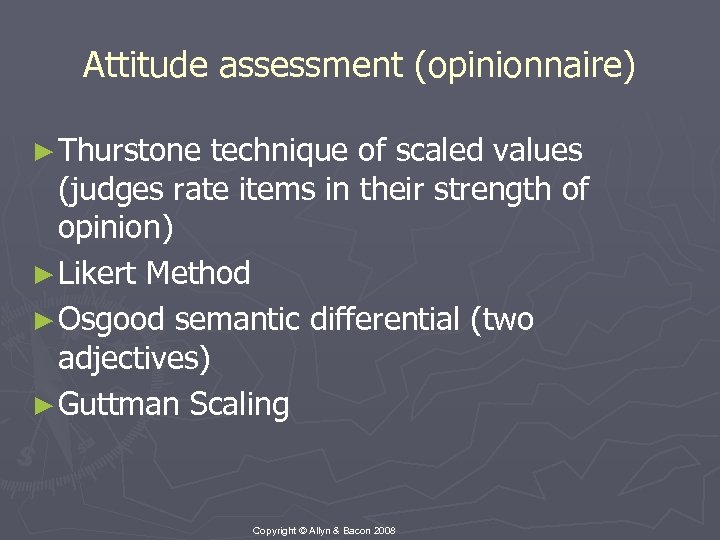 Attitude assessment (opinionnaire) ► Thurstone technique of scaled values (judges rate items in their strength of opinion) ► Likert Method ► Osgood semantic differential (two adjectives) ► Guttman Scaling Copyright © Allyn & Bacon 2008
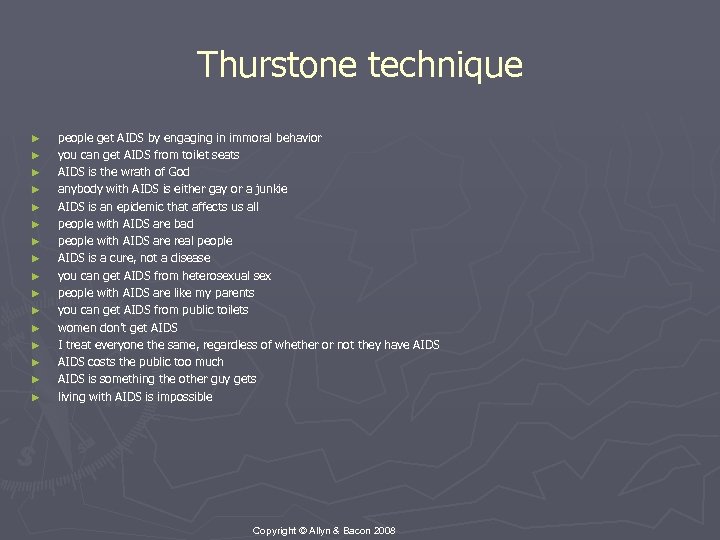 Thurstone technique ► ► ► ► people get AIDS by engaging in immoral behavior you can get AIDS from toilet seats AIDS is the wrath of God anybody with AIDS is either gay or a junkie AIDS is an epidemic that affects us all people with AIDS are bad people with AIDS are real people AIDS is a cure, not a disease you can get AIDS from heterosexual sex people with AIDS are like my parents you can get AIDS from public toilets women don’t get AIDS I treat everyone the same, regardless of whether or not they have AIDS costs the public too much AIDS is something the other guy gets living with AIDS is impossible Copyright © Allyn & Bacon 2008
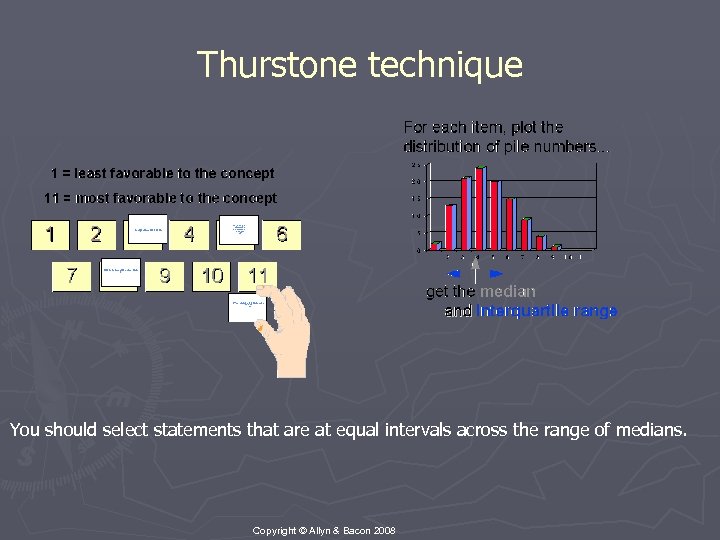 Thurstone technique You should select statements that are at equal intervals across the range of medians. Copyright © Allyn & Bacon 2008
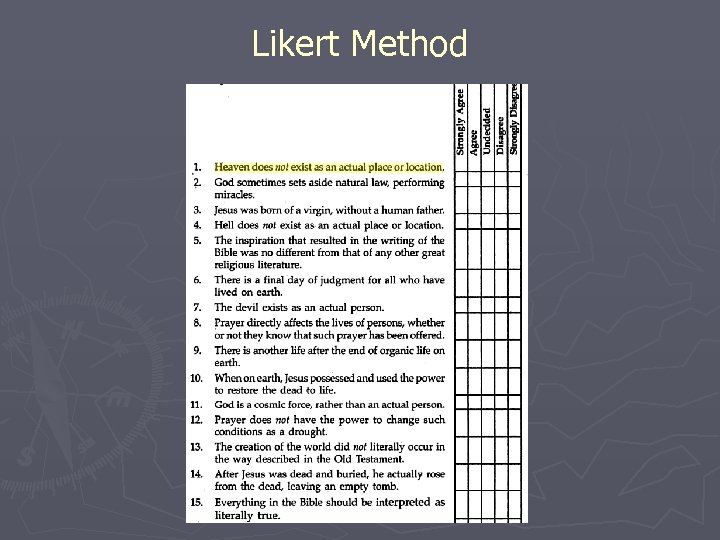 Likert Method
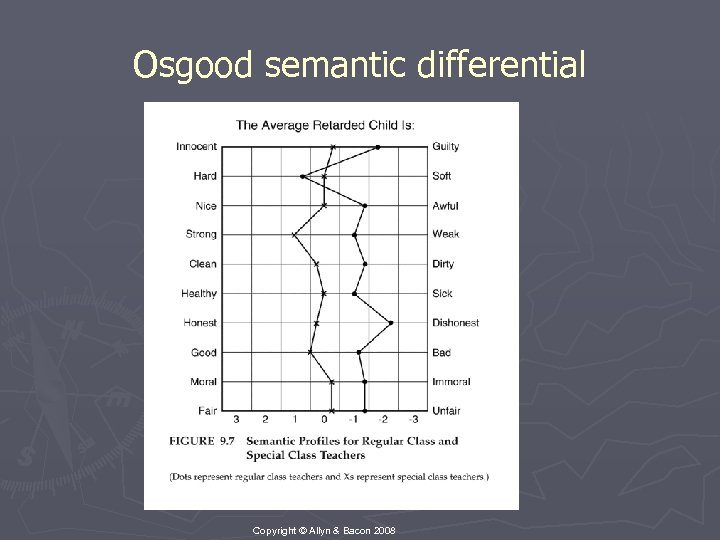 Osgood semantic differential Copyright © Allyn & Bacon 2008
 Guttman Scaling Cumulative scaling or scalogram analysis Gives us a set of items or statements so that a respondent who agrees with any specific question in the list will also agree with all previous questions ► (1) "I am willing to be near ice cream"; (2) "I am willing to smell ice cream"; (3) "I am willing to eat ice cream"; and (4) "I love to eat ice cream". Copyright © Allyn & Bacon 2008
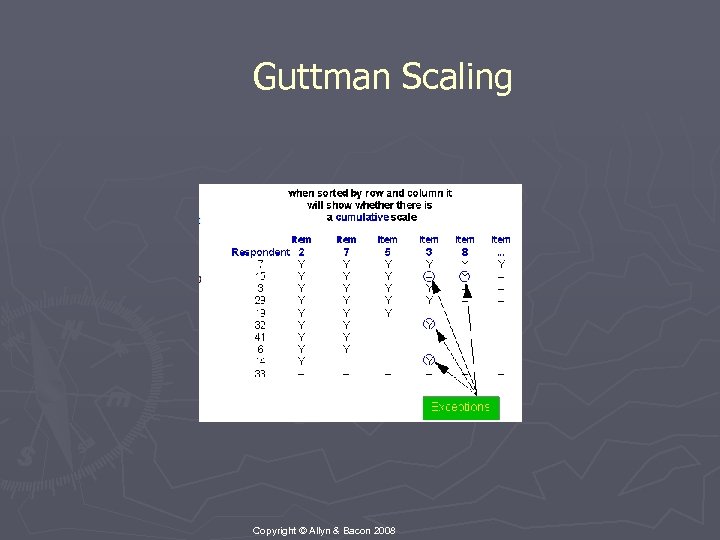 Guttman Scaling Copyright © Allyn & Bacon 2008
 Q methodology ► Q- sort ►A large number of items (opinions) are sorted into different (9 -11) categories (piles) Most important Most approve Most liberal Most favorable least important least approve least liberal least favorable Copyright © Allyn & Bacon 2008
 Social Scaling (stereotypes) ► Sociometry ► Sociogram ► Guess-Who technique ► Social distance scale Copyright © Allyn & Bacon 2008
 Sociometry ► subjects are asked to name in order of preference the persons that they would invite to A party Eat lunch with Sit next to Work on a class project Have as BFF Copyright © Allyn & Bacon 2008
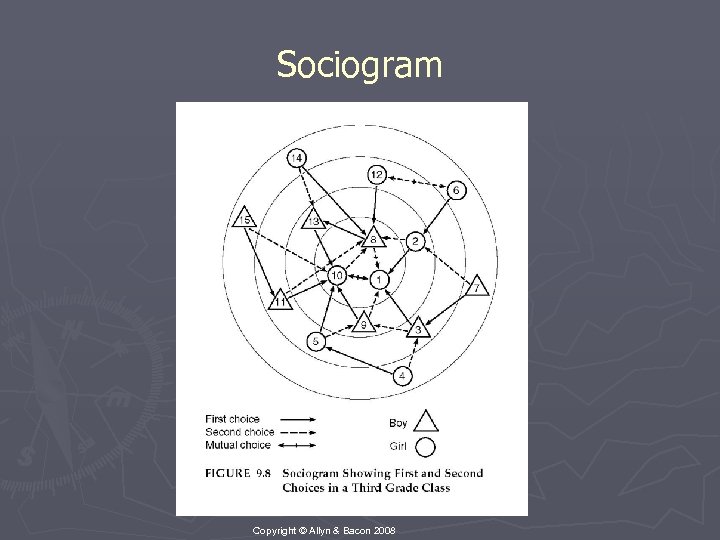 Sociogram Copyright © Allyn & Bacon 2008
 Guess-Who technique ► Hartshorne & May ► Descriptions of various roles played by children in a group § § § This one is always happy This one is always picking on others This one is always worried This one never likes to do anything This one will always help you Copyright © Allyn & Bacon 2008
 Bogardus Social distance scale ► The scale asks people the extent to which they would be accepting of each group (a score of 1. 00 for a group is taken to indicate no social distance): As close relatives by marriage (score 1. 00) ► As my close personal friends (2. 00) ► As neighbors on the same street (3. 00) ► As co-workers in the same occupation (4. 00) ► As citizens in my country (5. 00) ► As only visitors in my country (6. 00) ► Would exclude from my country (7. 00) ► Copyright © Allyn & Bacon 2008
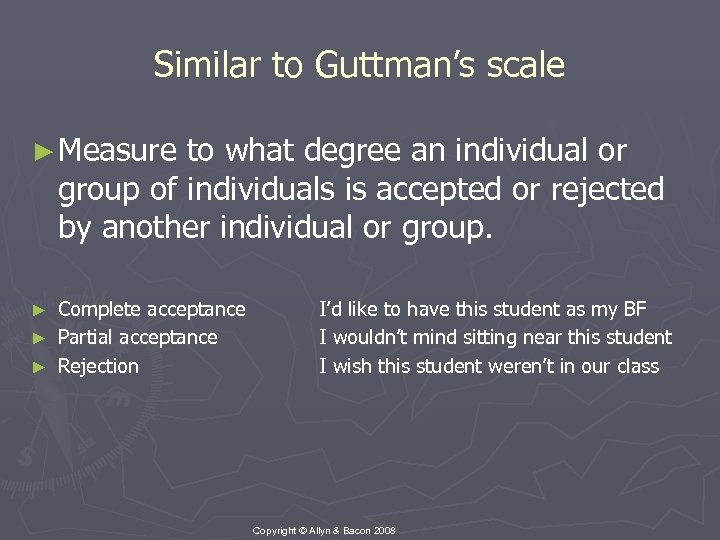 Similar to Guttman’s scale ► Measure to what degree an individual or group of individuals is accepted or rejected by another individual or group. Complete acceptance ► Partial acceptance ► Rejection ► I’d like to have this student as my BF I wouldn’t mind sitting near this student I wish this student weren’t in our class Copyright © Allyn & Bacon 2008
 The Questionnaire ► Inquiry Forms: § Open Form § Closed Form Copyright © Allyn & Bacon 2008
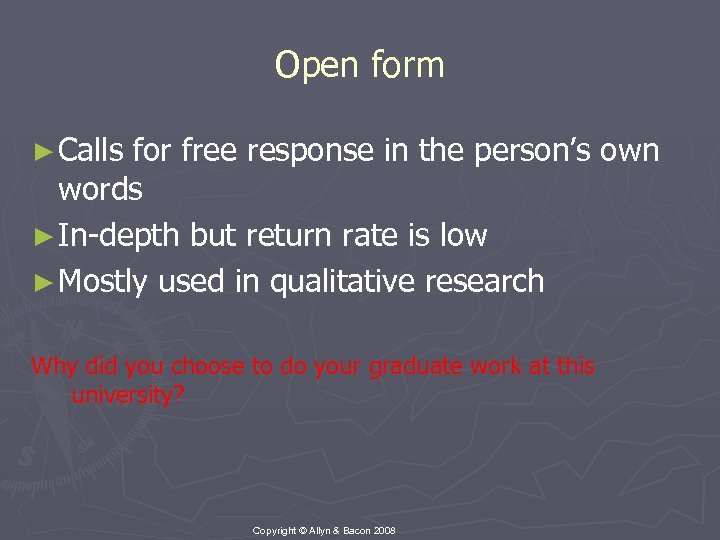 Open form ► Calls for free response in the person’s own words ► In-depth but return rate is low ► Mostly used in qualitative research Why did you choose to do your graduate work at this university? Copyright © Allyn & Bacon 2008
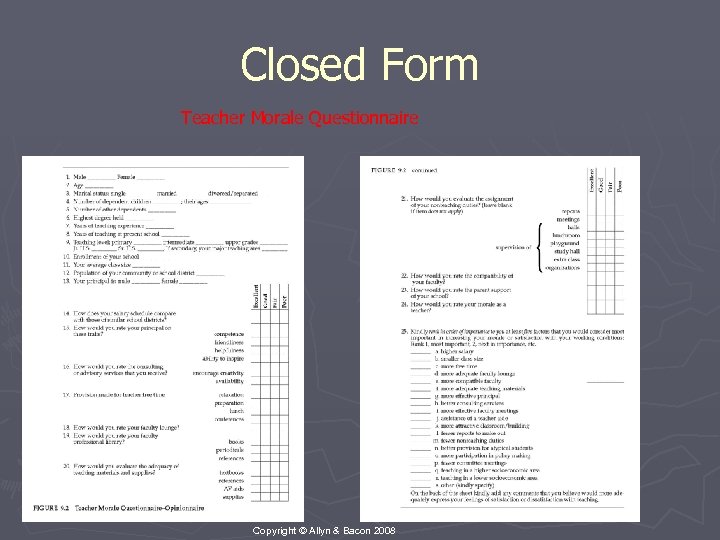 Closed Form Teacher Morale Questionnaire Copyright © Allyn & Bacon 2008
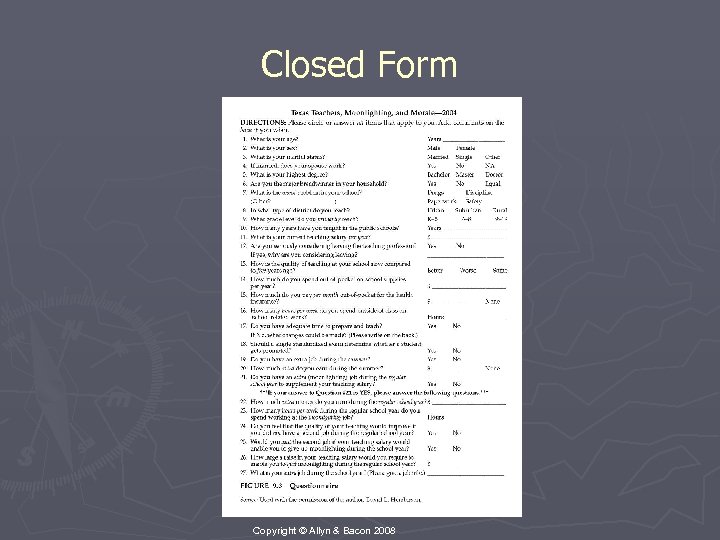 Closed Form Copyright © Allyn & Bacon 2008
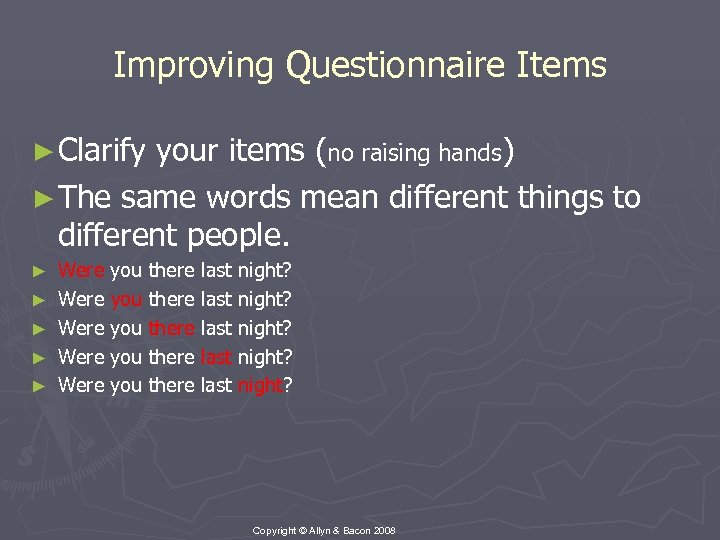 Improving Questionnaire Items ► Clarify your items (no raising hands) ► The same words mean different things to different people. ► ► ► Were you there last night? Were you there last night? Copyright © Allyn & Bacon 2008
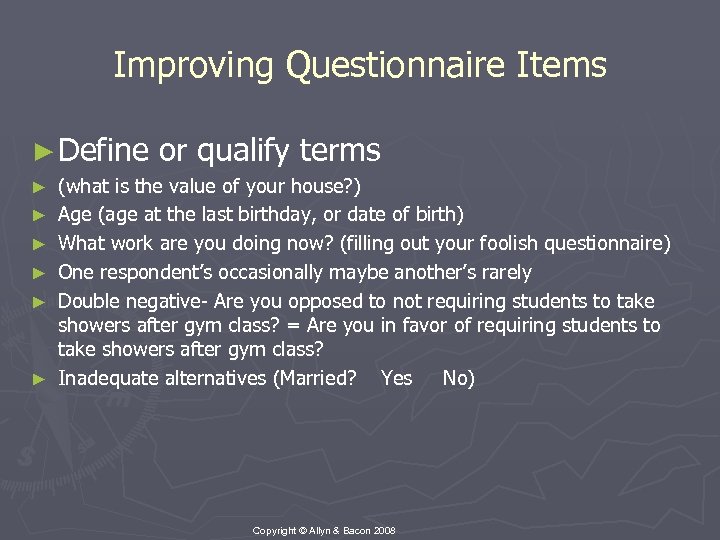 Improving Questionnaire Items ► Define ► ► ► or qualify terms (what is the value of your house? ) Age (age at the last birthday, or date of birth) What work are you doing now? (filling out your foolish questionnaire) One respondent’s occasionally maybe another’s rarely Double negative- Are you opposed to not requiring students to take showers after gym class? = Are you in favor of requiring students to take showers after gym class? Inadequate alternatives (Married? Yes No) Copyright © Allyn & Bacon 2008
 What is wrong with this question? ► How late at night do you permit your children to watch television? Copyright © Allyn & Bacon 2008
 What is wrong with this question? ► "do you think that students should have more classes about history and culture? " Copyright © Allyn & Bacon 2008
 Underline Keyword ► Should all schools offer a modern foreign language? Copyright © Allyn & Bacon 2008
 What is wrong with this question? ► How would you rate this student teacher’s classroom demeanor? Superior Average Copyright © Allyn & Bacon 2008 Below average
 What is wrong with this question? ► Are you satisfied with the salary raise that you received last year? Copyright © Allyn & Bacon 2008
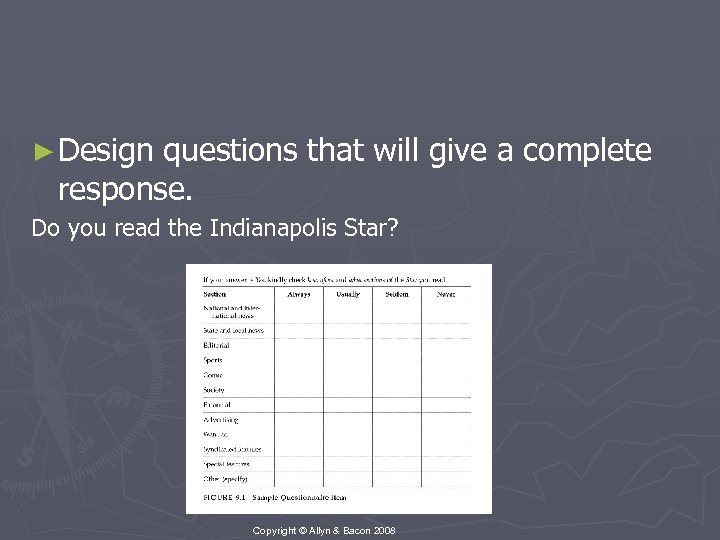 ► Design questions that will give a complete response. Do you read the Indianapolis Star? Copyright © Allyn & Bacon 2008
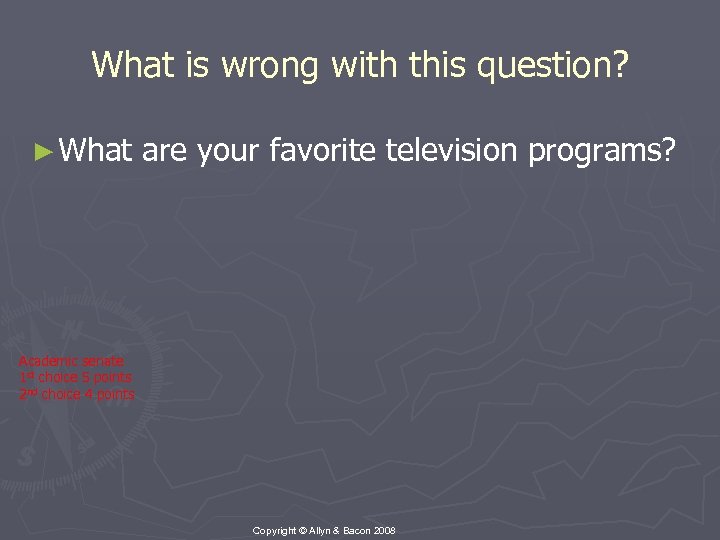 What is wrong with this question? ► What are your favorite television programs? Academic senate 1 st choice 5 points 2 nd choice 4 points Copyright © Allyn & Bacon 2008
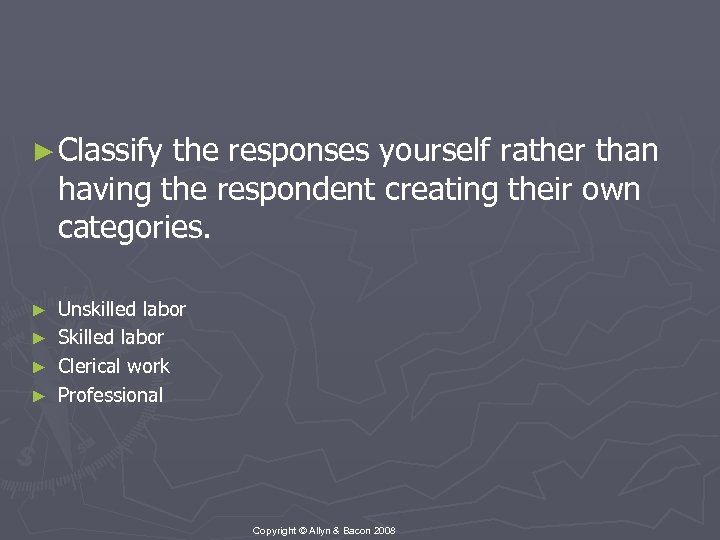 ► Classify the responses yourself rather than having the respondent creating their own categories. Unskilled labor ► Skilled labor ► Clerical work ► Professional ► Copyright © Allyn & Bacon 2008
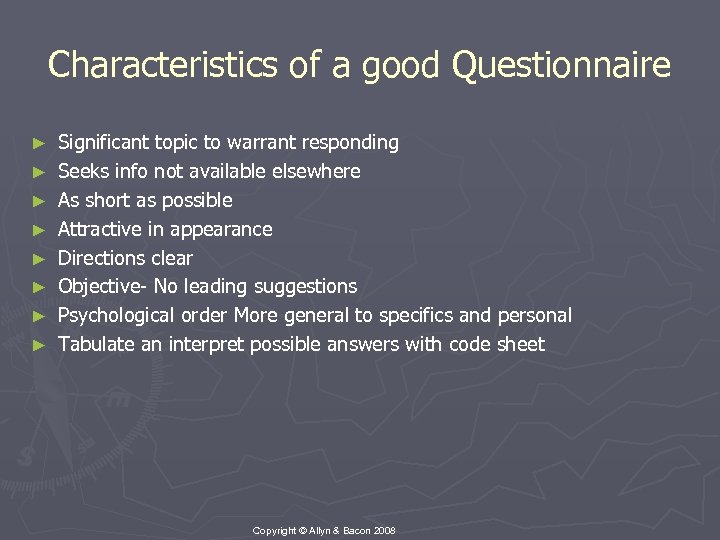 Characteristics of a good Questionnaire ► ► ► ► Significant topic to warrant responding Seeks info not available elsewhere As short as possible Attractive in appearance Directions clear Objective- No leading suggestions Psychological order More general to specifics and personal Tabulate an interpret possible answers with code sheet Copyright © Allyn & Bacon 2008