


 Скачать презентацию Chapter Introduction Section 1 America and the World
6d1d1856b2706e7aef8c290fca325029.ppt
- Количество слайдов: 53
 Chapter Introduction Section 1 America and the World Section 2 World War II Begins Section 3 The Holocaust Section 4 America Enters the War Chapter Summary Chapter Assessment Click on a hyperlink to view the corresponding slides.
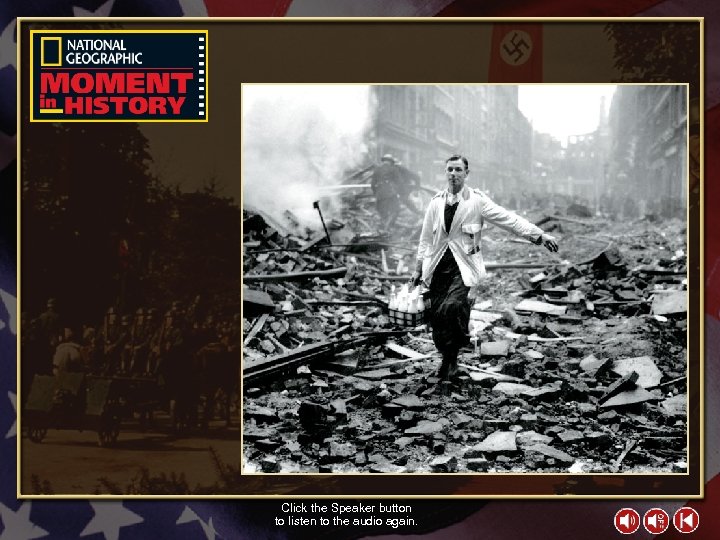
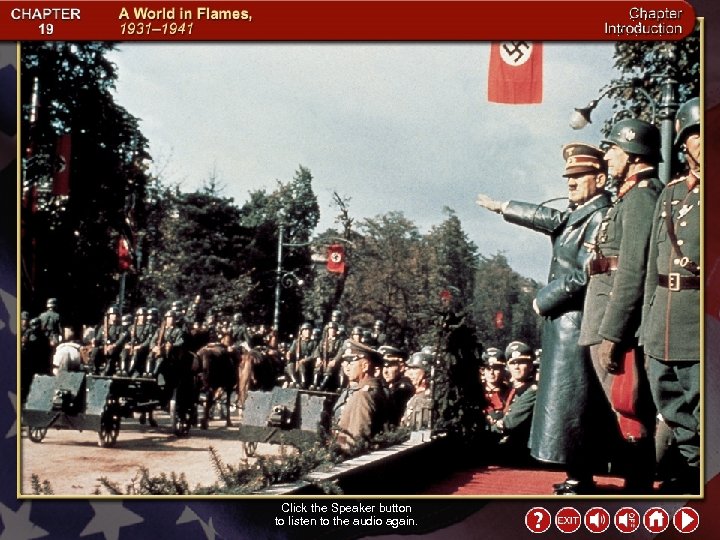 Click the Speaker button to listen to the audio again.
 Why It Matters After World War I, Europe was unstable. Fascists led by Benito Mussolini seized power in Italy, and Adolf Hitler and the Nazis took control of Germany. Meanwhile, Japan expanded its territory in Asia. As the Nazis gained power, they began a campaign of violence against Jews. When Germany attacked Poland, World War II began. The United States clung to neutrality until Japan attacked Pearl Harbor.
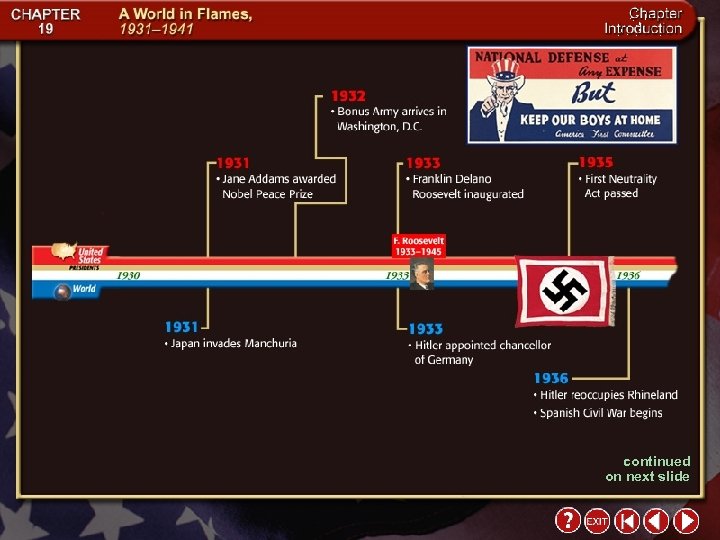 continued on next slide
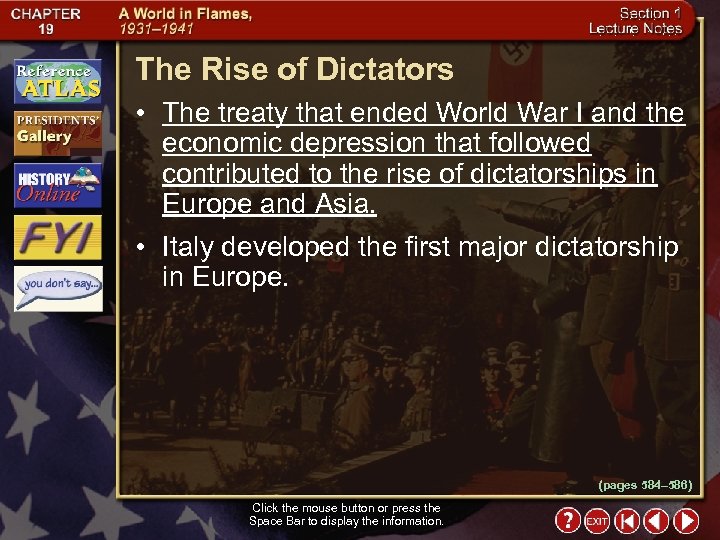 The Rise of Dictators • The treaty that ended World War I and the economic depression that followed contributed to the rise of dictatorships in Europe and Asia. • Italy developed the first major dictatorship in Europe. (pages 584– 586) Click the mouse button or press the Space Bar to display the information.
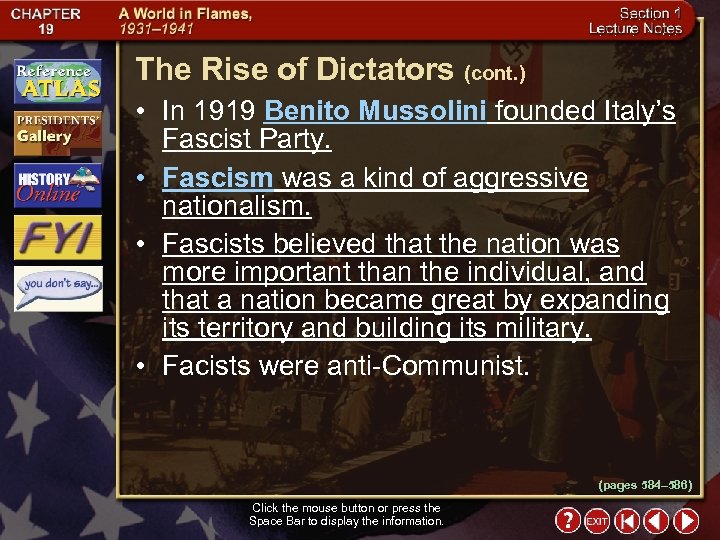 The Rise of Dictators (cont. ) • In 1919 Benito Mussolini founded Italy’s Fascist Party. • Fascism was a kind of aggressive nationalism. • Fascists believed that the nation was more important than the individual, and that a nation became great by expanding its territory and building its military. • Facists were anti-Communist. (pages 584– 586) Click the mouse button or press the Space Bar to display the information.
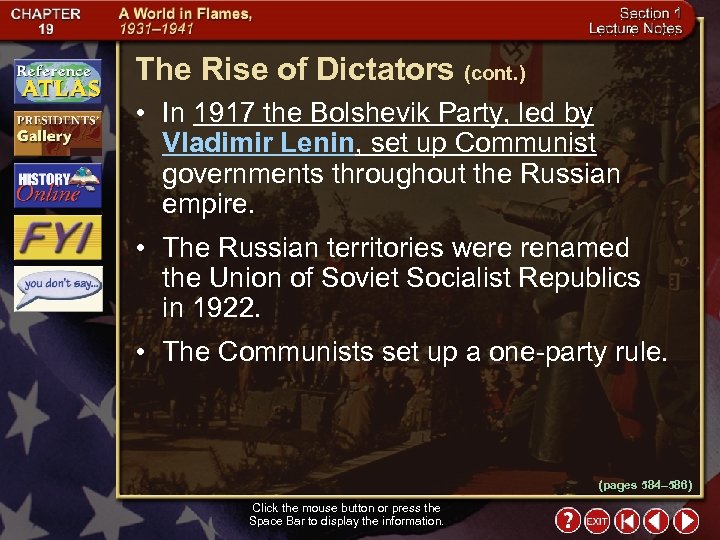 The Rise of Dictators (cont. ) • In 1917 the Bolshevik Party, led by Vladimir Lenin, set up Communist governments throughout the Russian empire. • The Russian territories were renamed the Union of Soviet Socialist Republics in 1922. • The Communists set up a one-party rule. (pages 584– 586) Click the mouse button or press the Space Bar to display the information.
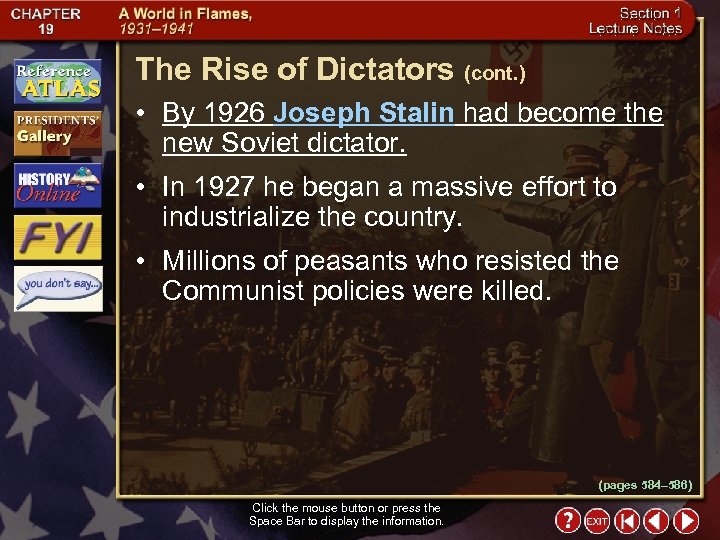 The Rise of Dictators (cont. ) • By 1926 Joseph Stalin had become the new Soviet dictator. • In 1927 he began a massive effort to industrialize the country. • Millions of peasants who resisted the Communist policies were killed. (pages 584– 586) Click the mouse button or press the Space Bar to display the information.
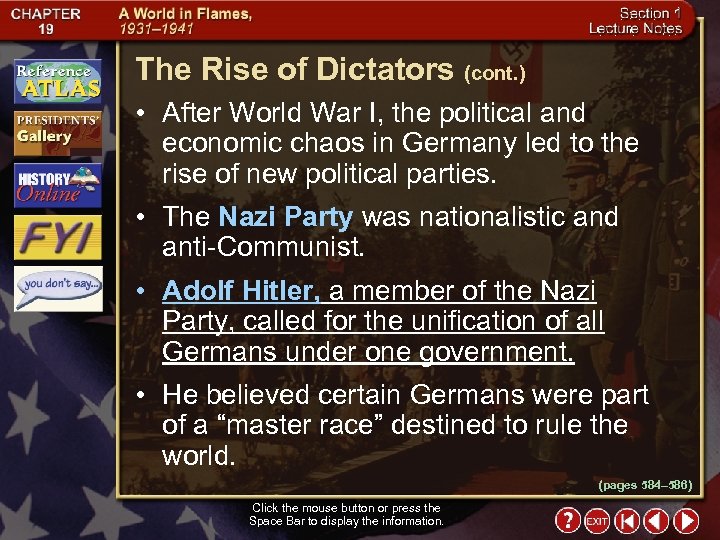 The Rise of Dictators (cont. ) • After World War I, the political and economic chaos in Germany led to the rise of new political parties. • The Nazi Party was nationalistic and anti-Communist. • Adolf Hitler, a member of the Nazi Party, called for the unification of all Germans under one government. • He believed certain Germans were part of a “master race” destined to rule the world. (pages 584– 586) Click the mouse button or press the Space Bar to display the information.
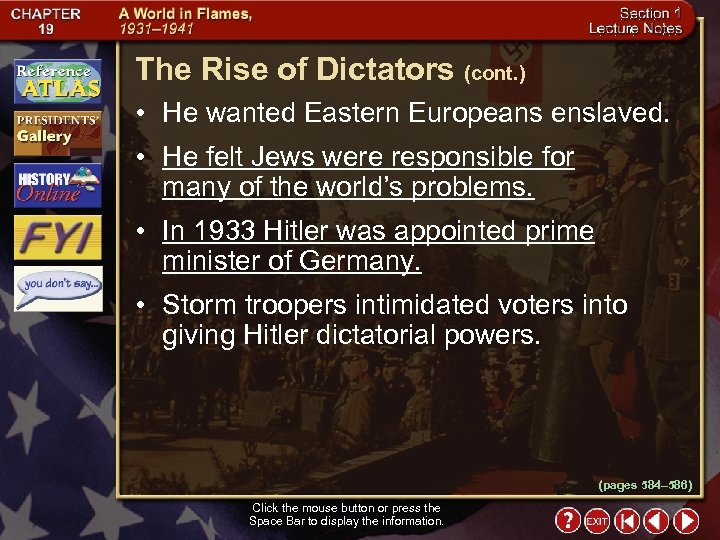 The Rise of Dictators (cont. ) • He wanted Eastern Europeans enslaved. • He felt Jews were responsible for many of the world’s problems. • In 1933 Hitler was appointed prime minister of Germany. • Storm troopers intimidated voters into giving Hitler dictatorial powers. (pages 584– 586) Click the mouse button or press the Space Bar to display the information.
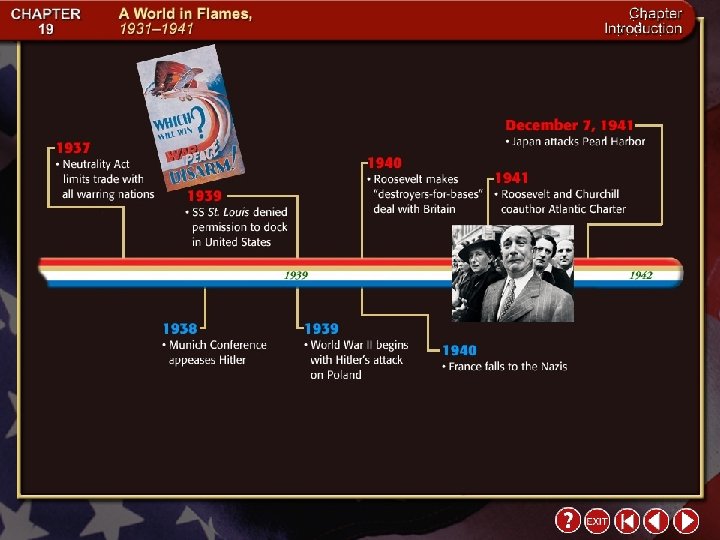
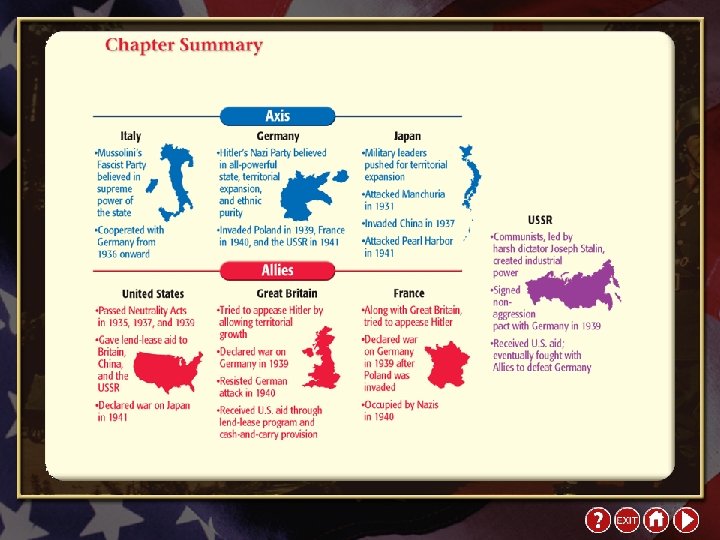
 America Turns to Neutrality (cont. ) • Japan aligned itself with Germany and Italy, and these three countries became known as the Axis Powers. • After Japan launched a full-scale attack on China in 1937, Roosevelt authorized the sale of weapons to China, saying that the Neutrality Act of 1937 did not apply, since neither China nor Japan had actually declared war. (pages 587– 588) Click the mouse button or press the Space Bar to display the information.
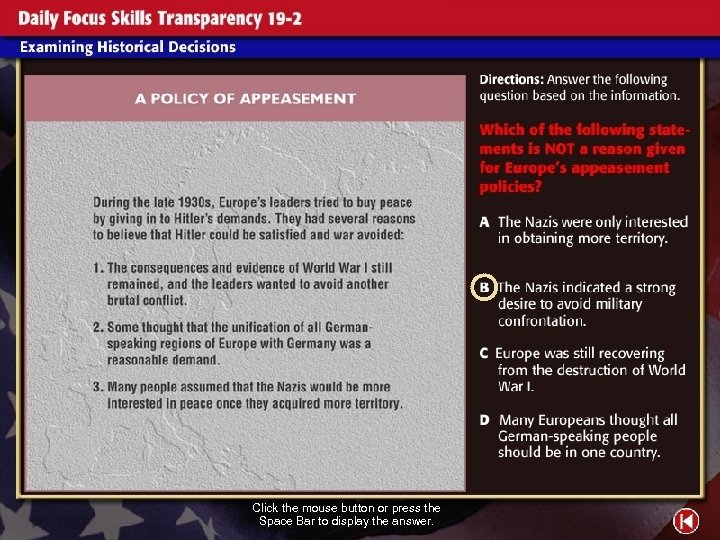
 Guide to Reading (cont. ) Section Theme Continuity and Change The desire of the French and British to avoid another war helped encourage Hitler’s aggression in Europe. 33 -Hitler becomes Chancellor 34 -Hitler becomes Fuhrer-absolute leader 35 -Military Draft-Violation 36 -Occupies Rhineland-Violation 38 -Combines Austria to Germany 38 -Takes Sudetenland/Czech 39 -Takes all of Czech 39 -Invades Poland War is FINALLY declared
 “Peace in Our Time” (cont. ) • At the Munich Conference on September 29, 1938, Britain and France, hoping to prevent another war, agreed to Hitler’s demands in a policy known as appeasement. • In March 1939, Germany sent troops into Czechoslovakia, bringing the Czech lands under German control. (pages 589– 591) Click the mouse button or press the Space Bar to display the information.
 “Peace in Our Time” • Germany and The Soviet Union sign a secret Peace Treaty in Aug 1939, promising not to attack each other. Non. Aggression Pact. • Germany invades Poland on Sept 1, 1939 and the Soviets do as well two weeks later. • Germany and Soviets split up Poland (pages 589– 591) Click the mouse button or press the Space Bar to display the information.
 “Peace in Our Time” (cont. ) Why did Britain and France agree to Hitler’s demands for the Sudetenland? They hoped that they could give Hitler the Sudetenland in exchange for peace. Also, this bought Britain time to get ready for war. Some thought Hitler’s demand that all German-speaking regions of Europe be united with Germany was reasonable. (pages 589– 591) Click the mouse button or press the Space Bar to display the answer.
 The War Begins • The Germans used a blitzkrieg, or lightening war, to attack Poland. • The Polish army was defeated by October 5. (pages 591– 593) Click the mouse button or press the Space Bar to display the information.
 The War Begins (cont. ) • On April 9, 1940, the German army attacked Norway and Denmark. • Within a month, Germany overtook both countries. (pages 591– 593) Click the mouse button or press the Space Bar to display the information.
 The War Begins (cont. ) • After World War I, the French built a line of concrete bunkers and fortifications called the Maginot Line along the German border. • When Hitler decided to attack France, he went around the Maginot Line by invading the Netherlands, Belgium, and Luxembourg. • The French and British forces quickly went into Belgium, becoming trapped there by German forces. (pages 591– 593) Click the mouse button or press the Space Bar to display the information.
 The War Begins (cont. ) • By June 4, about 338, 000 British and French troops had evacuated Belgium through the French port of Dunkirk and across the English Channel, using ships of all sizes. The Great Rescue • On June 22, 1940, France surrendered to the Germans. (pages 591– 593) Click the mouse button or press the Space Bar to display the information.
 Britain Remains Defiant • Hitler thought that Britain would negotiate peace after France surrendered. • He did not anticipate the bravery of the British people and their prime minister, Winston Churchill. • On June 4, 1940, Churchill delivered a defiant speech that rallied the British people and alerted the United States to Britain’s plight. (pages 593– 594) Click the mouse button or press the Space Bar to display the information.
 Britain Remains Defiant (cont. ) • To invade Britain, Germany had to defeat the British air force. • In the Battle of Britain, the German air force, the Luftwaffe, launched an all -out air battle to destroy the British Royal Air Force. • After German bombers bombed London, the British responded by bombing Berlin, Germany. (pages 593– 594) Click the mouse button or press the Space Bar to display the information.
 Britain Remains Defiant (cont. ) • The Royal Air Force was greatly outnumbered by the Luftwaffe, but the British had radar stations and were able to detect incoming German aircraft and direct British fighters to intercept them. (pages 593– 594)
 Checking for Understanding Define Match the terms on the right with their definitions on the left. __ 1. accepting demands in order to A avoid conflict __ 2. name given to sudden violent B offensive attacks the Germans used during World War II; “lightning war” Click the mouse button or press the Space Bar to display the answers. A. appeasement B. blitzkrieg
 Checking for Understanding (cont. ) Explain why Hitler was able to take over Austria and Czechoslovakia. Britain and France gave in to Hitler’s demands. Click the mouse button or press the Space Bar to display the answer.
 Critical Thinking Evaluating Why were the British able to prevent the Germans from invading their country? Britain was an island, with a strong air force, navy, and radar stations. Click the mouse button or press the Space Bar to display the answer.
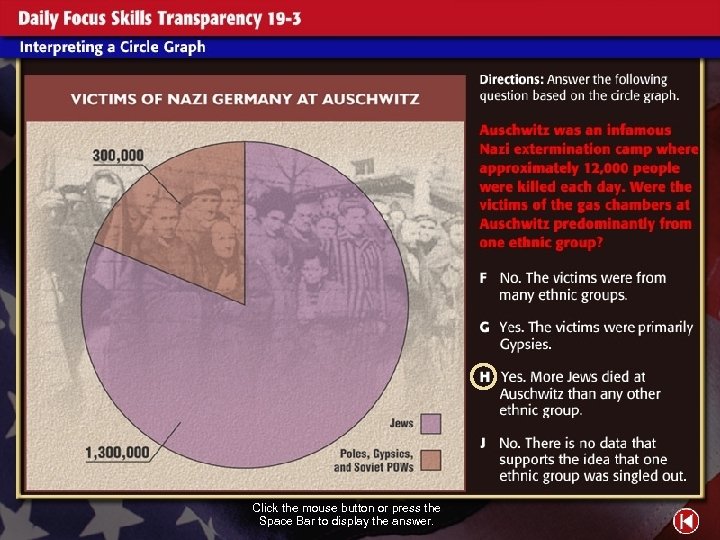
 Nazi Persecution of the Jews • The Nazis killed nearly 6 million Jews and millions of other people during the Holocaust. • The Nazis persecuted anyone who opposed them, as well as the disabled, Gypsies, homosexuals, and Slavic peoples. • The Nazis’ strongest hatred was aimed at all Jews. (pages 595– 598) Click the mouse button or press the Space Bar to display the information.
 Nazi Persecution of the Jews (cont. ) • Anti-Jewish violence erupted throughout Germany and Austria on November 9, 1938, known as Kristallnacht, or “night of broken glass. ” • Ninety Jews died, hundreds were badly injured, thousands of Jewish businesses were destroyed, and over 180 synagogues were wrecked. (pages 595– 598) Click the mouse button or press the Space Bar to display the information.
 Nazi Persecution of the Jews (cont. ) • Between 1933 and the beginning of World War II in 1939, about 350, 000 Jews escaped Nazi-controlled Germany. • Many of them emigrated to the United States. • Albert Einstein was the most famous of these. (pages 595– 598) Click the mouse button or press the Space Bar to display the information.
 The Final Solution • On January 20, 1942, Nazi leaders met at the Wannsee Conference to decide the “final solution” of the Jews and other “undesirables. ” • The plan was to round up Jews take them to concentration camps–detention centers where healthy individuals worked as slave laborers. • The elderly, the sick, and young children were sent to extermination camps to be killed in large gas chambers. (pages 599– 600) Click the mouse button or press the Space Bar to display the information.
 Checking for Understanding Define Match the terms on the right with their definitions on the left. __ 1. a camp where prisoners were C sent to be executed __ 2. name given to the mass A slaughter of Jews and other groups by the Nazis during World War II B __ 3. a camp where persons are detained or confined Click the mouse button or press the Space Bar to display the answers. A. Holocaust B. concentration camp C. extermination camp
 Checking for Understanding (cont. ) List the groups of people who were persecuted by the Nazis. Jews, the disabled, Gypsies, homosexuals, and Slavic peoples were persecuted by the Nazis. Click the mouse button or press the Space Bar to display the answer.
 Analyzing Visuals Analyzing Photographs Study the photographs of the Final Solution on pages 597– 599 of your textbook. How do the photographs show the systematic destruction of Jewish life? The photographs show stages of Hitler’s campaign, from civil discrimination and violence to deportation to camps. Click the mouse button or press the Space Bar to display the answer.
 FDR Supports England • Two days after Britain and France declared war against Germany, President Roosevelt declared the United States neutral. • The Neutrality Act of 1939 allowed warring countries to buy weapons from the United States as long as they paid cash and carried the arms away on their own ships. (pages 601– 602) Click the mouse button or press the Space Bar to display the information.
 FDR Supports England (cont. ) • President Roosevelt used a loophole in the Neutrality Act of 1939 and sent 50 old American destroyers to Britain in exchange for the right to build American bases on British-controlled Newfoundland, Bermuda, and Caribbean islands. (pages 601– 602)
 The Isolationist Debate (cont. ) • President Roosevelt ran for an unprecedented third term as president in the election of 1940. • Roosevelt won by a large margin. (pages 602– 603) Click the mouse button or press the Space Bar to display the information.
 Edging Toward War • President Roosevelt proposed the Lend. Lease Act, which stated that the United States could lend or lease arms to any country considered “vital to the defense of the United States. ” (pages 603– 604) Click the mouse button or press the Space Bar to display the information.
 Edging Toward War (cont. ) • In June 1941, in violation of the Nazi. Soviet Pact, Hitler began a massive invasion of the Soviet Union. • One of the Biggest Blunders in History!! • Creating a two-front War! (pages 603– 604)
 Japan Attacks the United States (cont. ) • In July 1940, Congress passed the Export Control Act, giving Roosevelt the power to restrict the sale of strategic materials– materials important for fighting a war–to other countries. • Roosevelt immediately blocked the sale of airplane fuel and scrap iron to Japan. • The Japanese signed an alliance with Germany and Italy called the Axis Powers. (pages 604– 606) Click the mouse button or press the Space Bar to display the information.
 Japan Attacks the United States (cont. ) • Roosevelt responded to the threat by freezing all Japanese assets in the United States and reducing the amount of oil shipped to Japan. • He also sent General Mac. Arthur to the Philippines to build up American defenses there. (pages 604– 606) Click the mouse button or press the Space Bar to display the information.
 Japan Attacks the United States (cont. ) • The Japanese decided to attack resourcerich British and Dutch colonies in Southeast Asia, seize the Philippines, and attack Pearl Harbor. • Japan attacked Pearl Harbor on December 7, 1941, sinking or damaging 21 ships of the U. S. Pacific Fleet, killing 2, 403 Americans, and injuring hundreds more. • The next day, President Roosevelt asked Congress to declare war on Japan. (pages 604– 606) Click the mouse button or press the Space Bar to display the information.
 Japan Attacks the United States (cont. ) • On December 11, 1941, Japan’s allies–Germany and Italy–declared war on the United States. The Axis Powers were now all at war with the U. S. (pages 604– 606)
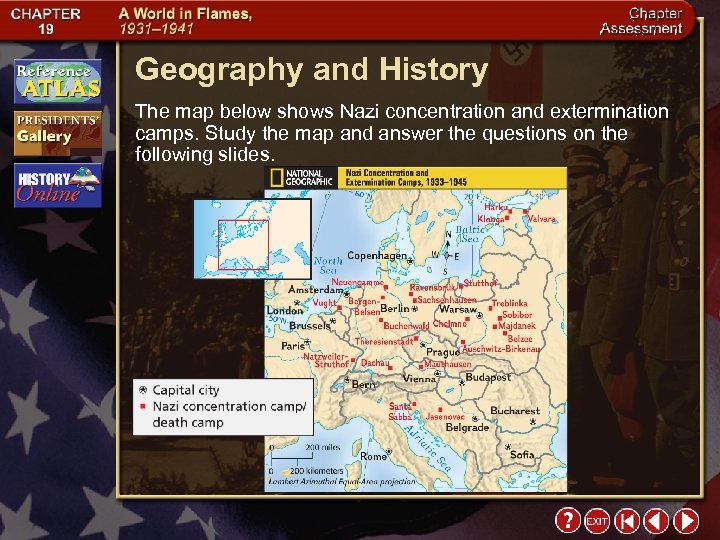 Geography and History The map below shows Nazi concentration and extermination camps. Study the map and answer the questions on the following slides.
 What is the name of the German-born Nobel Prize-winning physicist whose scientific theories revolutionized modern physics? The name of the physicist is Albert Einstein. Click the mouse button or press the Space Bar to display the answer.
 Geography To gain direct access to natural resources, Japanese military leaders aimed to build an empire in the Pacific. The U. S. Pacific Fleet was headquartered at Oahu island in Hawaii–approximately 70 warships, including 8 battleships and 24 auxiliary vessels, were stationed at Pearl Harbor on the island. Thus, Japanese military leaders saw the fleet as an obstacle that had to be destroyed if they were to achieve their goals.
 Click the Speaker button to listen to the audio again.
 Click the mouse button or press the Space Bar to display the answer.
 Click the mouse button or press the Space Bar to display the answer.