


 Скачать презентацию CHAPTER FOUR PART PRODUCT AND SERVICE DESIGN THREE
b3654037c7ee2b9efc5d89b85c6ce00b.ppt
- Количество слайдов: 27
 CHAPTER FOUR PART PRODUCT AND SERVICE DESIGN THREE • Chapter Four DESIGN OF PRODUCTION SYSTEMS • Product and Service Design • Chapter Five • Process Selection and Capacity Planning • Chapter Six • Facilities Layout • Chapter Seven • Design of Work Systems • Chapter Eight • Location Analysis Irwin/Mc. Graw-Hill ©The Mc. Graw-Hill Companies, Inc. , 1999 4 -1 ©The Mc. Graw-Hill Companies, Inc. , 1999
 CHAPTER FOUR PRODUCT AND SERVICE DESIGN Chapter 4 Product and Service Design Irwin/Mc. Graw-Hill ©The Mc. Graw-Hill Companies, Inc. , 1999 4 -2
 CHAPTER FOUR PRODUCT AND SERVICE DESIGN Reasons for Product or Service Design • Be competitive • Increase business growth & profits • Avoid downsizing with development of new products • Improve product quality • Achieve cost reductions in labor or materials Irwin/Mc. Graw-Hill ©The Mc. Graw-Hill Companies, Inc. , 1999 4 -3
 CHAPTER FOUR PRODUCT AND SERVICE DESIGN Trends in Product & Service Design • Increased emphasis on or attention to: – Customer satisfaction – Reducing time to introduce new product or service – Reducing time to produce product Irwin/Mc. Graw-Hill ©The Mc. Graw-Hill Companies, Inc. , 1999 4 -4
 CHAPTER FOUR PRODUCT AND SERVICE DESIGN Trends in Product & Service Design (Cont’d) • Increased emphasis on or attention to: – The organization’s capabilities to produce or deliver the item – Environmental concerns – Designing products & services that are “user friendly” – Designing products that use less material Irwin/Mc. Graw-Hill ©The Mc. Graw-Hill Companies, Inc. , 1999 4 -5
 CHAPTER FOUR PRODUCT AND SERVICE DESIGN Objects of Product & Service Design Beyond the overall objective to achieve customer satisfaction while making a reasonable profit is: Design for Manufacturing(DFM) The designers’ consideration of the organization’s manufacturing capabilities when designing a product. The more general term design for operations encompasses services as well as manufacturing Irwin/Mc. Graw-Hill ©The Mc. Graw-Hill Companies, Inc. , 1999 4 -6
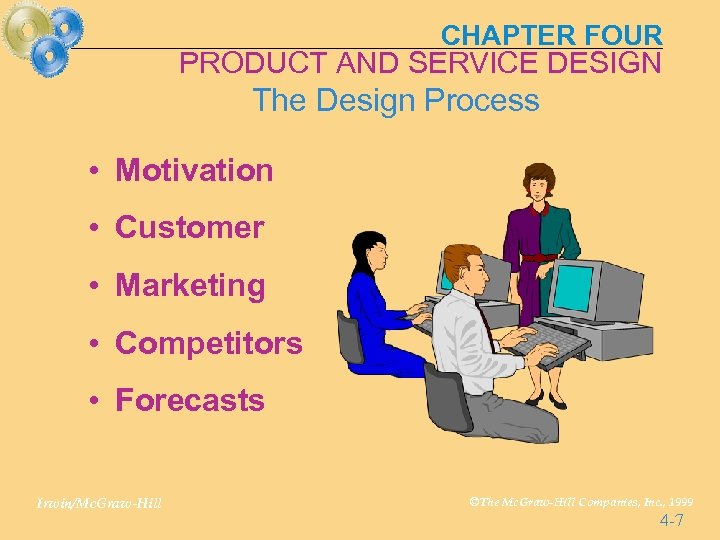 CHAPTER FOUR PRODUCT AND SERVICE DESIGN The Design Process • Motivation • Customer • Marketing • Competitors • Forecasts Irwin/Mc. Graw-Hill ©The Mc. Graw-Hill Companies, Inc. , 1999 4 -7
 CHAPTER FOUR PRODUCT AND SERVICE DESIGN Reverse Engineering Reverse engineering is the dismantling and inspecting of a competitor’s product to discover product improvements. Irwin/Mc. Graw-Hill ©The Mc. Graw-Hill Companies, Inc. , 1999 4 -8
 CHAPTER FOUR PRODUCT AND SERVICE DESIGN Manufacturability • Manufacturability is the ease of fabrication and/or assembly which is important for: – Cost – Productivity – Quality Irwin/Mc. Graw-Hill ©The Mc. Graw-Hill Companies, Inc. , 1999 4 -9
 CHAPTER FOUR PRODUCT AND SERVICE DESIGN Regulations & Legal Considerations • Product Liability - A manufacturer is liable for any injuries or damages caused by a faulty product. • Uniform Commercial Code Products carry an implication of merchantability and fitness. Irwin/Mc. Graw-Hill ©The Mc. Graw-Hill Companies, Inc. , 1999 4 -10
 CHAPTER FOUR PRODUCT AND SERVICE DESIGN Research & Development (R&D) • Organized efforts to increase scientific knowledge or product innovation & may involve: – – – Basic Research advances knowledge about a subject without near-term expectations of commercial applications. Applied Research achieves commercial applications. Development converts results of applied research into commercial applications. Irwin/Mc. Graw-Hill ©The Mc. Graw-Hill Companies, Inc. , 1999 4 -11
 CHAPTER FOUR PRODUCT AND SERVICE DESIGN Product Design • Product Life Cycles • Robust Design • Concurrent Engineering • Computer-Aided Design • Modular Design Irwin/Mc. Graw-Hill ©The Mc. Graw-Hill Companies, Inc. , 1999 4 -12
 CHAPTER FOUR PRODUCT AND SERVICE DESIGN Advantages of Standardization • Fewer parts to deal with in inventory & manufacturing • Reduced training costs and time • More routine purchasing, handling, and inspection procedures Irwin/Mc. Graw-Hill ©The Mc. Graw-Hill Companies, Inc. , 1999 4 -13
 CHAPTER FOUR PRODUCT AND SERVICE DESIGN Advantages of Standardization (Cont’d) • Orders fillable from inventory • Opportunities for long production runs and automation • Need for fewer parts justifies increased expenditures on perfecting designs and improving quality control procedures. Irwin/Mc. Graw-Hill ©The Mc. Graw-Hill Companies, Inc. , 1999 4 -14
 CHAPTER FOUR PRODUCT AND SERVICE DESIGN Disadvantages of Standardization • Designs may be frozen with too many imperfections remaining. • High cost of design changes increases resistance to improvements. • Decreased variety results in less consumer appeal. Irwin/Mc. Graw-Hill ©The Mc. Graw-Hill Companies, Inc. , 1999 4 -15
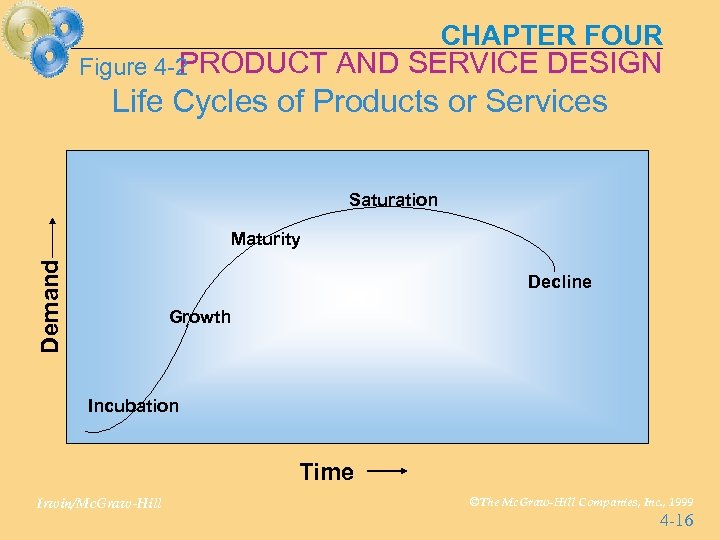 PRODUCT Figure 4 -2 CHAPTER FOUR AND SERVICE DESIGN Life Cycles of Products or Services Saturation Demand Maturity Decline Growth Incubation Time Irwin/Mc. Graw-Hill ©The Mc. Graw-Hill Companies, Inc. , 1999 4 -16
 CHAPTER FOUR PRODUCT AND SERVICE DESIGN Product design • • • Design for manufacturing (DFM) Design for assembly (DFA) Design for recycling (DFR) Remanufacturing Design for disassembly (DFD) Robust design Irwin/Mc. Graw-Hill ©The Mc. Graw-Hill Companies, Inc. , 1999 4 -17
 CHAPTER FOUR PRODUCT AND SERVICE DESIGN Taguchi Approach Robust Design • Design a robust product – Insensitive to environmental factors either in manufacturing or in use. • Central feature is Parameter Design. • Determines: – – factors that are controllable and those not controllable their optimal levels relative to major product advances Irwin/Mc. Graw-Hill ©The Mc. Graw-Hill Companies, Inc. , 1999 4 -18
 CHAPTER FOUR PRODUCT AND SERVICE DESIGN Concurrent Engineering Concurrent engineering is the bringing together of engineering design and manufacturing personnel early in the design phase. Irwin/Mc. Graw-Hill ©The Mc. Graw-Hill Companies, Inc. , 1999 4 -19
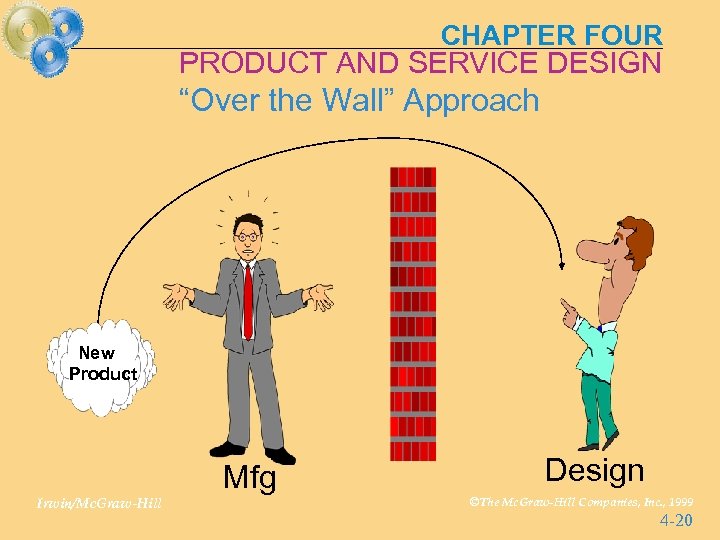 CHAPTER FOUR PRODUCT AND SERVICE DESIGN “Over the Wall” Approach New Product Mfg Irwin/Mc. Graw-Hill Design ©The Mc. Graw-Hill Companies, Inc. , 1999 4 -20
 CHAPTER FOUR PRODUCT AND SERVICE DESIGN Computer-Aided Design • Computer-Aided Design (CAD) is product design using computer graphics. – increases productivity of designers, 3 to 10 times – creates a database for manufacturing information on product specifications – provides possibility of engineering and cost analysis on proposed designs Irwin/Mc. Graw-Hill ©The Mc. Graw-Hill Companies, Inc. , 1999 4 -21
 CHAPTER FOUR PRODUCT AND SERVICE DESIGN Modular Design Modular design is a form of standardization in which component parts are subdivided into modules that are easily replaced or interchanged. It allows: – easier diagnosis and remedy of failures – easier repair and replacement – simplification of manufacturing and assembly Irwin/Mc. Graw-Hill ©The Mc. Graw-Hill Companies, Inc. , 1999 4 -22
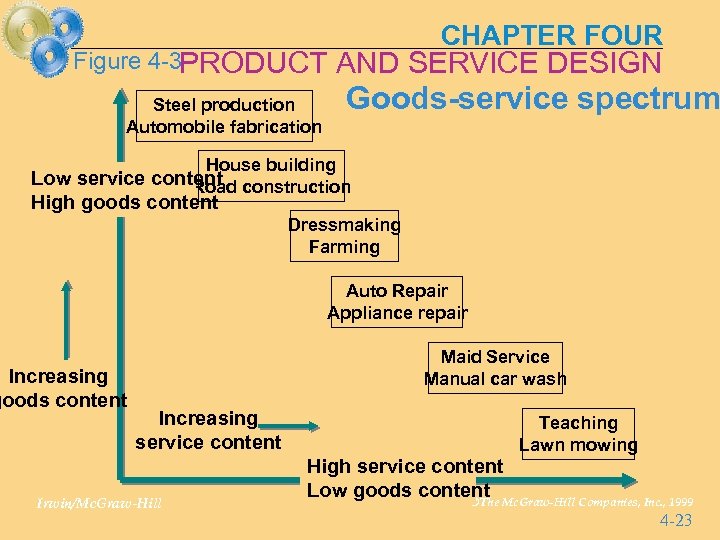 Figure 4 -3 PRODUCT Steel production Automobile fabrication CHAPTER FOUR AND SERVICE DESIGN Goods-service spectrum House building Low service content construction Road High goods content Dressmaking Farming Auto Repair Appliance repair Increasing goods content Maid Service Manual car wash Increasing service content Irwin/Mc. Graw-Hill Teaching Lawn mowing High service content Low goods content Mc. Graw-Hill Companies, Inc. , 1999 ©The 4 -23
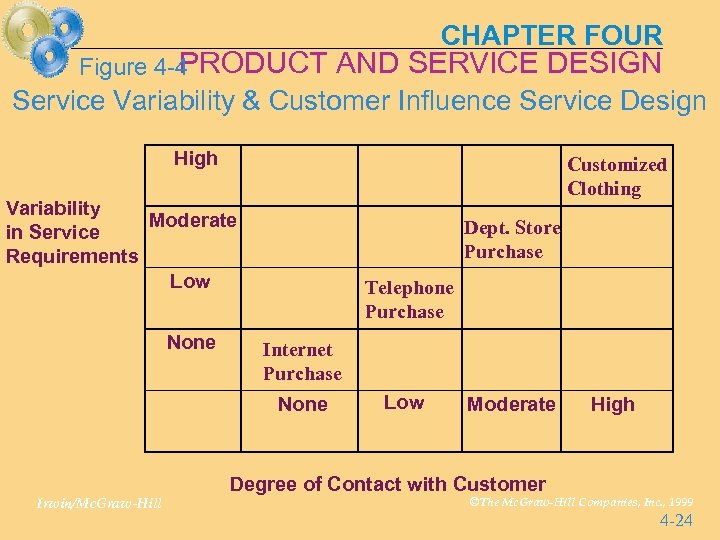 PRODUCT Figure 4 -4 CHAPTER FOUR AND SERVICE DESIGN Service Variability & Customer Influence Service Design High Customized Clothing Variability Moderate in Service Requirements Low None Dept. Store Purchase Telephone Purchase Internet Purchase None Irwin/Mc. Graw-Hill Low Moderate High Degree of Contact with Customer ©The Mc. Graw-Hill Companies, Inc. , 1999 4 -24
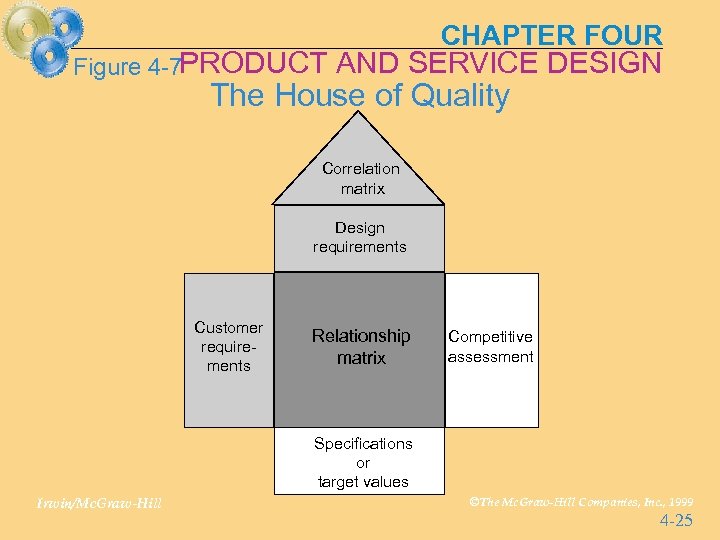 Figure 4 -7 PRODUCT CHAPTER FOUR AND SERVICE DESIGN The House of Quality Correlation matrix Design requirements Customer requirements Relationship matrix Competitive assessment Specifications or target values Irwin/Mc. Graw-Hill ©The Mc. Graw-Hill Companies, Inc. , 1999 4 -25
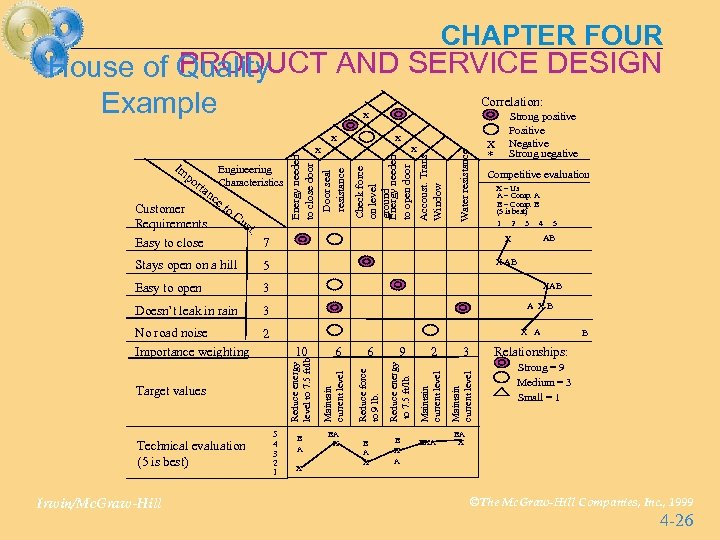 CHAPTER FOUR PRODUCT AND SERVICE DESIGN House of Quality Correlation: Example X X Cu st. Water resistance to Accoust. Trans. Window Customer Requirements Easy to close ce Check force on level ground Energy needed to open door tan Engineering Characteristics Door seal resistance or Energy needed to close door Im p X X * Strong positive Positive Negative Strong negative Competitive evaluation X = Us A = Comp. A B = Comp. B (5 is best) 1 2 3 4 7 5 X AB Easy to open 3 Doesn’t leak in rain 3 No road noise Importance weighting 2 AB X Stays open on a hill 5 XAB A XB X A Technical evaluation (5 is best) Irwin/Mc. Graw-Hill 5 4 3 2 1 B A X B X A BXA 3 Relationships: Maintain current level 2 Maintain current level 9 Reduce energy to 7. 5 ft/lb. 6 Reduce force to 9 lb. Target values 6 Maintain current level Reduce energy level to 7. 5 ft/lb 10 B Strong = 9 Medium = 3 Small = 1 BA X ©The Mc. Graw-Hill Companies, Inc. , 1999 4 -26
 CHAPTER FOUR PRODUCT AND SERVICE DESIGN Improving Reliability • Component design • Production/assembly techniques • Testing • Redundancy • Preventive maintenance procedures • User education • System design Irwin/Mc. Graw-Hill ©The Mc. Graw-Hill Companies, Inc. , 1999 4 -27