


 Скачать презентацию Chapter Four Minor Processes of Wordformation Shortening
aaf766e62e8c151aee35c75e5907e56f.ppt
- Количество слайдов: 31
 Chapter Four Minor Processes of Wordformation
 Shortening v Types of shortening or abbreviation(缩略法)
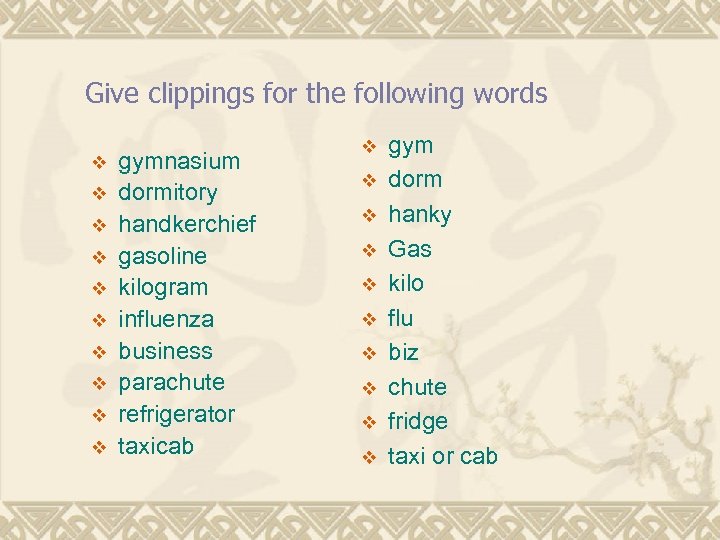
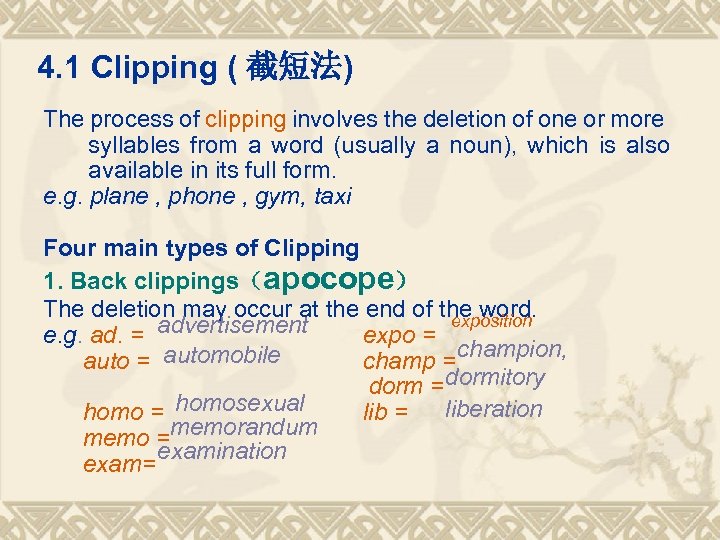 4. 1 Clipping ( 截短法) The process of clipping involves the deletion of one or more syllables from a word (usually a noun), which is also available in its full form. e. g. plane , phone , gym, taxi Four main types of Clipping 1. Back clippings(apocope) The deletion may occur at the end of the word. exposition advertisement e. g. ad. = expo = automobile auto = champ = champion, dormitory dorm = homosexual liberation homo = lib = memorandum memo = examination exam=
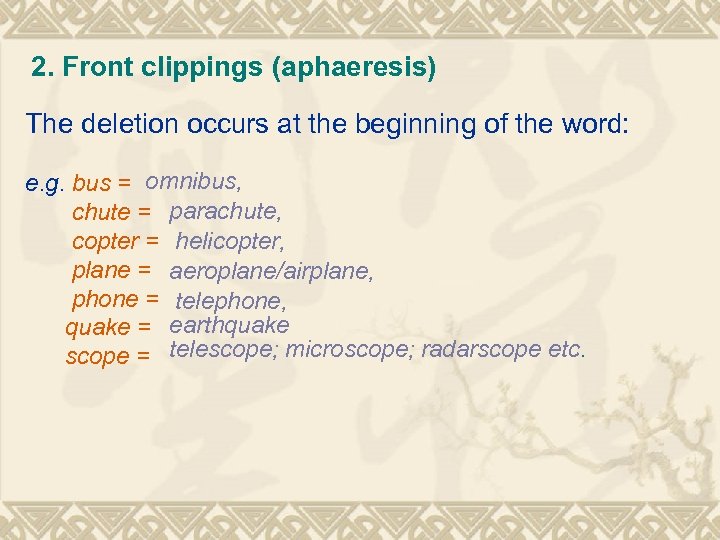 2. Front clippings (aphaeresis) The deletion occurs at the beginning of the word: e. g. bus = omnibus, chute = parachute, copter = helicopter, plane = aeroplane/airplane, phone = telephone, quake = earthquake scope = telescope; microscope; radarscope etc.
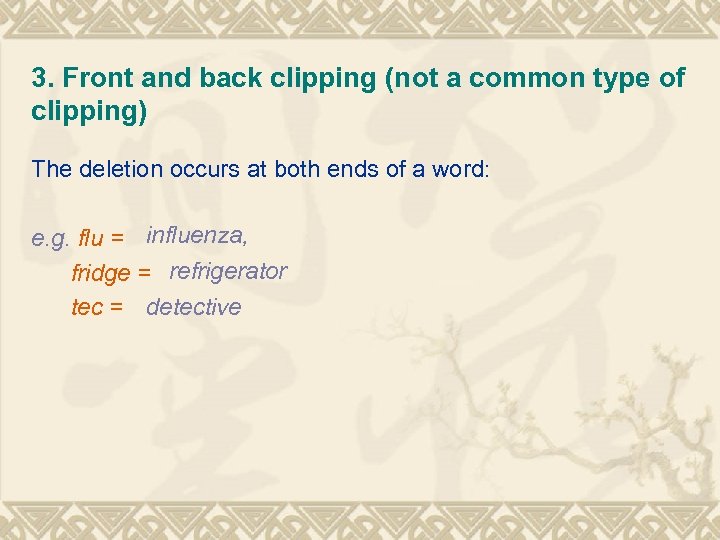 3. Front and back clipping (not a common type of clipping) The deletion occurs at both ends of a word: e. g. flu = influenza, fridge = refrigerator tec = detective
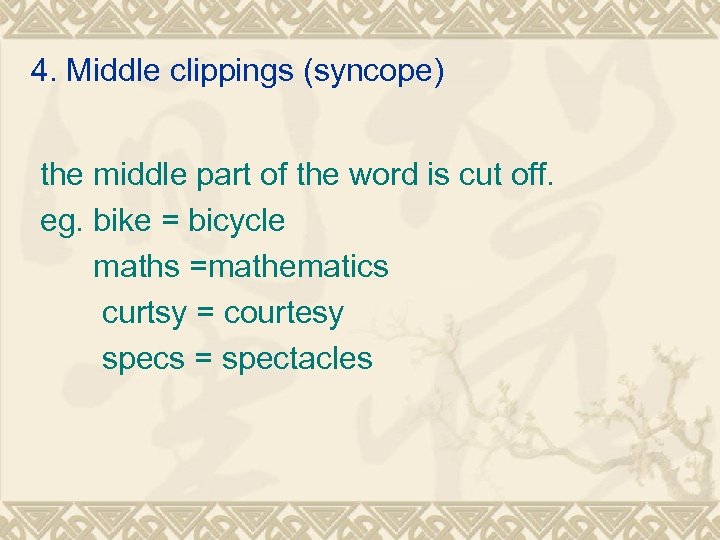 4. Middle clippings (syncope) the middle part of the word is cut off. eg. bike = bicycle maths =mathematics curtsy = courtesy specs = spectacles
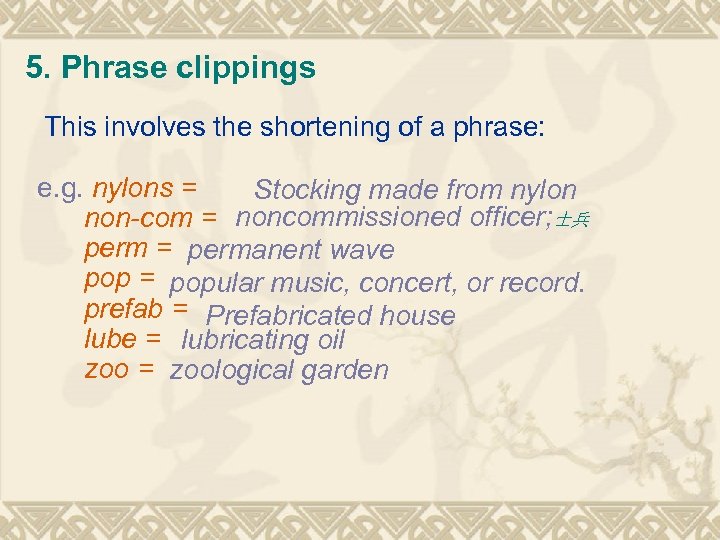 5. Phrase clippings This involves the shortening of a phrase: e. g. nylons = Stocking made from nylon non-com = noncommissioned officer; 士兵 perm = permanent wave pop = popular music, concert, or record. prefab = Prefabricated house lube = lubricating oil zoo = zoological garden
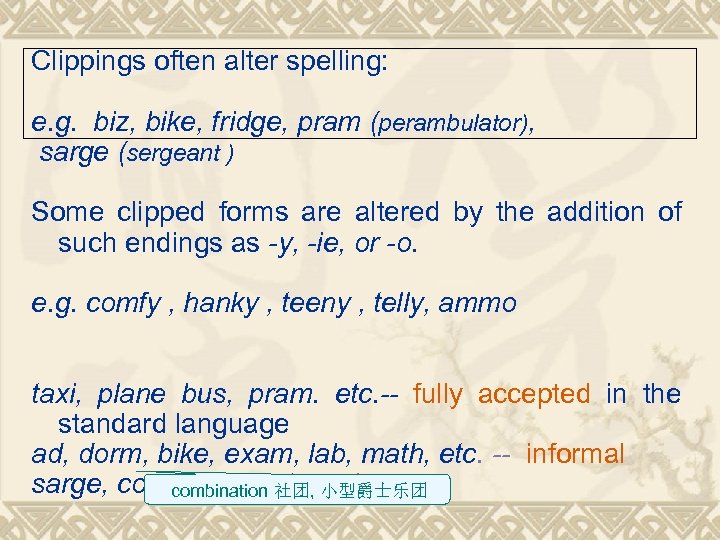 Clippings often alter spelling: e. g. biz, bike, fridge, pram (perambulator), sarge (sergeant ) Some clipped forms are altered by the addition of such endings as -y, -ie, or -o. e. g. comfy , hanky , teeny , telly, ammo taxi, plane bus, pram. etc. -- fully accepted in the standard language ad, dorm, bike, exam, lab, math, etc. -- informal sarge, combo, tec , etc -- slangy combination 社团, 小型爵士乐团
 Give clippings for the following words v v v v v gymnasium dormitory handkerchief gasoline kilogram influenza business parachute refrigerator taxicab v v v v v gym dorm hanky Gas kilo flu biz chute fridge taxi or cab
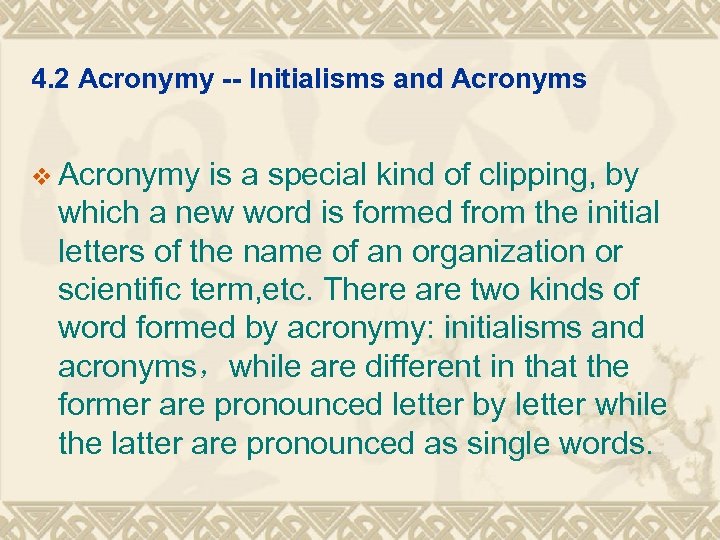 4. 2 Acronymy -- Initialisms and Acronyms v Acronymy is a special kind of clipping, by which a new word is formed from the initial letters of the name of an organization or scientific term, etc. There are two kinds of word formed by acronymy: initialisms and acronyms,while are different in that the former are pronounced letter by letter while the latter are pronounced as single words.
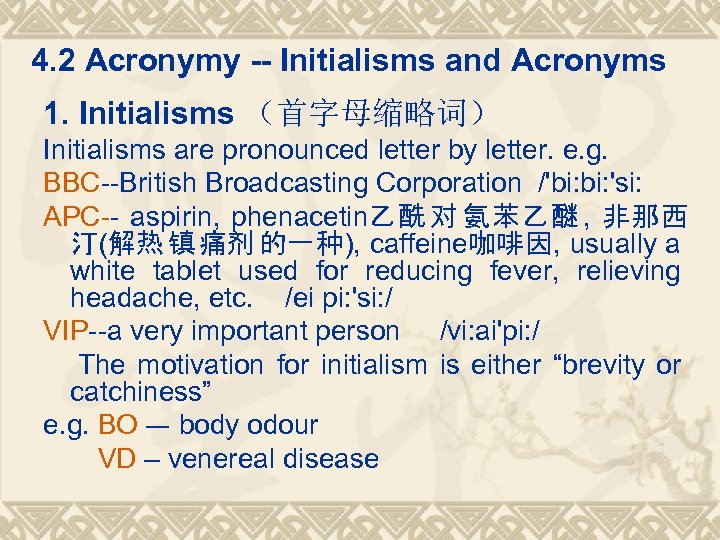 4. 2 Acronymy -- Initialisms and Acronyms 1. Initialisms (首字母缩略词) Initialisms are pronounced letter by letter. e. g. BBC--British Broadcasting Corporation /'bi: 'si: APC-- aspirin, phenacetin乙酰 对 氨苯乙醚 , 非那西 汀(解热 镇 痛剂 的一种), caffeine咖啡因, usually a white tablet used for reducing fever, relieving headache, etc. /ei pi: 'si: / VIP--a very important person /vi: ai'pi: / The motivation for initialism is either “brevity or catchiness” e. g. BO –- body odour VD – venereal disease
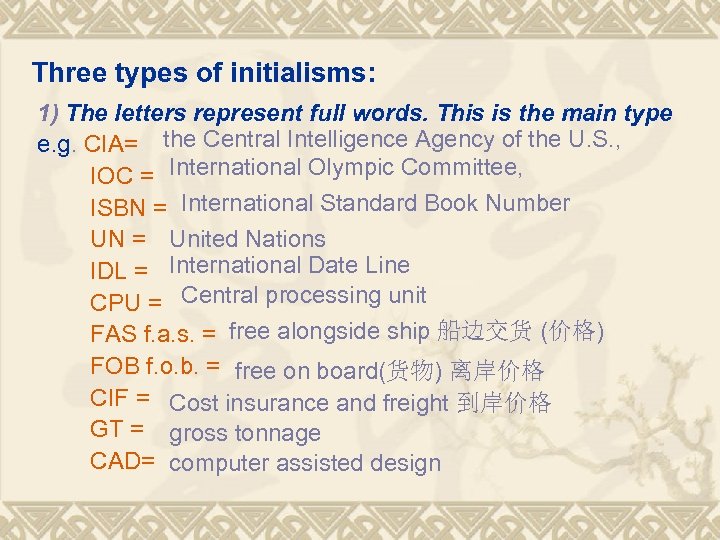 Three types of initialisms: 1) The letters represent full words. This is the main type e. g. CIA= the Central Intelligence Agency of the U. S. , IOC = International Olympic Committee, ISBN = International Standard Book Number UN = United Nations IDL = International Date Line CPU = Central processing unit FAS f. a. s. = free alongside ship 船边交货 (价格) FOB f. o. b. = free on board(货物) 离岸价格 CIF = Cost insurance and freight 到岸价格 GT = gross tonnage CAD= computer assisted design
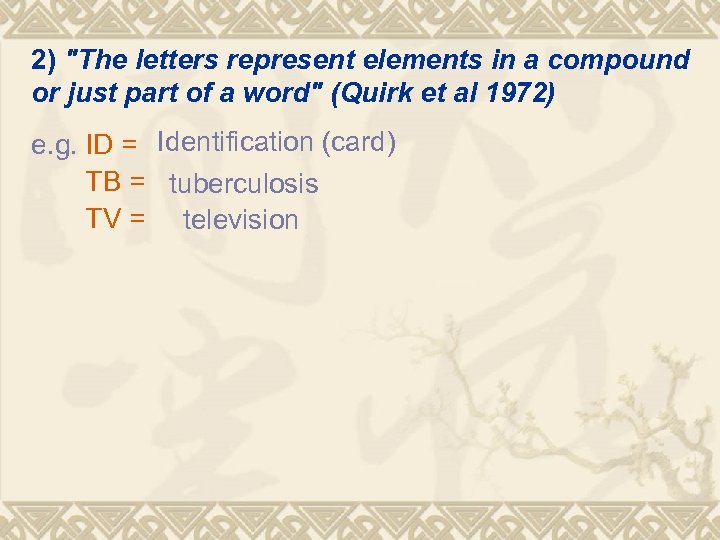 2) "The letters represent elements in a compound or just part of a word" (Quirk et al 1972) e. g. ID = Identification (card) TB = tuberculosis TV = television
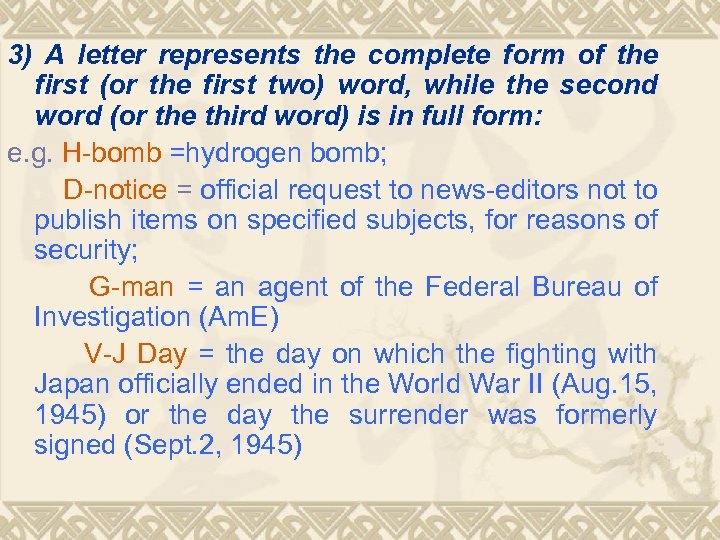 3) A letter represents the complete form of the first (or the first two) word, while the second word (or the third word) is in full form: e. g. H-bomb =hydrogen bomb; D-notice = official request to news-editors not to publish items on specified subjects, for reasons of security; G-man = an agent of the Federal Bureau of Investigation (Am. E) V-J Day = the day on which the fighting with Japan officially ended in the World War II (Aug. 15, 1945) or the day the surrender was formerly signed (Sept. 2, 1945)
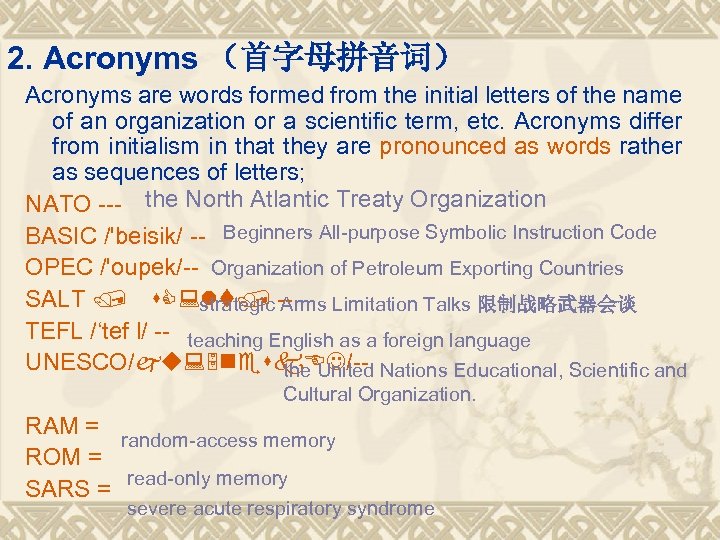 2. Acronyms (首字母拼音词) Acronyms are words formed from the initial letters of the name of an organization or a scientific term, etc. Acronyms differ from initialism in that they are pronounced as words rather as sequences of letters; NATO --- the North Atlantic Treaty Organization BASIC /'beisik/ -- Beginners All-purpose Symbolic Instruction Code OPEC /'oupek/-- Organization of Petroleum Exporting Countries SALT / s. C: lt/ -- strategic Arms Limitation Talks 限制战略武器会谈 TEFL /‘tef l/ -- teaching English as a foreign language UNESCO/ju: 5 nesk. EJ/-the United Nations Educational, Scientific and Cultural Organization. RAM = random-access memory ROM = read-only memory SARS = severe acute respiratory syndrome
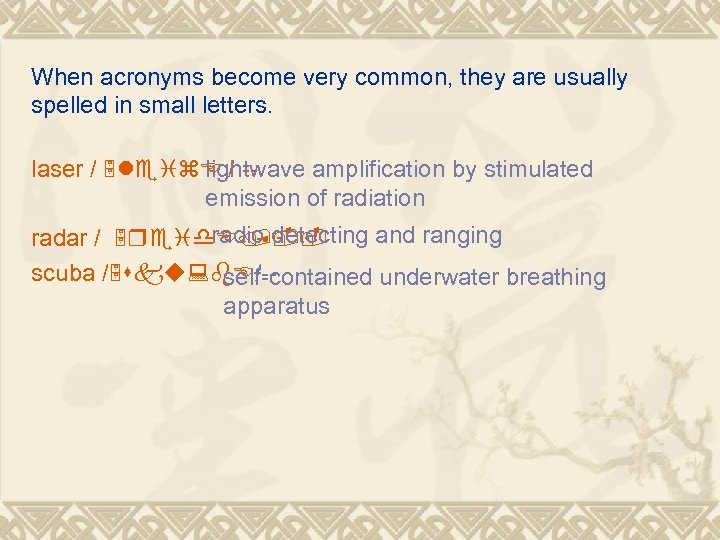 When acronyms become very common, they are usually spelled in small letters. laser / 5 leiz. E / -lightwave amplification by stimulated emission of radiation radio detecting and ranging radar / 5 reid. E/-scuba /5 sku: b. E/-- self-contained underwater breathing apparatus
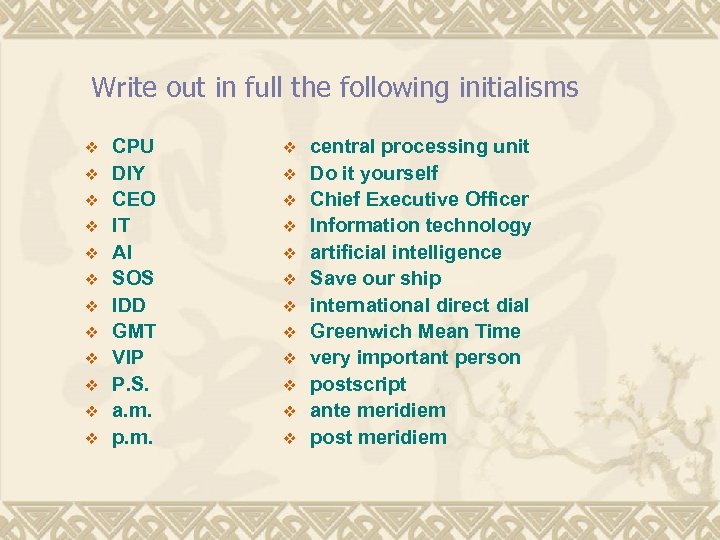 Write out in full the following initialisms v v v CPU DIY CEO IT AI SOS IDD GMT VIP P. S. a. m. p. m. v v v central processing unit Do it yourself Chief Executive Officer Information technology artificial intelligence Save our ship international direct dial Greenwich Mean Time very important person postscript ante meridiem post meridiem
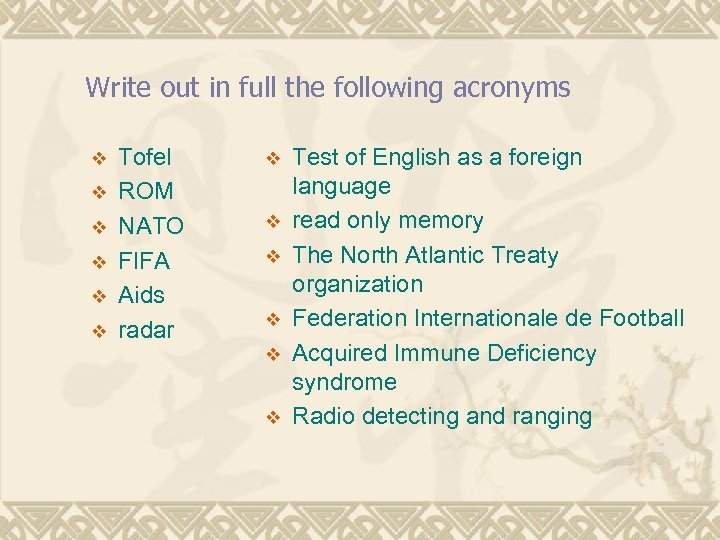 Write out in full the following acronyms v v v Tofel ROM NATO FIFA Aids radar v v v Test of English as a foreign language read only memory The North Atlantic Treaty organization Federation Internationale de Football Acquired Immune Deficiency syndrome Radio detecting and ranging
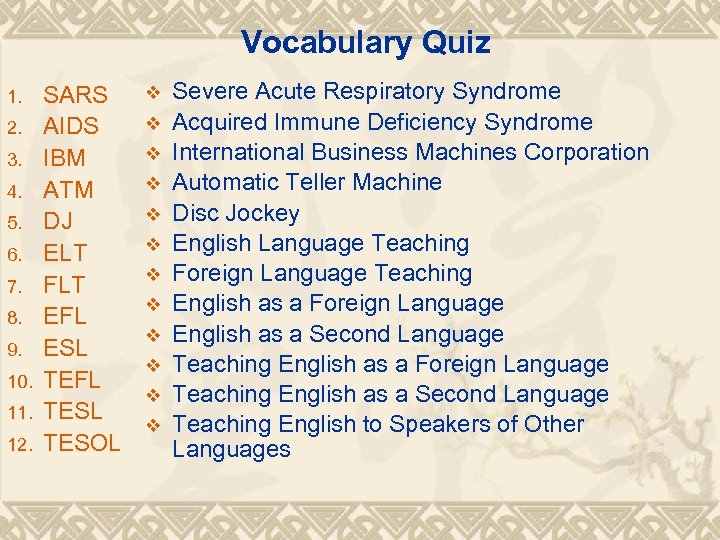 Vocabulary Quiz 1. 2. 3. 4. 5. 6. 7. 8. 9. 10. 11. 12. SARS AIDS IBM ATM DJ ELT FLT EFL ESL TEFL TESOL v v v Severe Acute Respiratory Syndrome Acquired Immune Deficiency Syndrome International Business Machines Corporation Automatic Teller Machine Disc Jockey English Language Teaching Foreign Language Teaching English as a Foreign Language English as a Second Language Teaching English as a Foreign Language Teaching English as a Second Language Teaching English to Speakers of Other Languages
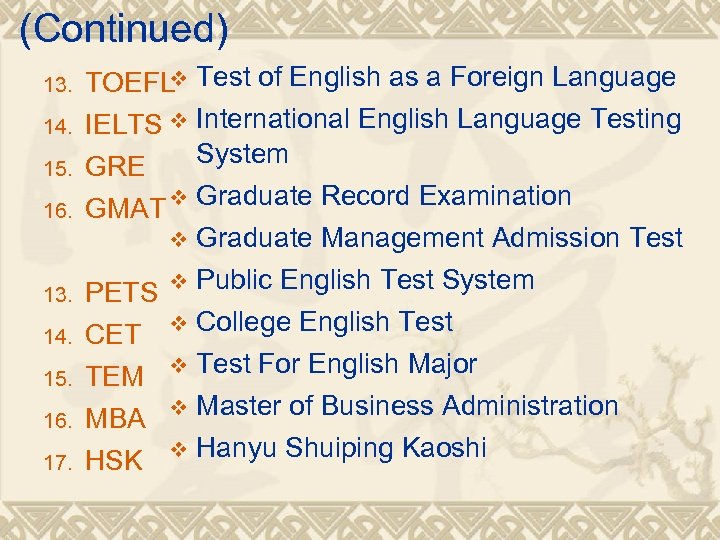 (Continued) 13. 14. 15. 16. 17. v TOEFL Test of English as a Foreign Language IELTS v International English Language Testing System GRE GMAT v Graduate Record Examination v Graduate Management Admission Test PETS v Public English Test System v College English Test CET TEM v Test For English Major v Master of Business Administration MBA HSK v Hanyu Shuiping Kaoshi
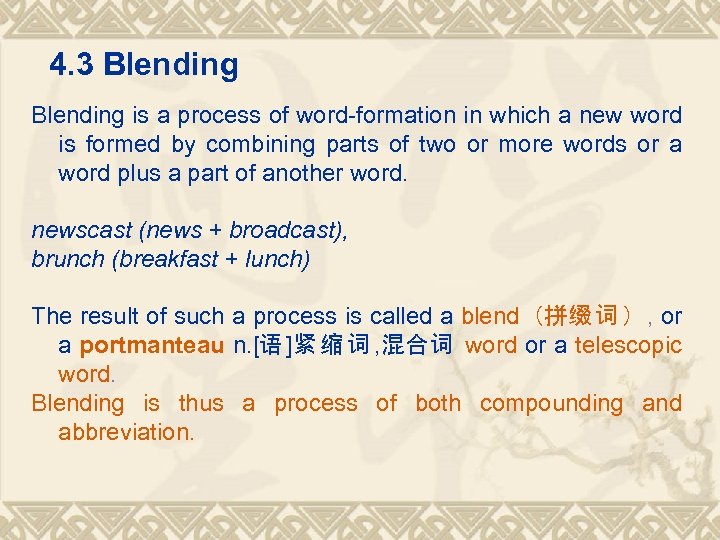 4. 3 Blending is a process of word-formation in which a new word is formed by combining parts of two or more words or a word plus a part of another word. newscast (news + broadcast), brunch (breakfast + lunch) The result of such a process is called a blend(拼缀 词 ), or a portmanteau n. [语 ]紧 缩 词 , 混合词 word or a telescopic word. Blending is thus a process of both compounding and abbreviation.
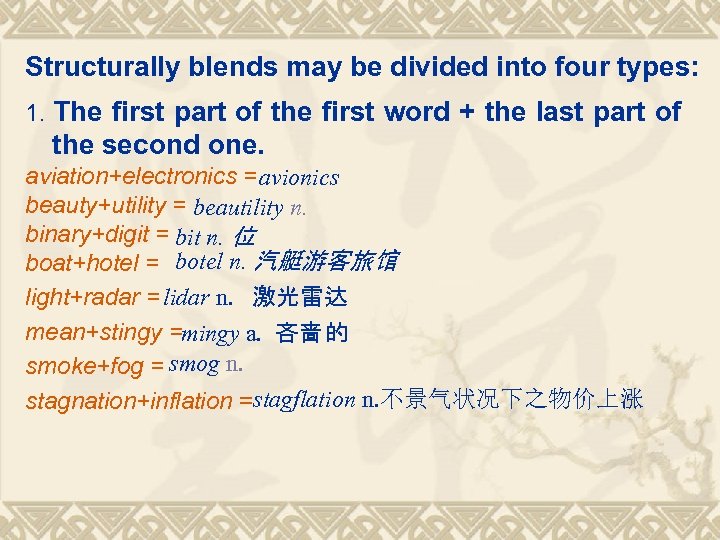 Structurally blends may be divided into four types: 1. The first part of the first word + the last part of the second one. aviation+electronics = avionics beauty+utility = beautility n. binary+digit = bit n. 位 botel n. 汽艇游客旅馆 boat+hotel = light+radar = lidar n. 激光雷达 mean+stingy = mingy a. 吝啬 的 smoke+fog = smog n. stagnation+inflation =stagflation n. 不景气状况下之物价上涨
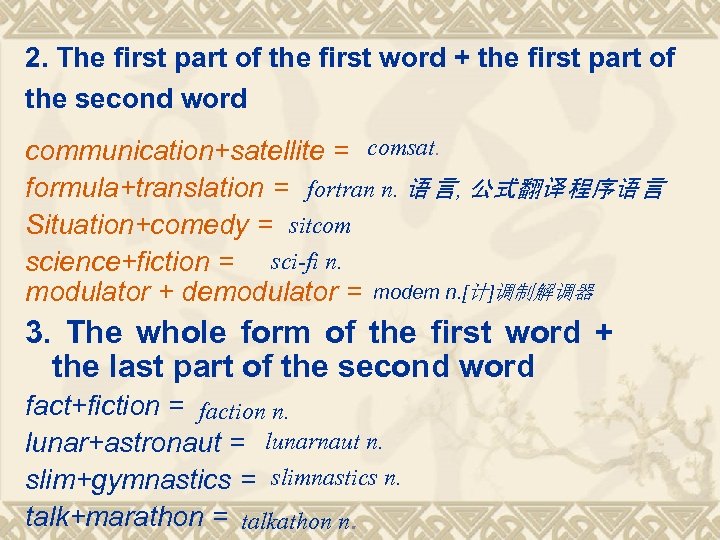 2. The first part of the first word + the first part of the second word communication+satellite = comsat. formula+translation = fortran n. 语言, 公式翻译程序语言 Situation+comedy = sitcom science+fiction = sci-fi n. modulator + demodulator = modem n. [计]调制解调器 3. The whole form of the first word + the last part of the second word fact+fiction = faction n. lunar+astronaut = lunarnaut n. slim+gymnastics = slimnastics n. talk+marathon = talkathon n.
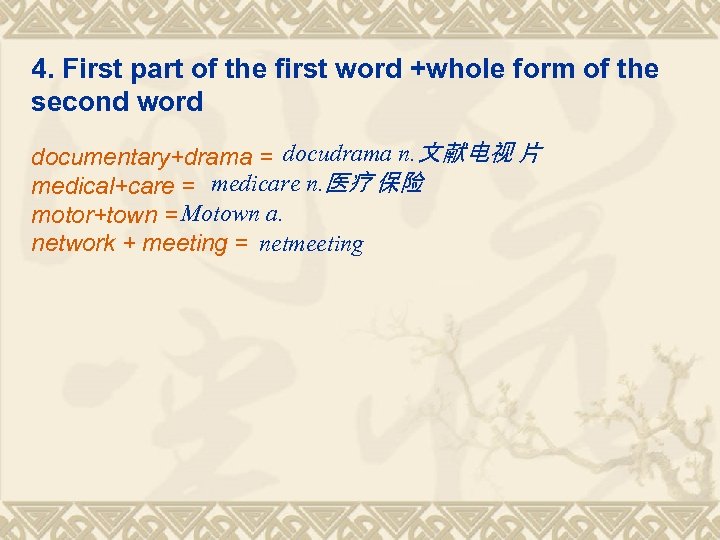 4. First part of the first word +whole form of the second word documentary+drama = docudrama n. 文献电视 片 medical+care = medicare n. 医疗保险 motor+town = Motown a. network + meeting = netmeeting
 4. 5 Back-formation is a term used to refer to a type of wordformation by which a shorter word is coined by the deletion of a supposed affix from a longer form already present in the language. e. g. burgle – burglar Affixation and backformation Back-formation is also known as a reverse derivation because a derived form has preceded the word from which it is derived. 1) Verbs created from nouns ending in -er, -or, -ar, e. g. editor--- to edit pedlar -- to peddle escalator -- to escalate house sitter -- to house sit vacuum cleaner- to vaccum clean
 2) Verbs created from abstract nouns e. g. diagnosis -- to diagnose television -- to televise enthusiasm -- to enthuse automation -- to automate concordance -- to concord 3) Verbs created from adjectives: e. g. lazy -- to laze cosy -- to cose complicity -- to complicit 4) Nouns created from adjectives: e. g. gloomy -- gloom greedy -- greed (few in number)
 5) Verbs created from compound nouns: e. g. match-maker -- to match-make merry-making-- to merry-make dress-maker -- to dress-make
 4. 6 Onomatopoeia v Some English words came into being by onomatopoeia, i. e. the imitation of natural sounds. Onomatopoeic words(拟声词) are echoic ones whose sounds suggest their senses. These words help us from mental pictures about the things, people, or places that are described.
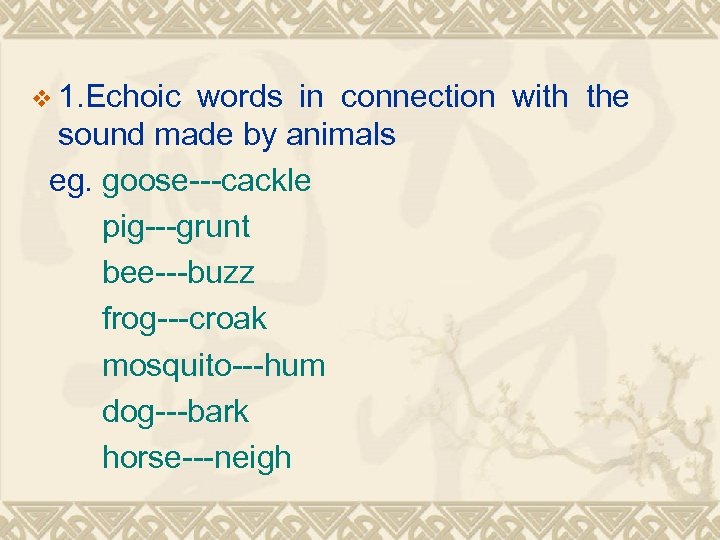 v 1. Echoic words in connection with the sound made by animals eg. goose---cackle pig---grunt bee---buzz frog---croak mosquito---hum dog---bark horse---neigh
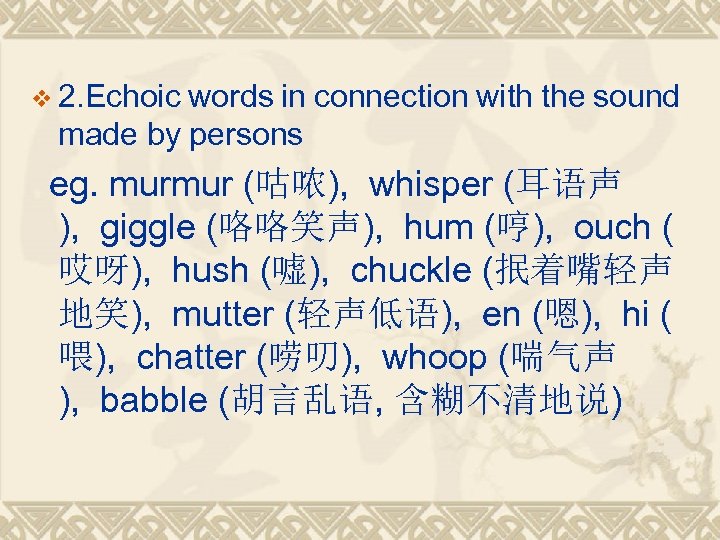 v 2. Echoic words in connection with the sound made by persons eg. murmur (咕哝), whisper (耳语声 ), giggle (咯咯笑声), hum (哼), ouch ( 哎呀), hush (嘘), chuckle (抿着嘴轻声 地笑), mutter (轻声低语), en (嗯), hi ( 喂), chatter (唠叨), whoop (喘气声 ), babble (胡言乱语, 含糊不清地说)
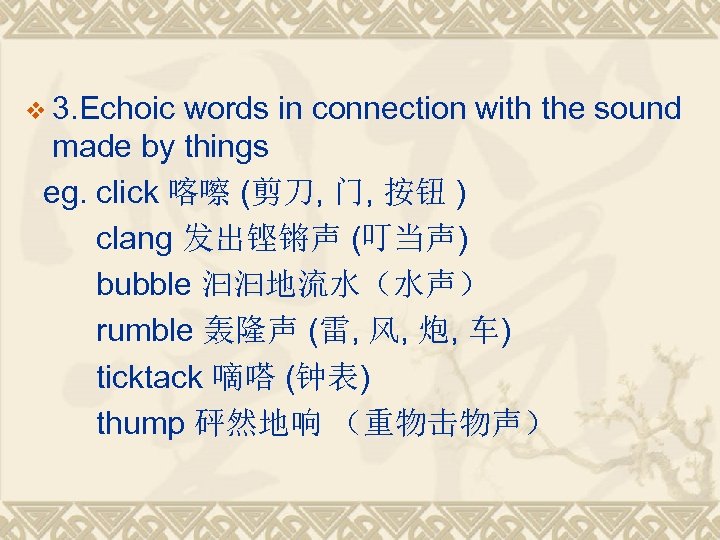 v 3. Echoic words in connection with the sound made by things eg. click 喀嚓 (剪刀, 门, 按钮 ) clang 发出铿锵声 (叮当声) bubble 汩汩地流水(水声) rumble 轰隆声 (雷, 风, 炮, 车) ticktack 嘀嗒 (钟表) thump 砰然地响 (重物击物声)