


 Скачать презентацию Chapter Four Consumer Choice Chapter Outline 1
0658fd7cc63a0170de63ebe0328b8daf.ppt
- Количество слайдов: 66
 Chapter Four Consumer Choice
 Chapter Outline 1. Preferences. 2. Utility. 3. Budget Constraint. 4. Constrained Consumer Choice. 5. Behavioral Economics. © 2009 Pearson Addison-Wesley. All rights reserved. 4 -2
 Premises of Consumer Behavior § Individual preferences determine the amount of pleasure people derive from the goods and services they consume. § Consumers face constraints or limits on their choices. § Consumers maximize their well-being or pleasure from consumption, subject to the constraints they face. © 2009 Pearson Addison-Wesley. All rights reserved. 4 -3
 Utility Theories § Cardinal Utility Theory w Measurable w Jeremy Bentham § Ordinal Utility Theory w Only requires ordering of preferences © 2007 Pearson Addison-Wesley. All rights reserved. 4– 4
 Ordinal Utility Theory § Preference assumptions Completeness Transitivity More is Better © 2007 Pearson Addison-Wesley. All rights reserved. 4– 5
 Properties of Consumer Preferences § Completeness - when facing a choice between any two bundles of goods, a consumer can rank them so that one and only one of the following relationships is true: The consumer prefers the first bundle to the second, prefers the second to the first, or is indifferent between them. © 2009 Pearson Addison-Wesley. All rights reserved. 4 -6
 Properties of Consumer Preferences § Transitivity - a consumer’s preferences over bundles is consistent in the sense that, if the consumer weakly prefers Bundle z to Bundle y (likes z at least as much as y) and weakly prefers Bundle y to Bundle x, the consumer also weakly prefers Bundle z to Bundle x. © 2009 Pearson Addison-Wesley. All rights reserved. 4 -7
 Properties of Consumer Preferences § More Is Better - all else being the same, more of a commodity is better than less of it (always wanting more is known as nonsatiation). w Good - a commodity for which more is preferred to less, at least at some levels of consumption w Bad - something for which less is preferred to more, such as pollution © 2009 Pearson Addison-Wesley. All rights reserved. 4 -8
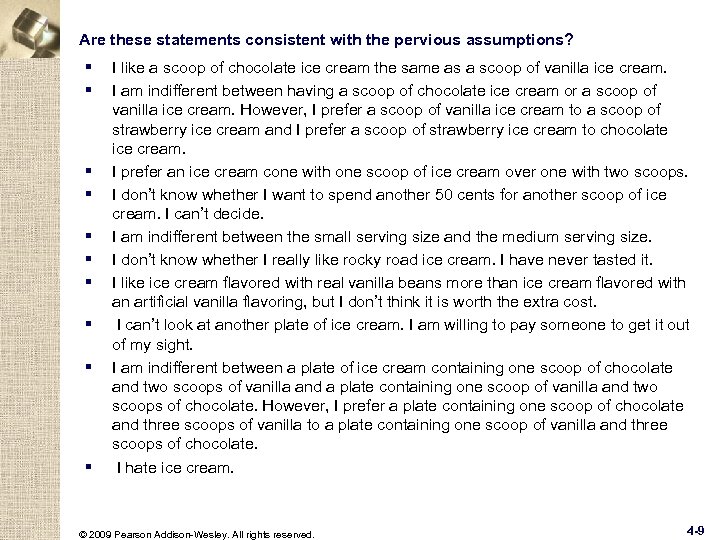 Are these statements consistent with the pervious assumptions? § § § § § I like a scoop of chocolate ice cream the same as a scoop of vanilla ice cream. I am indifferent between having a scoop of chocolate ice cream or a scoop of vanilla ice cream. However, I prefer a scoop of vanilla ice cream to a scoop of strawberry ice cream and I prefer a scoop of strawberry ice cream to chocolate ice cream. I prefer an ice cream cone with one scoop of ice cream over one with two scoops. I don’t know whether I want to spend another 50 cents for another scoop of ice cream. I can’t decide. I am indifferent between the small serving size and the medium serving size. I don’t know whether I really like rocky road ice cream. I have never tasted it. I like ice cream flavored with real vanilla beans more than ice cream flavored with an artificial vanilla flavoring, but I don’t think it is worth the extra cost. I can’t look at another plate of ice cream. I am willing to pay someone to get it out of my sight. I am indifferent between a plate of ice cream containing one scoop of chocolate and two scoops of vanilla and a plate containing one scoop of vanilla and two scoops of chocolate. However, I prefer a plate containing one scoop of chocolate and three scoops of vanilla to a plate containing one scoop of vanilla and three scoops of chocolate. I hate ice cream. © 2009 Pearson Addison-Wesley. All rights reserved. 4 -9
 Preference Maps § Indifference curve - the set of all bundles of goods that a consumer views as being equally desirable. w Indifference map - a complete set of indifference curves that summarize a consumer’s tastes or preferences © 2009 Pearson Addison-Wesley. All rights reserved. 4 -10
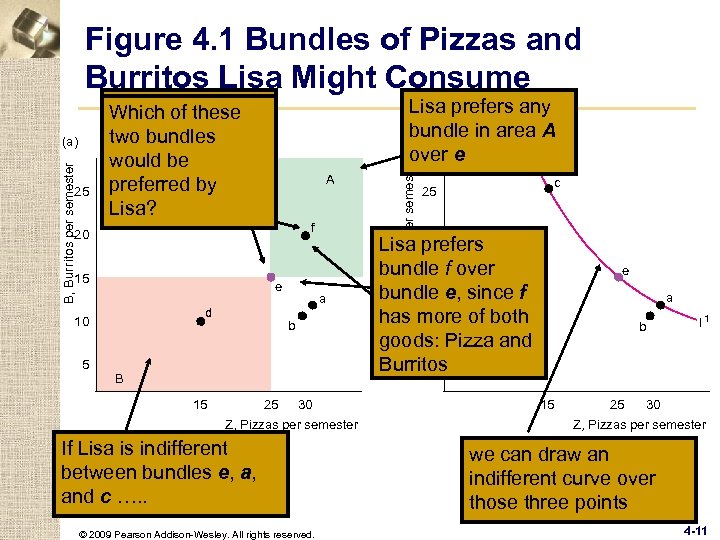 Figure 4. 1 Bundles of Pizzas and Burritos Lisa Might Consume 25 Lisa prefers any bundle in area A (b) over e A f 20 15 e d 10 5 a b B 15 25 30 Z, Pizzas per semester If Lisa is indifferent Lisa prefers between bundles e, a, bundle e to any and c …. . bundle in area B © 2009 Pearson Addison-Wesley. All rights reserved. B, Burritos per semester (a) Which of these two bundles would be preferred by c preferred by Lisa? c 25 20 Lisa prefers bundle f over bundle e over 15 bundle e, since f bundle d, since e has more of both 10 goods: Pizza and Burritos e a b 15 25 I 1 30 Z, Pizzas per semester we can draw an indifferent curve over those three points 4 -11
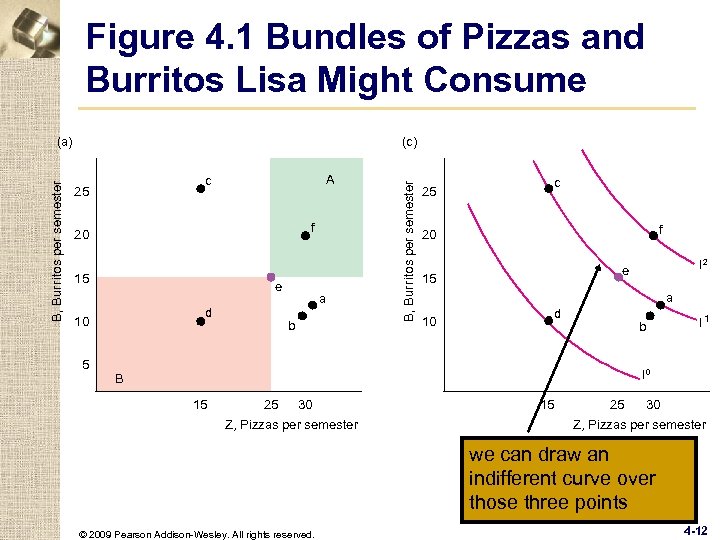 Figure 4. 1 Bundles of Pizzas and Burritos Lisa Might Consume (c) A c 25 f 20 15 e d 10 5 a b B, Burritos per semester (a) 25 c f 20 I 2 e 15 a 10 d b I 1 I 0 B 15 25 30 Z, Pizzas per semester we can draw an indifferent curve over those three points © 2009 Pearson Addison-Wesley. All rights reserved. 4 -12
 Properties of Indifference Maps 1. Bundles on indifference curves farther from the origin are preferred to those on indifference curves closer to the origin. 2. There is an indifference curve through every possible bundle. 3. Indifference curves cannot cross. 4. Indifference curves slope downward. © 2009 Pearson Addison-Wesley. All rights reserved. 4 -13
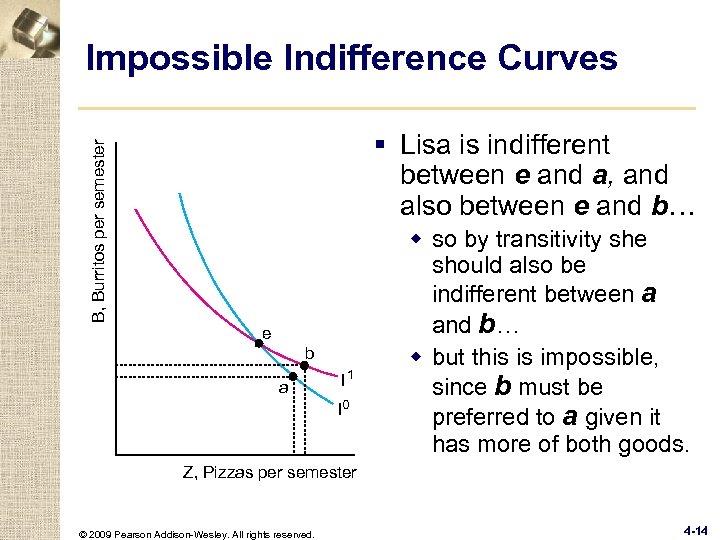 Impossible Indifference Curves B, Burritos per semester § Lisa is indifferent between e and a, and also between e and b… e b a I 1 I 0 w so by transitivity she should also be indifferent between a and b… w but this is impossible, since b must be preferred to a given it has more of both goods. Z, Pizzas per semester © 2009 Pearson Addison-Wesley. All rights reserved. 4 -14
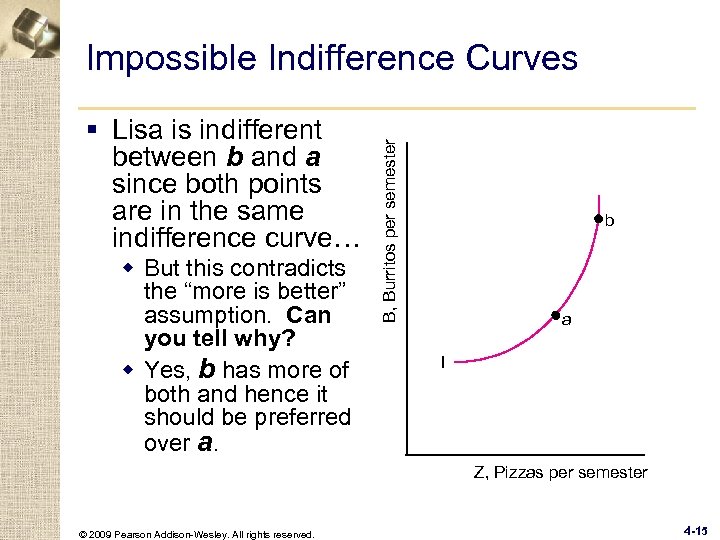 § Lisa is indifferent between b and a since both points are in the same indifference curve… w But this contradicts the “more is better” assumption. Can you tell why? w Yes, b has more of both and hence it should be preferred over a. B, Burritos per semester Impossible Indifference Curves b a I Z, Pizzas per semester © 2009 Pearson Addison-Wesley. All rights reserved. 4 -15
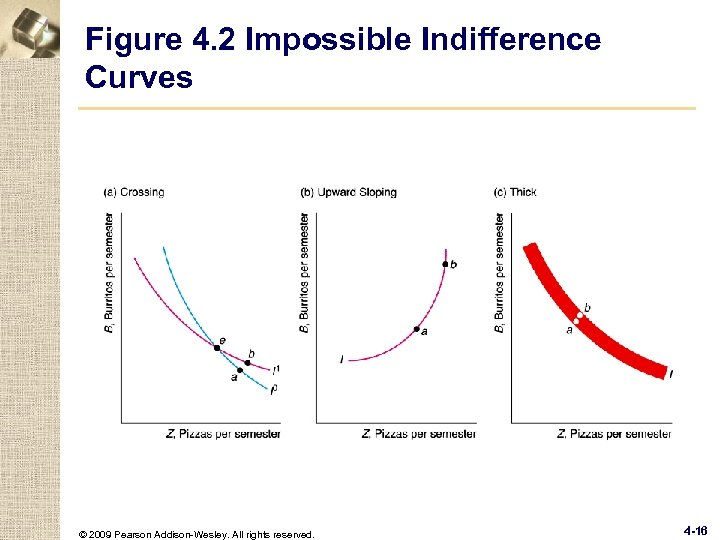 Figure 4. 2 Impossible Indifference Curves © 2009 Pearson Addison-Wesley. All rights reserved. 4 -16
 Solved Problem 4. 1 § Can indifference curves be thick? § Answer: w Draw an indifference curve that is at least two bundles thick, and show that a preference property is violated © 2009 Pearson Addison-Wesley. All rights reserved. 4 -17
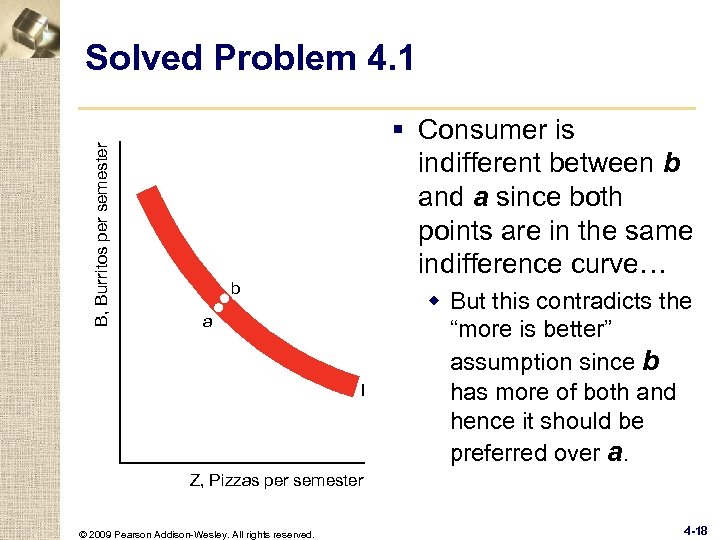 B, Burritos per semester Solved Problem 4. 1 § Consumer is indifferent between b and a since both points are in the same indifference curve… b a I w But this contradicts the “more is better” assumption since b has more of both and hence it should be preferred over a. Z, Pizzas per semester © 2009 Pearson Addison-Wesley. All rights reserved. 4 -18
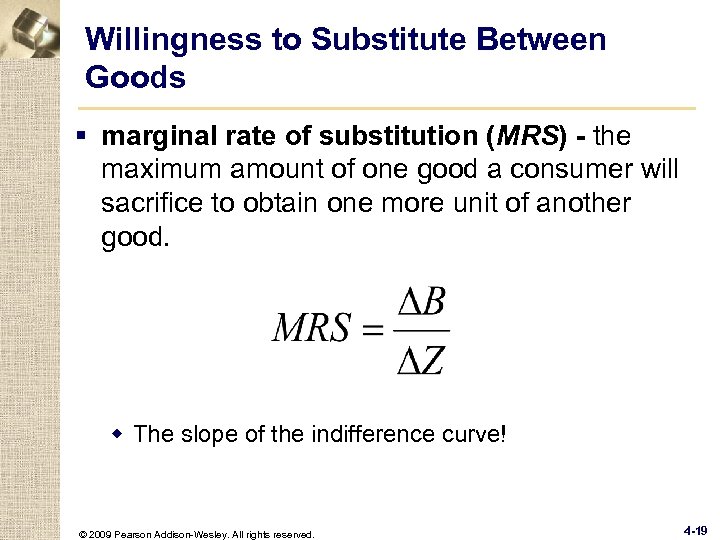 Willingness to Substitute Between Goods § marginal rate of substitution (MRS) - the maximum amount of one good a consumer will sacrifice to obtain one more unit of another good. w The slope of the indifference curve! © 2009 Pearson Addison-Wesley. All rights reserved. 4 -19
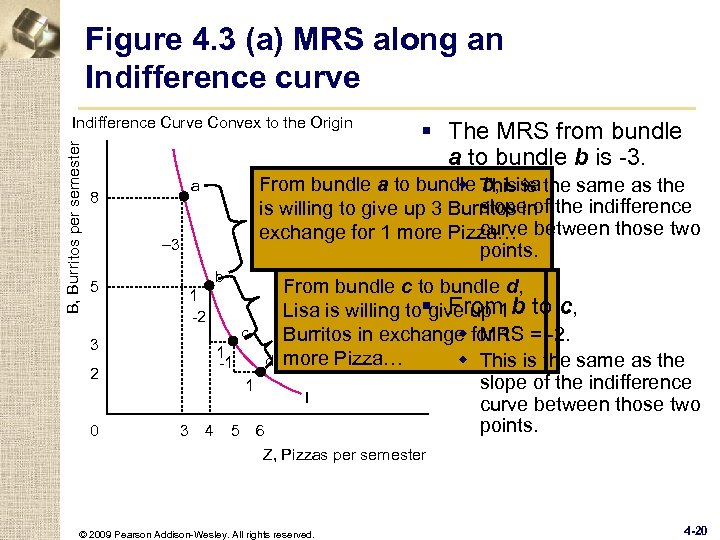 Figure 4. 3 (a) MRS along an Indifference curve B, Burritos per semester Indifference Curve Convex to the Origin From bundle a to bundle This is the same as the w b, Lisa slope of the indifference is willing to give up 3 Burritos in curve between those two exchange for 1 more Pizza… points. a 8 – 3 b 5 1 -2 3 c 1 -1 2 0 d 1 3 § The MRS from bundle a to bundle b is -3. 4 5 6 From bundle c From bundle b to bundle d, c, § From b to c, Lisa is willing to give up 1 Lisa is willing to give up 2 w MRS = -2. Burritos in exchange for 1 more Pizza… w This is the same as the slope of the indifference I curve between those two points. Z, Pizzas per semester © 2009 Pearson Addison-Wesley. All rights reserved. 4 -20
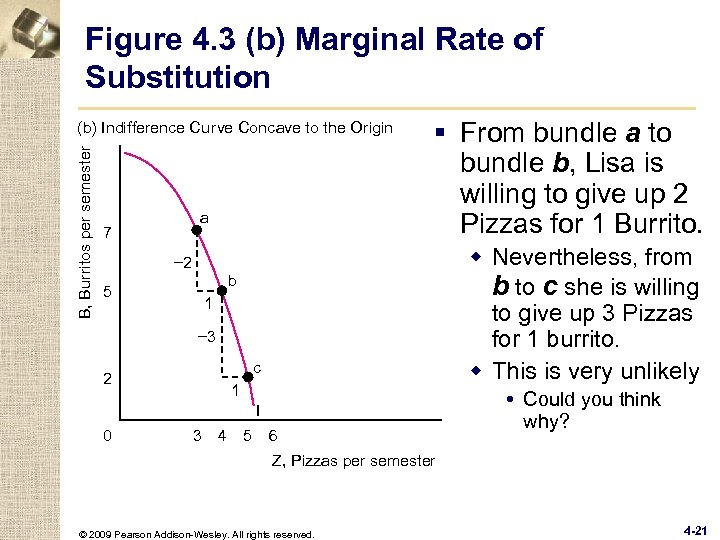 Figure 4. 3 (b) Marginal Rate of Substitution B, Burritos per semester (b) Indifference Curve Concave to the Origin a 7 – 2 § From bundle a to bundle b, Lisa is willing to give up 2 Pizzas for 1 Burrito. w Nevertheless, from b to c she is willing to give up 3 Pizzas for 1 burrito. w This is very unlikely b 5 1 – 3 c 2 1 I 0 3 4 5 6 Could you think why? Z, Pizzas per semester © 2009 Pearson Addison-Wesley. All rights reserved. 4 -21
 Diminishing marginal rate of substitution § The marginal rate of substitution approaches zero as we move down and to the right along an indifference curve. § Discussion: could you imagine a good that does not exhibit this property? © 2009 Pearson Addison-Wesley. All rights reserved. 4 -22
 Curvature of Indifference Curves. § Casual observation suggests that most people’s indifference curves are convex. § Exceptions: w Perfect substitutes - goods that a consumer is completely indifferent as to which to consume. w Perfect complements - goods that a consumer is interested in consuming only in fixed proportions © 2009 Pearson Addison-Wesley. All rights reserved. 4 -23
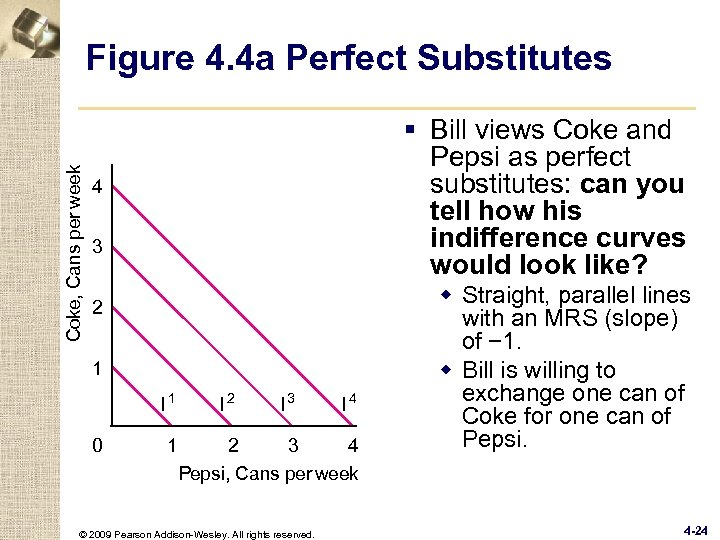 Coke, Cans per week Figure 4. 4 a Perfect Substitutes § Bill views Coke and Pepsi as perfect substitutes: can you tell how his indifference curves would look like? 4 3 2 1 I 1 0 1 I 2 I 3 I 4 2 3 4 Pepsi, Cans per week © 2009 Pearson Addison-Wesley. All rights reserved. w Straight, parallel lines with an MRS (slope) of − 1. w Bill is willing to exchange one can of Coke for one can of Pepsi. 4 -24
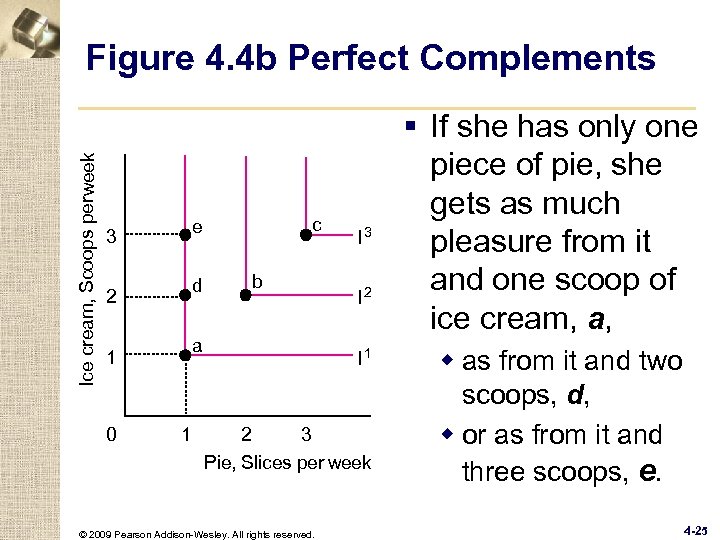 Ice cream, Scoops perweek Figure 4. 4 b Perfect Complements d 2 b a 1 0 c e 3 1 I 3 I 2 I 1 2 3 Pie, Slices per week © 2009 Pearson Addison-Wesley. All rights reserved. § If she has only one piece of pie, she gets as much pleasure from it and one scoop of ice cream, a, w as from it and two scoops, d, w or as from it and three scoops, e. 4 -25
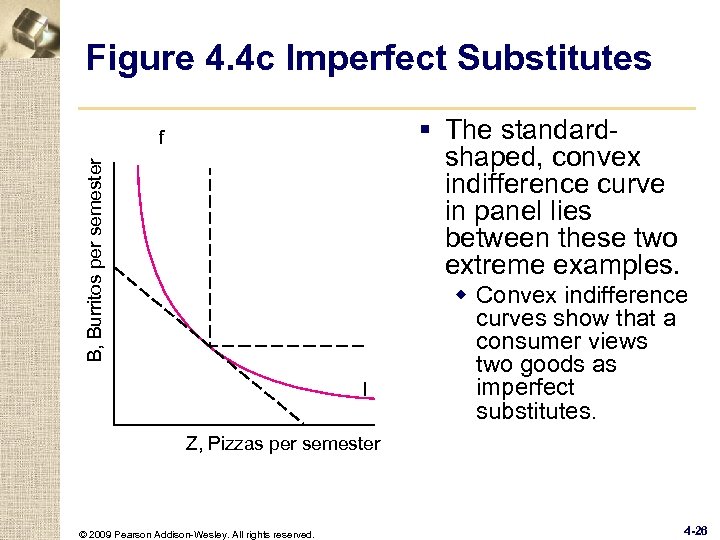 Figure 4. 4 c Imperfect Substitutes § The standardshaped, convex indifference curve in panel lies between these two extreme examples. B, Burritos per semester f I w Convex indifference curves show that a consumer views two goods as imperfect substitutes. Z, Pizzas per semester © 2009 Pearson Addison-Wesley. All rights reserved. 4 -26
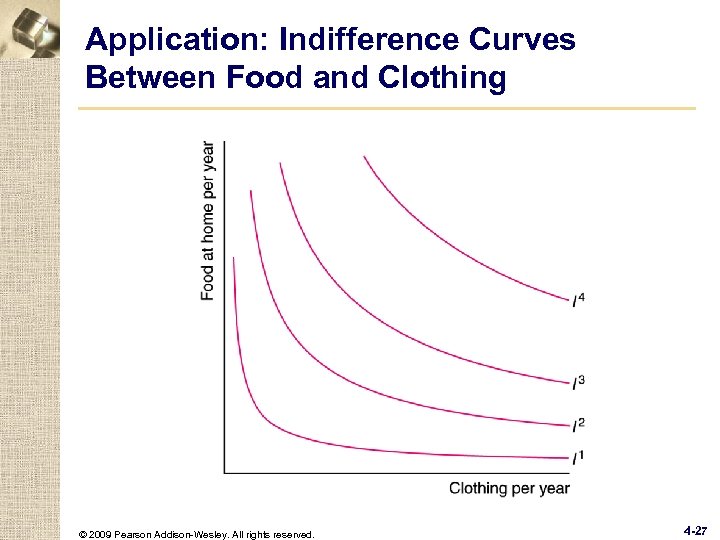 Application: Indifference Curves Between Food and Clothing © 2009 Pearson Addison-Wesley. All rights reserved. 4 -27
 Problems: constructing indifference curves 1. Don is altruistic. Show the possible shape of his indifference curves between charity and all other goods. 2. Miguel considers tickets to the Houston Grand Opera and to Houston Astros baseball games to be perfect substitutes. Show his preference map. 3. If Joe views two candy bars and one piece of cake as perfect substitutes, what is his marginal rate of substitution between candy bars and cake? © 2009 Pearson Addison-Wesley. All rights reserved. 4 -28
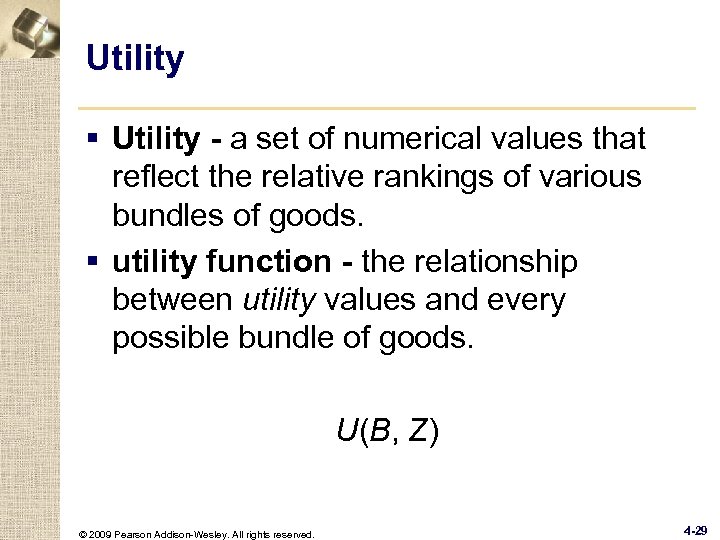 Utility § Utility - a set of numerical values that reflect the relative rankings of various bundles of goods. § utility function - the relationship between utility values and every possible bundle of goods. U(B, Z) © 2009 Pearson Addison-Wesley. All rights reserved. 4 -29
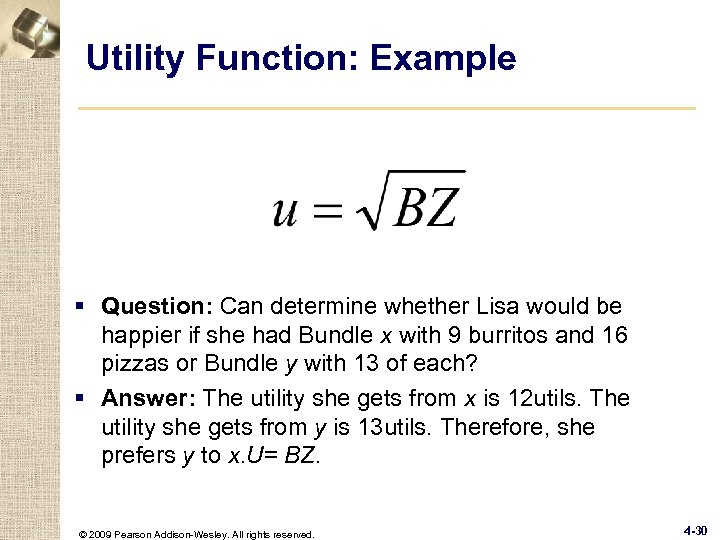 Utility Function: Example § Question: Can determine whether Lisa would be happier if she had Bundle x with 9 burritos and 16 pizzas or Bundle y with 13 of each? § Answer: The utility she gets from x is 12 utils. The utility she gets from y is 13 utils. Therefore, she prefers y to x. U= BZ. © 2009 Pearson Addison-Wesley. All rights reserved. 4 -30
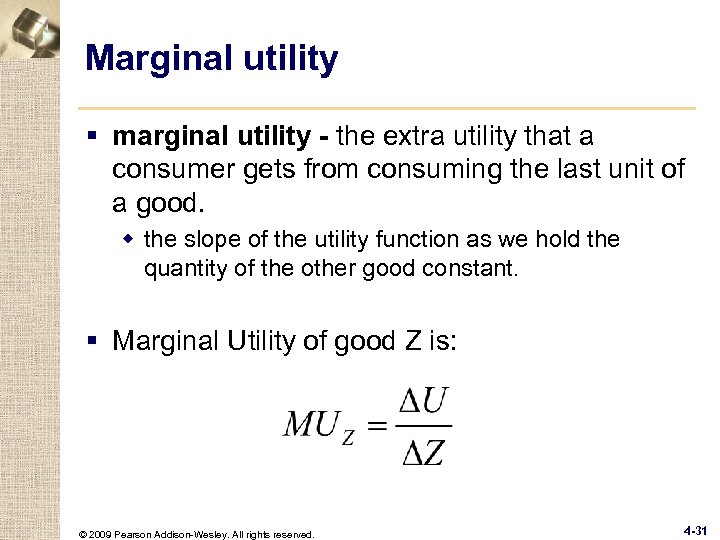 Marginal utility § marginal utility - the extra utility that a consumer gets from consuming the last unit of a good. w the slope of the utility function as we hold the quantity of the other good constant. § Marginal Utility of good Z is: © 2009 Pearson Addison-Wesley. All rights reserved. 4 -31
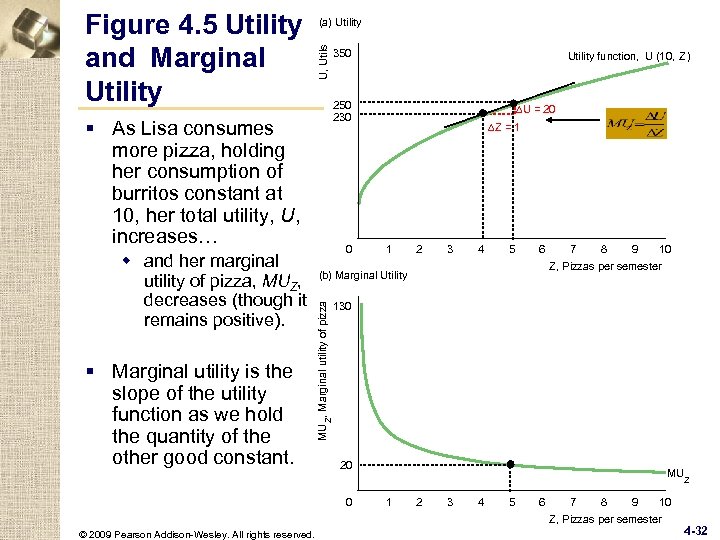 (a) Utility U, Utils Figure 4. 5 Utility and Marginal Utility 0 DU = 20 DZ = 1 1 2 3 4 5 6 7 8 9 10 Z, Pizzas per semester (b) Marginal Utility MU Z, Marginal utility of pizza § Marginal utility is the slope of the utility function as we hold the quantity of the other good constant. Utility function, U (10, Z ) 250 230 § As Lisa consumes more pizza, holding her consumption of burritos constant at 10, her total utility, U, increases… w and her marginal utility of pizza, MUZ, decreases (though it remains positive). 350 130 20 0 MU Z 1 2 3 4 5 6 7 8 9 10 Z, Pizzas per semester © 2009 Pearson Addison-Wesley. All rights reserved. 4 -32
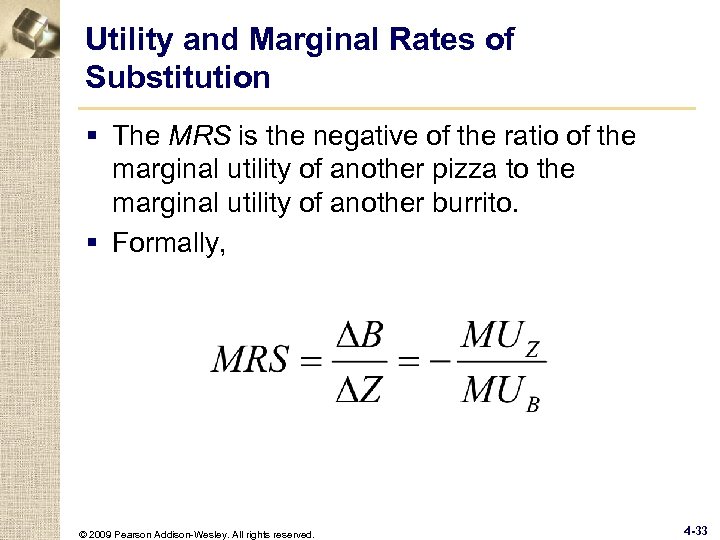 Utility and Marginal Rates of Substitution § The MRS is the negative of the ratio of the marginal utility of another pizza to the marginal utility of another burrito. § Formally, © 2009 Pearson Addison-Wesley. All rights reserved. 4 -33
 Movement along an indifference curve § Trade off B for Z so as to leave utility constant § As B declines MUB increases § As Z increases MUZ decreases § (MUZ /MUB) decreases © 2009 Pearson Addison-Wesley. All rights reserved. 4 -34
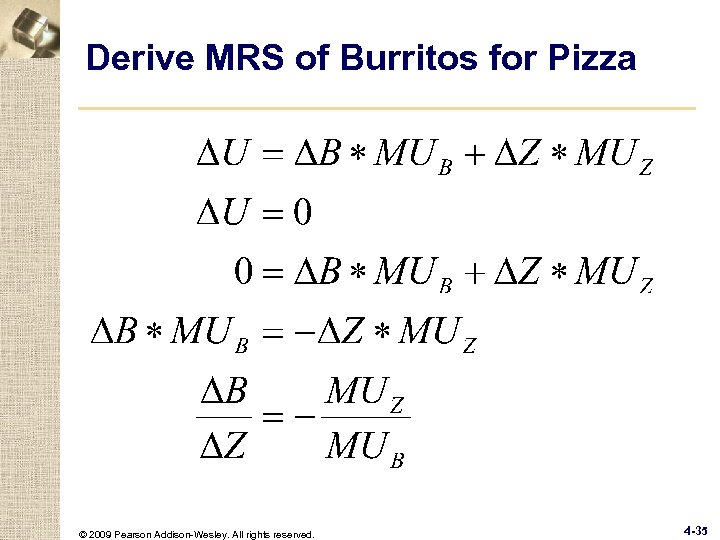 Derive MRS of Burritos for Pizza © 2009 Pearson Addison-Wesley. All rights reserved. 4 -35
 Budget Constraint § budget line (or budget constraint) - the bundles of goods that can be bought if the entire budget is spent on those goods at given prices. § opportunity set - all the bundles a consumer can buy, including all the bundles inside the budget constraint and on the budget constraint © 2009 Pearson Addison-Wesley. All rights reserved. 4 -36
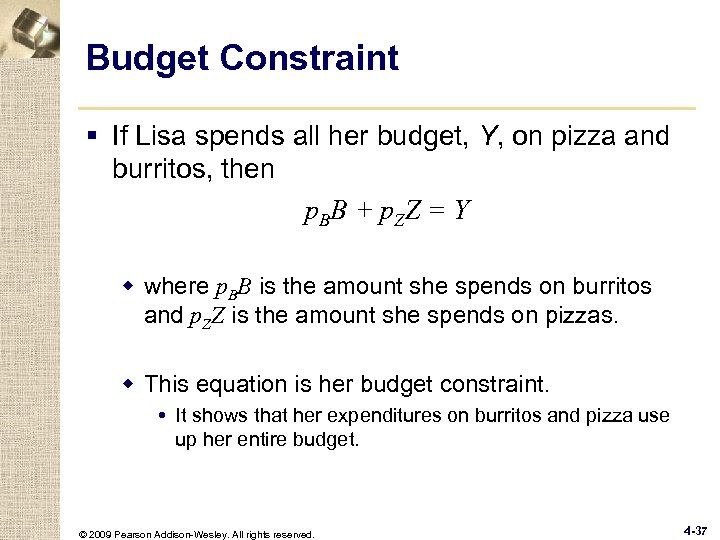 Budget Constraint § If Lisa spends all her budget, Y, on pizza and burritos, then p. BB + p. ZZ = Y w where p. BB is the amount she spends on burritos and p. ZZ is the amount she spends on pizzas. w This equation is her budget constraint. It shows that her expenditures on burritos and pizza use up her entire budget. © 2009 Pearson Addison-Wesley. All rights reserved. 4 -37
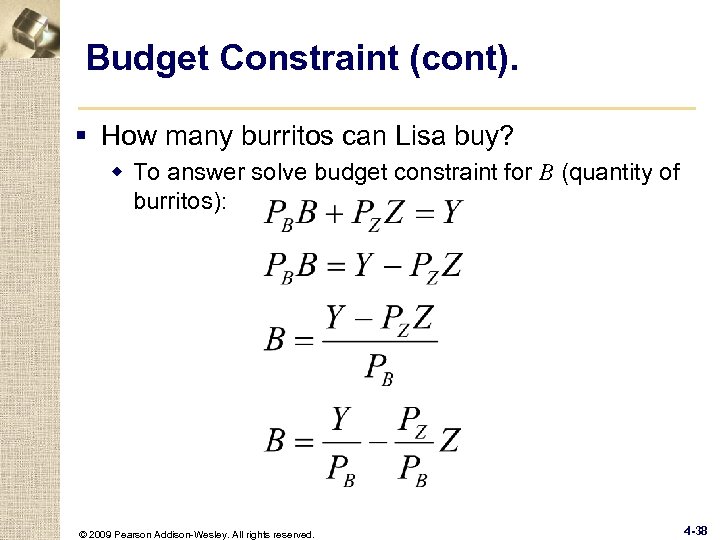 Budget Constraint (cont). § How many burritos can Lisa buy? w To answer solve budget constraint for B (quantity of burritos): © 2009 Pearson Addison-Wesley. All rights reserved. 4 -38
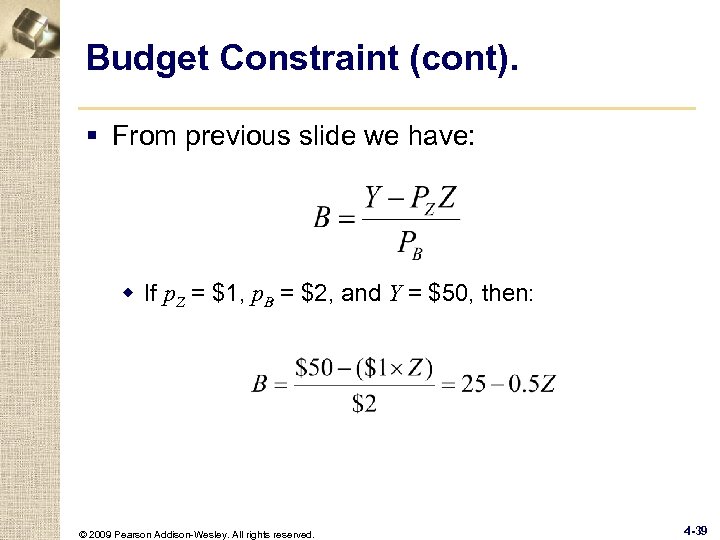 Budget Constraint (cont). § From previous slide we have: w If p. Z = $1, p. B = $2, and Y = $50, then: © 2009 Pearson Addison-Wesley. All rights reserved. 4 -39
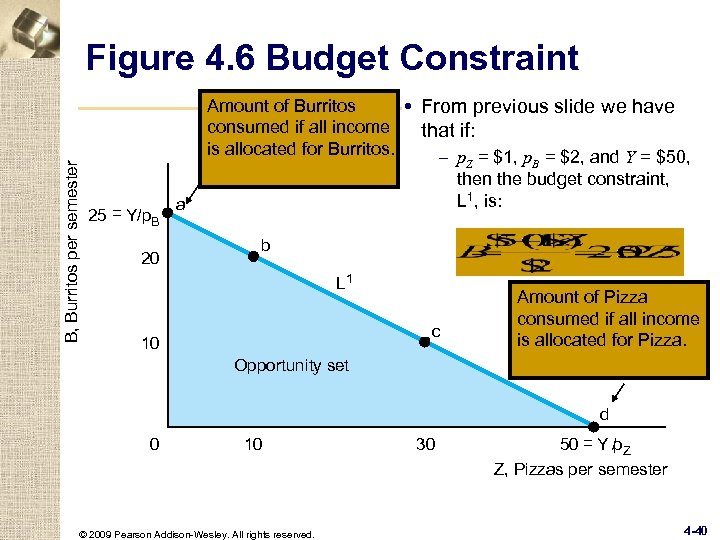 B, Burritos per semester Figure 4. 6 Budget Constraint 25 = Y/p. B 20 a Amount of Burritos From previous slide we have consumed if all income that if: is allocated for Burritos. – p. Z = $1, p. B = $2, and Y = $50, then the budget constraint, L 1, is: b L 1 c 10 Amount of Pizza consumed if all income is allocated for Pizza. Opportunity set d 0 10 © 2009 Pearson Addison-Wesley. All rights reserved. 30 50 = Y /p. Z Z, Pizzas per semester 4 -40
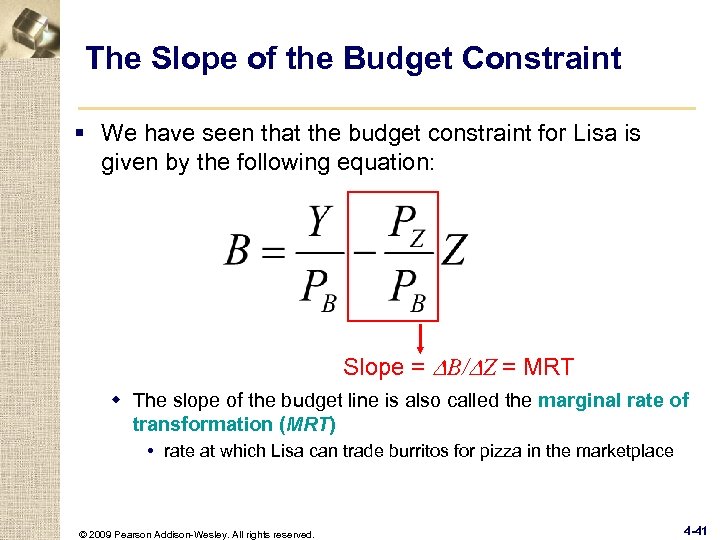 The Slope of the Budget Constraint § We have seen that the budget constraint for Lisa is given by the following equation: Slope = DB/DZ = MRT w The slope of the budget line is also called the marginal rate of transformation (MRT) rate at which Lisa can trade burritos for pizza in the marketplace © 2009 Pearson Addison-Wesley. All rights reserved. 4 -41
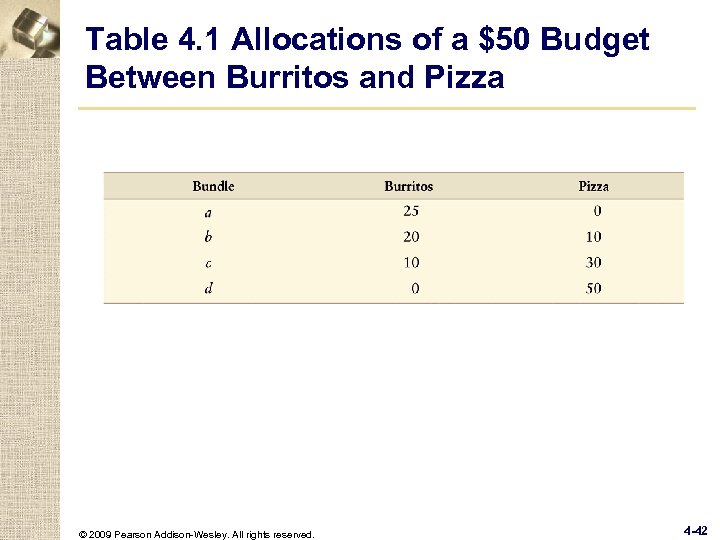 Table 4. 1 Allocations of a $50 Budget Between Burritos and Pizza © 2009 Pearson Addison-Wesley. All rights reserved. 4 -42
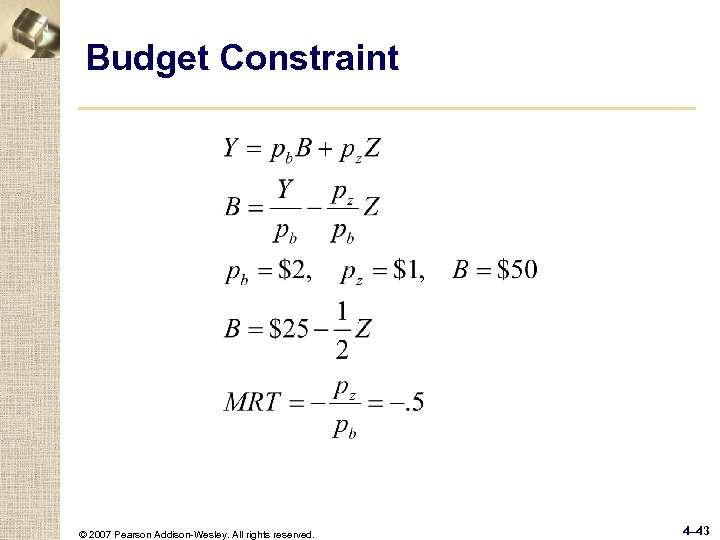 Budget Constraint © 2007 Pearson Addison-Wesley. All rights reserved. 4– 43
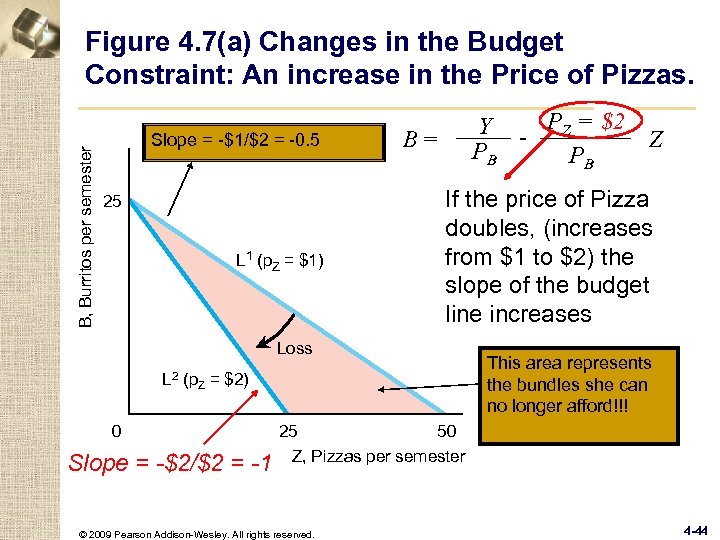 B, Burritos per semester Figure 4. 7(a) Changes in the Budget Constraint: An increase in the Price of Pizzas. Slope = -$1/$2 = -0. 5 25 L 1 (p. Z = $1) $2 Y - PZ = $1 PB PB B= If the price of Pizza doubles, (increases from $1 to $2) the slope of the budget line increases Loss L 2 (p Z = $2) 0 Slope = -$2/$2 = -1 Z This area represents the bundles she can no longer afford!!! 25 50 Z, Pizzas per semester © 2009 Pearson Addison-Wesley. All rights reserved. 4 -44
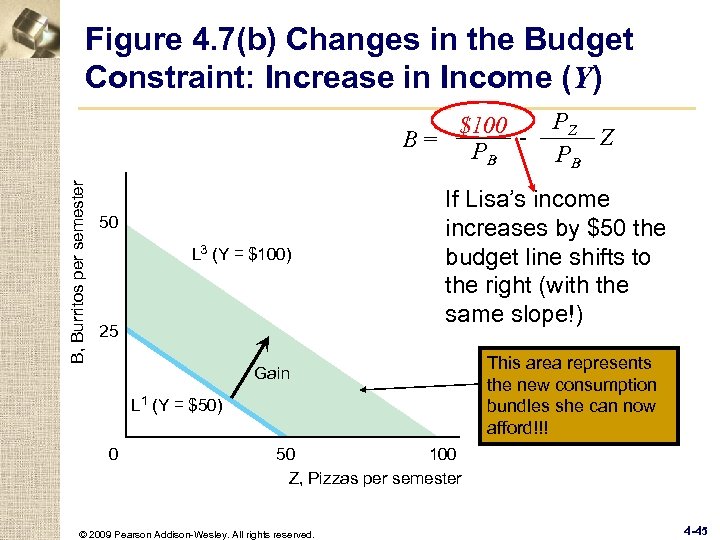 Figure 4. 7(b) Changes in the Budget Constraint: Increase in Income (Y) B, Burritos per semester $100 $50 B= PB 50 L 3 (Y = $100) 25 If Lisa’s income increases by $50 the budget line shifts to the right (with the same slope!) Gain L 1 (Y = $50) 0 PZ Z PB This area represents the new consumption bundles she can now afford!!! 50 100 Z, Pizzas per semester © 2009 Pearson Addison-Wesley. All rights reserved. 4 -45
 Changes in Budget Constraint § Change in relative prices w Rotates the budget constraint § Change in income w Parallel shift in budget constraint © 2009 Pearson Addison-Wesley. All rights reserved. 4 -46
 Solved Problem 4. 2 § A government rations water, setting a quota on how much a consumer can purchase. If a consumer can afford to buy 12 thousand gallons a month but the government restricts purchases to no more than 10 thousand gallons a month, how does the consumer’s opportunity set change? © 2009 Pearson Addison-Wesley. All rights reserved. 4 -47
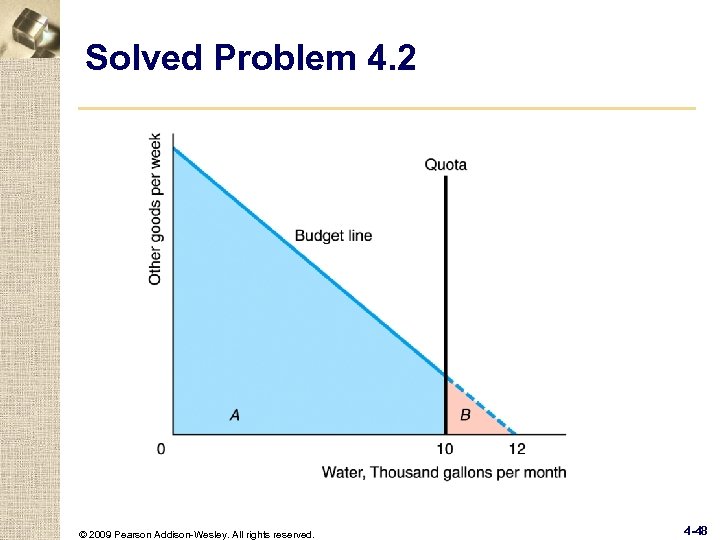 Solved Problem 4. 2 © 2009 Pearson Addison-Wesley. All rights reserved. 4 -48
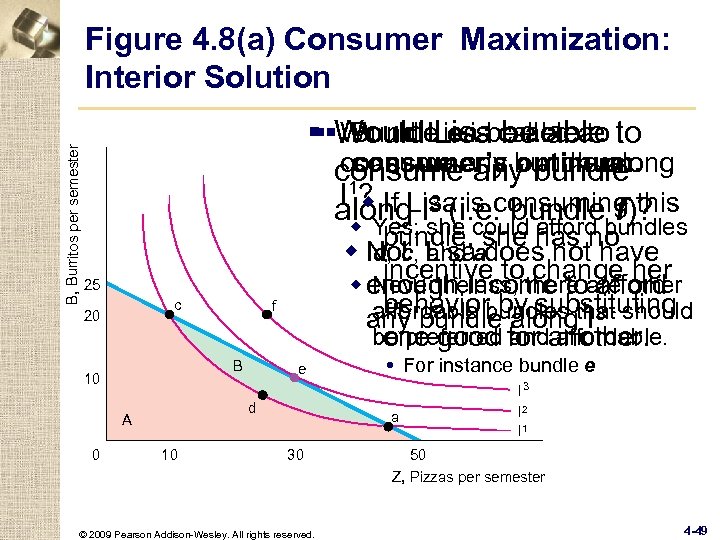 B, Burritos per semester Figure 4. 8(a) Consumer Maximization: Interior Solution § Would Lisa be able to Bundle e is called a § §Would Lisa be able to consume any bundle along consumer’s optimum. consume any bundle I 1? If Lisa is consuming this w along I 3 (i. e. bundle f)? w Yes; she could afford bundles bundle, she has no w No! Lisa does not have d, c, and a. incentive to change her w enough income to afford Nevertheless, there are other behavior by substituting affordable bundles that should any bundle along I 3 be preferred and affordable. one good for another. 25 c 20 B 10 e d A 0 f 10 For instance bundle e a 30 © 2009 Pearson Addison-Wesley. All rights reserved. I 3 I 2 I 1 50 Z, Pizzas per semester 4 -49
 Maximize Utility Given a Budget Constraint § Two possible solutions w Interior solution Some of both goods are consumed w Corner solution Only one of two goods is consumed © 2009 Pearson Addison-Wesley. All rights reserved. 4 -50
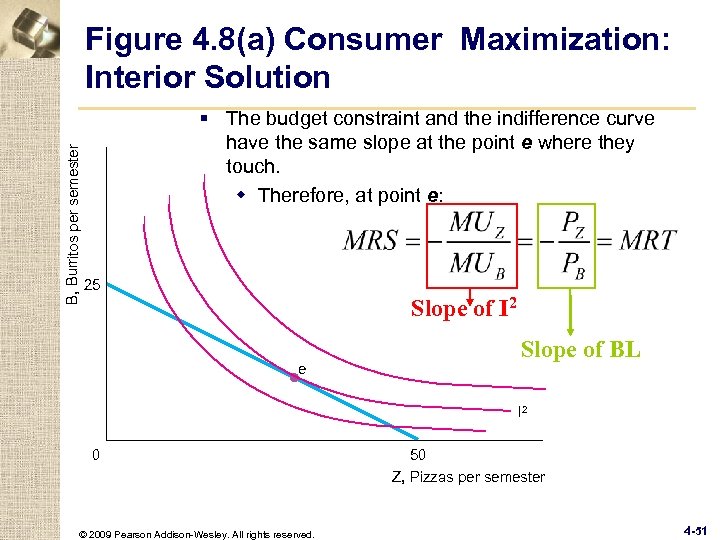 B, Burritos per semester Figure 4. 8(a) Consumer Maximization: Interior Solution § The budget constraint and the indifference curve have the same slope at the point e where they touch. w Therefore, at point e: 25 Slope of I 2 e Slope of BL I 2 0 © 2009 Pearson Addison-Wesley. All rights reserved. 50 Z, Pizzas per semester 4 -51
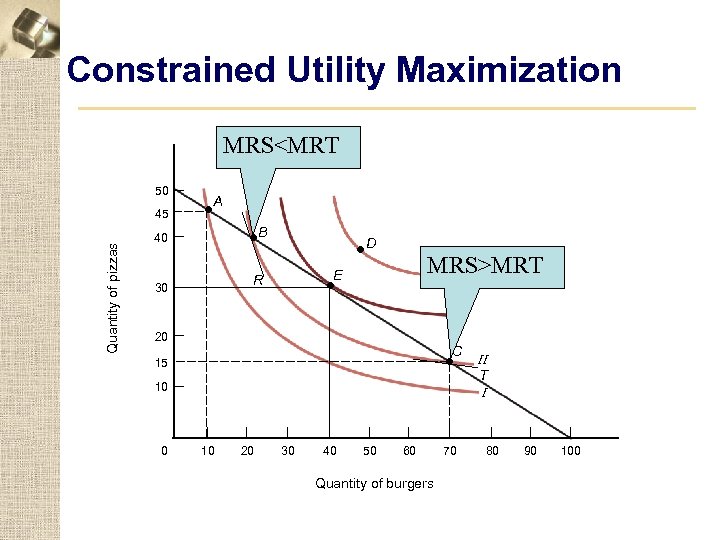 Constrained Utility Maximization MRS
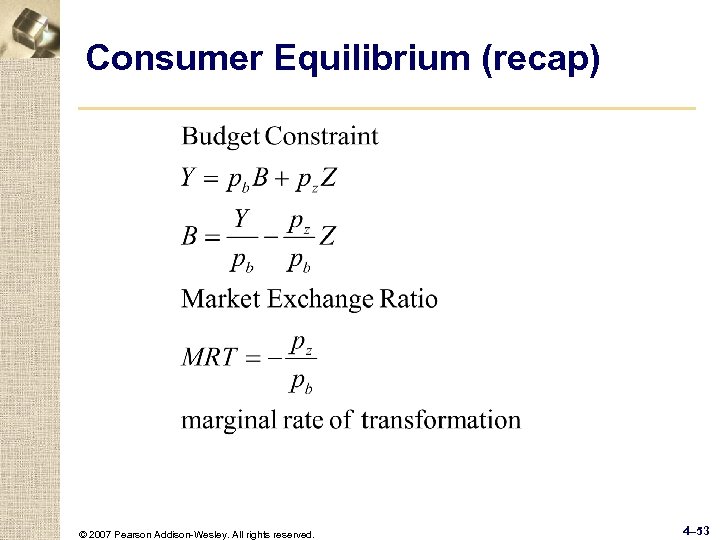 Consumer Equilibrium (recap) © 2007 Pearson Addison-Wesley. All rights reserved. 4– 53
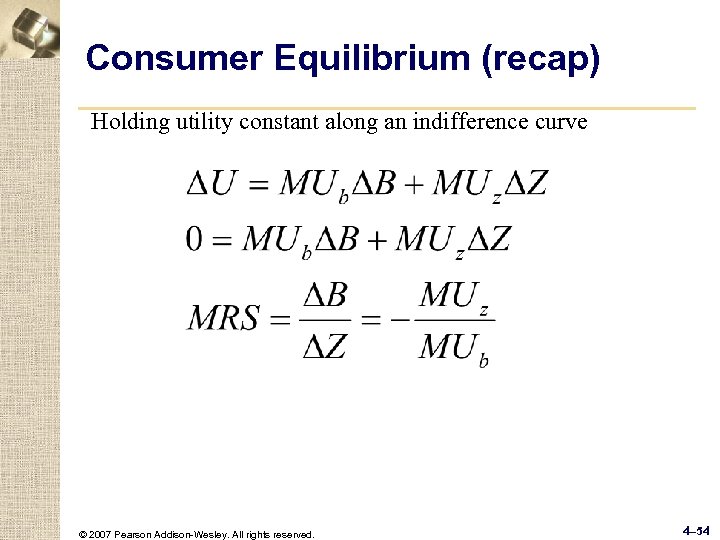 Consumer Equilibrium (recap) Holding utility constant along an indifference curve © 2007 Pearson Addison-Wesley. All rights reserved. 4– 54
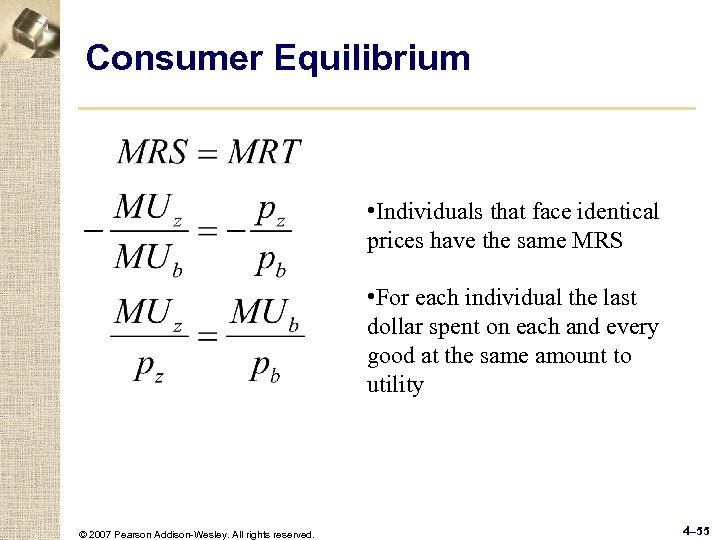 Consumer Equilibrium • Individuals that face identical prices have the same MRS • For each individual the last dollar spent on each and every good at the same amount to utility © 2007 Pearson Addison-Wesley. All rights reserved. 4– 55
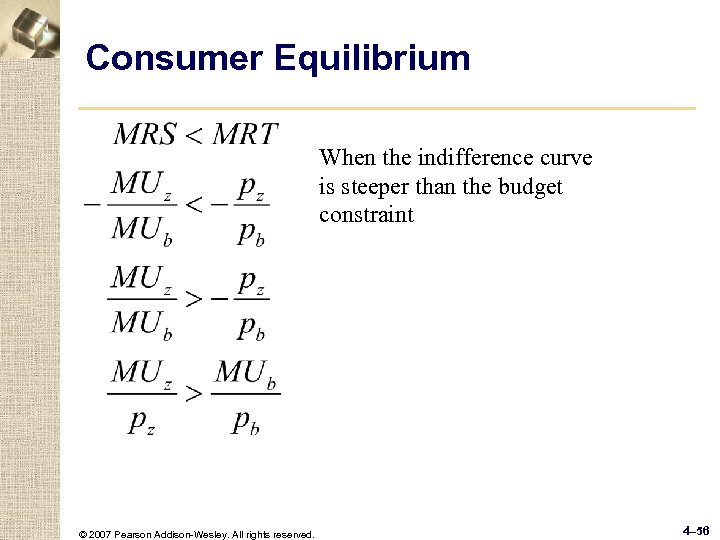 Consumer Equilibrium When the indifference curve is steeper than the budget constraint © 2007 Pearson Addison-Wesley. All rights reserved. 4– 56
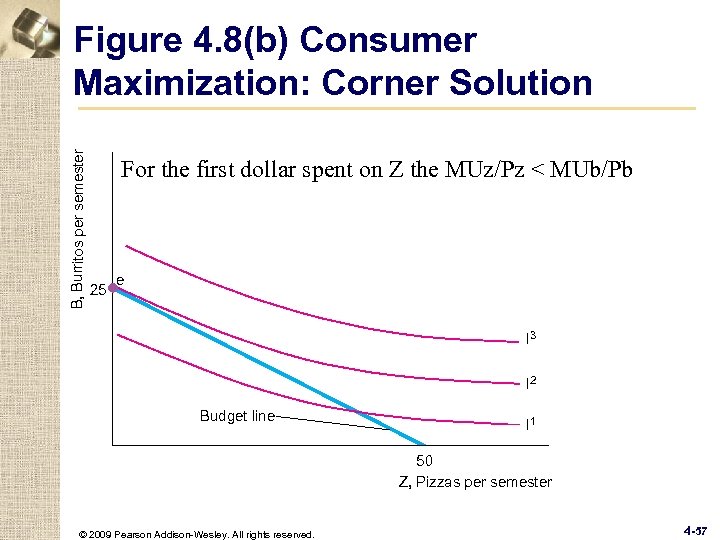 B, Burritos per semester Figure 4. 8(b) Consumer Maximization: Corner Solution For the first dollar spent on Z the MUz/Pz < MUb/Pb 25 e I 3 I 2 Budget line I 1 50 Z, Pizzas per semester © 2009 Pearson Addison-Wesley. All rights reserved. 4 -57
 Solved Problem 4. 3 § Nigel, a Brit, and Bob, a Yank, have the same tastes, and both are indifferent between a sports utility vehicle (SUV) and a luxury sedan. § Each has a budget that will allow him to buy and operate one vehicle for a decade. § For Nigel, the price of owning and operating an SUV is greater than that for the car. § For Bob, an SUV is a relative bargain because he benefits from lower gas prices and can qualify for an SUV tax break. § Use an indifference curve–budget line analysis to explain why Nigel buys and operates a car while Bob chooses an SUV. © 2009 Pearson Addison-Wesley. All rights reserved. 4 -58
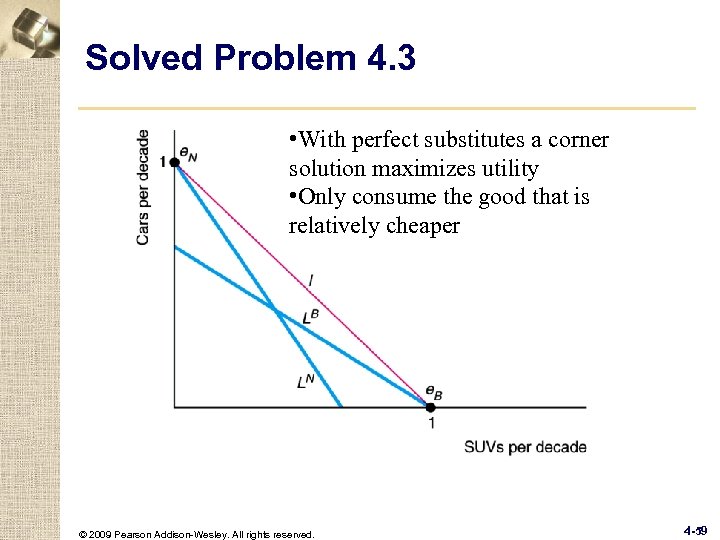 Solved Problem 4. 3 • With perfect substitutes a corner solution maximizes utility • Only consume the good that is relatively cheaper © 2009 Pearson Addison-Wesley. All rights reserved. 4 -59
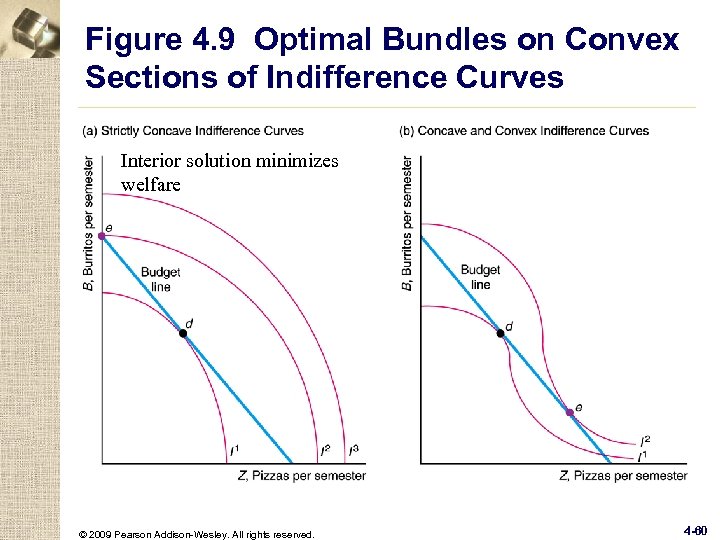 Figure 4. 9 Optimal Bundles on Convex Sections of Indifference Curves Interior solution minimizes welfare © 2009 Pearson Addison-Wesley. All rights reserved. 4 -60
 Solved Problem 4. 4 § Alexx doesn’t care about where he lives, but he does care about what he eats. Alexx spends all his money on restaurant meals at either American or French restaurants. § His firm offers to transfer him from its Miami office to its Paris office, where he will face different prices. § The firm will pay him a salary in Euros such that he can buy the same bundle of goods in Paris that he is currently buying in Miami. 11 Will Alexx benefit by moving to Paris? © 2009 Pearson Addison-Wesley. All rights reserved. 4 -61
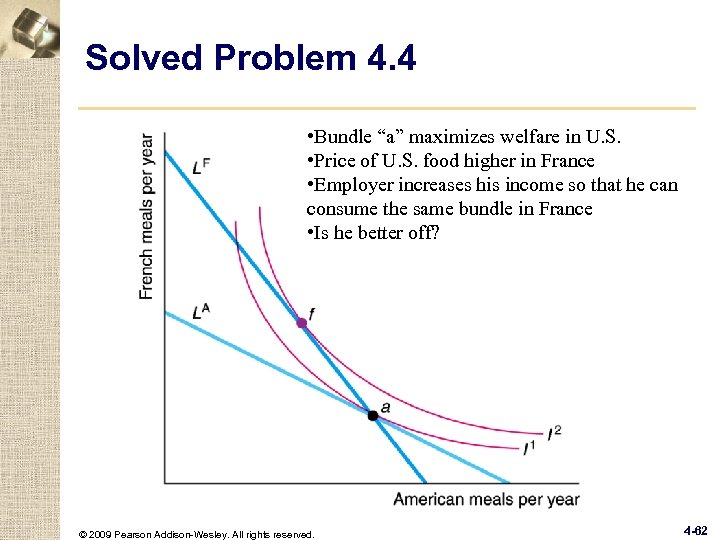 Solved Problem 4. 4 • Bundle “a” maximizes welfare in U. S. • Price of U. S. food higher in France • Employer increases his income so that he can consume the same bundle in France • Is he better off? © 2009 Pearson Addison-Wesley. All rights reserved. 4 -62
 Food Stamps § Nearly 11% of U. S. households worry about having enough money to buy food and 3. 3% report that they suffer from inadequate food (Sullivan and Choi, 2002). § Households that meet income, asset, and employment eligibility requirements receive coupons that can be used to purchase food from retail stores. © 2009 Pearson Addison-Wesley. All rights reserved. 4 -63
 Food Stamps (cont). § The Food Stamps Program is one of the nation’s largest social welfare programs with expenditures of $33. 1 billion for nearly 29. 1 million people in 2006. § Questions: w Would a switch to a comparable cash subsidy increase the well-being of food stamp recipients? w Would the recipients spend less on food and more on other goods? © 2009 Pearson Addison-Wesley. All rights reserved. 4 -64
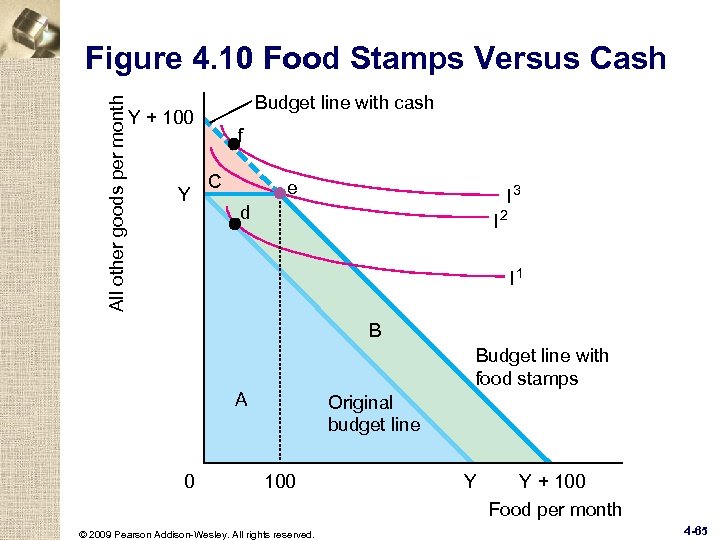 All other goods per month Figure 4. 10 Food Stamps Versus Cash Budget line with cash Y + 100 Y f C e I 3 d I 2 I 1 B Budget line with food stamps A 0 Original budget line 100 © 2009 Pearson Addison-Wesley. All rights reserved. Y Y + 100 Food per month 4 -65
 Behavioral Economics § behavioral economics - by adding insights from psychology and empirical research on human cognition and emotional biases to the rational economic model, economists try to better predict economic decision making © 2009 Pearson Addison-Wesley. All rights reserved. 4 -66