


 Скачать презентацию Chapter Five Money Markets Mc Graw-Hill Irwin 1
96bf2cd1b64c0749ae1e003af4de0abd.ppt
- Количество слайдов: 28
 Chapter Five Money Markets Mc. Graw-Hill /Irwin 1 Copyright © 2007 by The Mc. Graw-Hill Companies, Inc. All rights reserved.
 Chapter Outline 1. Overview 2. Treasury Bill 3. Federal Fund 4. Repurchase Agreement 5. Commercial Paper 6. Negotiable CD 7. Banker’s Acceptance 8. International Money Market Mc. Graw-Hill /Irwin 2 Copyright © 2007 by The Mc. Graw-Hill Companies, Inc. All rights reserved.
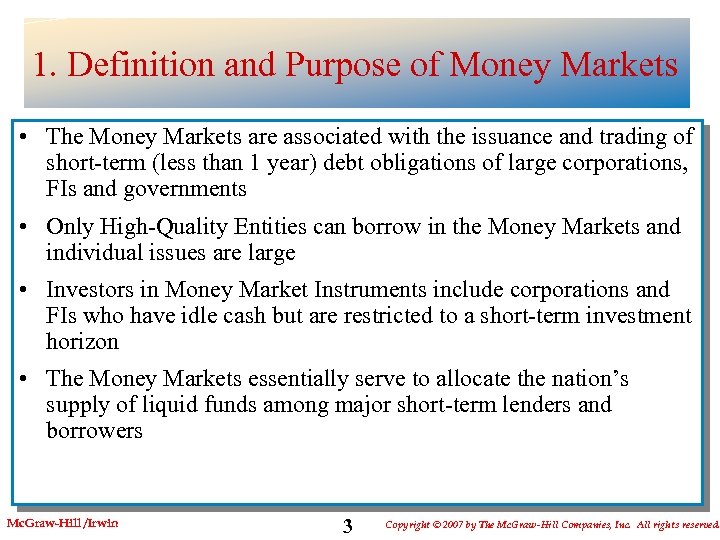 1. Definition and Purpose of Money Markets • The Money Markets are associated with the issuance and trading of short-term (less than 1 year) debt obligations of large corporations, FIs and governments • Only High-Quality Entities can borrow in the Money Markets and individual issues are large • Investors in Money Market Instruments include corporations and FIs who have idle cash but are restricted to a short-term investment horizon • The Money Markets essentially serve to allocate the nation’s supply of liquid funds among major short-term lenders and borrowers Mc. Graw-Hill /Irwin 3 Copyright © 2007 by The Mc. Graw-Hill Companies, Inc. All rights reserved.
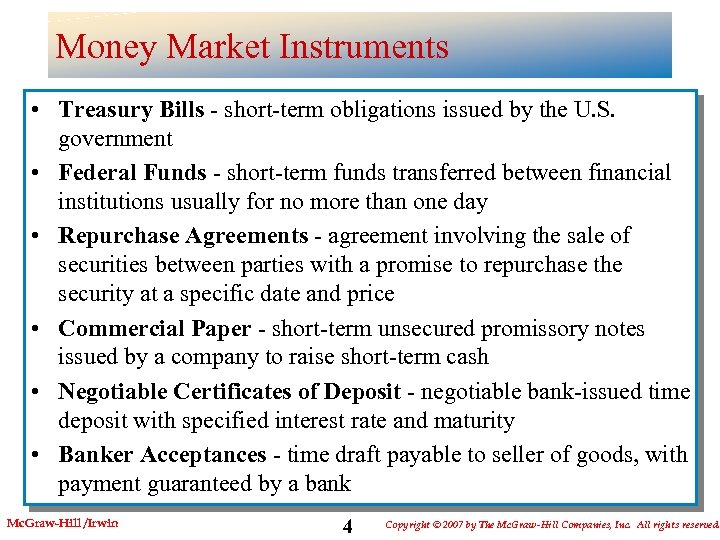 Money Market Instruments • Treasury Bills - short-term obligations issued by the U. S. government • Federal Funds - short-term funds transferred between financial institutions usually for no more than one day • Repurchase Agreements - agreement involving the sale of securities between parties with a promise to repurchase the security at a specific date and price • Commercial Paper - short-term unsecured promissory notes issued by a company to raise short-term cash • Negotiable Certificates of Deposit - negotiable bank-issued time deposit with specified interest rate and maturity • Banker Acceptances - time draft payable to seller of goods, with payment guaranteed by a bank Mc. Graw-Hill /Irwin 4 Copyright © 2007 by The Mc. Graw-Hill Companies, Inc. All rights reserved.
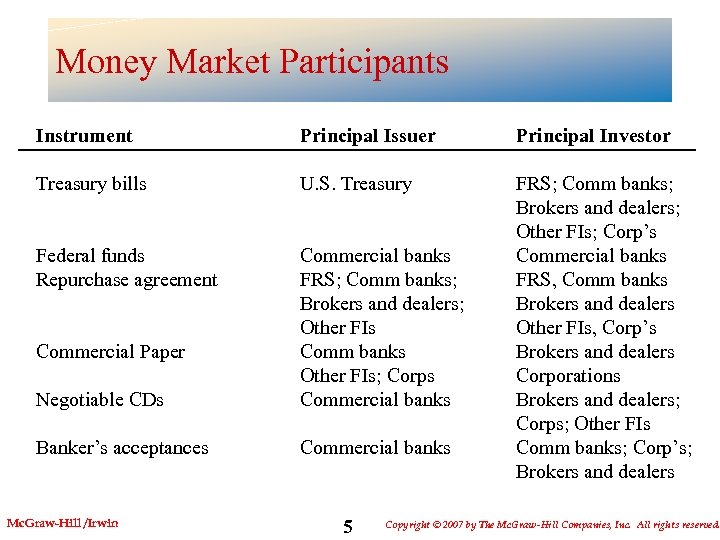 Money Market Participants Instrument Principal Issuer Principal Investor Treasury bills U. S. Treasury Federal funds Repurchase agreement Negotiable CDs Commercial banks FRS; Comm banks; Brokers and dealers; Other FIs Comm banks Other FIs; Corps Commercial banks Banker’s acceptances Commercial banks FRS; Comm banks; Brokers and dealers; Other FIs; Corp’s Commercial banks FRS, Comm banks Brokers and dealers Other FIs, Corp’s Brokers and dealers Corporations Brokers and dealers; Corps; Other FIs Comm banks; Corp’s; Brokers and dealers Commercial Paper Mc. Graw-Hill /Irwin 5 Copyright © 2007 by The Mc. Graw-Hill Companies, Inc. All rights reserved.
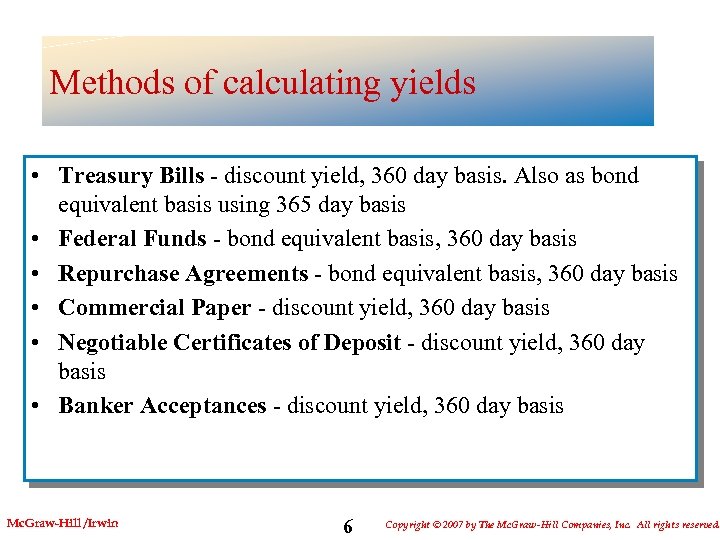 Methods of calculating yields • Treasury Bills - discount yield, 360 day basis. Also as bond equivalent basis using 365 day basis • Federal Funds - bond equivalent basis, 360 day basis • Repurchase Agreements - bond equivalent basis, 360 day basis • Commercial Paper - discount yield, 360 day basis • Negotiable Certificates of Deposit - discount yield, 360 day basis • Banker Acceptances - discount yield, 360 day basis Mc. Graw-Hill /Irwin 6 Copyright © 2007 by The Mc. Graw-Hill Companies, Inc. All rights reserved.
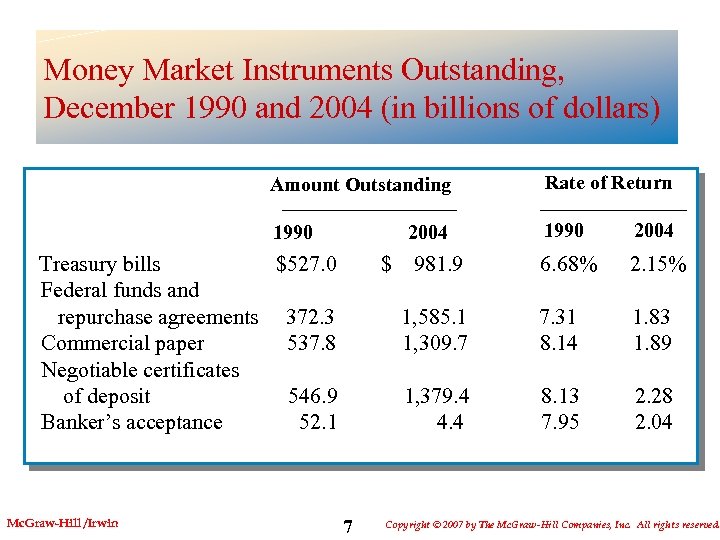 Money Market Instruments Outstanding, December 1990 and 2004 (in billions of dollars) Amount Outstanding Rate of Return 1990 2004 981. 9 6. 68% 2. 15% 1, 585. 1 1, 309. 7 7. 31 8. 14 1. 83 1. 89 1, 379. 4 4. 4 8. 13 7. 95 2. 28 2. 04 Treasury bills $527. 0 Federal funds and repurchase agreements 372. 3 Commercial paper 537. 8 Negotiable certificates of deposit 546. 9 Banker’s acceptance 52. 1 Mc. Graw-Hill /Irwin $ 7 Copyright © 2007 by The Mc. Graw-Hill Companies, Inc. All rights reserved.
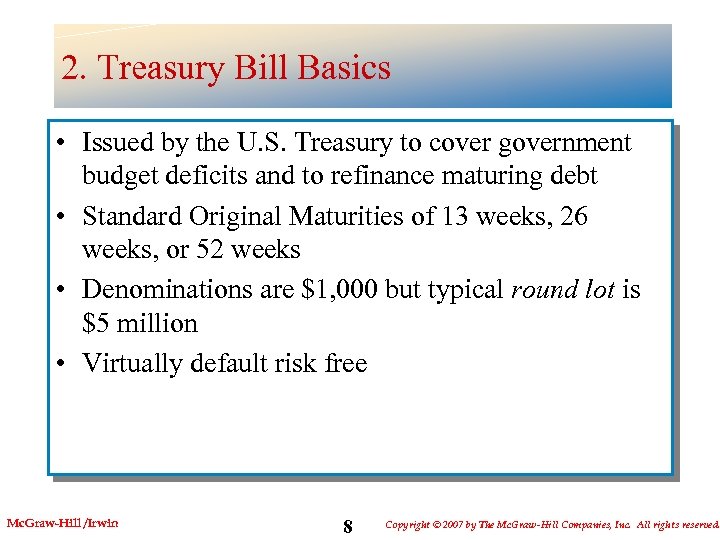 2. Treasury Bill Basics • Issued by the U. S. Treasury to cover government budget deficits and to refinance maturing debt • Standard Original Maturities of 13 weeks, 26 weeks, or 52 weeks • Denominations are $1, 000 but typical round lot is $5 million • Virtually default risk free Mc. Graw-Hill /Irwin 8 Copyright © 2007 by The Mc. Graw-Hill Companies, Inc. All rights reserved.
 The Auction Process for T-bills • Amount of new 13 -week and 26 -week T-bills offered announced weekly • Bids submitted by government securities dealers, financial and nonfinancial corporations and individuals • Individual competitive bidders limited to 35% total issue size, can submit more than one bid, allocations made beginning with highest bidder • Noncompetitive bidders indicate quantity desired and agree to pay a weighted-average of the rate on winning competitive bids; get preferential allocation Mc. Graw-Hill /Irwin 9 Copyright © 2007 by The Mc. Graw-Hill Companies, Inc. All rights reserved.
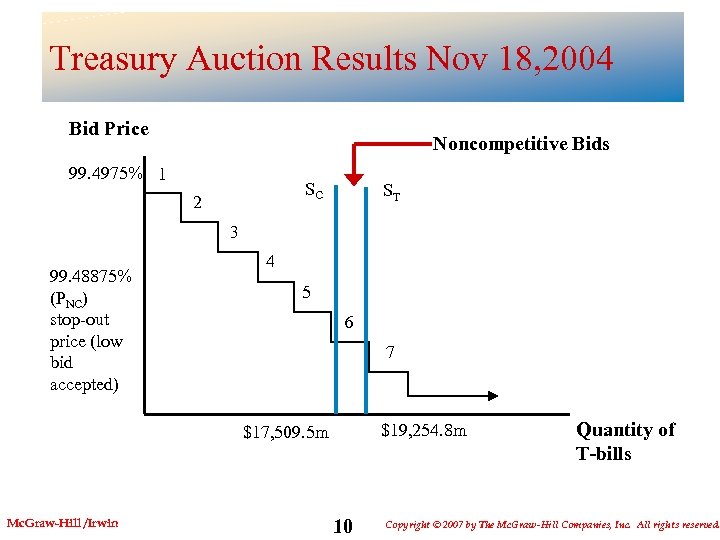 Treasury Auction Results Nov 18, 2004 Bid Price Noncompetitive Bids 99. 4975% 1 SC 2 ST 3 99. 48875% (PNC) stop-out price (low bid accepted) 4 5 6 7 $19, 254. 8 m $17, 509. 5 m Mc. Graw-Hill /Irwin 10 Quantity of T-bills Copyright © 2007 by The Mc. Graw-Hill Companies, Inc. All rights reserved.
 The Secondary Market for T-bills • The largest of any U. S. money market security • Approximately 30 financial institutions “make” a market in T-bills by buying and selling securities for their own accounts and by trading for their customers, including depository institutions, insurance companies, pensions funds, etc. • T-bills are the FOMC’s instrument of choice for its open market operations Mc. Graw-Hill /Irwin 11 Copyright © 2007 by The Mc. Graw-Hill Companies, Inc. All rights reserved.
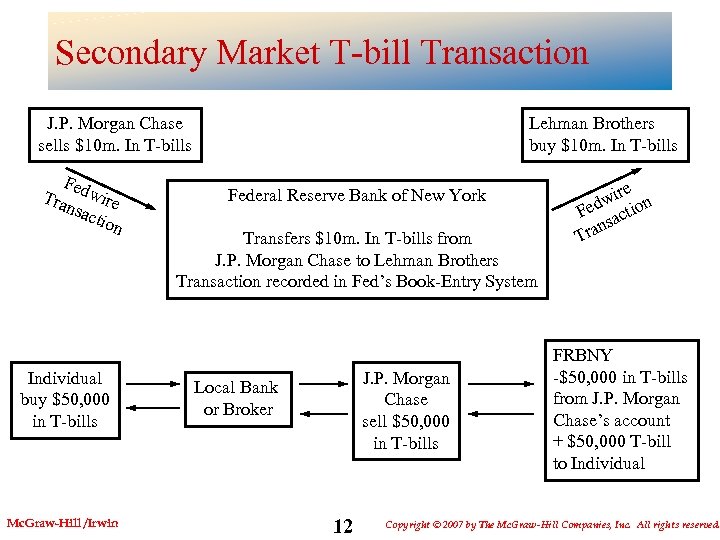 Secondary Market T-bill Transaction J. P. Morgan Chase sells $10 m. In T-bills Fed Tra wire nsa ctio n Individual buy $50, 000 in T-bills Mc. Graw-Hill /Irwin Lehman Brothers buy $10 m. In T-bills Federal Reserve Bank of New York Transfers $10 m. In T-bills from J. P. Morgan Chase to Lehman Brothers Transaction recorded in Fed’s Book-Entry System J. P. Morgan Chase sell $50, 000 in T-bills Local Bank or Broker 12 e wir on Fed acti ns Tra FRBNY -$50, 000 in T-bills from J. P. Morgan Chase’s account + $50, 000 T-bill to Individual Copyright © 2007 by The Mc. Graw-Hill Companies, Inc. All rights reserved.
 T-bill Rates and Yields • No interest paid on T-bills (coupon rate is zero), issued at a discount from their par (or face) value • T-bill rates are quoted in Wall Street Journal • Discount Yield – the price dealers are willing to pay T-bill holders to purchase their T-bills for them • Asked – the discount yield based on the current purchase price set by dealers that is available to investors • Spread – the percentage difference in the ask and bid yield; part of transaction cost; the profit for dealers Mc. Graw-Hill /Irwin 13 Copyright © 2007 by The Mc. Graw-Hill Companies, Inc. All rights reserved.
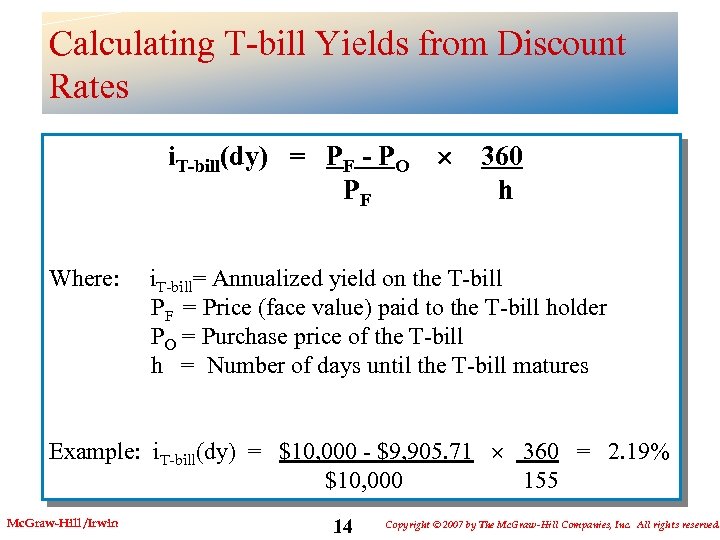 Calculating T-bill Yields from Discount Rates i. T-bill(dy) = PF - PO PF Where: 360 h i. T-bill= Annualized yield on the T-bill PF = Price (face value) paid to the T-bill holder PO = Purchase price of the T-bill h = Number of days until the T-bill matures Example: i. T-bill(dy) = $10, 000 - $9, 905. 71 360 = 2. 19% $10, 000 155 Mc. Graw-Hill /Irwin 14 Copyright © 2007 by The Mc. Graw-Hill Companies, Inc. All rights reserved.
 3. Federal Funds • Short-term funds transferred between FIs, usually for a period of one day • Federal Funds rate – the interest rate for borrowing fed funds – a focus or target rate in the conduct of monetary policy • Federal Funds Yields – single-payment loans - they pay interest only once, at maturity. – Fed fund transactions take the form of short-term (mostly overnight) unsecured loans Mc. Graw-Hill /Irwin 15 Copyright © 2007 by The Mc. Graw-Hill Companies, Inc. All rights reserved.
 Trading in the Fed Funds Market • Commercial banks conduct the majority of transactions in the fed funds market • Banks with excess reserves lend fed funds, while banks with deficient reserves borrow fed funds • Fed funds transactions can be initiated by either the lending or borrowing institution or handled through a broker • Correspondent banks – banks with reciprocal accounts and agreements Mc. Graw-Hill /Irwin 16 Copyright © 2007 by The Mc. Graw-Hill Companies, Inc. All rights reserved.
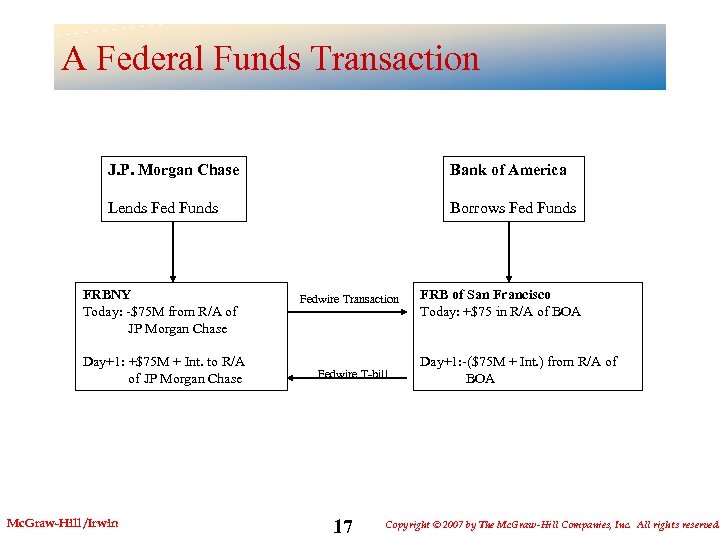 A Federal Funds Transaction J. P. Morgan Chase Bank of America Lends Fed Funds Borrows Fed Funds FRBNY Today: -$75 M from R/A of JP Morgan Chase Day+1: +$75 M + Int. to R/A of JP Morgan Chase Mc. Graw-Hill /Irwin Fedwire Transaction Fedwire T-bill 17 FRB of San Francisco Today: +$75 in R/A of BOA Day+1: -($75 M + Int. ) from R/A of BOA Copyright © 2007 by The Mc. Graw-Hill Companies, Inc. All rights reserved.
 4. Repurchase Agreements (RPs or Repos) • An agreement involving the sale of securities by one party to another with a promise to repurchase the securities at a specified price on a specified date • Essentially a collateralized funds loan with collateral in the form of securities (e. g. T-bills and Fannie Mae securities) • Reverse repurchase agreement – involves the purchase of securities between parties with the promise to sell them back at a given date in the future Mc. Graw-Hill /Irwin 18 Copyright © 2007 by The Mc. Graw-Hill Companies, Inc. All rights reserved.
 Trading Process for Repurchase Agreements • Arranged either directly between two parties or with the help of brokers and dealers • The repo buyer arranges to purchase T-bills from the repo seller with an agreement that the seller will repurchase the T-bills within a stated period of time Mc. Graw-Hill /Irwin 19 Copyright © 2007 by The Mc. Graw-Hill Companies, Inc. All rights reserved.
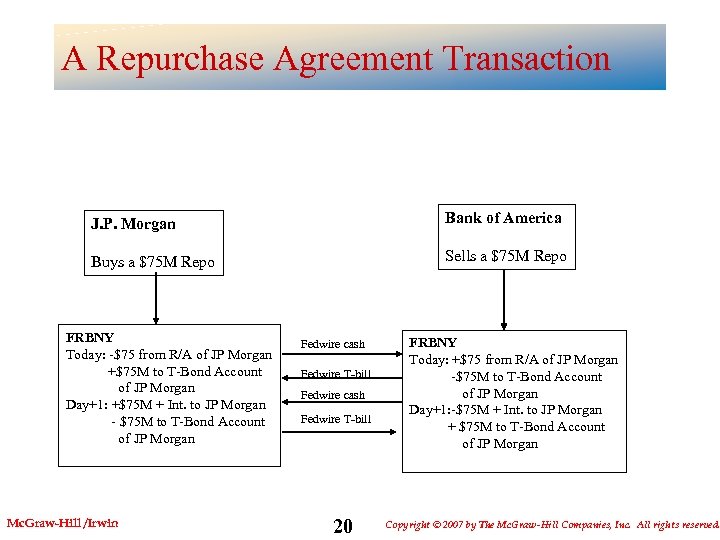 A Repurchase Agreement Transaction J. P. Morgan Bank of America Buys a $75 M Repo Sells a $75 M Repo FRBNY Today: -$75 from R/A of JP Morgan +$75 M to T-Bond Account of JP Morgan Day+1: +$75 M + Int. to JP Morgan - $75 M to T-Bond Account of JP Morgan Mc. Graw-Hill /Irwin Fedwire cash Fedwire T-bill 20 FRBNY Today: +$75 from R/A of JP Morgan -$75 M to T-Bond Account of JP Morgan Day+1: -$75 M + Int. to JP Morgan + $75 M to T-Bond Account of JP Morgan Copyright © 2007 by The Mc. Graw-Hill Companies, Inc. All rights reserved.
 5. Commercial Paper • An unsecured short-term promissory note issued by a corporation to raise short-term cash, often to finance working capital requirements • The largest (in terms of dollar value) of the money market instruments • Generally sold in denominations of $100, 000, $250, 000, $500, 000 and $1 million with maturities of 1 -270 days (if maturity is greater than 270 days, SEC requires registration) • Generally held until maturity so there is not an active secondary market Mc. Graw-Hill /Irwin 21 Copyright © 2007 by The Mc. Graw-Hill Companies, Inc. All rights reserved.
 Trading Process for Commercial Paper • CPs are sold either directly to investors (25%) or indirectly through brokers and dealers such as investment banks or major bank subsidiaries • Selling through brokers more expensive for issuer due to underwriting costs Mc. Graw-Hill /Irwin 22 Copyright © 2007 by The Mc. Graw-Hill Companies, Inc. All rights reserved.
 6. Negotiable Certificates of Deposits • A bank-issued time deposit that specifies an interest rate and maturity date and is negotiable in the secondary market • Bearer Instrument – whoever holds the CD when it matures receives the principal and interest • Denominations range from $100, 000 to $10 million; $1 million being the most common • Often purchased by money market mutual funds with pools of funds from individual investors Mc. Graw-Hill /Irwin 23 Copyright © 2007 by The Mc. Graw-Hill Companies, Inc. All rights reserved.
 Trading Process for NCDs • Banks issuing NCDs post daily rates for the more popular maturities and subject to funding needs, tries to sell to investors who are likely to hold them as investments rather than sell them to the secondary market • In some cases, the bank and investor negotiate the size, rate and maturity • Secondary market consists of a linked network of approximately 15 brokers and allows investors to buy existing CD’s rather than new issues Mc. Graw-Hill /Irwin 24 Copyright © 2007 by The Mc. Graw-Hill Companies, Inc. All rights reserved.
 7. Banker’s Acceptances • A time draft payable to a seller of goods with payment guaranteed by a bank • Arise from international trade transactions and are used to finance trade in goods that have yet to be shipped from a foreign exporter (seller) to a domestic importer (buyer) • Foreign exporters prefer that banks act as guarantors for payment before sending goods to importer Mc. Graw-Hill /Irwin 25 Copyright © 2007 by The Mc. Graw-Hill Companies, Inc. All rights reserved.
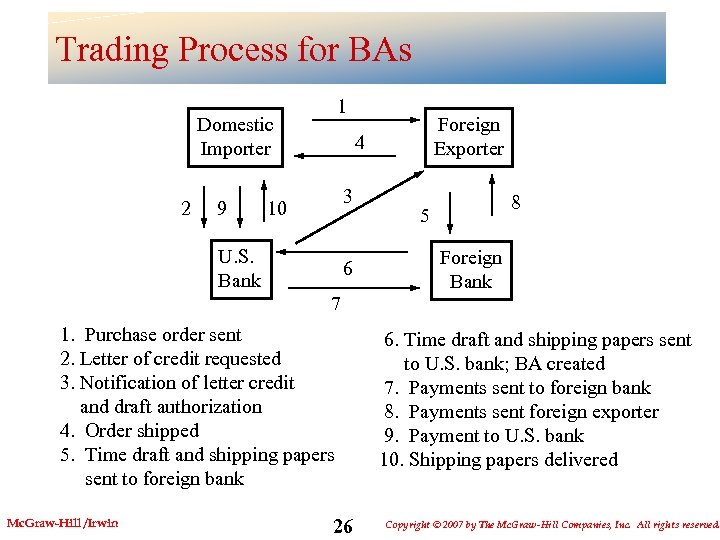 Trading Process for BAs 1 Domestic Importer 2 9 4 3 10 U. S. Bank 6 7 1. Purchase order sent 2. Letter of credit requested 3. Notification of letter credit and draft authorization 4. Order shipped 5. Time draft and shipping papers sent to foreign bank Mc. Graw-Hill /Irwin Foreign Exporter 26 8 5 Foreign Bank 6. Time draft and shipping papers sent to U. S. bank; BA created 7. Payments sent to foreign bank 8. Payments sent foreign exporter 9. Payment to U. S. bank 10. Shipping papers delivered Copyright © 2007 by The Mc. Graw-Hill Companies, Inc. All rights reserved.
 8. International Aspects of Money Markets • While U. S. money markets are the largest, the international market is growing – U. S. securities bought/sold by foreign investors – foreign money market securities • Euro money market instruments – Eurodollar deposits, Eurodollar CDs, Euro notes, Euro CP • London Interbank Offered Rate (LIBOR) – the rate paid on Eurodollars Mc. Graw-Hill /Irwin 27 Copyright © 2007 by The Mc. Graw-Hill Companies, Inc. All rights reserved.
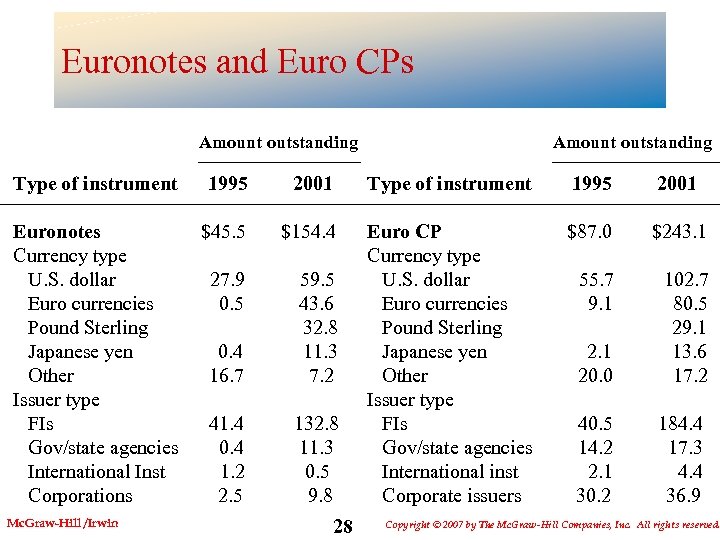 Euronotes and Euro CPs Amount outstanding Type of instrument 1995 2001 Euronotes Currency type U. S. dollar Euro currencies Pound Sterling Japanese yen Other Issuer type FIs Gov/state agencies International Inst Corporations $45. 5 $154. 4 $87. 0 $243. 1 27. 9 0. 5 55. 7 9. 1 0. 4 16. 7 59. 5 43. 6 32. 8 11. 3 7. 2 102. 7 80. 5 29. 1 13. 6 17. 2 41. 4 0. 4 1. 2 2. 5 132. 8 11. 3 0. 5 9. 8 Euro CP Currency type U. S. dollar Euro currencies Pound Sterling Japanese yen Other Issuer type FIs Gov/state agencies International inst Corporate issuers Mc. Graw-Hill /Irwin 28 2. 1 20. 0 40. 5 14. 2 2. 1 30. 2 184. 4 17. 3 4. 4 36. 9 Copyright © 2007 by The Mc. Graw-Hill Companies, Inc. All rights reserved.