


 Скачать презентацию Chapter Five Introduction to Valuation The Time Value
6b0937eeca66d3ca8b71ff107ee215e0.ppt
- Количество слайдов: 33
 Chapter Five Introduction to Valuation: The Time Value of Money (Calculators) © 2003 The Mc. Graw-Hill Companies, Inc. All rights reserved.
 5. 1 Key Concepts and Skills • Be able to compute the future value of an investment made today • Be able to compute the present value of cash to be received at some future date • Be able to compute the return on an investment • Be able to compute the number of periods that equates a present value and a future value given an interest rate • Be able to use a financial calculator and a spreadsheet to solve time value of money problems Mc. Graw-Hill/Irwin © 2003 The Mc. Graw-Hill Companies, Inc. All rights reserved.
 5. 2 Chapter Outline • Future Value and Compounding • Present Value and Discounting • More on Present and Future Values Mc. Graw-Hill/Irwin © 2003 The Mc. Graw-Hill Companies, Inc. All rights reserved.
 5. 3 Basic Definitions • Present Value – earlier money on a time line • Future Value – later money on a time line • Interest rate – “exchange rate” between earlier money and later money – Discount rate – Cost of capital – Opportunity cost of capital – Required return Mc. Graw-Hill/Irwin © 2003 The Mc. Graw-Hill Companies, Inc. All rights reserved.
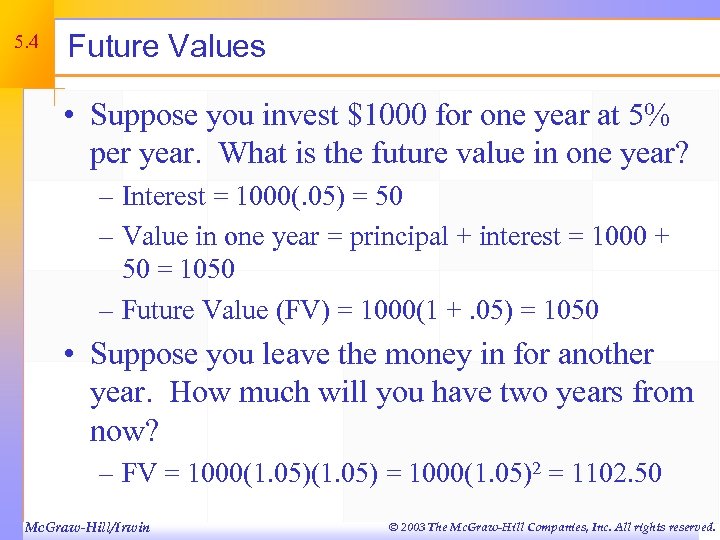 5. 4 Future Values • Suppose you invest $1000 for one year at 5% per year. What is the future value in one year? – Interest = 1000(. 05) = 50 – Value in one year = principal + interest = 1000 + 50 = 1050 – Future Value (FV) = 1000(1 +. 05) = 1050 • Suppose you leave the money in for another year. How much will you have two years from now? – FV = 1000(1. 05)2 = 1102. 50 Mc. Graw-Hill/Irwin © 2003 The Mc. Graw-Hill Companies, Inc. All rights reserved.
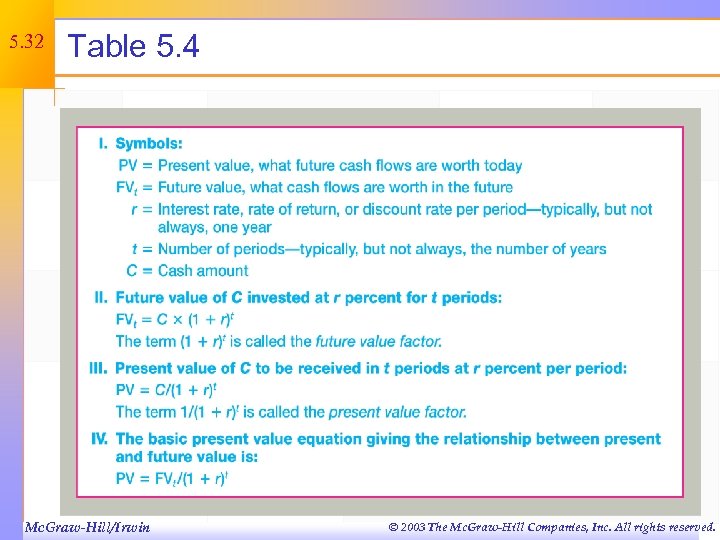
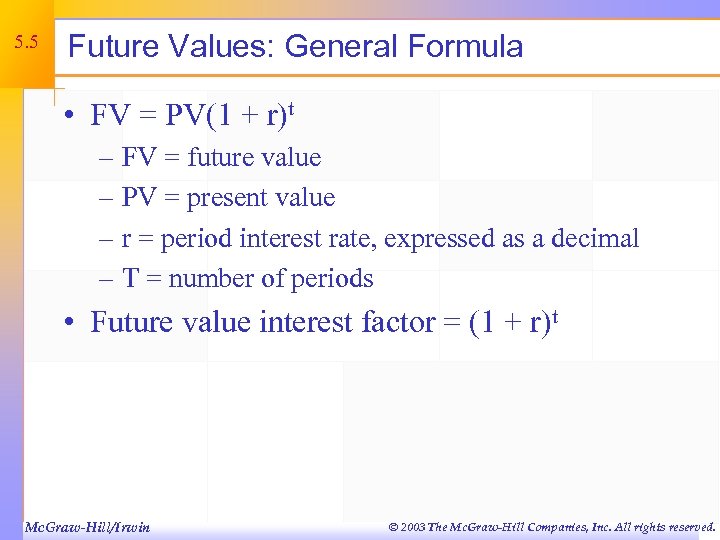 5. 5 Future Values: General Formula • FV = PV(1 + r)t – FV = future value – PV = present value – r = period interest rate, expressed as a decimal – T = number of periods • Future value interest factor = (1 + r)t Mc. Graw-Hill/Irwin © 2003 The Mc. Graw-Hill Companies, Inc. All rights reserved.
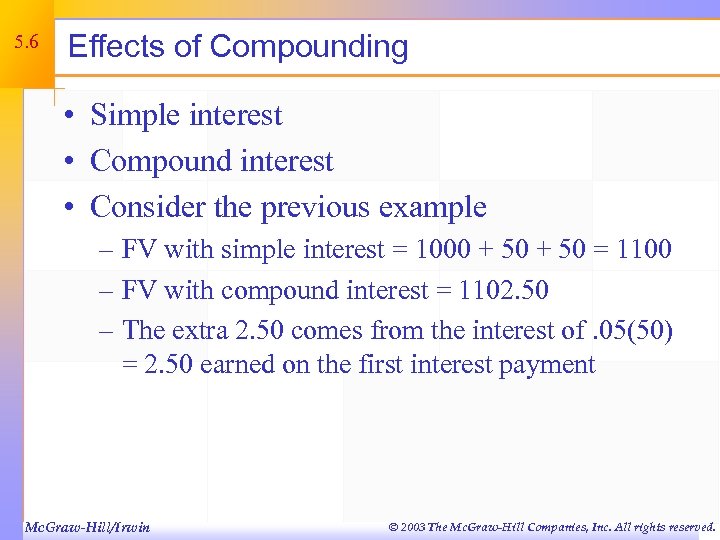 5. 6 Effects of Compounding • Simple interest • Compound interest • Consider the previous example – FV with simple interest = 1000 + 50 = 1100 – FV with compound interest = 1102. 50 – The extra 2. 50 comes from the interest of. 05(50) = 2. 50 earned on the first interest payment Mc. Graw-Hill/Irwin © 2003 The Mc. Graw-Hill Companies, Inc. All rights reserved.
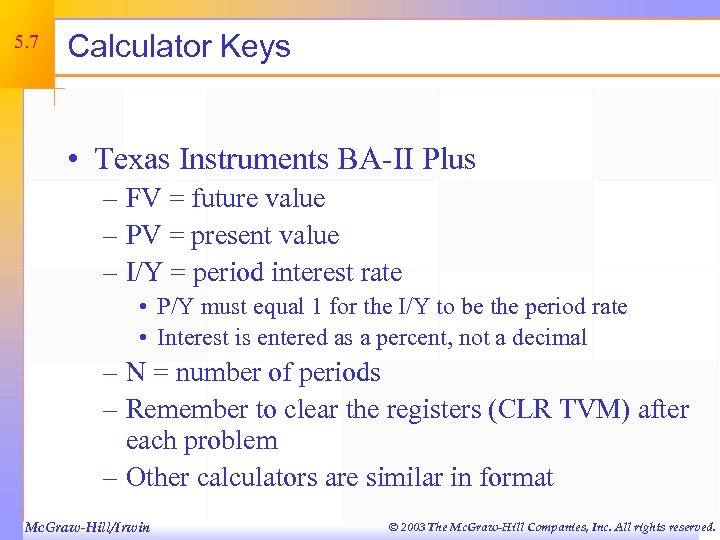 5. 7 Calculator Keys • Texas Instruments BA-II Plus – FV = future value – PV = present value – I/Y = period interest rate • P/Y must equal 1 for the I/Y to be the period rate • Interest is entered as a percent, not a decimal – N = number of periods – Remember to clear the registers (CLR TVM) after each problem – Other calculators are similar in format Mc. Graw-Hill/Irwin © 2003 The Mc. Graw-Hill Companies, Inc. All rights reserved.
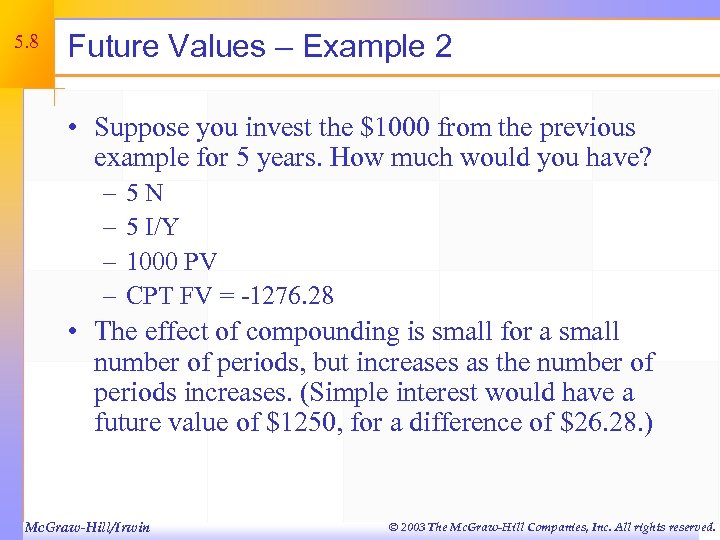 5. 8 Future Values – Example 2 • Suppose you invest the $1000 from the previous example for 5 years. How much would you have? – – 5 N 5 I/Y 1000 PV CPT FV = -1276. 28 • The effect of compounding is small for a small number of periods, but increases as the number of periods increases. (Simple interest would have a future value of $1250, for a difference of $26. 28. ) Mc. Graw-Hill/Irwin © 2003 The Mc. Graw-Hill Companies, Inc. All rights reserved.
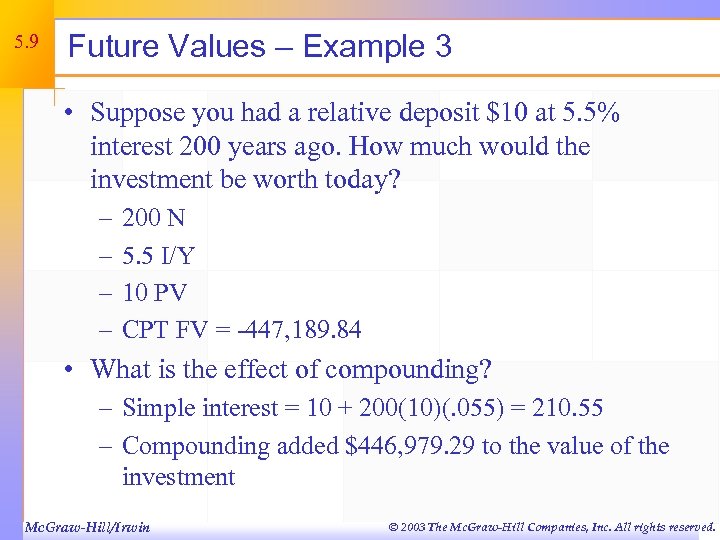 5. 9 Future Values – Example 3 • Suppose you had a relative deposit $10 at 5. 5% interest 200 years ago. How much would the investment be worth today? – – 200 N 5. 5 I/Y 10 PV CPT FV = -447, 189. 84 • What is the effect of compounding? – Simple interest = 10 + 200(10)(. 055) = 210. 55 – Compounding added $446, 979. 29 to the value of the investment Mc. Graw-Hill/Irwin © 2003 The Mc. Graw-Hill Companies, Inc. All rights reserved.
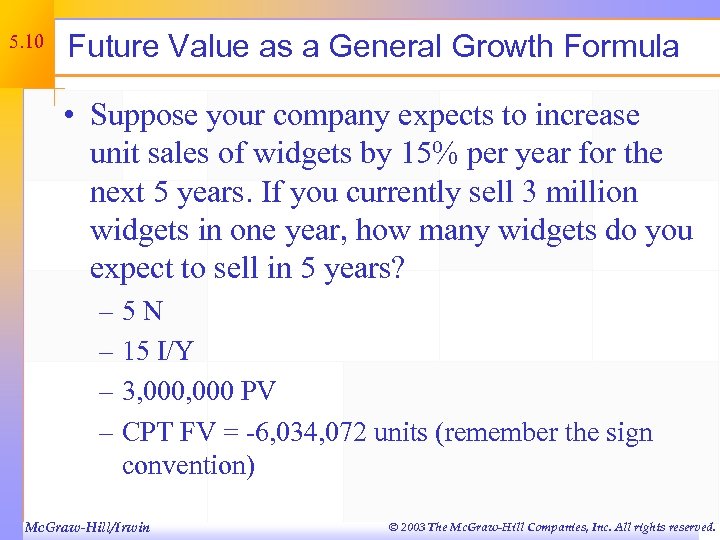 5. 10 Future Value as a General Growth Formula • Suppose your company expects to increase unit sales of widgets by 15% per year for the next 5 years. If you currently sell 3 million widgets in one year, how many widgets do you expect to sell in 5 years? – 5 N – 15 I/Y – 3, 000 PV – CPT FV = -6, 034, 072 units (remember the sign convention) Mc. Graw-Hill/Irwin © 2003 The Mc. Graw-Hill Companies, Inc. All rights reserved.
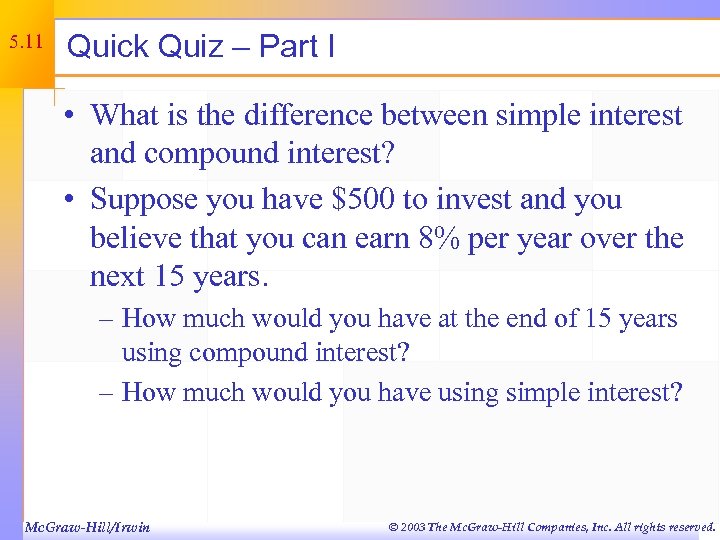 5. 11 Quick Quiz – Part I • What is the difference between simple interest and compound interest? • Suppose you have $500 to invest and you believe that you can earn 8% per year over the next 15 years. – How much would you have at the end of 15 years using compound interest? – How much would you have using simple interest? Mc. Graw-Hill/Irwin © 2003 The Mc. Graw-Hill Companies, Inc. All rights reserved.
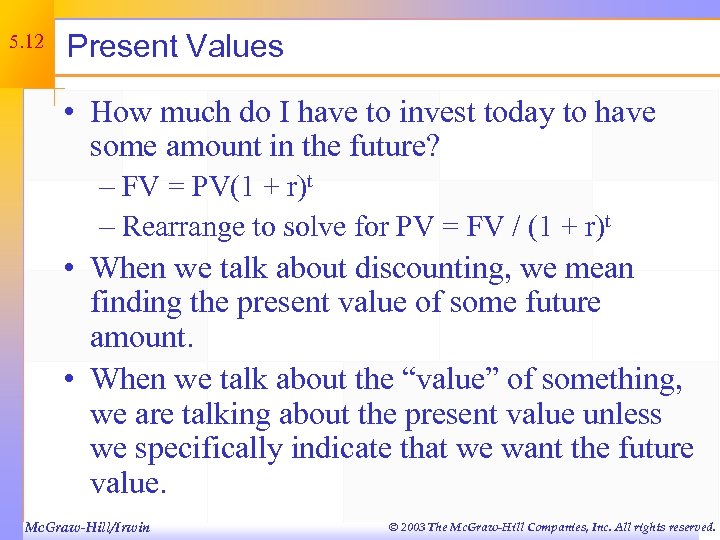 5. 12 Present Values • How much do I have to invest today to have some amount in the future? – FV = PV(1 + r)t – Rearrange to solve for PV = FV / (1 + r)t • When we talk about discounting, we mean finding the present value of some future amount. • When we talk about the “value” of something, we are talking about the present value unless we specifically indicate that we want the future value. Mc. Graw-Hill/Irwin © 2003 The Mc. Graw-Hill Companies, Inc. All rights reserved.
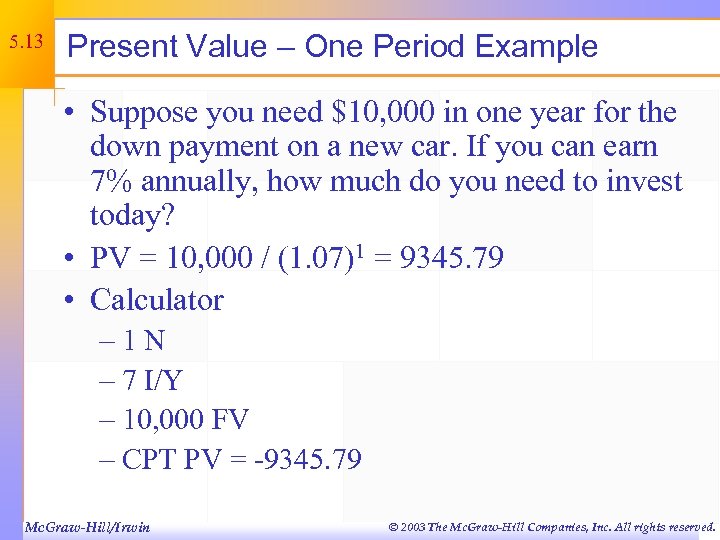 5. 13 Present Value – One Period Example • Suppose you need $10, 000 in one year for the down payment on a new car. If you can earn 7% annually, how much do you need to invest today? • PV = 10, 000 / (1. 07)1 = 9345. 79 • Calculator – 1 N – 7 I/Y – 10, 000 FV – CPT PV = -9345. 79 Mc. Graw-Hill/Irwin © 2003 The Mc. Graw-Hill Companies, Inc. All rights reserved.
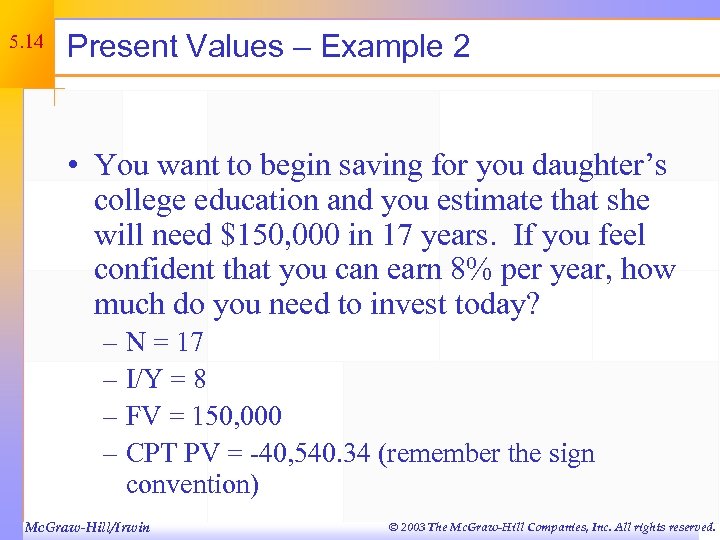 5. 14 Present Values – Example 2 • You want to begin saving for you daughter’s college education and you estimate that she will need $150, 000 in 17 years. If you feel confident that you can earn 8% per year, how much do you need to invest today? – N = 17 – I/Y = 8 – FV = 150, 000 – CPT PV = -40, 540. 34 (remember the sign convention) Mc. Graw-Hill/Irwin © 2003 The Mc. Graw-Hill Companies, Inc. All rights reserved.
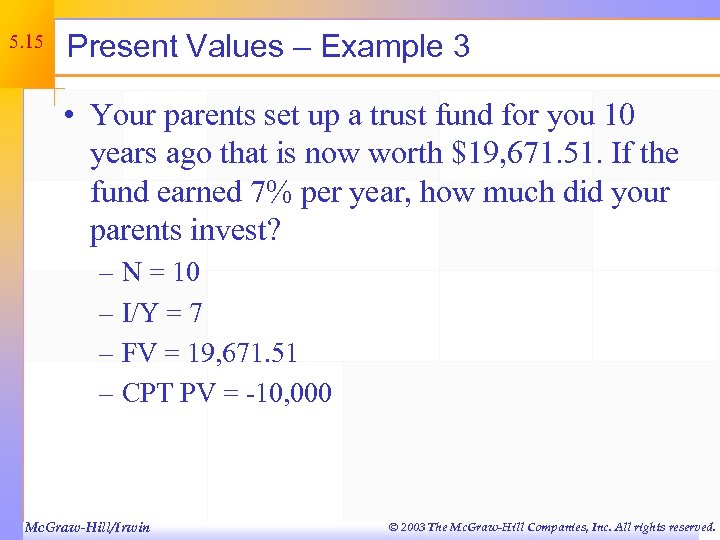 5. 15 Present Values – Example 3 • Your parents set up a trust fund for you 10 years ago that is now worth $19, 671. 51. If the fund earned 7% per year, how much did your parents invest? – N = 10 – I/Y = 7 – FV = 19, 671. 51 – CPT PV = -10, 000 Mc. Graw-Hill/Irwin © 2003 The Mc. Graw-Hill Companies, Inc. All rights reserved.
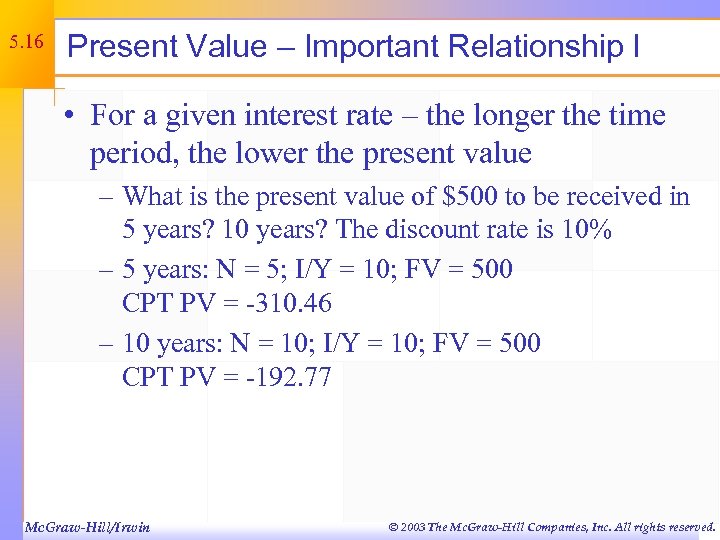 5. 16 Present Value – Important Relationship I • For a given interest rate – the longer the time period, the lower the present value – What is the present value of $500 to be received in 5 years? 10 years? The discount rate is 10% – 5 years: N = 5; I/Y = 10; FV = 500 CPT PV = -310. 46 – 10 years: N = 10; I/Y = 10; FV = 500 CPT PV = -192. 77 Mc. Graw-Hill/Irwin © 2003 The Mc. Graw-Hill Companies, Inc. All rights reserved.
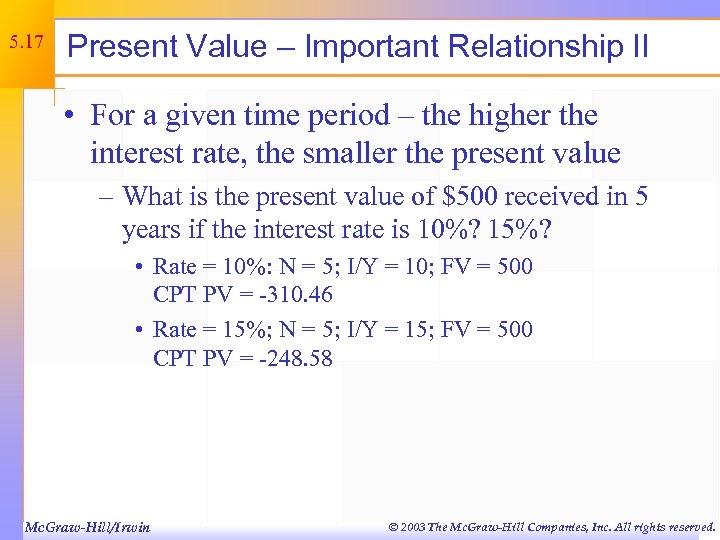 5. 17 Present Value – Important Relationship II • For a given time period – the higher the interest rate, the smaller the present value – What is the present value of $500 received in 5 years if the interest rate is 10%? 15%? • Rate = 10%: N = 5; I/Y = 10; FV = 500 CPT PV = -310. 46 • Rate = 15%; N = 5; I/Y = 15; FV = 500 CPT PV = -248. 58 Mc. Graw-Hill/Irwin © 2003 The Mc. Graw-Hill Companies, Inc. All rights reserved.
 5. 18 Quick Quiz – Part II • What is the relationship between present value and future value? • Suppose you need $15, 000 in 3 years. If you can earn 6% annually, how much do you need to invest today? • If you could invest the money at 8%, would you have to invest more or less than at 6%? How much? Mc. Graw-Hill/Irwin © 2003 The Mc. Graw-Hill Companies, Inc. All rights reserved.
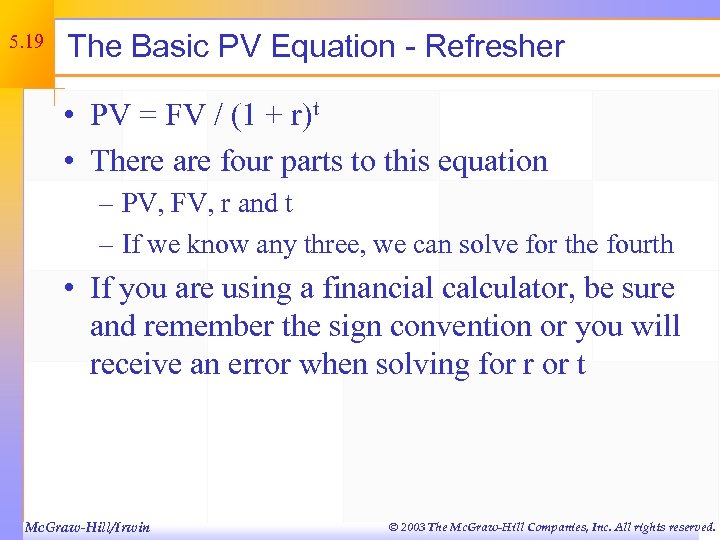 5. 19 The Basic PV Equation - Refresher • PV = FV / (1 + r)t • There are four parts to this equation – PV, FV, r and t – If we know any three, we can solve for the fourth • If you are using a financial calculator, be sure and remember the sign convention or you will receive an error when solving for r or t Mc. Graw-Hill/Irwin © 2003 The Mc. Graw-Hill Companies, Inc. All rights reserved.
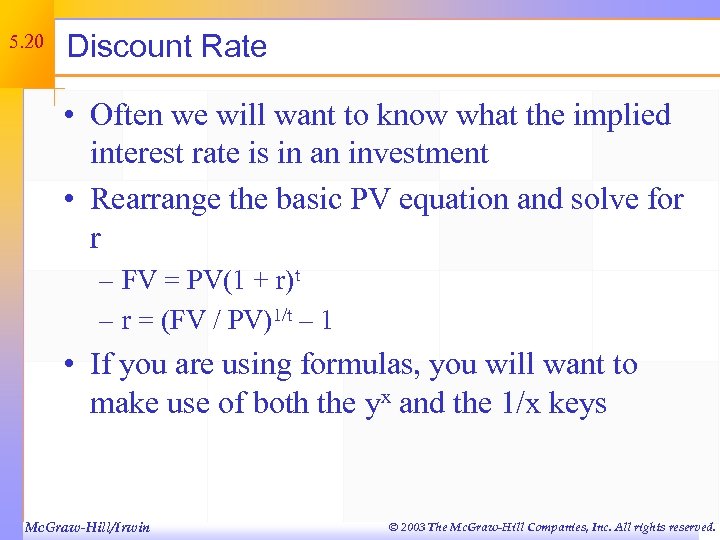 5. 20 Discount Rate • Often we will want to know what the implied interest rate is in an investment • Rearrange the basic PV equation and solve for r – FV = PV(1 + r)t – r = (FV / PV)1/t – 1 • If you are using formulas, you will want to make use of both the yx and the 1/x keys Mc. Graw-Hill/Irwin © 2003 The Mc. Graw-Hill Companies, Inc. All rights reserved.
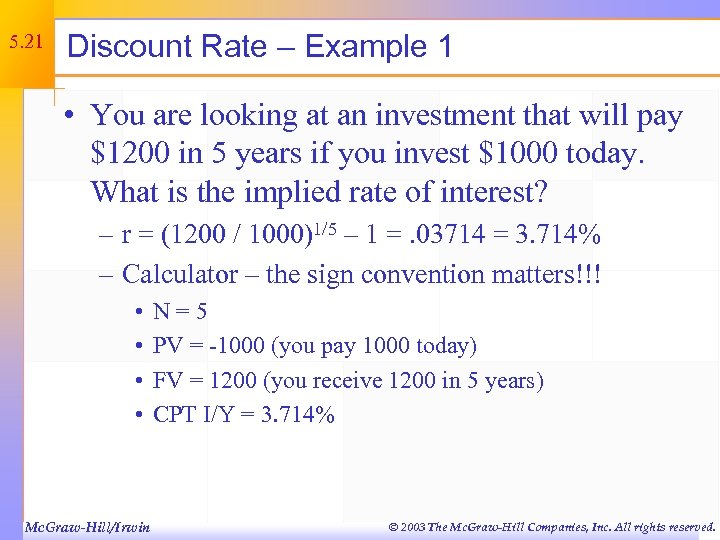 5. 21 Discount Rate – Example 1 • You are looking at an investment that will pay $1200 in 5 years if you invest $1000 today. What is the implied rate of interest? – r = (1200 / 1000)1/5 – 1 =. 03714 = 3. 714% – Calculator – the sign convention matters!!! • • Mc. Graw-Hill/Irwin N=5 PV = -1000 (you pay 1000 today) FV = 1200 (you receive 1200 in 5 years) CPT I/Y = 3. 714% © 2003 The Mc. Graw-Hill Companies, Inc. All rights reserved.
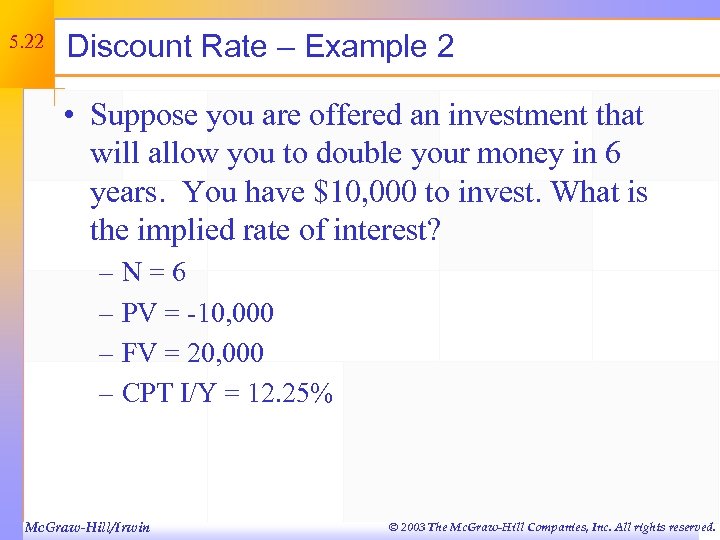 5. 22 Discount Rate – Example 2 • Suppose you are offered an investment that will allow you to double your money in 6 years. You have $10, 000 to invest. What is the implied rate of interest? –N=6 – PV = -10, 000 – FV = 20, 000 – CPT I/Y = 12. 25% Mc. Graw-Hill/Irwin © 2003 The Mc. Graw-Hill Companies, Inc. All rights reserved.
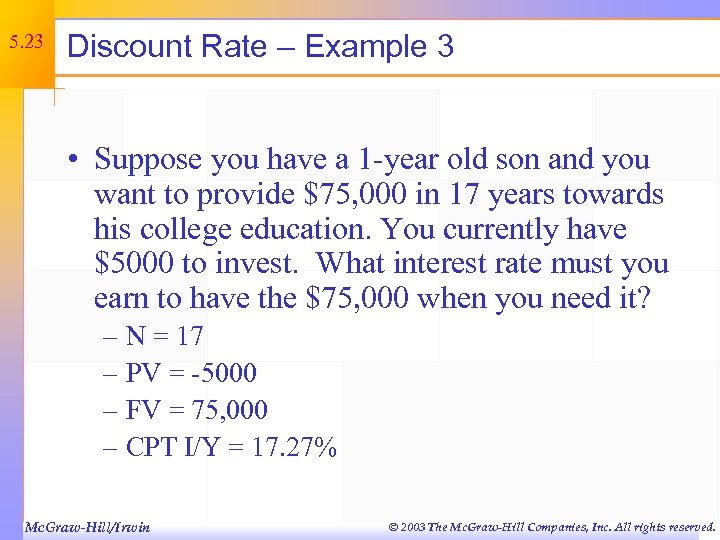 5. 23 Discount Rate – Example 3 • Suppose you have a 1 -year old son and you want to provide $75, 000 in 17 years towards his college education. You currently have $5000 to invest. What interest rate must you earn to have the $75, 000 when you need it? – N = 17 – PV = -5000 – FV = 75, 000 – CPT I/Y = 17. 27% Mc. Graw-Hill/Irwin © 2003 The Mc. Graw-Hill Companies, Inc. All rights reserved.
 5. 24 Quick Quiz – Part III • What are some situations where you might want to compute the implied interest rate? • Suppose you are offered the following investment choices: – You can invest $500 today and receive $600 in 5 years. The investment is considered low risk. – You can invest the $500 in a bank account paying 4%. – What is the implied interest rate for the first choice and which investment should you choose? Mc. Graw-Hill/Irwin © 2003 The Mc. Graw-Hill Companies, Inc. All rights reserved.
 5. 25 Finding the Number of Periods • Start with basic equation and solve for t (remember you logs) – FV = PV(1 + r)t – t = ln(FV / PV) / ln(1 + r) • You can use the financial keys on the calculator as well, just remember the sign convention. Mc. Graw-Hill/Irwin © 2003 The Mc. Graw-Hill Companies, Inc. All rights reserved.
 5. 26 Number of Periods – Example 1 • You want to purchase a new car and you are willing to pay $20, 000. If you can invest at 10% per year and you currently have $15, 000, how long will it be before you have enough money to pay cash for the car? – I/Y = 10 – PV = -15, 000 – FV = 20, 000 – CPT N = 3. 02 years Mc. Graw-Hill/Irwin © 2003 The Mc. Graw-Hill Companies, Inc. All rights reserved.
 5. 27 Number of Periods – Example 2 • Suppose you want to buy a new house. You currently have $15, 000 and you figure you need to have a 10% down payment plus an additional 5% in closing costs. If the type of house you want costs about $150, 000 and you can earn 7. 5% per year, how long will it be before you have enough money for the down payment and closing costs? Mc. Graw-Hill/Irwin © 2003 The Mc. Graw-Hill Companies, Inc. All rights reserved.
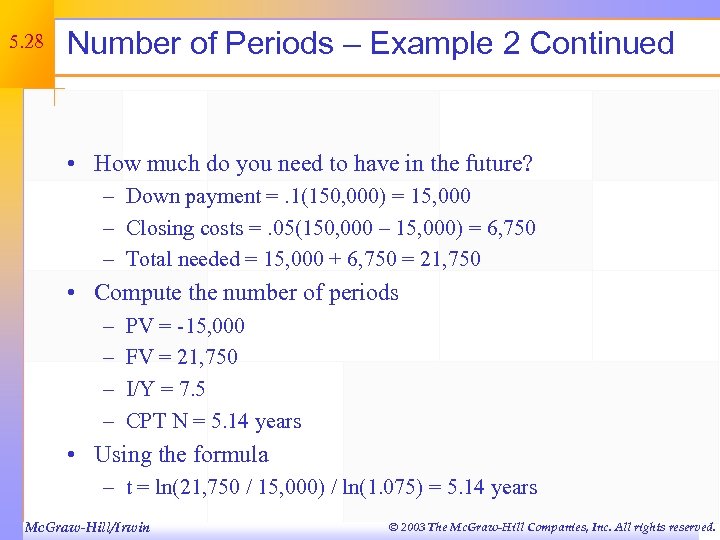 5. 28 Number of Periods – Example 2 Continued • How much do you need to have in the future? – Down payment =. 1(150, 000) = 15, 000 – Closing costs =. 05(150, 000 – 15, 000) = 6, 750 – Total needed = 15, 000 + 6, 750 = 21, 750 • Compute the number of periods – – PV = -15, 000 FV = 21, 750 I/Y = 7. 5 CPT N = 5. 14 years • Using the formula – t = ln(21, 750 / 15, 000) / ln(1. 075) = 5. 14 years Mc. Graw-Hill/Irwin © 2003 The Mc. Graw-Hill Companies, Inc. All rights reserved.
 5. 29 Quick Quiz – Part IV • When might you want to compute the number of periods? • Suppose you want to buy some new furniture for your family room. You currently have $500 and the furniture you want costs $600. If you can earn 6%, how long will you have to wait if you don’t add any additional money? Mc. Graw-Hill/Irwin © 2003 The Mc. Graw-Hill Companies, Inc. All rights reserved.
 5. 30 Spreadsheet Example • Use the following formulas for TVM calculations – FV(rate, nper, pmt, pv) – PV(rate, nper, pmt, fv) – RATE(nper, pmt, pv, fv) – NPER(rate, pmt, pv, fv) • The formula icon is very useful when you can’t remember the exact formula • Click on the Excel icon to open a spreadsheet containing four different examples. Mc. Graw-Hill/Irwin © 2003 The Mc. Graw-Hill Companies, Inc. All rights reserved.
 5. 31 Work the Web Example • Many financial calculators are available online • Click on the web surfer to go to Cigna’s web site and work the following example: – You need $50, 000 in 10 years. If you can earn 6% interest, how much do you need to invest today? – You should get $27, 920 Mc. Graw-Hill/Irwin © 2003 The Mc. Graw-Hill Companies, Inc. All rights reserved.
 5. 32 Table 5. 4 Mc. Graw-Hill/Irwin © 2003 The Mc. Graw-Hill Companies, Inc. All rights reserved.