


 Скачать презентацию CHAPTER FIVE CONTINGENCY MODELS USING RESOURCES EFFECTIVELY
6ceb282baef5224349a349ffb125438f.ppt
- Количество слайдов: 60
 CHAPTER FIVE CONTINGENCY MODELS: USING RESOURCES EFFECTIVELY
 Learning Objectives 1. 2. 3. Explain the importance of the effective use of resources to leadership. Distinguish between a task-motivated and a relationship-motivated leader and identify the elements of situational control used in Fiedler’s Contingency Model of Leadership. Present the Contingency Model’s predictions and explain how to use it to improve leadership effectiveness.
 Learning Objectives (con’t. ) 4. 5. 6. Present the four decision styles used in the Normative Decision Model of Leadership. Understand the role of decision quality and follower acceptance in the choice of leadership styles and how to use the Normative Decision Model to improve leadership effectiveness. Discuss the Cognitive Resource Theory and its implications for leaders.
 Elements Of Fiedler’s Contingency Model Ü Ü The leader’s style: • Task or relationship motivation measured by the LPC scale Situational control: • Leader-member relations • Task structure • Position power
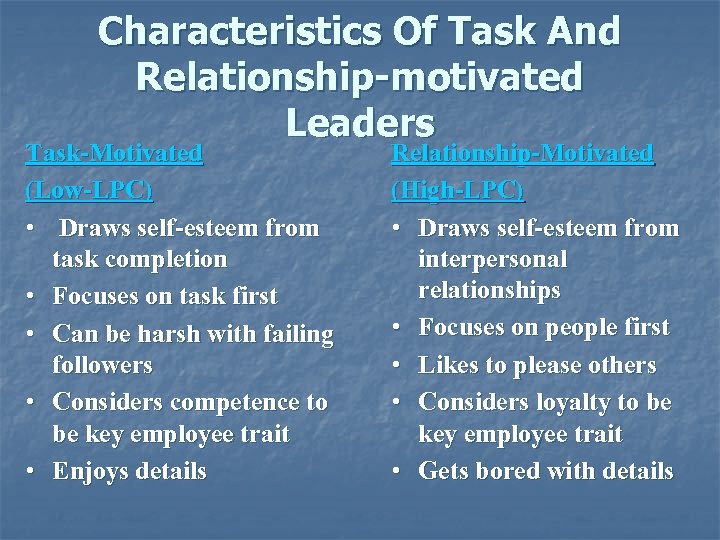 Characteristics Of Task And Relationship-motivated Leaders Task-Motivated (Low-LPC) • Draws self-esteem from task completion • Focuses on task first • Can be harsh with failing followers • Considers competence to be key employee trait • Enjoys details Relationship-Motivated (High-LPC) • Draws self-esteem from interpersonal relationships • Focuses on people first • Likes to please others • Considers loyalty to be key employee trait • Gets bored with details
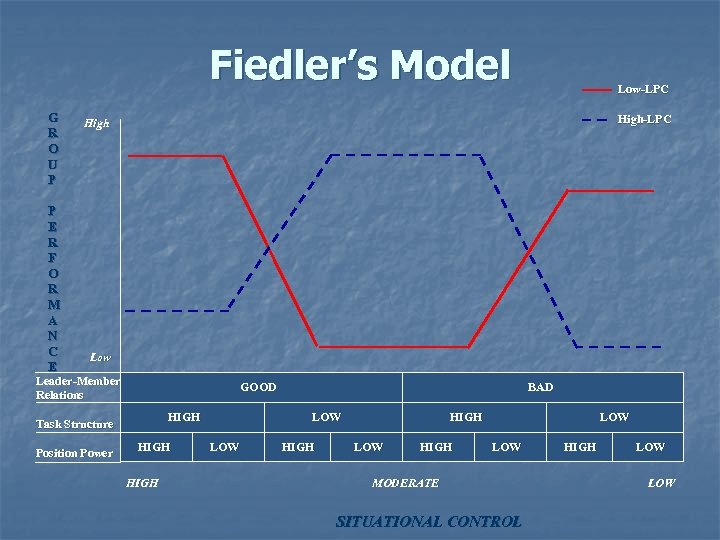 Fiedler’s Model G R O U P P E R F O R M A N C E Low-LPC High Low Leader-Member Relations GOOD HIGH Task Structure Position Power HIGH BAD LOW HIGH LOW MODERATE SITUATIONAL CONTROL HIGH LOW
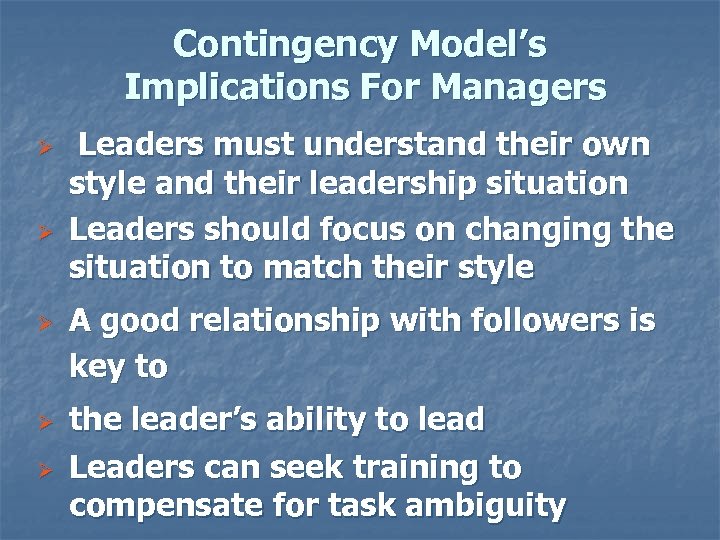 Contingency Model’s Implications For Managers Ø Ø Ø Leaders must understand their own style and their leadership situation Leaders should focus on changing the situation to match their style A good relationship with followers is key to the leader’s ability to lead Leaders can seek training to compensate for task ambiguity
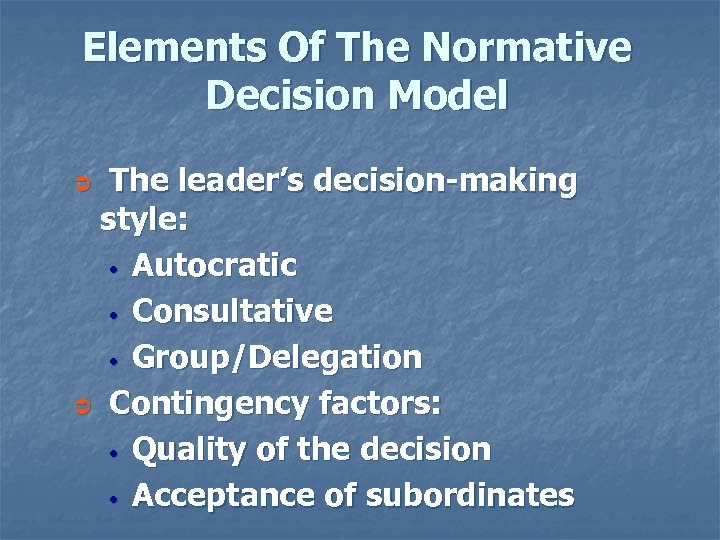 Elements Of The Normative Decision Model The leader’s decision-making style: • Autocratic • Consultative • Group/Delegation Ü Contingency factors: • Quality of the decision • Acceptance of subordinates Ü
 Contingency Factors In The Normative Decision Model Quality requirement (QR) How important is the quality of the decision? è Commitment requirement (CR) How important is employee commitment? è Leader information (LI) Does leader have enough information? è
 Contingency Factors In The Normative Decision Model (con’t. ) è Structure of the problem (ST) Is the problem clear? è Commitment probability (CP) How likely is employee commitment if leader makes the decision alone? è Goal congruence (GC) Do employees agree with organizational goals?
 Contingency Factors In The Normative Decision Model (con’t. ) è Employee conflict (CO) Is there conflict among employees over solution? è Subordinate information (SI) Do employees have enough information to make a high-quality decision?
 Normative Decision Model’s Implications For Managers Ø Ø Ø Leaders must understand the situation and how to use different decision styles Participation is not always desirable Leaders must pay attention to their followers’ needs and reactions when making decisions
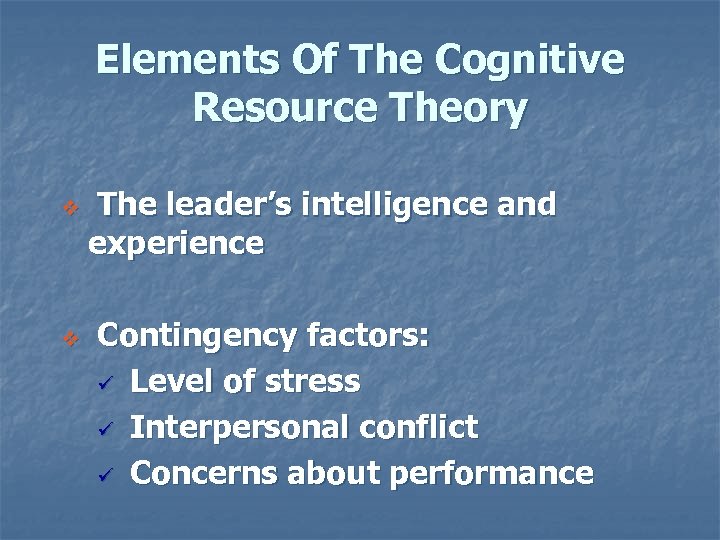 Elements Of The Cognitive Resource Theory v v The leader’s intelligence and experience Contingency factors: ü Level of stress ü Interpersonal conflict ü Concerns about performance
 Cognitive Resource Theory’s Implications For Managers Ø The role of stress must be considered and assessed Ø Organizations must consider both leader’s intelligence and experience
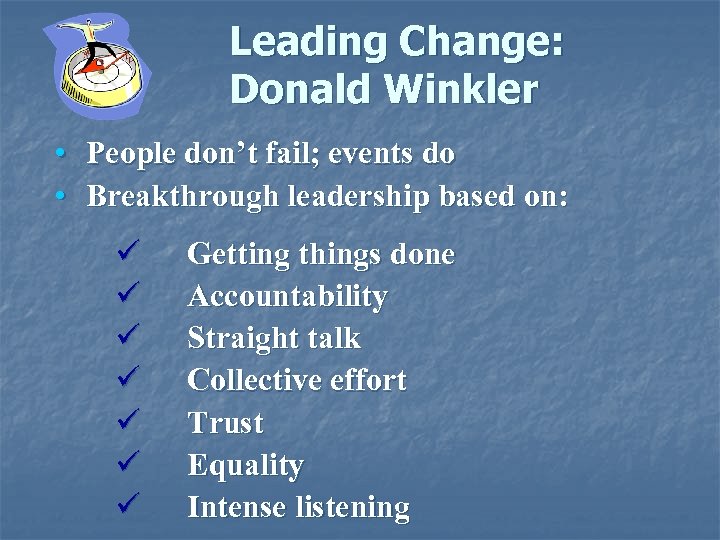 Leading Change: Donald Winkler • People don’t fail; events do • Breakthrough leadership based on: ü ü ü ü Getting things done Accountability Straight talk Collective effort Trust Equality Intense listening
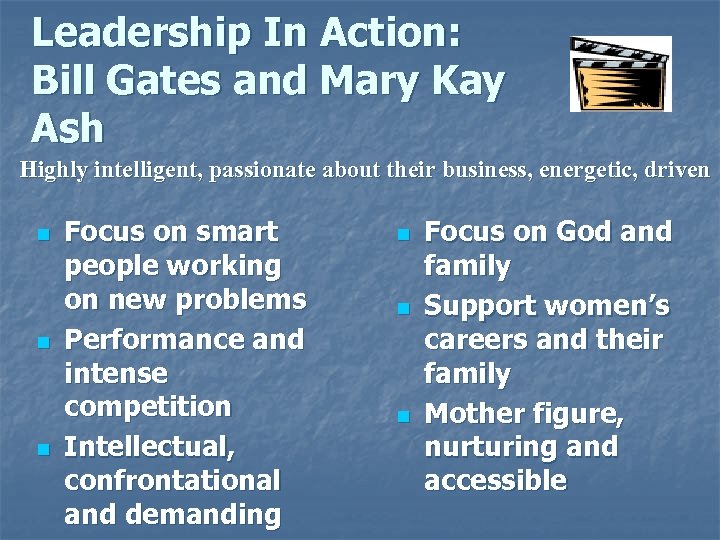 Leadership In Action: Bill Gates and Mary Kay Ash Highly intelligent, passionate about their business, energetic, driven n Focus on smart people working on new problems Performance and intense competition Intellectual, confrontational and demanding n n n Focus on God and family Support women’s careers and their family Mother figure, nurturing and accessible
 The Leadership Challenge n n n Leader may be low-LPC who gains a sense of control and accomplishments by working in very low situational control Intervention may be necessary to help him learn to change the situation without creating chaos Allow selection and building of cohesive team, provide leader with task training, and maintain his
 Industrial-Organizational Psychology Learning Module Diversity in the Workplace Prepared by the Society for Industrial and Organizational Psychology - SIOP ©
 Lesson Objectives At the end of this lecture, you should: n n Understand why diversity in the workplace matters Know the different types of diversity Understand the challenges raised by workplace diversity Know how I-O psychologists help organizations manage diversity Prepared by the Society for Industrial and Organizational Psychology - SIOP ©
 Why does diversity in the workplace matter? n The service economy interactions between people are key n customer base is more diverse n similarities between people ease process n n Globalization of business n n n doing business with people from around world The changing labor market Prepared mergers and Organizational Psychology - SIOP © Company by the Society for Industrial andbuy-outs
 Types of Diversity n Gender diversity n more women in workforce today than ever n n stereotypes still remain n n better educated than ever glass ceiling, etc. Age diversity as population ages, more older workers are available n re-entry of middle-aged women to work n retirees returningfor Industrial and Organizationalpension to supplement Psychology - SIOP © Prepared by the Society n
 Types of Diversity n Cultural diversity affects values, view of the world n more than 40% of new entrants into U. S. workforce from non-“majority” groups n about 22% new immigrants n about 20% African-American or Hispanic n growing international business n employees maintain ties to national and cultural heritage n Prepared by the Society for Industrial and Organizational Psychology - SIOP ©
 Other Types of Diversity (You May Not Have Thought Of) n Family situations n n Physical and psychological disabilities n n single employees (mothers and others) Americans with Disabilities Act Sexual orientation Political views Personal idiosyncrasies Prepared by the Society for Industrial and Organizational Psychology - SIOP ©
 Challenges of Diversity n Availability challenge n in past employers could control diversity n n qualified employees have become scarce n n n more people than jobs employers must become more flexible realize “Different does not mean deficient” Fairness challenge n in past, typically viewed as equal treatment n n Equal Employment Opportunity now employers must embrace new diversity n essentially focus on “differences” Prepared by the Society for Industrial and Organizational Psychology - SIOP ©
 Challenges of Diversity n Synergy challenge more and more group-based work n diversity can create positive and negative conflict n can facilitate creative problem-solving n can close down communication n can derail group processes n n group leaders must minimize destructive conflict and maximize diversity of input Prepared by the Society for Industrial and Organizational Psychology - SIOP © 1
 How do I-O psychologists help organizations manage diversity? n Providing managers with training how to recruit/hire diverse employees n how to orient/integrate new employees n n Providing all employees with training realizing the differences that exist n learning how differences affect working environment n how to maximize productivity without ignoring by the Society for Industrial and Organizational Psychology - SIOP © employee differences Prepared n
 Industrial-Organizational Psychology Learning Module Leadership and Gender Stereotypes Prepared by the Society for Industrial and Organizational Psychology - SIOP ©
 Lesson Objectives At the end of this lecture you should: n n n Understand the leadership perceptions approach Understand how gender stereotyping in organizations affects perceptions of leaders Know some of the methods used to control stereotyping in organizations Prepared by the Society for Industrial and Organizational Psychology - SIOP ©
 Leadership Perceptions n Leadership is hard to define n n but we know it when we see it! Leadership Perceptions Approach people must first be recognized as leaders. n they are allowed to influence followers. n followers determine the ultimate success of leaders. n Prepared by the Society for Industrial and Organizational Psychology - SIOP ©
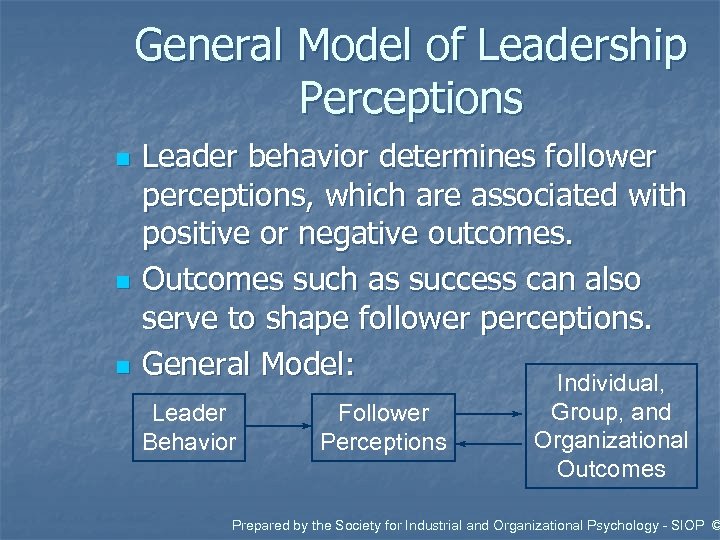 General Model of Leadership Perceptions n n n Leader behavior determines follower perceptions, which are associated with positive or negative outcomes. Outcomes such as success can also serve to shape follower perceptions. General Model: Individual, Leader Behavior Follower Perceptions Group, and Organizational Outcomes Prepared by the Society for Industrial and Organizational Psychology - SIOP ©
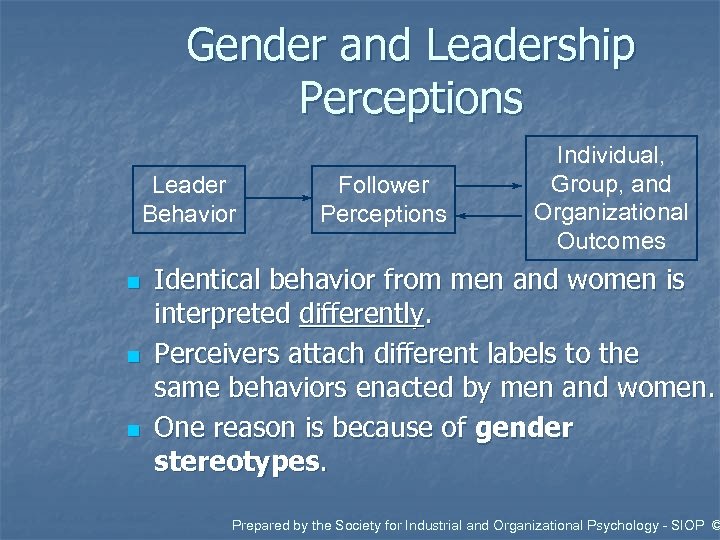 Gender and Leadership Perceptions Leader Behavior n n n Follower Perceptions Individual, Group, and Organizational Outcomes Identical behavior from men and women is interpreted differently. Perceivers attach different labels to the same behaviors enacted by men and women. One reason is because of gender stereotypes. Prepared by the Society for Industrial and Organizational Psychology - SIOP ©
 Gender Stereotypes and Leadership Perceptions n n Stereotypes are expectations about members of certain groups. Gender-based stereotypes include beliefs about: n n n expected interpersonal behavior the types of roles or jobs best suited for men and women. The role of gender stereotypes in employment was at issue in Price Waterhouse v. Hopkins. Prepared by the Society for Industrial and Organizational Psychology - SIOP ©
 Gender Stereotypes and Leadership Perceptions n n n Ann B. Hopkins was a high-performing, but masculine acting, prospective partner at PW. Hopkins alleged she was denied partnership because of her gender. PW countered that Hopkins had interpersonal problems (e. g. , she was "macho"). Court eventually ruled that gender-based stereotyping influenced perceptions of her behavior. Because she was a woman in a nontraditional role, Hopkins' behavior was seen as more extreme than men who behaved similarly. Prepared by the Society for Industrial and Organizational Psychology - SIOP ©
 Controlling our Stereotyping n n Everyone (or nearly everyone) engages in stereotyping. Most recognize it is inappropriate to judge others based on a stereotype. How can we learn to control our stereotyping? One way is through conscious control. Prepared by the Society for Industrial and Organizational Psychology - SIOP ©
 How do I/O psychologists help organizations control stereotyping? n n Identifying organizational consequences that gender and race stereotyping have Training employees to gather individuating information about the stereotyped person n n getting to know the person as an individual understanding benefits of diversity Training employers to effectively manage diversity Helping to minimize the effects of stereotyping and unfair treatment of employees Prepared by the Society for Industrial and Organizational Psychology - SIOP ©
 Sharing Perceptions n n Previous research indicates that the same behavior by men and women leaders results in different perceptions. Women are seen as more bossy and dominating. Men are seen as having greater ability, skill, and intelligence. Gender stereotypes influence our reactions, even without our awareness. Prepared by the Society for Industrial and Organizational Psychology - SIOP ©
 The Power of Talk: Who Gets Heard and Why By Deborah Tannen
 Linguistic Style n A person’s characteristic speaking pattern. A set of culturally learned signals by which we not only communicate what we mean but also interpret others’ meaning and evaluate one another as people
 Linguistic Style n Features include Directness or indirectness n Pacing & pausing n Word choice n Use of elements like jokes, figures of speech, stories, questions & apologies n Turn taking n
 Linguistic Style n Every utterance functions on two levels: Language communicates ideas n Language negotiates relationships n
 The Kicker n Girls tend to learn conversational rituals that focus on the rapport dimension of relationships whereas boys tend to learn rituals that focus on the status dimension
 Linguistic Patterns n n One Up, One Down Getting Credit Confidence & Boasting Asking Questions
 Linguistic Patterns n One Up, One Down Men tend to be sensitive to the power and attain one up n Women tend to be sensitive to rapport and will take one down n n Getting Credit n Men say ‘I’ where women say ‘we’
 Linguistic Patterns n Confidence & Boasting Women downplay certainty n Men minimize doubts n n Asking Questions n Can put you in a one down position, boys are more aware of this
 n The norms of behavior in the US business world are based on the style of interaction that is more common among men—at least American men.
 Conversational Rituals n n n Conversation is ritual in the sense that we speak in ways our culture has conventionalized and expect certain types of responses. Apologies Feedback Compliments Ritual Opposition
 Conversational Rituals n Apologies n n n Feedback n n Women say I’m sorry more often than men Puts in one-down, even though other women know they aren’t really sorry Differing Styles Compliments n Women pay more than men, puts at a disadvantage in the work place
 Conversational Rituals n Ritual Opposition An exploration through verbal opposition n They put their ideas in the most certain and absolute form they can, and wait to see if they are challenged n Being forced to defend an idea gives the opportunity to test it n
 Negotiating Authority n n Actual authority has to be negotiated day to day Managing Up and Down n n Boys are rewarded for talking up their accomplishments, girls aren’t Indirectness n n The tendency to say what we mean without spelling it out Men are often more direct
 What to do? n n n Become aware Make sure everyone is heard Be more flexible
 Knowing “What” to do is not Enough: Turning Knowledge into Action By Jeff Pfeffer & Robert Sutton
 We intuitively understand that knowing is not enough n n $60 billion spent on training annually Training not implemented Billions for management consultants Why don’t top performers look to the Ivy League Schools?
 Is there a gap? n n Even if evidence is strong, not always adopted Performance not transferred across firms
 Does it Matter? n n n There’s too much information out there to successfully hoard many secrets Most interventions are about things already known Although knowledge creation, benchmarking, and knowledge management may be important, transforming it into action is at least as important
 Problems with Knowledge Management n First, the conception of knowledge as explicit and quantifiable We treat knowledge like a warehouse item n Do we build it into products? n Do we develop new products based on it? n Working Knowledge – knowledge is transferred between people by stories, gossip and watching others work. n
 Problems with Knowledge Management n First (continued) Tacit knowledge cannot be stored readily n Knowledge storage and retrieval systems are often not developed by those who will use them n
 Problems with Knowledge Management n n Second, it is conceptualized as distinct from philosophy or values Third, we overestimate the importance of the tangible, specific, programmatic aspects of knowledge and underestimate the underlying philosophy that guides what is done and how
 Why Typical KM Practices Make the Gap Worse n n n Emphasize technology and transfer of codified information Treats knowledge as a tangible thing and separates it from its use Formal systems can’t easily store tacit knowledge The people responsible don’t understand Philosophy is ignored
 Turning Knowledge into Action n n Why before how: Philosophy is important Knowing comes from doing and teaching others how Action counts more than elegant plans and concepts There is no doing without mistakes. What is the company’s response?
 Turning Knowledge into Action n n Fear fosters knowing-doing gaps, so drive it out Beware of false analogies: fight the competition, not each other Measure what matters and what can help turn knowledge into action What leaders do, how they spend their time and how they allocate resources, matters