


 Скачать презентацию CHAPTER F 7 Accumulating Accounting Data 2007
82924566169f524fa0a9305aed5c161e.ppt
- Количество слайдов: 63
 CHAPTER F 7 Accumulating Accounting Data © 2007 Pearson Custom Publishing 1
 Learning Objective 1 Identify the eight steps of the accounting cycle. © 2007 Pearson Custom Publishing 2
 The Accounting Cycle The accounting cycle consists of a series of steps repeated in each accounting period that enable the firm to analyze, record, classify, and summarize the transactions into financial statements. © 2007 Pearson Custom Publishing 3
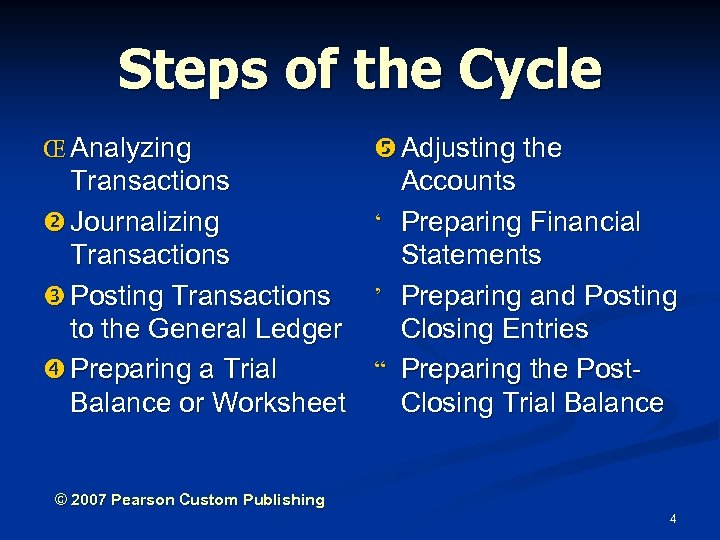 Steps of the Cycle Œ Analyzing Adjusting the Transactions Accounts Journalizing ‘ Preparing Financial Transactions Statements Posting Transactions ’ Preparing and Posting to the General Ledger Closing Entries Preparing a Trial “ Preparing the Post. Balance or Worksheet Closing Trial Balance © 2007 Pearson Custom Publishing 4
 Step 1: Analyzing Transactions n Part One: Determine when a transaction occurs. A transaction is any event that results in a change in the amount of an accounting element. n Part Two: Identify the nature of the transaction. This entails determining which accounting elements were affected and by how much. © 2007 Pearson Custom Publishing 5
 Step 2: Journalizing Transactions n A journal is a book of original entry that contains a chronological list of an entity’s transactions. n A special journal records specific types of transactions such as a sales, purchases, cash receipts or cash payments. n A general journal records all transactions not recorded in a special journal. © 2007 Pearson Custom Publishing 6
 Step 3: Posting to the Ledger n A ledger contains all the accounts of a firm. n A chart of accounts is a list of all of the accounts used by a company. n After transactions are entered in the journal, the same information is then posted to the ledger accounts. The ledger accounts indicate the current balance for each account. © 2007 Pearson Custom Publishing 7
 Step 4: Preparing a Trial Balance n Periodically, usually weekly or monthly, a trial balance is prepared. A trial balance is a listing of all ledger accounts and their balances. n The trial balance verifies that the accounting equation is in balance. © 2007 Pearson Custom Publishing 8
 Using a Worksheet n Another option for step 4 of the cycle is to prepare a worksheet. The worksheet is a ten column worksheet which begins with the trial balance. n A worksheet helps accountants examine the accounts, adjust the accounts, and gather the data to prepare the financial statements. © 2007 Pearson Custom Publishing 9
 Step 5: Adjusting the Accounts n Some account balances require adjustment at the end of the accounting period, before the financial statements are prepared. n Adjustments are needed to ensure the proper application of the revenue recognition and expense recognition rules. Many adjustments are accruals and deferrals studied in Chapter Six. © 2007 Pearson Custom Publishing 10
 Reconciling the Bank Account n Adjusting entries normally do not affect the cash account, except for one adjustment that is needed to change the cash balance to the correct amount as of the end of the period. n A bank reconciliation is prepared to determine the appropriate cash balance as part of the firm’s internal control structure. © 2007 Pearson Custom Publishing 11
 Step 6: Preparing Financial Statements n After all of the balances in the general ledger accounts have been properly adjusted, the financial statements can be prepared. n The income statement is prepared first, then the statement of retained earnings (or owners’ equity), then the balance sheet. © 2007 Pearson Custom Publishing 12
 Step 7: Preparing Closing Entries n Closing entries are prepared to reset the balance of temporary accounts to zero. n Temporary (or nominal) accounts include all income statement accounts plus dividends or owner withdrawals. Temporary accounts are closed at the end of the period. n Most balance sheet accounts are permanent (or real) accounts and are not closed. © 2007 Pearson Custom Publishing 13
 Step 8: Preparing the Post-Closing Trial Balance n After closing entries have been journalized and posted, only the balance sheet accounts should have a balance other than zero. n A post-closing trial balance provides verification that the closing process was completed properly and also serves as a record of the beginning account balances for the next accounting period. © 2007 Pearson Custom Publishing 14
 The Accounting Equation n An accounting system is based on the following equation: n Assets = Liabilities + Equity n If one side of the equation is changed, the other side must also change, this is the basis of the double-entry system. © 2007 Pearson Custom Publishing 15
 Learning Objective 2 Distinguish between debits and credits and apply them to the accounting equation. © 2007 Pearson Custom Publishing 16
 Debits and Credits n Two of the most familiar accounting terms are debits and credits. In the doubleentry system, debits must always equal credits. n Debit means the left side of the account and is abbreviated as DR. n Credit means the right side of the account and is abbreviated as CR. © 2007 Pearson Custom Publishing 17
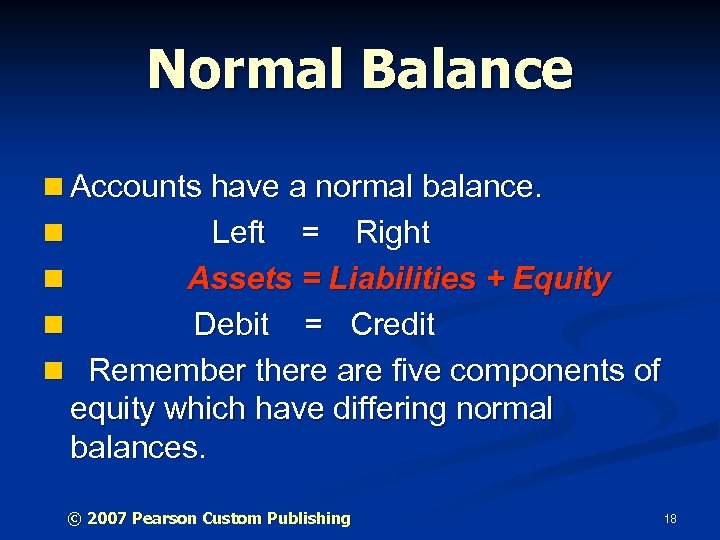 Normal Balance n Accounts have a normal balance. Left = Right n Assets = Liabilities + Equity n Debit = Credit n Remember there are five components of equity which have differing normal balances. n © 2007 Pearson Custom Publishing 18
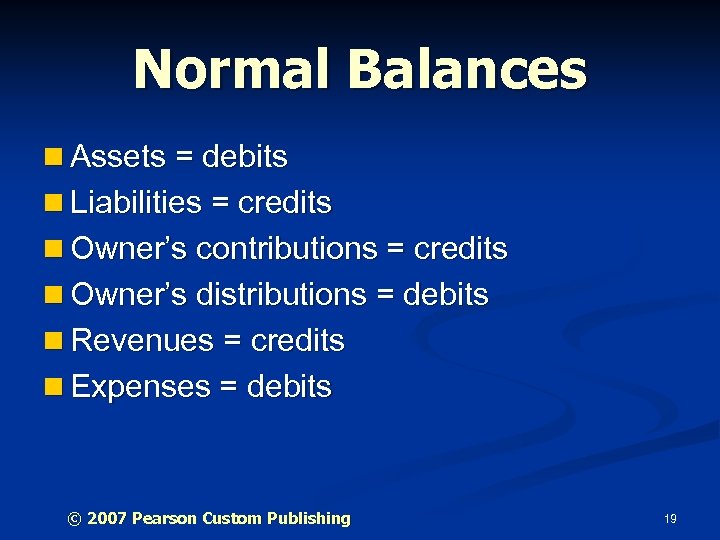 Normal Balances n Assets = debits n Liabilities = credits n Owner’s contributions = credits n Owner’s distributions = debits n Revenues = credits n Expenses = debits © 2007 Pearson Custom Publishing 19
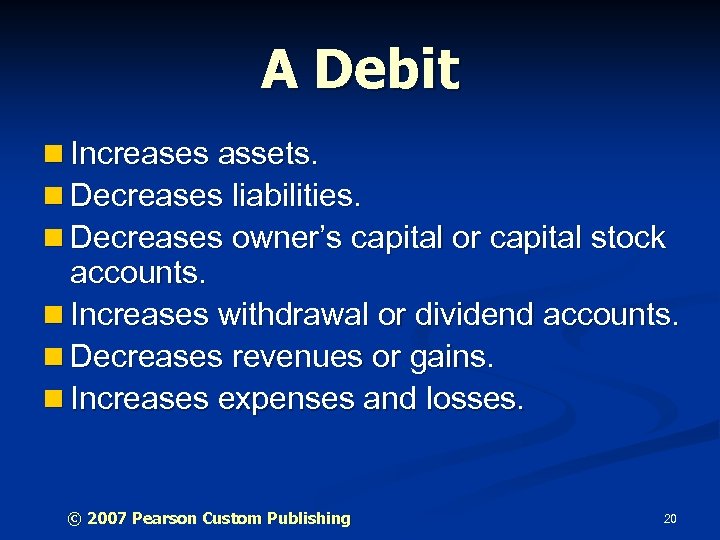 A Debit n Increases assets. n Decreases liabilities. n Decreases owner’s capital or capital stock accounts. n Increases withdrawal or dividend accounts. n Decreases revenues or gains. n Increases expenses and losses. © 2007 Pearson Custom Publishing 20
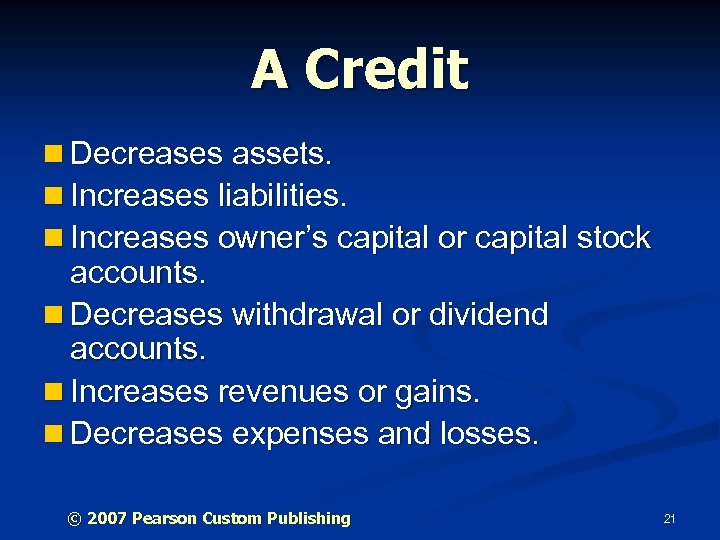 A Credit n Decreases assets. n Increases liabilities. n Increases owner’s capital or capital stock accounts. n Decreases withdrawal or dividend accounts. n Increases revenues or gains. n Decreases expenses and losses. © 2007 Pearson Custom Publishing 21
 Learning Objective 3 Describe accounts, journals, ledgers, and worksheets. © 2007 Pearson Custom Publishing 22
 The Account n Each accounting element is represented by a separate account. The following information is required: Account name and number n Date of each transaction n Beginning balance for the period n Each posted transaction from the journal including the date, reference, and amount n Ending balance for the period n © 2007 Pearson Custom Publishing 23
 T-Accounts n For illustration purposes, accountants will often use a T-account. A T-account is a simplified version of the real account format used in the accounting records. n In a T-account, you can see the effect of various transactions on any particular account. Debits, credits, and balances can all be shown with clarity. © 2007 Pearson Custom Publishing 24
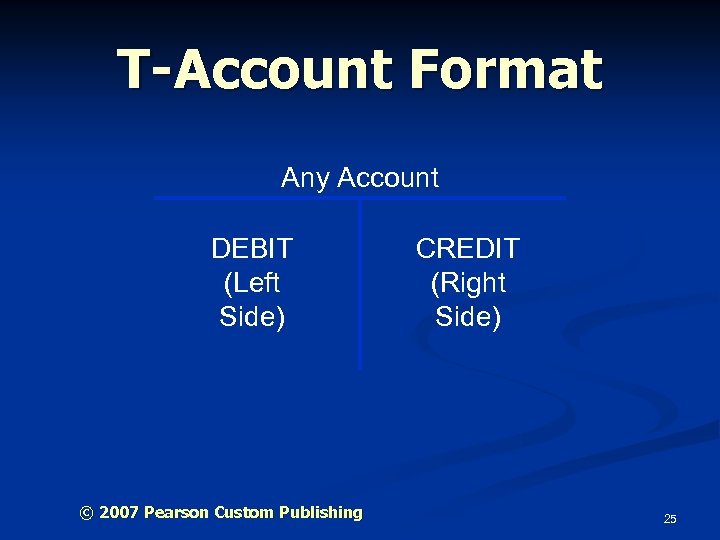 T-Account Format Any Account DEBIT (Left Side) © 2007 Pearson Custom Publishing CREDIT (Right Side) 25
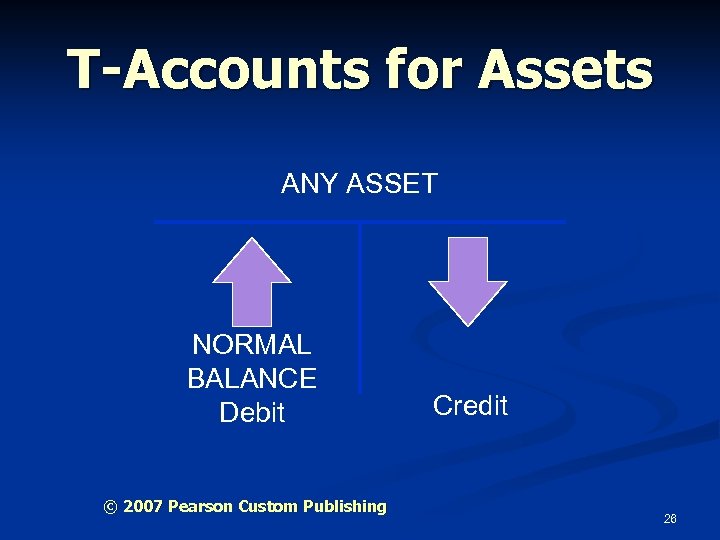 T-Accounts for Assets ANY ASSET NORMAL BALANCE Debit © 2007 Pearson Custom Publishing Credit 26
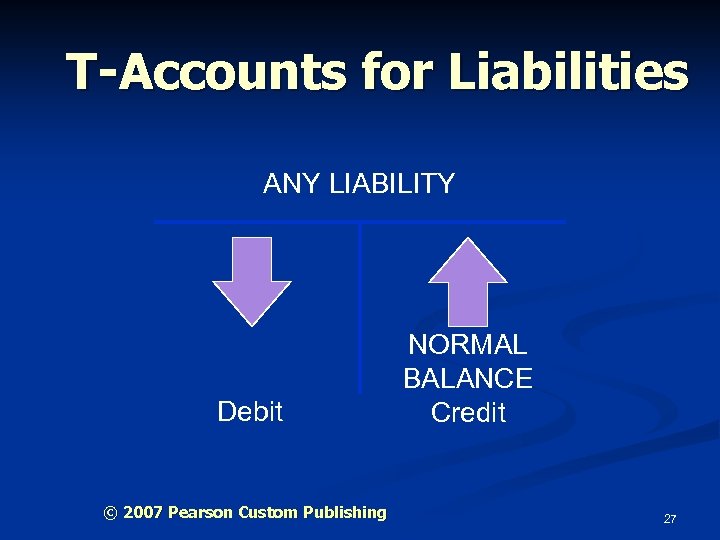 T-Accounts for Liabilities ANY LIABILITY Debit © 2007 Pearson Custom Publishing NORMAL BALANCE Credit 27
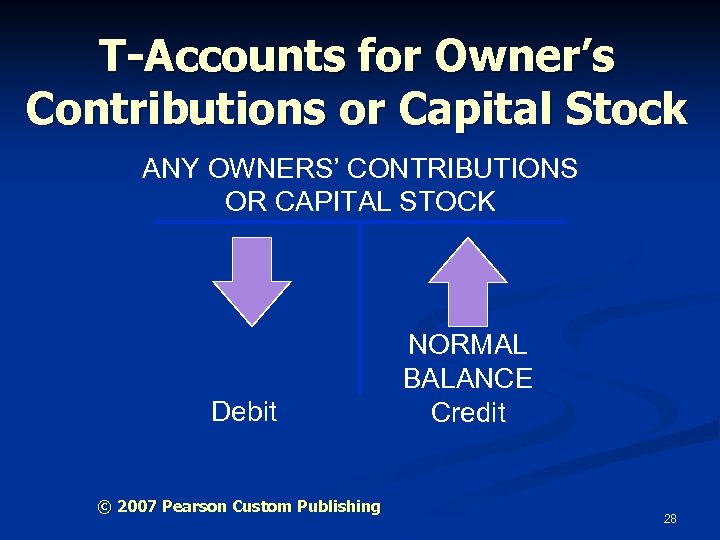 T-Accounts for Owner’s Contributions or Capital Stock ANY OWNERS’ CONTRIBUTIONS OR CAPITAL STOCK Debit © 2007 Pearson Custom Publishing NORMAL BALANCE Credit 28
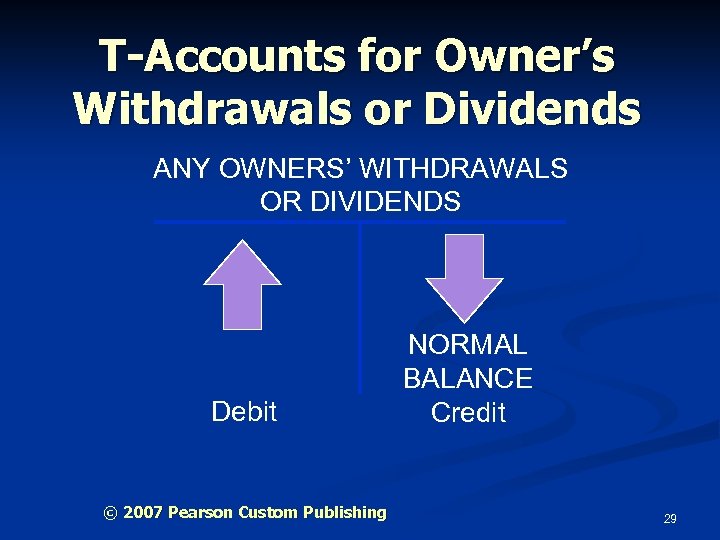 T-Accounts for Owner’s Withdrawals or Dividends ANY OWNERS’ WITHDRAWALS OR DIVIDENDS Debit © 2007 Pearson Custom Publishing NORMAL BALANCE Credit 29
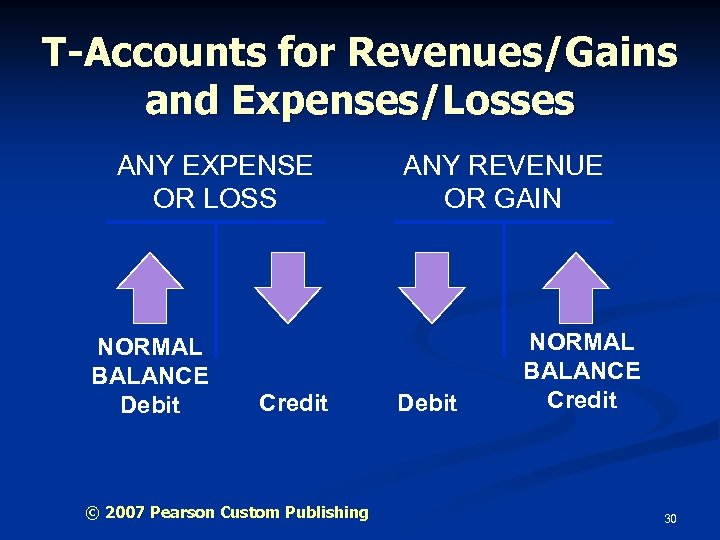 T-Accounts for Revenues/Gains and Expenses/Losses ANY EXPENSE OR LOSS NORMAL BALANCE Debit Credit © 2007 Pearson Custom Publishing ANY REVENUE OR GAIN Debit NORMAL BALANCE Credit 30
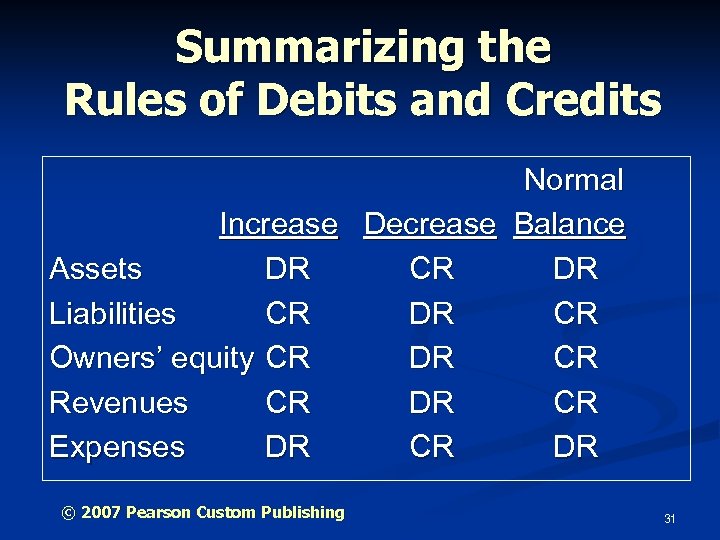 Summarizing the Rules of Debits and Credits Normal Increase Decrease Balance Assets DR CR DR Liabilities CR DR CR Owners’ equity CR DR CR Revenues CR DR CR Expenses DR CR DR © 2007 Pearson Custom Publishing 31
 Illustration Using T-Accounts n Let’s use T-accounts to analyze the effect on the accounting elements of three basic business transactions. n In each case, we will: Determine the accounts affected n Apply the rules of debits and credits n Enter the appropriate amount n © 2007 Pearson Custom Publishing 32
 Learning Objective 4 Record transactions in journals and post them to the general ledger. © 2007 Pearson Custom Publishing 33
 Transaction #1 Record the initial sale of stock by a new corporation, 10, 000 shares of no-par stock at $10 per share. CASH 100, 000 © 2007 Pearson Custom Publishing COMMON STOCK 100, 000 34
 Transaction #2 The new corporation purchased equipment for $20, 000 cash. EQUIPMENT 20, 000 © 2007 Pearson Custom Publishing CASH 20, 000 35
 Transaction #3 The firm purchased supplies for $2, 000 cash. SUPPLIES 2, 000 © 2007 Pearson Custom Publishing CASH 2, 000 36
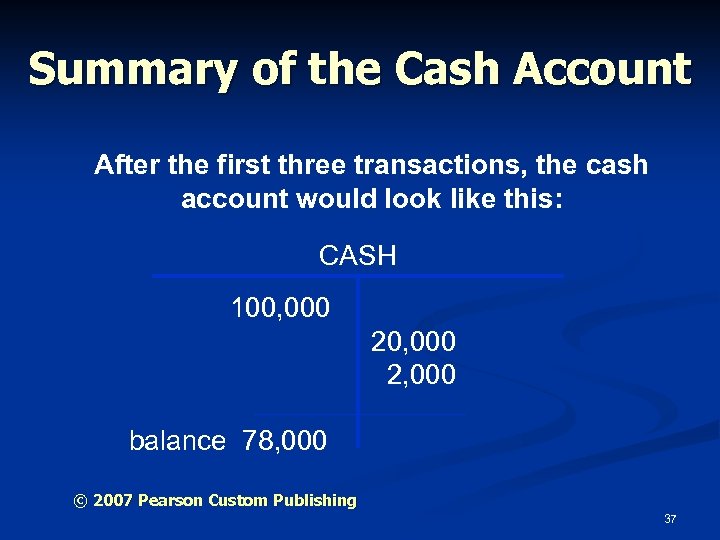 Summary of the Cash Account After the first three transactions, the cash account would look like this: CASH 100, 000 2, 000 balance 78, 000 © 2007 Pearson Custom Publishing 37
 Journal Entries n Remember that the T-accounts are for illustration purposes only. n Real accounting systems rely on journal entries and ledger accounts. n Entries are made in a journal to formally record each event for the company. Using the same three transactions, the journal will look like the example on the next slide. © 2007 Pearson Custom Publishing 38
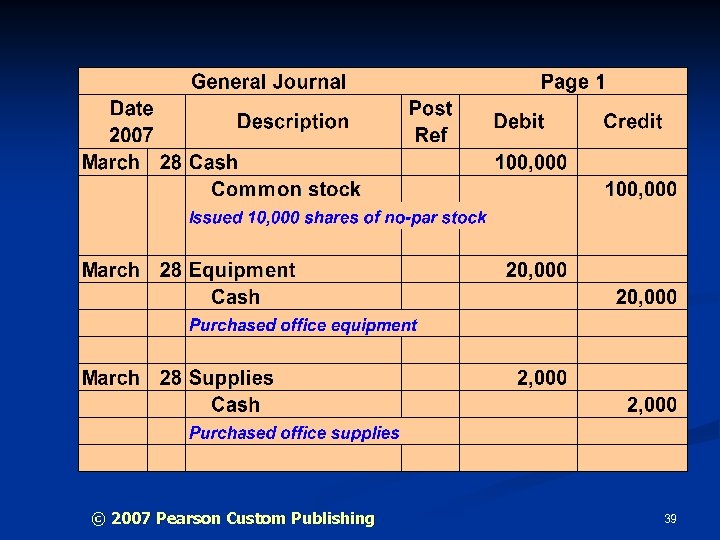 © 2007 Pearson Custom Publishing 39
 Posting to the Ledger n After the journal entries are made, the debits and credits need to be posted to the appropriate ledger accounts on a periodic basis. n The next slide will show the result of having posted the three transactions to the cash account. © 2007 Pearson Custom Publishing 40
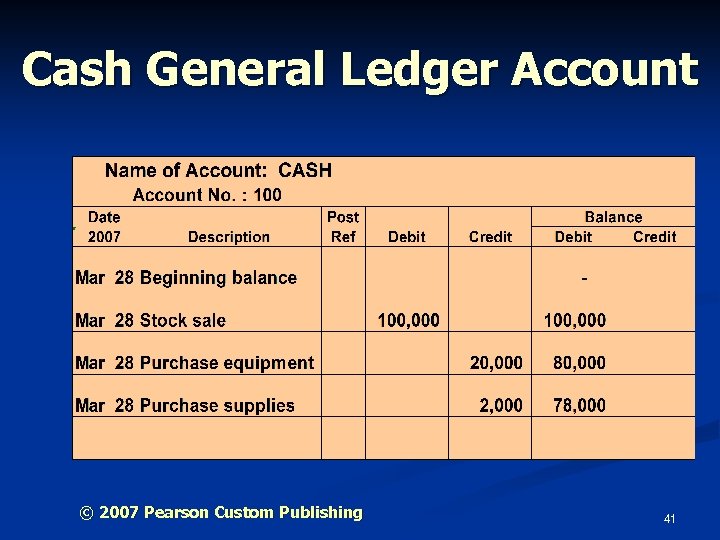 Cash General Ledger Account © 2007 Pearson Custom Publishing 41
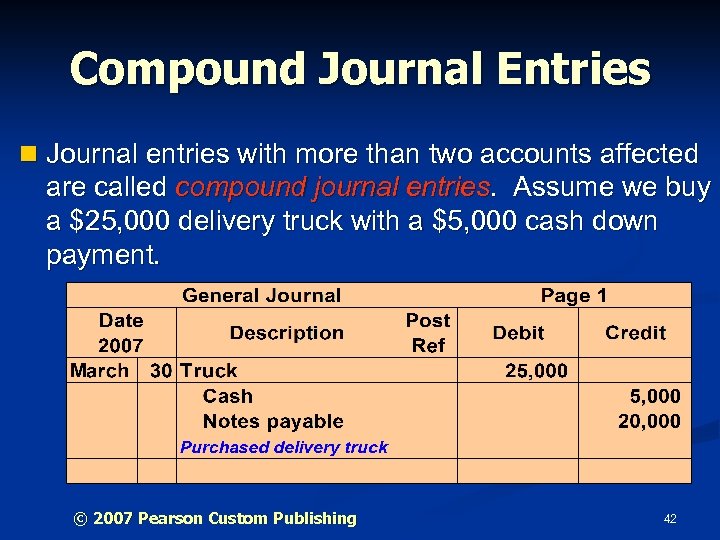 Compound Journal Entries n Journal entries with more than two accounts affected are called compound journal entries. Assume we buy a $25, 000 delivery truck with a $5, 000 cash down payment. © 2007 Pearson Custom Publishing 42
 Learning Objective 5 Prepare trial balances and worksheets. © 2007 Pearson Custom Publishing 43
 Trial Balance n Prepare a list of the entire general ledger accounts with their corresponding debit or credit balances. n Total each column of debits and credits. n The debit and credit totals should be equal. © 2007 Pearson Custom Publishing 44
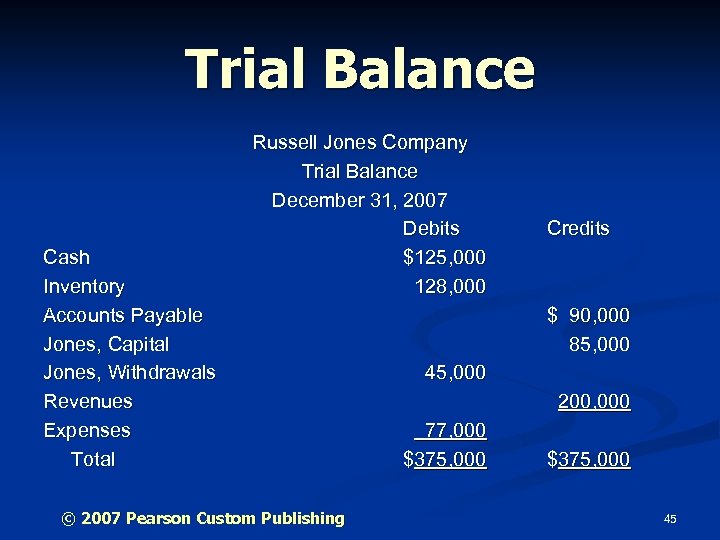 Trial Balance Cash Inventory Accounts Payable Jones, Capital Jones, Withdrawals Revenues Expenses Total Russell Jones Company Trial Balance December 31, 2007 Debits $125, 000 128, 000 © 2007 Pearson Custom Publishing Credits $ 90, 000 85, 000 45, 000 200, 000 77, 000 $375, 000 45
 Learning Objective 6 Prepare adjusting journal entries and reconcile a bank account. © 2007 Pearson Custom Publishing 46
 Adjusting Entries n As discussed in Chapter 6, there are various accounts that require adjustment prior to the preparation of the financial statements. n Example of adjustments include: accrued interest expense or revenue, accrued wages, deferred service revenues, and the like. n These adjustments must be journalized. © 2007 Pearson Custom Publishing 47
 Bank Reconciliation n Along with the typical adjustments for accruals, deferrals, and depreciation, the bank statement needs to be analyzed for any additional adjustments. n Typically, the cash account needs to be adjusted and the amount of the adjustment is determined by preparing a bank reconciliation. © 2007 Pearson Custom Publishing 48
 Reconciling the Bank Statement n Follow the steps as outlined on the bank reconciliation form. n The bank statement balance is reconciled to a corrected bank balance. n The balance per books (from the cash account in the general ledger) is reconciled to a corrected book balance. n Both balances should be the same! © 2007 Pearson Custom Publishing 49
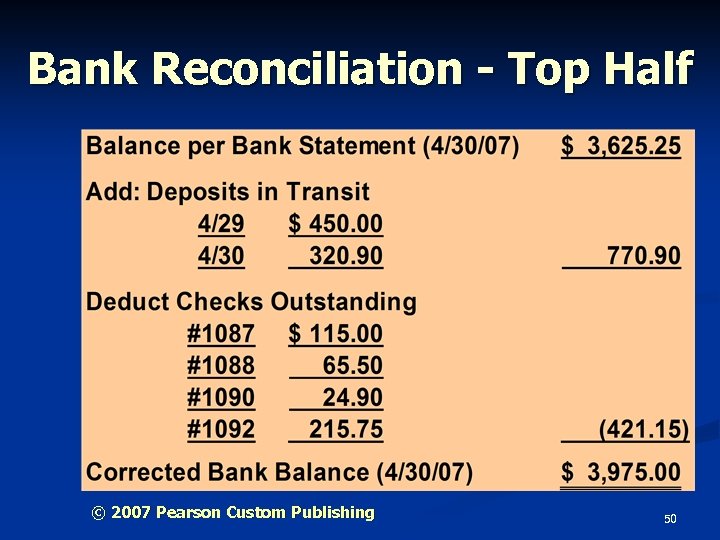 Bank Reconciliation - Top Half © 2007 Pearson Custom Publishing 50
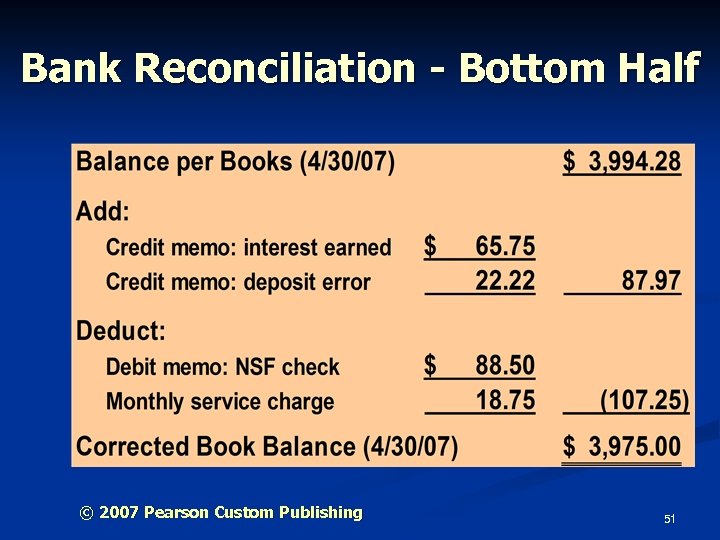 Bank Reconciliation - Bottom Half © 2007 Pearson Custom Publishing 51
 Learning Objective 7 Prepare financial statements from a worksheet. © 2007 Pearson Custom Publishing 52
 Preparing Financial Statements n After all accounts have been adjusted, the financial statements can be prepared. n At this point, you should be able to prepare three financial statements shown in Chapter 6: (1) the income statement, n (2) the statement of owner’s (stockholders’) equity, and n (3) the balance sheet. n © 2007 Pearson Custom Publishing 53
 Learning Objective 8 Prepare closing journal entries. © 2007 Pearson Custom Publishing 54
 Closing the Accounts n After the year-end financial statements have been prepared, the temporary (or nominal) accounts are closed. Closing an account means that the account will have a zero balance after the entry is journalized and posted. © 2007 Pearson Custom Publishing 55
 Closing the Accounts n Balance sheet accounts (permanent or real accounts) are not closed, their ending balance becomes the beginning balance for the next period. © 2007 Pearson Custom Publishing 56
 Preparing Closing Entries n There are four closing entries: n Close all revenue accounts to Income Summary n Close all expense accounts to Income Summary n Close Dividends to Retained Earnings, or close Withdrawals to the Owners’ Capital account(s) n Close Income Summary to Retained Earnings or to the Owners’ Capital account(s) © 2007 Pearson Custom Publishing 57
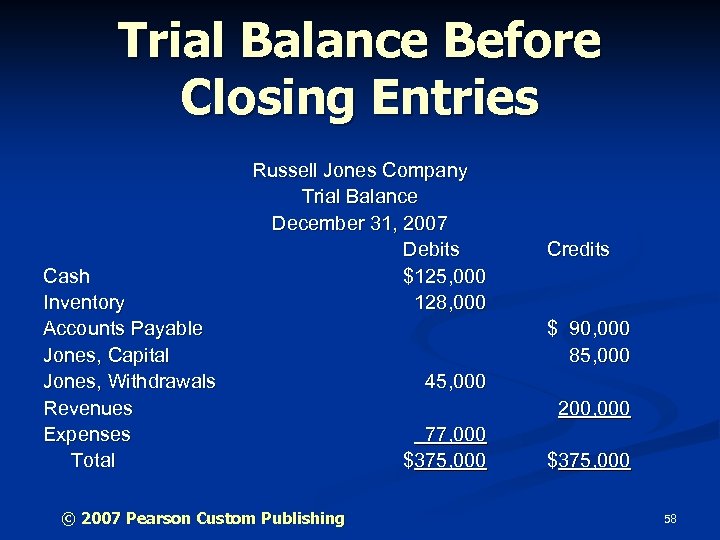 Trial Balance Before Closing Entries Cash Inventory Accounts Payable Jones, Capital Jones, Withdrawals Revenues Expenses Total Russell Jones Company Trial Balance December 31, 2007 Debits $125, 000 128, 000 © 2007 Pearson Custom Publishing Credits $ 90, 000 85, 000 45, 000 200, 000 77, 000 $375, 000 58
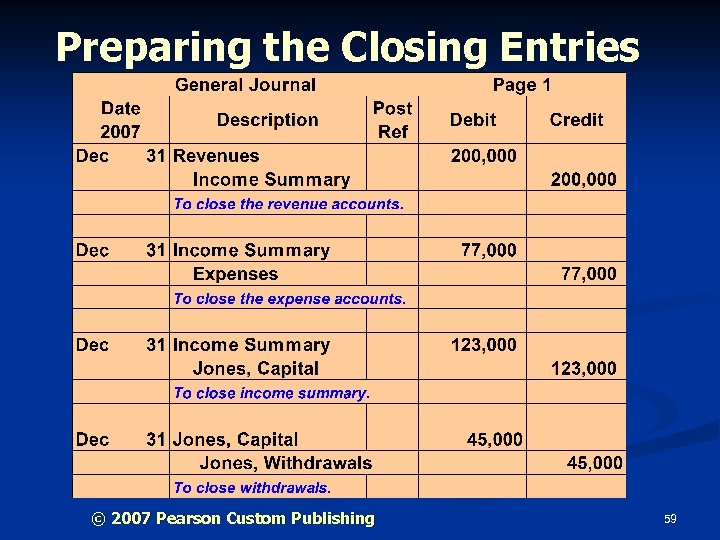 Preparing the Closing Entries © 2007 Pearson Custom Publishing 59
 Learning Objective 9 Prepare a post-closing trial balance. © 2007 Pearson Custom Publishing 60
 Post-Closing Trial Balance n The final step in the accounting cycle is to prepare a post-closing trial balance. n Since the nominal accounts have all been closed, only the real accounts will appear in the post-closing trial balance. n These account balances also serve as the opening balances for the next accounting period. © 2007 Pearson Custom Publishing 61
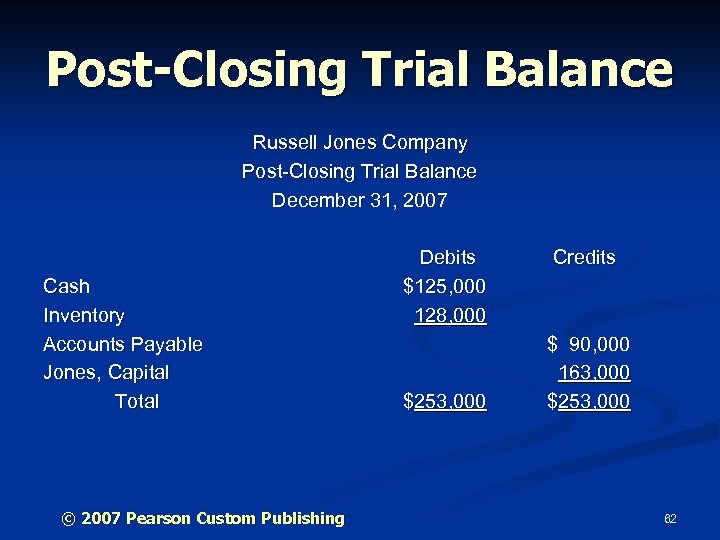 Post-Closing Trial Balance Russell Jones Company Post-Closing Trial Balance December 31, 2007 Cash Inventory Accounts Payable Jones, Capital Total © 2007 Pearson Custom Publishing Debits $125, 000 128, 000 $253, 000 Credits $ 90, 000 163, 000 $253, 000 62
 The End © 2007 Pearson Custom Publishing 63