


 Скачать презентацию Chapter Eight Stock Valuation 2003 The Mc
b75a8bda9852dd6bd64386a1ce3660c2.ppt
- Количество слайдов: 31
 Chapter Eight Stock Valuation © 2003 The Mc. Graw-Hill Companies, Inc. All rights reserved.
 Key Concepts and Skills • Understand how stock prices depend on future dividends and dividend growth • Be able to compute stock prices using the dividend growth model • Understand how corporate directors are elected • Understand how stock markets work • Understand how stock prices are quoted
 Chapter Outline • Common Stock Valuation • Some Features of Common and Preferred Stocks • The Stock Markets
 Cash Flows for Stockholders • If you buy a share of stock, you can receive cash in two ways – The company pays dividends – You sell your shares, either to another investor in the market or back to the company • As with bonds, the price of the stock is the present value of these expected cash flows
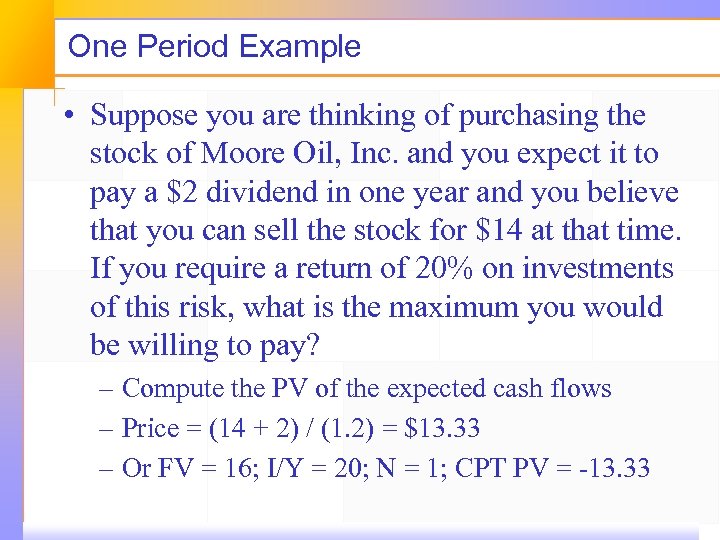 One Period Example • Suppose you are thinking of purchasing the stock of Moore Oil, Inc. and you expect it to pay a $2 dividend in one year and you believe that you can sell the stock for $14 at that time. If you require a return of 20% on investments of this risk, what is the maximum you would be willing to pay? – Compute the PV of the expected cash flows – Price = (14 + 2) / (1. 2) = $13. 33 – Or FV = 16; I/Y = 20; N = 1; CPT PV = -13. 33
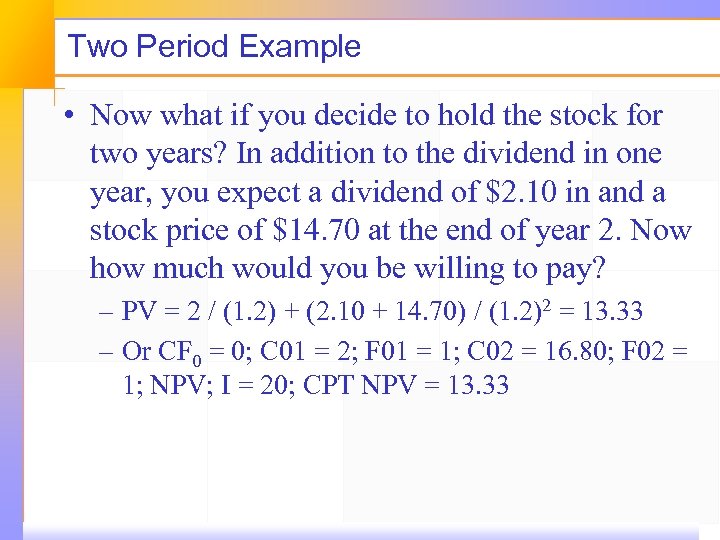 Two Period Example • Now what if you decide to hold the stock for two years? In addition to the dividend in one year, you expect a dividend of $2. 10 in and a stock price of $14. 70 at the end of year 2. Now how much would you be willing to pay? – PV = 2 / (1. 2) + (2. 10 + 14. 70) / (1. 2)2 = 13. 33 – Or CF 0 = 0; C 01 = 2; F 01 = 1; C 02 = 16. 80; F 02 = 1; NPV; I = 20; CPT NPV = 13. 33
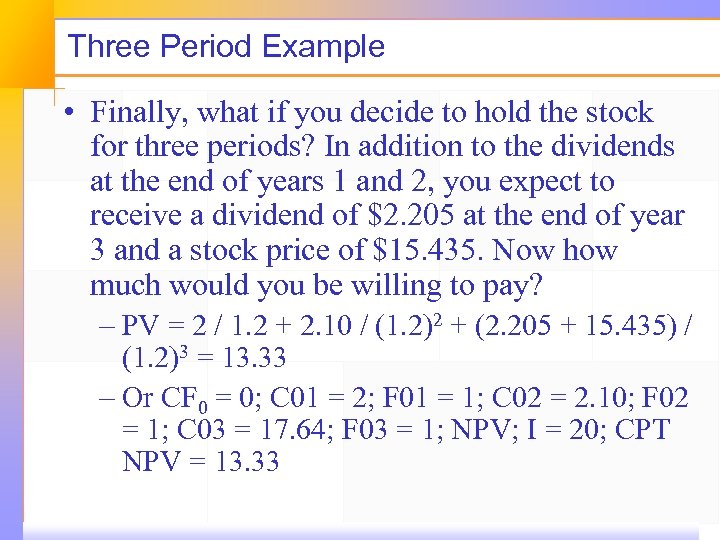 Three Period Example • Finally, what if you decide to hold the stock for three periods? In addition to the dividends at the end of years 1 and 2, you expect to receive a dividend of $2. 205 at the end of year 3 and a stock price of $15. 435. Now how much would you be willing to pay? – PV = 2 / 1. 2 + 2. 10 / (1. 2)2 + (2. 205 + 15. 435) / (1. 2)3 = 13. 33 – Or CF 0 = 0; C 01 = 2; F 01 = 1; C 02 = 2. 10; F 02 = 1; C 03 = 17. 64; F 03 = 1; NPV; I = 20; CPT NPV = 13. 33
 Developing The Model • You could continue to push back when you would sell the stock • You would find that the price of the stock is really just the present value of all expected future dividends • So, how can we estimate all future dividend payments?
 Estimating Dividends: Special Cases • Constant dividend – The firm will pay a constant dividend forever – This is like preferred stock – The price is computed using the perpetuity formula • Constant dividend growth – The firm will increase the dividend by a constant percent every period • Supernormal growth – Dividend growth is not consistent initially, but settles down to constant growth eventually
 Zero Growth • If dividends are expected at regular intervals forever, then this is like preferred stock and is valued as a perpetuity • P 0 = D / R • Suppose stock is expected to pay a $0. 50 dividend every quarter and the required return is 10% with quarterly compounding. What is the price? – P 0 =. 50 / (. 1 / 4) = $20
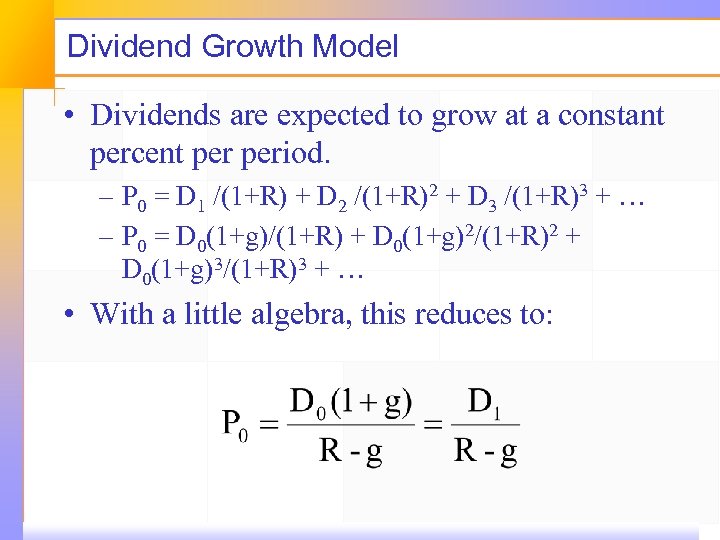 Dividend Growth Model • Dividends are expected to grow at a constant percent period. – P 0 = D 1 /(1+R) + D 2 /(1+R)2 + D 3 /(1+R)3 + … – P 0 = D 0(1+g)/(1+R) + D 0(1+g)2/(1+R)2 + D 0(1+g)3/(1+R)3 + … • With a little algebra, this reduces to:
 DGM – Example 1 • Suppose Big D, Inc. just paid a dividend of $. 50. It is expected to increase its dividend by 2% per year. If the market requires a return of 15% on assets of this risk, how much should the stock be selling for? • P 0 =. 50(1+. 02) / (. 15 -. 02) = $3. 92
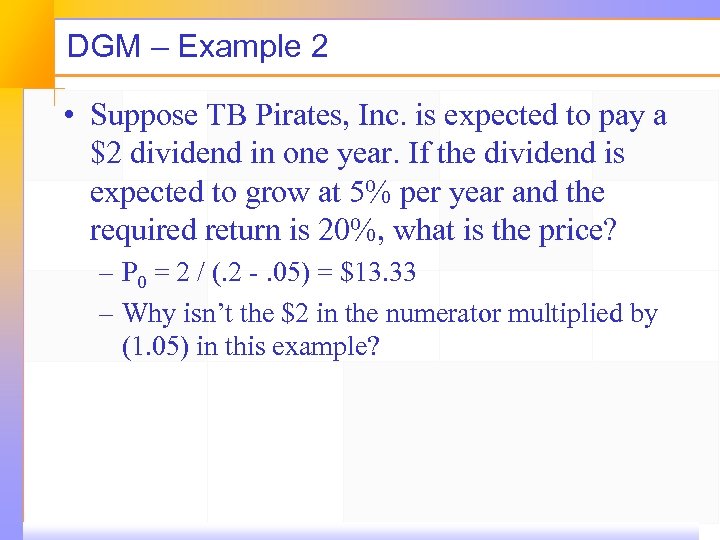 DGM – Example 2 • Suppose TB Pirates, Inc. is expected to pay a $2 dividend in one year. If the dividend is expected to grow at 5% per year and the required return is 20%, what is the price? – P 0 = 2 / (. 2 -. 05) = $13. 33 – Why isn’t the $2 in the numerator multiplied by (1. 05) in this example?
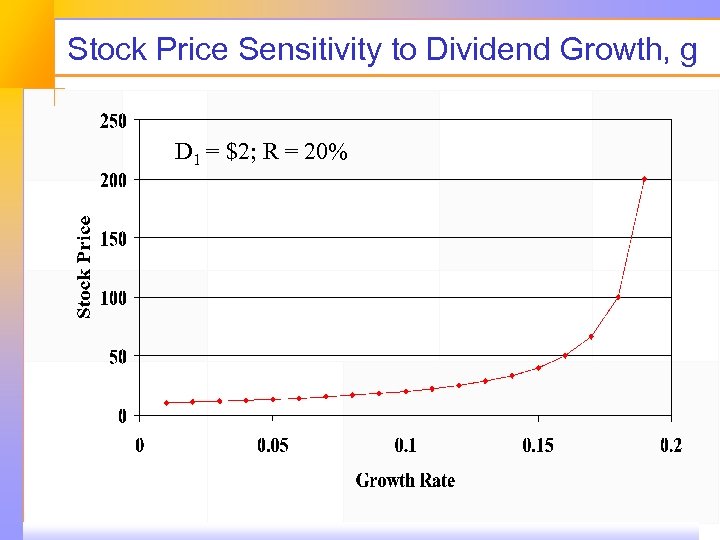 Stock Price Sensitivity to Dividend Growth, g D 1 = $2; R = 20%
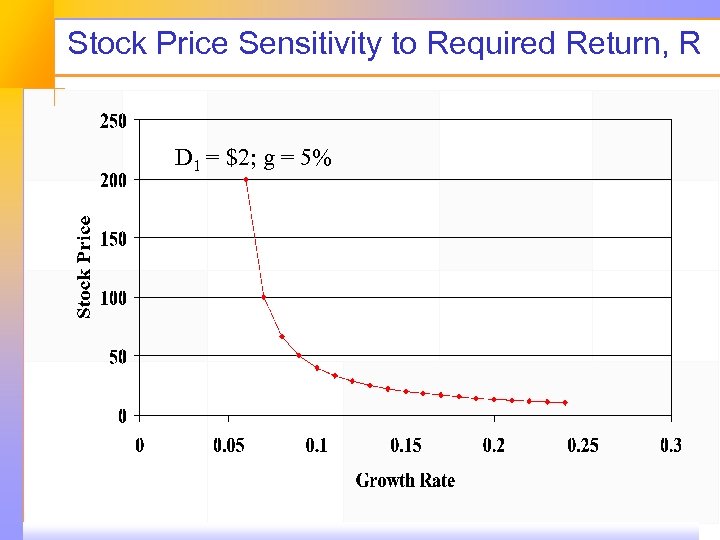 Stock Price Sensitivity to Required Return, R D 1 = $2; g = 5%
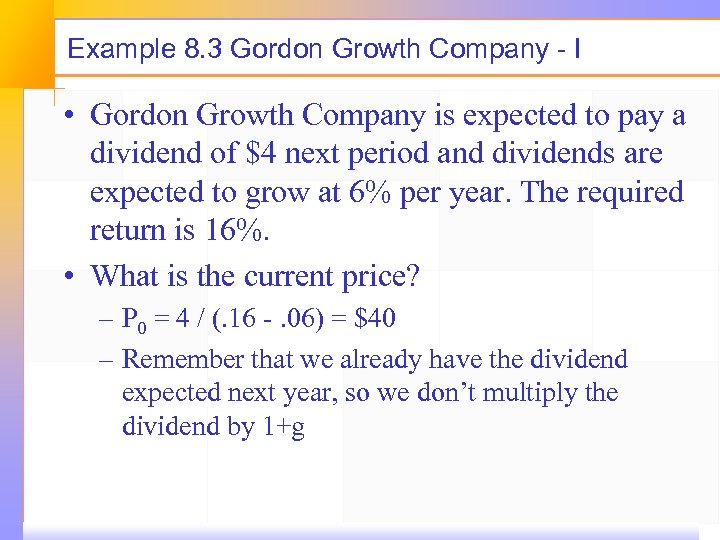 Example 8. 3 Gordon Growth Company - I • Gordon Growth Company is expected to pay a dividend of $4 next period and dividends are expected to grow at 6% per year. The required return is 16%. • What is the current price? – P 0 = 4 / (. 16 -. 06) = $40 – Remember that we already have the dividend expected next year, so we don’t multiply the dividend by 1+g
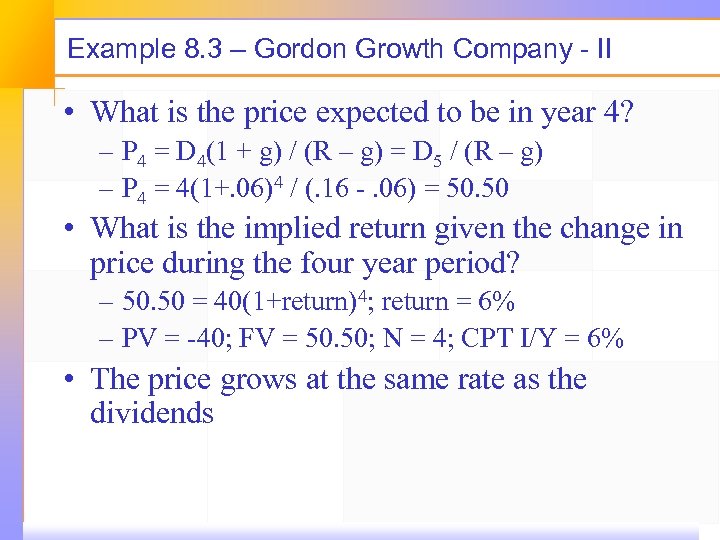 Example 8. 3 – Gordon Growth Company - II • What is the price expected to be in year 4? – P 4 = D 4(1 + g) / (R – g) = D 5 / (R – g) – P 4 = 4(1+. 06)4 / (. 16 -. 06) = 50. 50 • What is the implied return given the change in price during the four year period? – 50. 50 = 40(1+return)4; return = 6% – PV = -40; FV = 50. 50; N = 4; CPT I/Y = 6% • The price grows at the same rate as the dividends
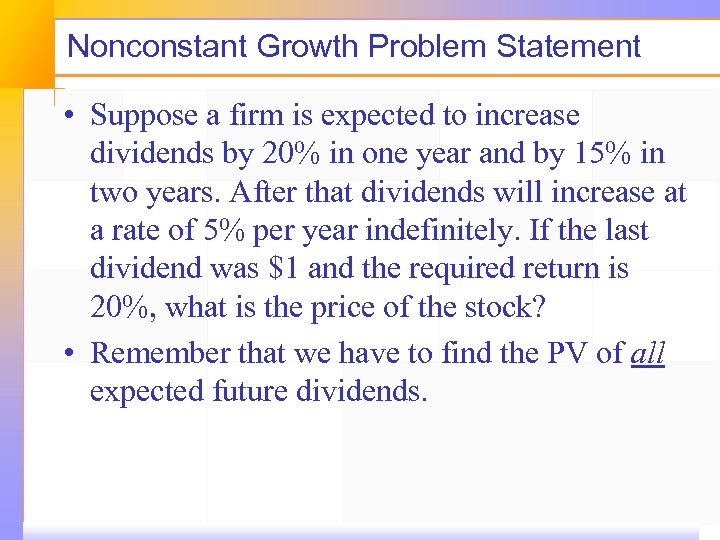 Nonconstant Growth Problem Statement • Suppose a firm is expected to increase dividends by 20% in one year and by 15% in two years. After that dividends will increase at a rate of 5% per year indefinitely. If the last dividend was $1 and the required return is 20%, what is the price of the stock? • Remember that we have to find the PV of all expected future dividends.
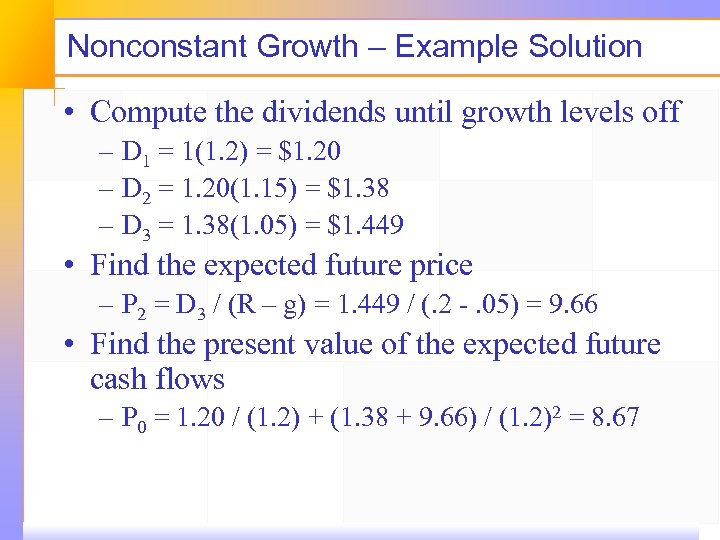 Nonconstant Growth – Example Solution • Compute the dividends until growth levels off – D 1 = 1(1. 2) = $1. 20 – D 2 = 1. 20(1. 15) = $1. 38 – D 3 = 1. 38(1. 05) = $1. 449 • Find the expected future price – P 2 = D 3 / (R – g) = 1. 449 / (. 2 -. 05) = 9. 66 • Find the present value of the expected future cash flows – P 0 = 1. 20 / (1. 2) + (1. 38 + 9. 66) / (1. 2)2 = 8. 67
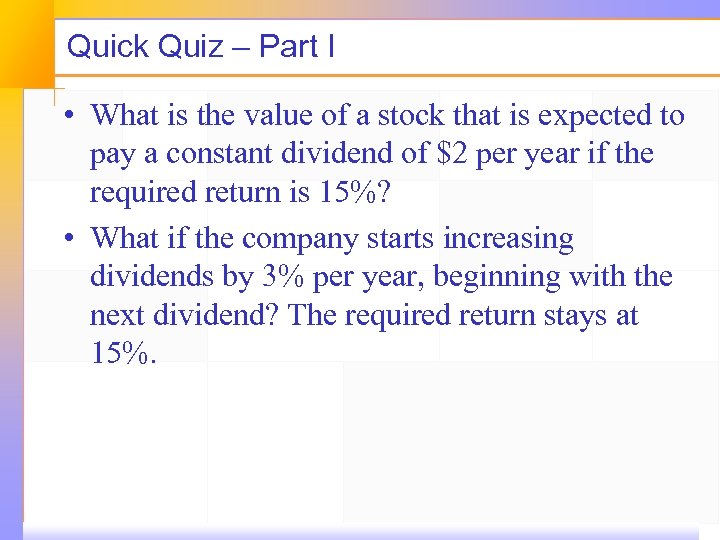 Quick Quiz – Part I • What is the value of a stock that is expected to pay a constant dividend of $2 per year if the required return is 15%? • What if the company starts increasing dividends by 3% per year, beginning with the next dividend? The required return stays at 15%.
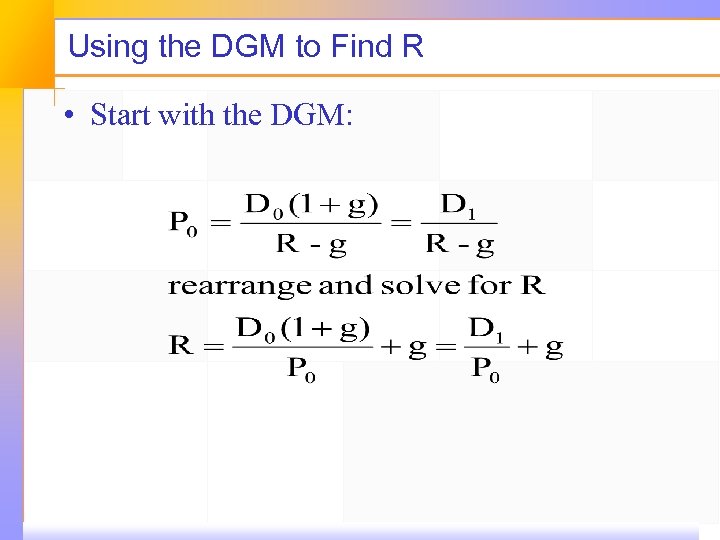 Using the DGM to Find R • Start with the DGM:
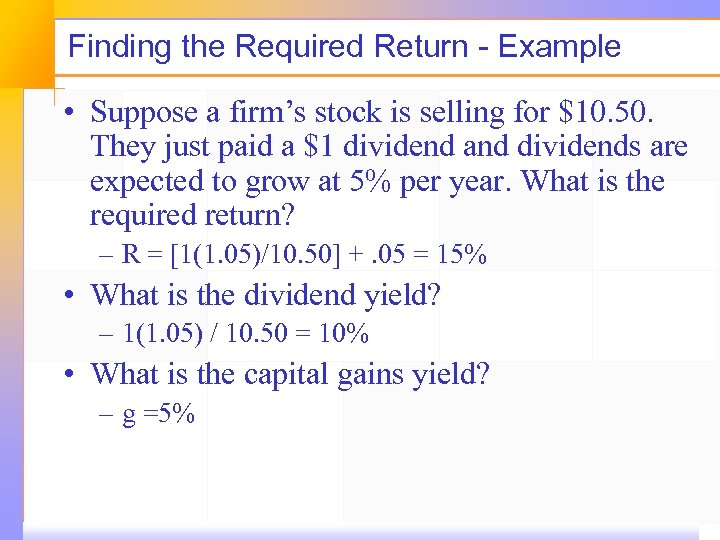 Finding the Required Return - Example • Suppose a firm’s stock is selling for $10. 50. They just paid a $1 dividend and dividends are expected to grow at 5% per year. What is the required return? – R = [1(1. 05)/10. 50] +. 05 = 15% • What is the dividend yield? – 1(1. 05) / 10. 50 = 10% • What is the capital gains yield? – g =5%
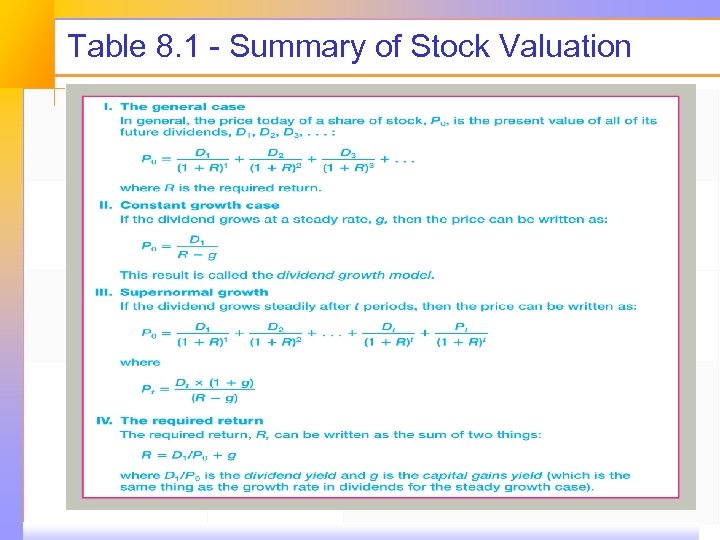 Table 8. 1 - Summary of Stock Valuation
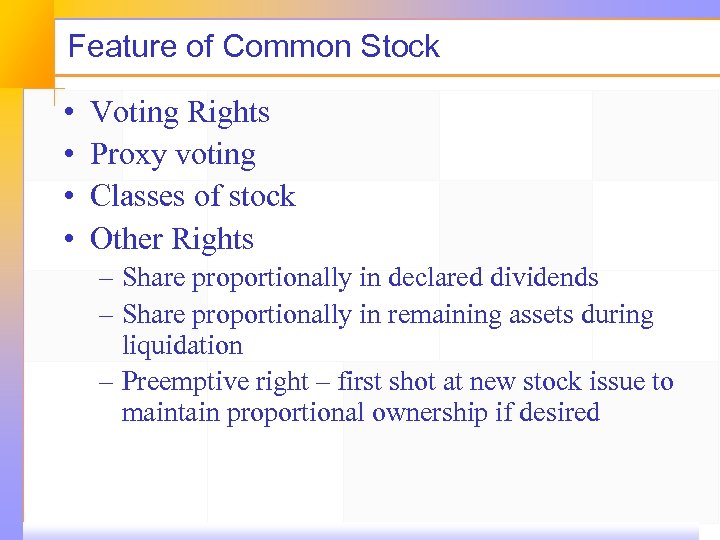 Feature of Common Stock • • Voting Rights Proxy voting Classes of stock Other Rights – Share proportionally in declared dividends – Share proportionally in remaining assets during liquidation – Preemptive right – first shot at new stock issue to maintain proportional ownership if desired
 Dividend Characteristics • Dividends are not a liability of the firm until a dividend has been declared by the Board • Consequently, a firm cannot go bankrupt for not declaring dividends • Dividends and Taxes – Dividend payments are not considered a business expense, therefore, they are not tax deductible – Dividends received by individuals are taxed as ordinary income – Dividends received by corporations have a minimum 70% exclusion from taxable income
 Features of Preferred Stock • Dividends – Stated dividend that must be paid before dividends can be paid to common stockholders – Dividends are not a liability of the firm and preferred dividends can be deferred indefinitely – Most preferred dividends are cumulative – any missed preferred dividends have to be paid before common dividends can be paid • Preferred stock generally does not carry voting rights
 Stock Market • Dealers vs. Brokers • New York Stock Exchange (NYSE) – Largest stock market in the world – Members • • • Own seats on the exchange Commission brokers Specialists Floor brokers Floor traders – Operations – Floor activity
 NASDAQ • Not a physical exchange – computer based quotation system • Multiple market makers • Electronic Communications Networks • Three levels of information – Level 1 – median quotes, registered representatives – Level 2 – view quotes, brokers & dealers – Level 3 – view and update quotes, dealers only • Large portion of technology stocks
 Work the Web Example • Electronic Communications Networks provide trading in NASDAQ securities • The Island allows the public to view the “order book” in real time • Click on the web surfer and visit The Island!
 Reading Stock Quotes • Sample Quote -3. 3 33. 25 20. 75 Harris HRS . 20. 7 87 3358 29. 60 +0. 50 • What information is provided in the stock quote? • Click on the web surfer to go to CNBC for current stock quotes.
 Quick Quiz – Part II • You observe a stock price of $18. 75. You expect a dividend growth rate of 5% and the most recent dividend was $1. 50. What is the required return? • What are some of the major characteristics of common stock? • What are some of the major characteristics of preferred stock?