 Скачать презентацию Chapter Eight Building The EBusiness Backbone Enterprise Resource
f53b331626bdbbd82721dc318dbbd708.ppt
- Количество слайдов: 22



Chapter Eight Building The EBusiness Backbone: Enterprise Resource Planning
ERP: The Technological Backbone of EBusiness Typical corporate computing environment today of mainframebased apps is antiquated – Cannot meet demands of new economy and must be replaced ERP integrated app suite – Framework to automate back-office functions: Financial, Manufacturing and Distribution, HR, Administrative – Unites major business processes within single family of modules: production, order processing, inventory mgmt and warehousing, A/P and A/R, general ledger, and payroll ERP phenomenon also catching fire among dot-coms – Managing customer relationships key for the newer online firms – ERP offers customers efficient, high-quality service • Ability to order online; inquire about product pricing and order status – ERP prices dropping and rental ASP model becoming prevalent © e-Business Strategies, Inc. -2 www. ebstrategy. com
ERP: The Technological Backbone of EBusiness ERP is the technological backbone of ebusiness – Enterprise-wide transaction framework with links into • sales order processing; inventory mgmt and control; production and distribution planning; finance – In early 1990 s, only large manufacturers saw benefits of ERP – Today, medium-size and dot-com firms also recognize necessity of integrating back-office processes for front-office success in e-commerce world © e-Business Strategies, Inc. -3 www. ebstrategy. com
Who Really Uses ERP Suites? Large corporations that want to gain control over disparate groups of core business apps – 3 Com, Chevron Products Company, GM 3 primary categories of ERP implementations – Single to few products in single industry: e. Toys – Single SBU firms, selling only few products in a single industry: Delta Airlines, Dell, Microsoft, Nike – Large corporate conglomerates or multiple-SBU firms, selling many products in multiple industries: GE, IBM, Colgate-Palmolive, and Nabisco © e-Business Strategies, Inc. -4 www. ebstrategy. com
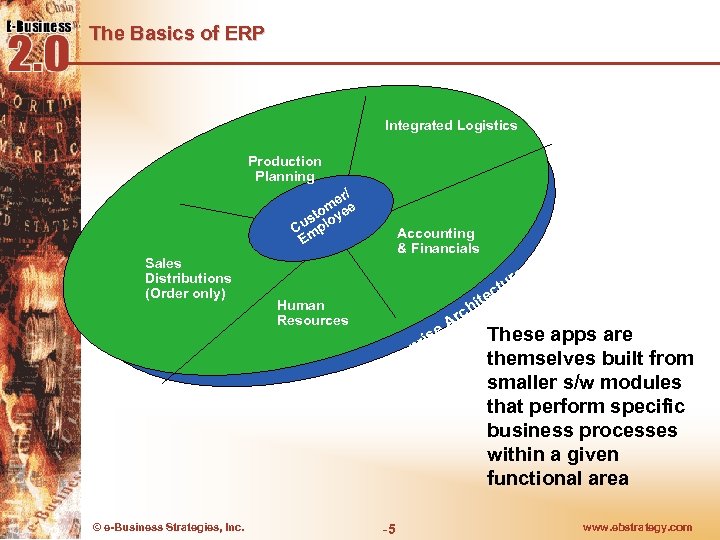
The Basics of ERP Integrated Logistics Production Planning r/ meee to y us plo C m E Sales Distributions (Order only) Accounting & Financials c te hi Human Resources c Ar e t is pr er En © e-Business Strategies, Inc. -5 e r tu These apps are themselves built from smaller s/w modules that perform specific business processes within a given functional area www. ebstrategy. com
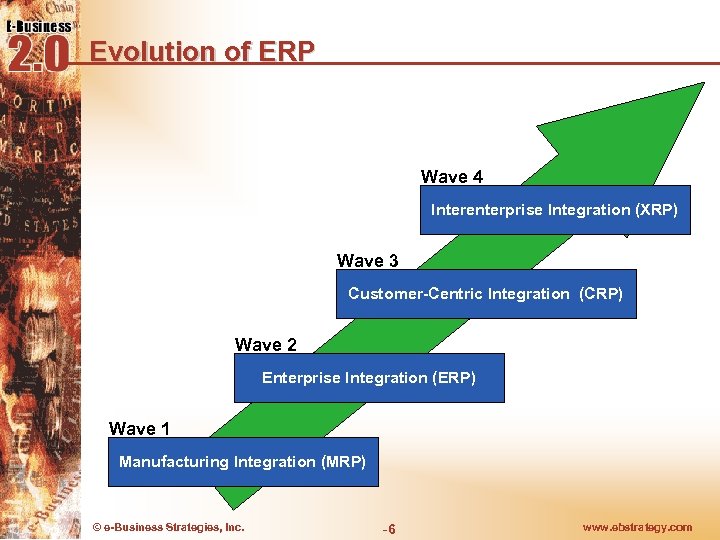
Evolution of ERP Wave 4 Interenterprise Integration (XRP) Wave 3 Customer-Centric Integration (CRP) Wave 2 Enterprise Integration (ERP) Wave 1 Manufacturing Integration (MRP) © e-Business Strategies, Inc. -6 www. ebstrategy. com
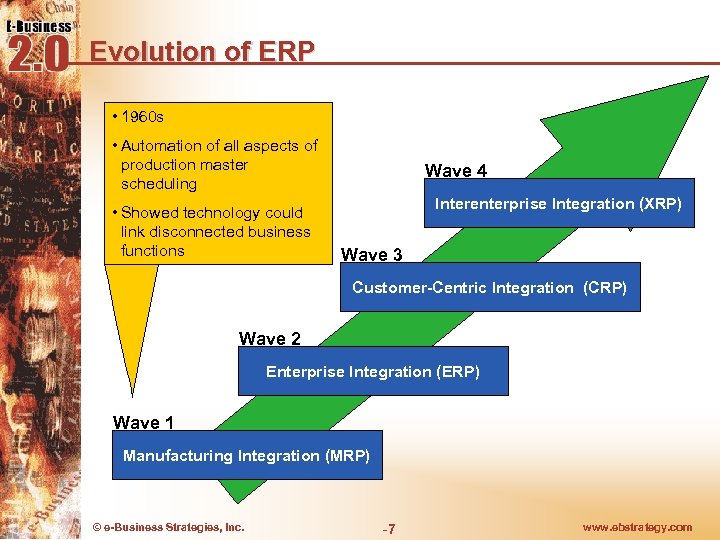
Evolution of ERP • 1960 s • Automation of all aspects of production master scheduling • Showed technology could link disconnected business functions Wave 4 Interenterprise Integration (XRP) Wave 3 Customer-Centric Integration (CRP) Wave 2 Enterprise Integration (ERP) Wave 1 Manufacturing Integration (MRP) © e-Business Strategies, Inc. -7 www. ebstrategy. com
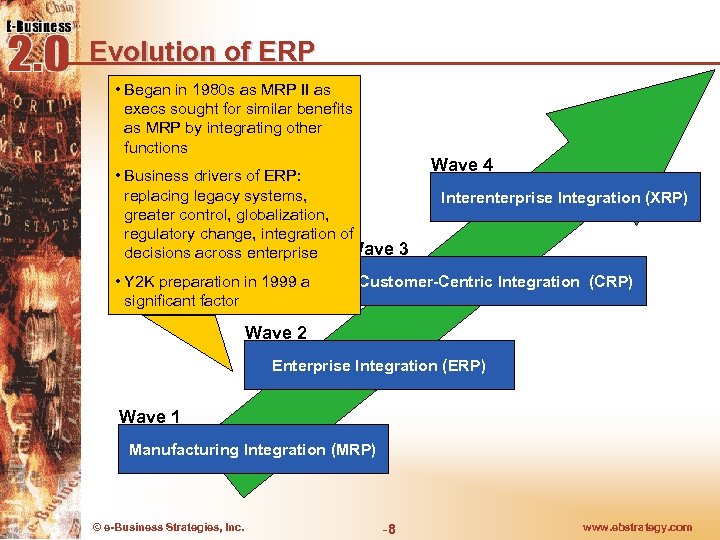
Evolution of ERP • Began in 1980 s as MRP II as execs sought for similar benefits as MRP by integrating other functions • Business drivers of ERP: replacing legacy systems, greater control, globalization, regulatory change, integration of Wave 3 decisions across enterprise • Y 2 K preparation in 1999 a significant factor Wave 4 Interenterprise Integration (XRP) Customer-Centric Integration (CRP) Wave 2 Enterprise Integration (ERP) Wave 1 Manufacturing Integration (MRP) © e-Business Strategies, Inc. -8 www. ebstrategy. com
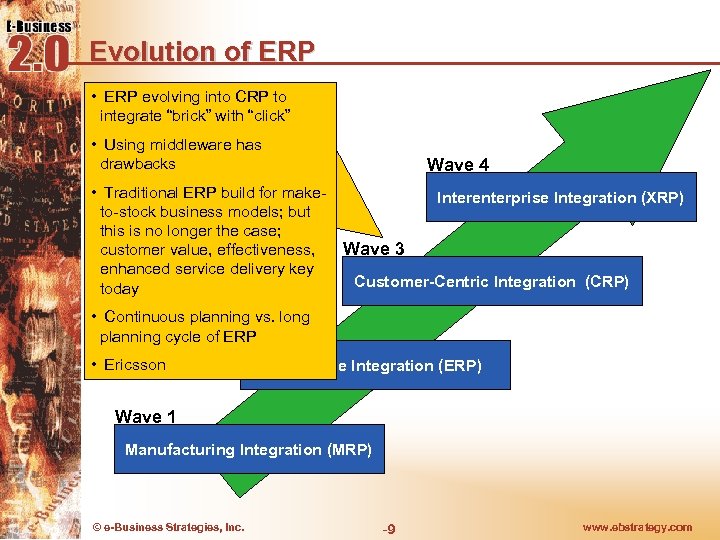
Evolution of ERP • ERP evolving into CRP to integrate “brick” with “click” • Using middleware has drawbacks Wave 4 • Traditional ERP build for maketo-stock business models; but this is no longer the case; customer value, effectiveness, enhanced service delivery key today Interenterprise Integration (XRP) Wave 3 Customer-Centric Integration (CRP) • Continuous planning vs. long Wave 2 planning cycle of ERP • Ericsson Enterprise Integration (ERP) Wave 1 Manufacturing Integration (MRP) © e-Business Strategies, Inc. -9 www. ebstrategy. com
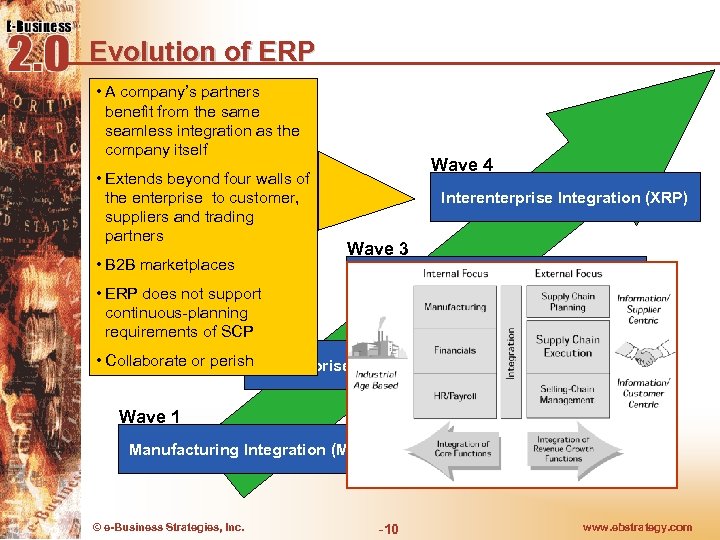
Evolution of ERP • A company’s partners benefit from the same seamless integration as the company itself • Extends beyond four walls of the enterprise to customer, suppliers and trading partners • B 2 B marketplaces • ERP does not support continuous-planning requirements of SCP Wave 2 • Collaborate or perish Wave 4 Interenterprise Integration (XRP) Wave 3 Customer-Centric Integration (CRP) Enterprise Integration (ERP) Wave 1 Manufacturing Integration (MRP) © e-Business Strategies, Inc. -10 www. ebstrategy. com
Benefits of ERP Critical business need: Enterprise-wide shared services – Replace old, autonomous departmental, or divisional services with single, streamlined, corporate-level process Shared-services standardize the processes for routine, non-core functions for all business units to use – Accounting With processes defined, an ERP-based IT infrastructure can be established to manage them efficiently © e-Business Strategies, Inc. -11 www. ebstrategy. com
ERP Decision = Enterprise Architecture Planning Management must resolve enterprise architecture issues before selecting an ERP suite of products – “What kind of company do we want to be? ” – Not, “What are each application’s features? ” Inability to find the right fit between ERP apps and their business causing corporate frustration – Fox. Meyer Problem not with ERP concept but in management’s demands for quick fixes and rapid cures to underlying structural problems © e-Business Strategies, Inc. -12 www. ebstrategy. com
ERP Decision = Enterprise Architecture Planning Selecting and installing a new ERP solution one of the most important and most expensive endeavors – Also most likely to go wrong – Lack of alignment between ERP, business processes and ecommerce objectives can derail best of firms – Managers must understand core functionality, not abdicate responsibility to IT dept Successful organizational change is gradual – Enterprise apps require moving decades of corporate knowledge and information to a new technology platform – Technology is not the only challenge in managing transformation © e-Business Strategies, Inc. -13 www. ebstrategy. com
ERP Decision = Enterprise Architecture Planning Cannot lose sight of customers – “Is this something our customers will recognize as valuable? ” – “Will it shorten order-to-delivery cycle? ” – “Will this improve our product and performance? ” ERP impacts not just s/w – Corporate culture, business processes, staff, and day-to-day procedures are all affected Executive mgmt must understand technical basis for business change and e-commerce functionality, besides ROI of new technology – “What business are we in? ” – “What are the key issues facing us today? ” – “What issues will be important tomorrow? ” © e-Business Strategies, Inc. -14 www. ebstrategy. com
ERP Decision: Build Vs Buy Vs Rent Important decision: whether to build or buy or rent – ERP apps define overall corporate architecture – Enterprise-wide implementations Custom design app that meets specific requirements of an organization has several drawbacks – Highly complex – Lengthy design, development and implementation efforts – Limited flexibility to support diverse and changing operations or to respond effectively to evolving business demands and technologies © e-Business Strategies, Inc. -15 www. ebstrategy. com
ERP Decision: Build Vs Buy Vs Rent COTS apps address limitations of custom built apps – Provide broad functionality, better integration with existing legacy systems, greater flexibility to change and upgrade, and a lower TCO Downside of COTS apps – – Reengineer estbd. business practices Customize apps Hire consultants to make s/w work No competitive edge Mgmt must view COTS apps within the context of overall business strategy – “What business processes bring us our identity and our competitive advantage? ” – “How can we ensure that we enhance these with COTS solution? ” – “How can we support our ecommerce initiatives with COTS? ” © e-Business Strategies, Inc. -16 www. ebstrategy. com
Capabilities of COTS ERP Solutions • Consolidation of back office • Creation of single back office that supports multiple distribution channels • Facilitation of changes in business practices • Facilitation of changes in technology © e-Business Strategies, Inc. -17 www. ebstrategy. com
Microsoft Spent 10 months and $25 million installing SAP R/3 to replace a tangle of 33 financial-tracking systems in 26 subsidiaries $18 million annual savings Growth rate was straining company’s systems – 50 subsidiaries worldwide; continues to grow every day – More than 30 systems implemented in a piecemeal fashion over time supported financial, operations and HR groups alone – Batch processes to move information between systems • Run time grew to more than 12 hours • 90% of the more than 20, 000 batch robs that ran each month retrieved and processes same information Mgmt realized it needed a global and integrated solution to support its core business © e-Business Strategies, Inc. -18 www. ebstrategy. com
ERP Implementation: Catching the Bull by the Horns Installation of ERP packages unique – Each ERP app suite has own architecture, customization features, installation procedures, and level of complexity Implementation strategies for SAP – Step-by-step • One module at a time – Big bang • Replacing all old systems at once – Modified big bang • Various modules at once, but pilot first • Very common Even if implementation strategy is right, setting up the solution not easy – Brother Industries © e-Business Strategies, Inc. -19 www. ebstrategy. com
Roadmap to Rapid Implementation: Accelerated ERP Approach Today’s intense competitive pressures require fast response – ERP app suites can’t keep up But successful companies understand business processes, simplify them, and then introduce automation – Automating complex or non-value-adding processes will not increase productivity or provide measurable improvements in performance – Automation without simplification immortalizes ineffective processes © e-Business Strategies, Inc. -20 www. ebstrategy. com
Roadmap to New Leadership Skills Effective coordination mgmt encompasses a combination of four capabilities – Strategic thinking • How well does your ERP selection, implementation, and evolution strategy align with your business strategy? – Process reengineering – Managing implementation complexity – Transition management © e-Business Strategies, Inc. -21 www. ebstrategy. com
E-Business Strategies, Inc. www. ebstrategy. com contact@ebstrategy. com 678 -339 -1236 x 201 Fax - 678 -339 -9793
Скачать презентацию Chapter Eight Building The EBusiness Backbone Enterprise Resource
f53b331626bdbbd82721dc318dbbd708.ppt