


 Скачать презентацию CHAPTER CHECKLIST When you have completed your study
6875f736b60979629e5df8fdcb71b4f0.ppt
- Количество слайдов: 39
 CHAPTER CHECKLIST When you have completed your study of this chapter, you will be able to 1 2 Distinguish between value and price and define consumer surplus. Distinguish between cost and price and define producer surplus. 3 Explain the conditions in which markets are efficient and inefficient. 4 Explain the main ideas about fairness and evaluate claims that competitive markets result in unfair outcomes.
 6. 1 VALUE, PRICE, CONSUMER SURPLUS
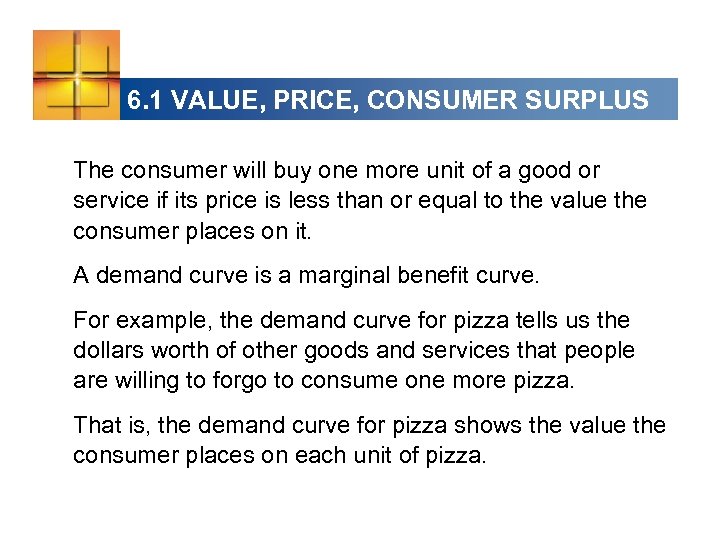 6. 1 VALUE, PRICE, CONSUMER SURPLUS The consumer will buy one more unit of a good or service if its price is less than or equal to the value the consumer places on it. A demand curve is a marginal benefit curve. For example, the demand curve for pizza tells us the dollars worth of other goods and services that people are willing to forgo to consume one more pizza. That is, the demand curve for pizza shows the value the consumer places on each unit of pizza.
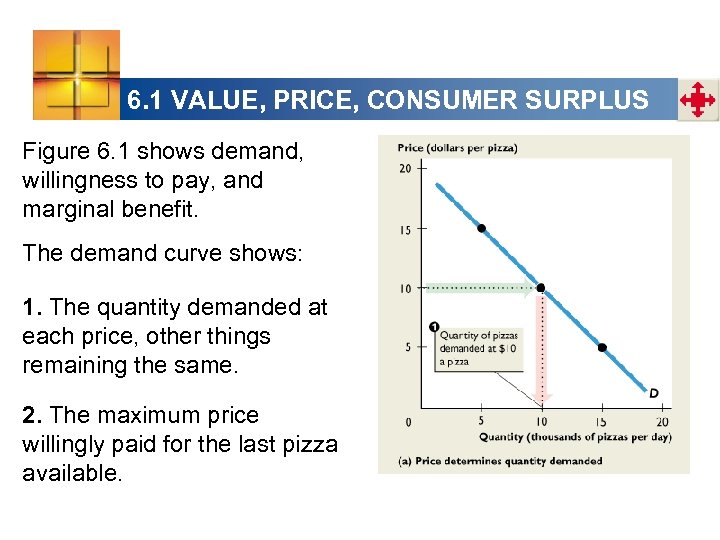 6. 1 VALUE, PRICE, CONSUMER SURPLUS Figure 6. 1 shows demand, willingness to pay, and marginal benefit. The demand curve shows: 1. The quantity demanded at each price, other things remaining the same. 2. The maximum price willingly paid for the last pizza available.
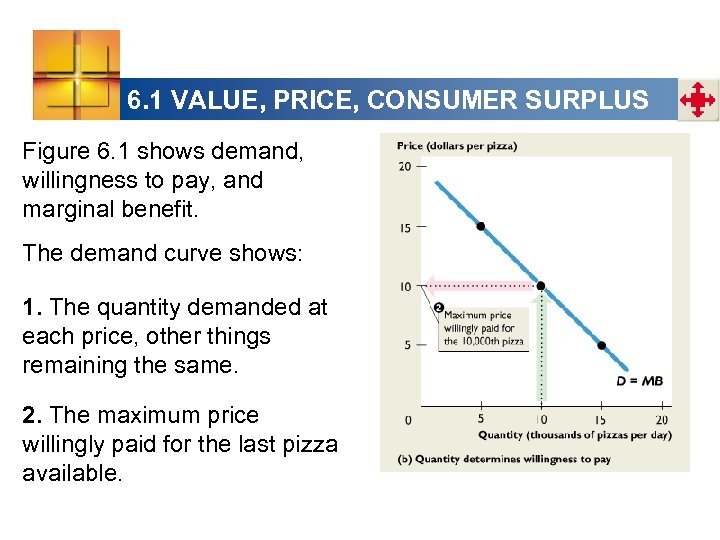 6. 1 VALUE, PRICE, CONSUMER SURPLUS Figure 6. 1 shows demand, willingness to pay, and marginal benefit. The demand curve shows: 1. The quantity demanded at each price, other things remaining the same. 2. The maximum price willingly paid for the last pizza available.
 6. 1 VALUE, PRICE, CONSUMER SURPLUS
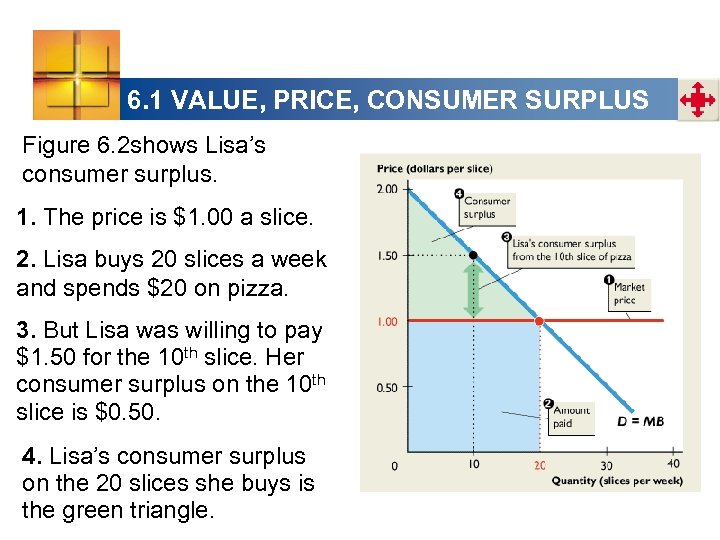 6. 1 VALUE, PRICE, CONSUMER SURPLUS Figure 6. 2 shows Lisa’s consumer surplus. 1. The price is $1. 00 a slice. 2. Lisa buys 20 slices a week and spends $20 on pizza. 3. But Lisa was willing to pay $1. 50 for the 10 th slice. Her consumer surplus on the 10 th slice is $0. 50. 4. Lisa’s consumer surplus on the 20 slices she buys is the green triangle.
 6. 2 COST, PRICE, PRODUCER SURPLUS
 6. 2 COST, PRICE, PRODUCER SURPLUS The seller will produce one more unit of a good or service if the price for which it can be sold exceeds or equals its marginal cost. A supply curve is a marginal cost curve. For example, the supply curve of pizza tells us the dollars worth of other goods and services that firms must forgo to produce one more pizza. That is, the supply curve of pizza shows the seller’s cost of producing each unit of pizza.
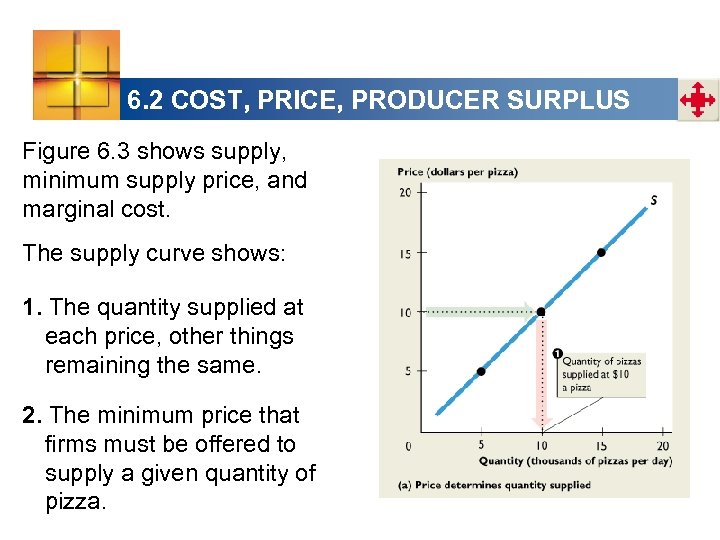 6. 2 COST, PRICE, PRODUCER SURPLUS Figure 6. 3 shows supply, minimum supply price, and marginal cost. The supply curve shows: 1. The quantity supplied at each price, other things remaining the same. 2. The minimum price that firms must be offered to supply a given quantity of pizza.
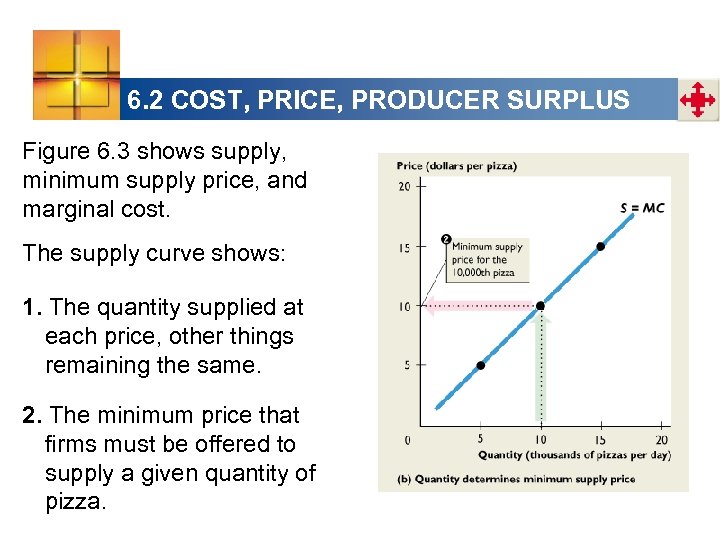 6. 2 COST, PRICE, PRODUCER SURPLUS Figure 6. 3 shows supply, minimum supply price, and marginal cost. The supply curve shows: 1. The quantity supplied at each price, other things remaining the same. 2. The minimum price that firms must be offered to supply a given quantity of pizza.
 6. 2 COST, PRICE, PRODUCER SURPLUS
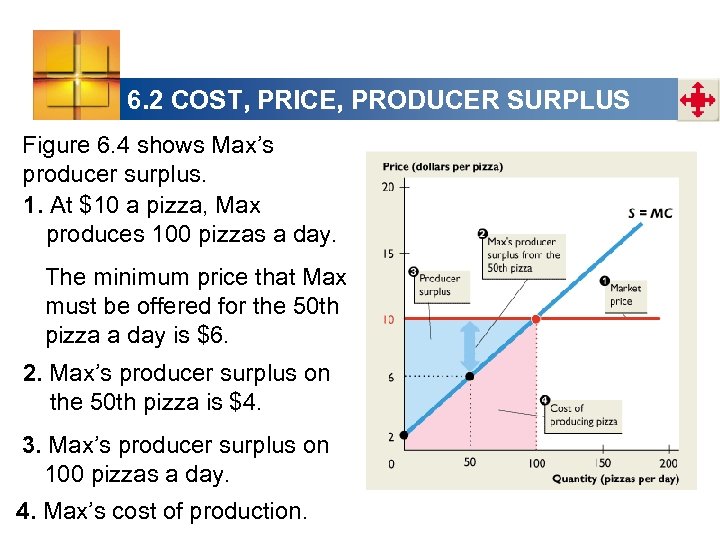 6. 2 COST, PRICE, PRODUCER SURPLUS Figure 6. 4 shows Max’s producer surplus. 1. At $10 a pizza, Max produces 100 pizzas a day. The minimum price that Max must be offered for the 50 th pizza a day is $6. 2. Max’s producer surplus on the 50 th pizza is $4. 3. Max’s producer surplus on 100 pizzas a day. 4. Max’s cost of production.
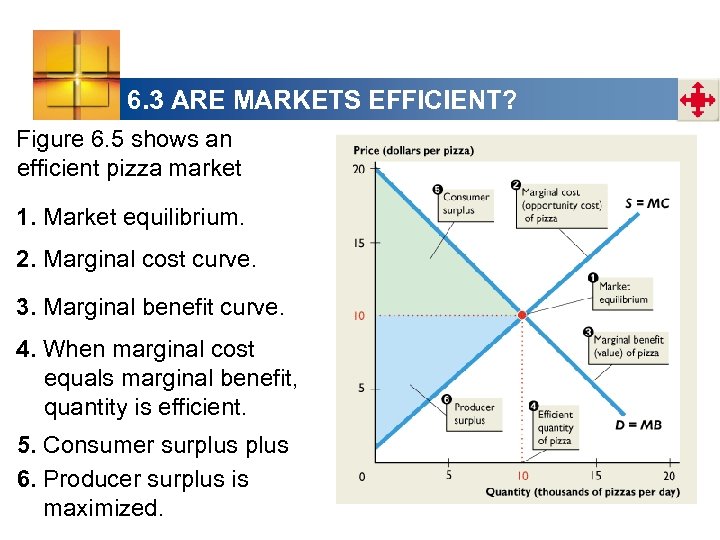 6. 3 ARE MARKETS EFFICIENT? Figure 6. 5 shows an efficient pizza market 1. Market equilibrium. 2. Marginal cost curve. 3. Marginal benefit curve. 4. When marginal cost equals marginal benefit, quantity is efficient. 5. Consumer surplus 6. Producer surplus is maximized.
 6. 3 ARE MARKETS EFFICIENT?
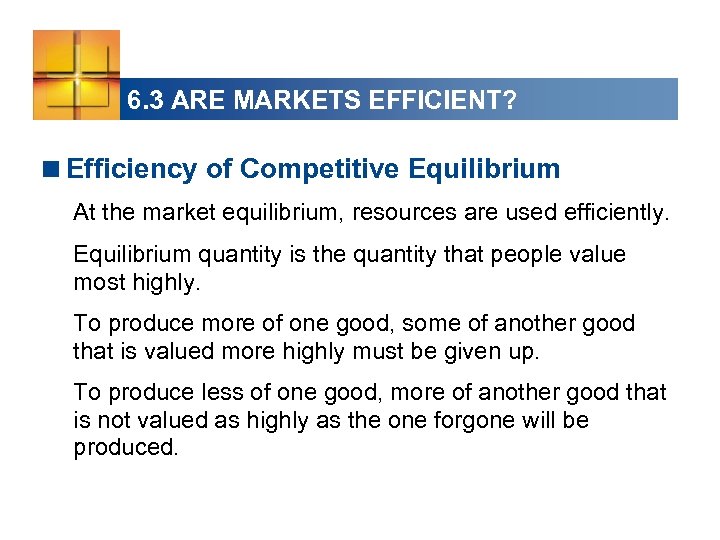
 6. 3 ARE MARKETS EFFICIENT? In a competitive market: • The demand curve shows buyers’ marginal benefit. • The supply curve shows the sellers’ marginal cost. So at the equilibrium in a competitive market, marginal benefit equals marginal cost. Resources are used efficiently. So the competitive market is efficient.
 6. 3 ARE MARKETS EFFICIENT?
 6. 3 ARE MARKETS EFFICIENT?
 6. 3 ARE MARKETS EFFICIENT? Price Ceilings, Price Floors, and Production Quotas A price ceiling is a regulation that makes it illegal to charge a price higher than a specified level. A rent ceiling is an example. A price floor is a regulation that makes it illegal to pay a price lower than a specified level. The minimum wage is an example. A production quota is a law that limits the quantity that may be produced.
 6. 3 ARE MARKETS EFFICIENT? A price ceiling, a price floor, or a production quota blocks the forces of demand supply and results in a quantity that might fall short of the efficient quantity. We study these restrictions on buyers and sellers in Chapter 7.
 6. 3 ARE MARKETS EFFICIENT? Taxes and Subsidies Taxes increase the prices paid by buyers and lower the prices received by sellers. So taxes decrease the quantity to less than the efficient quantity. Subsidies lower the prices paid by buyers and increase the prices received by sellers. So subsidies increase the quantity to more than the efficient quantity. We study taxes in Chapter 8.
 6. 3 ARE MARKETS EFFICIENT? Externalities An external cost is a cost of producing or consuming a good or service that affects someone other than the buyer and the seller of that good or service. Air pollution from the production and consumption of electric power is an example. The market produces more than the efficient quantity of such items.
 6. 3 ARE MARKETS EFFICIENT? An external benefit is a benefit of producing or consuming a good or service that affects someone other than the buyer and the seller of that good or service. Beautiful views from the production and consumption of landscaping services is an example. The market produces less than the efficient quantity of such items. We study externalities in Chapter 9.
 6. 3 ARE MARKETS EFFICIENT? Public Goods and Common Resources A public good is a good (or service) that is consumed simultaneously by everyone, such as national defense and law enforcement. Competitive markets produce less of a public good than the efficient quantity because of a free-rider problem Free-rider problem arises because it is in each person’s interest to avoid paying for her or his share of a public good.
 6. 3 ARE MARKETS EFFICIENT? A common resource is a resource that is owned by no one but used by everyone who wishes to use it, such as fish in the ocean. Competitive markets use more than the efficient quantity of a common resource. We study public goods and common resources in Chapter 10.
 6. 3 ARE MARKETS EFFICIENT? Monopoly A monopoly is a firm that has sole control of a market, such as the supplier of the town’s water supply. The monopoly increases its profit by producing less than the competitive market would produce and charging a higher price for it. A monopoly produces less than the efficient quantity. We study monopoly in Chapter 14.
 6. 3 ARE MARKETS EFFICIENT?
 6. 3 ARE MARKETS EFFICIENT? Underproduction When a firm cuts production to less than the efficient quantity, a deadweight loss is created. Deadweight loss The decrease in consumer surplus and producer surplus that results from an inefficient level of production. The deadweight loss is borne by the entire society. It is a social loss.
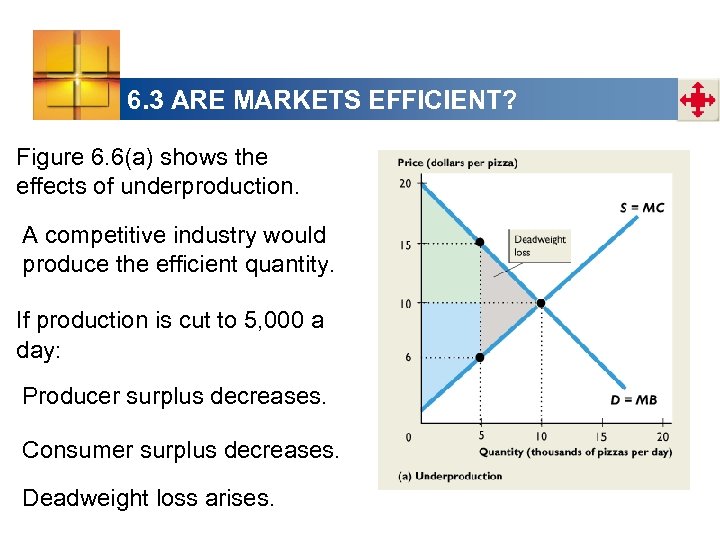 6. 3 ARE MARKETS EFFICIENT? Figure 6. 6(a) shows the effects of underproduction. A competitive industry would produce the efficient quantity. If production is cut to 5, 000 a day: Producer surplus decreases. Consumer surplus decreases. Deadweight loss arises.
 6. 3 ARE MARKETS EFFICIENT? Overproduction When the government pays producers a subsidy, the quantity produced exceeds the efficient quantity. A deadweight loss arises than reduces the sum of consumer surplus and producer surplus to less than its maximum.
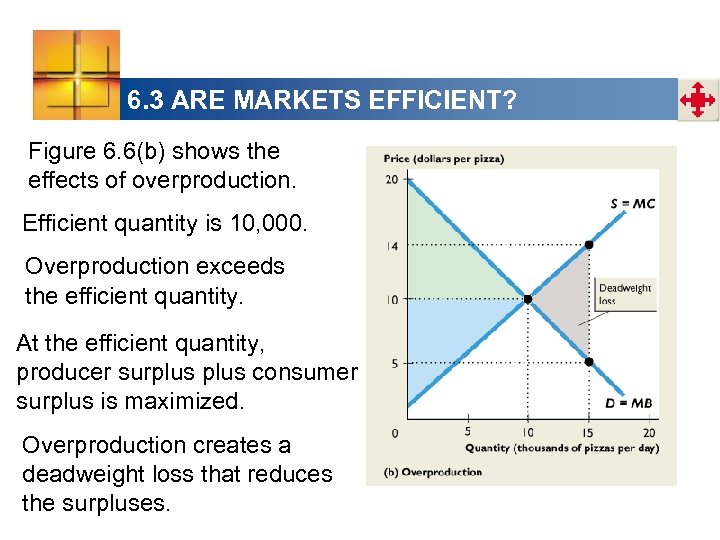 6. 3 ARE MARKETS EFFICIENT? Figure 6. 6(b) shows the effects of overproduction. Efficient quantity is 10, 000. Overproduction exceeds the efficient quantity. At the efficient quantity, producer surplus consumer surplus is maximized. Overproduction creates a deadweight loss that reduces the surpluses.
 6. 4 ARE MARKETS FAIR? Symmetry principle The requirement that people in similar situations be treated similarly. Two broad and generally conflicting views of fairness are: • It’s not fair if the result isn’t fair • It’s not fair if the rules aren’t fair.
 6. 4 ARE MARKETS FAIR? < Fair if the Result Isn’t Fair Utilitarianism A principle that states that we should strive to achieve “the greatest happiness for the greatest number. ” To achieve this outcome, income must be transferred from the rich to the poor until no one is rich or poor. Only if everyone’s share of the economic pie is the same as everyone else’s are resources being used in the most efficient way and bringing the greatest attainable total benefit.
 6. 4 ARE MARKETS FAIR? The Big Tradeoff Big tradeoff A tradeoff between efficiency and fairness that recognizes the cost of making income transfers. The tradeoff is between the size of the economic pie and the degree of equality with which it is shared. The greater the amount of income redistribution through income taxes, the greater is the inefficiency —the smaller is the economic pie.
 6. 4 ARE MARKETS FAIR? Make the Poorest as Well Off as Possible Harvard philosopher, John Rawls, proposed a modified version of utilitarianism in A Theory of Justice (1971). Taking all the costs of income transfers into account, the fair distribution of the economic pie is the one that makes the poorest person as well off as possible. The “fair results” ideas require a change in the results after the game is over. Some say that this in itself is unfair.
 6. 4 ARE MARKETS FAIR?
 6. 4 ARE MARKETS FAIR? A Price Hike in a Natural Disaster Shop Offers Water for $5 He owns the water. It is not fair that he should be compelled to help. Government Buys Water for $8 Government offers the water for sale for $1 a bottle, its “normal” price. The government must use some mechanism to ration the available quantity – a lottery.
 6. 4 ARE MARKETS FAIR? The main difference between the government scheme and Chip’s private charitable contributions lies in the fact that to buy the water for $8 and sell it for $1, the government must tax someone $7 for each bottle sold. Whether this arrangement is fair depends on whether the taxes are fair.