 Скачать презентацию Chapter 9 Web Hosting and E-Business Software 1
525ae6a0767b5cb8820813833b31f4ce.ppt
- Количество слайдов: 21



Chapter 9 Web Hosting and E-Business Software 1
Web Hosting Alternatives • Self-hosting – Running servers in-house – Most often used by large companies • Third-party Web-hosting service providers – Offer Web services, electronic commerce functions – Often used by midsize, smaller companies • Commerce service providers (CSPs) – Provide Internet access and Web-hosting services – Help companies conduct electronic commerce E- Business, Ninth Edition 2
Web Hosting Alternatives (cont’d. ) • Commerce service providers (cont’d. ) – Offer Web server management and rent application software (database, shopping cart etc. ) – Also called Managed service providers (MSPs) and Application service providers (ASPs) • Web server-hosting decisions – Ensure hardware platform and software combination: • Upgradable when site’s Web traffic increases – Web server requirements • Directly related to site electronic commerce transaction volume and Web traffic – Scalable hardware and software combinations • Adaptable to meet changing requirements when clients needs grow 3
Basic Functions of Electronic Commerce Software (cont’d. ) • All electronic commerce solutions must provide: – Catalog display – Shopping cart capabilities – Transaction processing • Larger complex sites may include: – Software adding features and capabilities to basic commerce tool set such as middleware, enterprise application integration, integration with ERP etc. E- Business, Ninth Edition 4
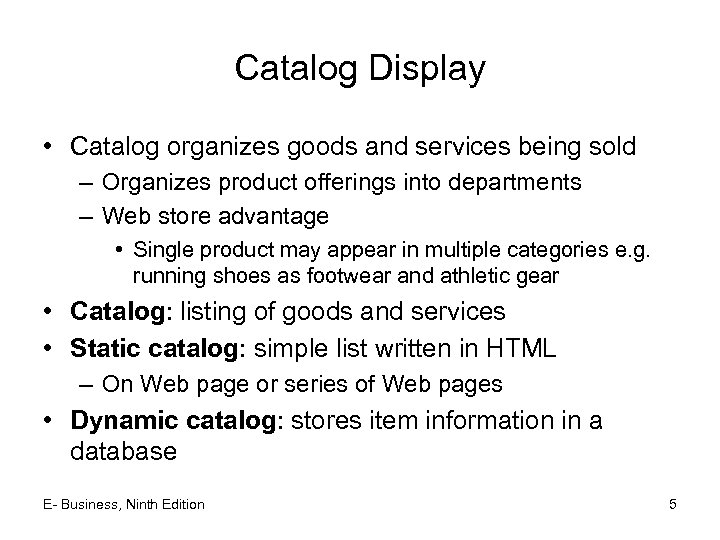
Catalog Display • Catalog organizes goods and services being sold – Organizes product offerings into departments – Web store advantage • Single product may appear in multiple categories e. g. running shoes as footwear and athletic gear • Catalog: listing of goods and services • Static catalog: simple list written in HTML – On Web page or series of Web pages • Dynamic catalog: stores item information in a database E- Business, Ninth Edition 5
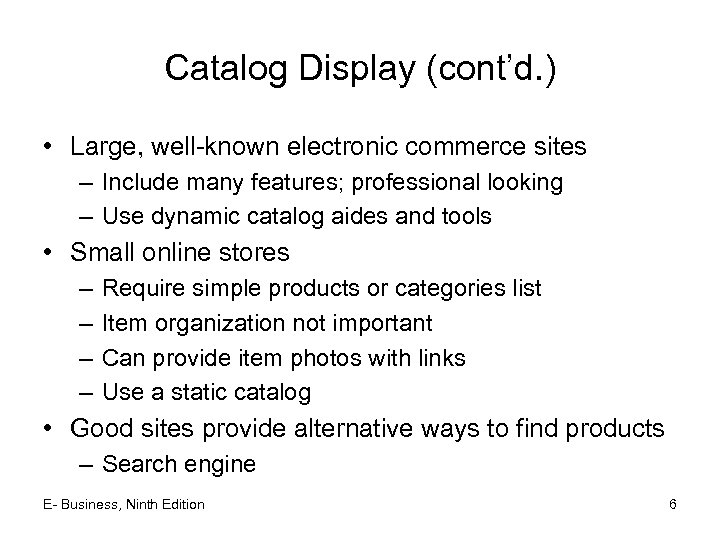
Catalog Display (cont’d. ) • Large, well-known electronic commerce sites – Include many features; professional looking – Use dynamic catalog aides and tools • Small online stores – – Require simple products or categories list Item organization not important Can provide item photos with links Use a static catalog • Good sites provide alternative ways to find products – Search engine E- Business, Ninth Edition 6
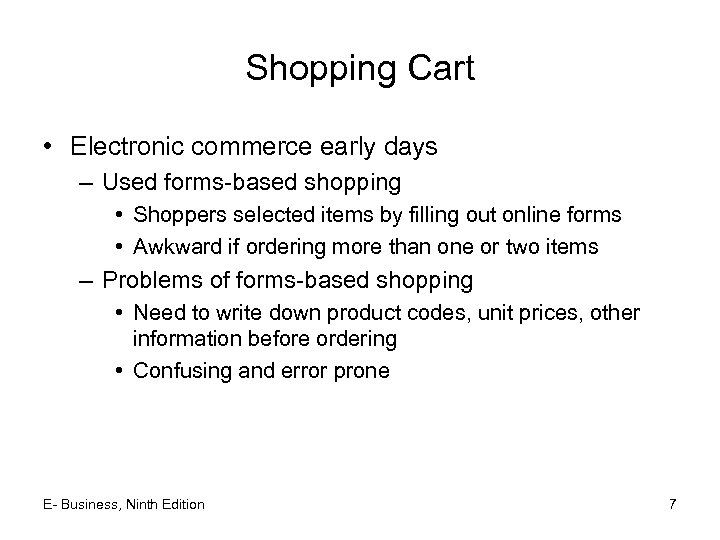
Shopping Cart • Electronic commerce early days – Used forms-based shopping • Shoppers selected items by filling out online forms • Awkward if ordering more than one or two items – Problems of forms-based shopping • Need to write down product codes, unit prices, other information before ordering • Confusing and error prone E- Business, Ninth Edition 7
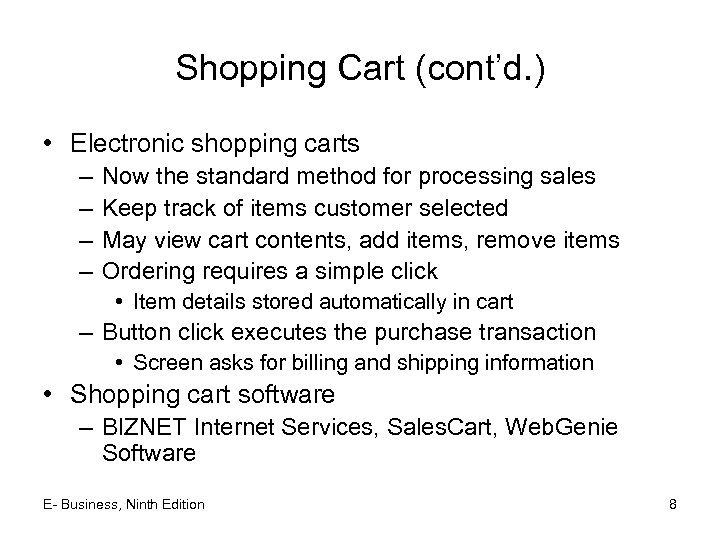
Shopping Cart (cont’d. ) • Electronic shopping carts – – Now the standard method for processing sales Keep track of items customer selected May view cart contents, add items, remove items Ordering requires a simple click • Item details stored automatically in cart – Button click executes the purchase transaction • Screen asks for billing and shipping information • Shopping cart software – BIZNET Internet Services, Sales. Cart, Web. Genie Software E- Business, Ninth Edition 8
Shopping Cart (cont’d. ) • Web: stateless system – Unable to remember anything from one transmission or session to another • To retrieve shopping cart information later: – Use cookies • Allows information to be stored explicitly • Allows unique user identification • If browser does not allow cookie storage: – Electronic commerce software automatically assigns temporary number – Example: Shop. Site E- Business, Ninth Edition 9
Transaction Processing • Transaction processing: occurs when shopper proceeds to virtual checkout counter – Click checkout button • Electronic commerce software performs necessary calculations • Web browser software and seller’s Web server software switch into secure communication state E- Business, Ninth Edition 10
Transaction Processing (cont’d. ) • Most companies use accounting software package – Records sales and inventory movements – Requires integration with accounting software • Web sites use software to update tax rates • Fed. Ex and UPS shipping rate software integrates with e-commerce software • Other calculations – Coupons, special promotions, time-sensitive offers E- Business, Ninth Edition 11
Databases • Database – Collection of information • Stored on a computer in a highly structured way • Business rules – How the company does business • Database management software – Makes it easy for users to: • Enter, edit, update, retrieve information in the database – Examples: Microsoft Access, IBM DB 2, Microsoft SQL Server, Oracle E- Business, Ninth Edition 12
Databases (cont’d. ) • Distributed information systems – Large information systems storing same data in many different physical locations • Distributed database systems – Databases within distributed information systems • Complexity leads to high cost • Complex DBMS can handle larger databases and can perform more functions at higher speeds – IBM DB 2 – Microsoft SQL Server – Oracle E- Business, Ninth Edition 13
Databases (cont’d. ) • Determine database support level – Provided by any electronic commerce software • Better to have one database serving two sales functions (online and in-store retail) – Eliminates errors occurring when running parallel but distinct databases • If inventory and product databases exist: – Only consider electronic commerce software supporting these systems E- Business, Ninth Edition 14
Middleware • Middleware software – Takes sales and inventory shipments information from electronic commerce software • Transmits to accounting and inventory management software • Companies can write own middleware • Companies can purchase customized middleware • The systematic tying together of different applications, often through the use of middleware, is known as enterprise application integration (EAI). • Interoperability – Making information systems work together 15 E- Business, Ninth Edition
Enterprise Application Integration • Application program (application software, application) – Program performing specific function e. g. creating invoices, processing payments etc. • Application server (computer) – Takes request messages received by Web server (that is hosting e-commerce Website) • Runs application program performing action based on request message’s contents • Actions determined by business logic • Business logic – Rules used in the business E- Business, Ninth Edition 16
Enterprise Application Integration (cont’d. ) • Application integration (enterprise application integration) – Creation of links among scattered applications – Interconnects organization’s business logic – Accomplished by programs transferring information: • From one application to another – Data formats in each application differs • Transfer program must edit and reformat data before transferring • Increasingly using XML data feeds E- Business, Ninth Edition 17
Enterprise Application Integration (cont’d. ) • Types of application servers – Page-based and component-based systems • Page-based application systems (like GMAIL, Facebook features on a single page) – Return pages generated by scripts containing rules • Present data on Web page with the business logic – Examples for page-based server systems • • Adobe Cold. Fusion Java. Server Pages (JSP) Microsoft Active Server Pages (ASP) Hypertext Preprocessor (PHP) E- Business, Ninth Edition 18
Enterprise Application Integration (cont’d. ) • Component-based application system (Checkout component, card-processing component) – Separates presentation logic from business logic – Preferred by larger businesses – Logic component created and maintained separately • Updating, changing system elements much easier – Common Web component-based systems • Enterprise Java. Beans (EJBs) • Microsoft Component Object Model (COM) • Common Object Request Broker Architecture (CORBA) E- Business, Ninth Edition 19
Integration with ERP Systems • Enterprise resource planning (ERP) software packages – Business systems integrating all facets of a business • Accounting, logistics, manufacturing, marketing, planning, project management, treasury functions • Two major ERP vendors: Oracle and SAP • ERP software installation costs – Between $2 million and $25 million E- Business, Ninth Edition 20
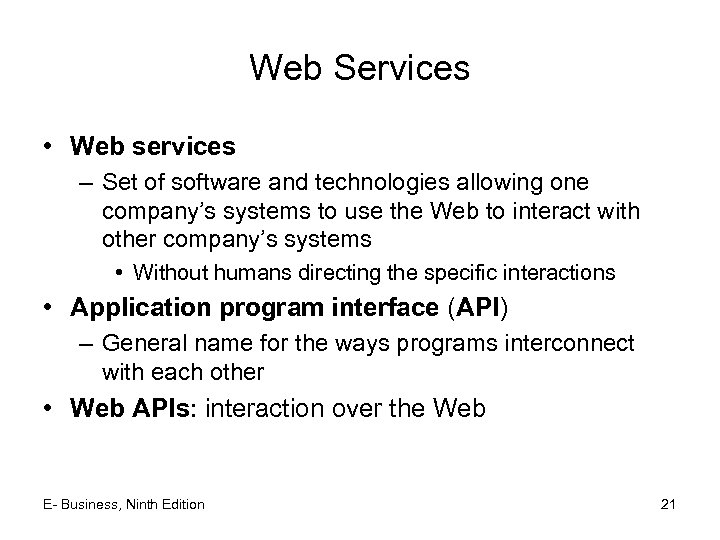
Web Services • Web services – Set of software and technologies allowing one company’s systems to use the Web to interact with other company’s systems • Without humans directing the specific interactions • Application program interface (API) – General name for the ways programs interconnect with each other • Web APIs: interaction over the Web E- Business, Ninth Edition 21
Скачать презентацию Chapter 9 Web Hosting and E-Business Software 1
525ae6a0767b5cb8820813833b31f4ce.ppt