


 Скачать презентацию Chapter 9 Valuing Stocks Chapter Outline 9
ede969c36fefe0a6a4d7b845e9648e6b.ppt
- Количество слайдов: 93
 Chapter 9 Valuing Stocks
 Chapter Outline 9. 1 The Dividend Discount Model 9. 2 Applying the Dividend Discount Model 9. 3 Total Payout and Free Cash Flow Valuation Models 9. 4 Valuation Based on Comparable Firms 9. 5 Information, Competition, and Stock Prices Copyright © 2014 Pearson Education, Inc. All rights reserved. 9 -2
 The Law of One Price • The Law of One Price implies that to value any security, we must determine the expected cash flows an investor will receive from owning it. • Thus, we begin our analysis of stock valuation by considering the cash flows for an investor with a one-year investment horizon. • We then consider the perspective of investors with longer investment horizons. • We show that if investors have the same beliefs, their valuation of the stock will not depend on their investment horizon. • Using this result, we then derive the first method to value a stock: the dividend-discount model. Copyright © 2014 Pearson Education, Inc. All rights reserved. 9 -3
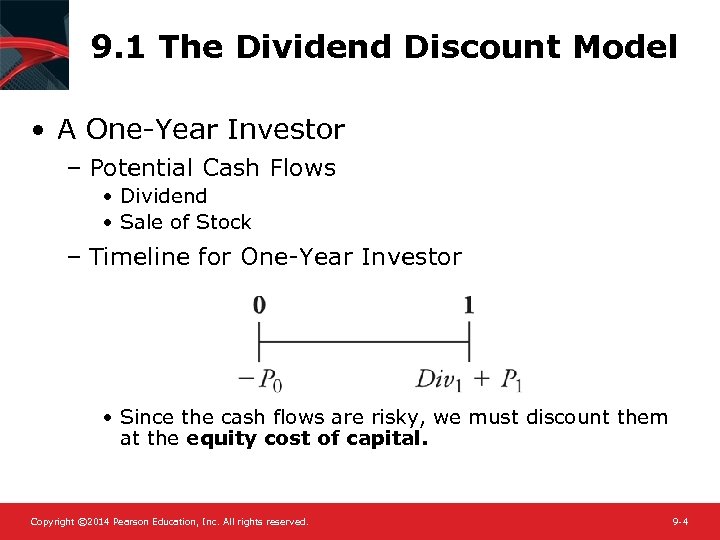 9. 1 The Dividend Discount Model • A One-Year Investor – Potential Cash Flows • Dividend • Sale of Stock – Timeline for One-Year Investor • Since the cash flows are risky, we must discount them at the equity cost of capital. Copyright © 2014 Pearson Education, Inc. All rights reserved. 9 -4
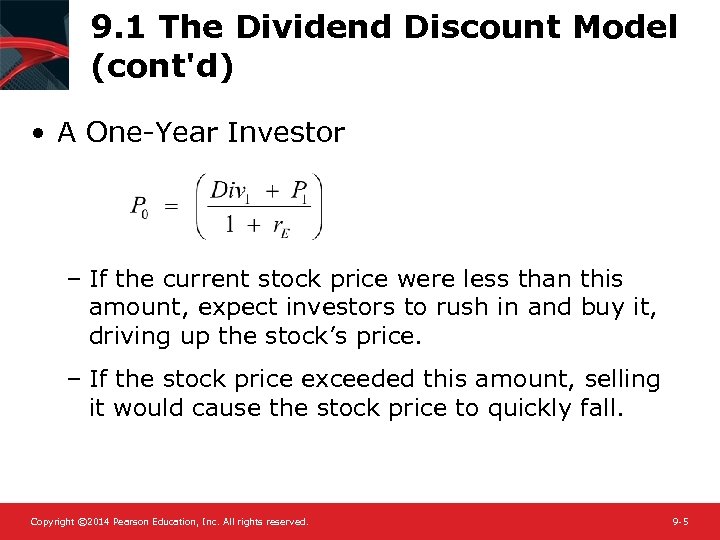 9. 1 The Dividend Discount Model (cont'd) • A One-Year Investor – If the current stock price were less than this amount, expect investors to rush in and buy it, driving up the stock’s price. – If the stock price exceeded this amount, selling it would cause the stock price to quickly fall. Copyright © 2014 Pearson Education, Inc. All rights reserved. 9 -5
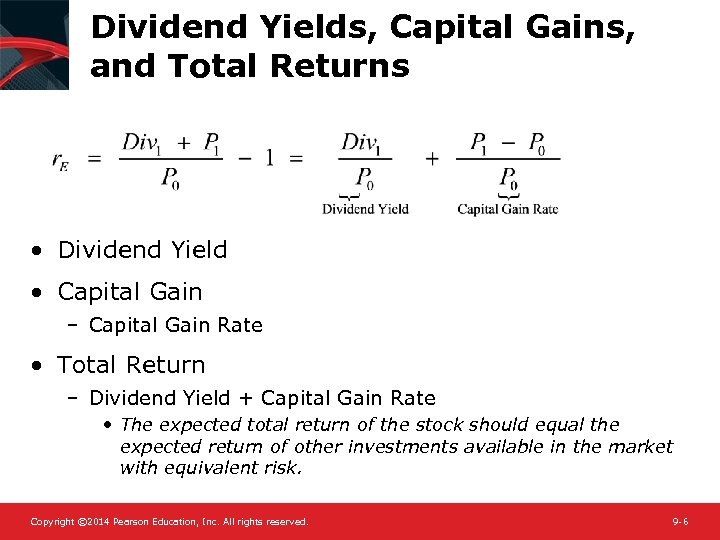 Dividend Yields, Capital Gains, and Total Returns • Dividend Yield • Capital Gain – Capital Gain Rate • Total Return – Dividend Yield + Capital Gain Rate • The expected total return of the stock should equal the expected return of other investments available in the market with equivalent risk. Copyright © 2014 Pearson Education, Inc. All rights reserved. 9 -6
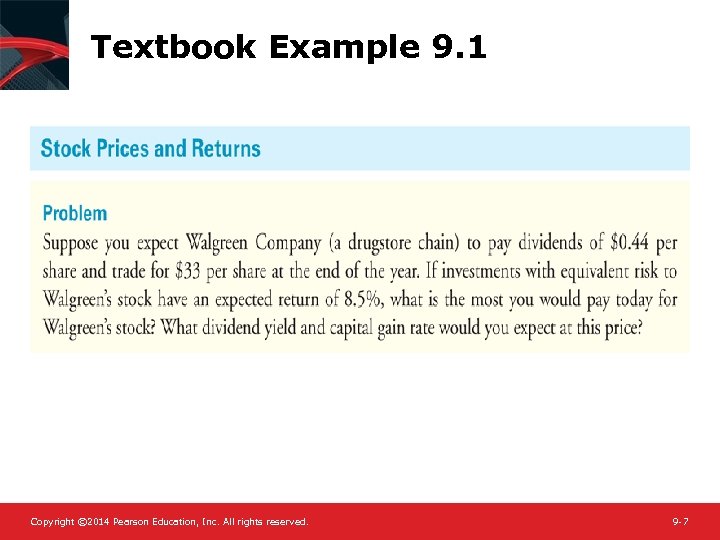 Textbook Example 9. 1 Copyright © 2014 Pearson Education, Inc. All rights reserved. 9 -7
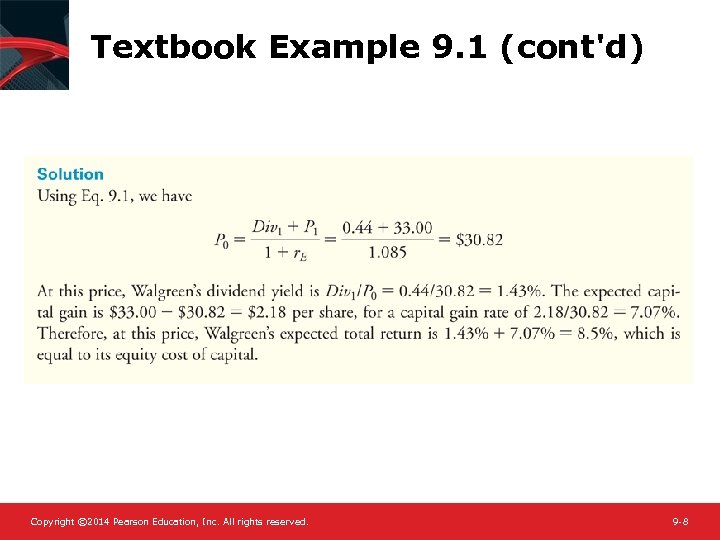 Textbook Example 9. 1 (cont'd) Copyright © 2014 Pearson Education, Inc. All rights reserved. 9 -8
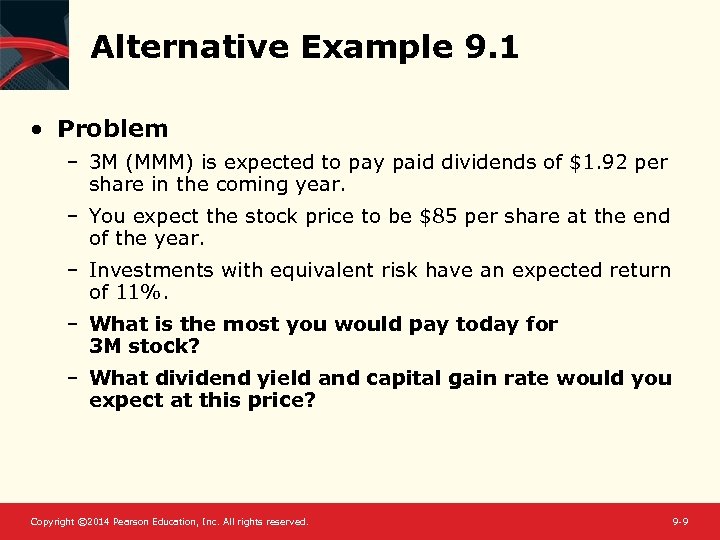 Alternative Example 9. 1 • Problem – 3 M (MMM) is expected to pay paid dividends of $1. 92 per share in the coming year. – You expect the stock price to be $85 per share at the end of the year. – Investments with equivalent risk have an expected return of 11%. – What is the most you would pay today for 3 M stock? – What dividend yield and capital gain rate would you expect at this price? Copyright © 2014 Pearson Education, Inc. All rights reserved. 9 -9
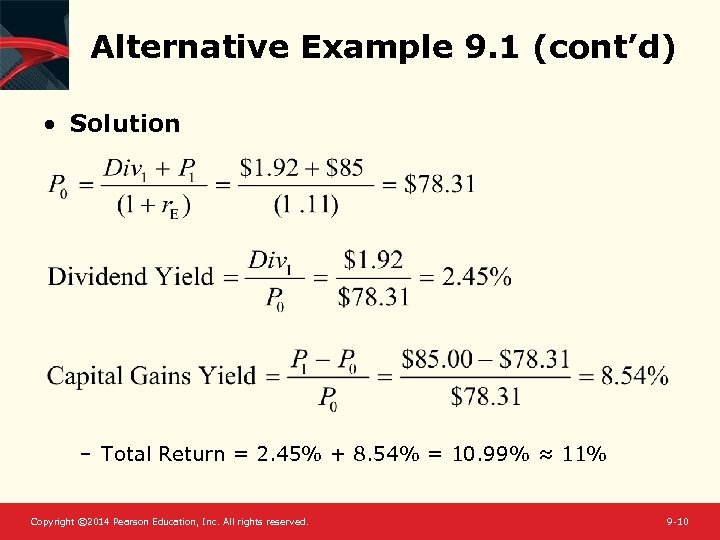 Alternative Example 9. 1 (cont’d) • Solution – Total Return = 2. 45% + 8. 54% = 10. 99% ≈ 11% Copyright © 2014 Pearson Education, Inc. All rights reserved. 9 -10
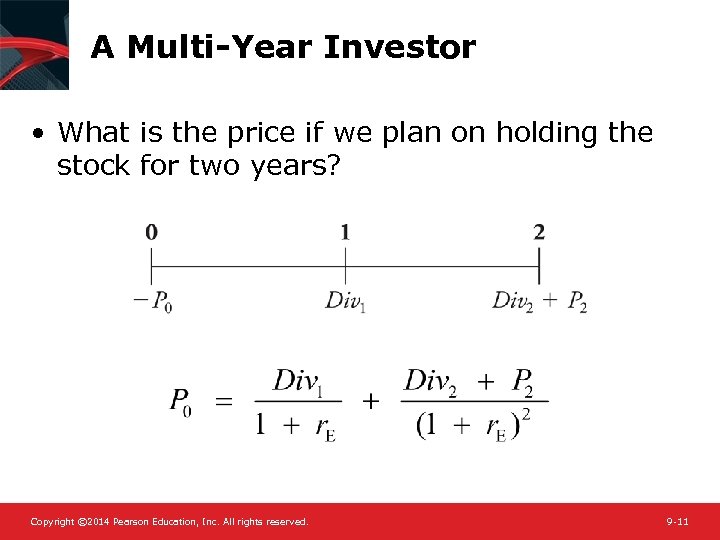 A Multi-Year Investor • What is the price if we plan on holding the stock for two years? Copyright © 2014 Pearson Education, Inc. All rights reserved. 9 -11
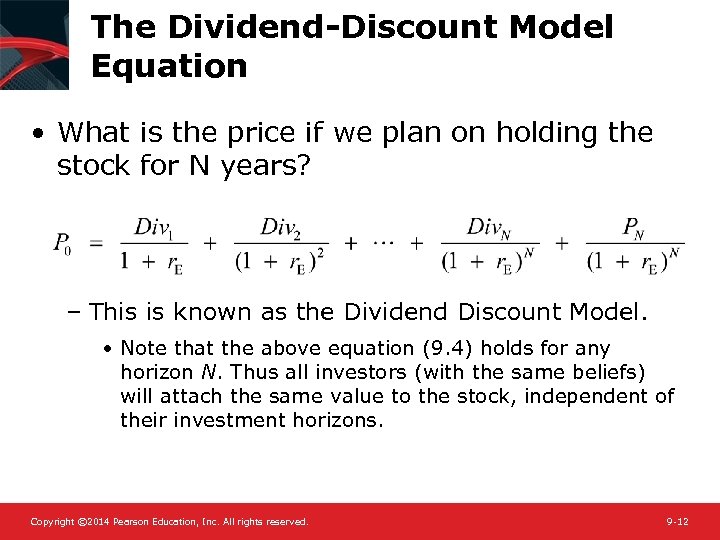 The Dividend-Discount Model Equation • What is the price if we plan on holding the stock for N years? – This is known as the Dividend Discount Model. • Note that the above equation (9. 4) holds for any horizon N. Thus all investors (with the same beliefs) will attach the same value to the stock, independent of their investment horizons. Copyright © 2014 Pearson Education, Inc. All rights reserved. 9 -12
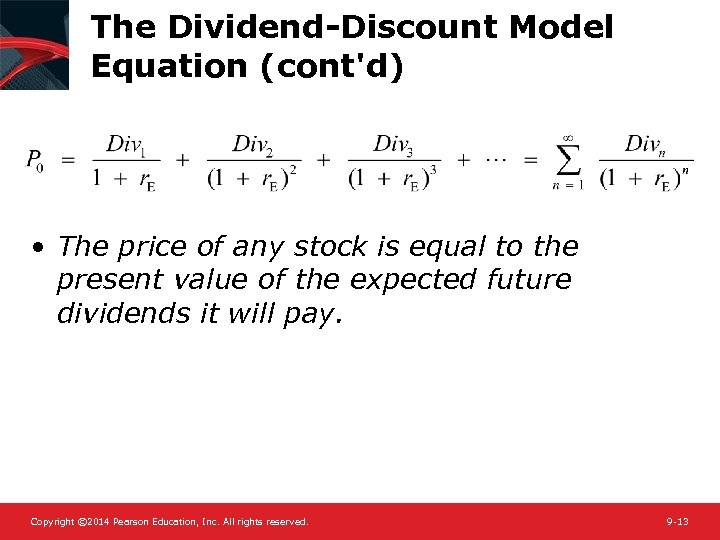 The Dividend-Discount Model Equation (cont'd) • The price of any stock is equal to the present value of the expected future dividends it will pay. Copyright © 2014 Pearson Education, Inc. All rights reserved. 9 -13
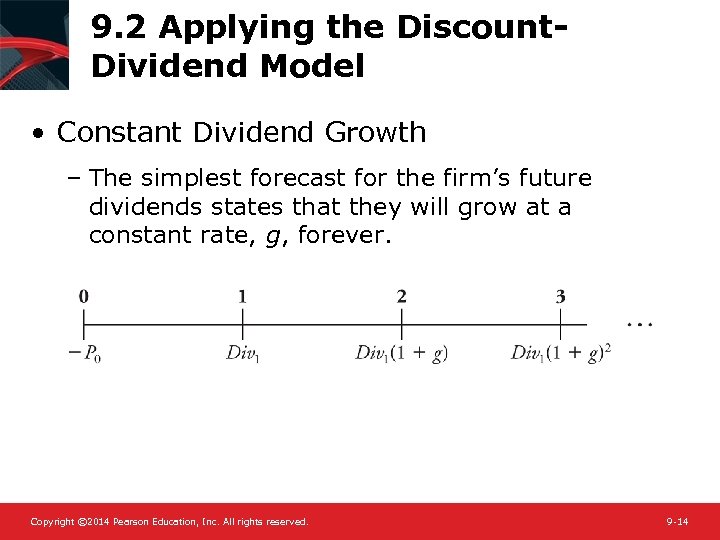 9. 2 Applying the Discount. Dividend Model • Constant Dividend Growth – The simplest forecast for the firm’s future dividends states that they will grow at a constant rate, g, forever. Copyright © 2014 Pearson Education, Inc. All rights reserved. 9 -14
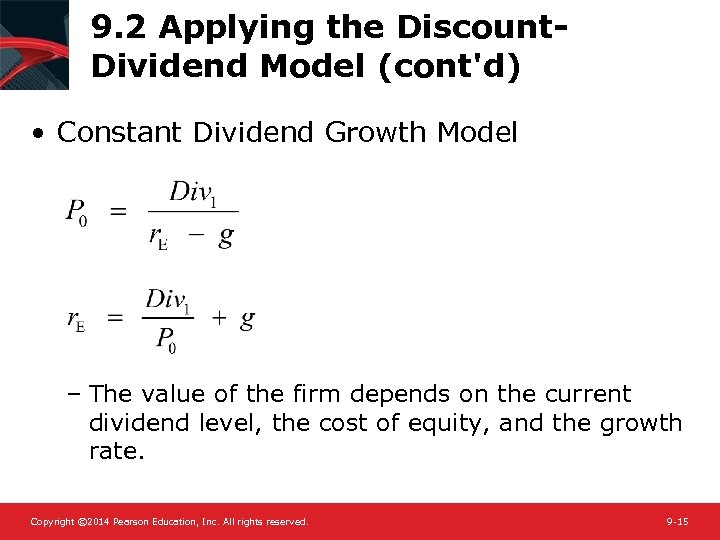 9. 2 Applying the Discount. Dividend Model (cont'd) • Constant Dividend Growth Model – The value of the firm depends on the current dividend level, the cost of equity, and the growth rate. Copyright © 2014 Pearson Education, Inc. All rights reserved. 9 -15
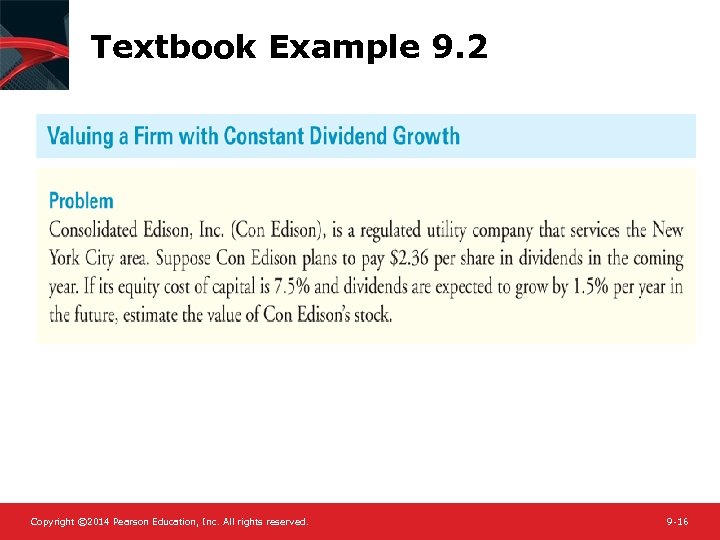 Textbook Example 9. 2 Copyright © 2014 Pearson Education, Inc. All rights reserved. 9 -16
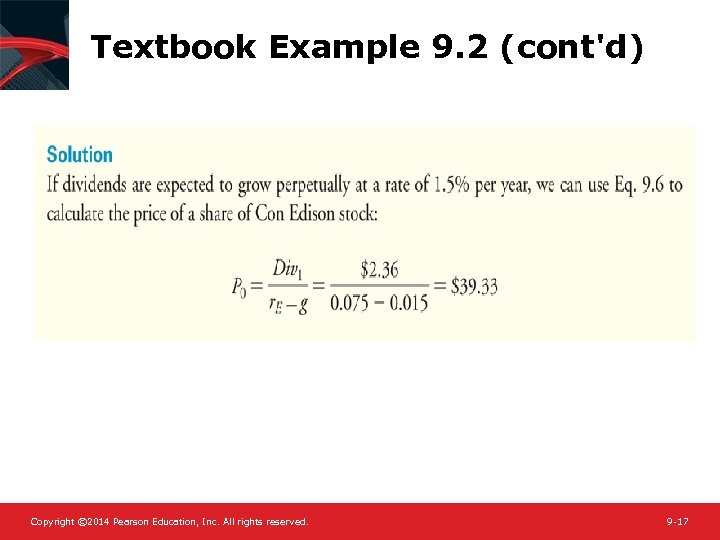 Textbook Example 9. 2 (cont'd) Copyright © 2014 Pearson Education, Inc. All rights reserved. 9 -17
 Alternative Example 9. 2 • Problem – AT&T plans to pay $1. 44 per share in dividends in the coming year. – Its equity cost of capital is 8%. – Dividends are expected to grow by 4% per year in the future. – Estimate the value of AT&T’s stock. Copyright © 2014 Pearson Education, Inc. All rights reserved. 9 -18
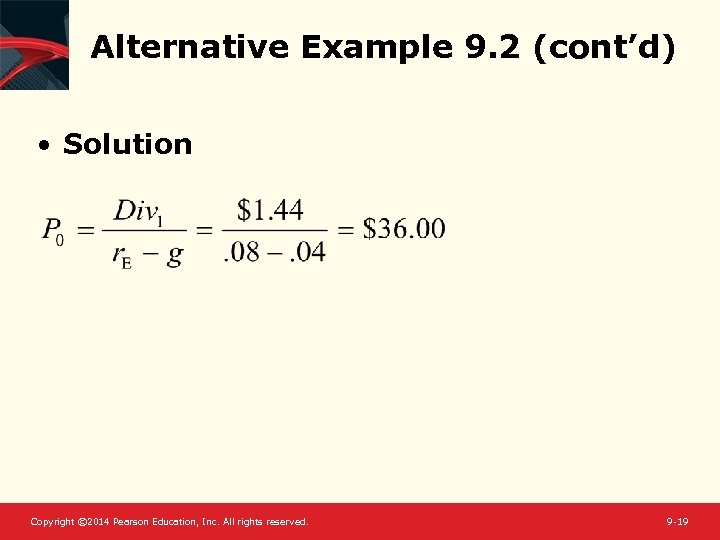 Alternative Example 9. 2 (cont’d) • Solution Copyright © 2014 Pearson Education, Inc. All rights reserved. 9 -19
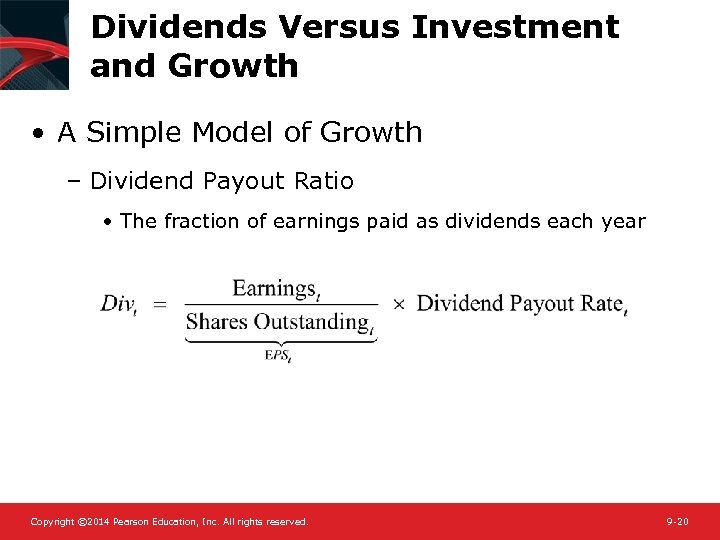 Dividends Versus Investment and Growth • A Simple Model of Growth – Dividend Payout Ratio • The fraction of earnings paid as dividends each year Copyright © 2014 Pearson Education, Inc. All rights reserved. 9 -20
 Dividends Versus Investment and Growth (cont'd) • A Simple Model of Growth – Assuming the number of shares outstanding is constant, the firm can do two things to increase its dividend: • Increase its earnings (net income) • Increase its dividend payout rate Copyright © 2014 Pearson Education, Inc. All rights reserved. 9 -21
 Dividends Versus Investment and Growth (cont'd) • A Simple Model of Growth – A firm can do one of two things with its earnings: • It can pay them out to investors. • It can retain and reinvest them. Copyright © 2014 Pearson Education, Inc. All rights reserved. 9 -22
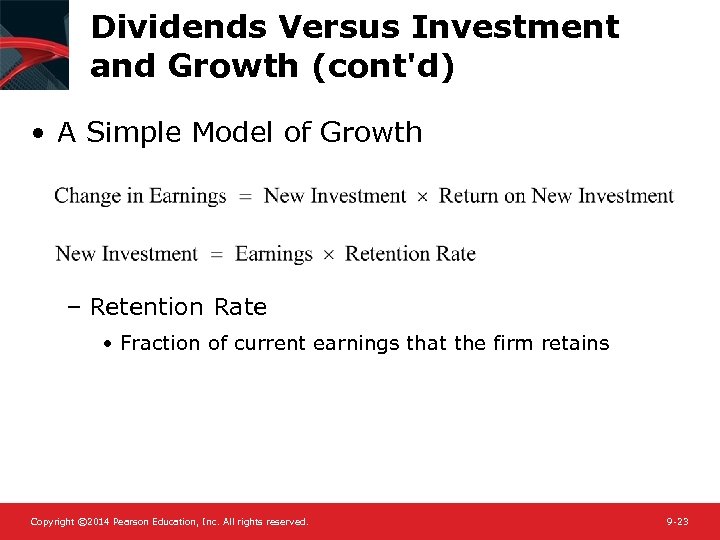 Dividends Versus Investment and Growth (cont'd) • A Simple Model of Growth – Retention Rate • Fraction of current earnings that the firm retains Copyright © 2014 Pearson Education, Inc. All rights reserved. 9 -23
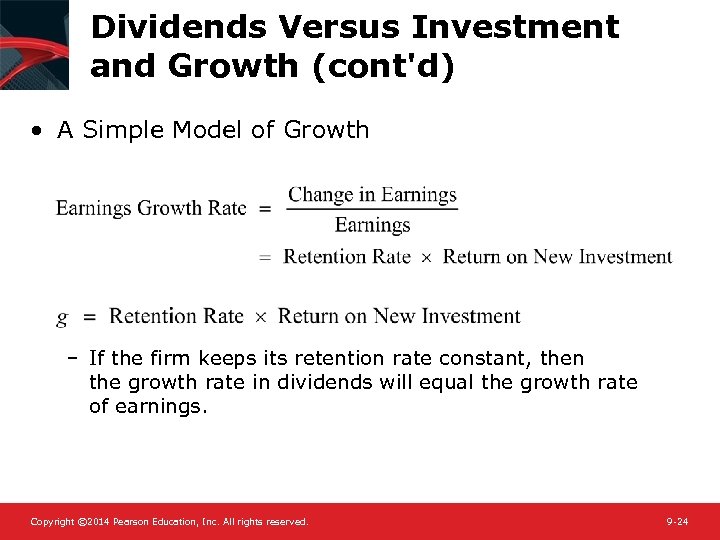 Dividends Versus Investment and Growth (cont'd) • A Simple Model of Growth – If the firm keeps its retention rate constant, then the growth rate in dividends will equal the growth rate of earnings. Copyright © 2014 Pearson Education, Inc. All rights reserved. 9 -24
 Dividends Versus Investment and Growth (cont'd) • Profitable Growth – If a firm wants to increase its share price, should it cut its dividend and invest more, or should it cut investment and increase its dividend? • The answer will depend on the profitability of the firm’s investments. – Cutting the firm’s dividend to increase investment will raise the stock price if, and only if, the new investments have a positive NPV. Copyright © 2014 Pearson Education, Inc. All rights reserved. 9 -25
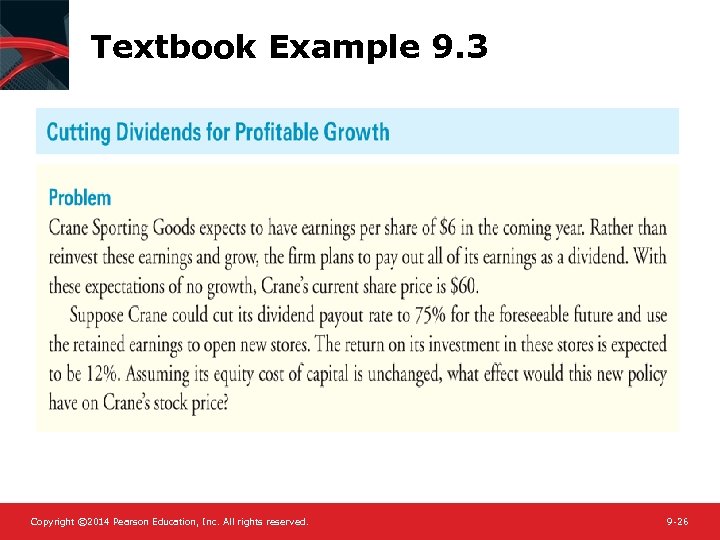 Textbook Example 9. 3 Copyright © 2014 Pearson Education, Inc. All rights reserved. 9 -26
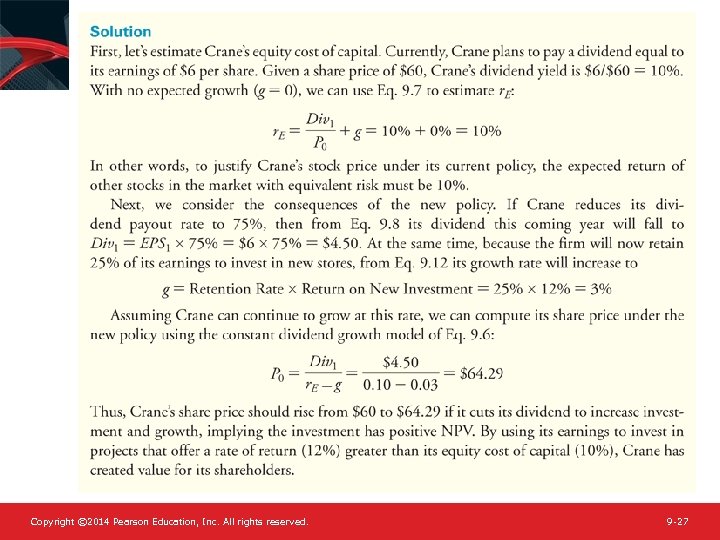 Copyright © 2014 Pearson Education, Inc. All rights reserved. 9 -27
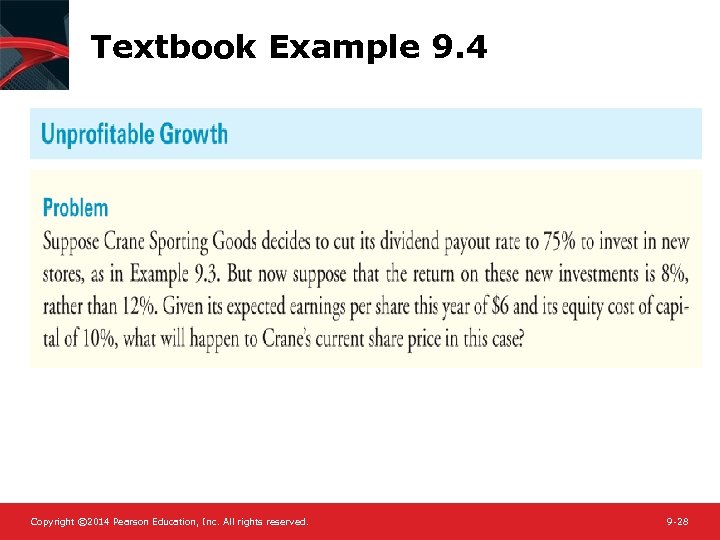 Textbook Example 9. 4 Copyright © 2014 Pearson Education, Inc. All rights reserved. 9 -28
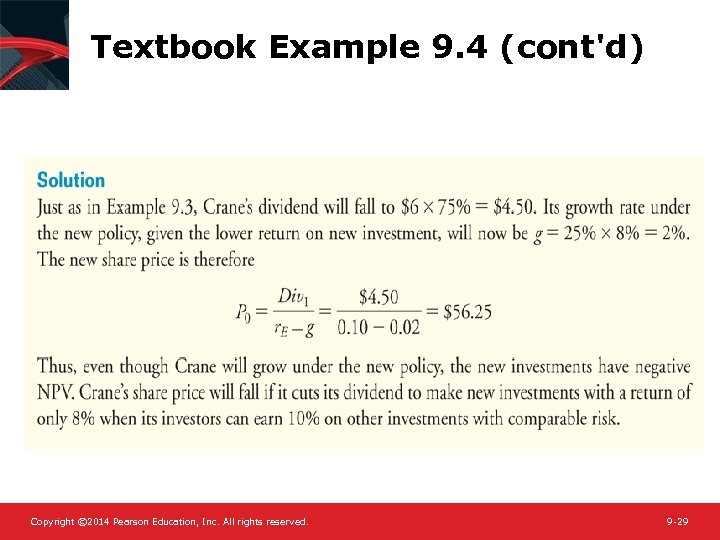 Textbook Example 9. 4 (cont'd) Copyright © 2014 Pearson Education, Inc. All rights reserved. 9 -29
 Alternative Example 9. 4 • Problem – Dren Industries is considering expanding into a new product line. – Earnings per share expected to be $5 in the coming year and are expected to grow annually at 5% without the new product line but growth would increase to 7% if the new product line is introduced. – To finance the expansion, Dren would need to cut its dividend payout ratio from 80% to 50%. – If Dren’s equity cost of capital is 11%, what would be the impact on Dren’s stock price if they introduce the new product line? – Assume the equity cost of capital will remain unchanged. Copyright © 2014 Pearson Education, Inc. All rights reserved. 9 -30
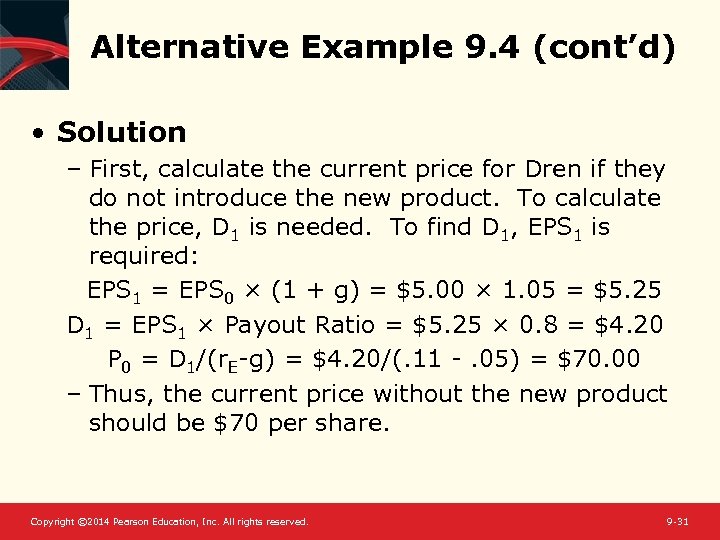 Alternative Example 9. 4 (cont’d) • Solution – First, calculate the current price for Dren if they do not introduce the new product. To calculate the price, D 1 is needed. To find D 1, EPS 1 is required: EPS 1 = EPS 0 × (1 + g) = $5. 00 × 1. 05 = $5. 25 D 1 = EPS 1 × Payout Ratio = $5. 25 × 0. 8 = $4. 20 P 0 = D 1/(r. E-g) = $4. 20/(. 11 -. 05) = $70. 00 – Thus, the current price without the new product should be $70 per share. Copyright © 2014 Pearson Education, Inc. All rights reserved. 9 -31
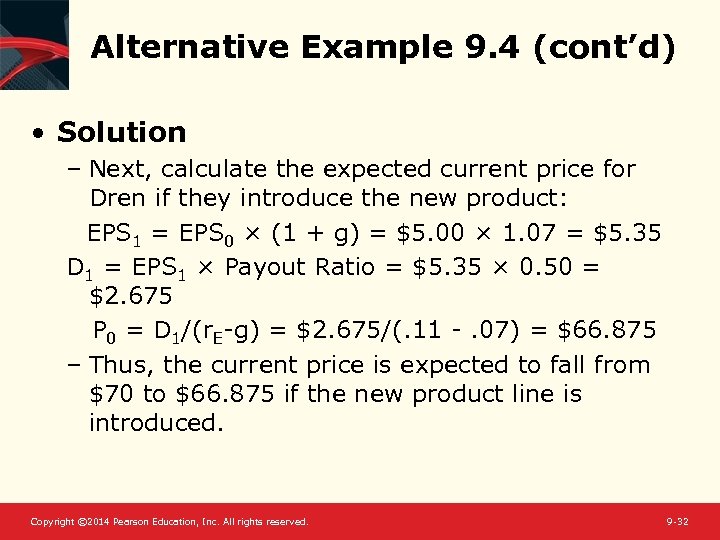 Alternative Example 9. 4 (cont’d) • Solution – Next, calculate the expected current price for Dren if they introduce the new product: EPS 1 = EPS 0 × (1 + g) = $5. 00 × 1. 07 = $5. 35 D 1 = EPS 1 × Payout Ratio = $5. 35 × 0. 50 = $2. 675 P 0 = D 1/(r. E-g) = $2. 675/(. 11 -. 07) = $66. 875 – Thus, the current price is expected to fall from $70 to $66. 875 if the new product line is introduced. Copyright © 2014 Pearson Education, Inc. All rights reserved. 9 -32
 Changing Growth Rates • We cannot use the constant dividend growth model to value a stock if the growth rate is not constant. – For example, young firms often have very high initial earnings growth rates. – During this period of high growth, these firms often retain 100% of their earnings to exploit profitable investment opportunities. – As they mature, their growth slows. – At some point, their earnings exceed their investment needs and they begin to pay dividends. Copyright © 2014 Pearson Education, Inc. All rights reserved. 9 -33
 Changing Growth Rates (cont'd) • Although we cannot use the constant dividend growth model directly when growth is not constant, → we can use the general form of the model to value a firm by applying the constant growth model to calculate the future share price of the stock once the expected growth rate stabilizes. Copyright © 2014 Pearson Education, Inc. All rights reserved. 9 -34
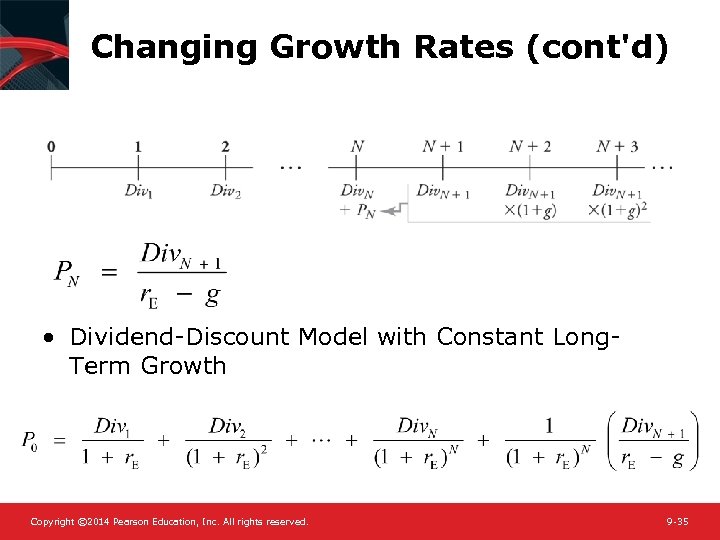 Changing Growth Rates (cont'd) • Dividend-Discount Model with Constant Long. Term Growth Copyright © 2014 Pearson Education, Inc. All rights reserved. 9 -35
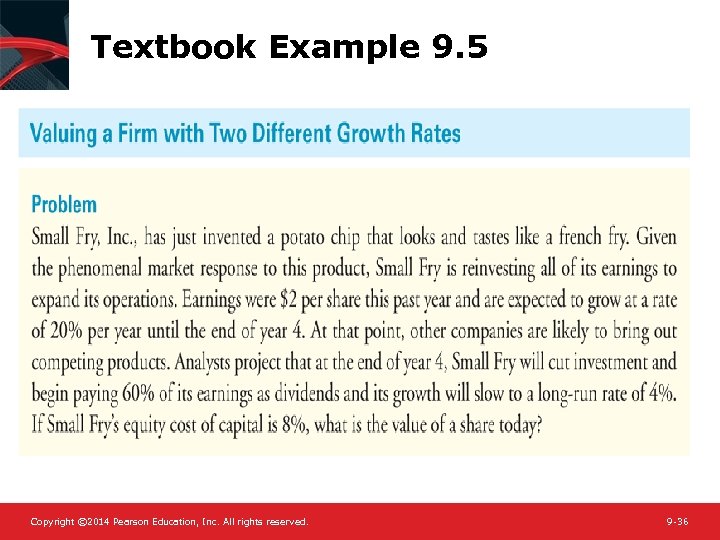 Textbook Example 9. 5 Copyright © 2014 Pearson Education, Inc. All rights reserved. 9 -36
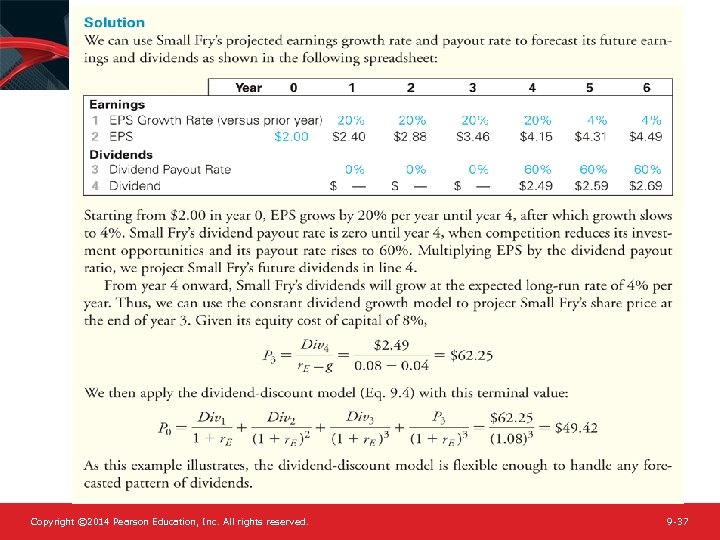 Copyright © 2014 Pearson Education, Inc. All rights reserved. 9 -37
 Limitations of the Dividend-Discount Model • There is a tremendous amount of uncertainty associated with forecasting a firm’s dividend growth rate and future dividends. • Small changes in the assumed dividend growth rate can lead to large changes in the estimated stock price. Copyright © 2014 Pearson Education, Inc. All rights reserved. 9 -38
 9. 3 Total Payout and Free Cash Flow Valuation Models • Share Repurchases and the Total Payout Model – Share Repurchase • When the firm uses excess cash to buy back its own stock – Implications for the Dividend-Discount Model • The more cash the firm uses to repurchase shares, the less it has available to pay dividends. • By repurchasing, the firm decreases the number of shares outstanding, which increases its earnings per and dividends per share. Copyright © 2014 Pearson Education, Inc. All rights reserved. 9 -39
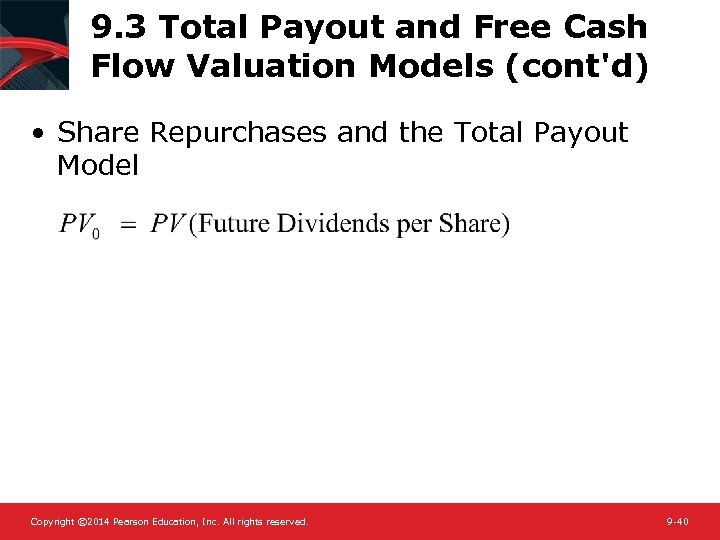 9. 3 Total Payout and Free Cash Flow Valuation Models (cont'd) • Share Repurchases and the Total Payout Model Copyright © 2014 Pearson Education, Inc. All rights reserved. 9 -40
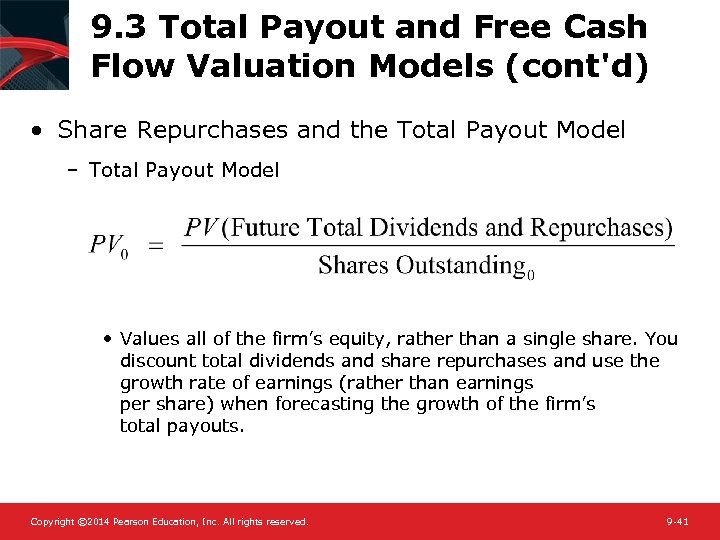 9. 3 Total Payout and Free Cash Flow Valuation Models (cont'd) • Share Repurchases and the Total Payout Model – Total Payout Model • Values all of the firm’s equity, rather than a single share. You discount total dividends and share repurchases and use the growth rate of earnings (rather than earnings per share) when forecasting the growth of the firm’s total payouts. Copyright © 2014 Pearson Education, Inc. All rights reserved. 9 -41
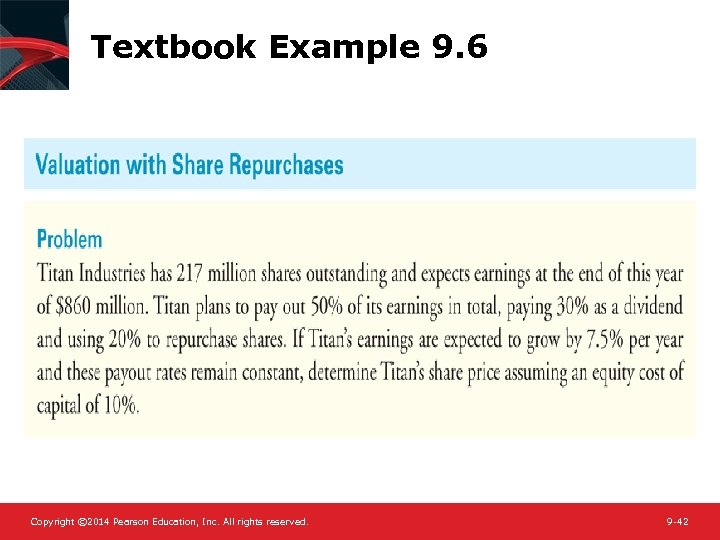 Textbook Example 9. 6 Copyright © 2014 Pearson Education, Inc. All rights reserved. 9 -42
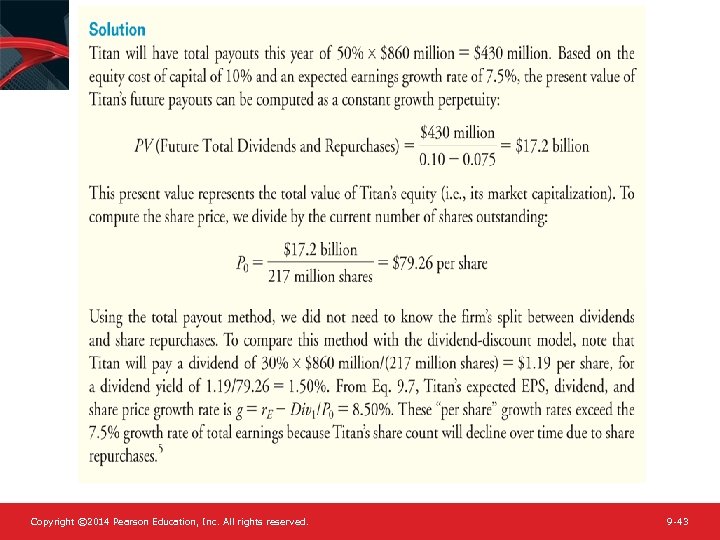 Copyright © 2014 Pearson Education, Inc. All rights reserved. 9 -43
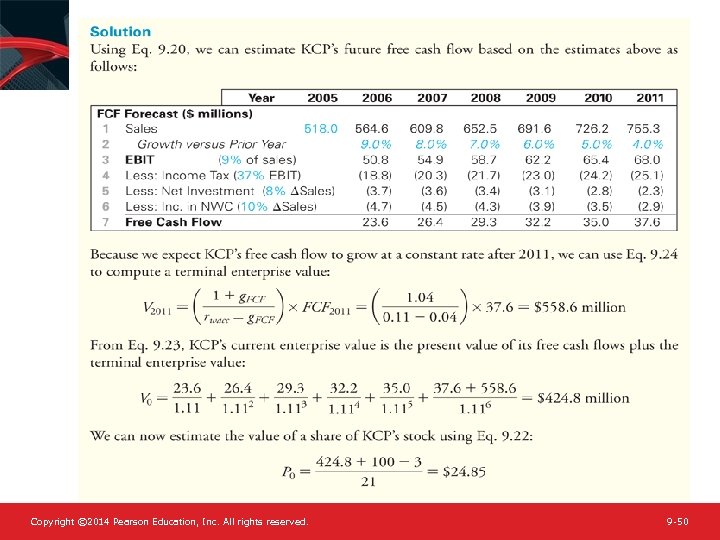
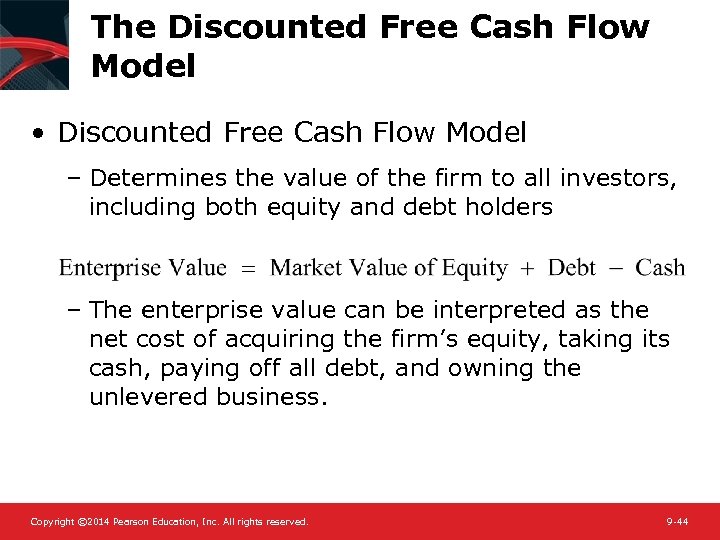 The Discounted Free Cash Flow Model • Discounted Free Cash Flow Model – Determines the value of the firm to all investors, including both equity and debt holders – The enterprise value can be interpreted as the net cost of acquiring the firm’s equity, taking its cash, paying off all debt, and owning the unlevered business. Copyright © 2014 Pearson Education, Inc. All rights reserved. 9 -44
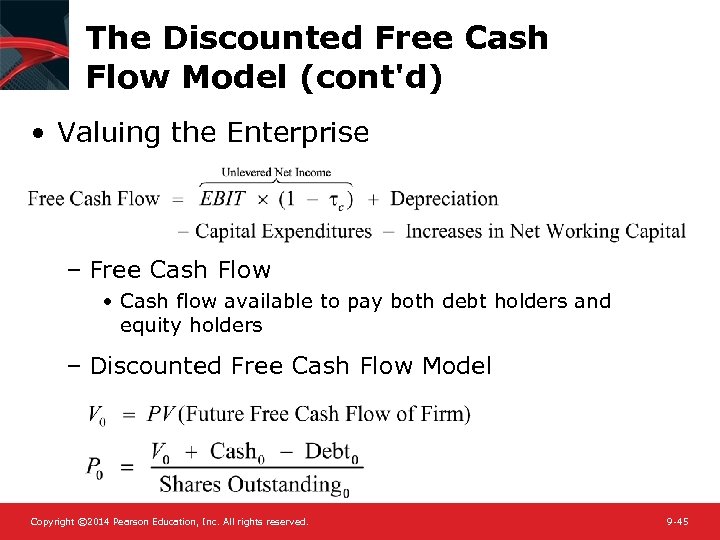 The Discounted Free Cash Flow Model (cont'd) • Valuing the Enterprise – Free Cash Flow • Cash flow available to pay both debt holders and equity holders – Discounted Free Cash Flow Model Copyright © 2014 Pearson Education, Inc. All rights reserved. 9 -45
 The Discounted Free Cash Flow Model (cont'd) • A key difference between the discounted free cash flow model and the earlier models we have considered is the discount rate. • In previous calculations we used the firm’s equity cost of capital, r. E, because we were discounting the cash flows to equity holders. • Here we are discounting the free cash flow that will be paid to both debt and equity holders. • Thus, we should use the firm’s weighted average cost of capital (WACC), denoted by rwacc, which is the average cost of capital the firm must pay to all of its investors, both debt and equity holders. Copyright © 2014 Pearson Education, Inc. All rights reserved. 9 -46
 The Discounted Free Cash Flow Model (cont'd) • Implementing the Model – Since we are discounting cash flows to both equity holders and debt holders, the free cash flows should be discounted at the firm’s weighted average cost of capital, rwacc. – If the firm has no debt, rwacc = r. E. Copyright © 2014 Pearson Education, Inc. All rights reserved. 9 -47
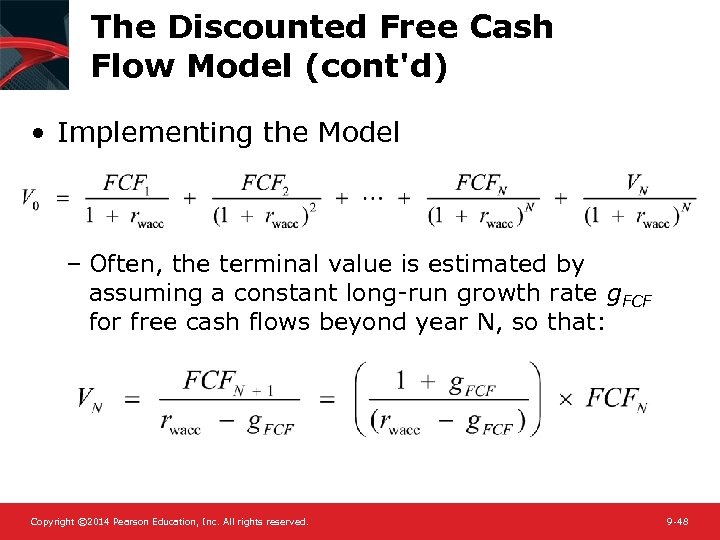 The Discounted Free Cash Flow Model (cont'd) • Implementing the Model – Often, the terminal value is estimated by assuming a constant long-run growth rate g. FCF for free cash flows beyond year N, so that: Copyright © 2014 Pearson Education, Inc. All rights reserved. 9 -48
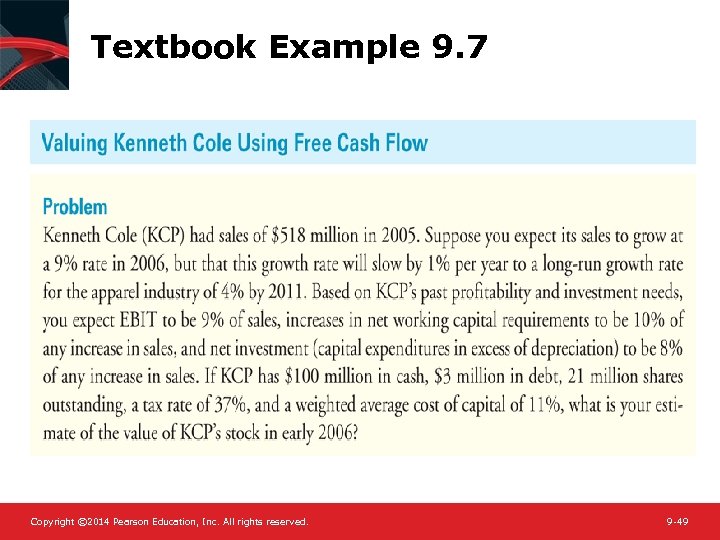 Textbook Example 9. 7 Copyright © 2014 Pearson Education, Inc. All rights reserved. 9 -49
 Copyright © 2014 Pearson Education, Inc. All rights reserved. 9 -50
 The Discounted Free Cash Flow Model (cont'd) • Connection to Capital Budgeting – The firm’s free cash flow is equal to the sum of the free cash flows from the firm’s current and future investments, so we can interpret the firm’s enterprise value as the total NPV that the firm will earn from continuing its existing projects and initiating new ones. • The NPV of any individual project represents its contribution to the firm’s enterprise value. To maximize the firm’s share price, we should accept projects that have a positive NPV. Copyright © 2014 Pearson Education, Inc. All rights reserved. 9 -51
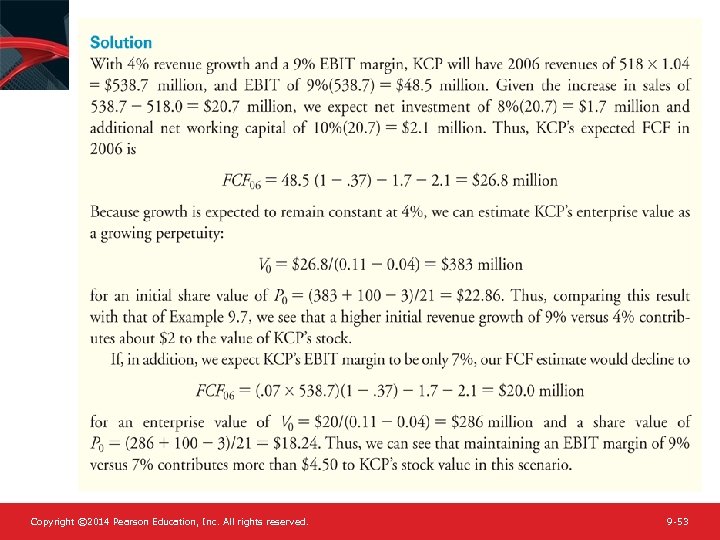
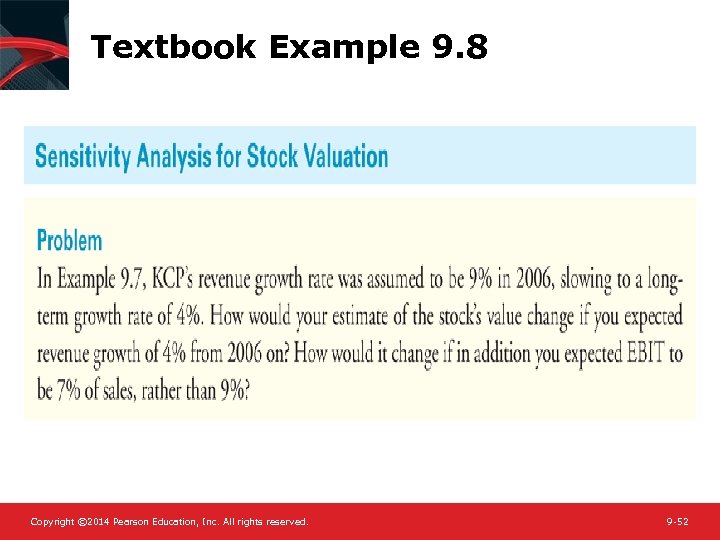 Textbook Example 9. 8 Copyright © 2014 Pearson Education, Inc. All rights reserved. 9 -52
 Copyright © 2014 Pearson Education, Inc. All rights reserved. 9 -53
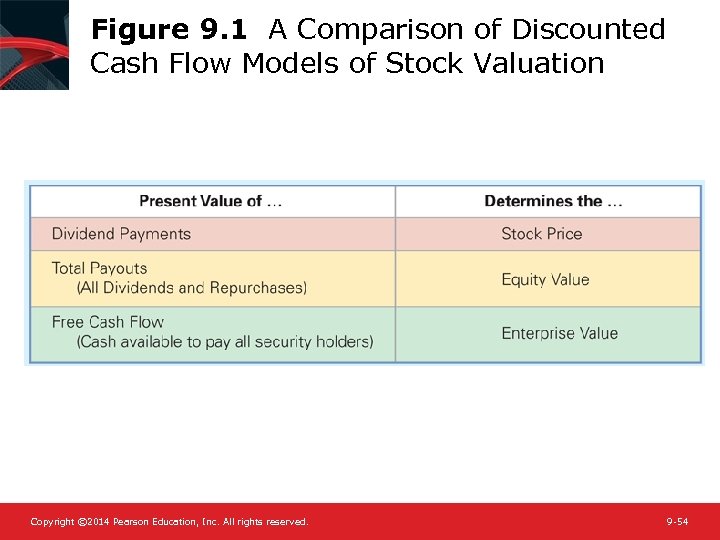 Figure 9. 1 A Comparison of Discounted Cash Flow Models of Stock Valuation Copyright © 2014 Pearson Education, Inc. All rights reserved. 9 -54
 9. 4 Valuation Based on Comparable Firms • Method of Comparables (Comps) – Estimate the value of the firm based on the value of other, comparable firms or investments that we expect will generate very similar cash flows in the future. Copyright © 2014 Pearson Education, Inc. All rights reserved. 9 -55
 9. 4 Valuation Based on Comparable Firms • Another application of the Law of One Price is the method of comparables. • In the method of comparables (or “comps”), rather than value the firm’s cash flows directly, we estimate the value of the firm based on the value of other, comparable firms or investments that we expect will generate very similar cash flows in the future. • For example, consider the case of a new firm that is identical to an existing publicly traded company. • If these firms will generate identical cash flows, the Law of One Price implies that we can use the value of the existing company to determine the value of the new firm. Copyright © 2014 Pearson Education, Inc. All rights reserved. 9 -56
 Valuation Multiples • Valuation Multiple – A ratio of firm’s value to some measure of the firm’s scale or cash flow • The Price-Earnings Ratio – P/E Ratio • Share price divided by earnings per share Copyright © 2014 Pearson Education, Inc. All rights reserved. 9 -57
 Valuation Multiples (cont'd) • Trailing Earnings – Earnings over the last 12 months • Trailing P/E • Forward Earnings – Expected earnings over the next 12 months • Forward P/E Copyright © 2014 Pearson Education, Inc. All rights reserved. 9 -58
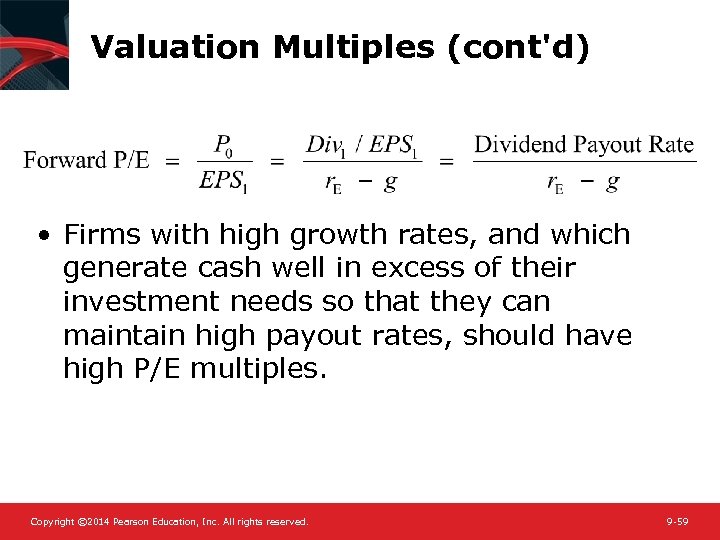 Valuation Multiples (cont'd) • Firms with high growth rates, and which generate cash well in excess of their investment needs so that they can maintain high payout rates, should have high P/E multiples. Copyright © 2014 Pearson Education, Inc. All rights reserved. 9 -59
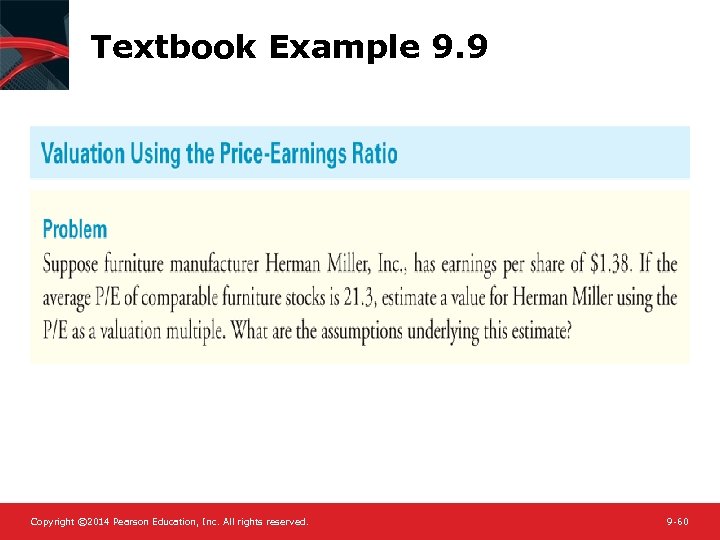 Textbook Example 9. 9 Copyright © 2014 Pearson Education, Inc. All rights reserved. 9 -60
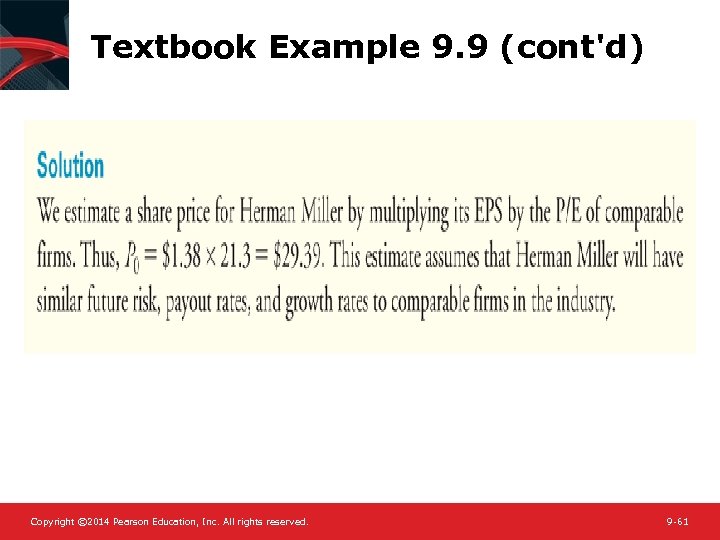 Textbook Example 9. 9 (cont'd) Copyright © 2014 Pearson Education, Inc. All rights reserved. 9 -61
 Alternative Example 9. 9 • Problem – Best Buy Co. Inc. (BBY) has earnings per share of $2. 22. – The average P/E of comparable companies’ stocks is 19. 7. – Estimate a value for Best Buy using the P/E as a valuation multiple. Copyright © 2014 Pearson Education, Inc. All rights reserved. 9 -62
 Alternative Example 9. 9 (cont’d) • Solution – The share price for Best Buy is estimated by multiplying its earnings per share by the P/E of comparable firms. – P 0 = $2. 22 × 19. 7 = $43. 73 Copyright © 2014 Pearson Education, Inc. All rights reserved. 9 -63
 Valuation Multiples (cont'd) • It is also common practice to use valuation multiples based on the firm’s enterprise value. • As we discussed earlier, because it represents the total value of the firm’s underlying business rather than just the value of equity, using the enterprise value is advantageous if we want to compare firms with different amounts of leverage. • Because the enterprise value represents the entire value of the firm before the firm pays its debt, to form an appropriate multiple, we divide it by a measure of earnings or cash flows before interest payments are made. • Common multiples to consider are enterprise value to EBIT, EBITDA (earnings before interest, taxes, depreciation, and amortization), and free cash flow. Copyright © 2014 Pearson Education, Inc. All rights reserved. 9 -64
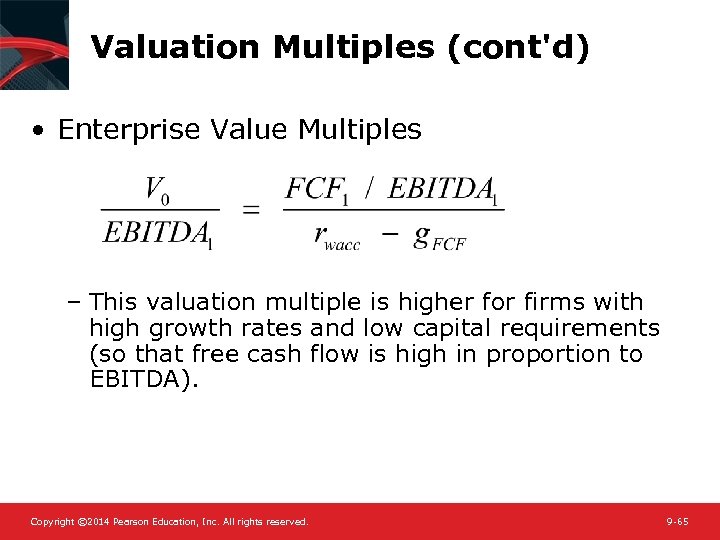 Valuation Multiples (cont'd) • Enterprise Value Multiples – This valuation multiple is higher for firms with high growth rates and low capital requirements (so that free cash flow is high in proportion to EBITDA). Copyright © 2014 Pearson Education, Inc. All rights reserved. 9 -65
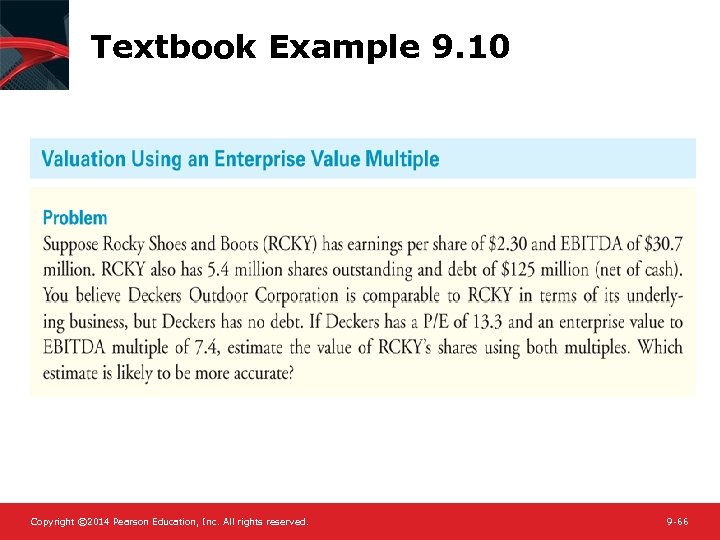 Textbook Example 9. 10 Copyright © 2014 Pearson Education, Inc. All rights reserved. 9 -66
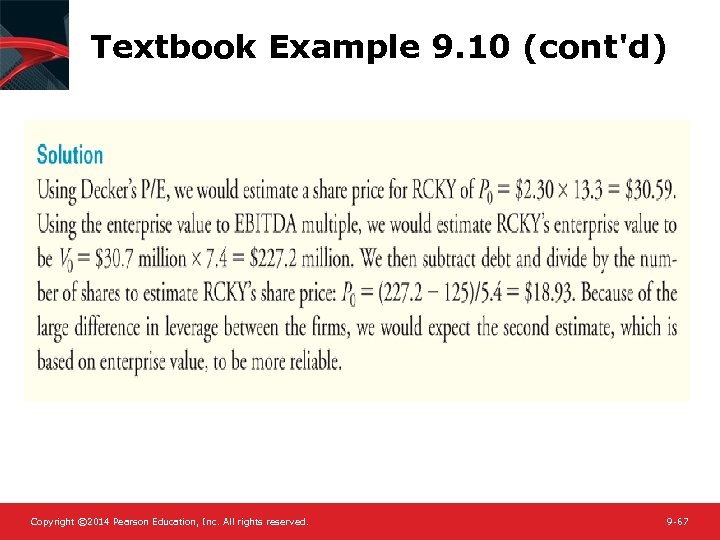 Textbook Example 9. 10 (cont'd) Copyright © 2014 Pearson Education, Inc. All rights reserved. 9 -67
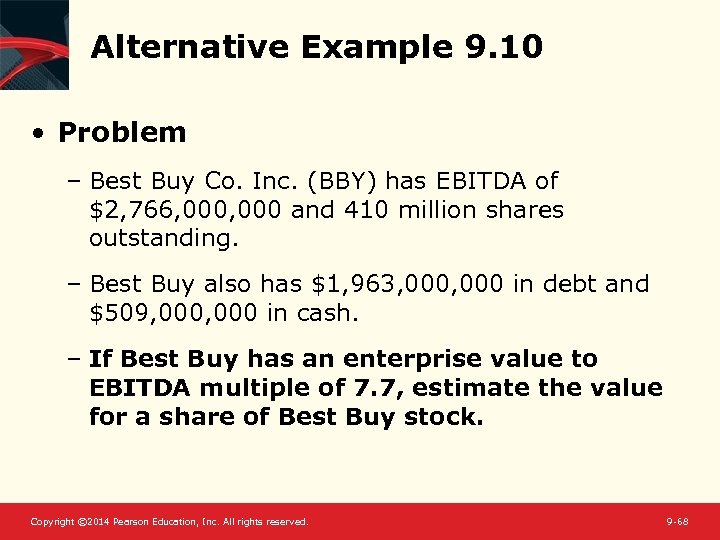 Alternative Example 9. 10 • Problem – Best Buy Co. Inc. (BBY) has EBITDA of $2, 766, 000 and 410 million shares outstanding. – Best Buy also has $1, 963, 000 in debt and $509, 000 in cash. – If Best Buy has an enterprise value to EBITDA multiple of 7. 7, estimate the value for a share of Best Buy stock. Copyright © 2014 Pearson Education, Inc. All rights reserved. 9 -68
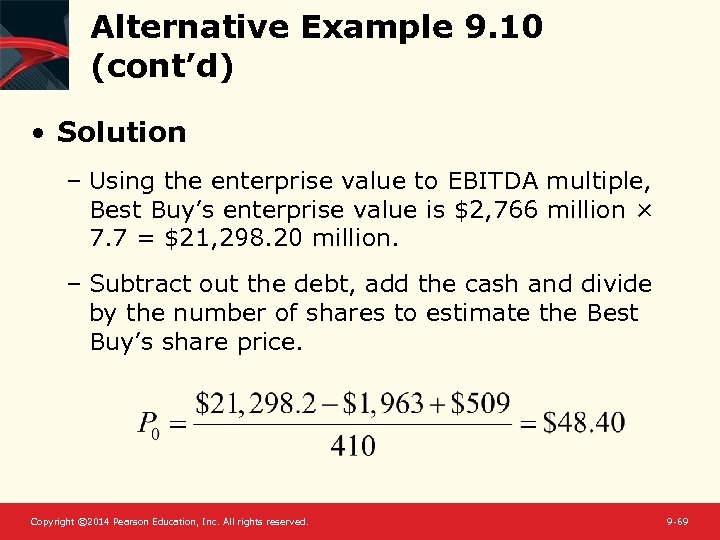 Alternative Example 9. 10 (cont’d) • Solution – Using the enterprise value to EBITDA multiple, Best Buy’s enterprise value is $2, 766 million × 7. 7 = $21, 298. 20 million. – Subtract out the debt, add the cash and divide by the number of shares to estimate the Best Buy’s share price. Copyright © 2014 Pearson Education, Inc. All rights reserved. 9 -69
 Valuation Multiples (cont'd) • Other Multiples – Multiple of sales – Price to book value of equity per share – Enterprise value per subscriber • Used in cable TV industry Copyright © 2014 Pearson Education, Inc. All rights reserved. 9 -70
 Limitations of Multiples • When valuing a firm using multiples, there is no clear guidance about how to adjust for differences in expected future growth rates, risk, or differences in accounting policies. • Comparables only provide information regarding the value of a firm relative to other firms in the comparison set. – Using multiples will not help us determine if an entire industry is overvalued, Copyright © 2014 Pearson Education, Inc. All rights reserved. 9 -71
 Comparison with Discounted Cash Flow Methods • Discounted cash flows methods have the advantage that they can incorporate specific information about the firm’s cost of capital or future growth. – The discounted cash flow methods have the potential to be more accurate than the use of a valuation multiple. Copyright © 2014 Pearson Education, Inc. All rights reserved. 9 -72
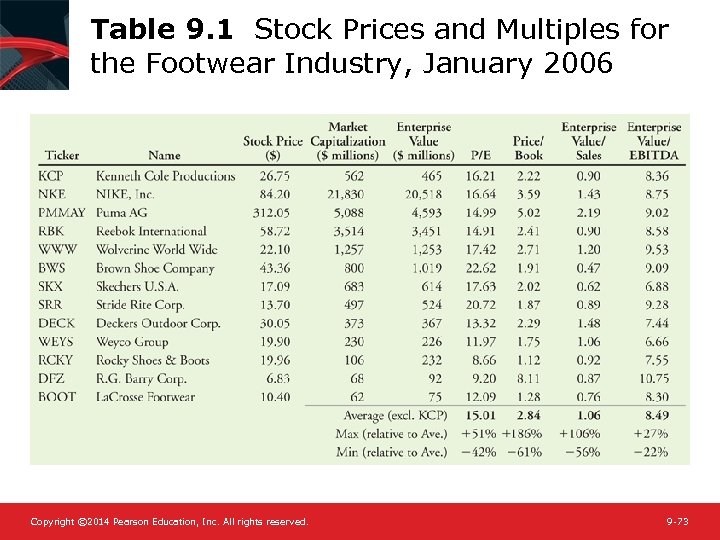 Table 9. 1 Stock Prices and Multiples for the Footwear Industry, January 2006 Copyright © 2014 Pearson Education, Inc. All rights reserved. 9 -73
 Stock Valuation Techniques: The Final Word • No single technique provides a final answer regarding a stock’s true value. • All approaches require assumptions or forecasts that are too uncertain to provide a definitive assessment of the firm’s value. – Most real-world practitioners use a combination of these approaches and gain confidence if the results are consistent across a variety of methods. Copyright © 2014 Pearson Education, Inc. All rights reserved. 9 -74
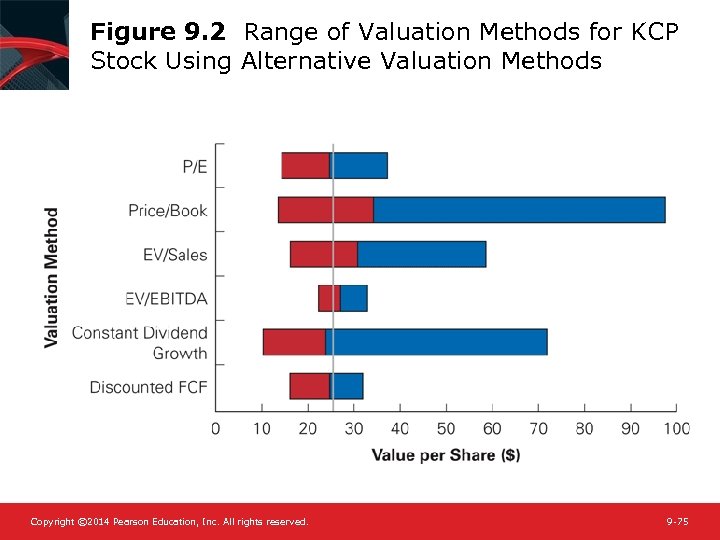 Figure 9. 2 Range of Valuation Methods for KCP Stock Using Alternative Valuation Methods Copyright © 2014 Pearson Education, Inc. All rights reserved. 9 -75
 Figure 9. 2 Range of Valuation Methods for KCP Stock Using Alternative Valuation Methods • Valuations from multiples are based on the low, high, and average values of the comparable firms from Table 9. 1 (see Problems 25 and 26 at the end of the chapter). • The constant dividend growth model is based on an 11% equity cost of capital and 4%, 8%, and 10% dividend growth rates, as discussed at the end of Section 9. 2. • The discounted free cash flow model is based on Example 9. 7 with the range of parameters in Problem 22. • (Midpoints are based on average multiples or base case assumptions. Red and blue regions show the variation between the lowestmultiple/ worst-case scenario and the highest-multiple/best-case scenario. KCP’s actual share price of $26. 75 is indicated by the gray line. ) Copyright © 2014 Pearson Education, Inc. All rights reserved. 9 -76
 9. 5 Information, Competition, and Stock Prices • Information in Stock Prices – Our valuation model links the firm’s future cash flows, its cost of capital, and its share price. – Given accurate information about any two of these variables, a valuation model allows us to make inferences about the third variable. Copyright © 2014 Pearson Education, Inc. All rights reserved. 9 -77
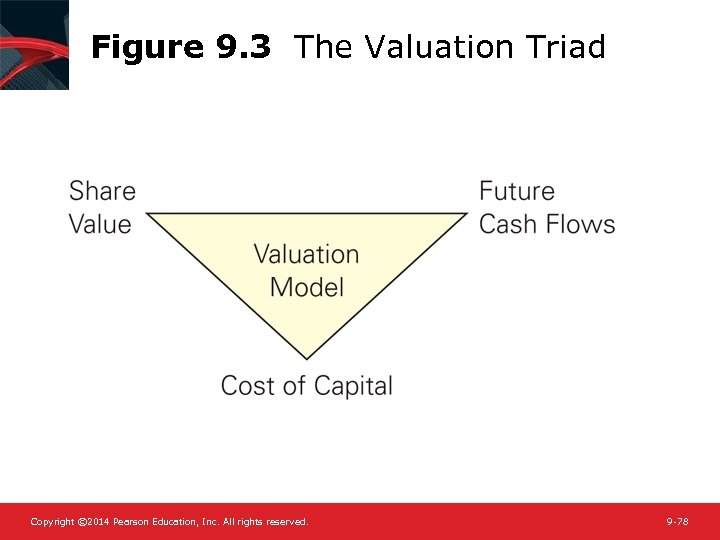 Figure 9. 3 The Valuation Triad Copyright © 2014 Pearson Education, Inc. All rights reserved. 9 -78
 9. 5 Information, Competition, and Stock Prices (cont'd) • Information in Stock Prices – For a publicly traded firm, its current stock price should already provide very accurate information, aggregated from a multitude of investors, regarding the true value of its shares. • Based on its current stock price, a valuation model will tell us something about the firm’s future cash flows or cost of capital. Copyright © 2014 Pearson Education, Inc. All rights reserved. 9 -79
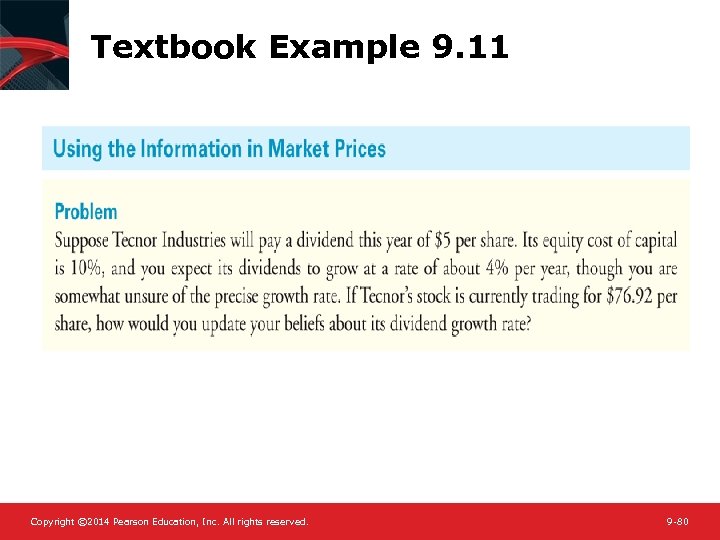 Textbook Example 9. 11 Copyright © 2014 Pearson Education, Inc. All rights reserved. 9 -80
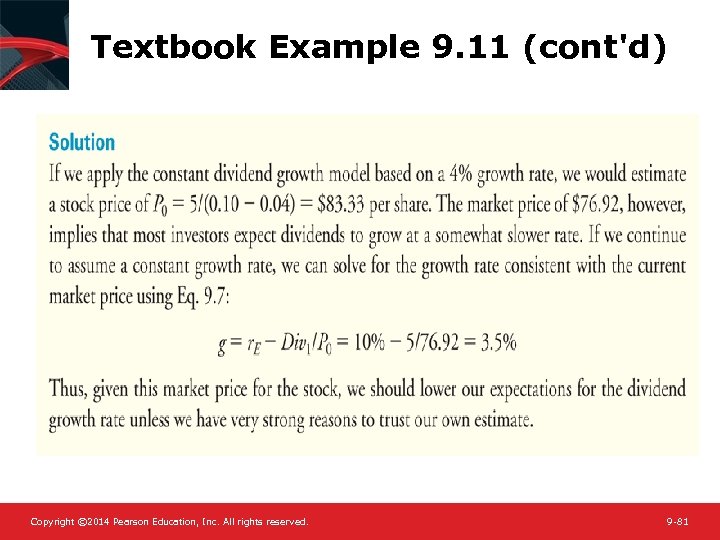 Textbook Example 9. 11 (cont'd) Copyright © 2014 Pearson Education, Inc. All rights reserved. 9 -81
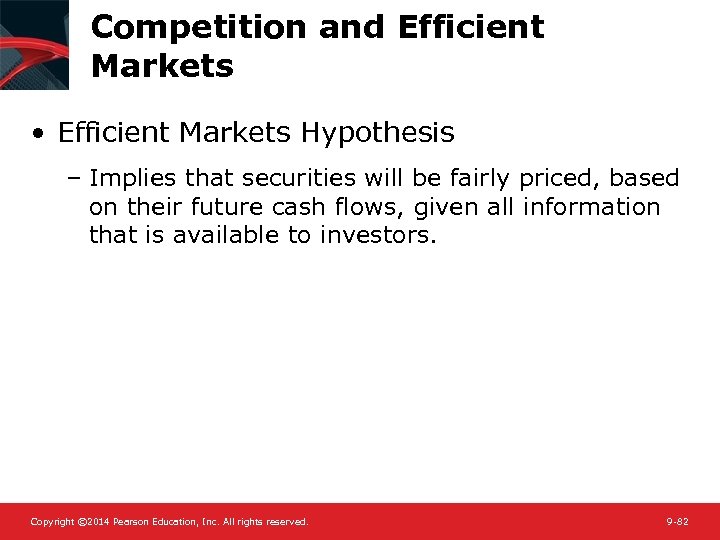 Competition and Efficient Markets • Efficient Markets Hypothesis – Implies that securities will be fairly priced, based on their future cash flows, given all information that is available to investors. Copyright © 2014 Pearson Education, Inc. All rights reserved. 9 -82
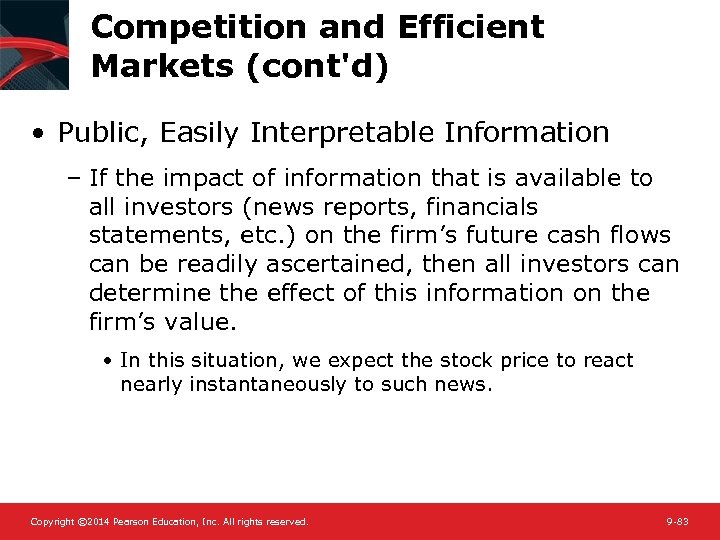 Competition and Efficient Markets (cont'd) • Public, Easily Interpretable Information – If the impact of information that is available to all investors (news reports, financials statements, etc. ) on the firm’s future cash flows can be readily ascertained, then all investors can determine the effect of this information on the firm’s value. • In this situation, we expect the stock price to react nearly instantaneously to such news. Copyright © 2014 Pearson Education, Inc. All rights reserved. 9 -83
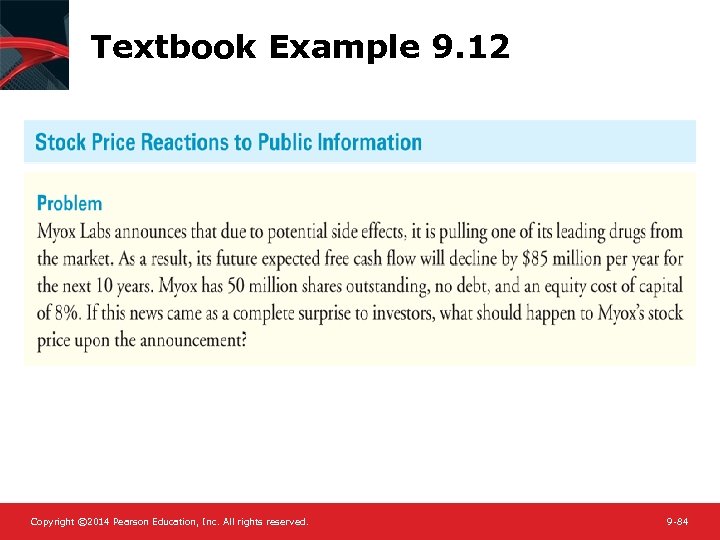 Textbook Example 9. 12 Copyright © 2014 Pearson Education, Inc. All rights reserved. 9 -84
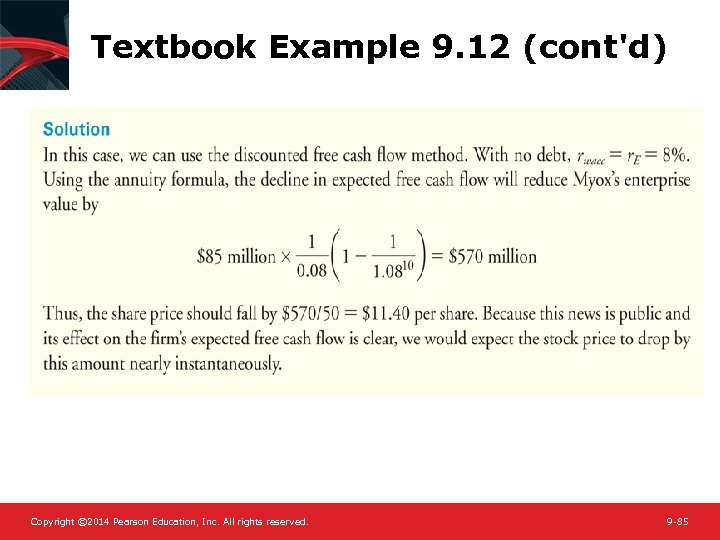 Textbook Example 9. 12 (cont'd) Copyright © 2014 Pearson Education, Inc. All rights reserved. 9 -85
 Competition and Efficient Markets (cont'd) • Private or Difficult-to-Interpret Information – Private information will be held by a relatively small number of investors. These investors may be able to profit by trading on their information. • In this case, the efficient markets hypothesis will not hold in the strict sense. However, as these informed traders begin to trade, they will tend to move prices, so over time prices will begin to reflect their information as well. Copyright © 2014 Pearson Education, Inc. All rights reserved. 9 -86
 Competition and Efficient Markets (cont'd) • Private or Difficult-to-Interpret Information – If the profit opportunities from having private information are large, others will devote the resources needed to acquire it. • In the long run, we should expect that the degree of “inefficiency” in the market will be limited by the costs of obtaining the private information. Copyright © 2014 Pearson Education, Inc. All rights reserved. 9 -87
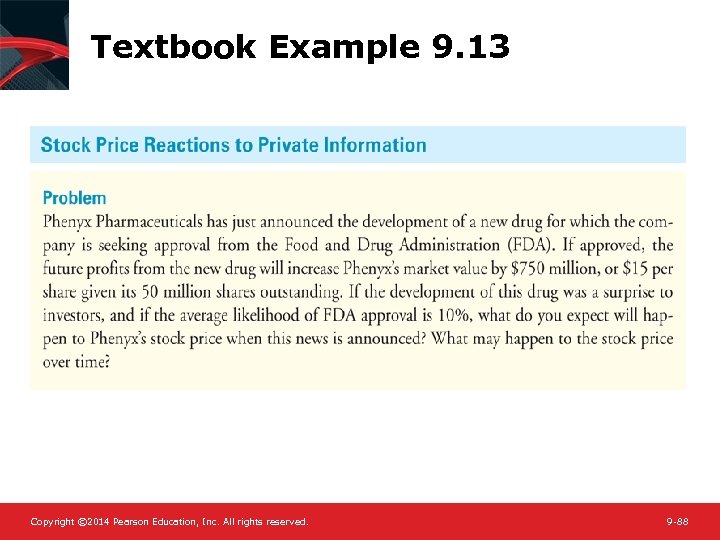 Textbook Example 9. 13 Copyright © 2014 Pearson Education, Inc. All rights reserved. 9 -88
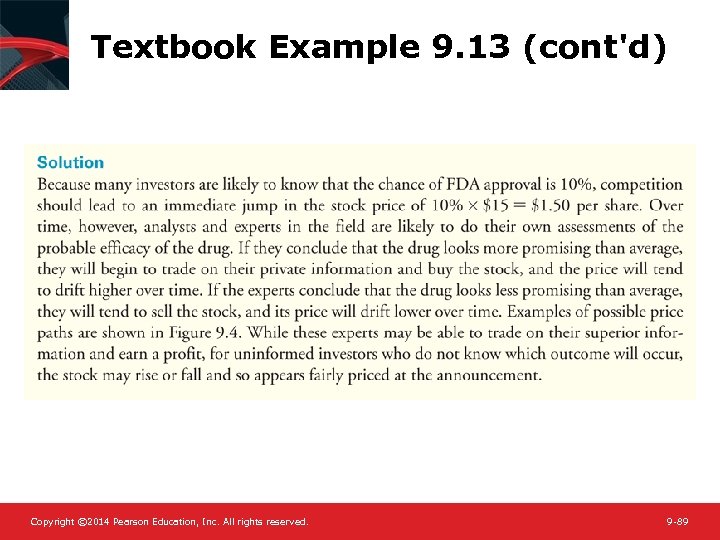 Textbook Example 9. 13 (cont'd) Copyright © 2014 Pearson Education, Inc. All rights reserved. 9 -89
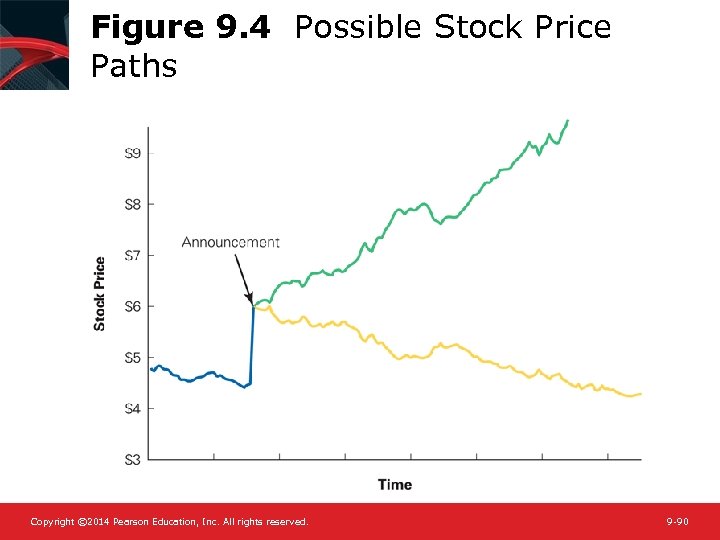 Figure 9. 4 Possible Stock Price Paths Copyright © 2014 Pearson Education, Inc. All rights reserved. 9 -90
 Lessons for Investors and Corporate Managers • Consequences for Investors – If stocks are fairly priced, then investors who buy stocks can expect to receive future cash flows that fairly compensate them for the risk of their investment. • In such cases the average investor can invest with confidence, even if he is not fully informed. Copyright © 2014 Pearson Education, Inc. All rights reserved. 9 -91
 Lessons for Investors and Corporate Managers (cont'd) • Implications for Corporate Managers – Focus on NPV and free cash flow – Avoid accounting illusions – Use financial transactions to support investment Copyright © 2014 Pearson Education, Inc. All rights reserved. 9 -92
 The Efficient Markets Hypothesis Versus No Arbitrage • The efficient markets hypothesis states that securities with equivalent risk should have the same expected return. • An arbitrage opportunity is a situation in which two securities with identical cash flows have different prices. Copyright © 2014 Pearson Education, Inc. All rights reserved. 9 -93