


 Скачать презентацию Chapter 9 TQM Quality Tools 1
2cae25491dbb42742b881b24663ced96.ppt
- Количество слайдов: 74
 Chapter 9 TQM & Quality Tools 1
 Quality and Total Quality Management • Quality is the ability of a product or service to consistently meet or exceed customer expectations. A philosophy that involves everyone in an organization in a continual effort to improve quality and achieve customer satisfaction. 2
 Quality • Definition 1: The ability of a product or service to consistently meet or exceed customer expectations. • Definition 2: a: Peculiar and essential character. b : an inherent feature. c: degree of excellence. d : superiority in kind. e : a distinguishing attribute. f : an acquired skill. g : the character in a logical proposition of being affirmative or negative. h : vividness of hue. • Definition 3: The ability to meet standards. “UTD provides quality education. ” 3
 Quality Assurance vs. Strategic Approach • Quality Assurance – Emphasis on finding and correcting defects before reaching market • Strategic Approach – Proactive, focusing on preventing mistakes from occurring – Greater emphasis on customer satisfaction 4
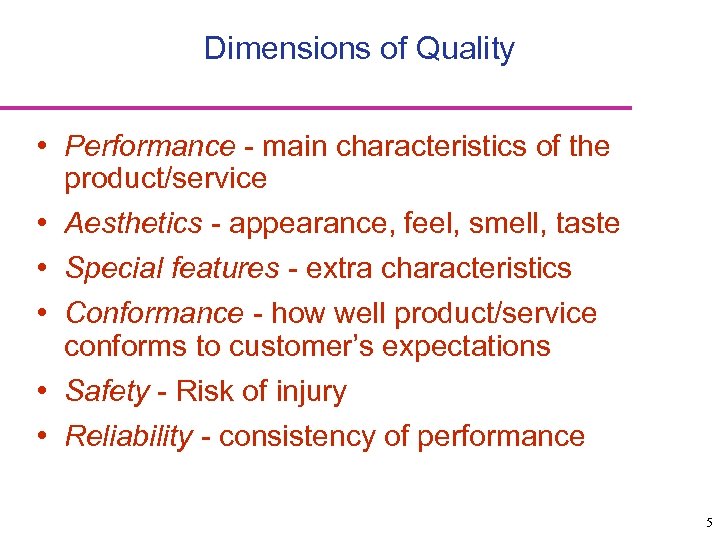 Dimensions of Quality • Performance - main characteristics of the product/service • Aesthetics - appearance, feel, smell, taste • Special features - extra characteristics • Conformance - how well product/service conforms to customer’s expectations • Safety - Risk of injury • Reliability - consistency of performance 5
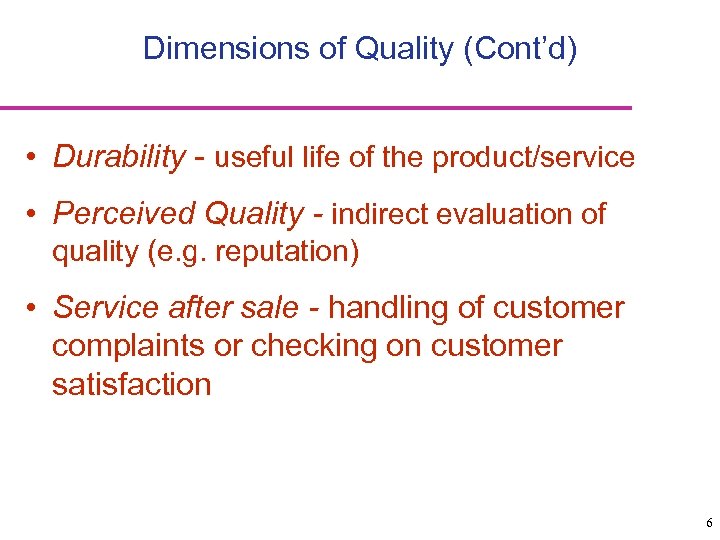 Dimensions of Quality (Cont’d) • Durability - useful life of the product/service • Perceived Quality - indirect evaluation of quality (e. g. reputation) • Service after sale - handling of customer complaints or checking on customer satisfaction 6
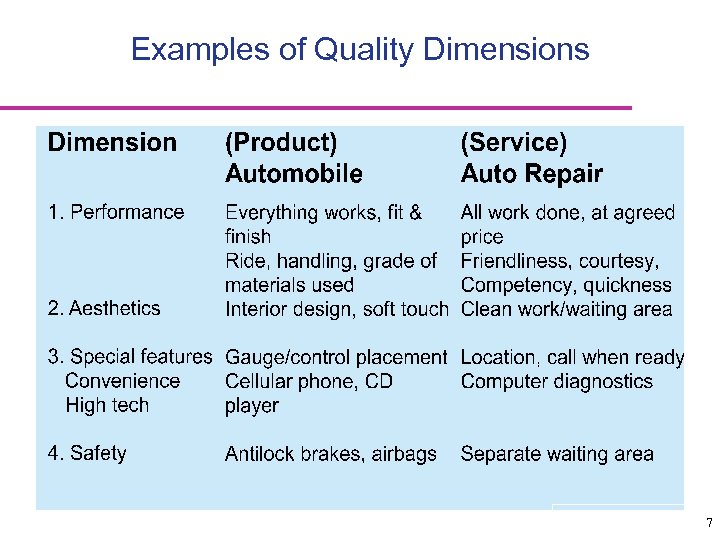 Examples of Quality Dimensions 7
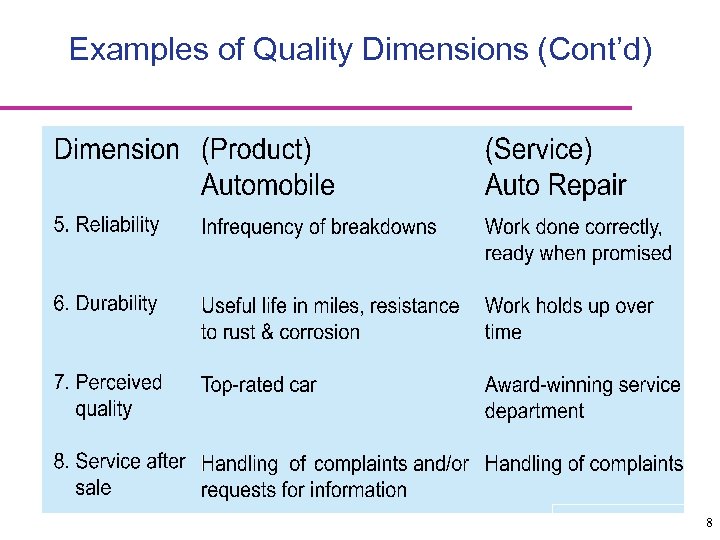 Examples of Quality Dimensions (Cont’d) 8
 Service Quality • • Tangibles Convenience Reliability Responsiveness Time Assurance Courtesy 9
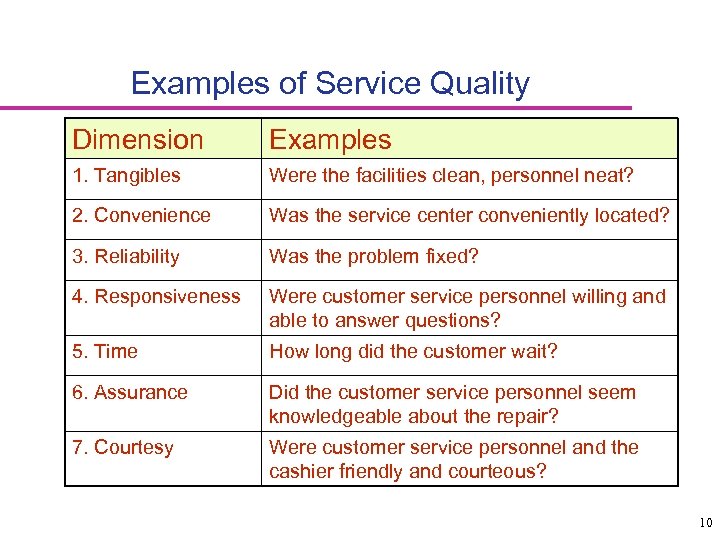 Examples of Service Quality Dimension Examples 1. Tangibles Were the facilities clean, personnel neat? 2. Convenience Was the service center conveniently located? 3. Reliability Was the problem fixed? 4. Responsiveness Were customer service personnel willing and able to answer questions? 5. Time How long did the customer wait? 6. Assurance Did the customer service personnel seem knowledgeable about the repair? 7. Courtesy Were customer service personnel and the cashier friendly and courteous? 10
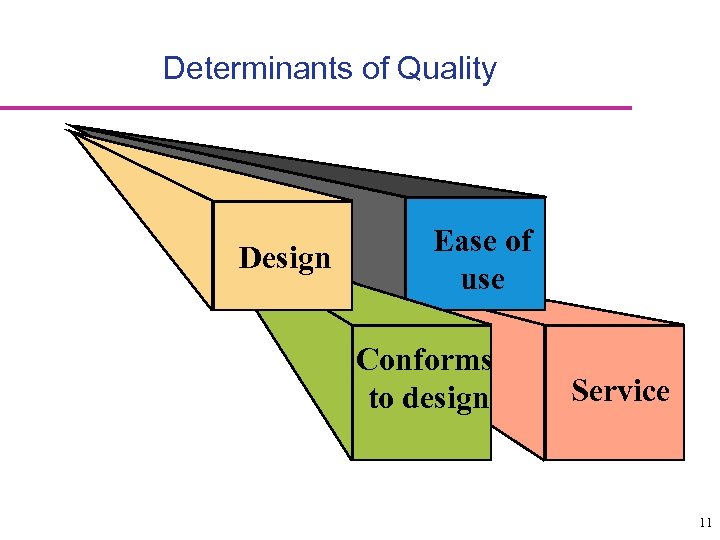 Determinants of Quality Design Ease of use Conforms to design Service 11
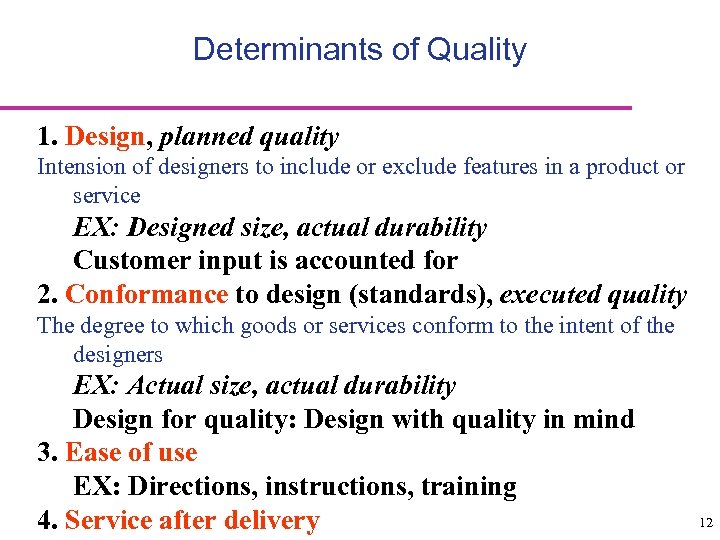 Determinants of Quality 1. Design, planned quality Intension of designers to include or exclude features in a product or service EX: Designed size, actual durability Customer input is accounted for 2. Conformance to design (standards), executed quality The degree to which goods or services conform to the intent of the designers EX: Actual size, actual durability Design for quality: Design with quality in mind 3. Ease of use EX: Directions, instructions, training 4. Service after delivery 12
 The Consequences of Poor Quality • • Loss of business Liability Productivity Costs 13
 The Consequences of Poor Quality • Loss of business: Customer quietly stops buying. Customer complaints rarely reach to the upper management. • Liability: Due to damages or injuries resulting from poor quality (design, conformance, ease of use, service) • Low productivity: Rework or scrap. More input but does not increase the output. • High costs 14
 Costs of Quality • Failure Costs - costs incurred by defective parts/products or faulty services. – Internal Failure Costs • Costs incurred to fix problems that are detected before the product/service is delivered to the customer. – External Failure Costs • All costs incurred to fix problems that are detected after the product/service is delivered to the customer. 15
 Costs of Quality (continued) • Appraisal Costs – – Product and/or service inspection costs. EX: Time and effort spent for course evaluations • Prevention Costs – – Quality training, planning, customer assessment, process control, and quality improvement costs to prevent defects from occurring EX: Instructor training for better course presentation 16
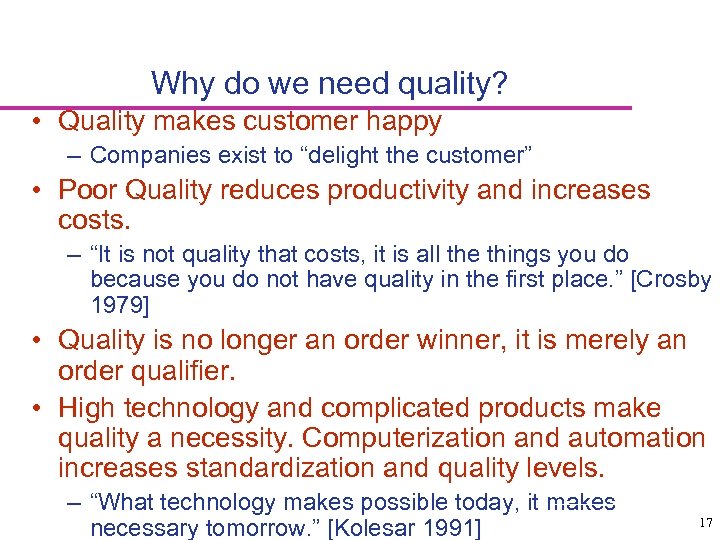 Why do we need quality? • Quality makes customer happy – Companies exist to “delight the customer” • Poor Quality reduces productivity and increases costs. – “It is not quality that costs, it is all the things you do because you do not have quality in the first place. ” [Crosby 1979] • Quality is no longer an order winner, it is merely an order qualifier. • High technology and complicated products make quality a necessity. Computerization and automation increases standardization and quality levels. – “What technology makes possible today, it makes necessary tomorrow. ” [Kolesar 1991] 17
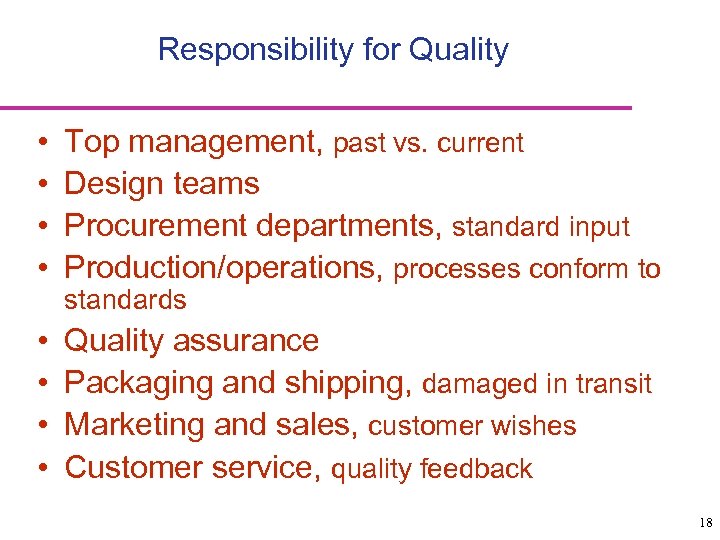 Responsibility for Quality • • Top management, past vs. current Design teams Procurement departments, standard input Production/operations, processes conform to • • Quality assurance Packaging and shipping, damaged in transit Marketing and sales, customer wishes Customer service, quality feedback standards 18
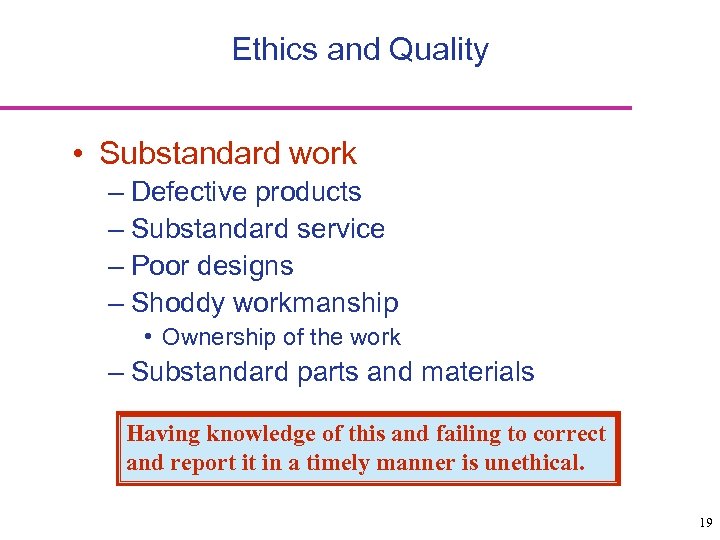 Ethics and Quality • Substandard work – Defective products – Substandard service – Poor designs – Shoddy workmanship • Ownership of the work – Substandard parts and materials Having knowledge of this and failing to correct and report it in a timely manner is unethical. 19
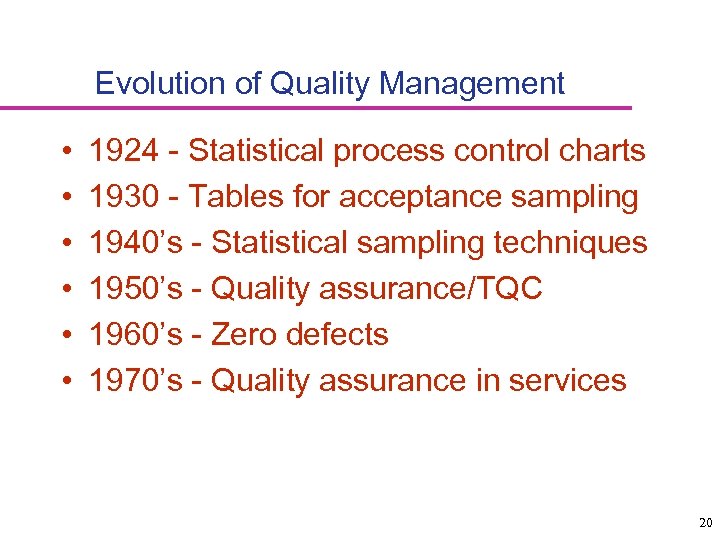 Evolution of Quality Management • • • 1924 - Statistical process control charts 1930 - Tables for acceptance sampling 1940’s - Statistical sampling techniques 1950’s - Quality assurance/TQC 1960’s - Zero defects 1970’s - Quality assurance in services 20
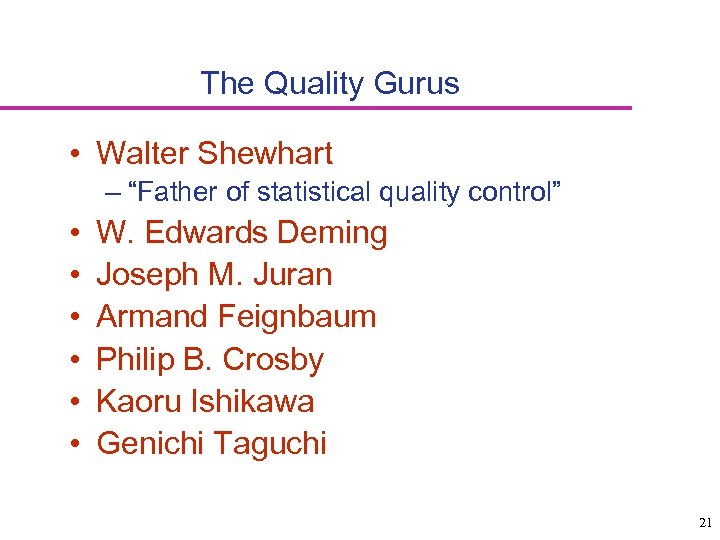 The Quality Gurus • Walter Shewhart – “Father of statistical quality control” • • • W. Edwards Deming Joseph M. Juran Armand Feignbaum Philip B. Crosby Kaoru Ishikawa Genichi Taguchi 21
 Some History of Quality: Pre WWII • 1920 s, Physicist W. Shewhart of Bell labs studied variation in the production processes for the first great US national telephone network. – Common cause variation due to minor differences – Assignable cause variation due to major differences – Statistical control (Shewhart) charts (Chapter 10) • 1940 s, NYU stat professor W. E. Deming edits Shewhart’s book – Deming’s 14 points – Plan-Do-Study-Act (PDSA) cycle 22
 Some History of Quality: During WWII • 1930 s, H. Dodge and H. Romig of Bell labs studied accepting a lot after partial inspection – Acceptance sampling: Is a lot of N products good if a sample of n (n
 Some history of Quality: Post WWII • US industry disregards quality. Deming and Juran (actually a body of Shewhart, Dodge and Romig in 1926) make an exodus to Japan to preach: Quality 1. will be the basis for future competition 2. and productivity are positively correlated 3. belongs to the upper management 4. best achieved with Deming wheel =continuous improvement • 1960’s, A. Feigenbaum’s unified and integrated view of quality also resonate in Japan rather than US. – Total Quality - Control 24
 Some History of Quality: About 70’s • 1960’s, P. B. Crosby goes to extreme – zero defects – do it right the first time –becomes a strong tenet of JIT • K. Ishikawa introduces cause-effect (fishbone) diagrams (Chapter 11) • G. Taguchi introduces his quality cost function – Quadratic penalty for variations from standards 25
 Quality Awards Baldrige Award Deming Prize 26
 Recent Quality Trends: Awards Baldrige National Quality Award • Administered by NIST • Promotes – Understanding of the requirements of performance excellence and competitiveness improvement – Sharing information on successful performance strategies • Eligibility – For-profit US companies – Categories: Manufacturing, Service, Small business – Winners cannot apply within 5 years 27
 Baldrige National Quality Award • 1. 0 Leadership, 90 points • 2. 0 Strategic Planning, 75 points • 3. 0 Customer and Market Focus, 75 points • 4. 0 Information and Analysis, 150 points • 5. 0 Human Resource Development and Management, 150 points • 6. 0 Process Management, 230 points • 7. 0 Business Results, 230 points 28
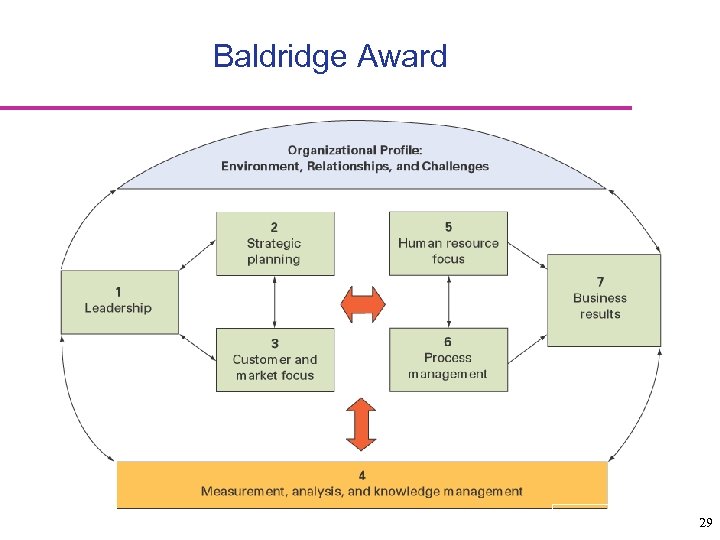 Baldridge Award 29
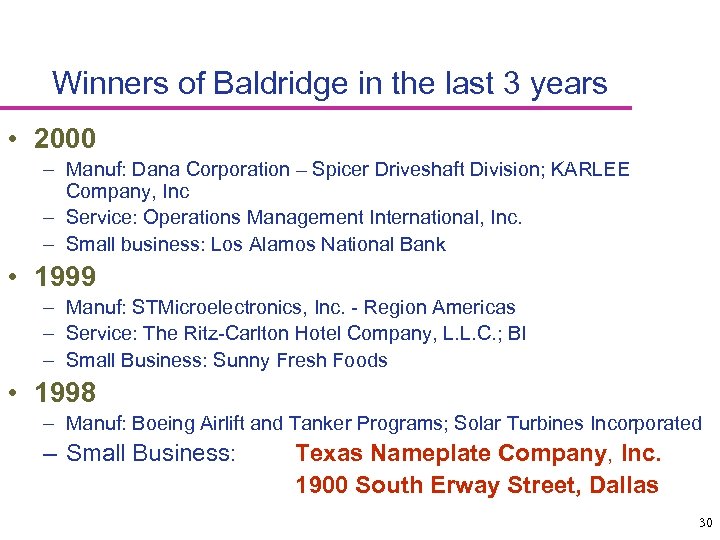 Winners of Baldridge in the last 3 years • 2000 – Manuf: Dana Corporation – Spicer Driveshaft Division; KARLEE Company, Inc – Service: Operations Management International, Inc. – Small business: Los Alamos National Bank • 1999 – Manuf: STMicroelectronics, Inc. - Region Americas – Service: The Ritz-Carlton Hotel Company, L. L. C. ; BI – Small Business: Sunny Fresh Foods • 1998 – Manuf: Boeing Airlift and Tanker Programs; Solar Turbines Incorporated – Small Business: Texas Nameplate Company, Inc. 1900 South Erway Street, Dallas 30
 Benefits of Baldrige Competition • • Financial success Winners share their knowledge The process motivates employees The process provides a well-designed quality system • The process requires obtaining data • The process provides feedback 31
 Critiques for Baldridge • • It is expensive in terms of money and time to apply Companies nominate themselves Very few companies apply Even fewer companies win – It is a competition not a recognition • Promotes a tendency to focus on the award • It does not include financial results, innovation, ethics, environmental issues • It does not correlate with success 32
 Recent Quality Trends: Awards The Deming Prize • Honoring W. E. Deming started in 1951 with his donation • Administrated by Japanese Union of Scientists and Engineers • Everybody who meets the standard receives the prize • Promotes statistical quality control 33
 Recent Quality Trends: Awards European Quality Award • European Foundation for Quality Management (EFQM) founded in 1988 • Two awards were established in 1992 – European Quality Prize • Awarded to all who meet the criteria – European Quality Award • Given to the best • Prizes intend to identify role models – – – Leadership and constancy of purpose Customer focus Corporate social responsibility People development and involvement Results orientation • Eligibility: For-profit firms with a “history of significant commitment to Western Europe. ” 34
 Recent Quality Trends: ISO Series Quality Certification: ISO 9000 • Set of international standards on quality management and Quality assurance, critical to international Business • ISO 9000 series standards, briefly, require firms to document their quality-control systems at every step so that they’ll be able to identify those areas that are causing quality problems and correct them. • ISO 9000 requires companies to document everything they do that affects the quality of goods and services. – Hierarchical approach to documentation of the Quality Management System 35
 ISO 9000 Registration Process • When an organization feels that its quality system is good enough, it may ask an accredited registrar or other third party audit team for pre-assessment. • The final audit begins with a review of the company's quality manual, which the accredited registrar or third party audit team typically uses as its guide. The audit team checks if the documented quality system meets the requirement of ISO 9000. • When the registrar is satisfied with the favorable recommendation of the audit team, it grants registration and issues a registration document to the company. 36
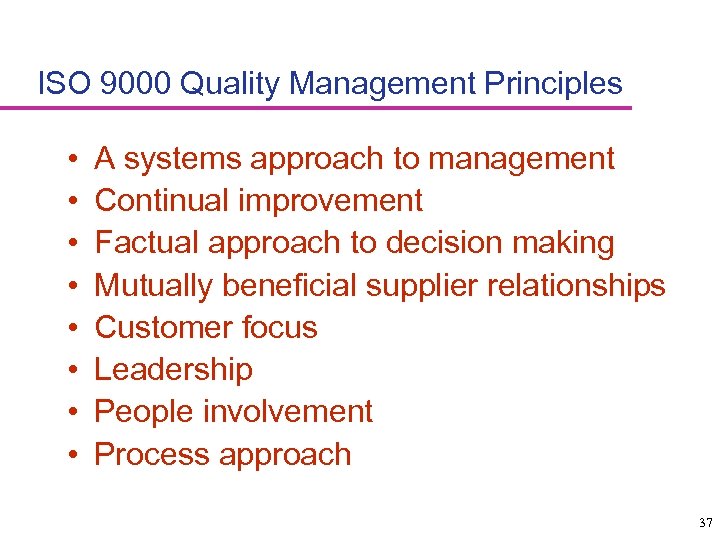 ISO 9000 Quality Management Principles • • A systems approach to management Continual improvement Factual approach to decision making Mutually beneficial supplier relationships Customer focus Leadership People involvement Process approach 37
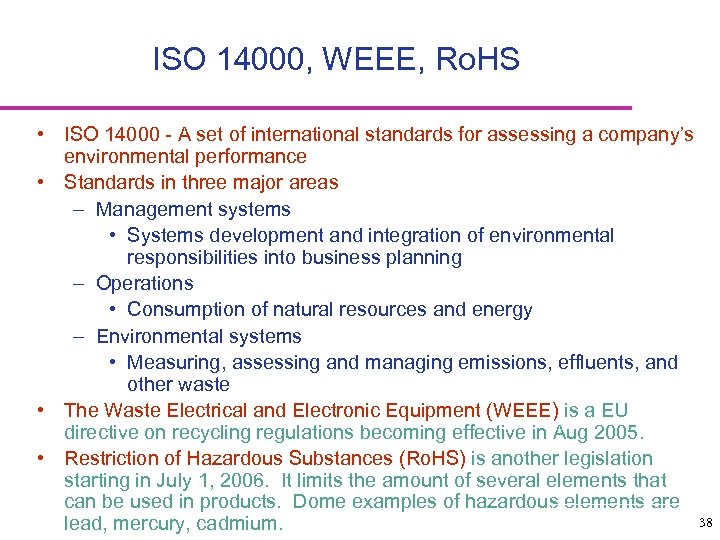 ISO 14000, WEEE, Ro. HS • ISO 14000 - A set of international standards for assessing a company’s environmental performance • Standards in three major areas – Management systems • Systems development and integration of environmental responsibilities into business planning – Operations • Consumption of natural resources and energy – Environmental systems • Measuring, assessing and managing emissions, effluents, and other waste • The Waste Electrical and Electronic Equipment (WEEE) is a EU directive on recycling regulations becoming effective in Aug 2005. • Restriction of Hazardous Substances (Ro. HS) is another legislation starting in July 1, 2006. It limits the amount of several elements that can be used in products. Dome examples of hazardous elements are 38 lead, mercury, cadmium.
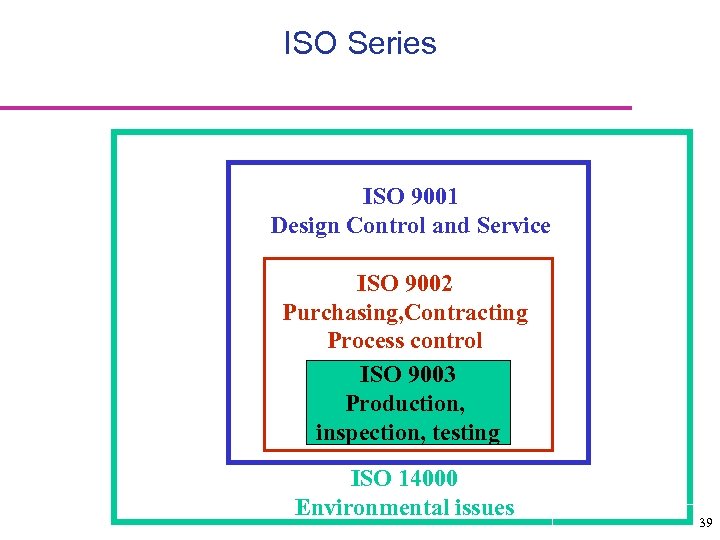 ISO Series ISO 9001 Design Control and Service ISO 9002 Purchasing, Contracting Process control ISO 9003 Production, inspection, testing ISO 14000 Environmental issues 39
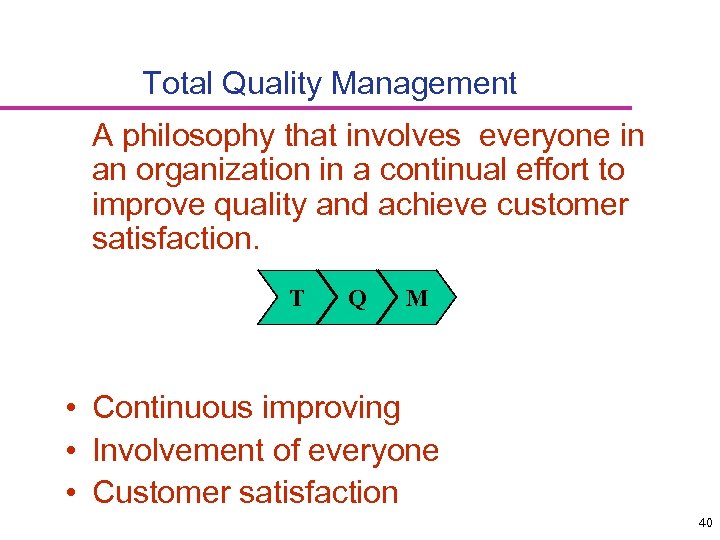 Total Quality Management A philosophy that involves everyone in an organization in a continual effort to improve quality and achieve customer satisfaction. T Q M • Continuous improving • Involvement of everyone • Customer satisfaction 40
 The TQM Approach • Find out what the customer wants • Design a product or service that meets or exceeds customer wants • Design processes that facilitates doing the job right the first time – Pokayoke : fail-safing : foolproofing • Laptop – projector plug shapes • Keep track of results • Extend these concepts to suppliers 41
 Elements of TQM • • • Continual improvement: Kaizen Competitive benchmarking Employee empowerment Team approach Decisions based on facts Knowledge of tools Supplier quality Champion Quality at the source: The philosophy of making each worker responsible for the quality of his or her work. • Suppliers 42
 Obstacles to Implementing TQM • Lack of: – Company-wide definition of quality – Strategic plan for change • Resistance to a change – Customer focus – Real employee empowerment • Red tape – Strong motivation – Time to devote to quality initiatives – Leadership 43
 Criticisms of TQM • Blind pursuit of TQM programs • Programs may not be linked to strategies • Quality may not be tied to – market performance – profitability • Failure to carefully plan a program 44
 Six Sigma • A business process for improving quality, reduce cost and increasing customer satisfaction. • Statistically – Having no more than 3. 4 defects per million • Conceptually – Program designed to reduce defects – Requires the use of certain tools and techniques • EX: Motorola, GE, TI, Kodak 45
 Six Sigma Programs • Six Sigma programs – Improve quality – Save time – Cut costs • Employed in – Design – Production – Service – Inventory management – Delivery 46
 Six Sigma Management components: • • Providing strong leadership Defining performance merits Selecting projects likely to succeed Selecting and training appropriate people Six Sigma Technical components: • • Improving process performance Reducing variation Utilizing statistical models Designing a structured improvement strategy 47
 Six Sigma Team • Top management: essential • Program champions • Master “black belts”: tools • “Black belts”: pivotal role implement process improvement projects, facility change convey knowledge to Green belts • “Green belts” • Six Sigma Process – Define Measure Analyze Improve Control 48
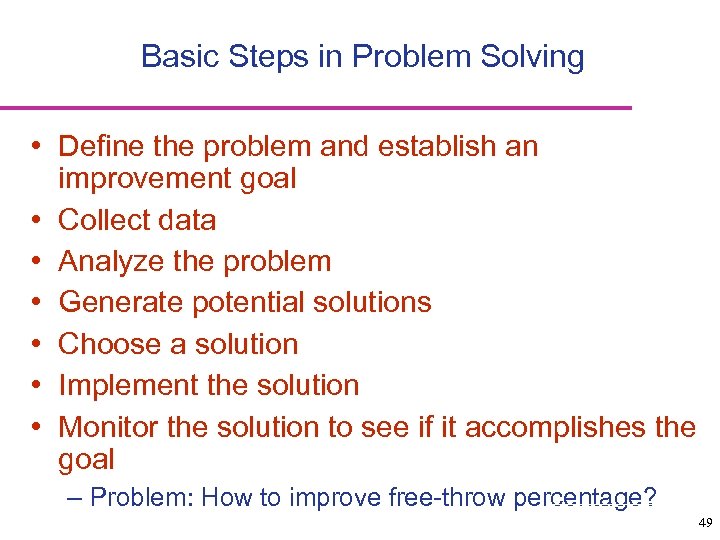 Basic Steps in Problem Solving • Define the problem and establish an improvement goal • Collect data • Analyze the problem • Generate potential solutions • Choose a solution • Implement the solution • Monitor the solution to see if it accomplishes the goal – Problem: How to improve free-throw percentage? 49
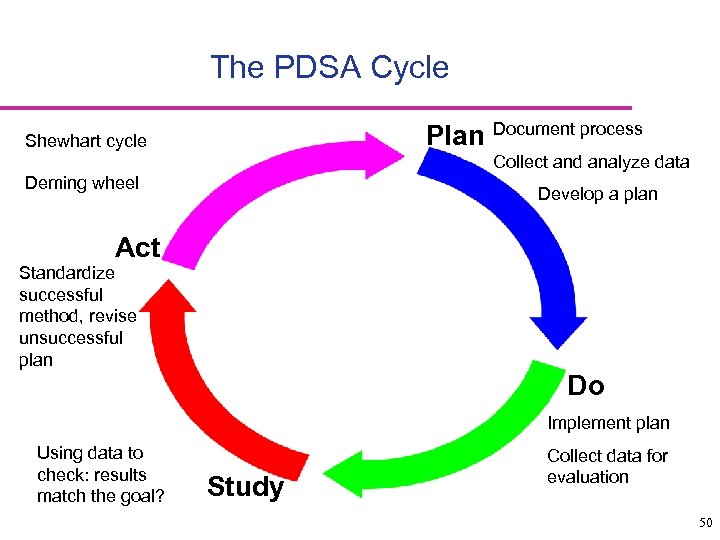 The PDSA Cycle Plan Document process Shewhart cycle Collect and analyze data Deming wheel Develop a plan Act Standardize successful method, revise unsuccessful plan Do Implement plan Using data to check: results match the goal? Study Collect data for evaluation 50
 Process Improvement and Tools • Process improvement - a systematic approach – Process mapping, flowchart – Analyze the process, too few steps, too many steps – Redesign the process • Tools – There a number of tools that can be used for problem solving and process improvement – Tools aid in data collection and interpretation, and provide the basis for decision making 51
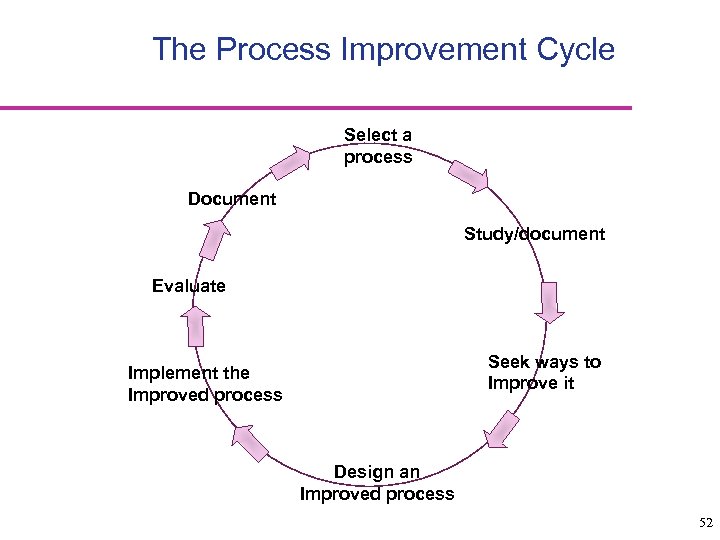 The Process Improvement Cycle Select a process Document Study/document Evaluate Seek ways to Improve it Implement the Improved process Design an Improved process 52
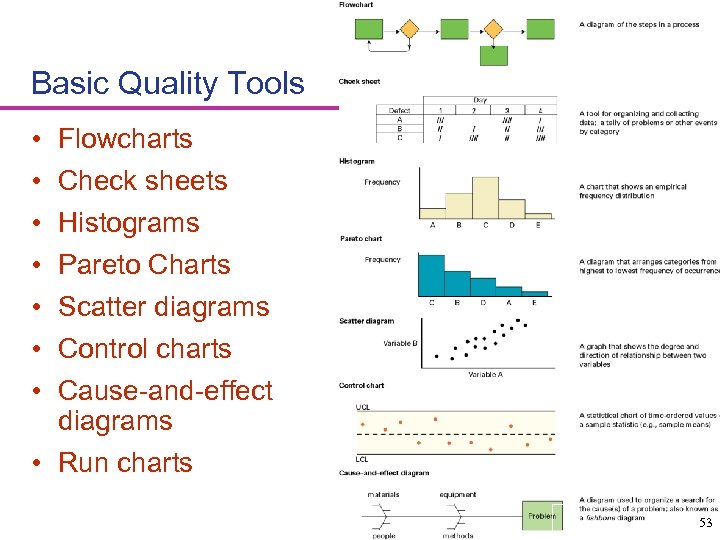 Basic Quality Tools • • Flowcharts Check sheets Histograms Pareto Charts Scatter diagrams Control charts Cause-and-effect diagrams • Run charts 53
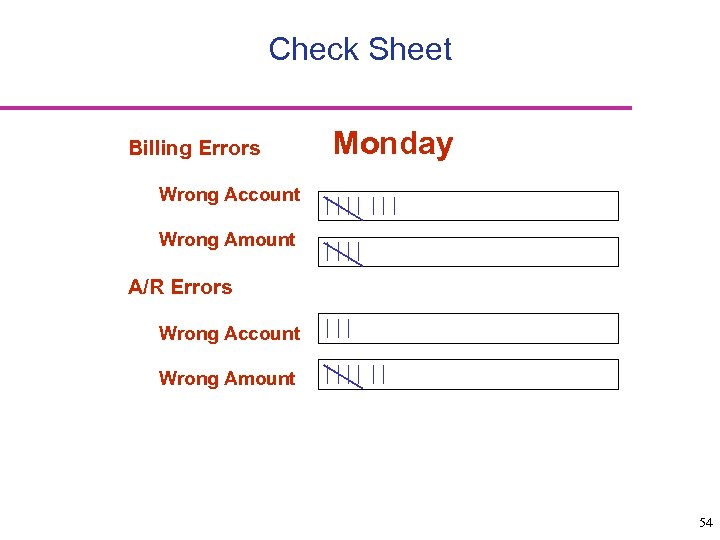 Check Sheet Billing Errors Monday Wrong Account Wrong Amount A/R Errors Wrong Account Wrong Amount 54
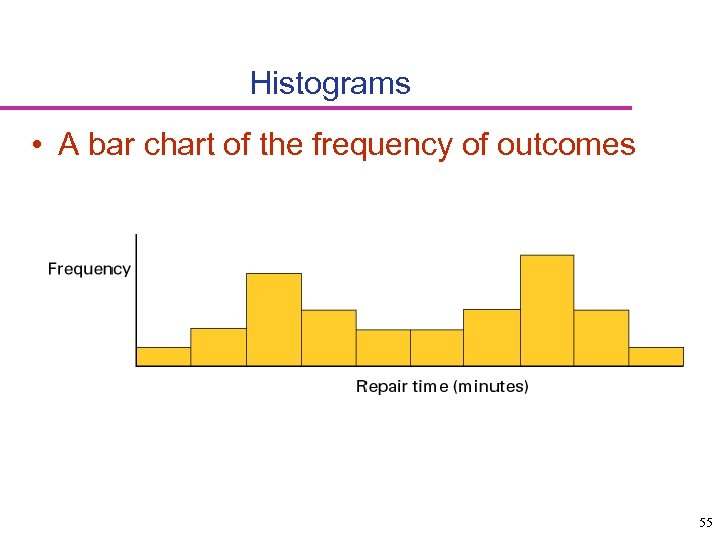 Histograms • A bar chart of the frequency of outcomes 55
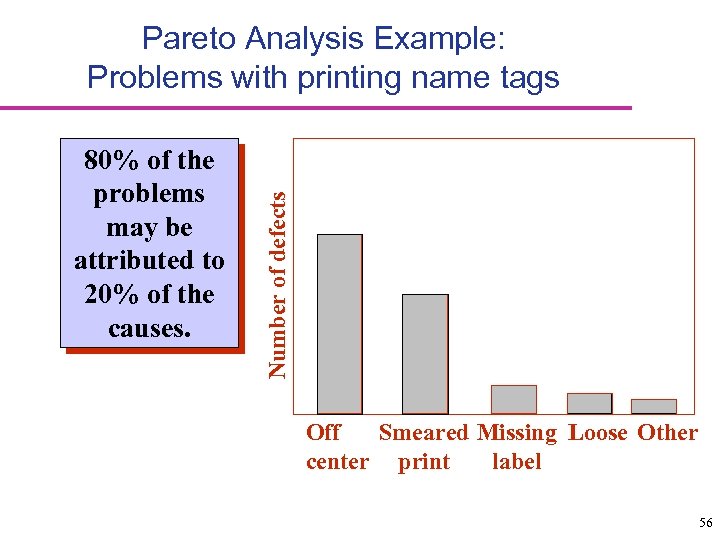 80% of the problems may be attributed to 20% of the causes. Number of defects Pareto Analysis Example: Problems with printing name tags Off Smeared Missing Loose Other center print label 56
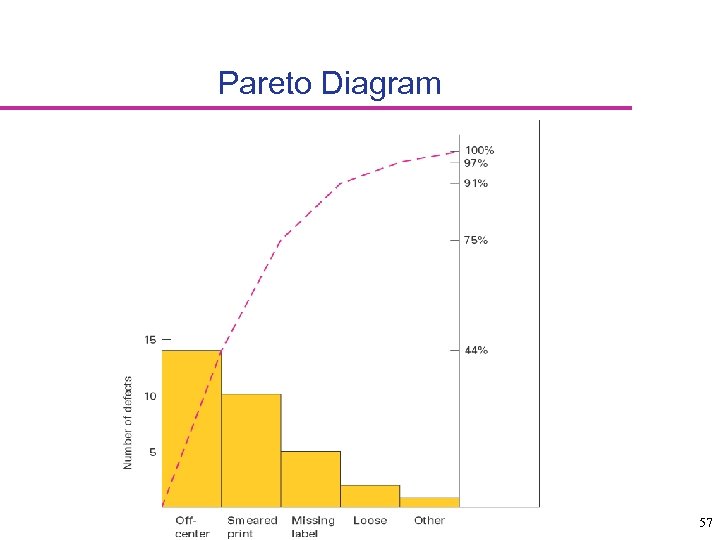 Pareto Diagram 57
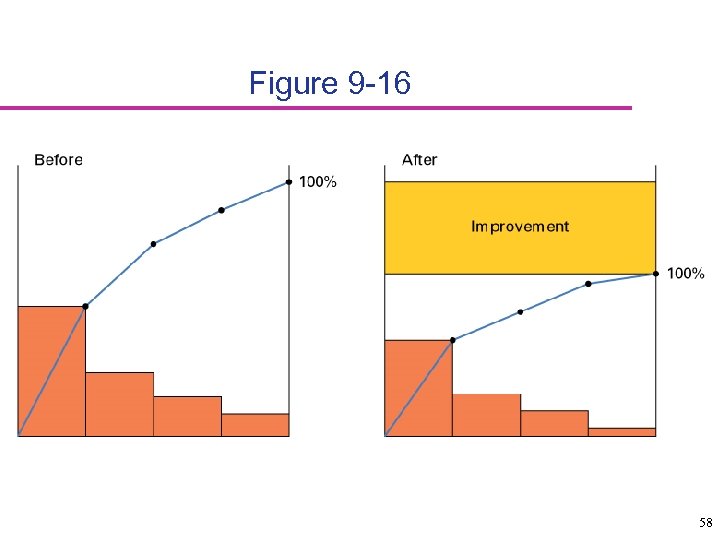 Figure 9 -16 58
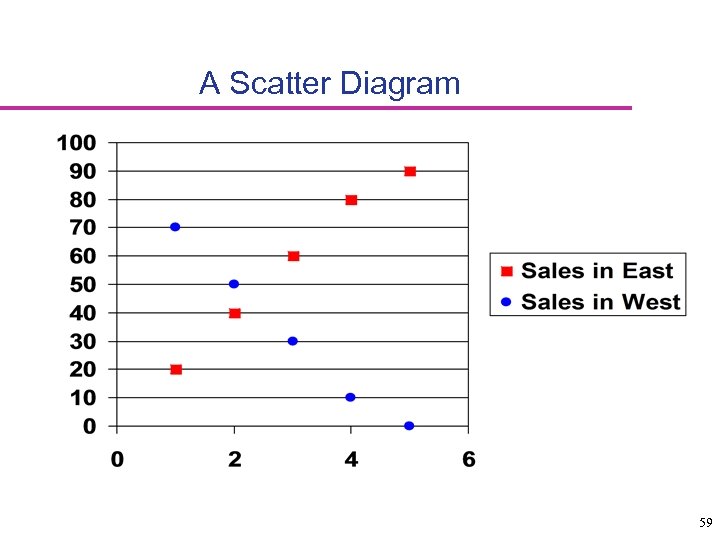 A Scatter Diagram 59
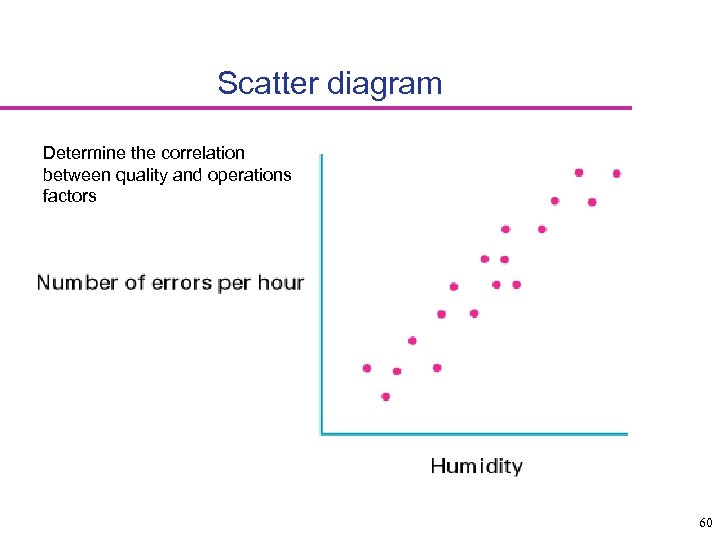 Scatter diagram Determine the correlation between quality and operations factors 60
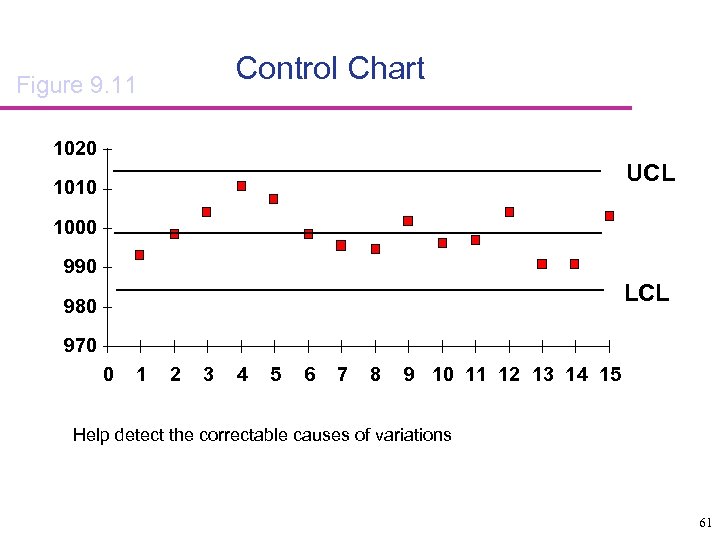 Control Chart Figure 9. 11 1020 UCL 1010 1000 990 LCL 980 970 0 1 2 3 4 5 6 7 8 9 10 11 12 13 14 15 Help detect the correctable causes of variations 61
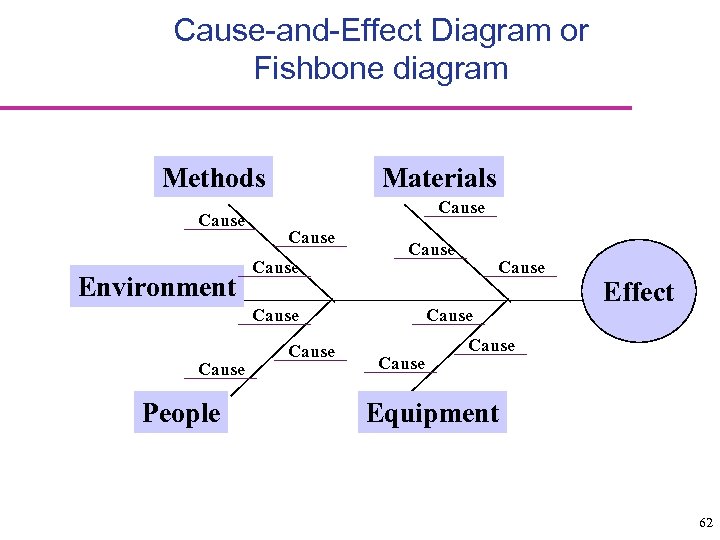 Cause-and-Effect Diagram or Fishbone diagram Methods Cause Environment Materials Cause Cause People Cause Effect Cause Equipment 62
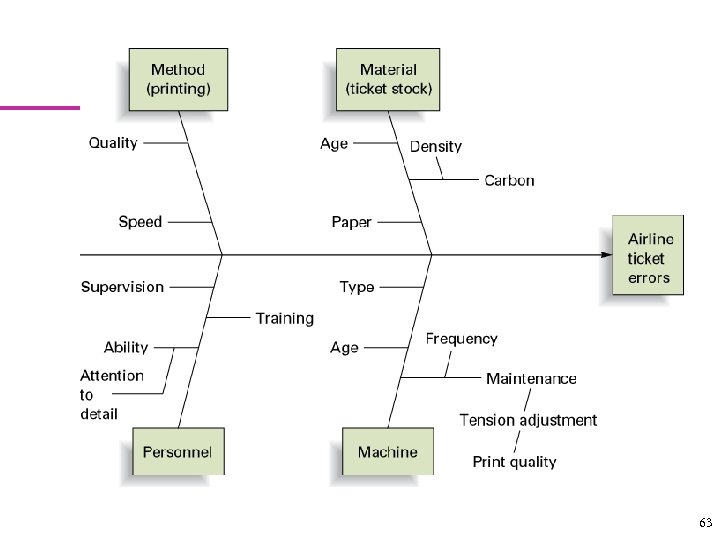 63
63
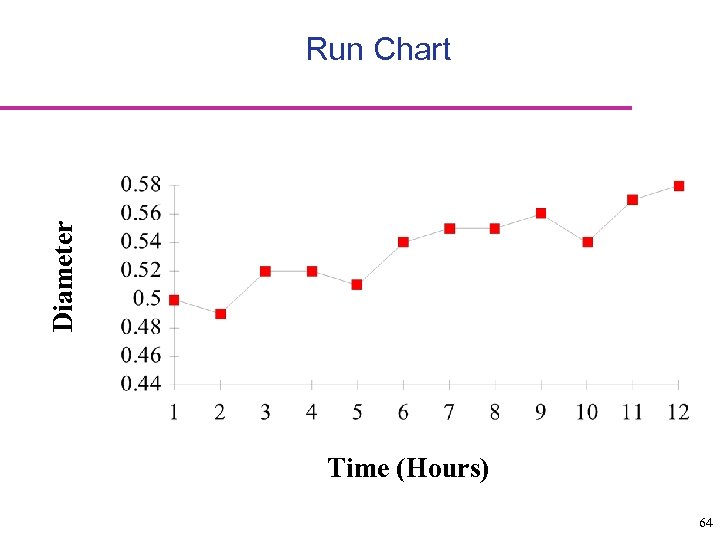 Diameter Run Chart Time (Hours) 64
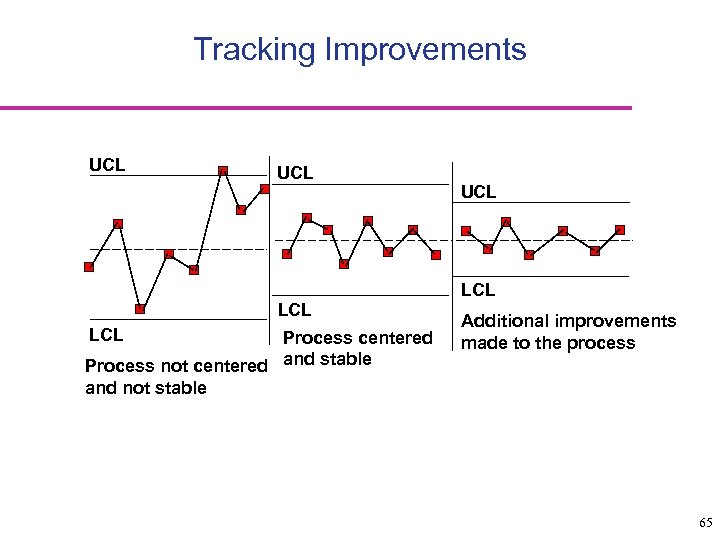 Tracking Improvements UCL LCL Process centered Process not centered and stable and not stable UCL LCL Additional improvements made to the process 65
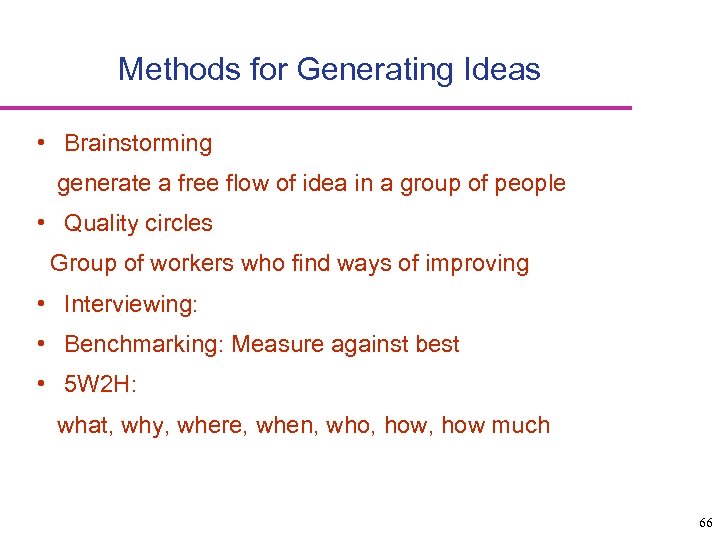 Methods for Generating Ideas • Brainstorming generate a free flow of idea in a group of people • Quality circles Group of workers who find ways of improving • Interviewing: • Benchmarking: Measure against best • 5 W 2 H: what, why, where, when, who, how much 66
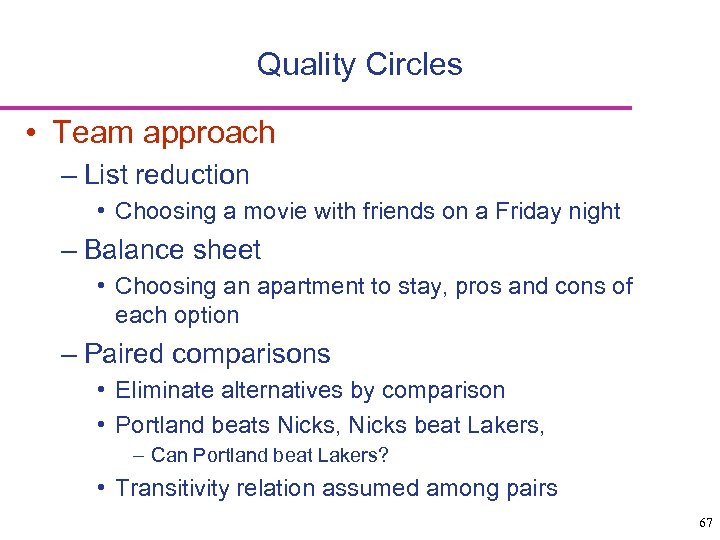 Quality Circles • Team approach – List reduction • Choosing a movie with friends on a Friday night – Balance sheet • Choosing an apartment to stay, pros and cons of each option – Paired comparisons • Eliminate alternatives by comparison • Portland beats Nicks, Nicks beat Lakers, – Can Portland beat Lakers? • Transitivity relation assumed among pairs 67
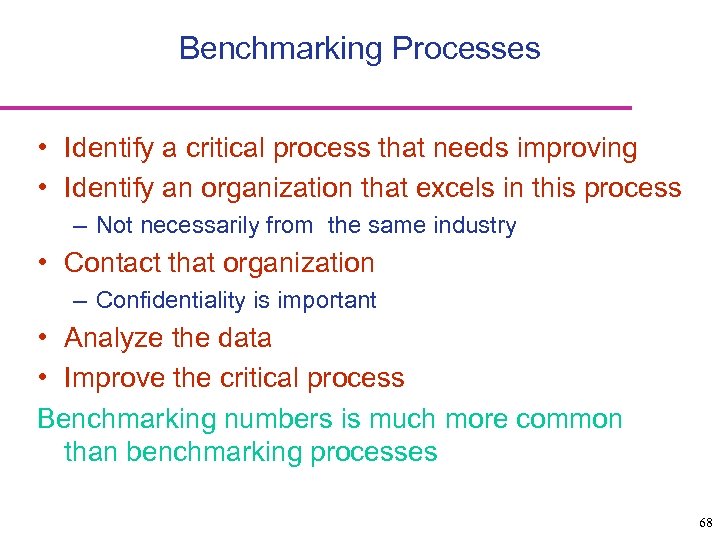 Benchmarking Processes • Identify a critical process that needs improving • Identify an organization that excels in this process – Not necessarily from the same industry • Contact that organization – Confidentiality is important • Analyze the data • Improve the critical process Benchmarking numbers is much more common than benchmarking processes 68
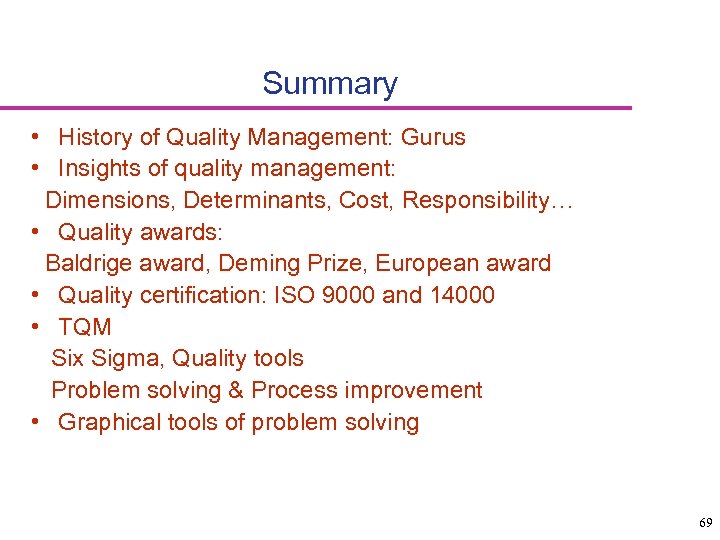 Summary • History of Quality Management: Gurus • Insights of quality management: Dimensions, Determinants, Cost, Responsibility… • Quality awards: Baldrige award, Deming Prize, European award • Quality certification: ISO 9000 and 14000 • TQM Six Sigma, Quality tools Problem solving & Process improvement • Graphical tools of problem solving 69
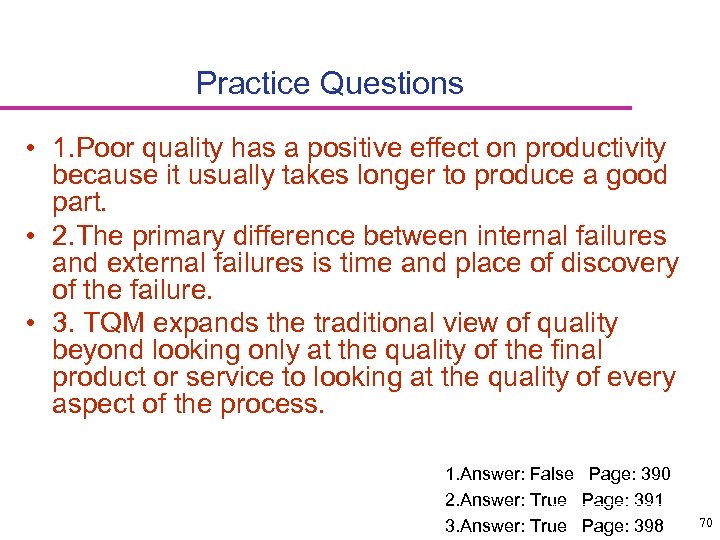 Practice Questions • 1. Poor quality has a positive effect on productivity because it usually takes longer to produce a good part. • 2. The primary difference between internal failures and external failures is time and place of discovery of the failure. • 3. TQM expands the traditional view of quality beyond looking only at the quality of the final product or service to looking at the quality of every aspect of the process. 1. Answer: False Page: 390 2. Answer: True Page: 391 3. Answer: True Page: 398 70
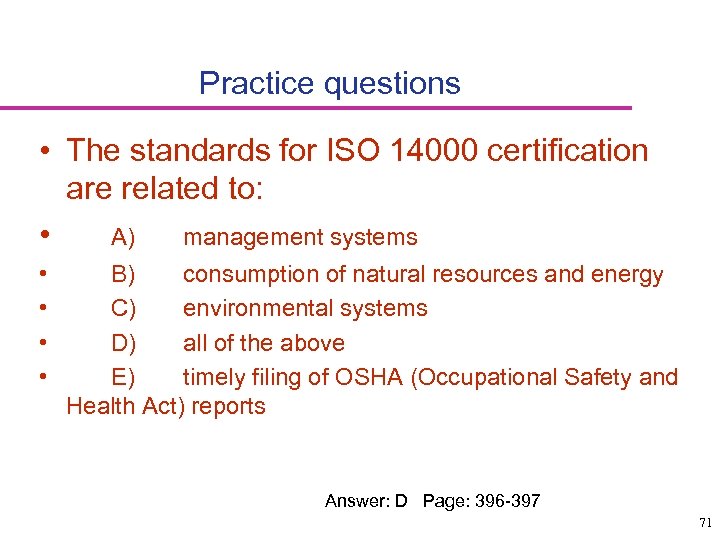 Practice questions • The standards for ISO 14000 certification are related to: • A) management systems • • B) consumption of natural resources and energy C) environmental systems D) all of the above E) timely filing of OSHA (Occupational Safety and Health Act) reports Answer: D Page: 396 -397 71
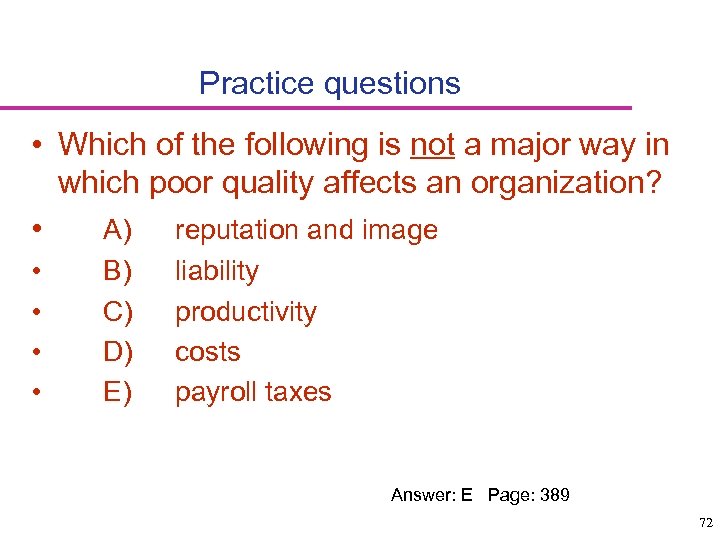 Practice questions • Which of the following is not a major way in which poor quality affects an organization? • A) reputation and image • • B) C) D) E) liability productivity costs payroll taxes Answer: E Page: 389 72
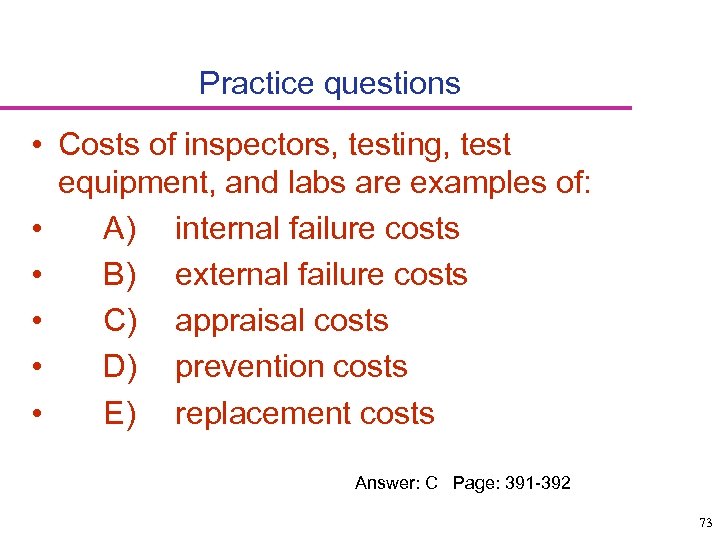 Practice questions • Costs of inspectors, testing, test equipment, and labs are examples of: • A) internal failure costs • B) external failure costs • C) appraisal costs • D) prevention costs • E) replacement costs Answer: C Page: 391 -392 73
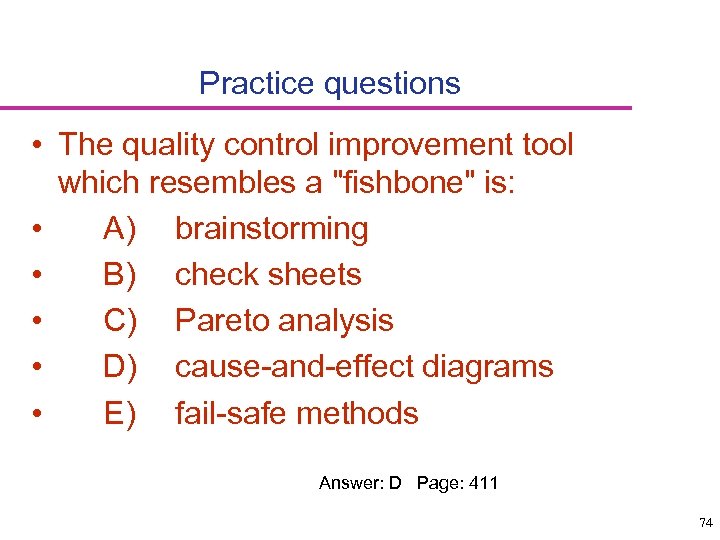 Practice questions • The quality control improvement tool which resembles a "fishbone" is: • A) brainstorming • B) check sheets • C) Pareto analysis • D) cause-and-effect diagrams • E) fail-safe methods Answer: D Page: 411 74