


 Скачать презентацию Chapter 9 Section The Industrial Age a k
5466a0e832a2a546da94a4416f563ea3.ppt
- Количество слайдов: 13
 Chapter 9, Section The Industrial Age (a. k. a. 2 nd Industrial Revolution) 1800– 1914
 Chapter 9, Section 1 New Industrial Powers Although Great Britain (GB) was starting place of Industrial Revolution, by mid-1800 s, other nations industrialized; some challenged GB’s industrial supremacy. v Belgium was 2 nd industrialized European nation. v Germany united into a powerful nation in 1871. Within 30 years, it was Europe’s leading industrial power. v US made rapid technological advances, especially after Civil War (1861 -65). By 1900, American industry led world in production. v Japan industrialized rapidly after 1868. v Canada, New Zealand, and Australia built thriving industries. v Eastern & Southern Europe industrialized more slowly – lacked natural resources or the capital to invest.
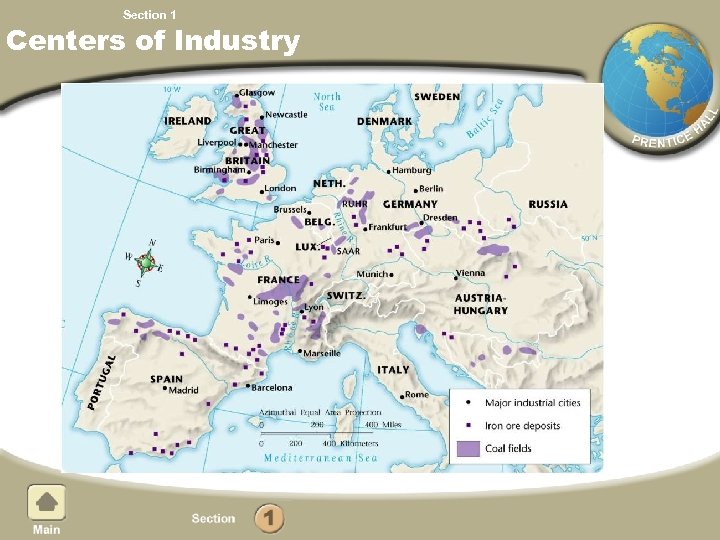 Chapter 9, Section 1 Centers of Industry
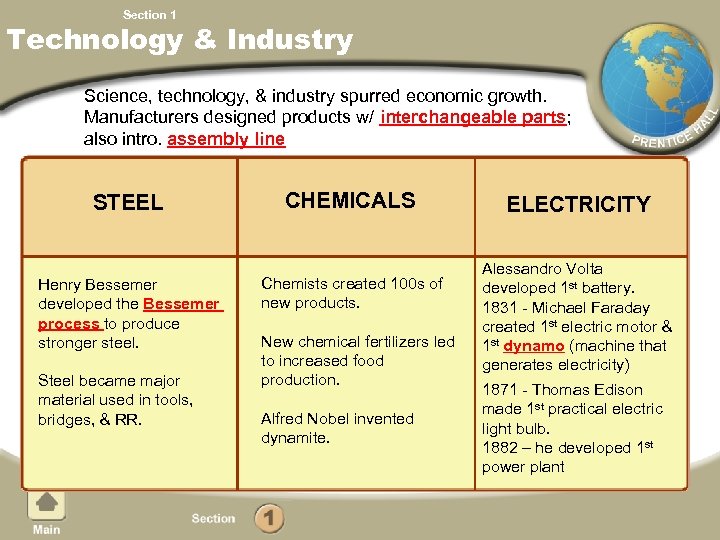 Chapter 9, Section 1 Technology & Industry Science, technology, & industry spurred economic growth. Manufacturers designed products w/ interchangeable parts; also intro. assembly line STEEL Henry Bessemer developed the Bessemer process to produce stronger steel. Steel became major material used in tools, bridges, & RR. CHEMICALS Chemists created 100 s of new products. New chemical fertilizers led to increased food production. Alfred Nobel invented dynamite. ELECTRICITY Alessandro Volta developed 1 st battery. 1831 - Michael Faraday created 1 st electric motor & 1 st dynamo (machine that generates electricity) 1871 - Thomas Edison made 1 st practical electric light bulb. 1882 – he developed 1 st power plant
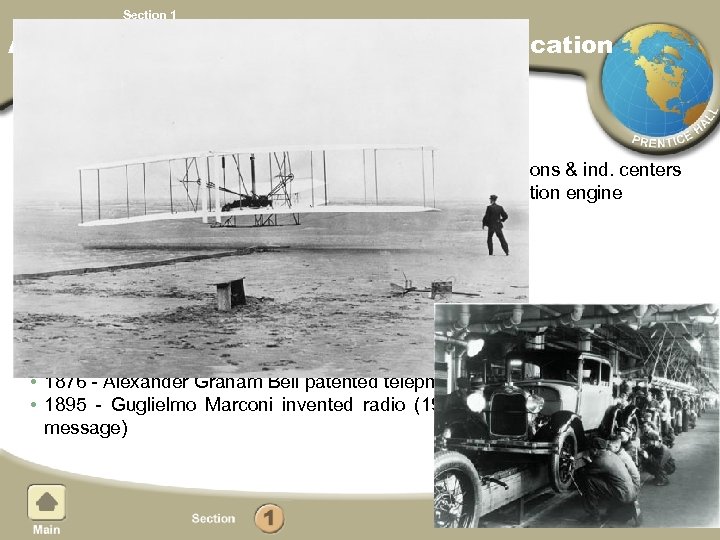 Chapter 9, Section 1 Advances in Transportation & Communication Both vastly transformed by technology. TRANSPORTATION • • • Steamships & RR connected cities & seaports, mining regions & ind. centers Nikolaus Otto invented gasoline-powered internal combustion engine Karl Benz patented 1 st automobile Henry Ford mass produced cars Orville & Wilbur Wright designed & flew 1 st airplane COMMUNICATION • 1844 - Samuel Morse developed 1 st telegraph & lines b/w Baltimore & Wash. , DC (▪ ▪ ▪ ▬ ▬ ▬ ▪ ▪ ▪) • 1876 - Alexander Graham Bell patented telephone • 1895 - Guglielmo Marconi invented radio (1901 = 1 st trans-Atlantic radio message)
 Chapter 9, Section 1 Rise of Big Business New technologies required investment of large amounts of money. To obtain capital, entrepreneurs sold stock, or shares in their companies, to investors. Large-scale companies formed corporations (businesses owned by many investors who buy shares of stock) Powerful business leaders created monopolies & trusts Sometimes a group of businesses joined forces & formed a cartel (an association of businesses/corporations that join together to fix prices, set production quotas, or control markets)
 Chapter 9, Section 2 Population Explosion Between 1800 & 1900, population of Europe more than doubled. Rapid growth was not due to larger families, but fall of the death rate Drop in death rate because: v People ate better. v Medical knowledge increased. v Public sanitation improved. v Hygiene improved. Year Male Female 1850 1870 1890 1910 42. 8 years 44. 7 years 48. 5 years 56. 0 years 40. 3 years 42. 3 years 45. 8 years 52. 7 years
 Chapter 9, Section 2 Advances in Medicine Improved medicine & hygiene had major role in life expectancy increasing (in industrialized countries) LOUIS PASTEUR – proved link b/w microbes & disease; developed vaccines against rabies & anthrax, and discovered process of pasteurization ROBERT KOCH – identified bacteria causing tuberculosis FLORENCE NIGHTINGALE – insisted on better hygiene in wartime field hospitals; intro. sanitary measures in Brit. Hospitals; started the world’s 1 st nursing school. JOSEPH LISTER – discovered how antiseptic prevented infection
 Chapter 9, Section 2 Advances in Physical Science • 1895 – William Roentgen (Ger. ) discovered X-rays & developed x-ray photographic process • 1897 – J. J. Thompson (Eng. ) discovered electrons & developed subatomic theory • 1898 – Pierre & Marie Curie (Fr. ) discovered radioactivity • 1900 – Max Planck (Ger. ) developed quantum theory • Albert Einstein – (Ger. ) developed several significant theories, e. g. general theory of relativity (gravity = a field in the space-time continuum), & the special theory of relativity
 Chapter 9, Section 2 Advances in Biological Science • 1858 – Rudolf Virchow (German) expanded cell theory to establish –Cells are basic unit of living matter –Diseases caused by destruction of cells • 1859 – Charles Darwin (British) published On the Origin of Species & theory of evolution became popular; he was influenced by: –Jean Lamarck (French) – theorized living beings adapted physically in response to environment –Thomas Malthus (British) – developed “survival of the fittest” theory
 Chapter 9, Section 2 Advances in Biological Science • 1860 s-1870 s – Gregor Mendel (Austrian monk) experimented with cross-pollinating pea plants – Discovered traits can be hidden in generations – Established basis for genetics
 Chapter 9, Section 2 Social Sciences • Political science began as study of government, not politics • Economics began because foundations laid by Adam Smith & Thomas Malthus • Anthropology began as the interest in human culture & society grew • Sociology began & gave rise to theory of social Darwinism (Darwin’s theories applied to evolution of human societies)
 Chapter 9, Section 2 Social Sciences • Psychology (study of the mind) developed when Wilhelm Wundt (German) started 1 st lab to study the mind • Ivan Pavlov (Russian) discovered process of classical conditioning while studying digestive process of dogs • Sigmund Freud (Austrian) developed theories about the unconscious mind, establishing an approach known as psychoanalysis (process of revealing and analyzing the unconscious)