


 Скачать презентацию CHAPTER 9 Long-Run Costs and Output Decisions Power
ff42a4be3f7ea48ae173ea1c2453a627.ppt
- Количество слайдов: 47
 CHAPTER 9 Long-Run Costs and Output Decisions Power. Point Lectures for Principles of Microeconomics, 9 e ; ; By Karl E. Case, Ray C. Fair & Sharon M. Oster © 2009 Prentice Hall Business Publishing Principles of Economics 9 e by Case, Fair and Oster 1
 CHAPTER 9 Long-Run Costs and Output Decisions © 2009 Prentice Hall Business Publishing Principles of Economics 9 e by Case, Fair and Oster 2
 PART II THE MARKET SYSTEM 9 CHAPTER 9 Long-Run Costs and Output Decisions Prepared by: Fernando & Yvonn Quijano © 2009 Prentice Hall Business Publishing Principles of Economics 9 e by Case, Fair and Oster 3
 PART II THE MARKET SYSTEM Long-Run Costs and Output Decisions 9 CHAPTER OUTLINE CHAPTER 9 Long-Run Costs and Output Decisions Short-Run Conditions and Long. Run Directions Maximizing Profits Minimizing Losses The Short-Run Industry Supply Curve Long-Run Directions: A Review Long-Run Costs: Economies and Diseconomies of Scale Increasing Returns to Scale Constant Returns to Scale Decreasing Returns to Scale Long-Run Adjustments to Short-Run Conditions Short-Run Profits: Expansion to Equilibrium Short-Run Losses: Contraction to Equilibrium The Long-Run Adjustment Mechanism: Investment Flows toward Profit Opportunities Output Markets: A Final Word Appendix: External Economies and Diseconomies and the Long-Run Industry Supply Curve © 2009 Prentice Hall Business Publishing Principles of Economics 9 e by Case, Fair and Oster 4
 Long-Run Costs and Output Decisions CHAPTER 9 Long-Run Costs and Output Decisions We begin our discussion of the long run by looking at firms in three short-run circumstances: (1) firms earning economic profits, (2) firms suffering economic losses but continuing to operate to reduce or minimize those losses, and (3) firms that decide to shut down and bear losses just equal to fixed costs. breaking even The situation in which a firm is earning exactly a normal rate of return. © 2009 Prentice Hall Business Publishing Principles of Economics 9 e by Case, Fair and Oster 5
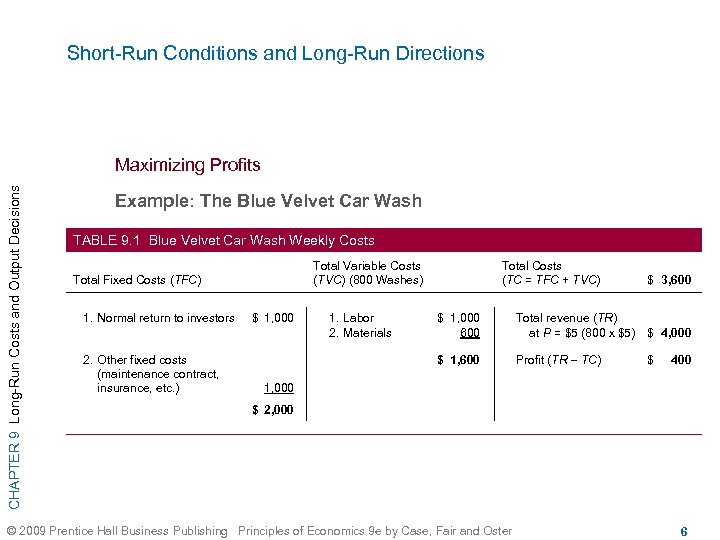 Short-Run Conditions and Long-Run Directions CHAPTER 9 Long-Run Costs and Output Decisions Maximizing Profits Example: The Blue Velvet Car Wash TABLE 9. 1 Blue Velvet Car Wash Weekly Costs Total Variable Costs (TVC) (800 Washes) Total Fixed Costs (TFC) 1. Normal return to investors 2. Other fixed costs (maintenance contract, insurance, etc. ) $ 1, 000 1. Labor 2. Materials Total Costs (TC = TFC + TVC) $ 3, 600 $ 1, 000 600 Total revenue (TR) at P = $5 (800 x $5) $ 4, 000 $ 1, 600 Profit (TR TC) $ 400 1, 000 $ 2, 000 © 2009 Prentice Hall Business Publishing Principles of Economics 9 e by Case, Fair and Oster 6
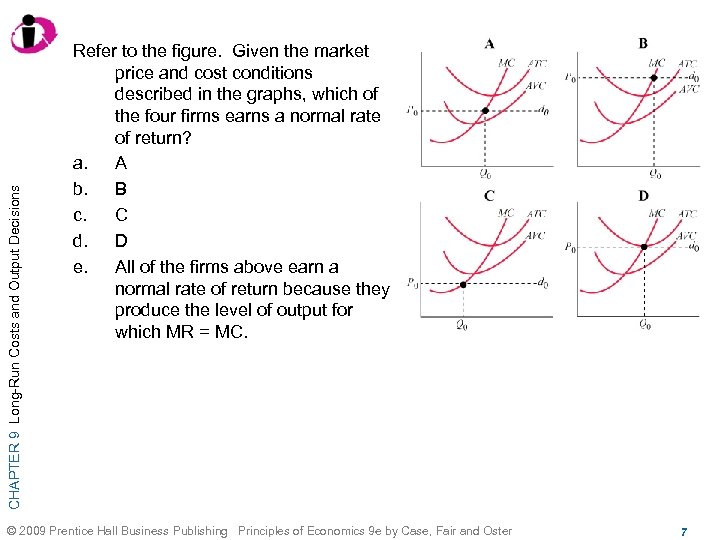 CHAPTER 9 Long-Run Costs and Output Decisions Refer to the figure. Given the market price and cost conditions described in the graphs, which of the four firms earns a normal rate of return? a. A b. B c. C d. D e. All of the firms above earn a normal rate of return because they produce the level of output for which MR = MC. © 2009 Prentice Hall Business Publishing Principles of Economics 9 e by Case, Fair and Oster 7
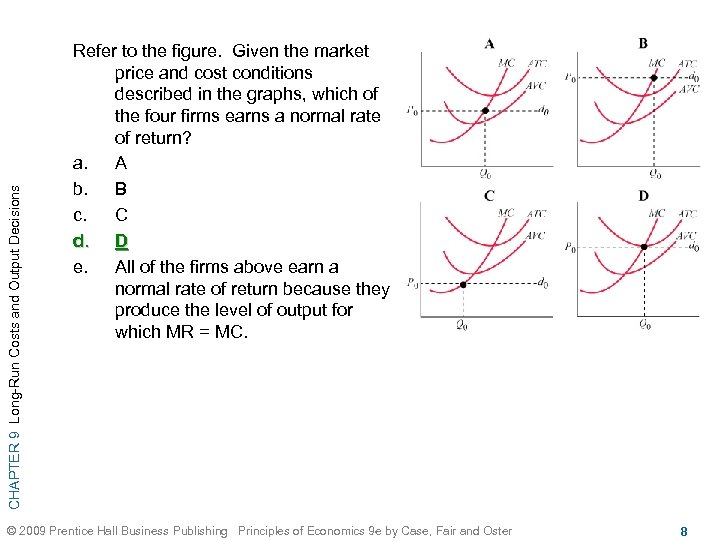 CHAPTER 9 Long-Run Costs and Output Decisions Refer to the figure. Given the market price and cost conditions described in the graphs, which of the four firms earns a normal rate of return? a. A b. B c. C d. D e. All of the firms above earn a normal rate of return because they produce the level of output for which MR = MC. © 2009 Prentice Hall Business Publishing Principles of Economics 9 e by Case, Fair and Oster 8
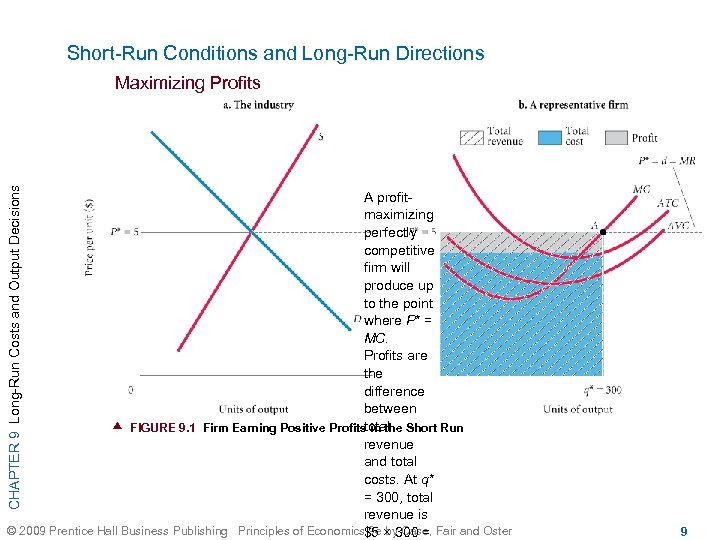 Short-Run Conditions and Long-Run Directions CHAPTER 9 Long-Run Costs and Output Decisions Maximizing Profits A profitmaximizing perfectly competitive firm will produce up to the point where P* = MC. Profits are the difference between total FIGURE 9. 1 Firm Earning Positive Profits in the Short Run revenue and total costs. At q* = 300, total revenue is © 2009 Prentice Hall Business Publishing Principles of Economics$5 × 300 = Fair and Oster 9 e by Case, 9
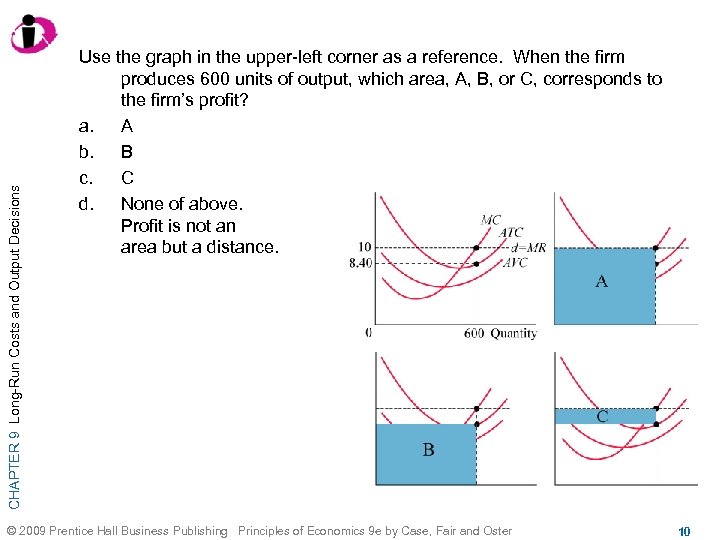 CHAPTER 9 Long-Run Costs and Output Decisions Use the graph in the upper-left corner as a reference. When the firm produces 600 units of output, which area, A, B, or C, corresponds to the firm’s profit? a. A b. B c. C d. None of above. Profit is not an area but a distance. © 2009 Prentice Hall Business Publishing Principles of Economics 9 e by Case, Fair and Oster 10
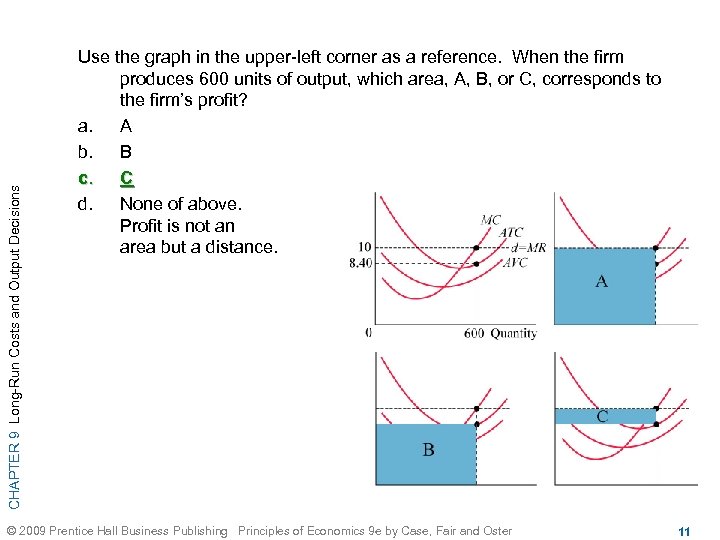 CHAPTER 9 Long-Run Costs and Output Decisions Use the graph in the upper-left corner as a reference. When the firm produces 600 units of output, which area, A, B, or C, corresponds to the firm’s profit? a. A b. B c. C d. None of above. Profit is not an area but a distance. © 2009 Prentice Hall Business Publishing Principles of Economics 9 e by Case, Fair and Oster 11
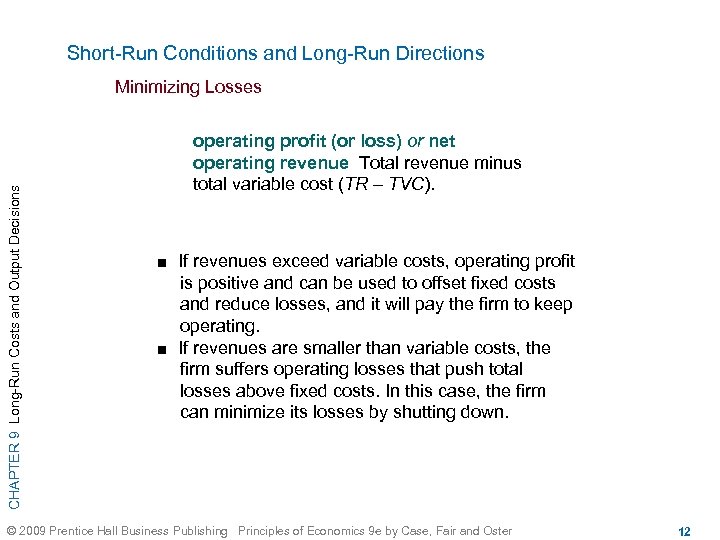 Short-Run Conditions and Long-Run Directions CHAPTER 9 Long-Run Costs and Output Decisions Minimizing Losses operating profit (or loss) or net operating revenue Total revenue minus total variable cost (TR TVC). ■ If revenues exceed variable costs, operating profit is positive and can be used to offset fixed costs and reduce losses, and it will pay the firm to keep operating. ■ If revenues are smaller than variable costs, the firm suffers operating losses that push total losses above fixed costs. In this case, the firm can minimize its losses by shutting down. © 2009 Prentice Hall Business Publishing Principles of Economics 9 e by Case, Fair and Oster 12
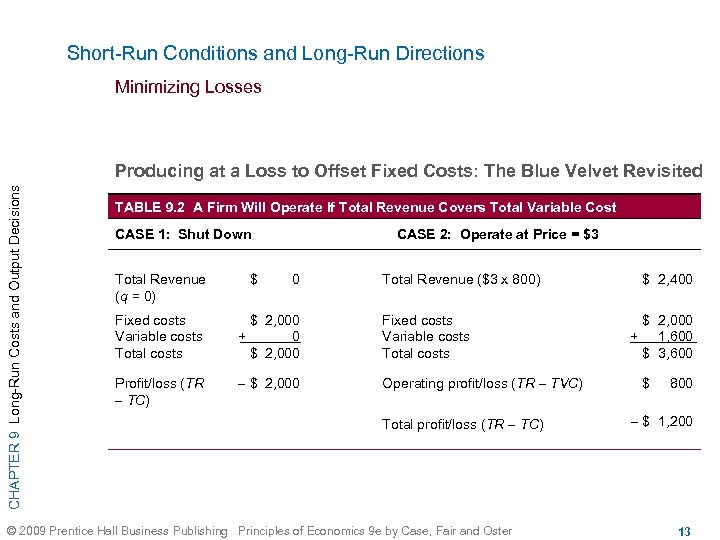 Short-Run Conditions and Long-Run Directions Minimizing Losses CHAPTER 9 Long-Run Costs and Output Decisions Producing at a Loss to Offset Fixed Costs: The Blue Velvet Revisited TABLE 9. 2 A Firm Will Operate If Total Revenue Covers Total Variable Cost CASE 1: Shut Down Total Revenue (q = 0) $ CASE 2: Operate at Price = $3 0 Total Revenue ($3 x 800) Fixed costs Variable costs Total costs $ 2, 000 + 0 $ 2, 000 Fixed costs Variable costs Total costs Profit/loss (TR TC) $ 2, 000 Operating profit/loss (TR TVC) Total profit/loss (TR TC) © 2009 Prentice Hall Business Publishing Principles of Economics 9 e by Case, Fair and Oster $ 2, 400 $ 2, 000 + 1, 600 $ 3, 600 $ 800 $ 1, 200 13
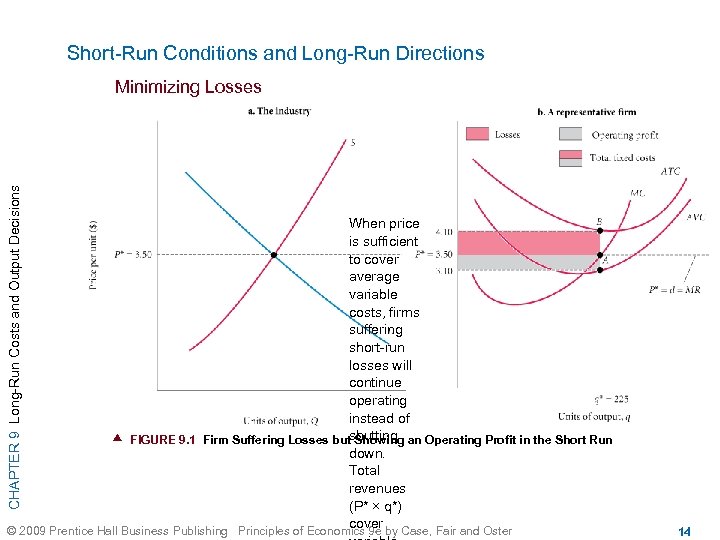 Short-Run Conditions and Long-Run Directions CHAPTER 9 Long-Run Costs and Output Decisions Minimizing Losses When price is sufficient to cover average variable costs, firms suffering short-run losses will continue operating instead of FIGURE 9. 1 Firm Suffering Losses butshutting an Operating Profit in the Short Run Showing down. Total revenues (P* × q*) cover © 2009 Prentice Hall Business Publishing Principles of Economics 9 e by Case, Fair and Oster 14
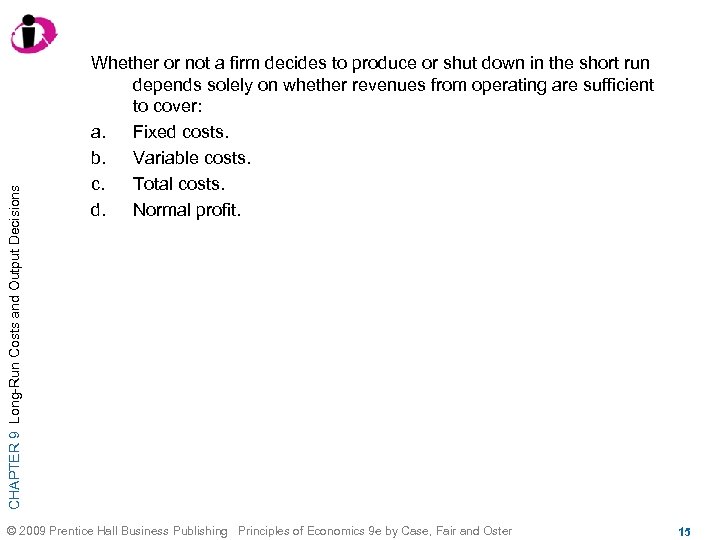 CHAPTER 9 Long-Run Costs and Output Decisions Whether or not a firm decides to produce or shut down in the short run depends solely on whether revenues from operating are sufficient to cover: a. Fixed costs. b. Variable costs. c. Total costs. d. Normal profit. © 2009 Prentice Hall Business Publishing Principles of Economics 9 e by Case, Fair and Oster 15
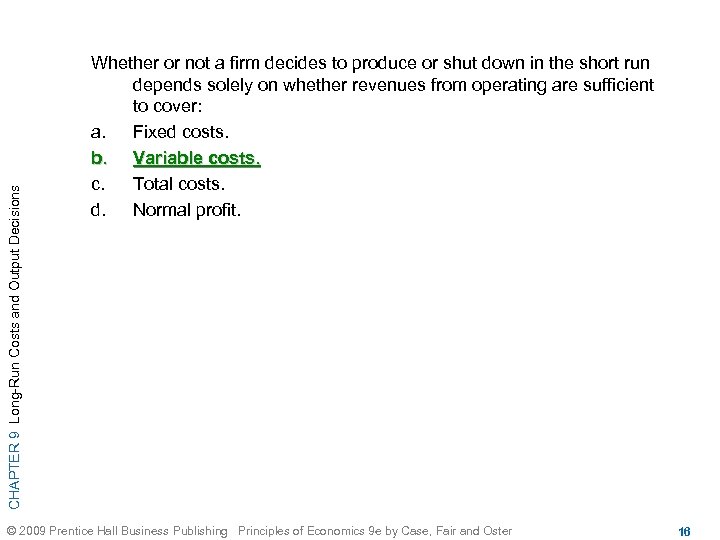 CHAPTER 9 Long-Run Costs and Output Decisions Whether or not a firm decides to produce or shut down in the short run depends solely on whether revenues from operating are sufficient to cover: a. Fixed costs. b. Variable costs. c. Total costs. d. Normal profit. © 2009 Prentice Hall Business Publishing Principles of Economics 9 e by Case, Fair and Oster 16
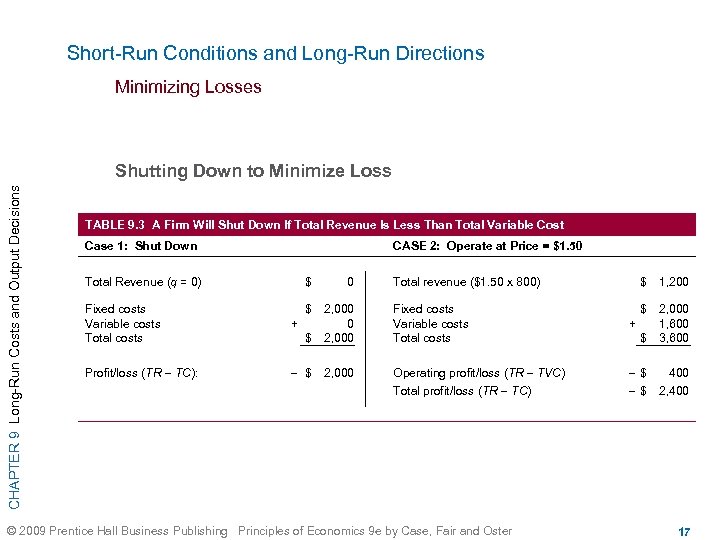 Short-Run Conditions and Long-Run Directions Minimizing Losses CHAPTER 9 Long-Run Costs and Output Decisions Shutting Down to Minimize Loss TABLE 9. 3 A Firm Will Shut Down If Total Revenue Is Less Than Total Variable Cost Case 1: Shut Down CASE 2: Operate at Price = $1. 50 Total Revenue (q = 0) $ 0 $ Fixed costs Variable costs Total costs + Operating profit/loss (TR TVC) Total profit/loss (TR TC) Fixed costs Variable costs Total costs + $ 2, 000 0 2, 000 Profit/loss (TR TC): $ 2, 000 Total revenue ($1. 50 x 800) © 2009 Prentice Hall Business Publishing Principles of Economics 9 e by Case, Fair and Oster $ 1, 200 $ $ 2, 000 1, 600 3, 600 $ $ 400 2, 400 17
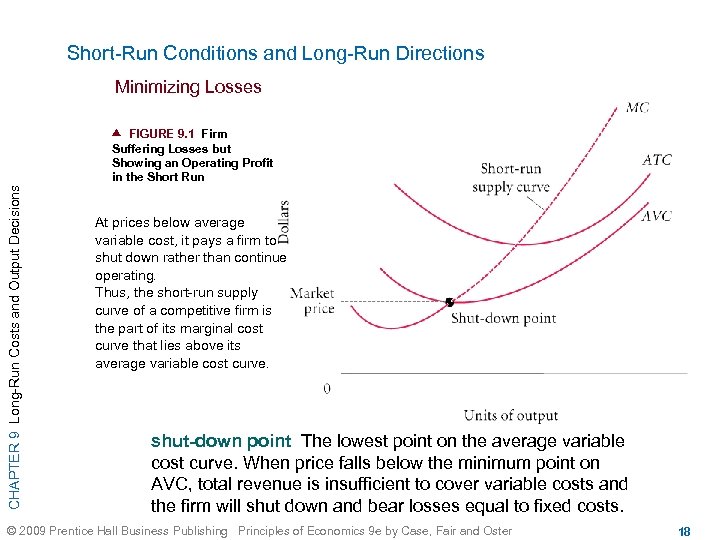 Short-Run Conditions and Long-Run Directions Minimizing Losses CHAPTER 9 Long-Run Costs and Output Decisions FIGURE 9. 1 Firm Suffering Losses but Showing an Operating Profit in the Short Run At prices below average variable cost, it pays a firm to shut down rather than continue operating. Thus, the short-run supply curve of a competitive firm is the part of its marginal cost curve that lies above its average variable cost curve. shut-down point The lowest point on the average variable cost curve. When price falls below the minimum point on AVC, total revenue is insufficient to cover variable costs and the firm will shut down and bear losses equal to fixed costs. © 2009 Prentice Hall Business Publishing Principles of Economics 9 e by Case, Fair and Oster 18
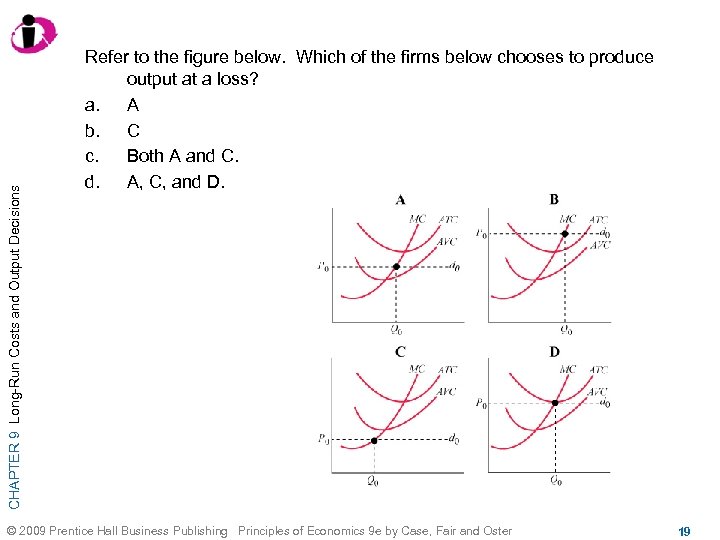 CHAPTER 9 Long-Run Costs and Output Decisions Refer to the figure below. Which of the firms below chooses to produce output at a loss? a. A b. C c. Both A and C. d. A, C, and D. © 2009 Prentice Hall Business Publishing Principles of Economics 9 e by Case, Fair and Oster 19
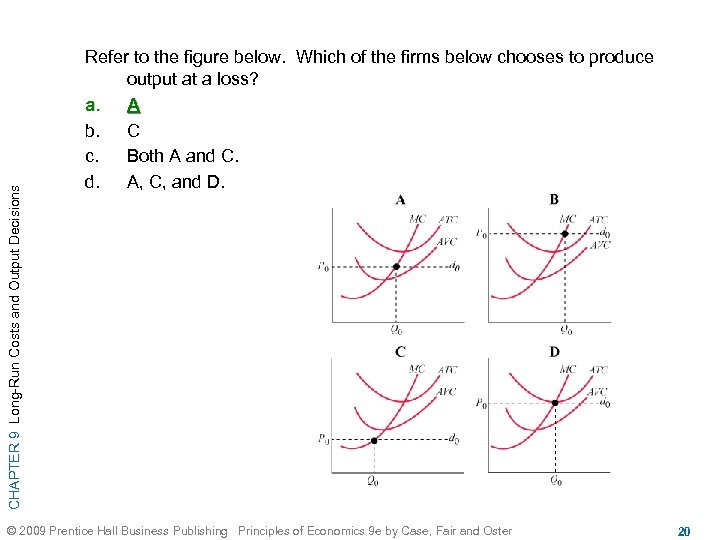 CHAPTER 9 Long-Run Costs and Output Decisions Refer to the figure below. Which of the firms below chooses to produce output at a loss? a. A b. C c. Both A and C. d. A, C, and D. © 2009 Prentice Hall Business Publishing Principles of Economics 9 e by Case, Fair and Oster 20
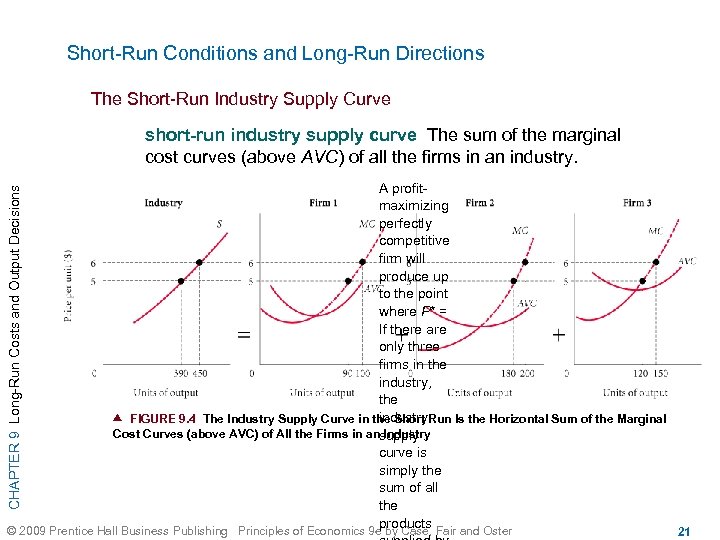 Short-Run Conditions and Long-Run Directions The Short-Run Industry Supply Curve CHAPTER 9 Long-Run Costs and Output Decisions short-run industry supply curve The sum of the marginal cost curves (above AVC) of all the firms in an industry. A profitmaximizing perfectly competitive firm will produce up to the point where P* = If there are only three firms in the industry, the industry FIGURE 9. 4 The Industry Supply Curve in the Short Run Is the Horizontal Sum of the Marginal Cost Curves (above AVC) of All the Firms in ansupply Industry curve is simply the sum of all the products © 2009 Prentice Hall Business Publishing Principles of Economics 9 e by Case, Fair and Oster 21
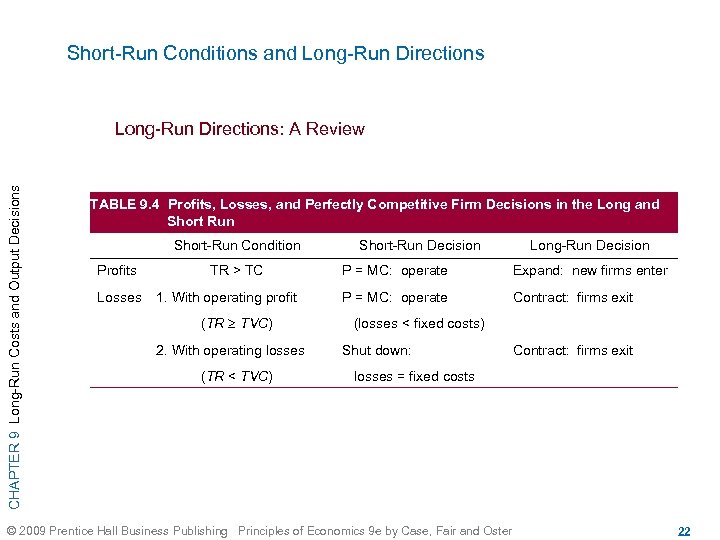 Short-Run Conditions and Long-Run Directions CHAPTER 9 Long-Run Costs and Output Decisions Long-Run Directions: A Review TABLE 9. 4 Profits, Losses, and Perfectly Competitive Firm Decisions in the Long and Short Run Short-Run Condition Profits Losses TR > TC 1. With operating profit (TR TVC) 2. With operating losses (TR < TVC) Short-Run Decision Long-Run Decision P = MC: operate Expand: new firms enter P = MC: operate Contract: firms exit (losses < fixed costs) Shut down: Contract: firms exit losses = fixed costs © 2009 Prentice Hall Business Publishing Principles of Economics 9 e by Case, Fair and Oster 22
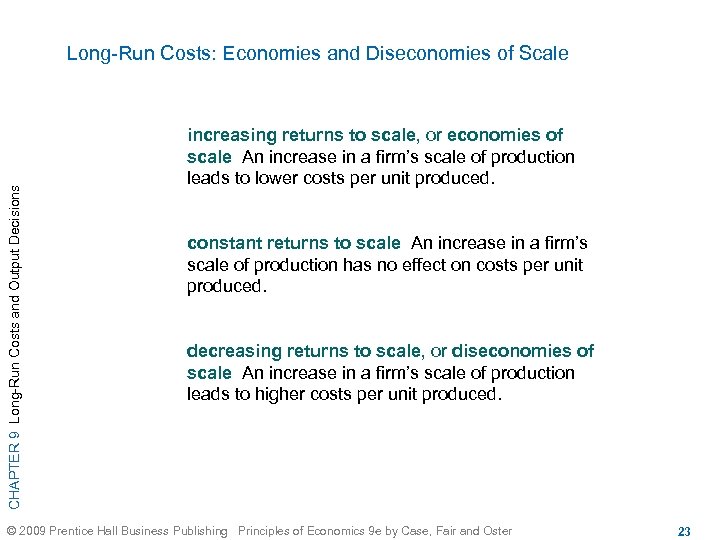 CHAPTER 9 Long-Run Costs and Output Decisions Long-Run Costs: Economies and Diseconomies of Scale increasing returns to scale, or economies of scale An increase in a firm’s scale of production leads to lower costs per unit produced. constant returns to scale An increase in a firm’s scale of production has no effect on costs per unit produced. decreasing returns to scale, or diseconomies of scale An increase in a firm’s scale of production leads to higher costs per unit produced. © 2009 Prentice Hall Business Publishing Principles of Economics 9 e by Case, Fair and Oster 23
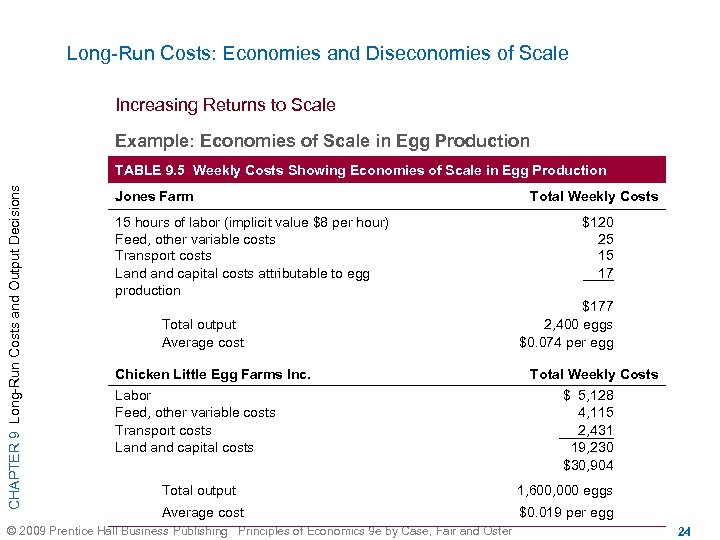 Long-Run Costs: Economies and Diseconomies of Scale Increasing Returns to Scale Example: Economies of Scale in Egg Production CHAPTER 9 Long-Run Costs and Output Decisions TABLE 9. 5 Weekly Costs Showing Economies of Scale in Egg Production Jones Farm 15 hours of labor (implicit value $8 per hour) Feed, other variable costs Transport costs Land capital costs attributable to egg production Total output Average cost Chicken Little Egg Farms Inc. Labor Feed, other variable costs Transport costs Land capital costs Total Weekly Costs $120 25 15 17 $177 2, 400 eggs $0. 074 per egg Total Weekly Costs $ 5, 128 4, 115 2, 431 19, 230 $30, 904 Total output 1, 600, 000 eggs Average cost $0. 019 per egg © 2009 Prentice Hall Business Publishing Principles of Economics 9 e by Case, Fair and Oster 24
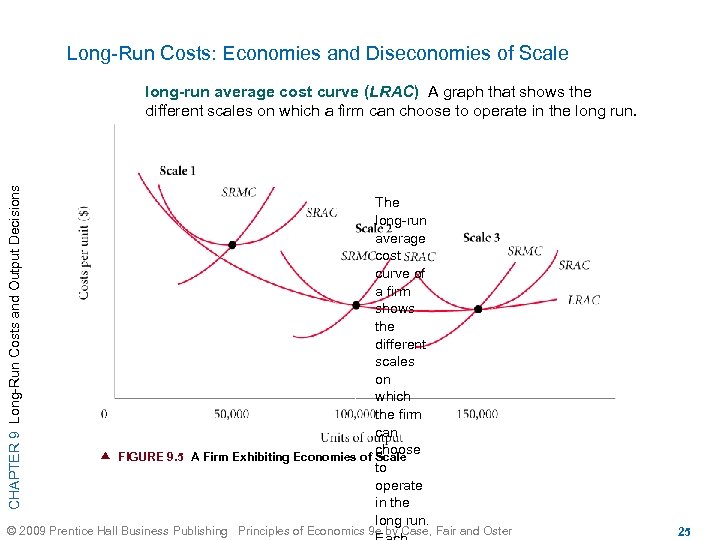 Long-Run Costs: Economies and Diseconomies of Scale CHAPTER 9 Long-Run Costs and Output Decisions long-run average cost curve (LRAC) A graph that shows the different scales on which a firm can choose to operate in the long run. The long-run average cost curve of a firm shows the different scales on which the firm can choose FIGURE 9. 5 A Firm Exhibiting Economies of Scale to operate in the long run. © 2009 Prentice Hall Business Publishing Principles of Economics 9 e by Case, Fair and Oster 25
 Long-Run Costs: Economies and Diseconomies of Scale CHAPTER 9 Long-Run Costs and Output Decisions Constant Returns to Scale Technically, the term constant returns means that the quantitative relationship between input and output stays constant, or the same, when output is increased. Constant returns to scale mean that the firm’s longrun average cost curve remains flat. © 2009 Prentice Hall Business Publishing Principles of Economics 9 e by Case, Fair and Oster 26
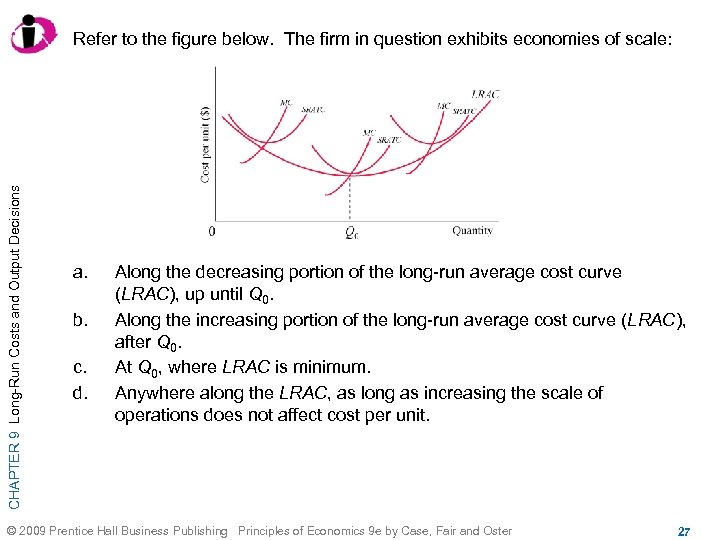 CHAPTER 9 Long-Run Costs and Output Decisions Refer to the figure below. The firm in question exhibits economies of scale: a. b. c. d. Along the decreasing portion of the long-run average cost curve (LRAC), up until Q 0. Along the increasing portion of the long-run average cost curve (LRAC), after Q 0. At Q 0, where LRAC is minimum. Anywhere along the LRAC, as long as increasing the scale of operations does not affect cost per unit. © 2009 Prentice Hall Business Publishing Principles of Economics 9 e by Case, Fair and Oster 27
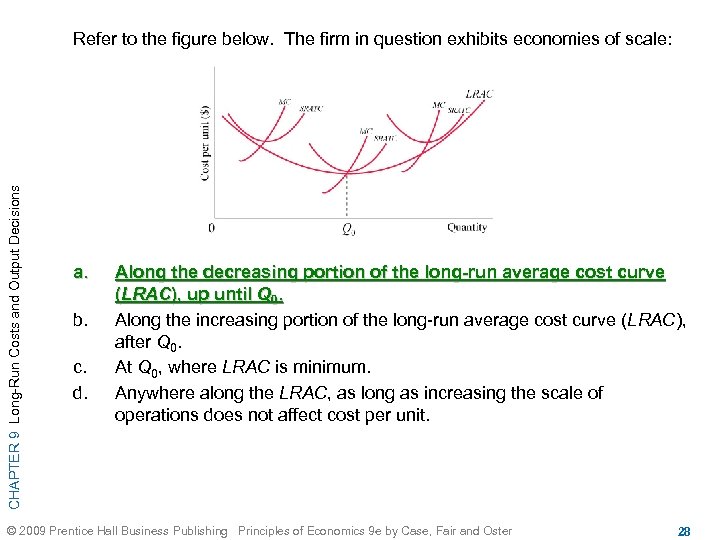 CHAPTER 9 Long-Run Costs and Output Decisions Refer to the figure below. The firm in question exhibits economies of scale: a. b. c. d. Along the decreasing portion of the long-run average cost curve (LRAC), up until Q 0. Along the increasing portion of the long-run average cost curve (LRAC), after Q 0. At Q 0, where LRAC is minimum. Anywhere along the LRAC, as long as increasing the scale of operations does not affect cost per unit. © 2009 Prentice Hall Business Publishing Principles of Economics 9 e by Case, Fair and Oster 28
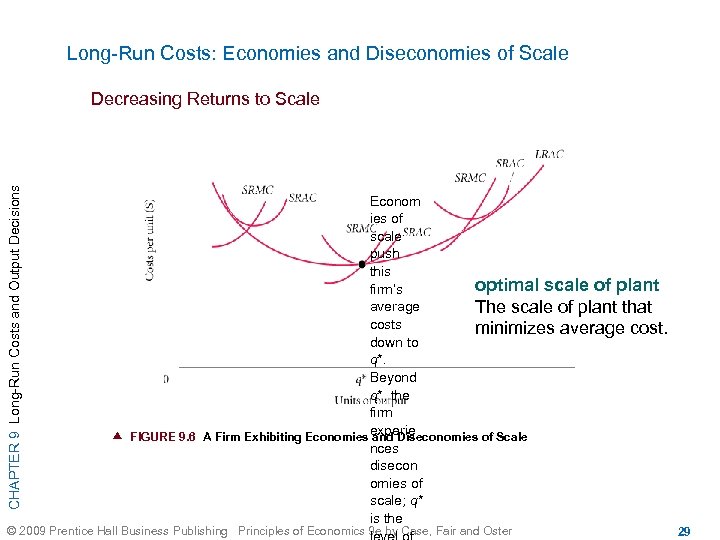 Long-Run Costs: Economies and Diseconomies of Scale CHAPTER 9 Long-Run Costs and Output Decisions Decreasing Returns to Scale Econom ies of scale push this optimal scale of plant firm’s average The scale of plant that costs minimizes average cost. down to q*. Beyond q*, the firm experie FIGURE 9. 6 A Firm Exhibiting Economies and Diseconomies of Scale nces disecon omies of scale; q* is the © 2009 Prentice Hall Business Publishing Principles of Economics 9 e by Case, Fair and Oster 29
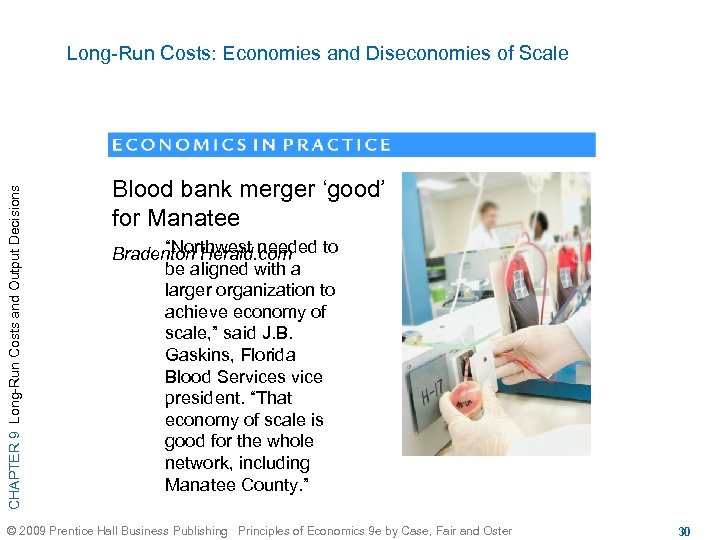 CHAPTER 9 Long-Run Costs and Output Decisions Long-Run Costs: Economies and Diseconomies of Scale Blood bank merger ‘good’ for Manatee “Northwest needed to Bradenton Herald. com be aligned with a larger organization to achieve economy of scale, ” said J. B. Gaskins, Florida Blood Services vice president. “That economy of scale is good for the whole network, including Manatee County. ” © 2009 Prentice Hall Business Publishing Principles of Economics 9 e by Case, Fair and Oster 30
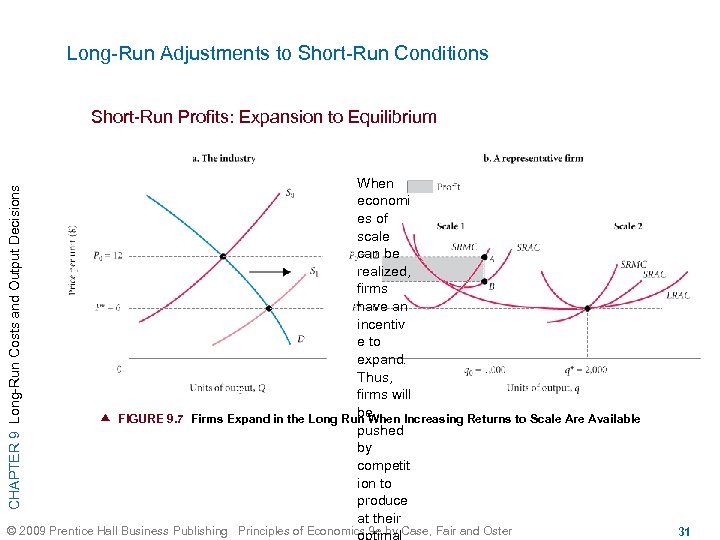 Long-Run Adjustments to Short-Run Conditions CHAPTER 9 Long-Run Costs and Output Decisions Short-Run Profits: Expansion to Equilibrium When economi es of scale can be realized, firms have an incentiv e to expand. Thus, firms will be FIGURE 9. 7 Firms Expand in the Long Run When Increasing Returns to Scale Are Available pushed by competit ion to produce at their © 2009 Prentice Hall Business Publishing Principles of Economics 9 e by Case, Fair and Oster 31
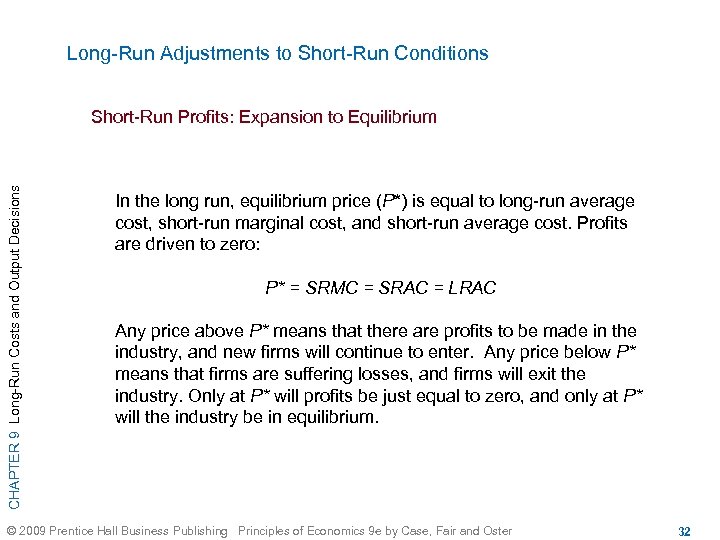 Long-Run Adjustments to Short-Run Conditions CHAPTER 9 Long-Run Costs and Output Decisions Short-Run Profits: Expansion to Equilibrium In the long run, equilibrium price (P*) is equal to long-run average cost, short-run marginal cost, and short-run average cost. Profits are driven to zero: P* = SRMC = SRAC = LRAC Any price above P* means that there are profits to be made in the industry, and new firms will continue to enter. Any price below P* means that firms are suffering losses, and firms will exit the industry. Only at P* will profits be just equal to zero, and only at P* will the industry be in equilibrium. © 2009 Prentice Hall Business Publishing Principles of Economics 9 e by Case, Fair and Oster 32
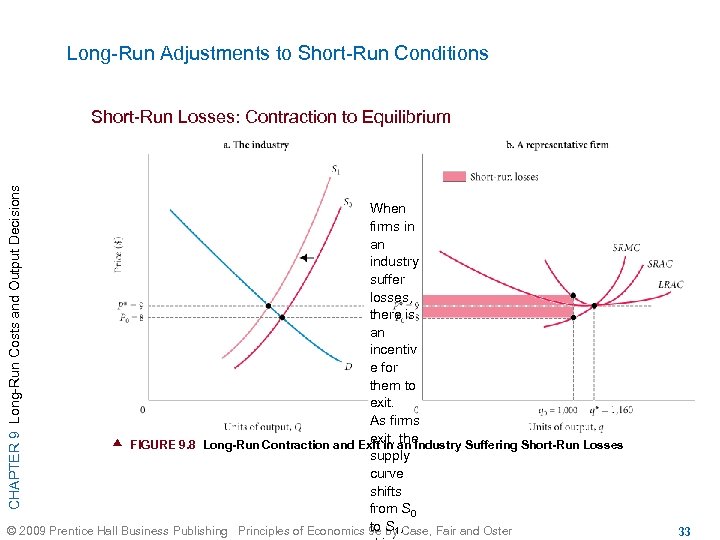 Long-Run Adjustments to Short-Run Conditions CHAPTER 9 Long-Run Costs and Output Decisions Short-Run Losses: Contraction to Equilibrium When firms in an industry suffer losses, there is an incentiv e for them to exit. As firms exit, the FIGURE 9. 8 Long-Run Contraction and Exit in an Industry Suffering Short-Run Losses supply curve shifts from S 0 to by © 2009 Prentice Hall Business Publishing Principles of Economics 9 e S 1, Case, Fair and Oster 33
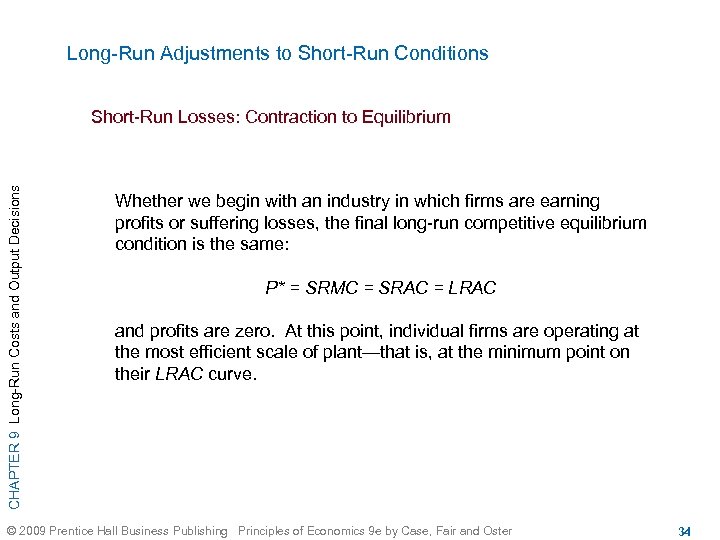 Long-Run Adjustments to Short-Run Conditions CHAPTER 9 Long-Run Costs and Output Decisions Short-Run Losses: Contraction to Equilibrium Whether we begin with an industry in which firms are earning profits or suffering losses, the final long-run competitive equilibrium condition is the same: P* = SRMC = SRAC = LRAC and profits are zero. At this point, individual firms are operating at the most efficient scale of plant—that is, at the minimum point on their LRAC curve. © 2009 Prentice Hall Business Publishing Principles of Economics 9 e by Case, Fair and Oster 34
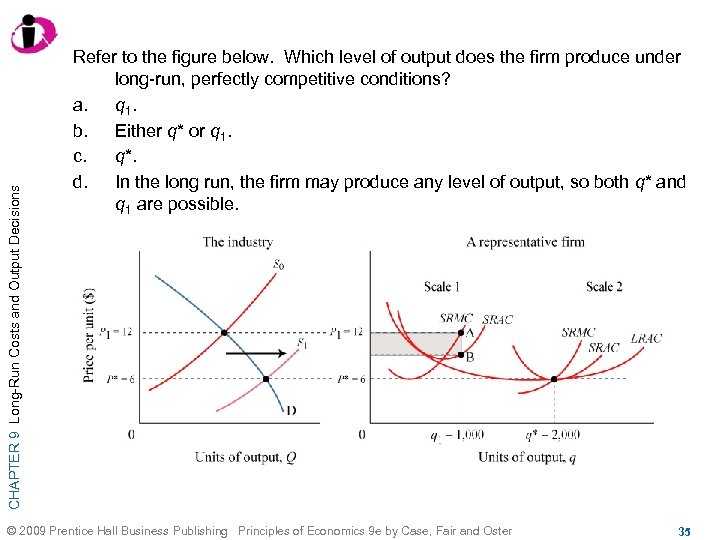 CHAPTER 9 Long-Run Costs and Output Decisions Refer to the figure below. Which level of output does the firm produce under long-run, perfectly competitive conditions? a. q 1. b. Either q* or q 1. c. q*. d. In the long run, the firm may produce any level of output, so both q* and q 1 are possible. © 2009 Prentice Hall Business Publishing Principles of Economics 9 e by Case, Fair and Oster 35
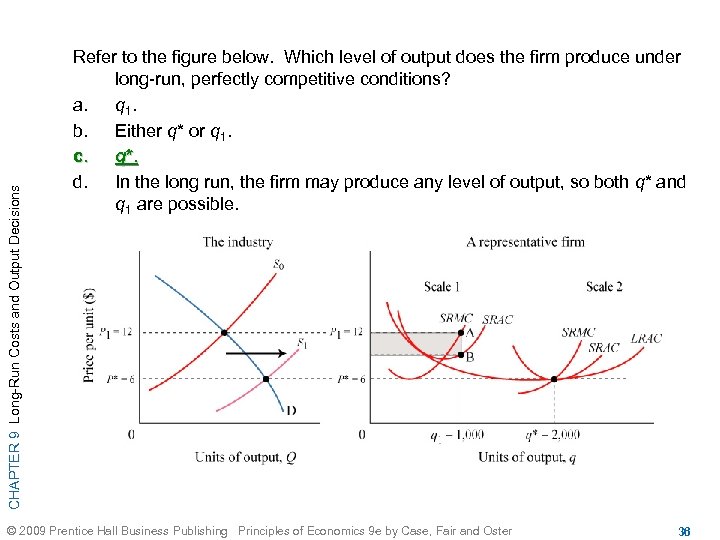 CHAPTER 9 Long-Run Costs and Output Decisions Refer to the figure below. Which level of output does the firm produce under long-run, perfectly competitive conditions? a. q 1. b. Either q* or q 1. c. q*. d. In the long run, the firm may produce any level of output, so both q* and q 1 are possible. © 2009 Prentice Hall Business Publishing Principles of Economics 9 e by Case, Fair and Oster 36
 CHAPTER 9 Long-Run Costs and Output Decisions Long-Run Adjustments to Short-Run Conditions The structure of the industry in the long run will depend on whether The Long-Run Averagefirms existing Cost expand faster Flat or U-Shaped? than new firms enter. Curve: There is an element of randomness in the way industries expand. Most industries contain some large firms and some small firms, © 2009 Prentice Hall Business Publishing Principles of Economics 9 e by Case, Fair and Oster 37
 Long-Run Adjustments to Short-Run Conditions CHAPTER 9 Long-Run Costs and Output Decisions The Long-Run Adjustment Mechanism: Investment Flows Toward Profit Opportunities The entry and exit of firms in response to profit opportunities usually involve the financial capital market. In capital markets, people are constantly looking for profits. When firms in an industry do well, capital is likely to flow into that industry in a variety of forms. long-run competitive equilibrium When P = SRMC = SRAC = LRAC and profits are zero. Investment—in the form of new firms and expanding old firms—will over time tend to favor those industries in which profits are being made, and over time industries in which firms are suffering losses will gradually contract from disinvestment. © 2009 Prentice Hall Business Publishing Principles of Economics 9 e by Case, Fair and Oster 38
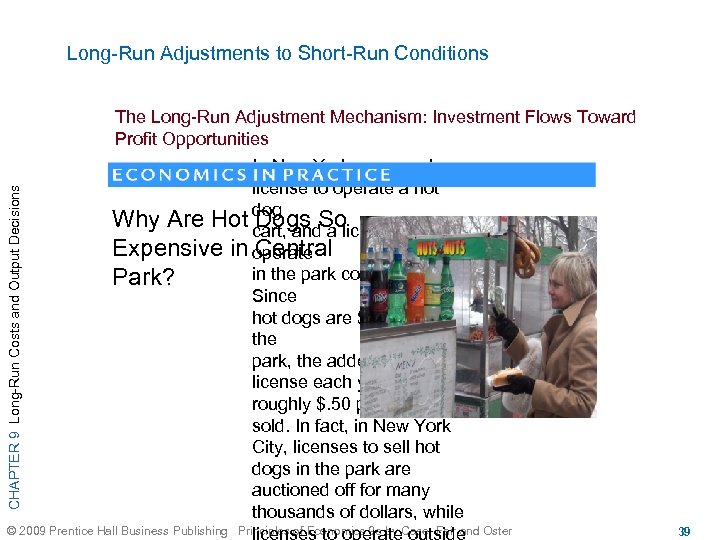 Long-Run Adjustments to Short-Run Conditions The Long-Run Adjustment Mechanism: Investment Flows Toward Profit Opportunities CHAPTER 9 Long-Run Costs and Output Decisions In New York, you need a license to operate a hot Why Are Hot dog and. So Dogs a license to cart, Expensive in operate Central in the park costs more. Park? Since hot dogs are $. 50 more in the park, the added cost of a license each year must be roughly $. 50 per hot dog sold. In fact, in New York City, licenses to sell hot dogs in the park are auctioned off for many thousands of dollars, while © 2009 Prentice Hall Business Publishing Principles of Economics 9 e by Case, Fair and Oster licenses to operate outside 39
 CHAPTER 9 Long-Run Costs and Output Decisions Output Markets: A Final Word In the last four chapters, we have been building a model of a simple market system under the assumption of perfect competition. You have now seen what lies behind the demand curves and supply curves in competitive output markets. The next two chapters take up competitive input markets and complete the picture. © 2009 Prentice Hall Business Publishing Principles of Economics 9 e by Case, Fair and Oster 40
 CHAPTER 9 Long-Run Costs and Output Decisions REVIEW TERMS AND CONCEPTS breaking even constant returns to scale decreasing returns to scale, or diseconomies of scale increasing returns to scale, or economies of scale long-run average cost curve (LRAC) long-run competitive equilibrium operating profit (or loss) or net operating revenue optimal scale of plant short-run industry supply curve shut-down point long-run competitive equilibrium, P = SRMC = SRAC = LRAC © 2009 Prentice Hall Business Publishing Principles of Economics 9 e by Case, Fair and Oster 41
 APPENDIX CHAPTER 9 Long-Run Costs and Output Decisions EXTERNAL ECONOMIES AND DISECONOMIES AND THE LONGRUN INDUSTRY SUPPLY CURVE When long-run average costs decrease as a result of industry growth, we say that there are external economies. When average costs increase as a result of industry growth, we say that there are external diseconomies. © 2009 Prentice Hall Business Publishing Principles of Economics 9 e by Case, Fair and Oster 42
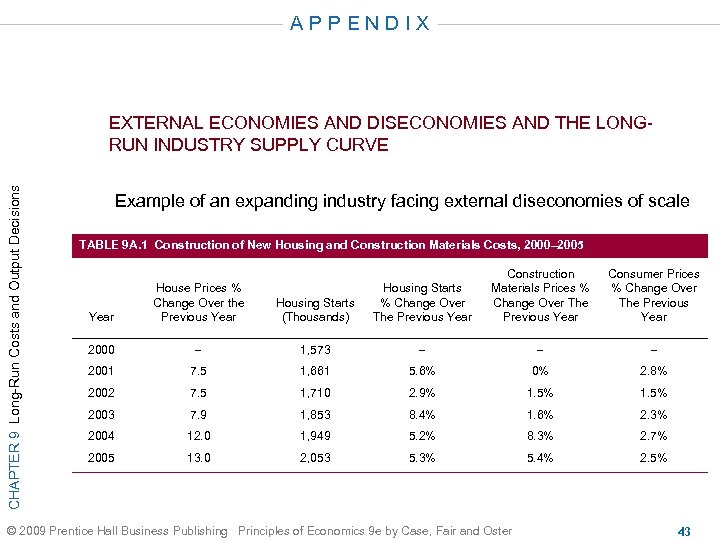 APPENDIX CHAPTER 9 Long-Run Costs and Output Decisions EXTERNAL ECONOMIES AND DISECONOMIES AND THE LONGRUN INDUSTRY SUPPLY CURVE Example of an expanding industry facing external diseconomies of scale TABLE 9 A. 1 Construction of New Housing and Construction Materials Costs, 2000– 2005 Year House Prices % Change Over the Previous Year Housing Starts (Thousands) Housing Starts % Change Over The Previous Year Construction Materials Prices % Change Over The Previous Year 2000 1, 573 2001 7. 5 1, 661 5. 6% 0% 2. 8% 2002 7. 5 1, 710 2. 9% 1. 5% 2003 7. 9 1, 853 8. 4% 1. 6% 2. 3% 2004 12. 0 1, 949 5. 2% 8. 3% 2. 7% 2005 13. 0 2, 053 5. 3% 5. 4% 2. 5% © 2009 Prentice Hall Business Publishing Principles of Economics 9 e by Case, Fair and Oster Consumer Prices % Change Over The Previous Year 43
 APPENDIX THE LONG-RUN INDUSTRY SUPPLY CURVE CHAPTER 9 Long-Run Costs and Output Decisions long-run industry supply curve (LRIS) A graph that traces out price and total output over time as an industry expands. decreasing-cost industry An industry that realizes external economies—that is, average costs decrease as the industry grows. The long-run supply curve for such an industry has a negative slope. constant-cost industry An industry that shows no economies or diseconomies of scale as the industry grows. Such industries have flat, or horizontal, long-run supply curves. increasing-cost industry An industry that encounters external diseconomies—that is, average costs increase as the industry grows. The long-run supply curve for such an industry has a positive slope. © 2009 Prentice Hall Business Publishing Principles of Economics 9 e by Case, Fair and Oster 44
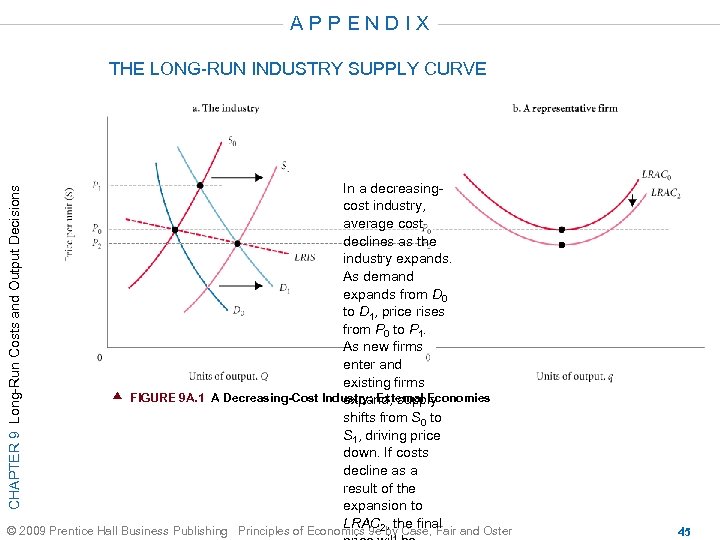 APPENDIX Appendix CHAPTER 9 Long-Run Costs and Output Decisions THE LONG-RUN INDUSTRY SUPPLY CURVE In a decreasingcost industry, average cost declines as the industry expands. As demand expands from D 0 to D 1, price rises from P 0 to P 1. As new firms enter and existing firms FIGURE 9 A. 1 A Decreasing-Cost Industry: External Economies expand, supply shifts from S 0 to S 1, driving price down. If costs decline as a result of the expansion to LRAC 2, the final © 2009 Prentice Hall Business Publishing Principles of Economics 9 e by Case, Fair and Oster 45
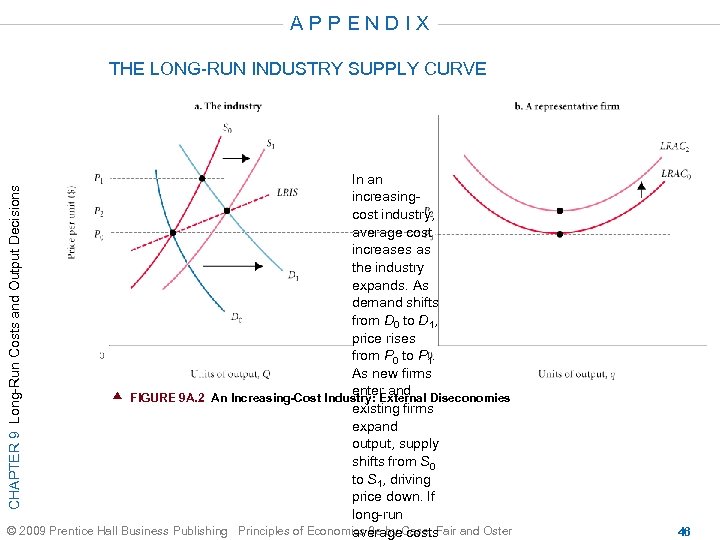 APPENDIX Appendix THE LONG-RUN INDUSTRY SUPPLY CURVE CHAPTER 9 Long-Run Costs and Output Decisions In an increasingcost industry, average cost increases as the industry expands. As demand shifts from D 0 to D 1, price rises from P 0 to P 1. As new firms enter and FIGURE 9 A. 2 An Increasing-Cost Industry: External Diseconomies existing firms expand output, supply shifts from S 0 to S 1, driving price down. If long-run © 2009 Prentice Hall Business Publishing Principles of Economics 9 e by Case, Fair and Oster average costs 46
 CHAPTER 9 Long-Run Costs and Output Decisions REVIEW TERMS AND CONCEPTS constant-cost industry decreasing-cost industry external economies and diseconomies increasing-cost industry long-run industry supply curve (LRIS) © 2009 Prentice Hall Business Publishing Principles of Economics 9 e by Case, Fair and Oster 47