


 Скачать презентацию Chapter 9 Lesson 1 The First President
9b9672f730aa46c16446bd45fa4b4bae.ppt
- Количество слайдов: 21
 Chapter 9 Lesson 1 The First President
 • Essential Question: − What are the characteristics of a leader? • Learning Goal: − Students will be able to identify and analyze the development of the American political system during the Federalist Era, evaluate decisions made by the new government, and draw conclusions about the economy developed under Alexander Hamilton.

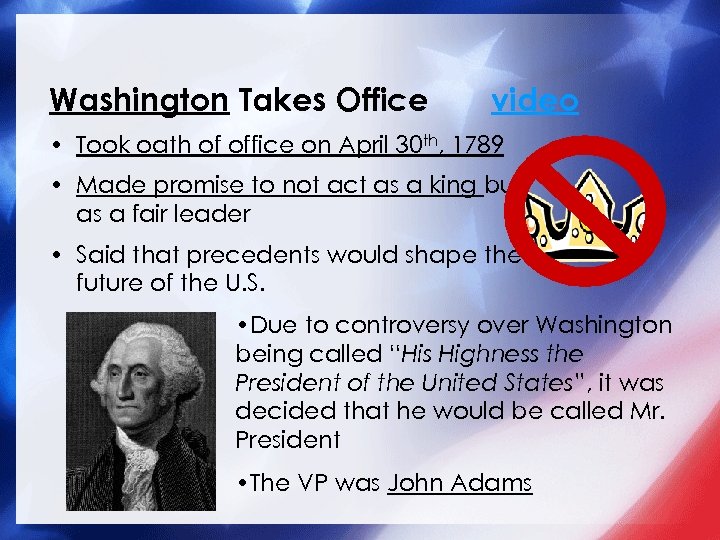 Washington Takes Office video • Took oath of office on April 30 th, 1789 • Made promise to not act as a king but as a fair leader • Said that precedents would shape the future of the U. S. • Due to controversy over Washington being called “His Highness the President of the United States”, it was decided that he would be called Mr. President • The VP was John Adams
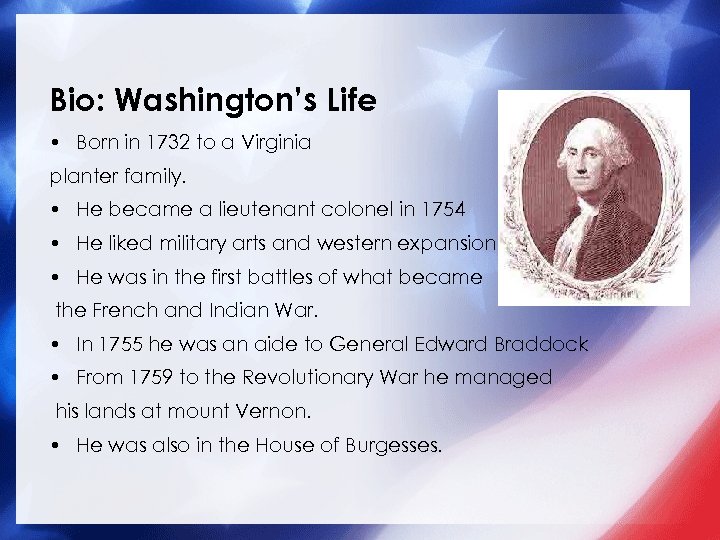 Bio: Washington’s Life • Born in 1732 to a Virginia planter family. • He became a lieutenant colonel in 1754 • He liked military arts and western expansion • He was in the first battles of what became the French and Indian War. • In 1755 he was an aide to General Edward Braddock • From 1759 to the Revolutionary War he managed his lands at mount Vernon. • He was also in the House of Burgesses.
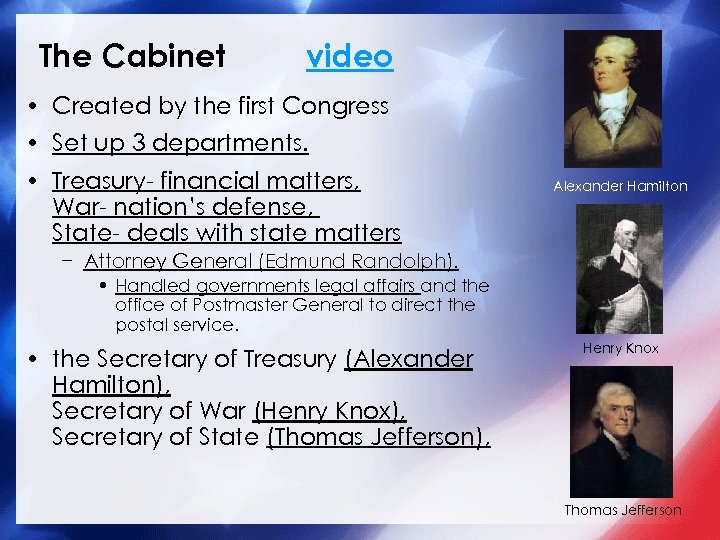 The Cabinet video • Created by the first Congress • Set up 3 departments. • Treasury- financial matters, War- nation’s defense, State- deals with state matters Alexander Hamilton − Attorney General (Edmund Randolph). • Handled governments legal affairs and the office of Postmaster General to direct the postal service. • the Secretary of Treasury (Alexander Hamilton), Secretary of War (Henry Knox), Secretary of State (Thomas Jefferson), Henry Knox Thomas Jefferson
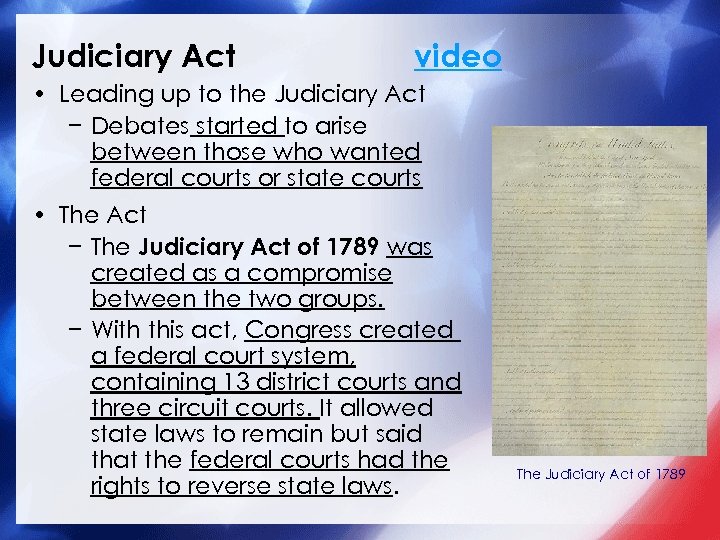 Judiciary Act video • Leading up to the Judiciary Act − Debates started to arise between those who wanted federal courts or state courts • The Act − The Judiciary Act of 1789 was created as a compromise between the two groups. − With this act, Congress created a federal court system, containing 13 district courts and three circuit courts. It allowed state laws to remain but said that the federal courts had the rights to reverse state laws. The Judiciary Act of 1789
 Judiciary Act (cont. ) • Following the Judiciary Act − With this Act, the Supreme Court would be the final authority on many issues. − John Jay was voted as the Supreme Court chief justice. − Also with this act, Congress had taken the first steps for creating a strong and independent judiciary system for the entire nation.
 Bill of Rights • Leading up to the Bill of Rights − Some states supported the Constitution on the condition that a bill of rights was added in order to have guarantees of their person liberties. − James Madison first introduced a Bill of Rights in the first session of Congress. • The Constitution -The states ratified 10 of the 12 amendments passed by Congress. - The 10 Amendments were added to the Constitution on December 1791, finally known as the Bill of Rights
 The 10 Amendments The first ten amendments: 1 st amendment: freedom of speech, the press, and religion; also the right to assemble peaceably or petition 2 nd amendment: the right to bear arms 3 rd amendment: no soldier, without the consent of the owner can take resident in someone else’s house 4 th amendment: people are secure in their persons, houses, and papers from unreasonable search and seizures (w/o a warrant) 5 th amendment: the right of a person to be innocent until proven guilty, and may not be deprived of life, liberty or property w/o due process of law 6 th amendment: right to a speedy, fair trial 7 th amendment: when the value in controversy exceeds $20, the right of trial by jury is reserved 8 th amendment: no cruel or unusual punishments are permitted 9 th amendment: powers reserved to people 10 th amendment: powers reserved to the states
 Financial Problems • After the war, the country was in a large amount of national debt and was suffering from a huge depression. • Many people were angry about money lost during the war, and other countries were unhappy that the newly formed United States still owed for help and supplies provided by them during the war against Britain. • To make matters worse, debt was growing. • Government economic policies were handled by the Sec. of Treasury, Alexander Hamilton, who proposed a plan to pay back the people and countries
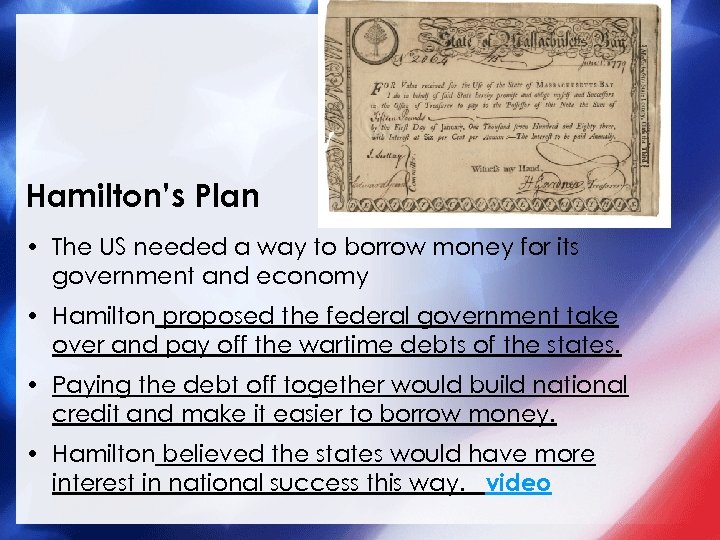 Hamilton’s Plan • The US needed a way to borrow money for its government and economy • Hamilton proposed the federal government take over and pay off the wartime debts of the states. • Paying the debt off together would build national credit and make it easier to borrow money. • Hamilton believed the states would have more interest in national success this way. video
 Opposition to the Plan • Hamilton’s plan made it difficult for many American citizens. • Bonds issued during the American Revolution had been sold to spectators for less than their value • The original bond owners felt betrayed by government because they had lost money. • At the same time, the new bond owners profited. • The south accumulated much less debt than the north. • The southern states complained that they would have to pay more than their share under the Hamilton's plan.
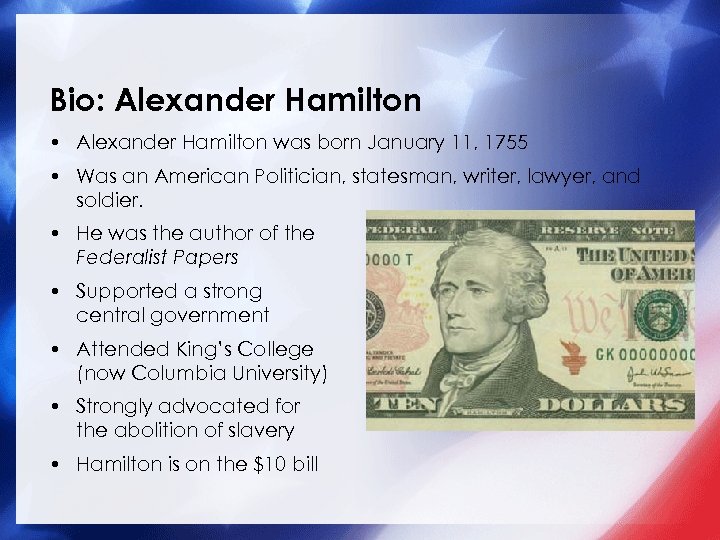 Bio: Alexander Hamilton • Alexander Hamilton was born January 11, 1755 • Was an American Politician, statesman, writer, lawyer, and soldier. • He was the author of the Federalist Papers • Supported a strong central government • Attended King’s College (now Columbia University) • Strongly advocated for the abolition of slavery • Hamilton is on the $10 bill
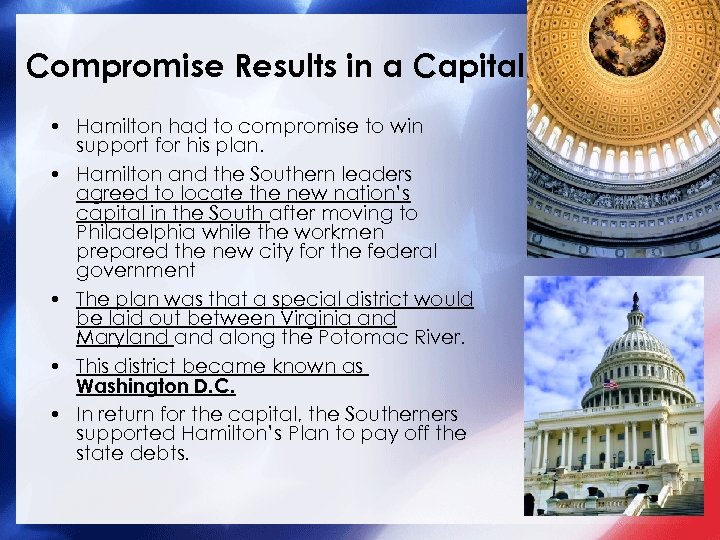 Compromise Results in a Capital • Hamilton had to compromise to win support for his plan. • Hamilton and the Southern leaders agreed to locate the new nation’s capital in the South after moving to Philadelphia while the workmen prepared the new city for the federal government • The plan was that a special district would be laid out between Virginia and Maryland along the Potomac River. • This district became known as Washington D. C. • In return for the capital, the Southerners supported Hamilton’s Plan to pay off the state debts.
 The Fight for a National Bank • In 1792, only 8 banks were in the entire nation, and all had been established by state governments • James Madison and Thomas Jefferson opposed the idea of a national bank: they thought it would only benefit wealthy people. • A bank was also said to be unconstitutional. • In the end, Alexander Hamilton signed a bill creating a national bank.
 Tariffs and Taxes • Hamilton proposed a tariff, or a tax on imports to encourage Americans to buy products. • This tariff would protect American industry from foreign competition. • The south opposed the protective tariffs, having little industry to protect. • Hamilton, however did win support from the congress. • By 1790 the revenue from tariffs provided 90% of the national government ‘s income. • Hamilton’s economic program gave the national government new financial powers.
 Exit Card • Why might the southern states oppose Hamilton’s plan? How might this have affected the relationship between the states?
 Timeline • April 6, 1789 – George Washington becomes first president • April 30, 1789 - Washington takes oath of office • Summer of 1789 - Congress sets up three executive branch departments of government • September 1789 - Judiciary Act of 1789 sets up court systems • December 1791 - 10 amendments are added to the Constitution and are known as the Bill of Rights • 1792 - there are only eight banks in the nation
 Test Questions 1. Why did people oppose to the President being addressed as “his highness the president of the United States? 2. What did the compromise in the Judiciary Act of 1789 do? 3. Who was to be the final authority on many issues? 4. Who introduced the amendments that became the Bill of Rights? 5. Who did the Congress owe money to?
 Test Questions 6. What are bonds? 7. What are speculators? 8. Why did the Southern states oppose Hamilton’s plan 9. What was the name of the area between VA and Maryland along the banks of the Potomac River called? 10. In 1972, how many banks where in the nation? 11. By the 1790’s, what percent of the countries revenue was from tariffs?