


 Скачать презентацию Chapter 9 Input Modeling Discrete-Event System Simulation
a2779dd739002a34f43aede8a77f87f9.ppt
- Количество слайдов: 53
 Chapter 9 Input Modeling Discrete-Event System Simulation
 Purpose & Overview Input models provide the driving force for a simulation model. The quality of the output is no better than the quality of inputs. In this chapter, we will discuss the 4 steps of input model development: Collect data from the real system Not always data is available. Expert opinion, knowledge of the process for educated guess. (nonexistent system, too little time or resources to collect data) Identify a probability distribution to represent the input process Histogram, nature of the process Choose parameters for the distribution Evaluate the chosen distribution and parameters for goodness of fit. Graphical methods (q_q test), statistical tests (Chi-Square and Kolmogrov-Simirnov tests) 2
 Data Collection One of the biggest tasks in solving a real problem. GIGO – garbage-in-garbage-out Suggestions that may enhance and facilitate data collection: Plan ahead: begin by a practice or pre-observing session, watch for unusual circumstances, device forms, video taping if possible. Analyze the data as it is being collected: check adequacy Check and Combine homogeneous data sets, e. g. successive time periods, during the same time period on successive days 3
 Data Collection Be aware of data censoring: the quantity is not observed in its entirety, danger of leaving out long process times Check for relationship between variables, e. g. build scatter diagram Check for autocorrelation for successive observations. Collect input data, not performance data. e. g. collect inter-arrival times, not the delays customers experience in queue (although performance measures can be useful for validation purposes) 4
 Identifying the Distribution Methods for selecting families of input distributions when data are available. Histograms Selecting families of distribution Parameter estimation Goodness-of-fit tests Fitting a non-stationary process 5
![Histograms [Identifying the distribution] A frequency distribution or histogram is useful in determining the](https://present5.com/presentation/a2779dd739002a34f43aede8a77f87f9/image-6.jpg "Histograms [Identifying the distribution] A frequency distribution or histogram is useful in determining the") Histograms [Identifying the distribution] A frequency distribution or histogram is useful in determining the shape of a distribution The number of class intervals for continuous R. V. depends on: The number of observations The dispersion of the data Suggested: the square root of the sample size Divide the range (max – min) into class intervals equal length. of 6
Histograms [Identifying the distribution] A frequency distribution or histogram is useful in determining the shape of a distribution The number of class intervals for continuous R. V. depends on: The number of observations The dispersion of the data Suggested: the square root of the sample size Divide the range (max – min) into class intervals equal length. of 6
![Histograms [Identifying the distribution] For continuous data: Corresponds to the probability density function of](https://present5.com/presentation/a2779dd739002a34f43aede8a77f87f9/image-7.jpg "Histograms [Identifying the distribution] For continuous data: Corresponds to the probability density function of") Histograms [Identifying the distribution] For continuous data: Corresponds to the probability density function of a theoretical distribution For discrete data: One interval for Corresponds to each data point. the probability mass function If few data points are available: combine adjacent cells to eliminate the ragged appearance of the histogram 7
Histograms [Identifying the distribution] For continuous data: Corresponds to the probability density function of a theoretical distribution For discrete data: One interval for Corresponds to each data point. the probability mass function If few data points are available: combine adjacent cells to eliminate the ragged appearance of the histogram 7
 Histograms 8
![Histograms [Identifying the distribution] Vehicle Arrival Example 9. 2: # of vehicles arriving at](https://present5.com/presentation/a2779dd739002a34f43aede8a77f87f9/image-9.jpg "Histograms [Identifying the distribution] Vehicle Arrival Example 9. 2: # of vehicles arriving at") Histograms [Identifying the distribution] Vehicle Arrival Example 9. 2: # of vehicles arriving at an intersection between 7 am and 7: 05 am was monitored for 100 random workdays. There ample data, so the histogram may have a cell for each possible value in the data range, which is the case for discrete random variables usually. Example 9. 3 9
Histograms [Identifying the distribution] Vehicle Arrival Example 9. 2: # of vehicles arriving at an intersection between 7 am and 7: 05 am was monitored for 100 random workdays. There ample data, so the histogram may have a cell for each possible value in the data range, which is the case for discrete random variables usually. Example 9. 3 9
![Selecting the Family of Distributions [Identifying the distribution] Purpose of histogram is to infer](https://present5.com/presentation/a2779dd739002a34f43aede8a77f87f9/image-10.jpg "Selecting the Family of Distributions [Identifying the distribution] Purpose of histogram is to infer") Selecting the Family of Distributions [Identifying the distribution] Purpose of histogram is to infer a known pdf or pmf A family of distributions is selected based on: The context of the input variable Shape of the histogram Frequently encountered distributions: Easier to analyze: exponential, normal and Poisson Harder to analyze (from computational standpoint): beta, gamma and Weibull 10
Selecting the Family of Distributions [Identifying the distribution] Purpose of histogram is to infer a known pdf or pmf A family of distributions is selected based on: The context of the input variable Shape of the histogram Frequently encountered distributions: Easier to analyze: exponential, normal and Poisson Harder to analyze (from computational standpoint): beta, gamma and Weibull 10
 Nature of the process Use the physical basis of the distribution as a guide, for example: Binomial; # of successes in n independent trials with p probability of successes Exm; # of defective chips in a lot of n chips. Each chip is independent Negative binomial (special case geometric distribution); # of trials required to achieve k successes (k=1 for geometric) Exm; # of computer chips we must inspect to find 4 defective chips Exm; Demand distribution. 11
 Nature of the process Poisson; # of independent events that occur in a fixed amount of time or space. Exm; # of customers arriving to a store in 1 hour. # of defects found in a 30 square meter of metal sheet. Exponential; Models the time between independent events, or a process time which is memoryless. Exm; Times between arrivals coming from a large populations who act independently. 12
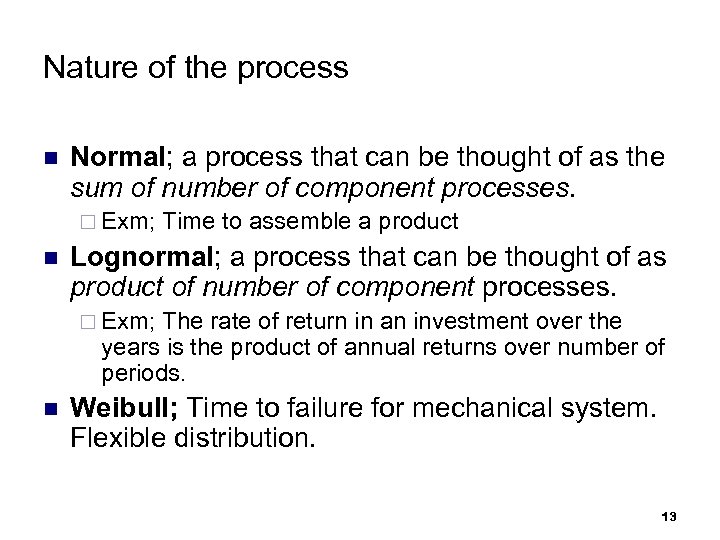 Nature of the process Normal; a process that can be thought of as the sum of number of component processes. Exm; Time to assemble a product Lognormal; a process that can be thought of as product of number of component processes. Exm; The rate of return in an investment over the years is the product of annual returns over number of periods. Weibull; Time to failure for mechanical system. Flexible distribution. 13
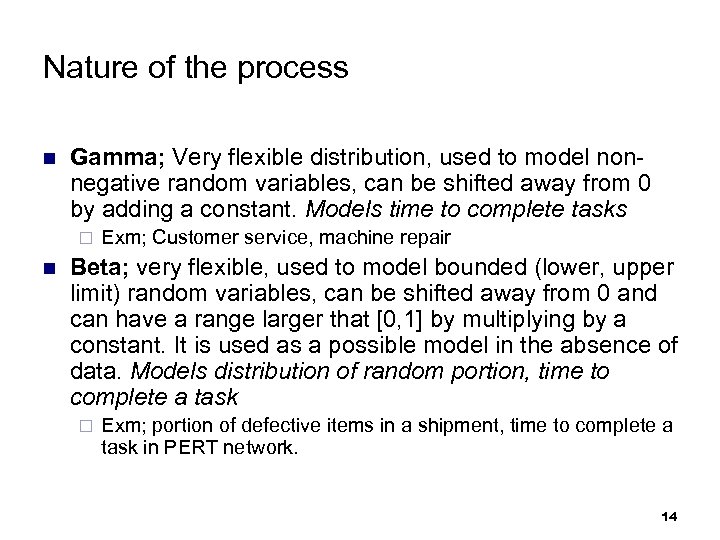 Nature of the process Gamma; Very flexible distribution, used to model nonnegative random variables, can be shifted away from 0 by adding a constant. Models time to complete tasks Exm; Customer service, machine repair Beta; very flexible, used to model bounded (lower, upper limit) random variables, can be shifted away from 0 and can have a range larger that [0, 1] by multiplying by a constant. It is used as a possible model in the absence of data. Models distribution of random portion, time to complete a task Exm; portion of defective items in a shipment, time to complete a task in PERT network. 14
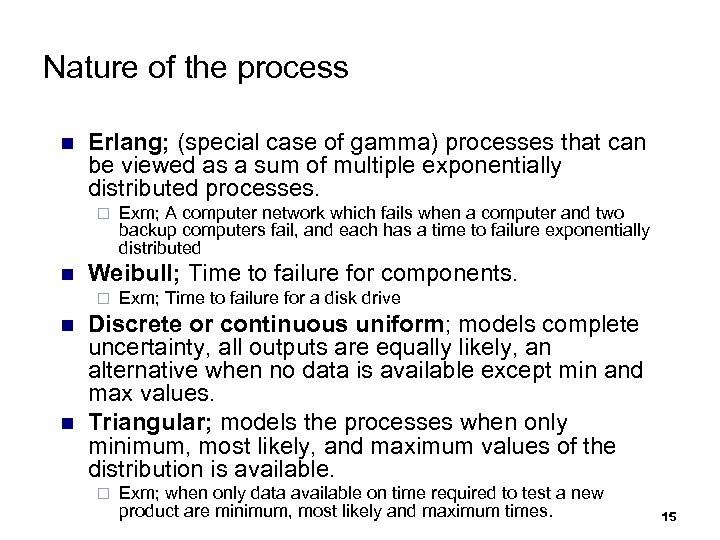 Nature of the process Erlang; (special case of gamma) processes that can be viewed as a sum of multiple exponentially distributed processes. Weibull; Time to failure for components. Exm; A computer network which fails when a computer and two backup computers fail, and each has a time to failure exponentially distributed Exm; Time to failure for a disk drive Discrete or continuous uniform; models complete uncertainty, all outputs are equally likely, an alternative when no data is available except min and max values. Triangular; models the processes when only minimum, most likely, and maximum values of the distribution is available. Exm; when only data available on time required to test a new product are minimum, most likely and maximum times. 15
![Selecting the Family of Distributions [Identifying the distribution] Remember the physical characteristics of the](https://present5.com/presentation/a2779dd739002a34f43aede8a77f87f9/image-16.jpg "Selecting the Family of Distributions [Identifying the distribution] Remember the physical characteristics of the") Selecting the Family of Distributions [Identifying the distribution] Remember the physical characteristics of the process Is the process naturally discrete or continuous valued? Is it bounded? No “true” distribution for any stochastic input process Goal: obtain a good approximation 16
Selecting the Family of Distributions [Identifying the distribution] Remember the physical characteristics of the process Is the process naturally discrete or continuous valued? Is it bounded? No “true” distribution for any stochastic input process Goal: obtain a good approximation 16
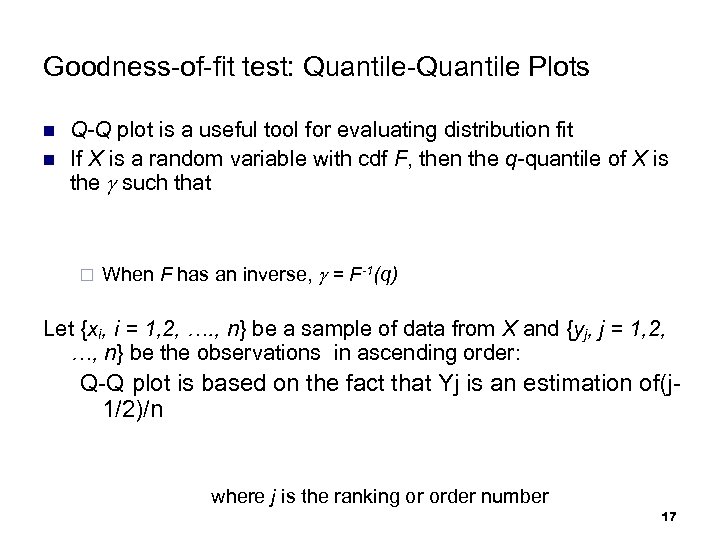 Goodness-of-fit test: Quantile-Quantile Plots Q-Q plot is a useful tool for evaluating distribution fit If X is a random variable with cdf F, then the q-quantile of X is the such that When F has an inverse, = F-1(q) Let {xi, i = 1, 2, …. , n} be a sample of data from X and {yj, j = 1, 2, …, n} be the observations in ascending order: Q-Q plot is based on the fact that Yj is an estimation of(j 1/2)/n where j is the ranking or order number 17
 Quantile-Quantile Plots The plot of yj versus F-1( (j-0. 5)/n) is Approximately a straight line if F is a member of an appropriate family of distributions The line has slope 1 if F is a member of an appropriate family of distributions with appropriate parameter values 18
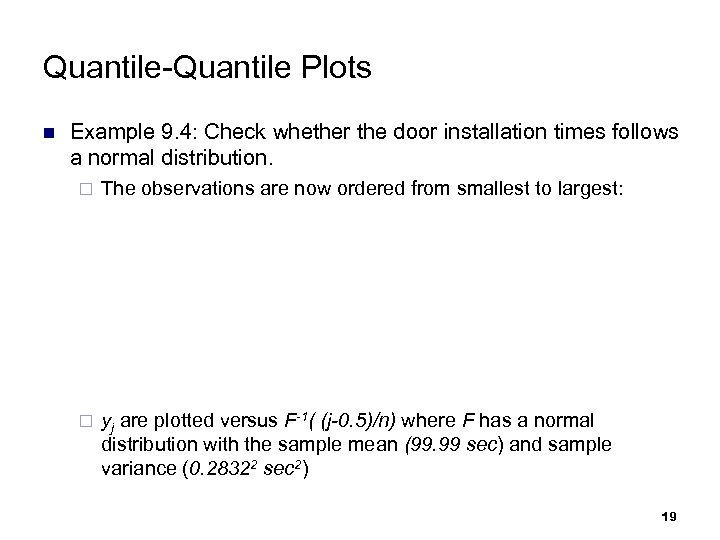 Quantile-Quantile Plots Example 9. 4: Check whether the door installation times follows a normal distribution. The observations are now ordered from smallest to largest: yj are plotted versus F-1( (j-0. 5)/n) where F has a normal distribution with the sample mean (99. 99 sec) and sample variance (0. 28322 sec 2) 19
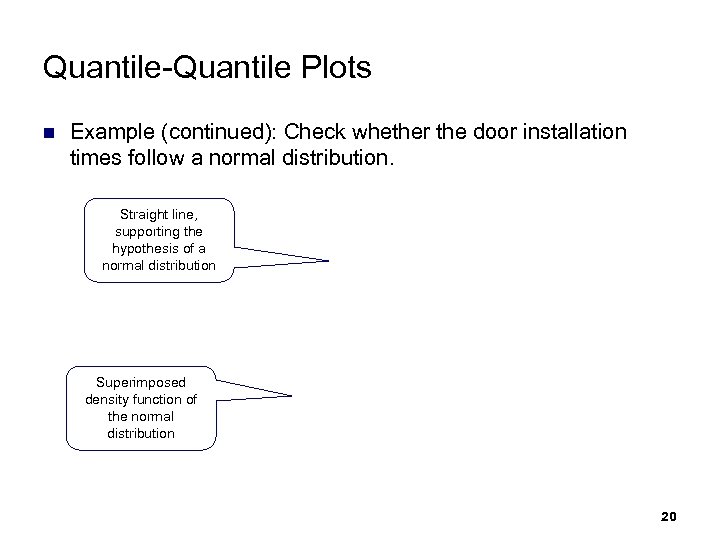 Quantile-Quantile Plots Example (continued): Check whether the door installation times follow a normal distribution. Straight line, supporting the hypothesis of a normal distribution Superimposed density function of the normal distribution 20
 Goodness-of-Fit: Quantile-Quantile Plots Consider the following while evaluating the linearity of a q-q plot: The observed values never fall exactly on a straight line The ordered values are ranked and hence not independent, unlikely for the points to be scattered about the line Variance of the extremes is higher than the middle. Linearity of the points in the middle of the plot is more important. Q-Q plot can also be used to check homogeneity Check whether a single distribution can represent both sample sets Plotting the order values of the two data samples against each other 21
 Probability-probability plot For both continuous and discrete data. Emphasizes errors in middle section of the distribution (fig 6. 40 -41) Rank the observation from smallest to largest; X(1), X(2) , . . , X(n) Plot 22
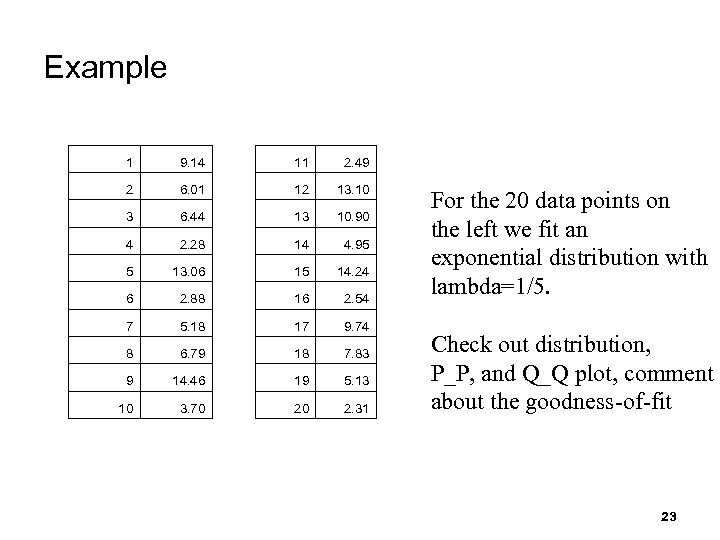 Example 1 9. 14 11 2. 49 2 6. 01 12 13. 10 3 6. 44 13 10. 90 4 2. 28 14 4. 95 5 13. 06 15 14. 24 6 2. 88 16 2. 54 7 5. 18 17 9. 74 8 6. 79 18 7. 83 9 14. 46 19 5. 13 10 3. 70 20 2. 31 For the 20 data points on the left we fit an exponential distribution with lambda=1/5. Check out distribution, P_P, and Q_Q plot, comment about the goodness-of-fit 23
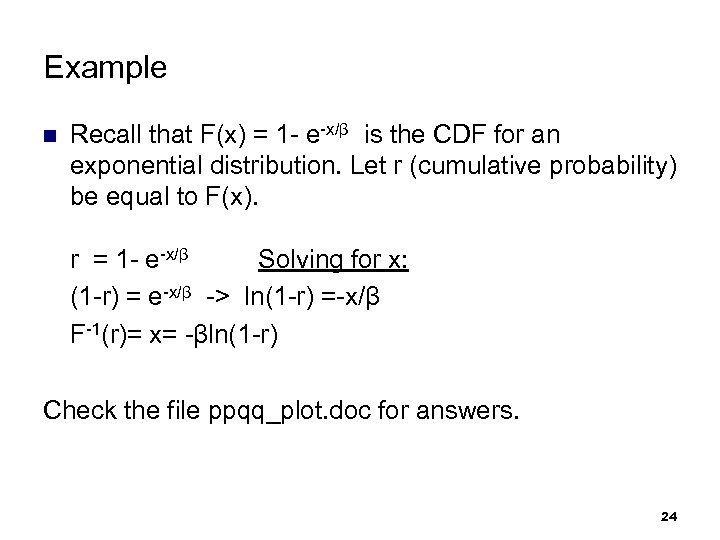 Example Recall that F(x) = 1 - e-x/β is the CDF for an exponential distribution. Let r (cumulative probability) be equal to F(x). r = 1 - e-x/β Solving for x: (1 -r) = e-x/β -> ln(1 -r) =-x/β F-1(r)= x= -βln(1 -r) Check the file ppqq_plot. doc for answers. 24
![Parameter Estimation [Identifying the distribution] Next step after selecting a family of distributions If](https://present5.com/presentation/a2779dd739002a34f43aede8a77f87f9/image-25.jpg "Parameter Estimation [Identifying the distribution] Next step after selecting a family of distributions If") Parameter Estimation [Identifying the distribution] Next step after selecting a family of distributions If observations in a sample of size n are X 1, X 2, …, Xn (discrete or continuous), the sample mean and variance are: If the data are discrete and have been grouped in a frequency distribution: where fj is the observed frequency of value Xj 25
Parameter Estimation [Identifying the distribution] Next step after selecting a family of distributions If observations in a sample of size n are X 1, X 2, …, Xn (discrete or continuous), the sample mean and variance are: If the data are discrete and have been grouped in a frequency distribution: where fj is the observed frequency of value Xj 25
![Parameter Estimation [Identifying the distribution] When raw data are unavailable (data are grouped into](https://present5.com/presentation/a2779dd739002a34f43aede8a77f87f9/image-26.jpg "Parameter Estimation [Identifying the distribution] When raw data are unavailable (data are grouped into") Parameter Estimation [Identifying the distribution] When raw data are unavailable (data are grouped into class intervals), the approximate sample mean and variance are: where fj is the observed frequency of in the jth class interval mj is the midpoint of the jth interval, and c is the number of class intervals A parameter is an unknown constant, but an estimator is a statistic. 26
Parameter Estimation [Identifying the distribution] When raw data are unavailable (data are grouped into class intervals), the approximate sample mean and variance are: where fj is the observed frequency of in the jth class interval mj is the midpoint of the jth interval, and c is the number of class intervals A parameter is an unknown constant, but an estimator is a statistic. 26
![Parameter Estimation [Identifying the distribution] Vehicle Arrival Example 9. 5: Table in the histogram](https://present5.com/presentation/a2779dd739002a34f43aede8a77f87f9/image-27.jpg "Parameter Estimation [Identifying the distribution] Vehicle Arrival Example 9. 5: Table in the histogram") Parameter Estimation [Identifying the distribution] Vehicle Arrival Example 9. 5: Table in the histogram example on slide 6 (Table 9. 1 in book) can be analyzed to obtain: The sample mean and variance are The histogram suggests X to have a Possion distribution However, note that sample mean is not equal to sample variance. Reason: each estimator is a random variable, is not perfect. 27
Parameter Estimation [Identifying the distribution] Vehicle Arrival Example 9. 5: Table in the histogram example on slide 6 (Table 9. 1 in book) can be analyzed to obtain: The sample mean and variance are The histogram suggests X to have a Possion distribution However, note that sample mean is not equal to sample variance. Reason: each estimator is a random variable, is not perfect. 27
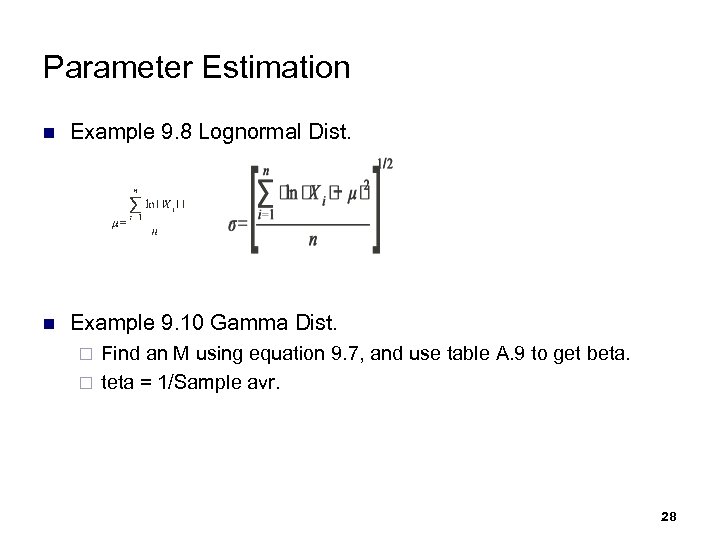 Parameter Estimation Example 9. 8 Lognormal Dist. Example 9. 10 Gamma Dist. Find an M using equation 9. 7, and use table A. 9 to get beta. teta = 1/Sample avr. 28
 Goodness-of-Fit: Statistical Tests Conduct hypothesis testing on input data distribution using: Kolmogorov-Smirnov test Chi-square test No single correct distribution in a real application exists. If very little data are available, it is unlikely to reject any candidate distributions If a lot of data are available, it is likely to reject all candidate distributions 29
![Chi-Square test [Goodness-of-Fit Tests] Intuition: comparing the histogram of the data to the shape](https://present5.com/presentation/a2779dd739002a34f43aede8a77f87f9/image-30.jpg "Chi-Square test [Goodness-of-Fit Tests] Intuition: comparing the histogram of the data to the shape") Chi-Square test [Goodness-of-Fit Tests] Intuition: comparing the histogram of the data to the shape of the candidate density or mass function Valid for large sample sizes when parameters are estimated by maximum likelihood By arranging the n observations into a set of k class intervals or cells, the test statistics is: Observed Frequency Expected Frequency Ei = n*pi where pi is theoretical prob. of the ith interval. Suggested Minimum = 5 which approximately follows the chi-square distribution with k-s-1 degrees of freedom, where s = no. of parameters of the hypothesized distribution estimated by the sample statistics. 30
Chi-Square test [Goodness-of-Fit Tests] Intuition: comparing the histogram of the data to the shape of the candidate density or mass function Valid for large sample sizes when parameters are estimated by maximum likelihood By arranging the n observations into a set of k class intervals or cells, the test statistics is: Observed Frequency Expected Frequency Ei = n*pi where pi is theoretical prob. of the ith interval. Suggested Minimum = 5 which approximately follows the chi-square distribution with k-s-1 degrees of freedom, where s = no. of parameters of the hypothesized distribution estimated by the sample statistics. 30
![Chi-Square test [Goodness-of-Fit Tests] The hypothesis of a chi-square test is: H 0: The](https://present5.com/presentation/a2779dd739002a34f43aede8a77f87f9/image-31.jpg "Chi-Square test [Goodness-of-Fit Tests] The hypothesis of a chi-square test is: H 0: The") Chi-Square test [Goodness-of-Fit Tests] The hypothesis of a chi-square test is: H 0: The random variable, X, conforms to the distributional assumption with the parameter(s) given by the estimate(s). H 1: The random variable X does not conform. If the distribution tested is discrete and combining adjacent cell is not required (so that Ei > 5): Each value of the random variable should be a class interval, unless combining is necessary, and 31
Chi-Square test [Goodness-of-Fit Tests] The hypothesis of a chi-square test is: H 0: The random variable, X, conforms to the distributional assumption with the parameter(s) given by the estimate(s). H 1: The random variable X does not conform. If the distribution tested is discrete and combining adjacent cell is not required (so that Ei > 5): Each value of the random variable should be a class interval, unless combining is necessary, and 31
![Chi-Square test [Goodness-of-Fit Tests] If the distribution tested is continuous: where ai-1 and ai](https://present5.com/presentation/a2779dd739002a34f43aede8a77f87f9/image-32.jpg "Chi-Square test [Goodness-of-Fit Tests] If the distribution tested is continuous: where ai-1 and ai") Chi-Square test [Goodness-of-Fit Tests] If the distribution tested is continuous: where ai-1 and ai are the endpoints of the ith class interval and f(x) is the assumed pdf, F(x) is the assumed cdf. Recommended number of class intervals (k): Caution: Different grouping of data (i. e. , k) can affect the hypothesis testing result. 32
Chi-Square test [Goodness-of-Fit Tests] If the distribution tested is continuous: where ai-1 and ai are the endpoints of the ith class interval and f(x) is the assumed pdf, F(x) is the assumed cdf. Recommended number of class intervals (k): Caution: Different grouping of data (i. e. , k) can affect the hypothesis testing result. 32
![Chi-Square test [Goodness-of-Fit Tests] Vehicle Arrival Example (example 9. 14): H 0: the random](https://present5.com/presentation/a2779dd739002a34f43aede8a77f87f9/image-33.jpg "Chi-Square test [Goodness-of-Fit Tests] Vehicle Arrival Example (example 9. 14): H 0: the random") Chi-Square test [Goodness-of-Fit Tests] Vehicle Arrival Example (example 9. 14): H 0: the random variable is Poisson distributed. H 1: the random variable is not Poisson distributed. Combined because of min Ei Degree of freedom is k-s-1 = 7 -1 -1 = 5, hence, the hypothesis is rejected at the 0. 05 level of significance. 33
Chi-Square test [Goodness-of-Fit Tests] Vehicle Arrival Example (example 9. 14): H 0: the random variable is Poisson distributed. H 1: the random variable is not Poisson distributed. Combined because of min Ei Degree of freedom is k-s-1 = 7 -1 -1 = 5, hence, the hypothesis is rejected at the 0. 05 level of significance. 33
 Chi-Square test with equal-probability intervals Example; 34
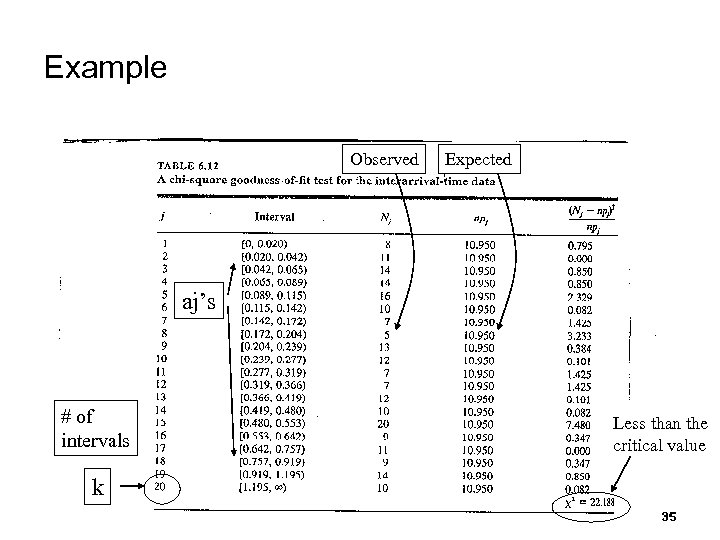 Example Observed Expected aj’s # of intervals Less than the critical value k 35
![Kolmogorov-Smirnov Test [Goodness-of-Fit Tests] Intuition: formalize the idea behind examining a q-q plot Recall](https://present5.com/presentation/a2779dd739002a34f43aede8a77f87f9/image-36.jpg "Kolmogorov-Smirnov Test [Goodness-of-Fit Tests] Intuition: formalize the idea behind examining a q-q plot Recall") Kolmogorov-Smirnov Test [Goodness-of-Fit Tests] Intuition: formalize the idea behind examining a q-q plot Recall from Chapter 7. 4. 1: The test compares the continuous cdf, F(x), of the hypothesized distribution with the empirical cdf, SN(x), of the N sample observations. Based on the maximum difference statistics (Tabulated in A. 8): D = max| F(x) - SN(x)| A more powerful test, particularly useful when: Sample sizes are small, No parameters have been estimated from the data. When parameter estimates have been made: Critical values in Table A. 8 are biased, too large. More conservative, i. e. , smaller Type I error than specified. Type I error; Probability that we reject Ho when it is true 36
Kolmogorov-Smirnov Test [Goodness-of-Fit Tests] Intuition: formalize the idea behind examining a q-q plot Recall from Chapter 7. 4. 1: The test compares the continuous cdf, F(x), of the hypothesized distribution with the empirical cdf, SN(x), of the N sample observations. Based on the maximum difference statistics (Tabulated in A. 8): D = max| F(x) - SN(x)| A more powerful test, particularly useful when: Sample sizes are small, No parameters have been estimated from the data. When parameter estimates have been made: Critical values in Table A. 8 are biased, too large. More conservative, i. e. , smaller Type I error than specified. Type I error; Probability that we reject Ho when it is true 36
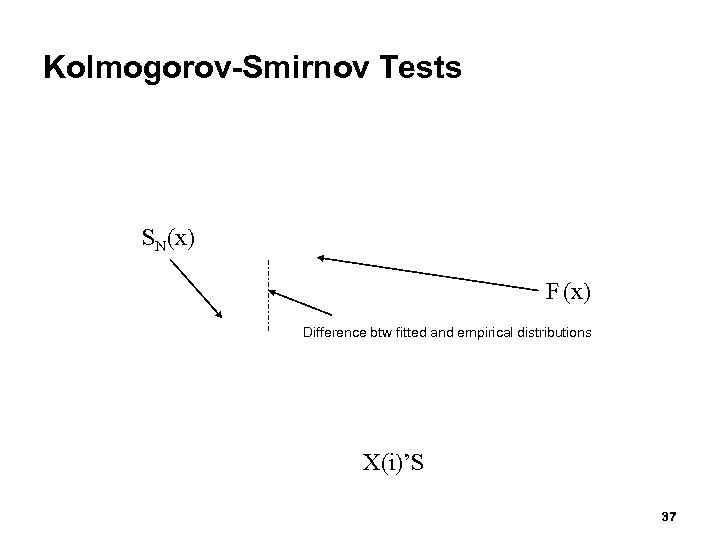 Kolmogorov-Smirnov Tests SN(x) F (x) Difference btw fitted and empirical distributions X(i)’S 37
![p-Values and “Best Fits” [Goodness-of-Fit Tests] p-value for the test statistics The significance level](https://present5.com/presentation/a2779dd739002a34f43aede8a77f87f9/image-38.jpg "p-Values and “Best Fits” [Goodness-of-Fit Tests] p-value for the test statistics The significance level") p-Values and “Best Fits” [Goodness-of-Fit Tests] p-value for the test statistics The significance level at which one would just reject H 0 for the given test statistic value. A measure of fit, the larger the better Large p-value: good fit Small p-value: poor fit Vehicle Arrival Example (cont. ): H 0: data is Possion Test statistics: , with 5 degrees of freedom p-value = 0. 00004, meaning we would reject H 0 with 0. 00004 significance level, hence Poisson is a poor fit. 38
p-Values and “Best Fits” [Goodness-of-Fit Tests] p-value for the test statistics The significance level at which one would just reject H 0 for the given test statistic value. A measure of fit, the larger the better Large p-value: good fit Small p-value: poor fit Vehicle Arrival Example (cont. ): H 0: data is Possion Test statistics: , with 5 degrees of freedom p-value = 0. 00004, meaning we would reject H 0 with 0. 00004 significance level, hence Poisson is a poor fit. 38
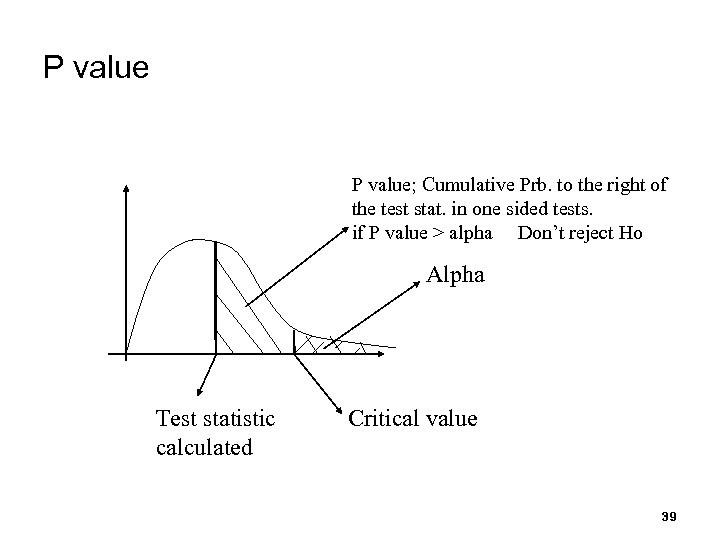 P value; Cumulative Prb. to the right of the test stat. in one sided tests. if P value > alpha Don’t reject Ho Alpha Test statistic calculated Critical value 39
![p-Values and “Best Fits” [Goodness-of-Fit Tests] Many software use p-value as the ranking measure](https://present5.com/presentation/a2779dd739002a34f43aede8a77f87f9/image-40.jpg "p-Values and “Best Fits” [Goodness-of-Fit Tests] Many software use p-value as the ranking measure") p-Values and “Best Fits” [Goodness-of-Fit Tests] Many software use p-value as the ranking measure to automatically determine the “best fit”. Things to be cautious about: Software may not know about the physical basis of the data, distribution families it suggests may be inappropriate. Close conformance to the data does not always lead to the most appropriate input model. p-value does not say much about where the lack of fit occurs Recommended: always inspect the automatic selection using graphical methods. 40
p-Values and “Best Fits” [Goodness-of-Fit Tests] Many software use p-value as the ranking measure to automatically determine the “best fit”. Things to be cautious about: Software may not know about the physical basis of the data, distribution families it suggests may be inappropriate. Close conformance to the data does not always lead to the most appropriate input model. p-value does not say much about where the lack of fit occurs Recommended: always inspect the automatic selection using graphical methods. 40
 Fitting a Non-stationary Poisson Process Fitting a NSPP to arrival data is difficult, possible approaches: Fit a very flexible model with lots of parameters or Approximate constant arrival rate over some basic interval of time, but vary it from time interval to time interval. Our focus Suppose we need to model arrivals over time [0, T], our approach is the most appropriate when we can: Observe the time period repeatedly and Count arrivals / record arrival times. 41
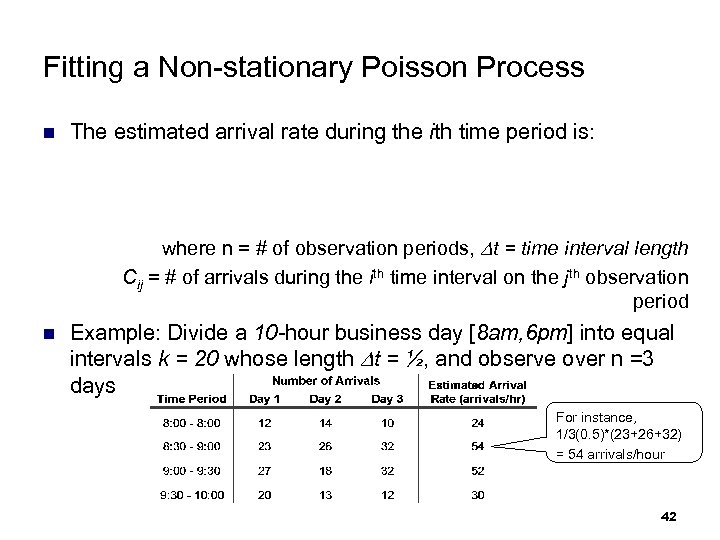 Fitting a Non-stationary Poisson Process The estimated arrival rate during the ith time period is: where n = # of observation periods, t = time interval length Cij = # of arrivals during the ith time interval on the jth observation period Example: Divide a 10 -hour business day [8 am, 6 pm] into equal intervals k = 20 whose length t = ½, and observe over n =3 days For instance, 1/3(0. 5)*(23+26+32) = 54 arrivals/hour 42
 Selecting Model without Data If data is not available, some possible sources to obtain information about the process are: Engineering data: often product or process has performance ratings provided by the manufacturer or company rules specify time or production standards. Expert option: people who are experienced with the process or similar processes, often, they can provide optimistic, pessimistic and most-likely times, and they may know the variability as well. Physical or conventional limitations: physical limits on performance, limits or bounds that narrow the range of the input process. The nature of the process. The uniform, triangular, and beta distributions are often used as input models. 43
 Selecting Model without Data Example 9. 17: Production planning simulation. Input of sales volume of various products is required, salesperson of product XYZ says that: No fewer than 1, 000 units and no more than 5, 000 units will be sold. Given her experience, she believes there is a 90% chance of selling more than 2, 000 units, a 25% chance of selling more than 2, 500 units, and only a 1% chance of selling more than 4, 500 units. Translating these information into a cumulative probability of being less than or equal to those goals for simulation input: 44
 Multivariate and Time-Series Input Models Multivariate: For example, lead time and annual demand for an inventory model, increase in demand results in lead time increase, hence variables are dependent. Time-series: For example, time between arrivals of orders to buy and sell stocks, buy and sell orders tend to arrive in bursts, hence, times between arrivals are dependent. 45
![Covariance and Correlation [Multivariate/Time Series] Consider the model that describes relationship between X 1](https://present5.com/presentation/a2779dd739002a34f43aede8a77f87f9/image-46.jpg "Covariance and Correlation [Multivariate/Time Series] Consider the model that describes relationship between X 1") Covariance and Correlation [Multivariate/Time Series] Consider the model that describes relationship between X 1 and X 2: is a random variable with mean 0 and is independent of X 2 = 0, X 1 and X 2 are statistically independent > 0, X 1 and X 2 tend to be above or below their means together < 0, X 1 and X 2 tend to be on opposite sides of their means Covariance between X 1 and X 2 : where = 0, cov(X 1, X 2) > 0, =0 < 0, >0 then <0 46
Covariance and Correlation [Multivariate/Time Series] Consider the model that describes relationship between X 1 and X 2: is a random variable with mean 0 and is independent of X 2 = 0, X 1 and X 2 are statistically independent > 0, X 1 and X 2 tend to be above or below their means together < 0, X 1 and X 2 tend to be on opposite sides of their means Covariance between X 1 and X 2 : where = 0, cov(X 1, X 2) > 0, =0 < 0, >0 then <0 46
![Covariance and Correlation [Multivariate/Time Series] Covariance can take any value between -ф to +](https://present5.com/presentation/a2779dd739002a34f43aede8a77f87f9/image-47.jpg "Covariance and Correlation [Multivariate/Time Series] Covariance can take any value between -ф to +") Covariance and Correlation [Multivariate/Time Series] Covariance can take any value between -ф to + ф the correlation standardizes the cov to be b/w -1 to +1. Correlation between X 1 and X 2 (values between -1 and 1): = 0, =0 where corr(X 1, X 2) < 0, then < 0 > 0, >0 The closer is to -1 or 1, the stronger the linear relationship is between X 1 and X 2. 47
Covariance and Correlation [Multivariate/Time Series] Covariance can take any value between -ф to + ф the correlation standardizes the cov to be b/w -1 to +1. Correlation between X 1 and X 2 (values between -1 and 1): = 0, =0 where corr(X 1, X 2) < 0, then < 0 > 0, >0 The closer is to -1 or 1, the stronger the linear relationship is between X 1 and X 2. 47
![Covariance and Correlation [Multivariate/Time Series] A time series is a sequence of random variables](https://present5.com/presentation/a2779dd739002a34f43aede8a77f87f9/image-48.jpg "Covariance and Correlation [Multivariate/Time Series] A time series is a sequence of random variables") Covariance and Correlation [Multivariate/Time Series] A time series is a sequence of random variables X 1, X 2, X 3, … , are identically distributed (same mean and variance) but dependent. cov(Xt, Xt+h) is the lag-h autocovariance corr(Xt, Xt+h) is the lag-h autocorrelation If the autocovariance value depends only on h and not on t, the time series is covariance stationary 48
Covariance and Correlation [Multivariate/Time Series] A time series is a sequence of random variables X 1, X 2, X 3, … , are identically distributed (same mean and variance) but dependent. cov(Xt, Xt+h) is the lag-h autocovariance corr(Xt, Xt+h) is the lag-h autocorrelation If the autocovariance value depends only on h and not on t, the time series is covariance stationary 48
![Multivariate Input Models [Multivariate/Time Series] If X 1 and X 2 are normally distributed,](https://present5.com/presentation/a2779dd739002a34f43aede8a77f87f9/image-49.jpg "Multivariate Input Models [Multivariate/Time Series] If X 1 and X 2 are normally distributed,") Multivariate Input Models [Multivariate/Time Series] If X 1 and X 2 are normally distributed, dependence between them can be modeled by the bivariate normal distribution with 1, 2, 12, 22 and correlation To Estimate 1, 2, 12, 22, see “Parameter Estimation” (slide 1517, Section 9. 3. 2 in book) To Estimate , suppose we have n independent and identically distributed pairs (X 11, X 21), (X 12, X 22), … (X 1 n, X 2 n), then: Sample deviation 49
Multivariate Input Models [Multivariate/Time Series] If X 1 and X 2 are normally distributed, dependence between them can be modeled by the bivariate normal distribution with 1, 2, 12, 22 and correlation To Estimate 1, 2, 12, 22, see “Parameter Estimation” (slide 1517, Section 9. 3. 2 in book) To Estimate , suppose we have n independent and identically distributed pairs (X 11, X 21), (X 12, X 22), … (X 1 n, X 2 n), then: Sample deviation 49
![Time-Series Input Models [Multivariate/Time Series] If X 1, X 2, X 3, … is](https://present5.com/presentation/a2779dd739002a34f43aede8a77f87f9/image-50.jpg "Time-Series Input Models [Multivariate/Time Series] If X 1, X 2, X 3, … is") Time-Series Input Models [Multivariate/Time Series] If X 1, X 2, X 3, … is a sequence of identically distributed, but dependent and covariance-stationary random variables, then we can represent the process as follows: Autoregressive order-1 model, AR(1) Exponential autoregressive order-1 model, EAR(1) Both have the characteristics that: Lag-h autocorrelation decreases geometrically as the lag increases, hence, observations far apart in time are nearly independent 50
Time-Series Input Models [Multivariate/Time Series] If X 1, X 2, X 3, … is a sequence of identically distributed, but dependent and covariance-stationary random variables, then we can represent the process as follows: Autoregressive order-1 model, AR(1) Exponential autoregressive order-1 model, EAR(1) Both have the characteristics that: Lag-h autocorrelation decreases geometrically as the lag increases, hence, observations far apart in time are nearly independent 50
![AR(1) Time-Series Input Models [Multivariate/Time Series] Consider the time-series model: If X 1 is](https://present5.com/presentation/a2779dd739002a34f43aede8a77f87f9/image-51.jpg "AR(1) Time-Series Input Models [Multivariate/Time Series] Consider the time-series model: If X 1 is") AR(1) Time-Series Input Models [Multivariate/Time Series] Consider the time-series model: If X 1 is chosen appropriately, then X 1, X 2, … are normally distributed with mean = , and variance = /(1 - ) Autocorrelation h = h To estimate , 2 : 51
AR(1) Time-Series Input Models [Multivariate/Time Series] Consider the time-series model: If X 1 is chosen appropriately, then X 1, X 2, … are normally distributed with mean = , and variance = /(1 - ) Autocorrelation h = h To estimate , 2 : 51
![EAR(1) Time-Series Input Models [Multivariate/Time Series] Consider the time-series model: If X 1 is](https://present5.com/presentation/a2779dd739002a34f43aede8a77f87f9/image-52.jpg "EAR(1) Time-Series Input Models [Multivariate/Time Series] Consider the time-series model: If X 1 is") EAR(1) Time-Series Input Models [Multivariate/Time Series] Consider the time-series model: If X 1 is chosen appropriately, then X 1, X 2, … are exponentially distributed with mean = 1/ Autocorrelation h = h , and only positive correlation is allowed. To estimate : 52
EAR(1) Time-Series Input Models [Multivariate/Time Series] Consider the time-series model: If X 1 is chosen appropriately, then X 1, X 2, … are exponentially distributed with mean = 1/ Autocorrelation h = h , and only positive correlation is allowed. To estimate : 52
 Summary In this chapter, we described the 4 steps in developing input data models: Collecting the raw data Identifying the underlying statistical distribution Estimating the parameters Testing for goodness of fit 53