


 Скачать презентацию CHAPTER 9 Decision Strategies in Transportation Areas
085caa8f140fef3fc3c56c66b4e78314.ppt
- Количество слайдов: 48
 CHAPTER 9 Decision Strategies in Transportation
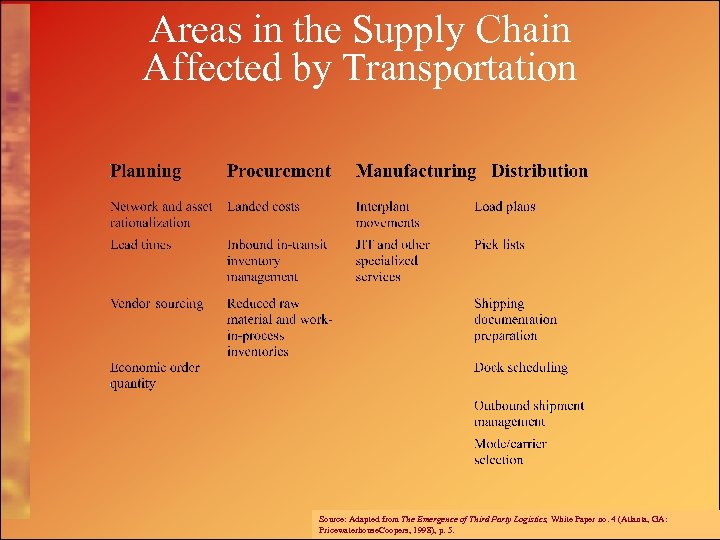 Areas in the Supply Chain Affected by Transportation Source: Adapted from The Emergence of Third Party Logistics, White Paper no. 4 (Atlanta, GA: Pricewaterhouse. Coopers, 1998), p. 5.
 Terms • • • Bill of Lading Manifest Claims Tracing and Expediting Inbound Outbound
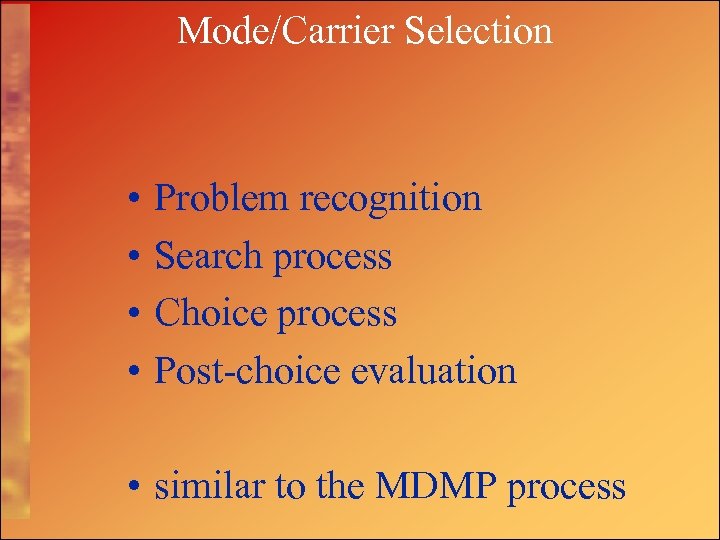 Mode/Carrier Selection • • Problem recognition Search process Choice process Post-choice evaluation • similar to the MDMP process
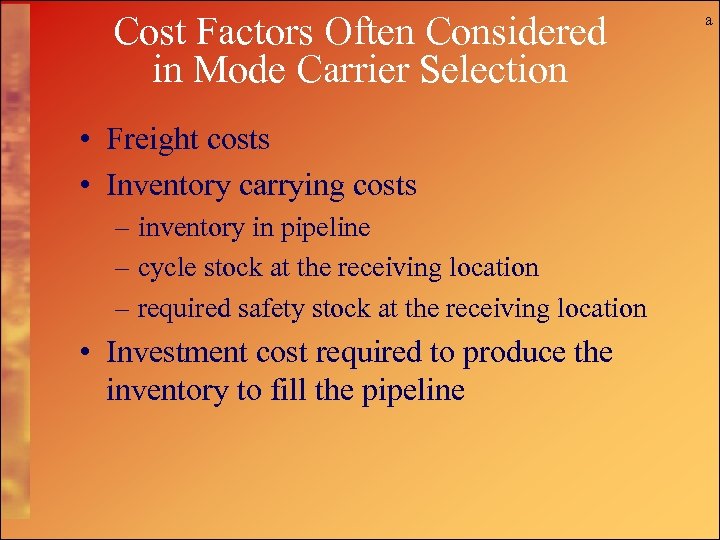 Cost Factors Often Considered in Mode Carrier Selection • Freight costs • Inventory carrying costs – inventory in pipeline – cycle stock at the receiving location – required safety stock at the receiving location • Investment cost required to produce the inventory to fill the pipeline a
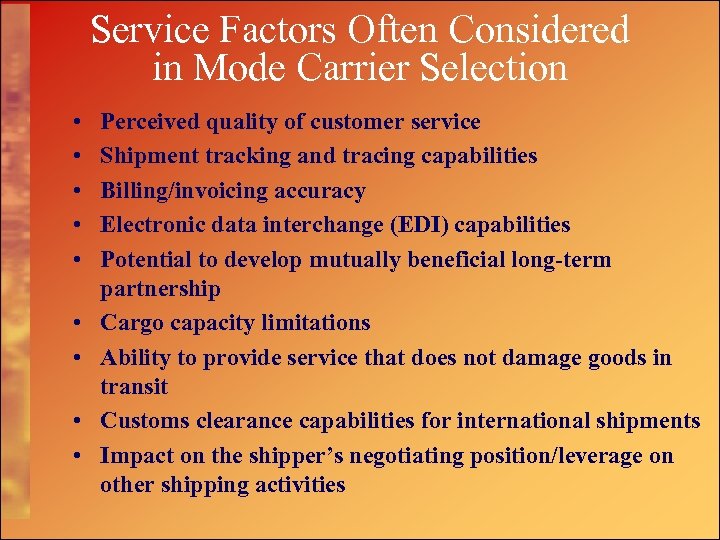 Service Factors Often Considered in Mode Carrier Selection • • • Perceived quality of customer service Shipment tracking and tracing capabilities Billing/invoicing accuracy Electronic data interchange (EDI) capabilities Potential to develop mutually beneficial long-term partnership Cargo capacity limitations Ability to provide service that does not damage goods in transit Customs clearance capabilities for international shipments Impact on the shipper’s negotiating position/leverage on other shipping activities
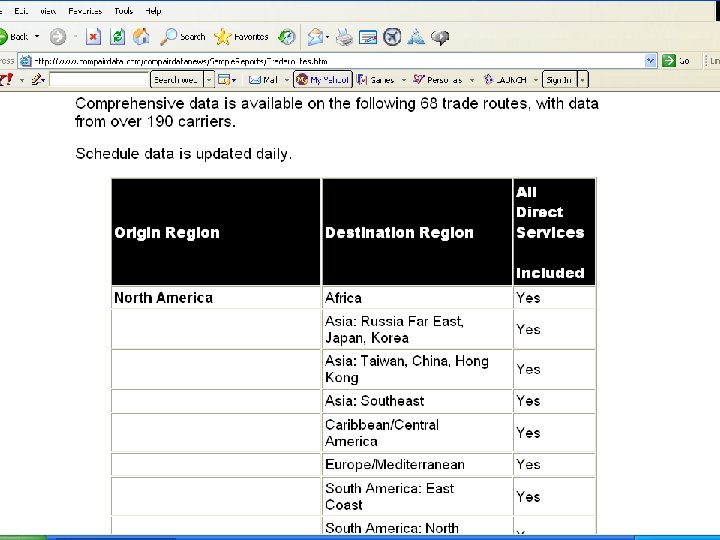
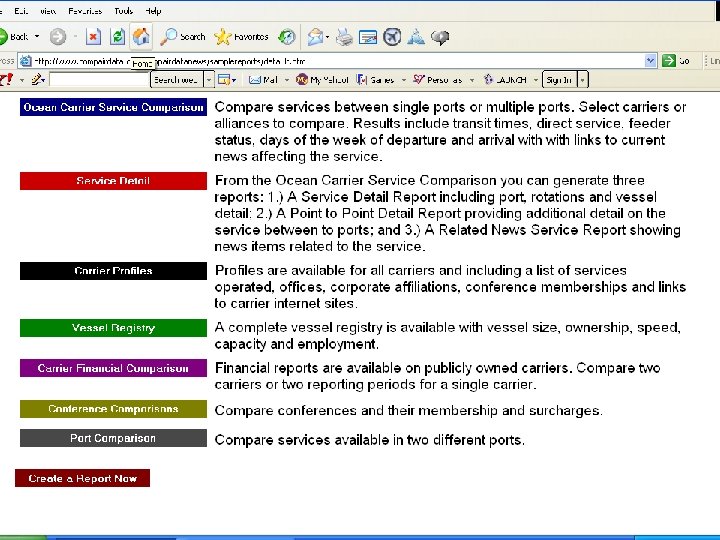
 Compairdata. com
 Freight Brokers
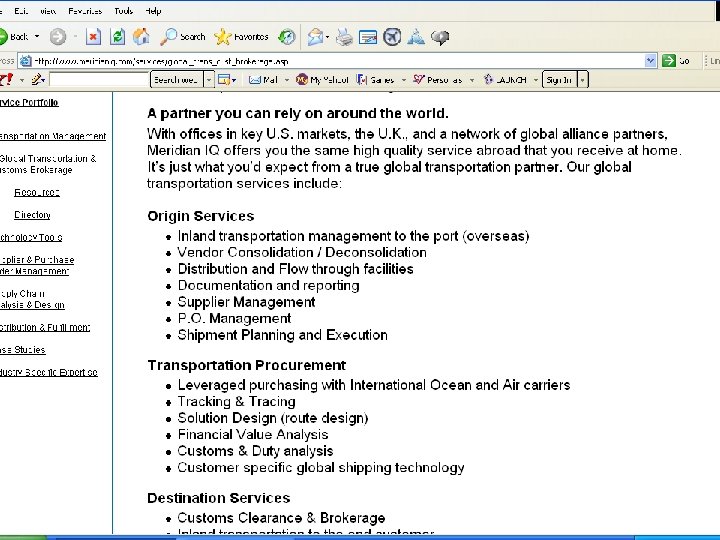
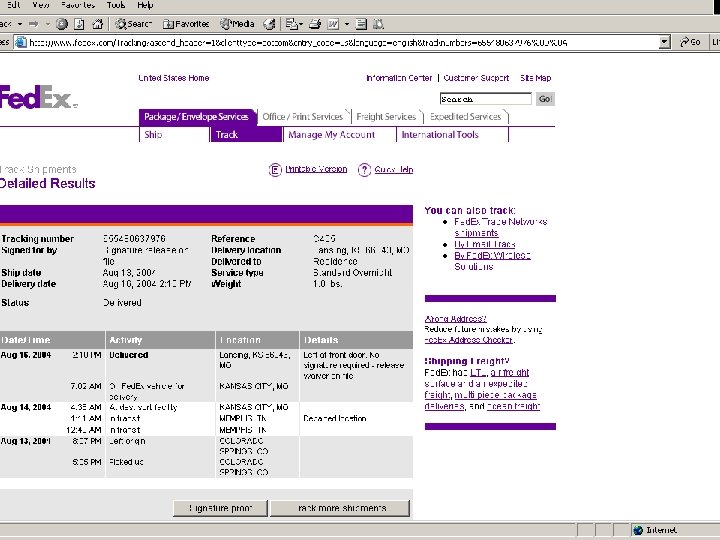
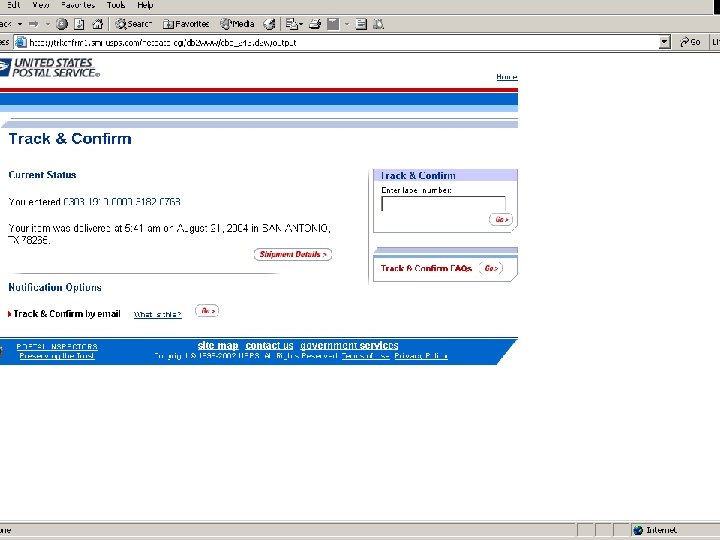
 Tracking and Expediting
 Transportation Security
 C-T PAT Customs-Trade Partnership Against Terrorism • Joint government - business program • voluntary - 7000 participants • Security - procedural, physical personnel, manifest • prevent incoming dirty bomb/material in containers • ensure integrity of practices • reduced inspections • reduced losses from theft
 Questions?
 CHAPTER 10 Warehousing
 Objectives • Why is warehousing important - 2 -5% of sales • Types of warehouses • functions • why have warehouses in a JIT economy? • Is there a difference between a Distribution Center and a Warehouse?
 Warehousing Management • Warehousing emphasizes storage of products. • Distribution centers emphasize rapid movement of products through the facility. • Throughput is the amount of product entering and leaving a facility in a given time period. • Regrouping function – – Accumulating (increasing quantity) Allocating (reducing quantity) Assorting (building up a variety of products) Sorting (separating products into grades and qualities)
 Uses of Warehousing • • • Manufacturing support Product - mixing Consolidation Breakbulk Cross Docking shorten customer wait times and transportation lead times
 Functions • • • Receive putaway Store order entry Pick Pack Ship Value added services postponement
 Factors Influencing Warehousing in the Future • Time - The best warehouse operations are those designed to reduce every aspect of order cycle time. • Quality - Users now expect performance that approaches perfection. • Asset productivity - Reduce total cost, reuse, and recycle. • New kind of workforce - Requirements for both management and labor will change significantly.
 Private Warehousing • Private warehousing is owned or occupied on a long-term lease • Offers control to owner • Assumes both sufficient demand volume and stability so that warehouse remains full • High fixed costs
 Advantages of Private Warehousing • • • Control Flexibility Less costly Better use of human resources Tax benefits Intangible benefits
 Advantages of Public Warehousing • Conservation of capital • Use of space to meet peak requirements • Reduced risk • Economies of scale • Flexibility • Tax advantages • Specific knowledge of storage and handling costs
 Disadvantages of Public Warehousing • Effective communication may be difficult because of system incompatibility • Specialized services may not always be available. • Space may not be available on demand.
 Attributes of World Class Warehouses and Distribution Centers • • 100% Inventory Accuracy Perfect Order Fulfillment Value added services Cleanliness Time Definite Delivery On-time deliveries Logical warehouse flow
 World Class • • Employee Education Programs Safety Layout Obsolete Stocks Turns Processing Times Cross Docking
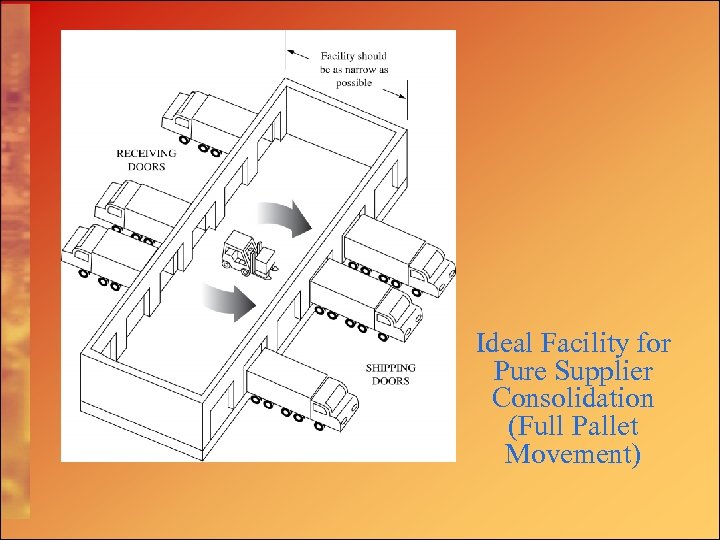 Ideal Facility for Pure Supplier Consolidation (Full Pallet Movement)
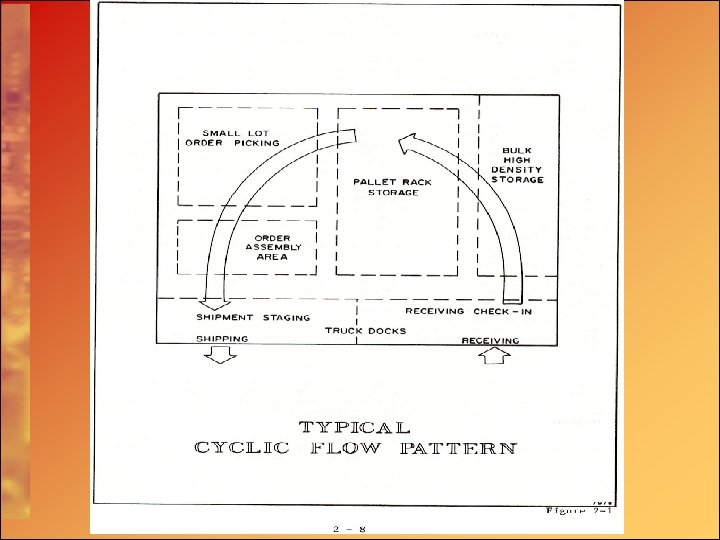
 Poor Warehouse Warning Signs • • Excessive handling poor utilization/cube obsolete equipment obsolete merchandise old docks manual procedures lack of barcodes
 Cycle Counting • • Reduce losses identify problems earlier security costs • “Significant cuts in inventory come only from finding and fixing the causes of excess. ”
 Measures • • • Picks per worker per hour inventory accuracy loss/shrinkage stockouts percent of utilization facing fill rates
 CHAPTER 12 Procurement
 Goals of Procurement • Uninterrupted flow of materials, supplies, and services • keeping investment at a minimum • maintain and improve quality • find and/or develop competent suppliers • standardize items and procedures
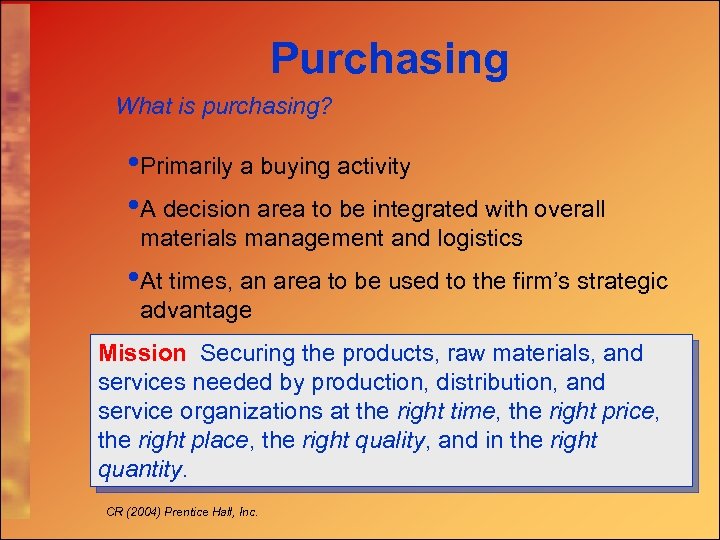 Purchasing What is purchasing? • Primarily a buying activity • A decision area to be integrated with overall materials management and logistics • At times, an area to be used to the firm’s strategic advantage Mission Securing the products, raw materials, and services needed by production, distribution, and service organizations at the right time, the right price, the right place, the right quality, and in the right quantity. CR (2004) Prentice Hall, Inc.
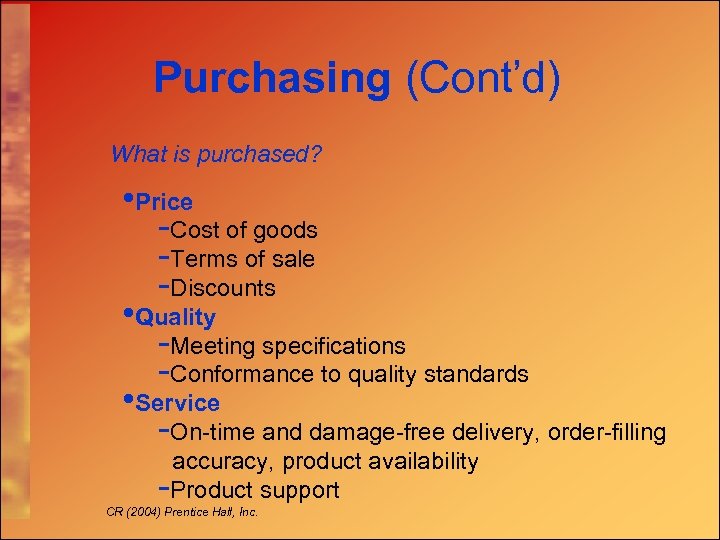 Purchasing (Cont’d) What is purchased? • Price -Cost of goods -Terms of sale -Discounts • Quality -Meeting specifications -Conformance to quality standards • Service -On-time and damage-free delivery, order-filling accuracy, product availability -Product support CR (2004) Prentice Hall, Inc.
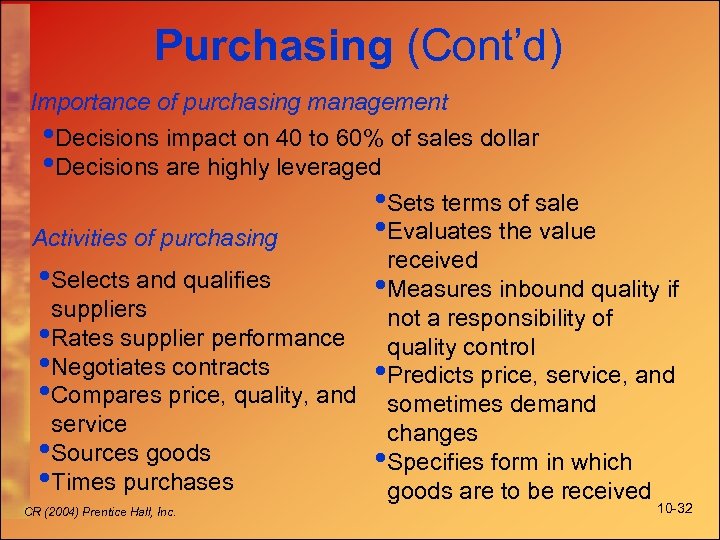 Purchasing (Cont’d) Importance of purchasing management • Decisions impact on 40 to 60% of sales dollar • Decisions are highly leveraged Activities of purchasing • Sets terms of sale • Evaluates the value received • Selects and qualifies • Measures inbound quality if suppliers not a responsibility of • Rates supplier performance quality control • Negotiates contracts • Predicts price, service, and • Compares price, quality, and sometimes demand service changes • Sources goods • Specifies form in which • Times purchases goods are to be received CR (2004) Prentice Hall, Inc. 10 -32
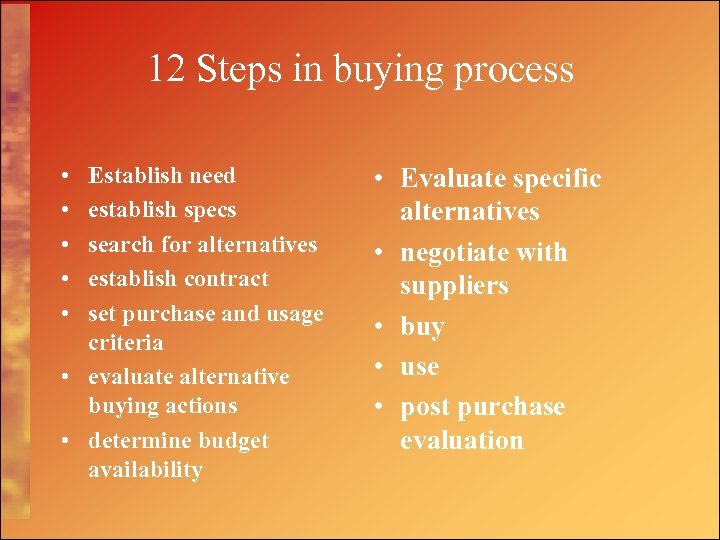 12 Steps in buying process • • • Establish need establish specs search for alternatives establish contract set purchase and usage criteria • evaluate alternative buying actions • determine budget availability • Evaluate specific alternatives • negotiate with suppliers • buy • use • post purchase evaluation
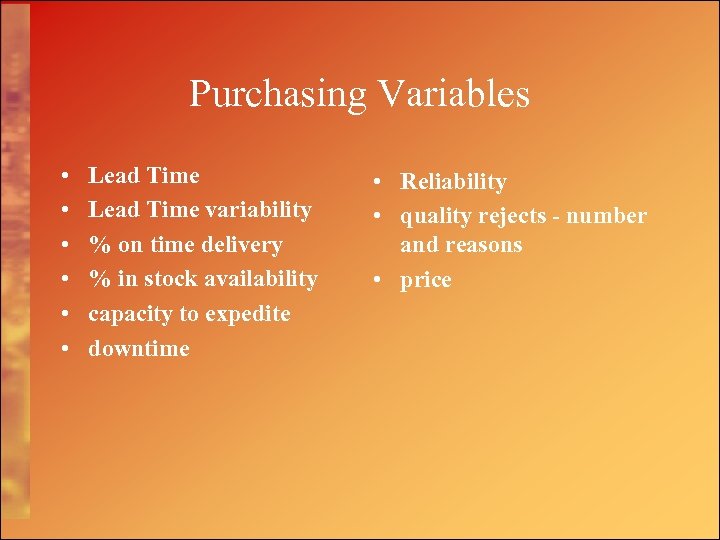 Purchasing Variables • • • Lead Time variability % on time delivery % in stock availability capacity to expedite downtime • Reliability • quality rejects - number and reasons • price
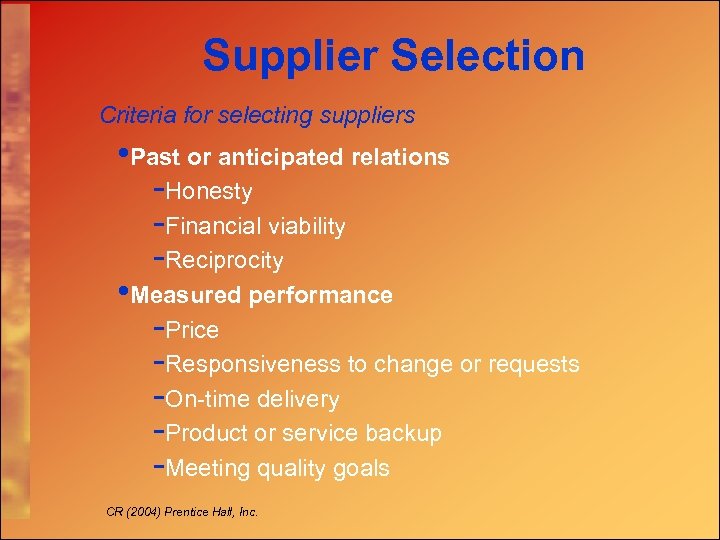 Supplier Selection Criteria for selecting suppliers • Past or anticipated relations -Honesty -Financial viability -Reciprocity • Measured performance -Price -Responsiveness to change or requests -On-time delivery -Product or service backup -Meeting quality goals CR (2004) Prentice Hall, Inc.
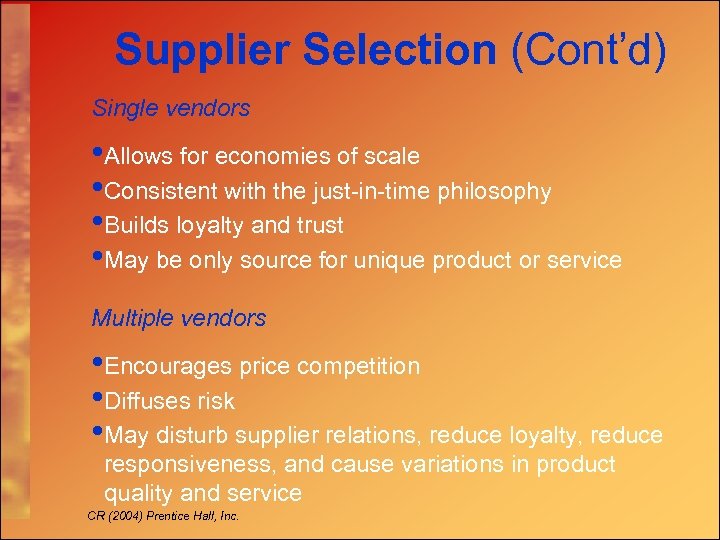 Supplier Selection (Cont’d) Single vendors • Allows for economies of scale • Consistent with the just-in-time philosophy • Builds loyalty and trust • May be only source for unique product or service Multiple vendors • Encourages price competition • Diffuses risk • May disturb supplier relations, reduce loyalty, reduce responsiveness, and cause variations in product quality and service CR (2004) Prentice Hall, Inc.
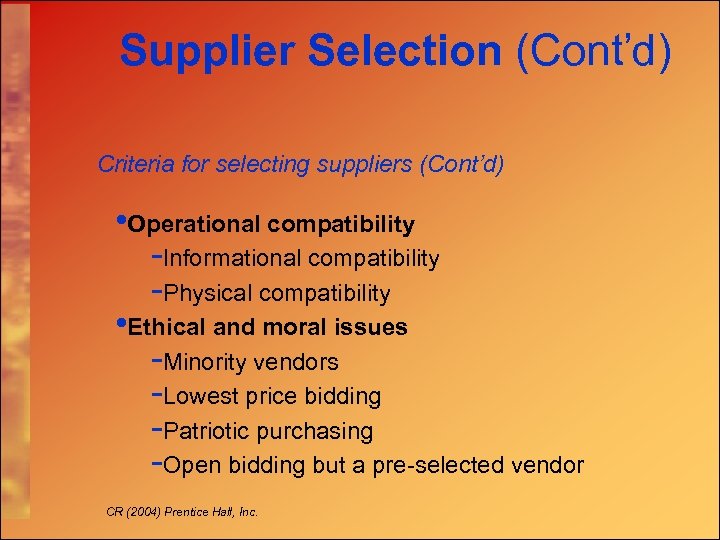 Supplier Selection (Cont’d) Criteria for selecting suppliers (Cont’d) • Operational compatibility -Informational compatibility -Physical compatibility • Ethical and moral issues -Minority vendors -Lowest price bidding -Patriotic purchasing -Open bidding but a pre-selected vendor CR (2004) Prentice Hall, Inc.
 Objectives of Systems Contracts and Stockless Purchasing • • Lower inventory levels. Reduce the number of suppliers. Reduce administrative cost and paperwork. Reduce the number of purchases of small dollar value and requisitions that purchasers have to handle. • Provide the opportunity for larger dollar volumes of business to suppliers. • Provide for timely delivery of material directly to user. • Standardize purchase items when possible.
 Government Influences on Foreign Trade • Government controls on the flow of international trade – Customs or duties – Import quotas – Health inspections – Safety standards – Currency outflow – Political or military reasons – Port choice – Non-trade reasons – Country of Origin
 Upcoming • Chapter 13, 15, Reverse Logistics • Final Exam