 Скачать презентацию Chapter 9 Consumer Choice and Behavioral Economics Copyright
aa4911f12943aeba5f11e4379a98c359.ppt
- Количество слайдов: 49



Chapter 9: Consumer Choice and Behavioral Economics Copyright © 2010 Pearson Education, Inc. Publishing as Prentice Hall · Economics · R. Glenn Hubbard, Anthony Patrick O’Brien, 3 e. 1 of 49

Chapter 9: Consumer Choice and Behavioral Economics Copyright © 2010 Pearson Education, Inc. Publishing as Prentice Hall · Economics · R. Glenn Hubbard, Anthony Patrick O’Brien, 3 e. 2 of 49
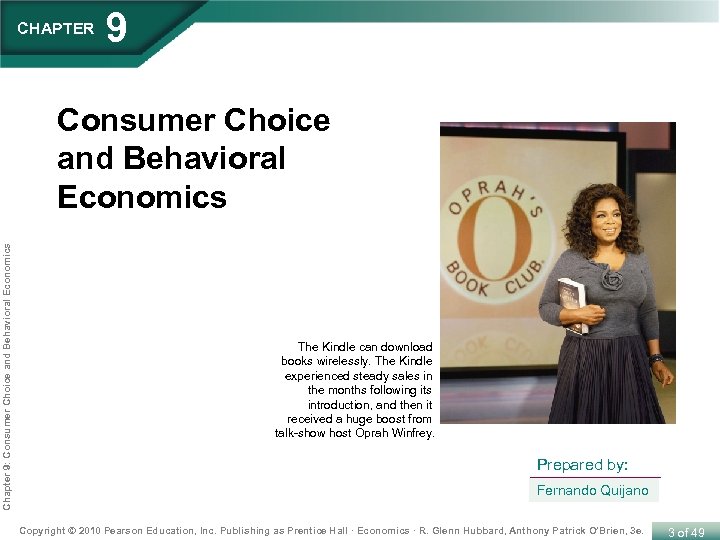
CHAPTER 9 Chapter 9: Consumer Choice and Behavioral Economics The Kindle can download books wirelessly. The Kindle experienced steady sales in the months following its introduction, and then it received a huge boost from talk-show host Oprah Winfrey. Prepared by: Fernando Quijano Copyright © 2010 Pearson Education, Inc. Publishing as Prentice Hall · Economics · R. Glenn Hubbard, Anthony Patrick O’Brien, 3 e. 3 of 49
CHAPTER 9 9. 1 Utility and Consumer Decision Making Define utility and explain how consumers choose goods and services to maximize their utility. 9. 2 Where Demand Curves Come From Use the concept of utility to explain the law of demand. 9. 3 Social Influences on Decision Making Explain how social influences can affect consumption choices. 9. . 4 Consumer Choice and Behavioral Economics Chapter 9: Consumer Choice and Behavioral Economics Chapter Outline and Learning Objectives Behavioral Economics: Do People Make Their Choices Rationally? Describe the behavioral economics approach to understanding decision making. Appendix: Using Indifference Curves and Budget Lines to Understand Consumer Behavior Use indifference curves and budget lines to understand consumer behavior. Copyright © 2010 Pearson Education, Inc. Publishing as Prentice Hall · Economics · R. Glenn Hubbard, Anthony Patrick O’Brien, 3 e. 4 of 49
9. 1 LEARNING OBJECTIVE Utility and Consumer Decision Making Define utility and explain how consumers choose goods and services to maximize their utility. Chapter 9: Consumer Choice and Behavioral Economics The Economic Model of Consumer Behavior in a Nutshell The economic model of consumer behavior predicts that consumers will choose to buy the combination of goods and services that makes them as well off as possible from among all the combinations that their budgets allow them to buy. Utility The enjoyment or satisfaction people receive from consuming goods and services. Copyright © 2010 Pearson Education, Inc. Publishing as Prentice Hall · Economics · R. Glenn Hubbard, Anthony Patrick O’Brien, 3 e. 5 of 49
9. 1 LEARNING OBJECTIVE Utility and Consumer Decision Making Define utility and explain how consumers choose goods and services to maximize their utility. Chapter 9: Consumer Choice and Behavioral Economics The Principle of Diminishing Marginal Utility Marginal utility (MU) The change in total utility a person receives from consuming one additional unit of a good or service. Law of diminishing marginal utility The principle that consumers experience diminishing additional satisfaction as they consume more of a good or service during a given period of time. Copyright © 2010 Pearson Education, Inc. Publishing as Prentice Hall · Economics · R. Glenn Hubbard, Anthony Patrick O’Brien, 3 e. 6 of 49
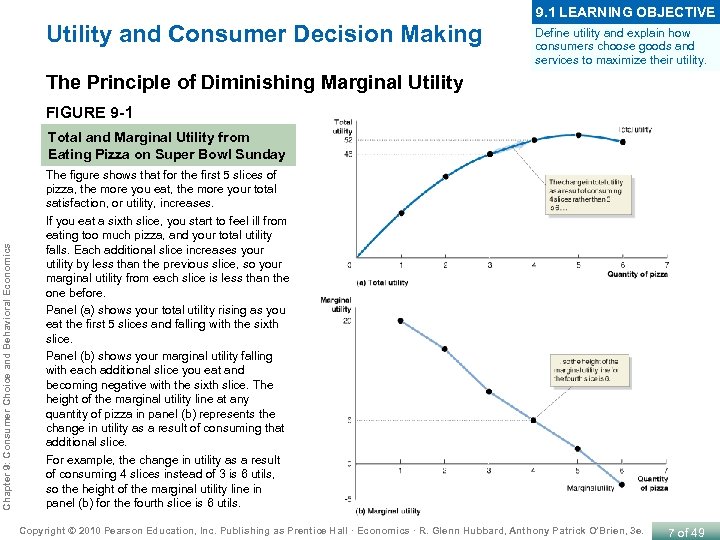
9. 1 LEARNING OBJECTIVE Utility and Consumer Decision Making Define utility and explain how consumers choose goods and services to maximize their utility. The Principle of Diminishing Marginal Utility FIGURE 9 -1 Chapter 9: Consumer Choice and Behavioral Economics Total and Marginal Utility from Eating Pizza on Super Bowl Sunday The figure shows that for the first 5 slices of pizza, the more you eat, the more your total satisfaction, or utility, increases. If you eat a sixth slice, you start to feel ill from eating too much pizza, and your total utility falls. Each additional slice increases your utility by less than the previous slice, so your marginal utility from each slice is less than the one before. Panel (a) shows your total utility rising as you eat the first 5 slices and falling with the sixth slice. Panel (b) shows your marginal utility falling with each additional slice you eat and becoming negative with the sixth slice. The height of the marginal utility line at any quantity of pizza in panel (b) represents the change in utility as a result of consuming that additional slice. For example, the change in utility as a result of consuming 4 slices instead of 3 is 6 utils, so the height of the marginal utility line in panel (b) for the fourth slice is 6 utils. Copyright © 2010 Pearson Education, Inc. Publishing as Prentice Hall · Economics · R. Glenn Hubbard, Anthony Patrick O’Brien, 3 e. 7 of 49
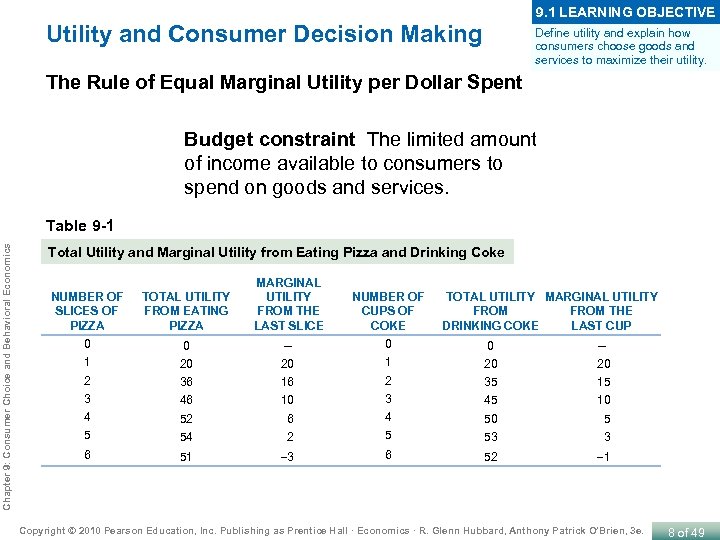
9. 1 LEARNING OBJECTIVE Utility and Consumer Decision Making Define utility and explain how consumers choose goods and services to maximize their utility. The Rule of Equal Marginal Utility per Dollar Spent Budget constraint The limited amount of income available to consumers to spend on goods and services. Chapter 9: Consumer Choice and Behavioral Economics Table 9 -1 Total Utility and Marginal Utility from Eating Pizza and Drinking Coke NUMBER OF SLICES OF PIZZA TOTAL UTILITY FROM EATING PIZZA MARGINAL UTILITY FROM THE LAST SLICE 0 0 -- 1 20 20 2 36 16 2 35 15 3 46 10 3 45 10 4 52 6 4 50 5 5 54 2 5 53 3 6 51 3 6 52 1 NUMBER OF CUPS OF COKE TOTAL UTILITY MARGINAL UTILITY FROM THE DRINKING COKE LAST CUP Copyright © 2010 Pearson Education, Inc. Publishing as Prentice Hall · Economics · R. Glenn Hubbard, Anthony Patrick O’Brien, 3 e. 8 of 49
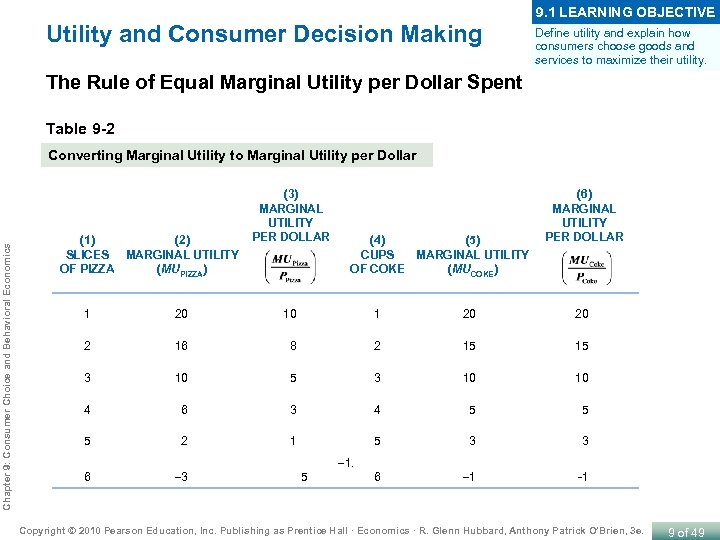
9. 1 LEARNING OBJECTIVE Utility and Consumer Decision Making Define utility and explain how consumers choose goods and services to maximize their utility. The Rule of Equal Marginal Utility per Dollar Spent Table 9 -2 Chapter 9: Consumer Choice and Behavioral Economics Converting Marginal Utility to Marginal Utility per Dollar (1) (2) SLICES MARGINAL UTILITY OF PIZZA (MUPIZZA) (3) MARGINAL UTILITY PER DOLLAR (4) (5) CUPS MARGINAL UTILITY OF COKE (MUCOKE) (6) MARGINAL UTILITY PER DOLLAR 1 20 10 1 20 20 2 16 8 2 15 15 3 10 10 4 6 3 4 5 5 5 2 1 5 3 3 6 1 -1 6 3 1. 5 Copyright © 2010 Pearson Education, Inc. Publishing as Prentice Hall · Economics · R. Glenn Hubbard, Anthony Patrick O’Brien, 3 e. 9 of 49
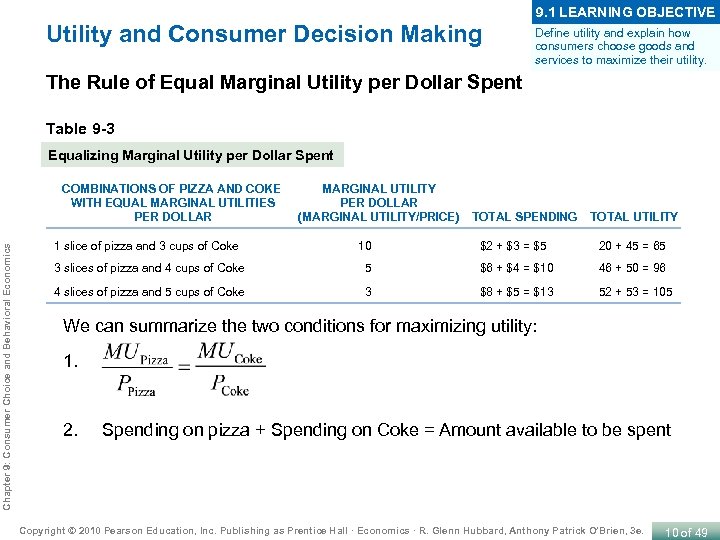
9. 1 LEARNING OBJECTIVE Utility and Consumer Decision Making Define utility and explain how consumers choose goods and services to maximize their utility. The Rule of Equal Marginal Utility per Dollar Spent Table 9 -3 Equalizing Marginal Utility per Dollar Spent Chapter 9: Consumer Choice and Behavioral Economics COMBINATIONS OF PIZZA AND COKE WITH EQUAL MARGINAL UTILITIES PER DOLLAR MARGINAL UTILITY PER DOLLAR (MARGINAL UTILITY/PRICE) TOTAL SPENDING TOTAL UTILITY 1 slice of pizza and 3 cups of Coke 10 $2 + $3 = $5 20 + 45 = 65 3 slices of pizza and 4 cups of Coke 5 $6 + $4 = $10 46 + 50 = 96 4 slices of pizza and 5 cups of Coke 3 $8 + $5 = $13 52 + 53 = 105 We can summarize the two conditions for maximizing utility: 1. 2. Spending on pizza + Spending on Coke = Amount available to be spent Copyright © 2010 Pearson Education, Inc. Publishing as Prentice Hall · Economics · R. Glenn Hubbard, Anthony Patrick O’Brien, 3 e. 10 of 49
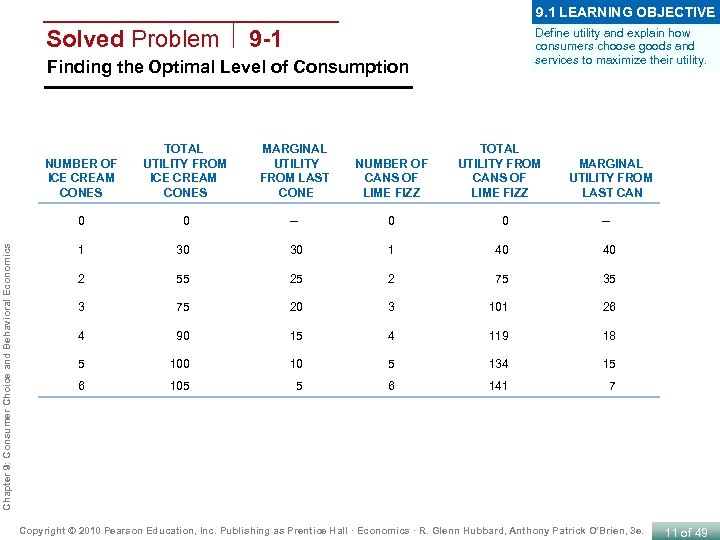
9. 1 LEARNING OBJECTIVE Solved Problem 9 -1 Define utility and explain how consumers choose goods and services to maximize their utility. Finding the Optimal Level of Consumption TOTAL UTILITY FROM ICE CREAM CONES MARGINAL UTILITY FROM LAST CONE NUMBER OF CANS OF LIME FIZZ 0 Chapter 9: Consumer Choice and Behavioral Economics NUMBER OF ICE CREAM CONES TOTAL UTILITY FROM CANS OF LIME FIZZ 0 -- 0 0 -- 1 30 30 1 40 40 2 55 25 2 75 35 3 75 20 3 101 26 4 90 15 4 119 18 5 100 10 5 134 15 6 105 5 6 141 7 MARGINAL UTILITY FROM LAST CAN Copyright © 2010 Pearson Education, Inc. Publishing as Prentice Hall · Economics · R. Glenn Hubbard, Anthony Patrick O’Brien, 3 e. 11 of 49
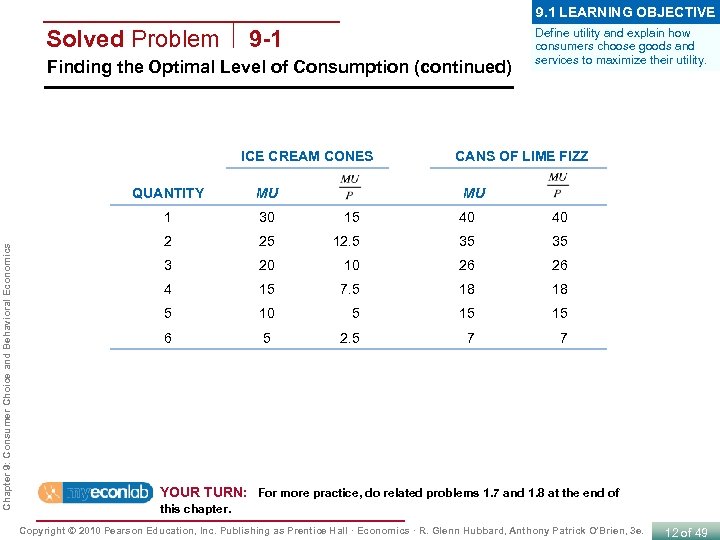
9. 1 LEARNING OBJECTIVE Solved Problem 9 -1 Finding the Optimal Level of Consumption (continued) ICE CREAM CONES Define utility and explain how consumers choose goods and services to maximize their utility. CANS OF LIME FIZZ MU 1 Chapter 9: Consumer Choice and Behavioral Economics QUANTITY MU 30 15 40 40 2 25 12. 5 35 35 3 20 10 26 26 4 15 7. 5 18 18 5 10 5 15 15 6 5 2. 5 7 7 YOUR TURN: For more practice, do related problems 1. 7 and 1. 8 at the end of this chapter. Copyright © 2010 Pearson Education, Inc. Publishing as Prentice Hall · Economics · R. Glenn Hubbard, Anthony Patrick O’Brien, 3 e. 12 of 49
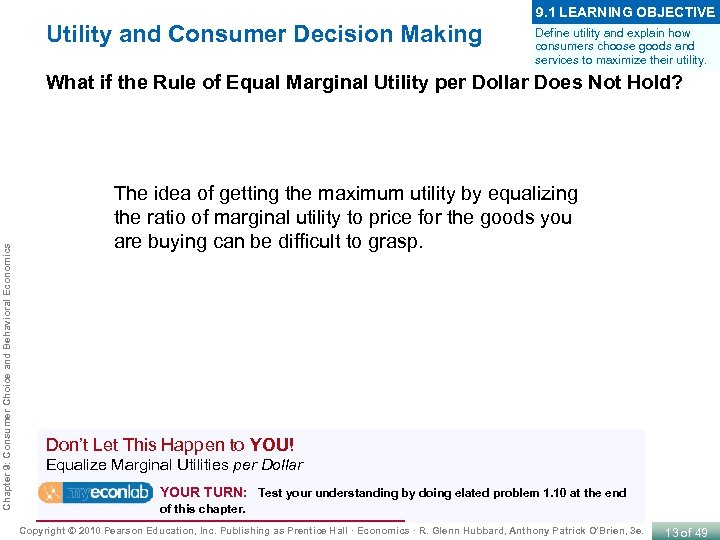
9. 1 LEARNING OBJECTIVE Utility and Consumer Decision Making Define utility and explain how consumers choose goods and services to maximize their utility. Chapter 9: Consumer Choice and Behavioral Economics What if the Rule of Equal Marginal Utility per Dollar Does Not Hold? The idea of getting the maximum utility by equalizing the ratio of marginal utility to price for the goods you are buying can be difficult to grasp. Don’t Let This Happen to YOU! Equalize Marginal Utilities per Dollar YOUR TURN: Test your understanding by doing elated problem 1. 10 at the end of this chapter. Copyright © 2010 Pearson Education, Inc. Publishing as Prentice Hall · Economics · R. Glenn Hubbard, Anthony Patrick O’Brien, 3 e. 13 of 49
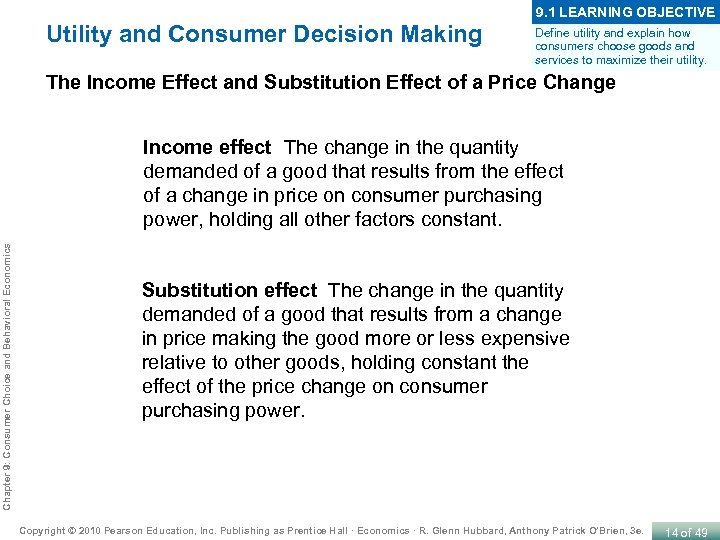
9. 1 LEARNING OBJECTIVE Utility and Consumer Decision Making Define utility and explain how consumers choose goods and services to maximize their utility. The Income Effect and Substitution Effect of a Price Change Chapter 9: Consumer Choice and Behavioral Economics Income effect The change in the quantity demanded of a good that results from the effect of a change in price on consumer purchasing power, holding all other factors constant. Substitution effect The change in the quantity demanded of a good that results from a change in price making the good more or less expensive relative to other goods, holding constant the effect of the price change on consumer purchasing power. Copyright © 2010 Pearson Education, Inc. Publishing as Prentice Hall · Economics · R. Glenn Hubbard, Anthony Patrick O’Brien, 3 e. 14 of 49
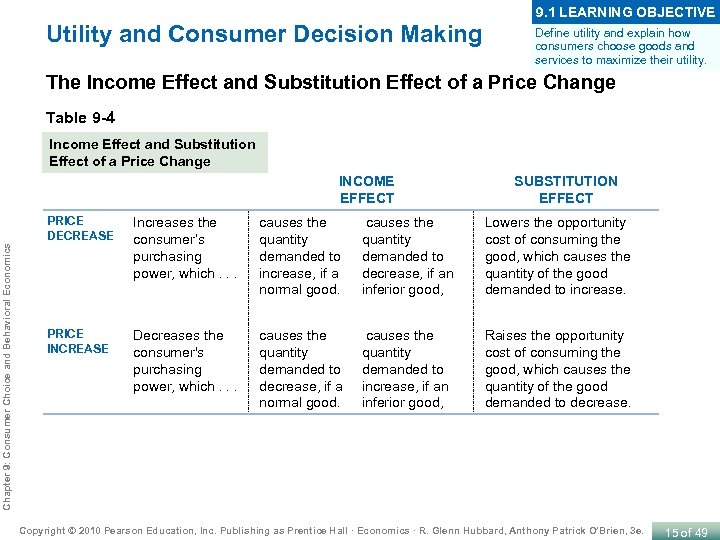
9. 1 LEARNING OBJECTIVE Utility and Consumer Decision Making Define utility and explain how consumers choose goods and services to maximize their utility. The Income Effect and Substitution Effect of a Price Change Table 9 -4 Income Effect and Substitution Effect of a Price Change INCOME EFFECT SUBSTITUTION EFFECT Chapter 9: Consumer Choice and Behavioral Economics PRICE DECREASE Increases the consumer‘s purchasing power, which. . . causes the quantity demanded to increase, if a normal good. causes the quantity demanded to decrease, if an inferior good, Lowers the opportunity cost of consuming the good, which causes the quantity of the good demanded to increase. PRICE INCREASE Decreases the consumer's purchasing power, which. . . causes the quantity demanded to decrease, if a normal good. causes the quantity demanded to increase, if an inferior good, Raises the opportunity cost of consuming the good, which causes the quantity of the good demanded to decrease. Copyright © 2010 Pearson Education, Inc. Publishing as Prentice Hall · Economics · R. Glenn Hubbard, Anthony Patrick O’Brien, 3 e. 15 of 49
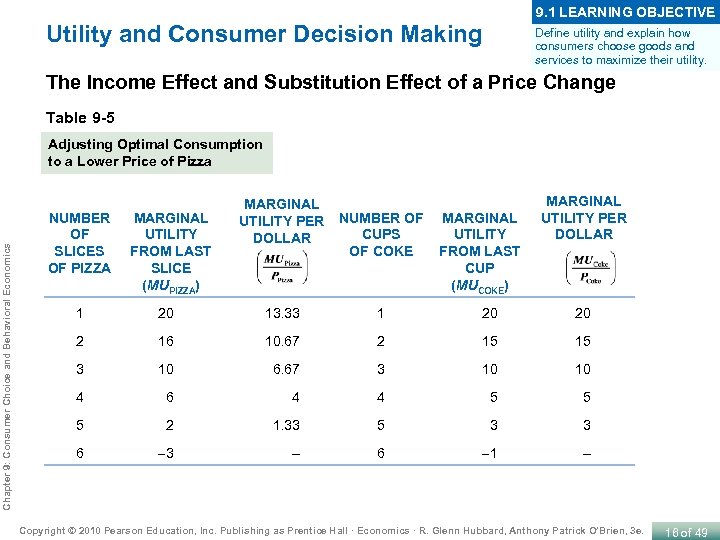
9. 1 LEARNING OBJECTIVE Utility and Consumer Decision Making Define utility and explain how consumers choose goods and services to maximize their utility. The Income Effect and Substitution Effect of a Price Change Table 9 -5 Chapter 9: Consumer Choice and Behavioral Economics Adjusting Optimal Consumption to a Lower Price of Pizza NUMBER OF SLICES OF PIZZA MARGINAL UTILITY FROM LAST SLICE (MUPIZZA) MARGINAL UTILITY PER DOLLAR NUMBER OF CUPS OF COKE MARGINAL UTILITY FROM LAST CUP (MUCOKE) MARGINAL UTILITY PER DOLLAR 1 20 13. 33 1 20 20 2 16 10. 67 2 15 15 3 10 6. 67 3 10 10 4 6 4 4 5 5 5 2 1. 33 5 3 3 6 3 – 6 1 – Copyright © 2010 Pearson Education, Inc. Publishing as Prentice Hall · Economics · R. Glenn Hubbard, Anthony Patrick O’Brien, 3 e. 16 of 49
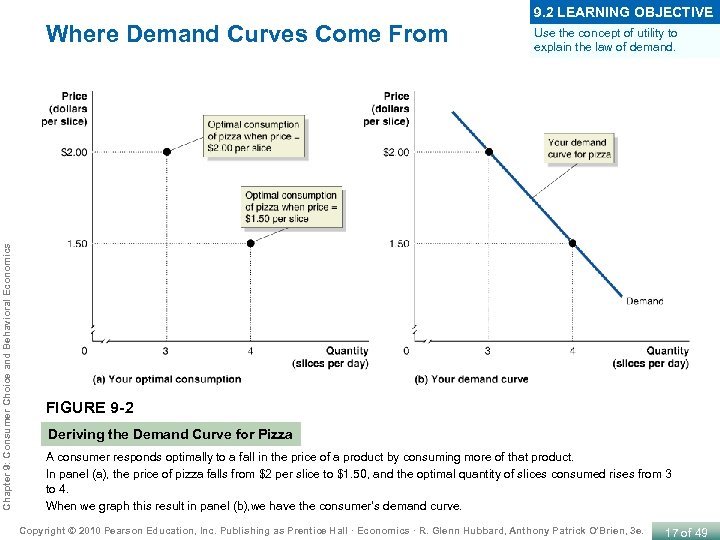
9. 2 LEARNING OBJECTIVE Chapter 9: Consumer Choice and Behavioral Economics Where Demand Curves Come From Use the concept of utility to explain the law of demand. FIGURE 9 -2 Deriving the Demand Curve for Pizza A consumer responds optimally to a fall in the price of a product by consuming more of that product. In panel (a), the price of pizza falls from $2 per slice to $1. 50, and the optimal quantity of slices consumed rises from 3 to 4. When we graph this result in panel (b), we have the consumer’s demand curve. Copyright © 2010 Pearson Education, Inc. Publishing as Prentice Hall · Economics · R. Glenn Hubbard, Anthony Patrick O’Brien, 3 e. 17 of 49
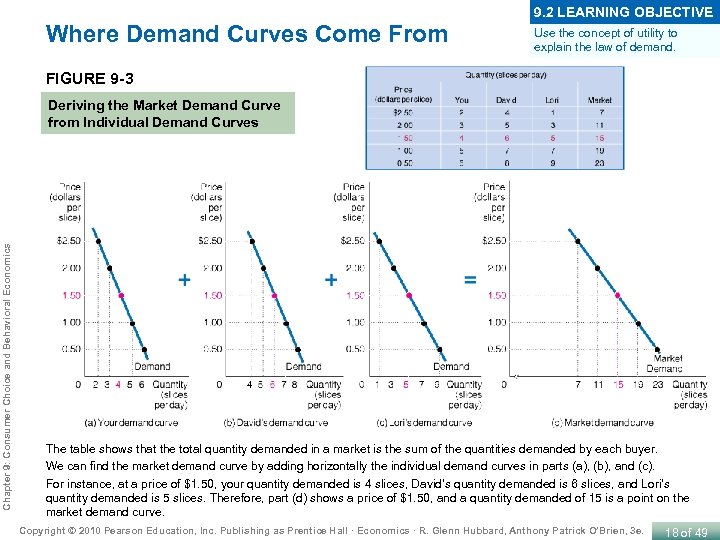
9. 2 LEARNING OBJECTIVE Where Demand Curves Come From Use the concept of utility to explain the law of demand. FIGURE 9 -3 Chapter 9: Consumer Choice and Behavioral Economics Deriving the Market Demand Curve from Individual Demand Curves The table shows that the total quantity demanded in a market is the sum of the quantities demanded by each buyer. We can find the market demand curve by adding horizontally the individual demand curves in parts (a), (b), and (c). For instance, at a price of $1. 50, your quantity demanded is 4 slices, David’s quantity demanded is 6 slices, and Lori’s quantity demanded is 5 slices. Therefore, part (d) shows a price of $1. 50, and a quantity demanded of 15 is a point on the market demand curve. Copyright © 2010 Pearson Education, Inc. Publishing as Prentice Hall · Economics · R. Glenn Hubbard, Anthony Patrick O’Brien, 3 e. 18 of 49
9. 3 LEARNING OBJECTIVE Social Influences on Decision Making Explain how social influences can affect consumption choices. Sociologists and anthropologists have argued that social factors such as culture, customs, and religion are very important in explaining the choices consumers make. Chapter 9: Consumer Choice and Behavioral Economics Economists have traditionally seen such factors as being relatively unimportant, if they take them into consideration at all. Recently, however, some economists have begun to study how social factors influence consumer choice. The Effects of Celebrity Endorsements In many cases, it is not just the number of people who use a product that makes it desirable but the types of people who use it. If consumers believe that media stars or professional athletes use a product, demand for the product will often increase. Copyright © 2010 Pearson Education, Inc. Publishing as Prentice Hall · Economics · R. Glenn Hubbard, Anthony Patrick O’Brien, 3 e. 19 of 49
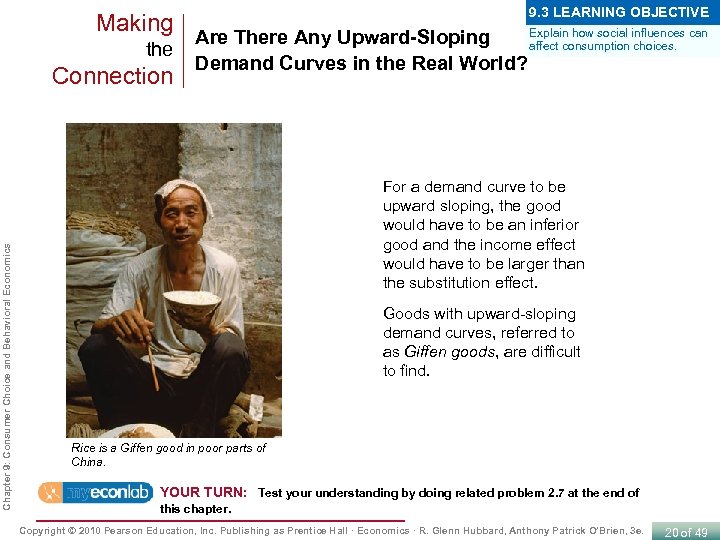
Making the Chapter 9: Consumer Choice and Behavioral Economics Connection 9. 3 LEARNING OBJECTIVE Explain how social influences can Are There Any Upward-Sloping affect consumption choices. Demand Curves in the Real World? For a demand curve to be upward sloping, the good would have to be an inferior good and the income effect would have to be larger than the substitution effect. Goods with upward-sloping demand curves, referred to as Giffen goods, are difficult to find. Rice is a Giffen good in poor parts of China. YOUR TURN: Test your understanding by doing related problem 2. 7 at the end of this chapter. Copyright © 2010 Pearson Education, Inc. Publishing as Prentice Hall · Economics · R. Glenn Hubbard, Anthony Patrick O’Brien, 3 e. 20 of 49
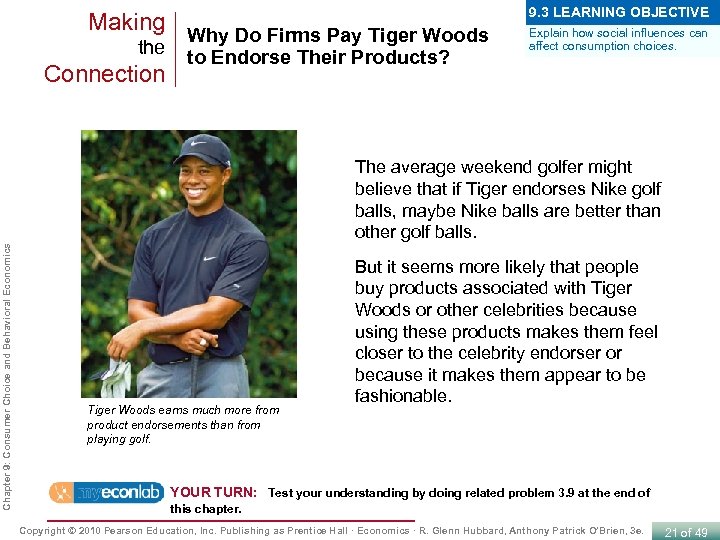
Making the Connection 9. 3 LEARNING OBJECTIVE Why Do Firms Pay Tiger Woods to Endorse Their Products? Explain how social influences can affect consumption choices. Chapter 9: Consumer Choice and Behavioral Economics The average weekend golfer might believe that if Tiger endorses Nike golf balls, maybe Nike balls are better than other golf balls. Tiger Woods earns much more from product endorsements than from playing golf. But it seems more likely that people buy products associated with Tiger Woods or other celebrities because using these products makes them feel closer to the celebrity endorser or because it makes them appear to be fashionable. YOUR TURN: Test your understanding by doing related problem 3. 9 at the end of this chapter. Copyright © 2010 Pearson Education, Inc. Publishing as Prentice Hall · Economics · R. Glenn Hubbard, Anthony Patrick O’Brien, 3 e. 21 of 49
9. 3 LEARNING OBJECTIVE Social Influences on Decision Making Explain how social influences can affect consumption choices. Network Externalities Chapter 9: Consumer Choice and Behavioral Economics Network externality A situation in which the usefulness of a product increases with the number of consumers who use it. Does Fairness Matter? A Test of Fairness in the Economic Laboratory: The Ultimatum Game Experiment Economists have used experiments to increase their understanding of the role that fairness plays in consumer decision making. Copyright © 2010 Pearson Education, Inc. Publishing as Prentice Hall · Economics · R. Glenn Hubbard, Anthony Patrick O’Brien, 3 e. 22 of 49
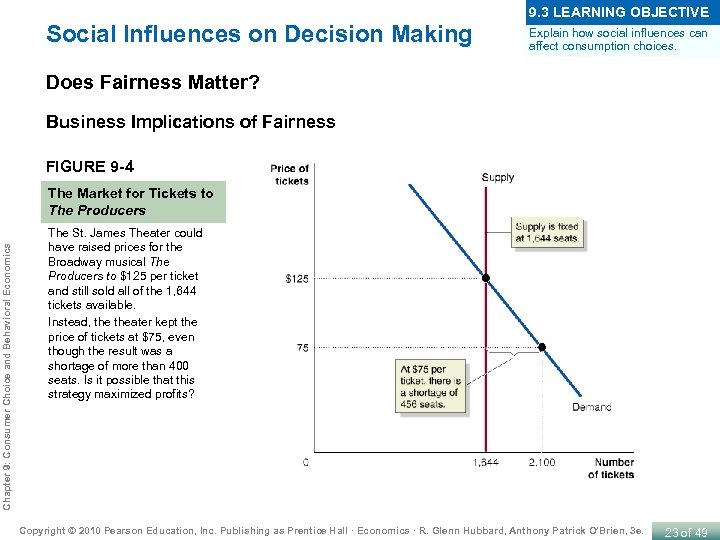
9. 3 LEARNING OBJECTIVE Social Influences on Decision Making Explain how social influences can affect consumption choices. Does Fairness Matter? Business Implications of Fairness FIGURE 9 -4 Chapter 9: Consumer Choice and Behavioral Economics The Market for Tickets to The Producers The St. James Theater could have raised prices for the Broadway musical The Producers to $125 per ticket and still sold all of the 1, 644 tickets available. Instead, theater kept the price of tickets at $75, even though the result was a shortage of more than 400 seats. Is it possible that this strategy maximized profits? Copyright © 2010 Pearson Education, Inc. Publishing as Prentice Hall · Economics · R. Glenn Hubbard, Anthony Patrick O’Brien, 3 e. 23 of 49
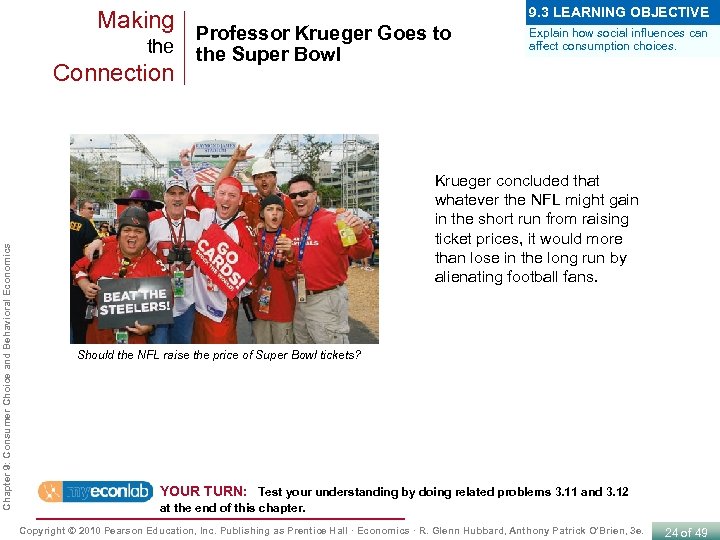
Making Professor Krueger Goes to the Chapter 9: Consumer Choice and Behavioral Economics Connection the Super Bowl 9. 3 LEARNING OBJECTIVE Explain how social influences can affect consumption choices. Krueger concluded that whatever the NFL might gain in the short run from raising ticket prices, it would more than lose in the long run by alienating football fans. Should the NFL raise the price of Super Bowl tickets? YOUR TURN: Test your understanding by doing related problems 3. 11 and 3. 12 at the end of this chapter. Copyright © 2010 Pearson Education, Inc. Publishing as Prentice Hall · Economics · R. Glenn Hubbard, Anthony Patrick O’Brien, 3 e. 24 of 49
Behavioral Economics: Do People Make Their Choices Rationally? 9. 4 LEARNING OBJECTIVE Describe the behavioral economics approach to understanding decision making. Chapter 9: Consumer Choice and Behavioral Economics Behavioral economics The study of situations in which people make choices that do not appear to be economically rational. Consumers commonly commit the following three mistakes when making decisions: • They take into account monetary costs but ignore nonmonetary opportunity costs. • They fail to ignore sunk costs. • They are unrealistic about their future behavior. Copyright © 2010 Pearson Education, Inc. Publishing as Prentice Hall · Economics · R. Glenn Hubbard, Anthony Patrick O’Brien, 3 e. 25 of 49
Behavioral Economics: Do People Make Their Choices Rationally? 9. 4 LEARNING OBJECTIVE Describe the behavioral economics approach to understanding decision making. Ignoring Nonmonetary Opportunity Costs Chapter 9: Consumer Choice and Behavioral Economics Opportunity cost The highest-valued alternative that must be given up to engage in an activity. Endowment effect The tendency of people to be unwilling to sell a good they already own even if they are offered a price that is greater than the price they would be willing to pay to buy the good if they didn’t already own it. Copyright © 2010 Pearson Education, Inc. Publishing as Prentice Hall · Economics · R. Glenn Hubbard, Anthony Patrick O’Brien, 3 e. 26 of 49

Making A Blogger Who Understands the Chapter 9: Consumer Choice and Behavioral Economics Connection the Importance of Ignoring Sunk Costs 9. 4 LEARNING OBJECTIVE Describe the behavioral economics approach to understanding decision making. Knowing that it is rational to ignore sunk costs can be important in making key decisions in life. Would you give up being a surgeon to start your own blog? YOUR TURN: Test your understanding by doing related problems 4. 7, 4. 8, and 4. 9 at the end of this chapter. Copyright © 2010 Pearson Education, Inc. Publishing as Prentice Hall · Economics · R. Glenn Hubbard, Anthony Patrick O’Brien, 3 e. 27 of 49
Behavioral Economics: Do People Make Their Choices Rationally? 9. 4 LEARNING OBJECTIVE Describe the behavioral economics approach to understanding decision making. Failing to Ignore Sunk Costs Chapter 9: Consumer Choice and Behavioral Economics Sunk cost A cost that has already been paid and cannot be recovered. Being Unrealistic about Future Behavior If you are unrealistic about your future behavior, you underestimate the costs of choices that you make today. Copyright © 2010 Pearson Education, Inc. Publishing as Prentice Hall · Economics · R. Glenn Hubbard, Anthony Patrick O’Brien, 3 e. 28 of 49
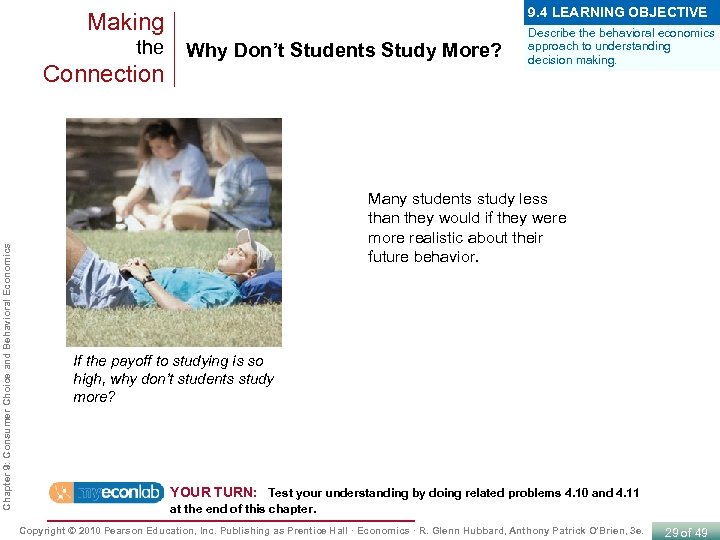
9. 4 LEARNING OBJECTIVE Making the Chapter 9: Consumer Choice and Behavioral Economics Connection Why Don’t Students Study More? Describe the behavioral economics approach to understanding decision making. Many students study less than they would if they were more realistic about their future behavior. If the payoff to studying is so high, why don’t students study more? YOUR TURN: Test your understanding by doing related problems 4. 10 and 4. 11 at the end of this chapter. Copyright © 2010 Pearson Education, Inc. Publishing as Prentice Hall · Economics · R. Glenn Hubbard, Anthony Patrick O’Brien, 3 e. 29 of 49
9 -4 Solved Problem Chapter 9: Consumer Choice and Behavioral Economics How Do You Get People to Save More of Their Income? 9. 4 LEARNING OBJECTIVE Describe the behavioral economics approach to understanding decision making. Use your understanding of consumer decision making to show a savings plan may work. YOUR TURN: For more practice, do related problems 4. 12 and 4. 13 at the end of this chapter. Copyright © 2010 Pearson Education, Inc. Publishing as Prentice Hall · Economics · R. Glenn Hubbard, Anthony Patrick O’Brien, 3 e. 30 of 49
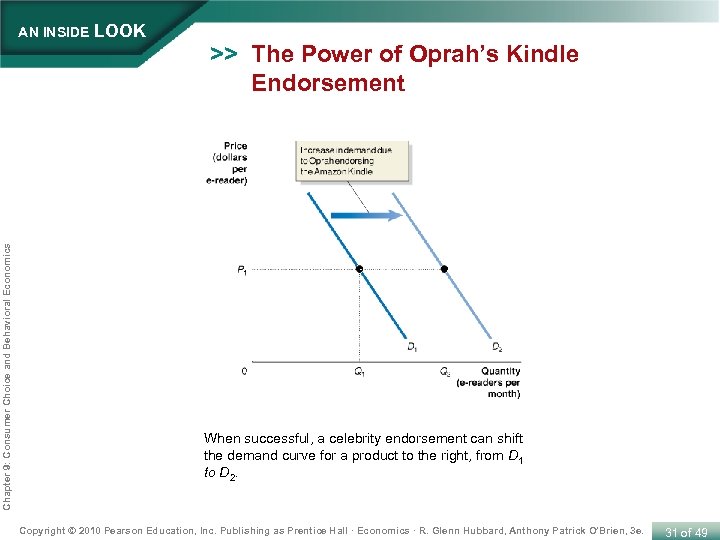
Chapter 9: Consumer Choice and Behavioral Economics AN INSIDE LOOK >> The Power of Oprah’s Kindle Endorsement When successful, a celebrity endorsement can shift the demand curve for a product to the right, from D 1 to D 2. Copyright © 2010 Pearson Education, Inc. Publishing as Prentice Hall · Economics · R. Glenn Hubbard, Anthony Patrick O’Brien, 3 e. 31 of 49
KEY TERMS Network externality Budget constraint Opportunity cost Endowment effect Chapter 9: Consumer Choice and Behavioral Economics Behavioral economics Substitution effect Income effect Sunk cost Law of diminishing marginal utility Marginal utility (MU) Utility Copyright © 2010 Pearson Education, Inc. Publishing as Prentice Hall · Economics · R. Glenn Hubbard, Anthony Patrick O’Brien, 3 e. 32 of 49
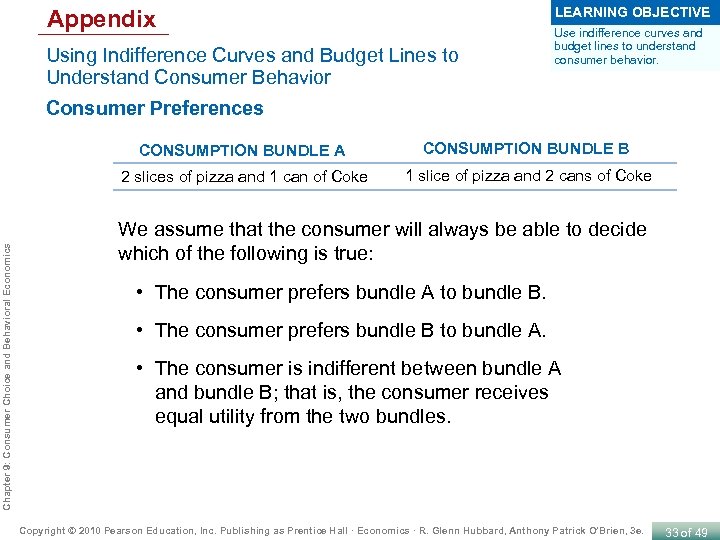
LEARNING OBJECTIVE Appendix Using Indifference Curves and Budget Lines to Understand Consumer Behavior Use indifference curves and budget lines to understand consumer behavior. Consumer Preferences CONSUMPTION BUNDLE B 2 slices of pizza and 1 can of Coke Chapter 9: Consumer Choice and Behavioral Economics CONSUMPTION BUNDLE A 1 slice of pizza and 2 cans of Coke We assume that the consumer will always be able to decide which of the following is true: • The consumer prefers bundle A to bundle B. • The consumer prefers bundle B to bundle A. • The consumer is indifferent between bundle A and bundle B; that is, the consumer receives equal utility from the two bundles. Copyright © 2010 Pearson Education, Inc. Publishing as Prentice Hall · Economics · R. Glenn Hubbard, Anthony Patrick O’Brien, 3 e. 33 of 49
LEARNING OBJECTIVE Appendix Use indifference curves and budget lines to understand consumer behavior. Consumer Preferences Chapter 9: Consumer Choice and Behavioral Economics Indifference Curves Indifference curve A curve that shows the combinations of consumption bundles that give the consumer the same utility. Copyright © 2010 Pearson Education, Inc. Publishing as Prentice Hall · Economics · R. Glenn Hubbard, Anthony Patrick O’Brien, 3 e. 34 of 49
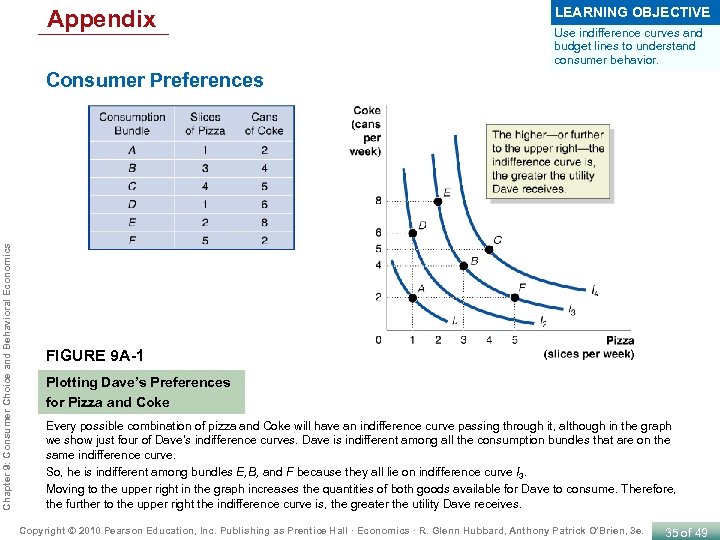
Appendix LEARNING OBJECTIVE Use indifference curves and budget lines to understand consumer behavior. Chapter 9: Consumer Choice and Behavioral Economics Consumer Preferences FIGURE 9 A-1 Plotting Dave’s Preferences for Pizza and Coke Every possible combination of pizza and Coke will have an indifference curve passing through it, although in the graph we show just four of Dave’s indifference curves. Dave is indifferent among all the consumption bundles that are on the same indifference curve. So, he is indifferent among bundles E, B, and F because they all lie on indifference curve I 3. Moving to the upper right in the graph increases the quantities of both goods available for Dave to consume. Therefore, the further to the upper right the indifference curve is, the greater the utility Dave receives. Copyright © 2010 Pearson Education, Inc. Publishing as Prentice Hall · Economics · R. Glenn Hubbard, Anthony Patrick O’Brien, 3 e. 35 of 49
LEARNING OBJECTIVE Appendix Use indifference curves and budget lines to understand consumer behavior. Consumer Preferences Chapter 9: Consumer Choice and Behavioral Economics The Slope of an Indifference Curve Marginal rate of substitution (MRS) The rate at which a consumer would be willing to trade off one good for another. Copyright © 2010 Pearson Education, Inc. Publishing as Prentice Hall · Economics · R. Glenn Hubbard, Anthony Patrick O’Brien, 3 e. 36 of 49
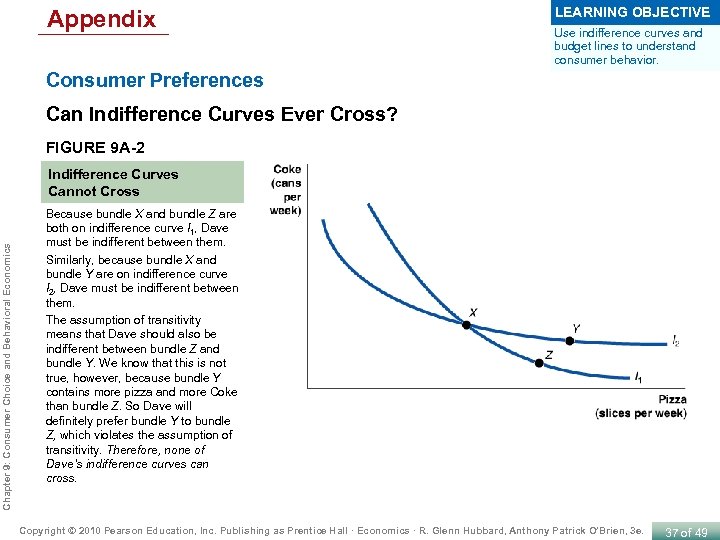
Appendix LEARNING OBJECTIVE Use indifference curves and budget lines to understand consumer behavior. Consumer Preferences Can Indifference Curves Ever Cross? FIGURE 9 A-2 Chapter 9: Consumer Choice and Behavioral Economics Indifference Curves Cannot Cross Because bundle X and bundle Z are both on indifference curve I 1, Dave must be indifferent between them. Similarly, because bundle X and bundle Y are on indifference curve I 2, Dave must be indifferent between them. The assumption of transitivity means that Dave should also be indifferent between bundle Z and bundle Y. We know that this is not true, however, because bundle Y contains more pizza and more Coke than bundle Z. So Dave will definitely prefer bundle Y to bundle Z, which violates the assumption of transitivity. Therefore, none of Dave’s indifference curves can cross. Copyright © 2010 Pearson Education, Inc. Publishing as Prentice Hall · Economics · R. Glenn Hubbard, Anthony Patrick O’Brien, 3 e. 37 of 49
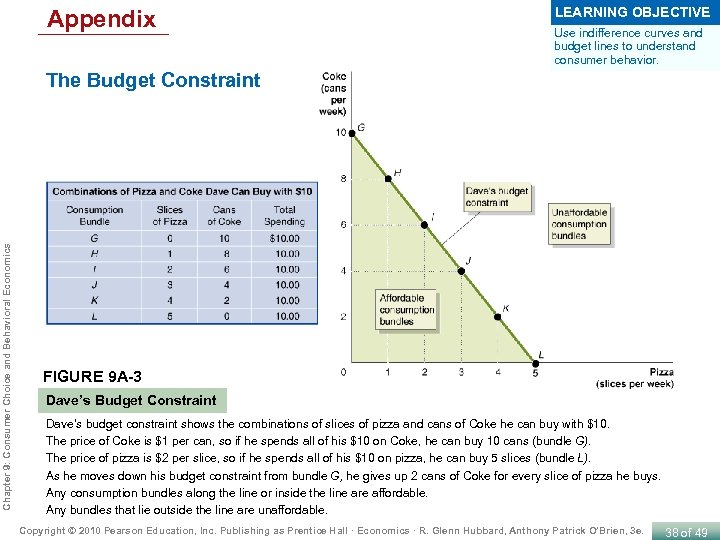
Appendix LEARNING OBJECTIVE Use indifference curves and budget lines to understand consumer behavior. Chapter 9: Consumer Choice and Behavioral Economics The Budget Constraint FIGURE 9 A-3 Dave’s Budget Constraint Dave’s budget constraint shows the combinations of slices of pizza and cans of Coke he can buy with $10. The price of Coke is $1 per can, so if he spends all of his $10 on Coke, he can buy 10 cans (bundle G). The price of pizza is $2 per slice, so if he spends all of his $10 on pizza, he can buy 5 slices (bundle L). As he moves down his budget constraint from bundle G, he gives up 2 cans of Coke for every slice of pizza he buys. Any consumption bundles along the line or inside the line are affordable. Any bundles that lie outside the line are unaffordable. Copyright © 2010 Pearson Education, Inc. Publishing as Prentice Hall · Economics · R. Glenn Hubbard, Anthony Patrick O’Brien, 3 e. 38 of 49
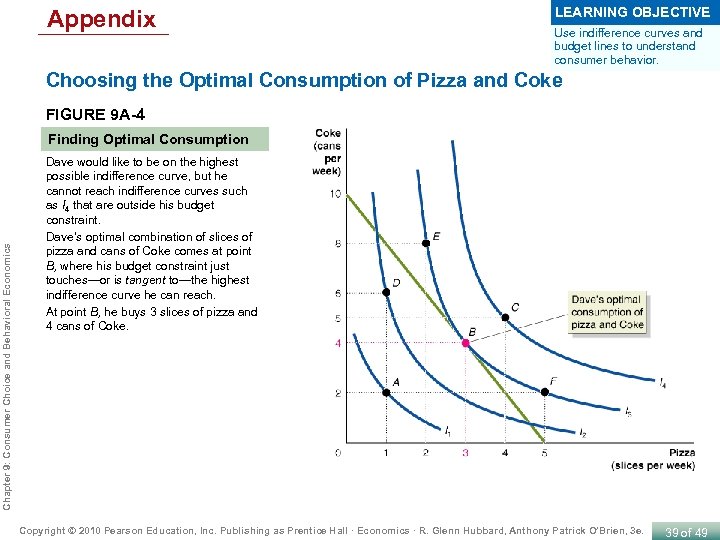
Appendix LEARNING OBJECTIVE Use indifference curves and budget lines to understand consumer behavior. Choosing the Optimal Consumption of Pizza and Coke FIGURE 9 A-4 Chapter 9: Consumer Choice and Behavioral Economics Finding Optimal Consumption Dave would like to be on the highest possible indifference curve, but he cannot reach indifference curves such as I 4 that are outside his budget constraint. Dave’s optimal combination of slices of pizza and cans of Coke comes at point B, where his budget constraint just touches—or is tangent to—the highest indifference curve he can reach. At point B, he buys 3 slices of pizza and 4 cans of Coke. Copyright © 2010 Pearson Education, Inc. Publishing as Prentice Hall · Economics · R. Glenn Hubbard, Anthony Patrick O’Brien, 3 e. 39 of 49
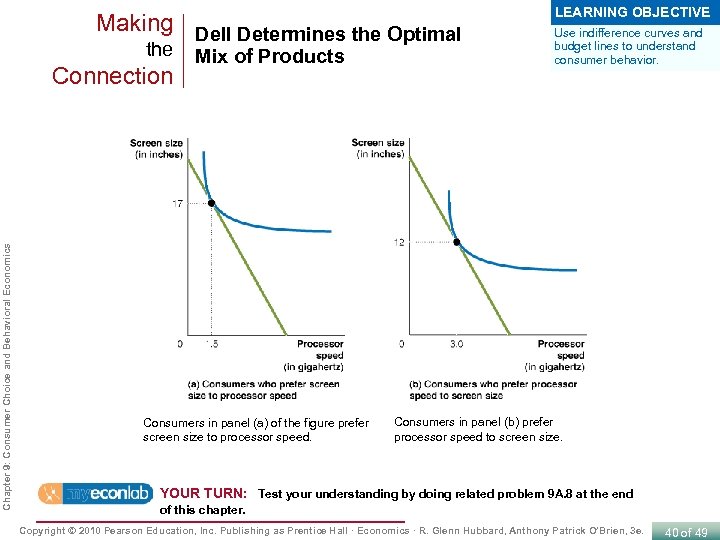
Making Dell Determines the Optimal the Chapter 9: Consumer Choice and Behavioral Economics Connection Mix of Products Consumers in panel (a) of the figure prefer screen size to processor speed. LEARNING OBJECTIVE Use indifference curves and budget lines to understand consumer behavior. Consumers in panel (b) prefer processor speed to screen size. YOUR TURN: Test your understanding by doing related problem 9 A. 8 at the end of this chapter. Copyright © 2010 Pearson Education, Inc. Publishing as Prentice Hall · Economics · R. Glenn Hubbard, Anthony Patrick O’Brien, 3 e. 40 of 49
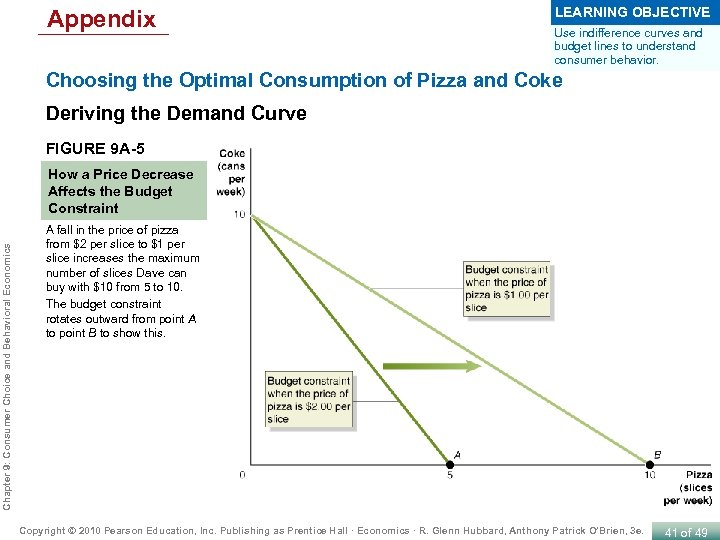
Appendix LEARNING OBJECTIVE Use indifference curves and budget lines to understand consumer behavior. Choosing the Optimal Consumption of Pizza and Coke Deriving the Demand Curve FIGURE 9 A-5 Chapter 9: Consumer Choice and Behavioral Economics How a Price Decrease Affects the Budget Constraint A fall in the price of pizza from $2 per slice to $1 per slice increases the maximum number of slices Dave can buy with $10 from 5 to 10. The budget constraint rotates outward from point A to point B to show this. Copyright © 2010 Pearson Education, Inc. Publishing as Prentice Hall · Economics · R. Glenn Hubbard, Anthony Patrick O’Brien, 3 e. 41 of 49
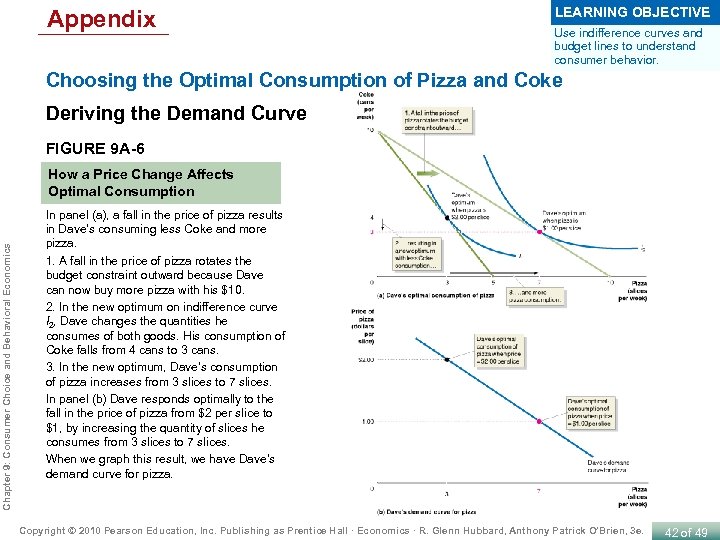
Appendix LEARNING OBJECTIVE Use indifference curves and budget lines to understand consumer behavior. Choosing the Optimal Consumption of Pizza and Coke Deriving the Demand Curve FIGURE 9 A-6 Chapter 9: Consumer Choice and Behavioral Economics How a Price Change Affects Optimal Consumption In panel (a), a fall in the price of pizza results in Dave’s consuming less Coke and more pizza. 1. A fall in the price of pizza rotates the budget constraint outward because Dave can now buy more pizza with his $10. 2. In the new optimum on indifference curve I 2, Dave changes the quantities he consumes of both goods. His consumption of Coke falls from 4 cans to 3 cans. 3. In the new optimum, Dave’s consumption of pizza increases from 3 slices to 7 slices. In panel (b) Dave responds optimally to the fall in the price of pizza from $2 per slice to $1, by increasing the quantity of slices he consumes from 3 slices to 7 slices. When we graph this result, we have Dave’s demand curve for pizza. Copyright © 2010 Pearson Education, Inc. Publishing as Prentice Hall · Economics · R. Glenn Hubbard, Anthony Patrick O’Brien, 3 e. 42 of 49
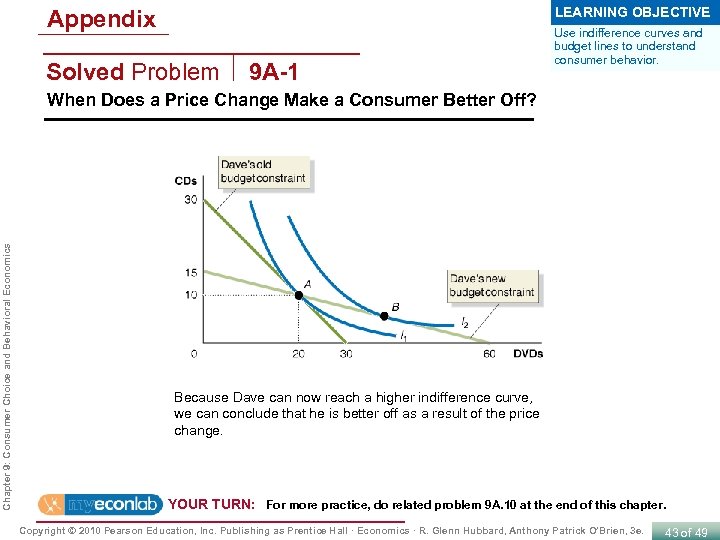
LEARNING OBJECTIVE Appendix Solved Problem 9 A-1 Use indifference curves and budget lines to understand consumer behavior. Chapter 9: Consumer Choice and Behavioral Economics When Does a Price Change Make a Consumer Better Off? Because Dave can now reach a higher indifference curve, we can conclude that he is better off as a result of the price change. YOUR TURN: For more practice, do related problem 9 A. 10 at the end of this chapter. Copyright © 2010 Pearson Education, Inc. Publishing as Prentice Hall · Economics · R. Glenn Hubbard, Anthony Patrick O’Brien, 3 e. 43 of 49
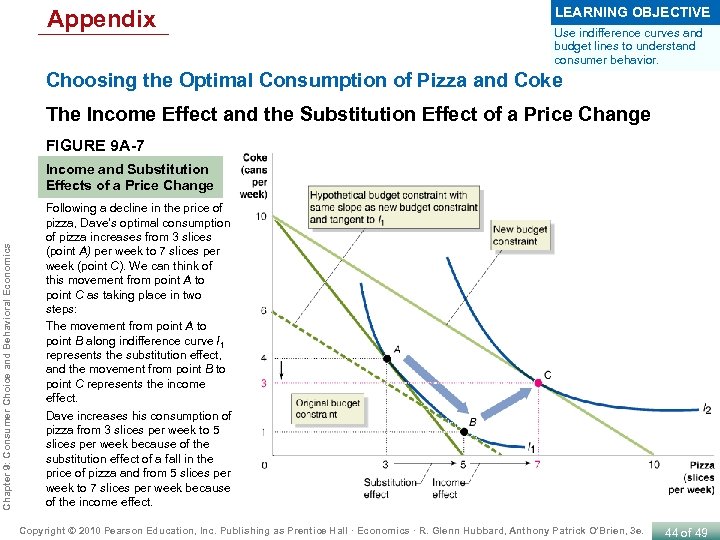
Appendix LEARNING OBJECTIVE Use indifference curves and budget lines to understand consumer behavior. Choosing the Optimal Consumption of Pizza and Coke The Income Effect and the Substitution Effect of a Price Change FIGURE 9 A-7 Chapter 9: Consumer Choice and Behavioral Economics Income and Substitution Effects of a Price Change Following a decline in the price of pizza, Dave’s optimal consumption of pizza increases from 3 slices (point A) per week to 7 slices per week (point C). We can think of this movement from point A to point C as taking place in two steps: The movement from point A to point B along indifference curve I 1 represents the substitution effect, and the movement from point B to point C represents the income effect. Dave increases his consumption of pizza from 3 slices per week to 5 slices per week because of the substitution effect of a fall in the price of pizza and from 5 slices per week to 7 slices per week because of the income effect. Copyright © 2010 Pearson Education, Inc. Publishing as Prentice Hall · Economics · R. Glenn Hubbard, Anthony Patrick O’Brien, 3 e. 44 of 49
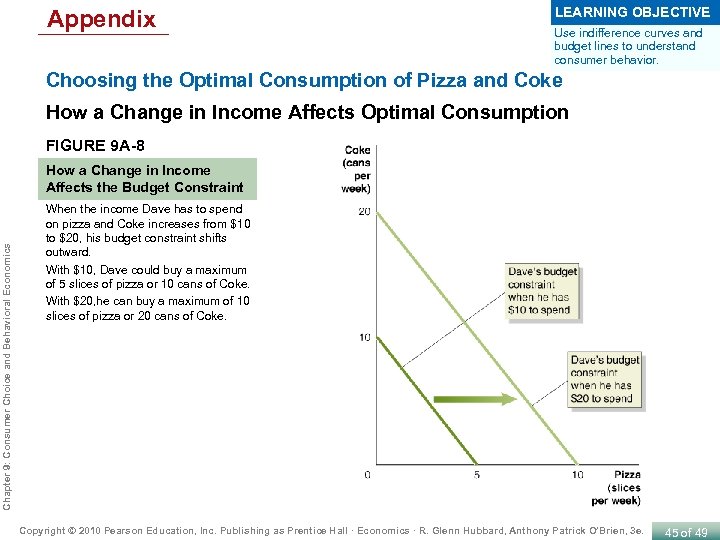
Appendix LEARNING OBJECTIVE Use indifference curves and budget lines to understand consumer behavior. Choosing the Optimal Consumption of Pizza and Coke How a Change in Income Affects Optimal Consumption FIGURE 9 A-8 Chapter 9: Consumer Choice and Behavioral Economics How a Change in Income Affects the Budget Constraint When the income Dave has to spend on pizza and Coke increases from $10 to $20, his budget constraint shifts outward. With $10, Dave could buy a maximum of 5 slices of pizza or 10 cans of Coke. With $20, he can buy a maximum of 10 slices of pizza or 20 cans of Coke. Copyright © 2010 Pearson Education, Inc. Publishing as Prentice Hall · Economics · R. Glenn Hubbard, Anthony Patrick O’Brien, 3 e. 45 of 49
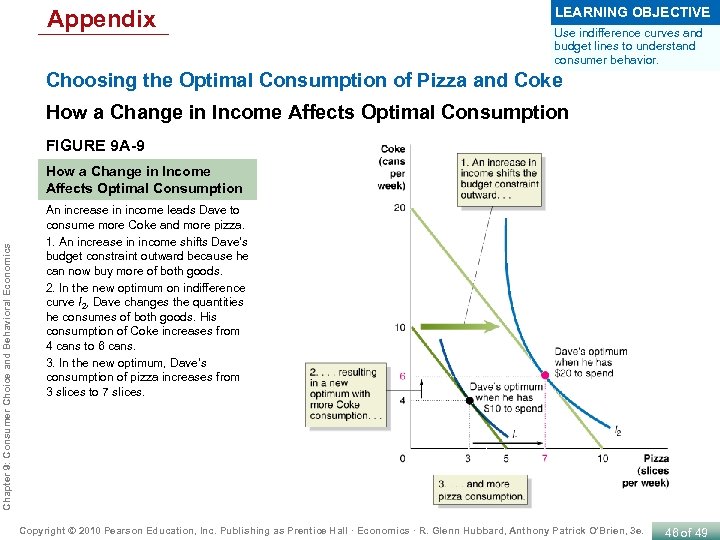
Appendix LEARNING OBJECTIVE Use indifference curves and budget lines to understand consumer behavior. Choosing the Optimal Consumption of Pizza and Coke How a Change in Income Affects Optimal Consumption FIGURE 9 A-9 Chapter 9: Consumer Choice and Behavioral Economics How a Change in Income Affects Optimal Consumption An increase in income leads Dave to consume more Coke and more pizza. 1. An increase in income shifts Dave’s budget constraint outward because he can now buy more of both goods. 2. In the new optimum on indifference curve I 2, Dave changes the quantities he consumes of both goods. His consumption of Coke increases from 4 cans to 6 cans. 3. In the new optimum, Dave’s consumption of pizza increases from 3 slices to 7 slices. Copyright © 2010 Pearson Education, Inc. Publishing as Prentice Hall · Economics · R. Glenn Hubbard, Anthony Patrick O’Brien, 3 e. 46 of 49
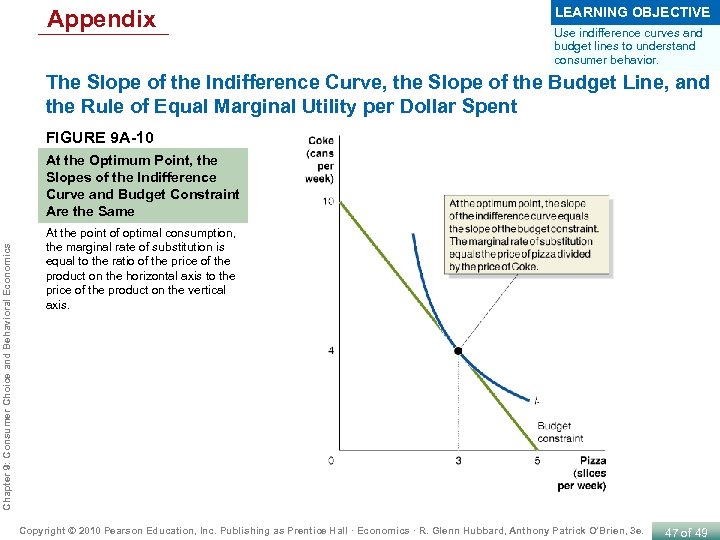
Appendix LEARNING OBJECTIVE Use indifference curves and budget lines to understand consumer behavior. The Slope of the Indifference Curve, the Slope of the Budget Line, and the Rule of Equal Marginal Utility per Dollar Spent FIGURE 9 A-10 Chapter 9: Consumer Choice and Behavioral Economics At the Optimum Point, the Slopes of the Indifference Curve and Budget Constraint Are the Same At the point of optimal consumption, the marginal rate of substitution is equal to the ratio of the price of the product on the horizontal axis to the price of the product on the vertical axis. Copyright © 2010 Pearson Education, Inc. Publishing as Prentice Hall · Economics · R. Glenn Hubbard, Anthony Patrick O’Brien, 3 e. 47 of 49
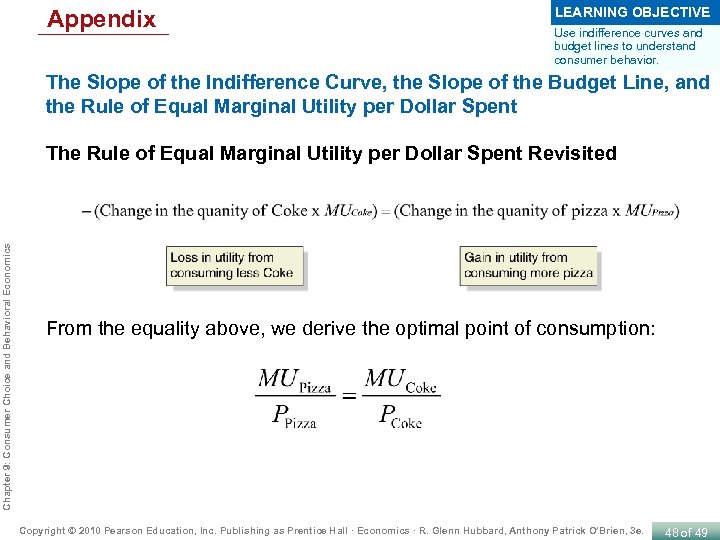
Appendix LEARNING OBJECTIVE Use indifference curves and budget lines to understand consumer behavior. The Slope of the Indifference Curve, the Slope of the Budget Line, and the Rule of Equal Marginal Utility per Dollar Spent Chapter 9: Consumer Choice and Behavioral Economics The Rule of Equal Marginal Utility per Dollar Spent Revisited From the equality above, we derive the optimal point of consumption: Copyright © 2010 Pearson Education, Inc. Publishing as Prentice Hall · Economics · R. Glenn Hubbard, Anthony Patrick O’Brien, 3 e. 48 of 49
KEY TERMS Indifference curve Chapter 9: Consumer Choice and Behavioral Economics Marginal rate of substitution (MRS) Copyright © 2010 Pearson Education, Inc. Publishing as Prentice Hall · Economics · R. Glenn Hubbard, Anthony Patrick O’Brien, 3 e. 49 of 49
Скачать презентацию Chapter 9 Consumer Choice and Behavioral Economics Copyright
aa4911f12943aeba5f11e4379a98c359.ppt