


 Скачать презентацию Chapter 9 Capacity Planning Facility Location Operations
2bf33c31249a5704412e60697d0c1aa8.ppt
- Количество слайдов: 39
 Chapter 9– Capacity Planning & Facility Location Operations Management by R. Dan Reid & Nada R. Sanders 4 th Edition © Wiley 2010 1
 Learning Objectives n n Define capacity planning Define location analysis Describe relationship between capacity planning and location, and their importance Explain the steps involved in capacity planning and location analysis © Wiley 2010 2
 Learning Objectives – con’t n n n Describe the decision support tools used for capacity planning Identify key factors in location analysis Describe the decision support tools used for location analysis © Wiley 2010 3
 Capacity planning n n Capacity is the maximum output rate of a facility Capacity planning is the process of establishing the output rate that can be achieved at a facility: n Capacity is usually purchased in “chunks” n Strategic issues: how much and when to spend capital for additional facility & equipment n Tactical issues: workforce & inventory levels, & day-to-day use of equipment © Wiley 2010 4
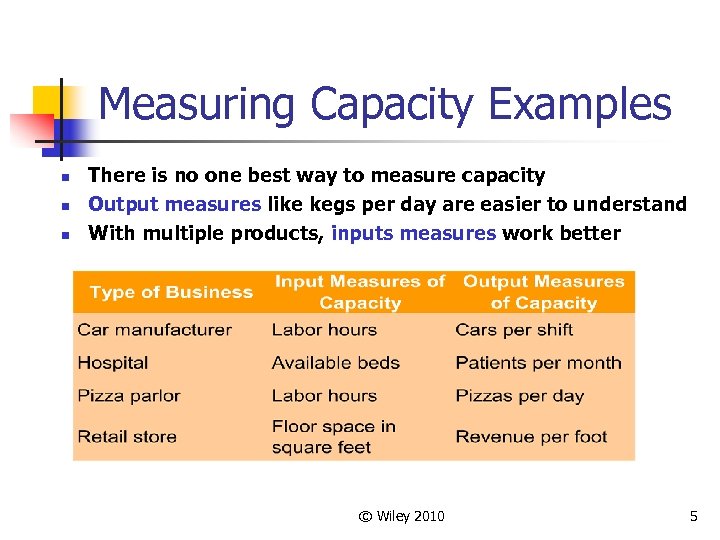 Measuring Capacity Examples n n n There is no one best way to measure capacity Output measures like kegs per day are easier to understand With multiple products, inputs measures work better © Wiley 2010 5
 Measuring Available Capacity n Design capacity: n n n Maximum output rate under ideal conditions A bakery can make 30 custom cakes per day when pushed at holiday time Effective capacity: n n Maximum output rate under normal (realistic) conditions On the average this bakery can make 20 custom cakes per day © Wiley 2010 6
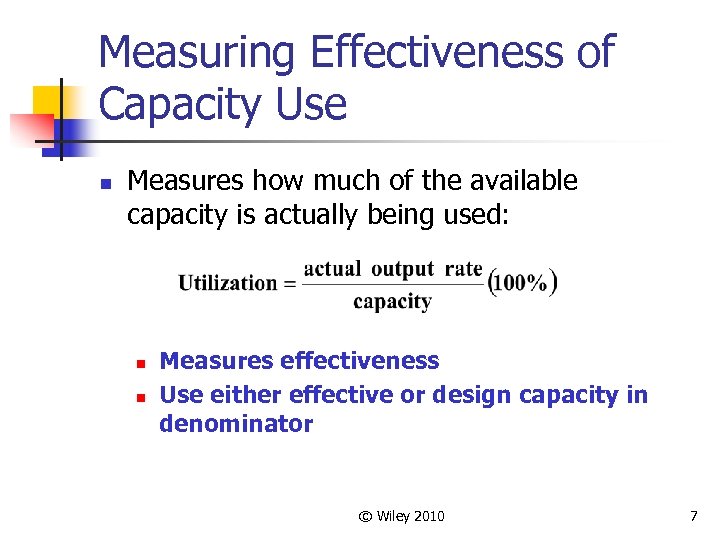 Measuring Effectiveness of Capacity Use n Measures how much of the available capacity is actually being used: n n Measures effectiveness Use either effective or design capacity in denominator © Wiley 2010 7
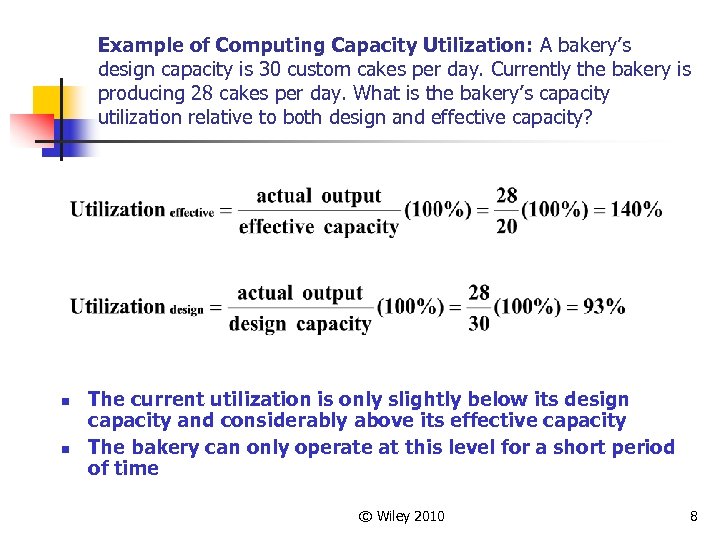 Example of Computing Capacity Utilization: A bakery’s design capacity is 30 custom cakes per day. Currently the bakery is producing 28 cakes per day. What is the bakery’s capacity utilization relative to both design and effective capacity? n n The current utilization is only slightly below its design capacity and considerably above its effective capacity The bakery can only operate at this level for a short period of time © Wiley 2010 8
 Capacity Considerations n n The Best Operating Level is the output that results in the lowest average unit cost Economies of Scale: n n n Where the cost per unit of output drops as volume of output increases Spread the fixed costs of buildings & equipment over multiple units, allow bulk purchasing & handling of material Diseconomies of Scale: n n Where the cost per unit rises as volume increases Often caused by congestion (overwhelming the process with too much work-in-process) and scheduling complexity © Wiley 2010 9
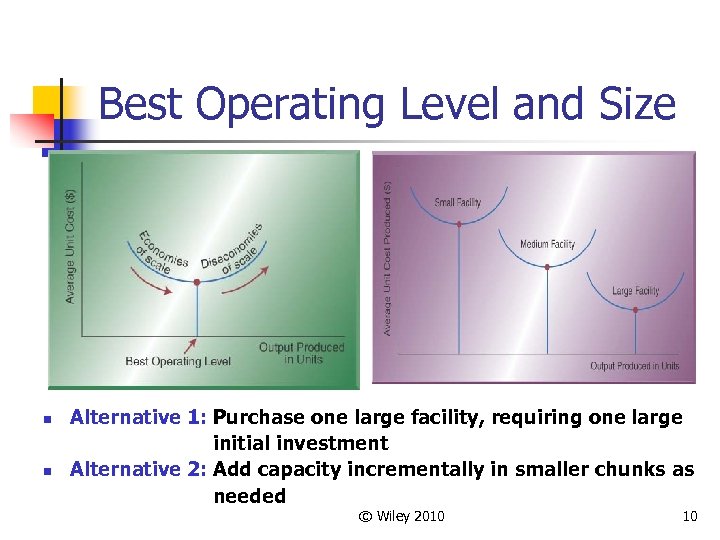 Best Operating Level and Size n n Alternative 1: Purchase one large facility, requiring one large initial investment Alternative 2: Add capacity incrementally in smaller chunks as needed © Wiley 2010 10
 Other Capacity Considerations n Focused factories: n n Plant within a plant (PWP): n n Small, specialized facilities with limited objectives Segmenting larger operations into smaller operating units with focused objectives Subcontractor networks: n Outsource non-core items to free up capacity for what you do well © Wiley 2010 11
 Making Capacity Planning Decisions The three-step procedure for making capacity planning decisions is as follows: 1. Identify Capacity Requirements 2. Develop Capacity Alternatives 3. Evaluate Capacity Alternatives © Wiley 2010 12
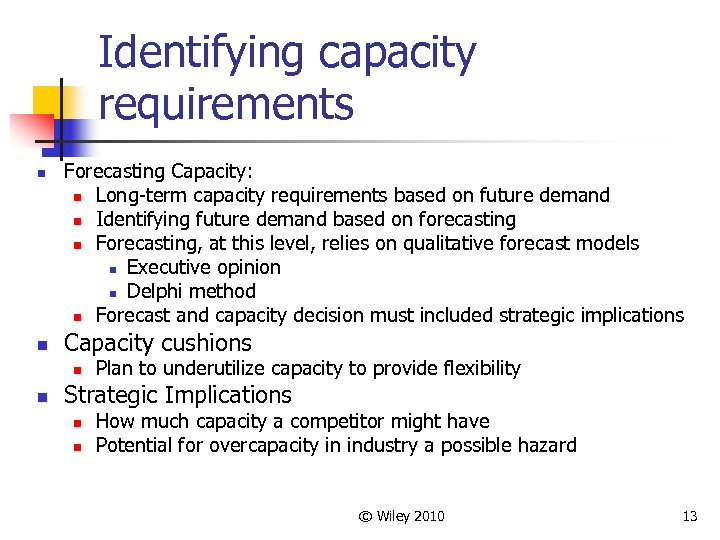 Identifying capacity requirements n n Forecasting Capacity: n Long-term capacity requirements based on future demand n Identifying future demand based on forecasting n Forecasting, at this level, relies on qualitative forecast models n Executive opinion n Delphi method n Forecast and capacity decision must included strategic implications Capacity cushions n n Plan to underutilize capacity to provide flexibility Strategic Implications n n How much capacity a competitor might have Potential for overcapacity in industry a possible hazard © Wiley 2010 13
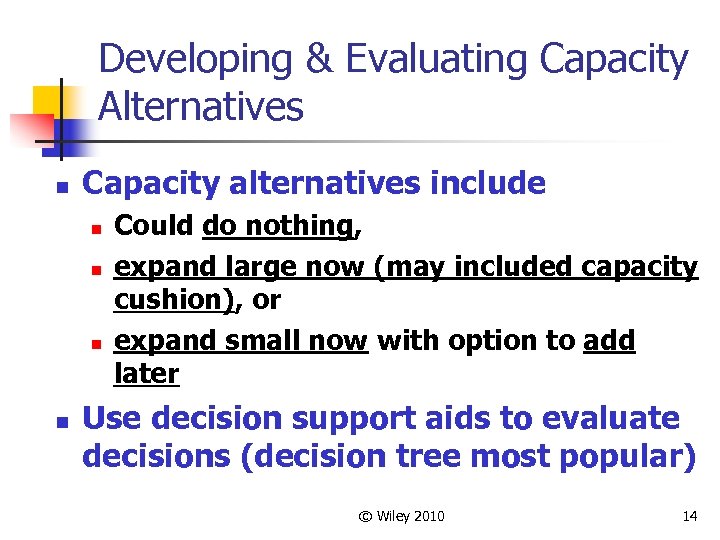 Developing & Evaluating Capacity Alternatives n Capacity alternatives include n n Could do nothing, expand large now (may included capacity cushion), or expand small now with option to add later Use decision support aids to evaluate decisions (decision tree most popular) © Wiley 2010 14
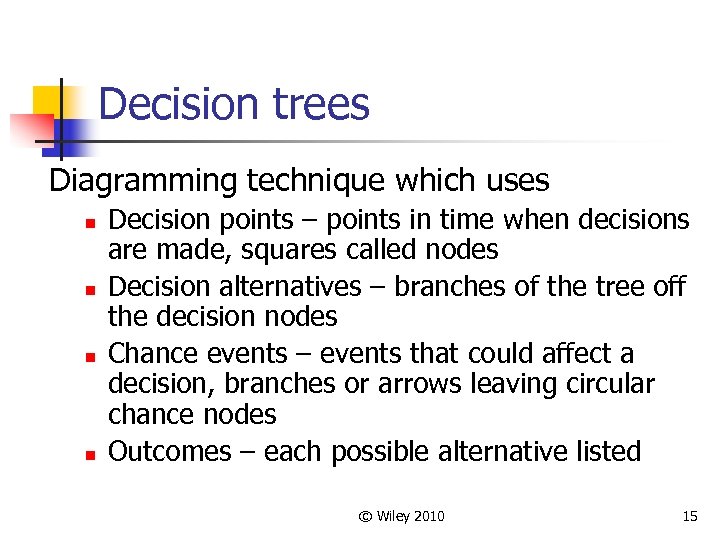 Decision trees Diagramming technique which uses n n Decision points – points in time when decisions are made, squares called nodes Decision alternatives – branches of the tree off the decision nodes Chance events – events that could affect a decision, branches or arrows leaving circular chance nodes Outcomes – each possible alternative listed © Wiley 2010 15
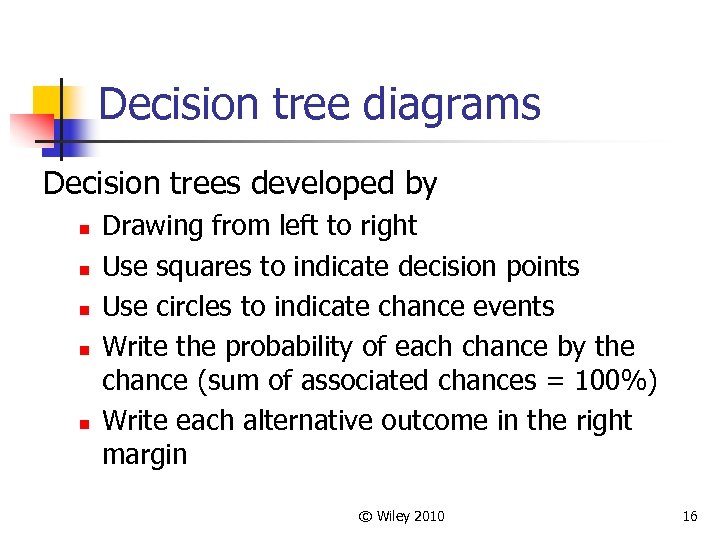 Decision tree diagrams Decision trees developed by n n n Drawing from left to right Use squares to indicate decision points Use circles to indicate chance events Write the probability of each chance by the chance (sum of associated chances = 100%) Write each alternative outcome in the right margin © Wiley 2010 16
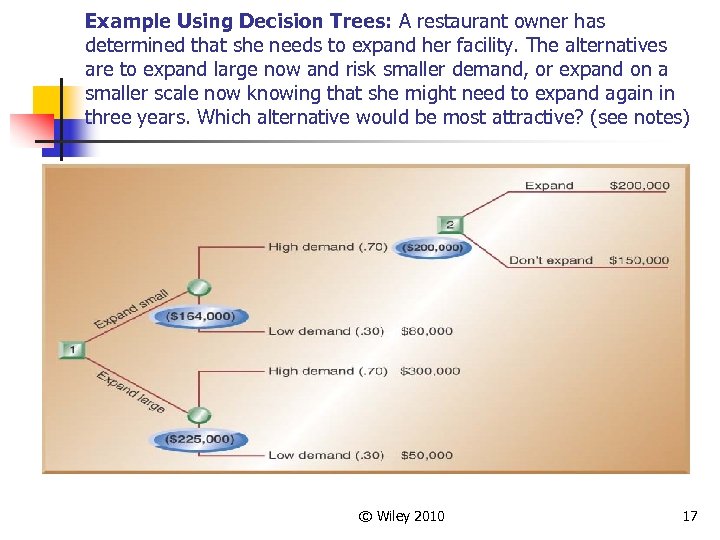 Example Using Decision Trees: A restaurant owner has determined that she needs to expand her facility. The alternatives are to expand large now and risk smaller demand, or expand on a smaller scale now knowing that she might need to expand again in three years. Which alternative would be most attractive? (see notes) © Wiley 2010 17
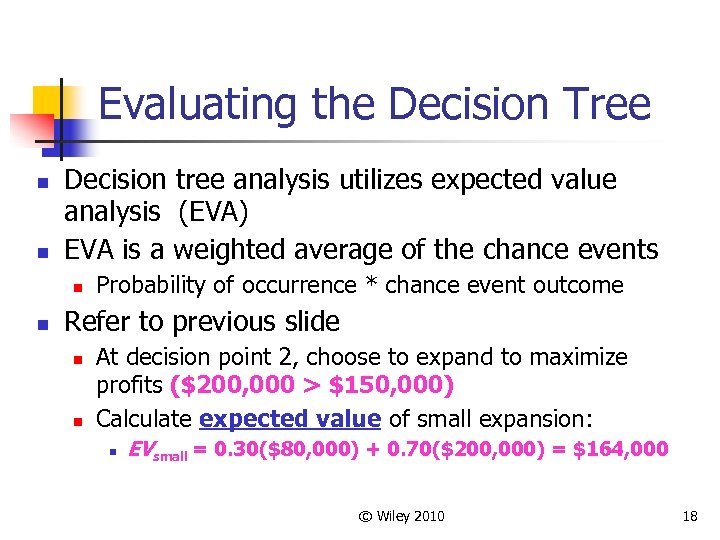 Evaluating the Decision Tree n n Decision tree analysis utilizes expected value analysis (EVA) EVA is a weighted average of the chance events n n Probability of occurrence * chance event outcome Refer to previous slide n n At decision point 2, choose to expand to maximize profits ($200, 000 > $150, 000) Calculate expected value of small expansion: n EVsmall = 0. 30($80, 000) + 0. 70($200, 000) = $164, 000 © Wiley 2010 18
 Evaluating the Decision Tree con’t n Calculate expected value of large expansion: n EVlarge = 0. 30($50, 000) + 0. 70($300, 000) = $225, 000 n At decision point 1, compare alternatives & choose the large expansion to maximize the expected profit: n n $225, 000 > $164, 000 Choose large expansion despite the fact that there is a 30% chance it’s the worst decision: n Take the calculated risk! © Wiley 2010 19
 Location Analysis Three most important factors in real estate: 1. Location 2. Location 3. Location Facility location is the process of identifying the best geographic location for a service or production facility © Wiley 2010 20
 Factors Affecting Location Decisions n Proximity to source of supply: n n Proximity to customers: n n Reduce transportation costs of perishable or bulky raw materials High population areas, close to JIT partners Proximity to labor: n Local wage rates, attitude toward unions, availability of special skills (silicon valley) © Wiley 2010 21
 More Location Factors n Community considerations: n n Site considerations: n n Local zoning & taxes, access to utilities, etc. Quality-of-life issues: n n Local community’s attitude toward the facility (prisons, utility plants, etc. ) Climate, cultural attractions, commuting time, etc. Other considerations: n Options for future expansion, local competition, etc. © Wiley 2010 22
 Globalization – Should Firm Go Global? Globalization is the process of locating facilities n around the world Potential advantages: n n Potential disadvantages: n n Inside track to foreign markets, avoid trade barriers, gain access to cheaper labor Political risks may increase, loss of control of proprietary technology, local infrastructure (roads & utilities) may be inadequate, high inflation Other issues to consider: n Language barriers, different laws & regulations, different business cultures © Wiley 2010 23
 Making Location Decisions Analysis should follow 3 step process: 1. 2. 3. Identify dominant location factors Develop location alternatives Evaluate locations alternatives Procedures for evaluation location alternatives include n n n Factor rating method Load-distance model Center of gravity approach Break-even analysis Transportation method © Wiley 2010 24
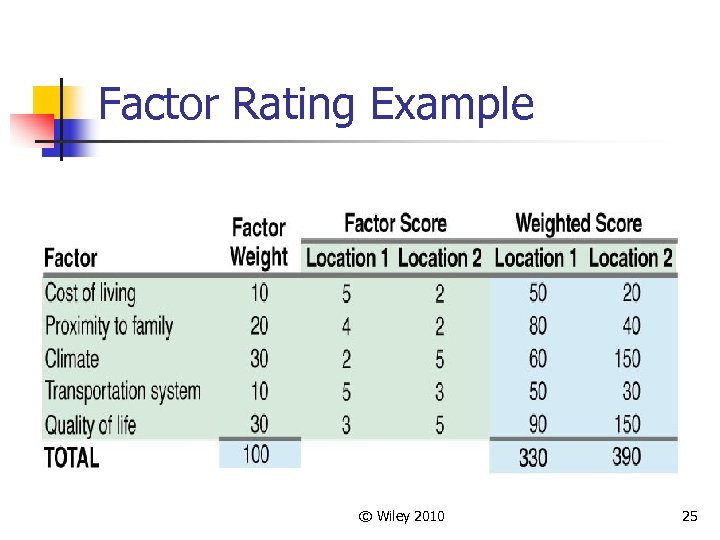 Factor Rating Example © Wiley 2010 25
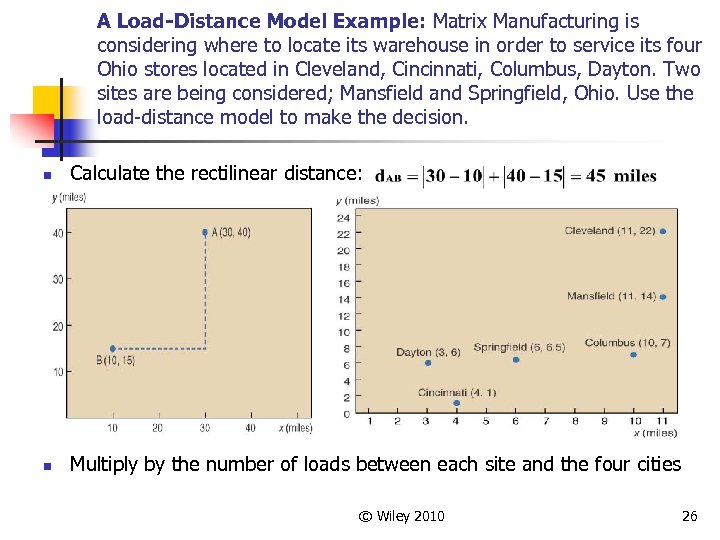 A Load-Distance Model Example: Matrix Manufacturing is considering where to locate its warehouse in order to service its four Ohio stores located in Cleveland, Cincinnati, Columbus, Dayton. Two sites are being considered; Mansfield and Springfield, Ohio. Use the load-distance model to make the decision. n Calculate the rectilinear distance: n Multiply by the number of loads between each site and the four cities © Wiley 2010 26
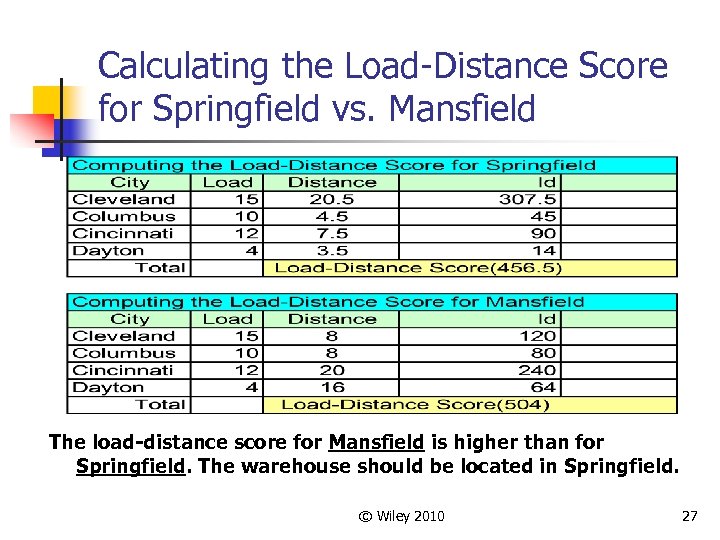 Calculating the Load-Distance Score for Springfield vs. Mansfield n The load-distance score for Mansfield is higher than for Springfield. The warehouse should be located in Springfield. © Wiley 2010 27
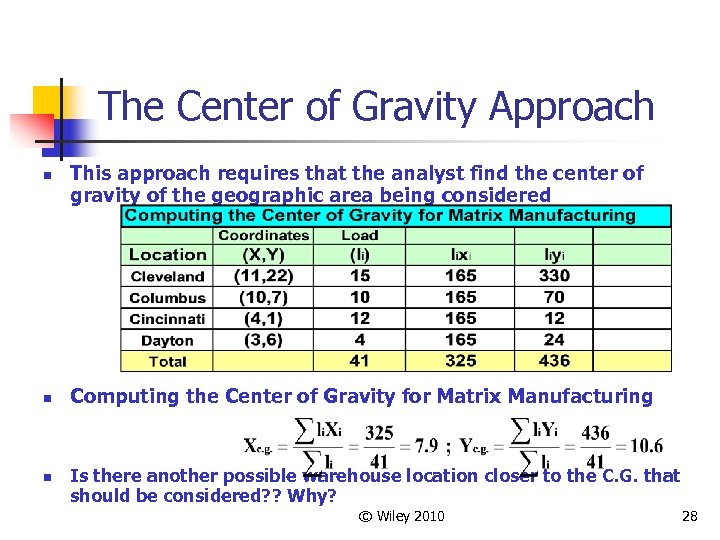 The Center of Gravity Approach n n n This approach requires that the analyst find the center of gravity of the geographic area being considered Computing the Center of Gravity for Matrix Manufacturing Is there another possible warehouse location closer to the C. G. that should be considered? ? Why? © Wiley 2010 28
 Break-Even Analysis n n n Break-even analysis computes the amount of goods required to be sold to just cover costs Break-even analysis includes fixed and variable costs Break-even analysis can be used for location analysis especially when the costs of each location are known Step 1: For each location, determine the fixed and variable costs Step 2: Plot the total costs for each location on one graph Step 3: Identify ranges of output for which each location has the lowest total cost Step 4: Solve algebraically for the break-even points over the identified ranges © Wiley 2010 29
 Break-Even Analysis n Remember the break even equations used for calculation total cost of each location and for calculating the breakeven quantity Q. n Total cost = F + c. Q n n Total revenue = p. Q Break-even is where Total Revenue = Total Cost Q = break-even quantity p = price/unit c = variable cost/unit F = fixed cost Q = F/(p-c) © Wiley 2010 30
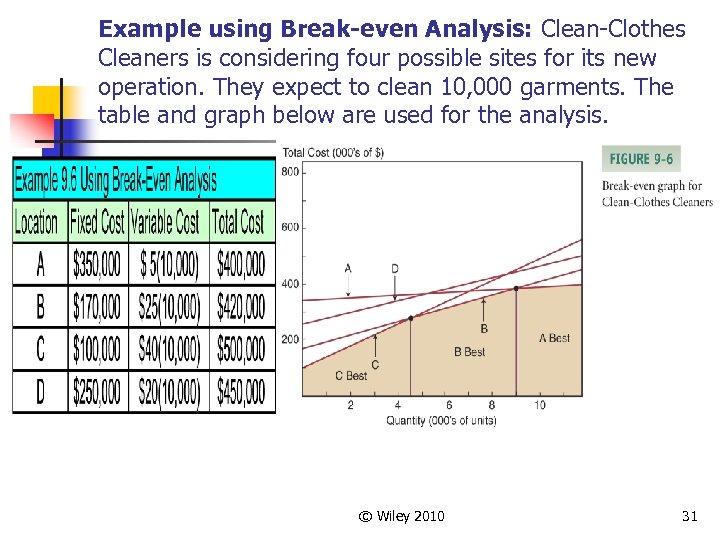 Example using Break-even Analysis: Clean-Clothes Cleaners is considering four possible sites for its new operation. They expect to clean 10, 000 garments. The table and graph below are used for the analysis. © Wiley 2010 31
 The Transportation Method n n Can be used to solve specific location problems Is discussed in detail in the supplement to this text Could be used to evaluate the cost impact of adding potential location sites to the network of existing facilities Could also be used to evaluate adding multiple new sites or completely redesigning the network © Wiley 2010 32
 Capacity Planning & Facility Location within OM n n n Decisions about capacity and location are highly dependent on forecasts of demand (Ch 8). Capacity is also affected by operations strategy (Ch 2), as size of capacity is a key element of organizational structure. Other operations decisions that are affected by capacity and location are issues of job design and labor skills (Ch 11), choice on the mix of labor and technology, as well as choices on technology and automation (Ch 3). © Wiley 2010 33
 Capacity Planning and Facility Location Across the Organization n Capacity planning and location analysis affect operations management and are important to many others n n Finance provides input to finalize capacity decisions Marketing impacted by the organizational capacity and location to customers © Wiley 2010 34
 Chapter 9 Highlights n n n Capacity planning is deciding on the maximum output rate of a facility Location analysis is deciding on the best location for a facility Capacity planning and location analysis decision are often made simultaneously because the location of the facility is usually related to its capacity. © Wiley 2010 35
 Chapter 9 Highlights – con’t n n In both capacity planning and location analysis, managers must follow three-step process to make good decision. The steps are assessing needs, developing alternatives, and evaluating alternatives. To choose between capacity planning alternatives managers may use decision trees, which are a modeling tool for evaluating independent decisions that must be made in sequence. © Wiley 2010 36
 Chapter 9 Highlights – con’t n Key factors in location analysis included proximity to customers, transportation, source of labor, community attitude, and proximity to supplies. Service and manufacturing firms focus on different factors. Profit-making and nonprofit organizations also focus on different factors. © Wiley 2010 37
 Chapter 9 Highlights – con’t n Several tools can be used to facilitate location analysis. Factor rating is a tool that helps managers evaluate qualitative factors. The loaddistance model and center of gravity approach evaluate the location decision based on distance. Break-even analysis is used to evaluate location decisions based on cost values. The transportation method is an excellent tool for evaluating the cost impact of adding sites to the network of current facilities. © Wiley 2010 38
 Chapter 9 Homework Hints n n Problem 9. 5: calculate utilizations based on design and effective capacities (see example 9. 1). Present conclusions. Problem 9. 14: use factor rating method to compare the possible locations (see example 9. 3). Problem 9. 15: use load-distance model to compare locations (see example 9. 4). Problem 9. 16: use center-of-gravity method. Use data from problem 15 (e. g. load between city and warehouse) to determine desired coordinates for the new warehouse.