


 Скачать презентацию Chapter 8 World Trade Organization Copyright 2010
60c1dc3c41fd198b152cd73e2361abee.ppt
- Количество слайдов: 29
 Chapter 8 World Trade Organization Copyright © 2010 Pearson Addison-Wesley. All rights reserved.
 THE GENERAL AGREEMENT ON TARIFFS AND TRADE (GATT) • Major wars used to be followed by recessions as governments tried to return to balanced budgets • In 1944, allied powers met in Bretton Woods, NH to set guidelines for world economy after the war • International Monetary Fund (IMF) and World Bank were conceived at this conference • A framework for international trade was developed to repair the damage of escalating tariffs and prevent it from occurring in the future Copyright © 2010 Pearson Addison-Wesley. All rights reserved. 8 -2
 THE GENERAL AGREEMENT ON TARIFFS AND TRADE (GATT) • International Trade Organization (ITO) was conceived to develop the international trading system • This did not occur because Congress did not ratify the agreement • Instead of establishing the ITO under the supervision of the united Nation, the General Agreement on Tariffs and Trade (GATT) was established in 20 Oct 1947. • This did not require Congressional approval and functioned effectively for 50 years Copyright © 2010 Pearson Addison-Wesley. All rights reserved. 8 -3
 THE GENERAL AGREEMENT ON TARIFFS AND TRADE (GATT) • ( 56 countries signed Havana agreement, congress did not ratify because they were worried to lose control over it international trade & the disagreement with EC). • Part of the reason the U. S. government declined to participate in the original ITO was that it covered trade in agricultural products as well as manufactured products. The U. S. government was fearful that U. S. farmers could not compete with "low-wage" foreign farmers. Copyright © 2010 Pearson Addison-Wesley. All rights reserved. 8 -4
 General Agreement on Tariffs and Trade (GATT) • After WWII, the GATT was one of several international organizations created to deal with problems facing the countries of the world. IMF 25 Des 1945, WB 1946 • GATT’s objectives were: – To establish the rules of conduct of international commerce – To provide a forum for multilateral talks aimed at lowering trade protection around the world Copyright © 2010 Pearson Addison-Wesley. All rights reserved. 8 -5
 THE GENERAL AGREEMENT ON TARIFFS AND TRADE (GATT) • More than 100 contracting parties (countries) participate in GATT and it covers more than 90% of world trade • In order to become a contracting party, a country had to give MFN status to all other contracting parties and eliminate any quotas Copyright © 2010 Pearson Addison-Wesley. All rights reserved. 8 -6
 THE GENERAL AGREEMENT ON TARIFFS AND TRADE (GATT) • GATT and Multilateral Trade Negotiations – A number of Multilateral Trade Negotiations (MTNs) successfully reduced tariffs – First a meeting of trade ministers would propose negotiation agenda – Trade ministers of each country would ask their government for authorization to participate in MTN – Given its size, U. S. participation was critical Copyright © 2010 Pearson Addison-Wesley. All rights reserved. 8 -7
 THE GENERAL AGREEMENT ON TARIFFS AND TRADE (GATT) • Other contracting parties did not want to enter negotiation unless U. S. agreed to honor negotiated agreement • Congressional fast-track approval was a statement that the U. S. Congress would vote to ratify negotiated the agreement without modification or amendments • Once negotiated an approved, the tariff cuts would be phased in over a number of years Copyright © 2010 Pearson Addison-Wesley. All rights reserved. 8 -8
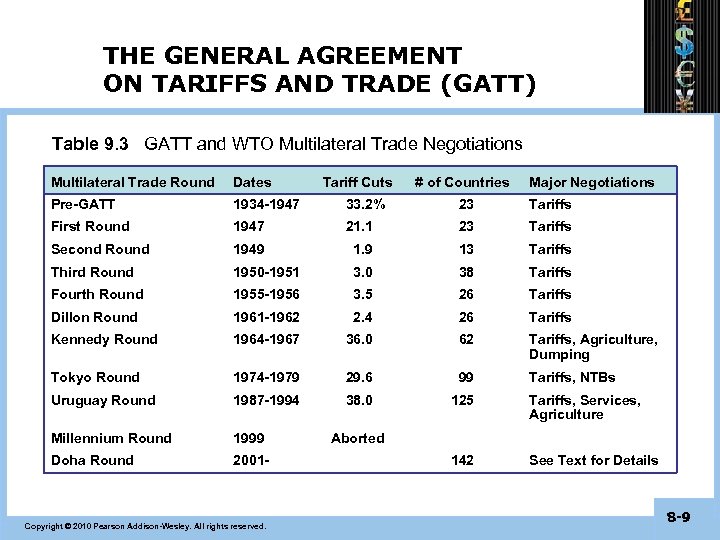 THE GENERAL AGREEMENT ON TARIFFS AND TRADE (GATT) Table 9. 3 GATT and WTO Multilateral Trade Negotiations Multilateral Trade Round Dates Pre-GATT 1934 -1947 33. 2% 23 Tariffs First Round 1947 21. 1 23 Tariffs Second Round 1949 1. 9 13 Tariffs Third Round 1950 -1951 3. 0 38 Tariffs Fourth Round 1955 -1956 3. 5 26 Tariffs Dillon Round 1961 -1962 2. 4 26 Tariffs Kennedy Round 1964 -1967 36. 0 62 Tariffs, Agriculture, Dumping Tokyo Round 1974 -1979 29. 6 99 Tariffs, NTBs Uruguay Round 1987 -1994 38. 0 125 Tariffs, Services, Agriculture Millennium Round 1999 Doha Round 2001 - 142 See Text for Details Copyright © 2010 Pearson Addison-Wesley. All rights reserved. Tariff Cuts # of Countries Major Negotiations Aborted 8 -9
 The Uruguay Round • Negotiations began in 1986 and concluded in 1993. • The Round focused on contentious issues such as non-tariff barriers, intellectual property rights, trade in services, and agriculture. • Its greatest achievement was the creation of a new international institution, the World Trade Organization (WTO). Copyright © 2010 Pearson Addison-Wesley. All rights reserved. 8 -10
 THE WORLD TRADE ORGANIZATION • The World Trade Organization (WTO) was created in the Uruguay Round • This replaced the old GATT Interim Committee • The large number of countries participating in negotiations and the increasing complexity of the issues made the old system unworkable • The WTO also has an effective enforcement mechanism that was lacking in GATT Copyright © 2010 Pearson Addison-Wesley. All rights reserved. 8 -11
 World Trade Organization • As of 2008, WTO has 153 member countries accounting for more than 97% of world trade. • Another 30 countries are applying for membership. • The WTO dispute settlements system is stronger and more effective than the previous GATT. Copyright © 2010 Pearson Addison-Wesley. All rights reserved. 8 -12
 World Trade Organization (cont. ) • The World Trade Organization was founded in Jan 1, 1995 on a number of agreements – General Agreement on Tariffs and Trade: covers trade in goods – General Agreement on Tariffs and Services: covers trade in services (ex. , insurance, consulting, legal services, banking). – Agreement on Trade-Related Aspects of Intellectual Property: covers international property rights (ex. , patents and copyrights). Copyright © 2009 Pearson Addison-Wesley. All rights reserved. Copyright © 2010 Pearson Addison-Wesley. All rights reserved. 9 -13 8 -13
 World Trade Organization (cont. ) – The dispute settlement procedure: a formal procedure where countries in a trade dispute can bring their case to a panel of WTO experts to rule upon. – The cases are settled fairly quickly: even with appeals the procedure is not supposed to last more than 15 months. – The panel uses previous agreements by member countries to decide which ones are breaking their agreements. Copyright © 2009 Pearson Addison-Wesley. All rights reserved. Copyright © 2010 Pearson Addison-Wesley. All rights reserved. 9 -14 8 -14
 World Trade Organization (cont. ) – A country that refuses to adhere to the panel’s decision may be punished by allowing other countries to impose trade restrictions on its exports. Copyright © 2009 Pearson Addison-Wesley. All rights reserved. Copyright © 2010 Pearson Addison-Wesley. All rights reserved. 9 -15 8 -15
 WTO principles. 1 • 234 - Nondiscrimination, which achieved by tow conditions A- MFN B- National Treatment Avoidance of Quantitative Restriction. Negotiations to decrease tariff, ( tariff Binding). Encourage Competition & Avoidance of Dumping and Subsidies. 5 - Transparency 6 - encouraging Development & Economic Reform. Copyright © 2010 Pearson Addison-Wesley. All rights reserved. 8 -16
 Managerial structure 1 - Ministerial Conference. Every tow years 2 - General Council. Member ambassadors , Every tow Month. A- The policy review council B- Dispute settlement council C- Trade in goods council D- Trade in Service council E- Intellectual property council. 3 - Main Committees Copyright © 2010 Pearson Addison-Wesley. All rights reserved. 8 -17
 World Trade Organization • The WTO negotiations addresses trade restrictions in at least 3 ways: 1. Reduction of tariff rates through multilateral negotiations. 2. Binding: a tariff is “bound” by having the imposing country agree not to raise it in the future. Copyright © 2009 Pearson Addison-Wesley. All rights reserved. Copyright © 2010 Pearson Addison-Wesley. All rights reserved. 9 -18 8 -18
 World Trade Organization (cont. ) 3. Prevention of non-tariff barriers: quotas and export subsidies are changed to tariffs because the costs of tariff protection are more apparent. – Subsidies for agricultural exports are an exception. – Exceptions are also allowed for “market disruptions” caused by a surge in imports. Copyright © 2009 Pearson Addison-Wesley. All rights reserved. Copyright © 2010 Pearson Addison-Wesley. All rights reserved. 9 -19 8 -19
 World Trade Organization (cont. ) • The GATT/WTO multilateral negotiations, ratified in 1994 (called the Uruguay Round), – agreed that all quantitative restrictions (ex. , quotas) on trade in textiles and clothing were to be eliminated by 2005. • But as the restrictions were eliminated, China had to reimpose quotas until 2011 due to political pressure. Copyright © 2010 Pearson Addison-Wesley. All rights reserved. 8 -20
 The Doha Round • Talks were held in Doha, Qatar in November 2001. • Focus of the talks was on the links between economic growth and trade liberalization. • Talks collapsed in July 2008. • The main point of contention is trade in agriculture with major industrialized nations such as the U. S. , EU and Japan maintaining production subsidies and import barriers. Copyright © 2010 Pearson Addison-Wesley. All rights reserved. 8 -21
 World Trade Organization (cont. ) • The major issues are – International Trade in Agricultural Products. – The primary goal of Doha round is the reduction of agriculture subsidies primary in the developed countries. This is an important issue as the size of the subsidies are quite large. The WTO estimated that the total amount of farm subsidies for its members is $221 billions. – Market Access – The WTO describes tariff reduction as market access ( developed countries impose high tariff on its agriculture imports, & developing countries impose high tariff on manufactured goods imports, so there is a potential for the two groups to bargain reciprocal tariff reductions on these issues. Copyright © 2010 Pearson Addison-Wesley. All rights reserved. 8 -22
 World Trade Organization (cont. ) – International Trade in Services covered in the General Agreement of Trade in Services (GATS) – Trade-Related Intellectual Property (TRIPS) there is a dispute about respected of IPR between developed & developing countries, the WTO mediate between these conflict interest. The Doha round negotiations involve the developing countries offering to more rigorously enforce IPR in exchange for access to some products at a price appropriate to there level of economic development. Trade-Related Investment Measures (TRIMS) – If goods can freely flow but factors of production cannot, then I T has been distorted. The WYO can negotiate the free flow of FDI but cannot negotiate the movement of labor. The goal of Doha round are the reduction in regulations on FDI that also distort flows. Copyright © 2010 Pearson Addison-Wesley. All rights reserved. 8 -23
 The Escape Clause: Section 201 • Escape Clause—a measure in U. S. trade law that allows for temporary protection of domestic industry against fairly traded foreign imports. • Two reasons: (1) It provides more time for reallocation of domestic resources; (2) By increasing profits, it encourages domestic firms to reinvest in their industry. • Industry files petition with the ITC. • The clause has been used rarely. Copyright © 2010 Pearson Addison-Wesley. All rights reserved. 8 -24
 Trade Adjustment Assistance • Payments made by the government to help resources retrain or retool after they have been displaced by foreign competition. • This aid was used extensively in the late 1970 s as an alternative to trade protection. Copyright © 2010 Pearson Addison-Wesley. All rights reserved. 8 -25
 Other Measures • Section 337—restricts unfair methods of competition such as patent or copyright infringement. • Section 406—provides relief from market disruption by imports from non-market economies. • National defense-related restrictions such as voluntary export restraints and “Buy American” policy. Copyright © 2010 Pearson Addison-Wesley. All rights reserved. 8 -26
 Safeguards Protection • A general name for protective measures similar to the escape clause that are used by foreign countries. Copyright © 2010 Pearson Addison-Wesley. All rights reserved. 8 -27
 Global Antidumping Cases • Refer to Table 8. 3 • 3, 305 antidumping cases were initiated worldwide from 1995 to 2008. • Major users of antidumping laws are developed countries such as the U. S. , Canada, and the EU. • Countries targeted in antidumping cases, in rank order, are China, the EU, Korea, U. S. , and Taiwan. Copyright © 2010 Pearson Addison-Wesley. All rights reserved. 8 -28
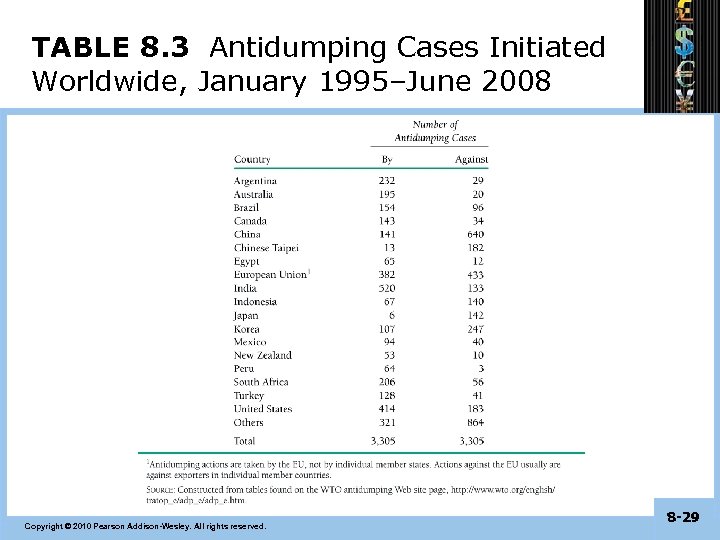 TABLE 8. 3 Antidumping Cases Initiated Worldwide, January 1995–June 2008 Copyright © 2010 Pearson Addison-Wesley. All rights reserved. 8 -29