


 Скачать презентацию Chapter 8 The Payment System and Financial Institution
ac53cafd8387effa607c8dc41c3b2b1f.ppt
- Количество слайдов: 40
 Chapter 8 The Payment System and Financial Institution Relationships Copyright 2005 by Thomson Learning, Inc.
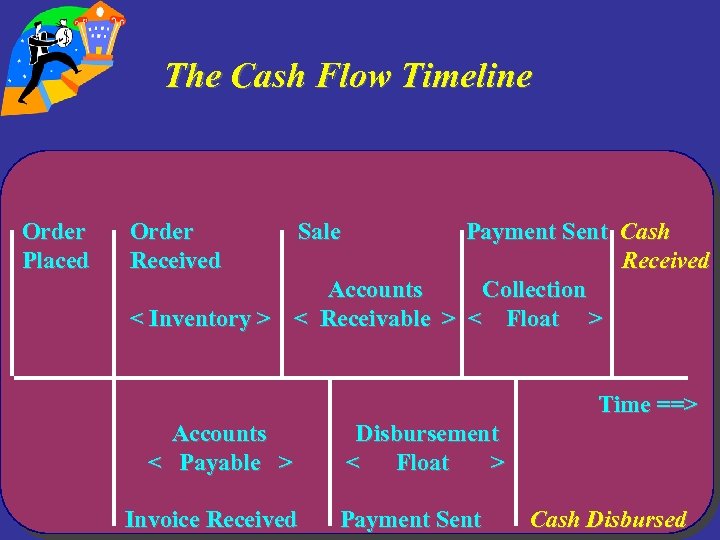 The Cash Flow Timeline Order Placed Order Received Sale Payment Sent Cash Received Accounts Collection < Inventory > < Receivable > < Float > Time ==> Accounts < Payable > Invoice Received Disbursement < Float > Payment Sent 2005 by Thomson Learning, Inc. Cash Disbursed Copyright
 Learning Objectives v Explain, understand, and calculate float. v Explain the roles of the two major components of the payment system. v Describe the major paper-based and electronicbased payment systems. v Understand the ACH and how its fits with the EDI. v Use an availability schedule. v Explain the uses of an account analysis statement. Copyright 2005 by Thomson Learning, Inc.
 Value of Float v The delay in value transfer from the time a check is written until it finally is charged to the payor’s account. v Value of float is based on differences in present value based on time delay. Copyright 2005 by Thomson Learning, Inc.
 U. S. Payment System v Banking system v Payment mechanisms Copyright 2005 by Thomson Learning, Inc.
 Financial Institutions v Product differences, Exhibit 8. 1 v Geographical restrictions v Safety considerations Copyright 2005 by Thomson Learning, Inc.
 Federal Reserve System v Organization, Exhibits 8. 2, 8 -3 v Fed’s involvement in payment system v Check clearing Copyright 2005 by Thomson Learning, Inc.
 Organization, Exhibit 8. 2 v Board of Governors v FOMC v Federal Advisory Council v District banks, Figure 8. 2 v Member banks Copyright 2005 by Thomson Learning, Inc.
 Fed’s Involvement v Circulate new money v Check processing, 16 billion checks/yr v Check settlement v ACH v Fed. Wire v Regulate availability schedules Copyright 2005 by Thomson Learning, Inc.
 Check Clearing v MICR line, Exhibit 8. 5 v Clearing process, Exhibit 8. 4 Copyright 2005 by Thomson Learning, Inc.
 MICR Line, Exhibit 8. 5 v 2 digit Fed Bank Code v 2 digit Fed Office Code v 4 digit ABA Code v 1 digit verification code v Account number v Sequence number v Encoded amount Copyright 2005 by Thomson Learning, Inc.
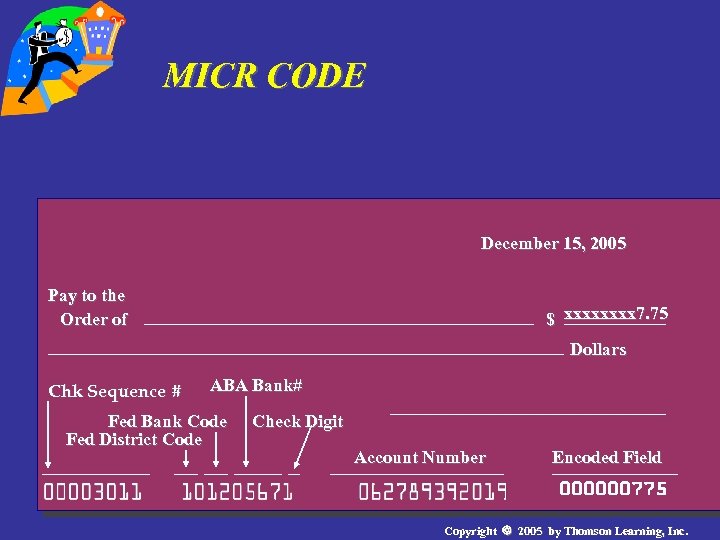 MICR CODE December 15, 2005 Pay to the Order of $ xxxx 7. 75 Dollars Chk Sequence # ABA Bank# Fed Bank Code Fed District Code Check Digit Account Number Encoded Field 000000775 Copyright 2005 by Thomson Learning, Inc.
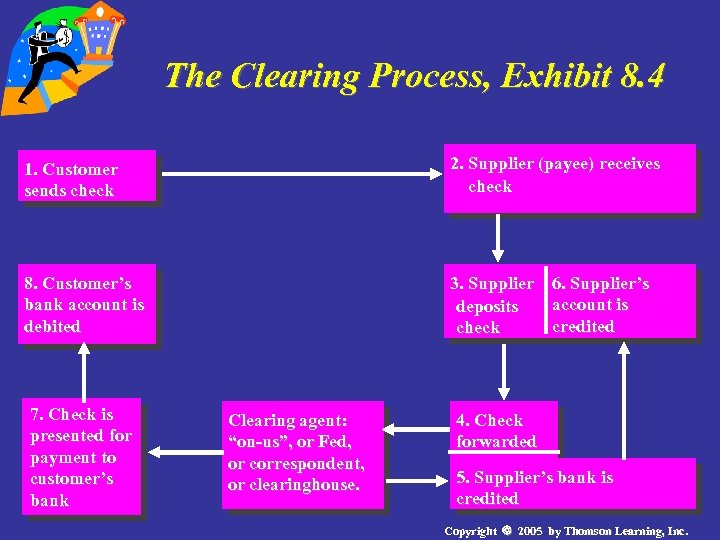 The Clearing Process, Exhibit 8. 4 1. Customer writescheck sends check 2. Supplier (payee) receives check 8. Customer’s bank account is debited 3. Supplier 6. Supplier’s account is deposits credited check 7. Check is presented for payment to customer’s bank Clearing agent: “on-us”, or Fed, or correspondent, or clearinghouse. 4. Check forwarded 5. Supplier’s bank is credited Copyright 2005 by Thomson Learning, Inc.
 Clearing Mechanisms v House/On-us checks v Local items v Transit items Copyright 2005 by Thomson Learning, Inc.
 “On-us” Items v Payee deposits check in the bank on which it is drawn v Bank credit depositor’s account v Bank debits payor’s account Copyright 2005 by Thomson Learning, Inc.
 Local Items v Checks may be sent by courier to be swapped for checks drawn on itself at another bank v Checks may be processed through correspondent bank relationship v Local clearing house may be used Copyright 2005 by Thomson Learning, Inc.
 Transit Items v Direct send v Correspondent bank v Fed Reserve Copyright 2005 by Thomson Learning, Inc.
 Concept of Float v Types of float v Components of float Copyright 2005 by Thomson Learning, Inc.
 Types of Float v Collection float v Disbursement float Copyright 2005 by Thomson Learning, Inc.
 Components of Float v Mail float v Processing float v Clearing float Copyright 2005 by Thomson Learning, Inc.
 Fed Float v When the Fed grants the depositing bank credit according to a preset availability schedule, but is not always able to present the check to the drawee bank for payment within the same period. v Methods used to reduce float – check truncation – high-dollar group sort – inter-district transportation system – later presentment and deposit deadlines Copyright 2005 by Thomson Learning, Inc.
 Paper-Based Payments v Types v Ledger balance v Collected balance Copyright 2005 by Thomson Learning, Inc.
 Types of Paper-based payments v Checks v Drafts Copyright 2005 by Thomson Learning, Inc.
 Ledger Balance v All credits and debits v Not all spendable Copyright 2005 by Thomson Learning, Inc.
 Collected Balance v Adjusted ledger v Reg CC (2 and 5 days) Copyright 2005 by Thomson Learning, Inc.
 Electronic-Based Payments v Wire transfers v Automated clearinghouses v POS debit cards Copyright 2005 by Thomson Learning, Inc.
 International Payment Systems v Paper-based systems – Giro systems – Value dating v Electronic payments – Clearing House Interbank Payment System, CHIPS – Society for Worldwide Interbank Financial Telecommunications, SWIFT Copyright 2005 by Thomson Learning, Inc.
 Managing the Bank Relationship v Objective: To ensure that all the company’s banking services are provided reliably at a reasonable cost. Copyright 2005 by Thomson Learning, Inc.
 Managing the Bank Relationship Copyright 2005 by Thomson Learning, Inc.
 Services Provided v Collections v Payments v Information v Credit v Investments Copyright 2005 by Thomson Learning, Inc.
 Bank Selection and Relationship Management Copyright 2005 by Thomson Learning, Inc.
 Bank Selection v Location v Bank/Company Fit v Service Quality and Breadth v Bank Creditworthiness v Bank Specialties v Price Copyright 2005 by Thomson Learning, Inc.
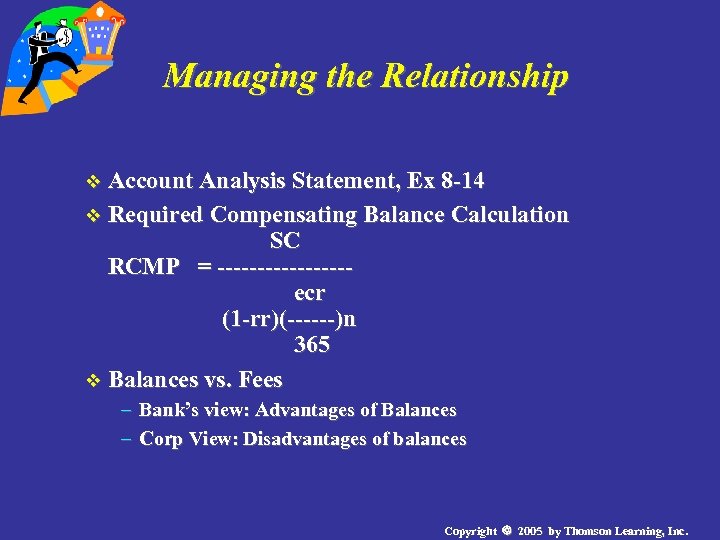 Managing the Relationship v Account Analysis Statement, Ex 8 -14 v Required Compensating Balance Calculation SC RCMP = --------ecr (1 -rr)(------)n 365 v Balances vs. Fees – Bank’s view: Advantages of Balances – Corp View: Disadvantages of balances Copyright 2005 by Thomson Learning, Inc.
 Bank’s View: Advantages of Balances v Effect of increasing deposits for the bank v Balances can be lent v Form a cushion in case of loan default Copyright 2005 by Thomson Learning, Inc.
 Corp View: Disadvantages of Balances v ECR is < investment rate v Fees are tax deductible v Fees offer tangible expense that can be monitored v Fees are generally fixed and thus comparable, whereas ECR floats Copyright 2005 by Thomson Learning, Inc.
 Daylight Overdrafts and the Availability Schedule v Definition: when a bank’s Federal Reserve account book balance is negative during the day Copyright 2005 by Thomson Learning, Inc.
 Optimizing the Banking Network v Checklist – what is bank’s compensation rate and how will it be paid, fees or balances, etc. ? – if balances, over what time period? – multiyear agreement available with capped price increases? – compare a proforma account analysis statement – who is the account officer? – who is the customer service rep? – how will float be computed? – what performance guarantees are offered? – penalties for customer overdrafts? Copyright 2005 by Thomson Learning, Inc.
 Nonbank Service Providers v Pepsico’s loan to Marriott v Almost half of all consumer and business loans held by nonbank companies v Third-party vendors of information between banks and companies Copyright 2005 by Thomson Learning, Inc.
 Financial System Trends v Nationwide banking in the US v Economic unification of Europe v Both of these will be catalysts for an ongoing drift toward concentration and globalization in the banking industry v Imaging v Information services v Banking on the Internet v International aspects of banking relationships v Global bank consolidation Copyright 2005 by Thomson Learning, Inc.
 Summary v We developed the uniqueness of the US payment system and its major components. v We discussed the role the Federal Reserve plays. v We discussed the payment system using paperbased and electronic-based methods. v We discussed bank selection and relationship management. v We concluded with financial system trends. Copyright 2005 by Thomson Learning, Inc.